air condition BMW Z3 2002 User Guide
[x] Cancel search | Manufacturer: BMW, Model Year: 2002, Model line: Z3, Model: BMW Z3 2002Pages: 187, PDF Size: 2.73 MB
Page 84 of 187

84n
Heating and ventilation/Air conditioner
*
367de714
Page 85 of 187

85n
IndexDataTechnologyRepairsMaintenanceControlsOverview
Heating and ventilation/Air conditioner
*
1 Airflow toward the windshield and
side windows
2 Airflow toward upper body
The rotary dials allow infinitely-vari-
able regulation of the air supply. You
can change the airflow direction with
the lever in the center of the vent or
by rotating the vent grille87
3 Front footwell ventilation
4 Air distribution onto the
>windows
>upper body
>footwell
All intermediate settings are
possible86
5 Temperature86
6 Air supply
The heating and ventilation are oper-
ational beginning with position 186
7 Recirculated-air mode86
8 Air conditioner86
Page 86 of 187

86n
Heating and ventilation/Air conditioner
*
Air distribution
You can direct the flow of air
onto the windows , toward
the upper body and into the
footwell . All intermediate settings
are possible. In position , a small
volume of air is directed onto the
windows in order to keep them free of
condensation.
A "6 o'clock" position is recommended
as the normal operating setting.
Temperature
In order to increase the temper-
ature of the passenger compart-
ment, turn to the right (red). For
rapid heating, turn completely to the
right. Then select an interior tempera-
ture which is pleasant for you.
Air supply
You can select blower speeds
from 1 to 4. Both heating and
ventilation become more effec-
tive as the air supply rate is increased.
In position 0, the blower and the heater
are switched off.
Air conditioner
The air is cooled and dehumidi-
fied and Ð depending on the
temperature setting Ð warmed
again when the air conditioner system
is switched on. Depending on the
weather, the windshield may fog over
briefly when the engine is started.
Use the button to switch the air condi-
tioner off at outside temperatures
below approx. 41 7(+5 6). This will
help to prevent condensation from
forming on the windows.
If the windows fog over after switching
the air conditioner off, switch it back
on.
Condensation forms in the air
conditioner system during opera-
tion, which then exits under the vehicle.
Traces of condensed water of this kind
are thus normal.<
Recirculated-air mode
If there are unpleasant odors in
the outside air, you can tempo-
rarily block the supply of the
incoming air. The system then recircu-
lates the air currently within the vehicle.
If the windows fog over in the
recirculated-air mode, switch this
mode off and increase the air supply as
required.<
Page 87 of 187
87n
IndexDataTechnologyRepairsMaintenanceControlsOverview
Heating and ventilation/Air conditioner
*
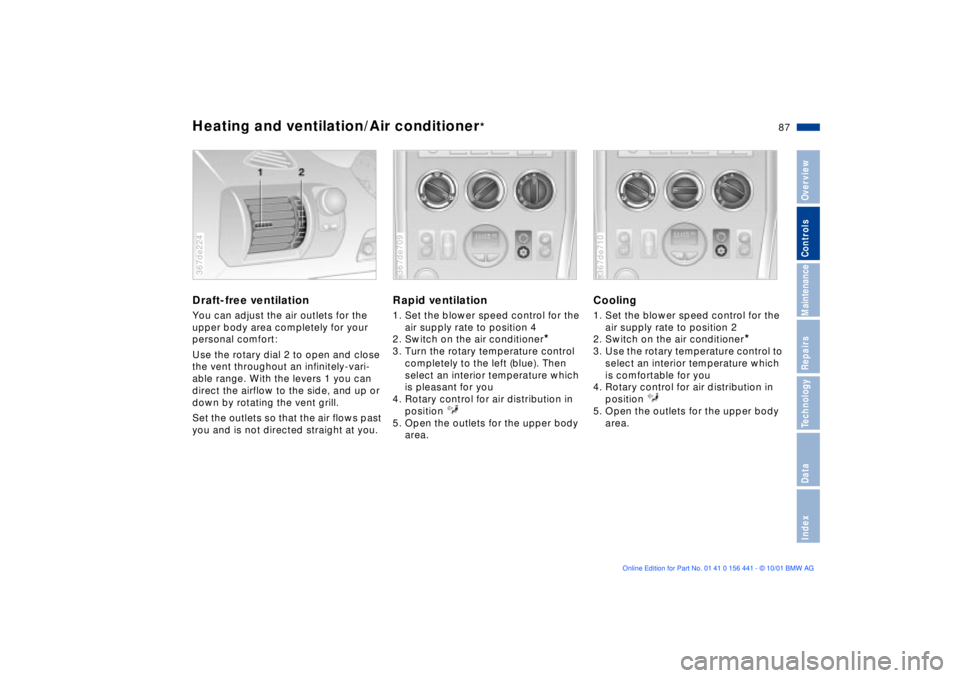
Draft-free ventilationYou can adjust the air outlets for the
upper body area completely for your
personal comfort:
Use the rotary dial 2 to open and close
the vent throughout an infinitely-vari-
able range. With the levers 1 you can
direct the airflow to the side, and up or
down by rotating the vent grill.
Set the outlets so that the air flows past
you and is not directed straight at you.367de224
Rapid ventilation1. Set the blower speed control for the
air supply rate to position 4
2. Switch on the air conditioner
*
3. Turn the rotary temperature control
completely to the left (blue). Then
select an interior temperature which
is pleasant for you
4. Rotary control for air distribution in
position
5. Open the outlets for the upper body
area.367de709
Cooling1. Set the blower speed control for the
air supply rate to position 2
2. Switch on the air conditioner
*
3. Use the rotary temperature control to
select an interior temperature which
is comfortable for you
4. Rotary control for air distribution in
position
5. Open the outlets for the upper body
area.367de710
Page 88 of 187
88n
Heating and ventilation/Air conditioner
*
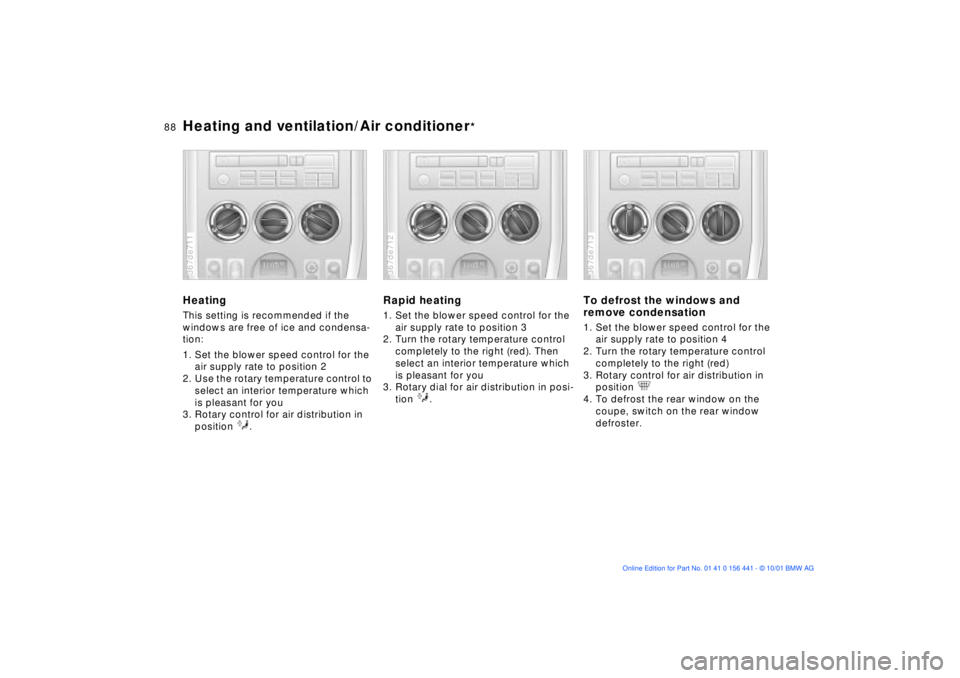
HeatingThis setting is recommended if the
windows are free of ice and condensa-
tion:
1. Set the blower speed control for the
air supply rate to position 2
2. Use the rotary temperature control to
select an interior temperature which
is pleasant for you
3. Rotary control for air distribution in
position .367de711
Rapid heating1. Set the blower speed control for the
air supply rate to position 3
2. Turn the rotary temperature control
completely to the right (red). Then
select an interior temperature which
is pleasant for you
3. Rotary dial for air distribution in posi-
tion .367de712
To defrost the windows and
remove condensation 1. Set the blower speed control for the
air supply rate to position 4
2. Turn the rotary temperature control
completely to the right (red)
3. Rotary control for air distribution in
position
4. To defrost the rear window on the
coupe, switch on the rear window
defroster.367de713
Page 97 of 187
Overview
Controls and features
Operation, maintenance
Owner service procedures
Technical data
Index Advanced technology
97n
IndexDataTechnologyRepairsMaintenanceControlsOverview
Special operating instructions:
Break-in procedure98
Driving notes99
Catalytic converter100
Antilock Brake System
(ABS)101
Disc brakes103
Brake system104
Winter operation105
Power steering106
Cellular phone107
Car radio reception107
Hardtop Ð roadster108
Wheels and tires:
Notes on inflation pressures110
Tire condition110
Tire replacement111
Tire rotation113
Wheel and tire
combinations114
Special features of winter
tires115
Snow chains115
Approved wheel and tire
specifications116In the engine compartment:
Hood118
Engine compartment120
Fluids for the washer
systems122
Washer nozzles122
Engine oil123
Coolant125
Brake fluid126
Vehicle Identification127
Care and maintenance:
The BMW Maintenance
System128
Airbags130
Storing your vehicle130
Laws and regulations:
Technical modifications132
California Proposition
65 Warning132
OBD interface socket133
Maintenance
Page 101 of 187

101n
IndexDataTechnologyRepairsMaintenanceControlsOverview
Antilock Brake System (ABS)The conceptThe Antilock Brake System (ABS) keeps
the wheels from locking during braking,
thereby enhancing active driving safety.
The reason: locked wheels are
dangerous. When the front wheels
slide, the driver loses steering control
over the vehicle. Traction loss at the
rear wheels can cause the rear end to
break into an uncontrolled skid.
The system can achieve the shortest
braking distances possible under most
conditions (on straight-aways or in
curves, on the various road surfaces).
ABS is designed to meet two essential
requirements during every brake appli-
cation:
>To help provide vehicle stability
>Assured ability to steer and maneuver
on the various road surfaces (asphalt,
concrete, dirt, wet conditions, snow
and ice).
Braking with ABSThe system is operative once the
vehicle exceeds a speed of approx.
6 mph (10 km/h). It is inactive once
again below approx. 4 mph (6 km/h).
Therefore, the wheels could theoreti-
cally tend to lock in the final phase of a
braking action, but this is insignificant in
actual practice.
If you are in a situation which requires
full braking, you will exploit the full
benefits of the ABS system if you apply
maximum brake pressure ("panic stop").
Since the vehicle maintains steering
responsiveness, you can avoid possible
obstacles with a minimum of steering
effort, despite the full brake application.The ABS closed-loop control circuit
cycles in fractions of a second. The
pulsation at the brake pedal, together
with sounds generated by the hydraulic
control system, indicate to you that the
vehicle is approaching its maximum
braking range. It is a reminder to you
that you must adapt the vehicle's road
speed to existing road conditions.
On road surfaces that have a loose
surface layer on a firm base with good
traction (on gravel, deep sand or snow,
for example), braking distances may be
longer than with locked wheels. This
also applies for driving with snow
chains. However, ABS continues to
provide enhanced vehicle stability and
steering response under these condi-
tions.
Page 103 of 187

103n
IndexDataTechnologyRepairsMaintenanceControlsOverview
ABS Disc brakesDynamic Brake Control (DBC)*DBC is included in the DSC, refer to
information beginning on page 74.
If you step on the brake rapidly, this
system automatically produces
maximum braking force boost and thus
helps to achieve the shortest possible
braking distance during "panic stops".
All of the benefits of the ABS system
are exploited under these circum-
stances.
Do not reduce the pressure on the
brake pedal for the duration of the
brake application. When the brake
pedal is released, the DBC is deacti-
vated.
In the event of a malfunction,
the brake warning lamp lights up
yellow. Normal braking effi-
ciency is still fully available.
Have the system checked and
repaired at your BMW center as
soon as possible.
Please observe the section "Infor-
mation for your safety" concerning
the ABS system, which also applies to
the DSC system.<
Disc brakes furnish optimum decelera-
tion and braking control and greater
fade resistance under heavy use.
When the vehicle is driven only occa-
sionally, during extended periods when
the vehicle is not used at all, or in oper-
ating conditions where brake applica-
tions are less frequent, there is an
increased tendency for corrosion of the
rotors and accumulation of contamina-
tion on the brake pads. This occurs
because the minimal pressure which
must be exerted by the pads to clean
the rotors by brake applications is not
reached.
If the brake rotors are corroded, they
will tend to respond to braking with a
pulsating effect which even extended
application will fail to cure.
For your own safety: use only
brake pads that BMW has
approved for your specific vehicle
model. BMW cannot evaluate non-
approved brake pads to determine if
they are suited for use, and therefore
cannot ensure the operating safety of
the vehicle in the event of their use.<
Driving notesWhile driving in wet conditions and in
heavy rain, it is advisable to apply light
pressure to the brake pedal every few
miles Ð watch traffic conditions to
ensure that this maneuver does not
endanger other road users. The heat
generated in this process helps dry the
pads and rotors.
Maximum braking force is obtained
while the wheels continue to rotate,
peaking when the wheels remain on the
verge of locking without actually doing
so. ABS maintains this state automati-
cally. If the ABS fails, you should revert
to the staggered braking technique
described on page 106.
Extended or steep mountain descents
should be driven in the gear in which
only minimal periodic brake application
is required. This avoids excessive strain
on the brakes and possible
impairment of the braking effect.
You can increase the engine's braking
effect by selecting progressively lower
gears, downshifting into first gear, if
necessary. You can also downshift into
first gear if you are using the manual
mode in a vehicle with automatic trans-
mission, refer to page 63.
Page 105 of 187

105n
IndexDataTechnologyRepairsMaintenanceControlsOverview
Winter operationThe onset of winter is often accompa-
nied by rapid changes in weather.
Adaptations in driving style should be
accompanied by preparations on the
vehicle itself to ensure that your vehicle
operation through the winter remains
safe and trouble-free.CoolantEnsure that the coolant contains the
year-round 50 : 50 ratio of water and
antifreeze with corrosion inhibitor. This
mixture provides protection against
freezing down to approx. Ð 34 7
(Ð 37 6). Replace the coolant every
three years.LocksBMW door lock deicer can be used to
free the doors if they are frozen. This
deicer also contains lubricant.
After using deicer, treatment with BMW
lock cylinder grease is recommended.
Rubber seals and components In order to prevent freezing, apply BMW
rubber treatment to weather-stripping
on the doors, hood, luggage compart-
ment and to convertible top seals.
A full range of car-care products is
available from your BMW center.< Snow chainsBMW snow chains
* can be mounted on
both summer and winter tires. Mount
them in pairs on the rear wheels only.
Comply with the manufacturer's safety
precautions. Do not exceed a speed
limit of 30 mph (50 km/h) when driving
with chains. As an exception in this
situation, we recommend that you
switch off the ASC+T/DSC
* system
when snow chains are mounted. Refer
to pages 73, 74.
Starting offWhen starting from a full stop or
"rocking" free in deep snow, we recom-
mend that you switch off the ASC+T/
DSC
* system, refer to pages 73, 74.
Driving on low-traction road
surfacesUse smooth, gentle pressure to control
the accelerator pedal. Avoid excessive
engine speeds and shift to the next
higher gear at an early point. Shift down
into the next lowest gear when
approaching uphill or downhill grades.
Maintain an adequate distance between
yourself and the vehicle ahead.Brakes Winter road conditions substantially
reduce the traction available between
the tires and the road surface.
Remember that Ð in every situation Ð
braking distances will be significantly
longer as a result of this.
ABS is intended to prevent the wheels
from locking during brake applications,
thus helping to maintain vehicle stability
and steering response.
Page 111 of 187

111n
IndexDataTechnologyRepairsMaintenanceControlsOverview
Tire condition Tire replacementmoderate speeds and with only small
amounts of water on the road.
Never continue driving on a
deflated (flat) tire. A flat tire greatly
impairs steering and braking response,
and can lead to complete loss of
control over the vehicle.
Avoid overloading the vehicle so that
the permitted load on the tires is not
exceeded. Overloading causes over-
heating and damage inside the tires.
The ultimate result can assume the
form of a sudden air loss.
Unusual vibrations encountered during
normal vehicle operation can indicate a
flat tire or some other vehicle malfunc-
tion. The type of problem can be
caused by contact with curbs, etc. This
is also true for irregularities in the
vehicle's handling characteristics, such
as a pronounced tendency to pull to the
left or right. Should this occur, respond
by immediately reducing your speed.
Proceed carefully to the nearest BMW
center or professional tire center, or
have the vehicle towed in to have it, its
wheels and tires inspected.
Tire damage (up to and including
sudden and complete air loss) can pose
an extreme hazard for both vehicle
occupants and other road users.< To maintain good handling and vehicle
response, use only tires of a single tread
configuration from a single manufac-
turer. BMW tests and approves wheel
and tire combinations, refer to page 116.
DOT Quality GradesTread wear
Traction AA A B C
Temperature A B C
All passenger vehicle tires must
conform to Federal Safety
Requirements in addition to these
grades.
when tested under controlled condi-
tions on a specified government test
course.
For example, a tire graded 150 would
wear one and one-half (1g) times as
well on the government course as a tire
graded 100. The relative performance
of tires depends upon the actual condi-
tions of their use, however, and may
depart significantly from the norm due
to variations in driving habits, service
practices and differences in road char-
acteristics and climate.