belt BMW Z3 2002 User Guide
[x] Cancel search | Manufacturer: BMW, Model Year: 2002, Model line: Z3, Model: BMW Z3 2002Pages: 187, PDF Size: 2.73 MB
Page 55 of 187
55n
IndexDataTechnologyRepairsMaintenanceControlsOverview
AirbagsSitting correctly with airbags
For your safety, comply with the
following instructions for the
airbags. If you do not, the airbags may
not be able to provide their maximum
protection. All passengers in the vehicle
should be aware of and comply with this
information:
The airbags are supplemental restraint
devices designed to provide extra
protection; they are not a substitute for
safety belts. Wear your safety belt at
all times.
Adjust your seat to a position that is
comfortable for you, allowing unre-
stricted vehicle operation, and is not
closer to the steering wheel than neces-
sary.
Always grasp the steering wheel by the
steering wheel rim, keeping your hands
at the "9-o'clock" and "3-o'clock" posi-
tions in order to minimize any risk of
injury to hands or arms if the airbag does
deploy.
There should not be any other persons,
animals or objects between the airbag
and the passenger in that seat.
Do not use the cover panel for the front
airbag on the passenger side as a
storage area.
Do not apply adhesive materials to the
cover panels of the airbags, cover them
or modify them in any other way.
If you use a child-restraint system, read
carefully and comply with the instruc-
tions on page 56.
Be sure that child-restraint systems are
installed correctly and with the greatest
possible distance from the airbag in the
side trim panel. Do not allow children to
lean out of the child-restraint system in
the direction of the side trim panel.
Otherwise, serious injuries could occur
if the airbag is triggered.<
Even when you have complied with all
of these guidelines, there is still a small
residual risk of minor facial, hand and
arm injuries from airbag deployment
occurring in isolated instances.
The ignition and inflation noise may
cause a mild temporary hearing loss in
extremely sensitive individuals.
Corresponding airbag safety precau-
tions are provided on both sun visors
and the instrument panel (US models).
For additional information concerning
the airbag system, refer to pages 130
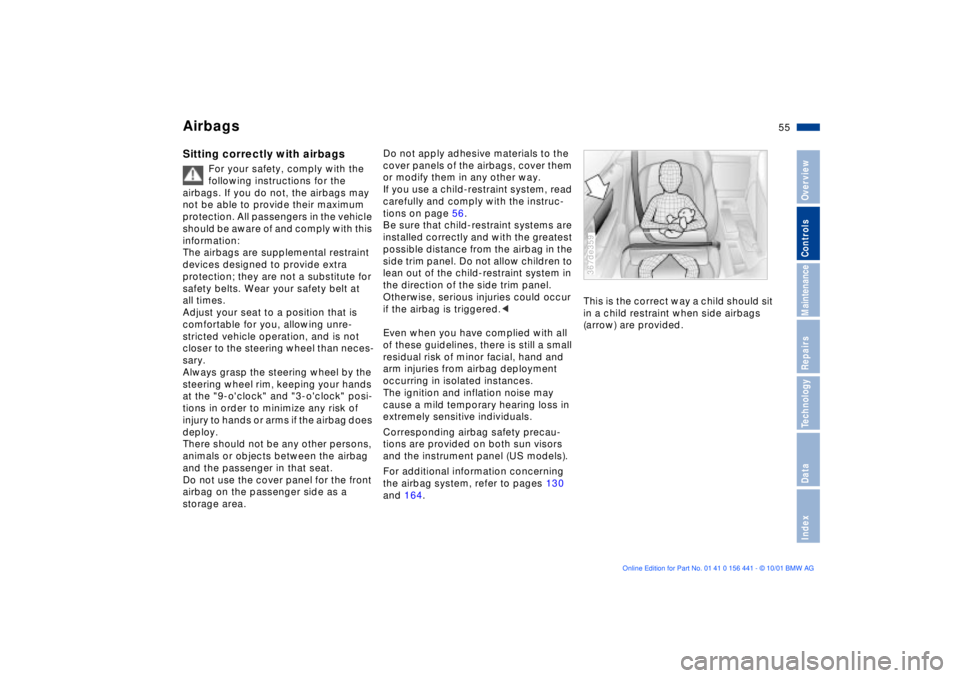
and 164.This is the correct way a child should sit
in a child restraint when side airbags
(arrow) are provided.
367de359
Page 56 of 187
56n
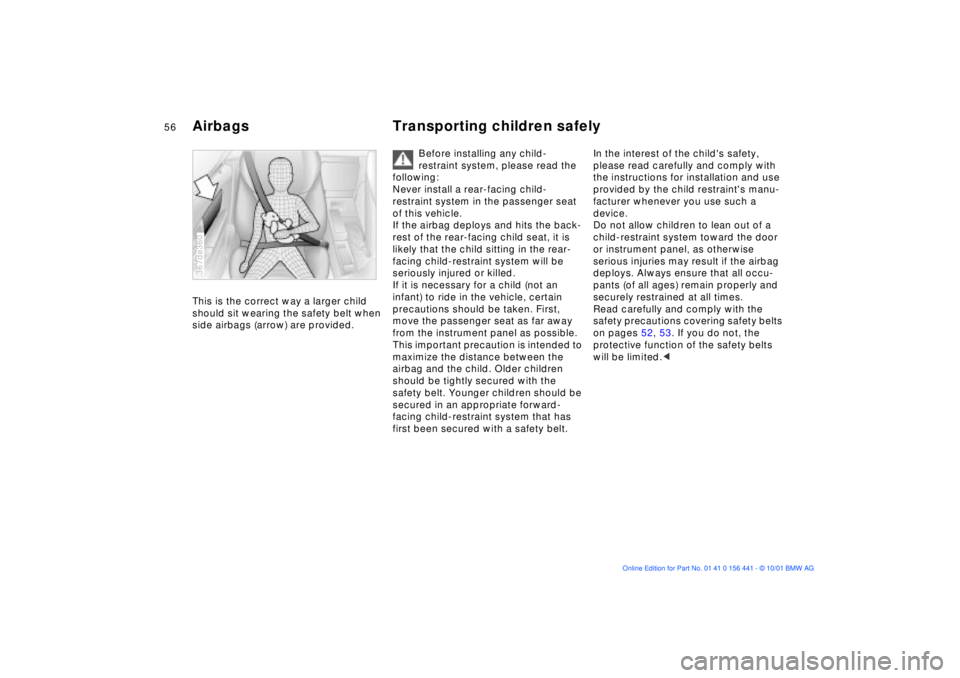
Airbags Transporting children safely This is the correct way a larger child
should sit wearing the safety belt when
side airbags (arrow) are provided.367de360
Before installing any child-
restraint system, please read the
following:
Never install a rear-facing child-
restraint system in the passenger seat
of this vehicle.
If the airbag deploys and hits the back-
rest of the rear-facing child seat, it is
likely that the child sitting in the rear-
facing child-restraint system will be
seriously injured or killed.
If it is necessary for a child (not an
infant) to ride in the vehicle, certain
precautions should be taken. First,
move the passenger seat as far away
from the instrument panel as possible.
This important precaution is intended to
maximize the distance between the
airbag and the child. Older children
should be tightly secured with the
safety belt. Younger children should be
secured in an appropriate forward-
facing child-restraint system that has
first been secured with a safety belt.
In the interest of the child's safety,
please read carefully and comply with
the instructions for installation and use
provided by the child restraint's manu-
facturer whenever you use such a
device.
Do not allow children to lean out of a
child-restraint system toward the door
or instrument panel, as otherwise
serious injuries may result if the airbag
deploys. Always ensure that all occu-
pants (of all ages) remain properly and
securely restrained at all times.
Read carefully and comply with the
safety precautions covering safety belts
on pages 52, 53. If you do not, the
protective function of the safety belts
will be limited.<
Page 57 of 187
57n
IndexDataTechnologyRepairsMaintenanceControlsOverview
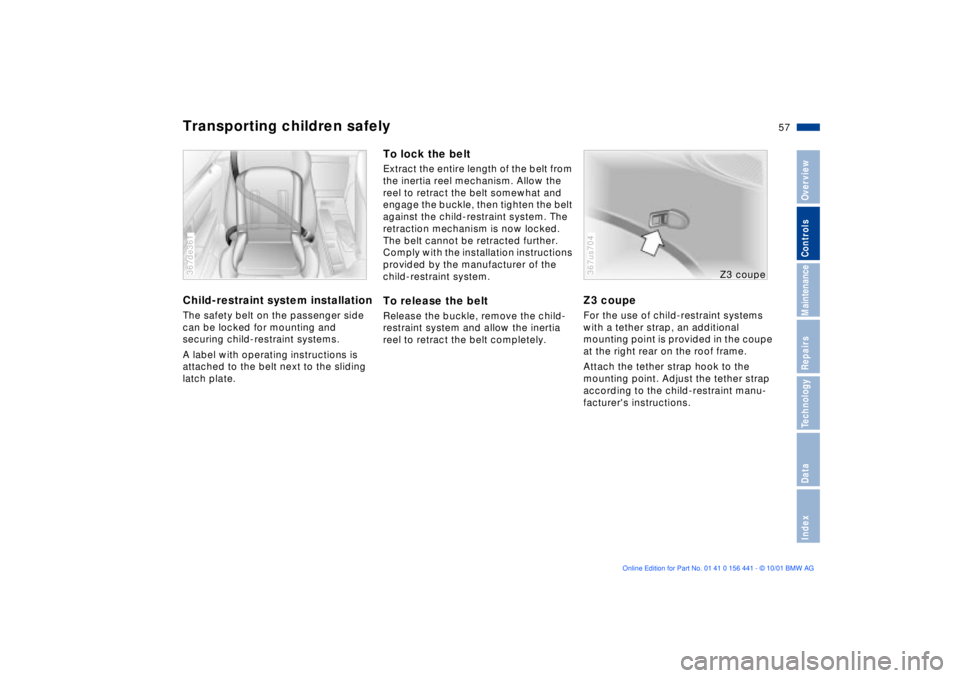
Transporting children safelyChild-restraint system installationThe safety belt on the passenger side
can be locked for mounting and
securing child-restraint systems.
A label with operating instructions is
attached to the belt next to the sliding
latch plate.367de361
To lock the beltExtract the entire length of the belt from
the inertia reel mechanism. Allow the
reel to retract the belt somewhat and
engage the buckle, then tighten the belt
against the child-restraint system. The
retraction mechanism is now locked.
The belt cannot be retracted further.
Comply with the installation instructions
provided by the manufacturer of the
child-restraint system.To release the beltRelease the buckle, remove the child-
restraint system and allow the inertia
reel to retract the belt completely.
Z3 coupeFor the use of child-restraint systems
with a tether strap, an additional
mounting point is provided in the coupe
at the right rear on the roof frame.
Attach the tether strap hook to the
mounting point. Adjust the tether strap
according to the child-restraint manu-
facturer's instructions.367us704
Z3 coupe
Page 114 of 187

114n
Wheel and tire combinationsThe right choice
Use only wheels and tires
approved by BMW for the corre-
sponding vehicle model, as otherwise
the tires may make contact with the
body as the result of tolerances despite
the same nominal size being used,
resulting in serious accidents. If non-
approved wheels and tires are used,
BMW cannot evaluate their suitability,
and therefore cannot be held liable for
driving safety.<
For wheel and tire specifications
approved by BMW, refer to the informa-
tion beginning on page 116.
The correct wheel and tire combi-
nation affects different systems
such as ABS and ASC+T/DSC
*. The
function of these systems is impaired if
improper wheel and tire combinations
are used.
For this reason, use only tires of the
same manufacture and tread configura-
tion. In the event of a flat tire, for
example, remount the approved wheel
and tire combination as soon as
possible.<
Codes on tires and wheelsThe code on the tires has the following
meaning.
Codes on radial tires:
The speed rating indicates the
approved maximum speed for the tire.
Summer tires:
S = up to 112 mph (180 km/h)
T = up to 118 mph (190 km/h)
H = up to 130 mph (210 km/h)
V = up to 149 mph (240 km/h)
W = up to 167 mph (270 km/h)
Y = up to 186 mph (300 km/h)
ZR = over 149 mph (240 km/h) Example:
Nominal width
in mm
Aspect ratio in %
Belt rating ID code
for radial tires
Wheel diameter in inches
Load rating
(not on ZR tires)
Speed rating
(before R on ZR tires)
205/60 R 15 91 H
All season and winter tires:
Q M+S = up to 100 mph (160 km/h)
T M+S = up to 118 mph (190 km/h)
H M+S = up to 130 mph (210 km/h)
Codes on light-alloy wheels:
Protect valve inserts against dirt by
using screw-on valve caps. Dirt in the
valve inserts frequently causes a slow
loss in tire pressure.Storage Store tires in a cool, dry place,
protecting them against light whenever
possible. Protect the tires against
contact with oil, grease and fuel. Example:
Rim width
in inches
Code letter for
flange type
Symbol for full-drop
center rim
Rim diameter in inches
Hump on the 2 rim shoulders
7x15H2
J
Page 116 of 187

116n
Approved wheel and tire specificationsBMW tests certain tire brands for each tire size, classifies them as road-safe and
approves them. Consult your BMW center for more information.
Observe any regulations applicable in the country of use, e.g. requiring entry in
the vehicle documents.
Tire specifications Suitable for
snow chainsSteel wheel
(rim)Light-alloy
wheel
Z3 roadster 2.5i
Summer
225/50 R 16 92 V
225/50 ZR 16[Ð 7Jx16
Front: 225/45 ZR 17
Rear: 245/40 ZR 17Ð
ÐÐ
Ð7.5Jx17
8.5Jx17
Winter (M+S)
205/60 R 15 91 Q/T/H[ 6.5Jx15 7Jx15
205/55 R 16 91 Q/T/H
225/50 R 16 92 Q/T/H[7Jx16 7Jx16
225/45 R 17 91 Q/T/H[Ð
Ð7.5Jx17
8Jx17
Spare tire
T 115/90 R 16 92 M Ð 3.00Bx16 Ð
Use the spare wheel only for short
distances (to reach the nearest BMW
center, for instance). Due to the altered
handling characteristics, do not exceed
a maximum speed of 50 mph (80 km/h).
Mounting snow chains on the spare tire
is not possible. Be sure that all tires are
properly inflated, refer to page 27.
The use of rims and lug bolts that
do not meet the specifications of
the original factory-installed equipment
will affect the safe operation of your
vehicle and may cause an accident and
personal injury.
Never mix tires of different design, such
as steel-belted radials with bias-belted
or bias-ply tires etc. Mixing tire types
will adversely affect road-holding and
can lead to loss of vehicle control.<
Page 117 of 187

117n
IndexDataTechnologyRepairsMaintenanceControlsOverview
Approved wheel and tire specificationsBMW tests certain tire brands for each tire size, classifies them as road-safe and
approves them. Consult your BMW center for more information.
Observe any regulations applicable in the country of use, e.g. requiring entry in
the vehicle documents.
Z3 roadster 3.0i, Z3 coupe 3.0i
Summer
225/50 R 16 92 V
225/50 ZR 16[Ð 7Jx16
Front: 225/45 ZR 17 Ð Ð 7.5Jx17
Rear: 245/40 ZR 17 Ð Ð 8.5Jx17
Winter (M+S)
205/55 R 16 91 Q/T/H
225/50 R 16 92 Q/T/H[7Jx16 7Jx16
225/45 R 17 91 Q[Ð
Ð7.5Jx17
8Jx17
Spare tire
T 115/90 R 16 92 M Ð 3.00Bx16 Ð
Use the spare tire only for short
distances (to reach the nearest BMW
center, for instance). Due to the altered
handling characteristics, do not exceed
a maximum speed of 50 mph (80 km/h).
Mounting snow chains on the spare tire
is not possible. Be sure that all tires are
properly inflated, refer to page 27.
The use of rims and lug bolts that
do not meet the specifications of
the original factory-installed equipment
will affect the safe operation of your
vehicle and may cause an accident and
personal injury.
Never mix tires of different design, such
as steel-belted radials with bias-belted
or bias-ply tires etc. Mixing tire types
will adversely affect road-holding and
can lead to loss of vehicle control.<
Page 163 of 187
Overview
Controls and features
Operation, maintenance
Owner service procedures
Technical data
Index Advanced technology
163n
IndexDataTechnologyRepairsMaintenanceControlsOverview
Adaptive Transmission Control
(ATC)164
Airbags164
Automatic Stability Control plus
Traction (ASC+T)/Dynamic
Stability Control (DSC)165
Car radio reception166
Safety belt tensioner166
Technology
Page 166 of 187
166n
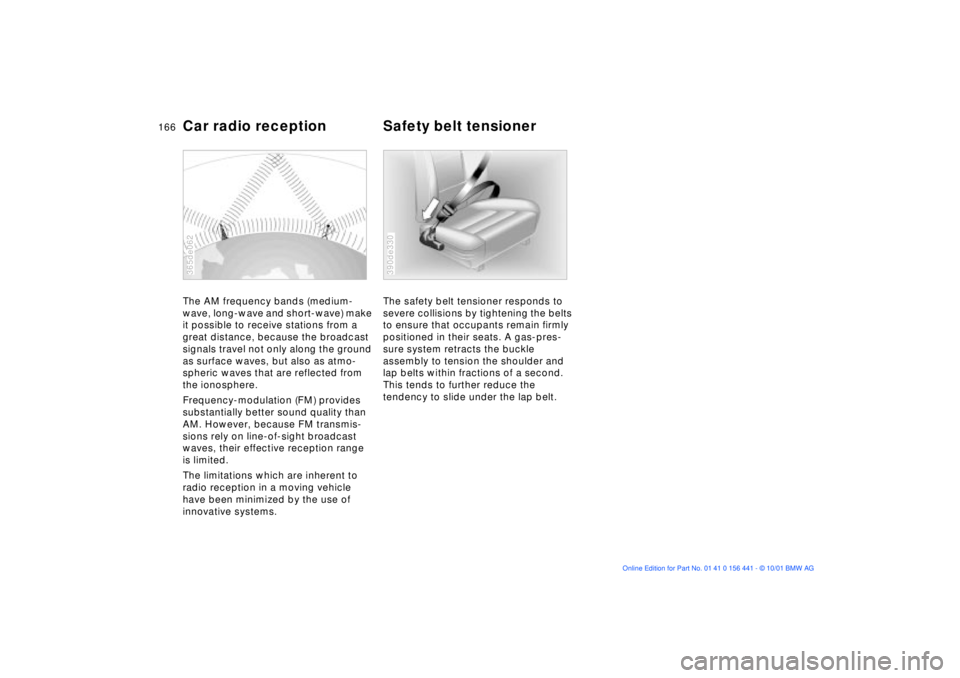
Car radio reception Safety belt tensionerThe AM frequency bands (medium-
wave, long-wave and short-wave) make
it possible to receive stations from a
great distance, because the broadcast
signals travel not only along the ground
as surface waves, but also as atmo-
spheric waves that are reflected from
the ionosphere.
Frequency-modulation (FM) provides
substantially better sound quality than
AM. However, because FM transmis-
sions rely on line-of-sight broadcast
waves, their effective reception range
is limited.
The limitations which are inherent to
radio reception in a moving vehicle
have been minimized by the use of
innovative systems.365de062
The safety belt tensioner responds to
severe collisions by tightening the belts
to ensure that occupants remain firmly
positioned in their seats. A gas-pres-
sure system retracts the buckle
assembly to tension the shoulder and
lap belts within fractions of a second.
This tends to further reduce the
tendency to slide under the lap belt.390de330
Page 169 of 187
Overview
Controls and features
Operation, maintenance
Owner service procedures
Technical data
Index Advanced technology
169n
IndexDataTechnologyRepairsMaintenanceControlsOverview
Engine specifications170
Dimensions171
Weights172
Capacities173
Electrical system174
Drive belts174
Data
Page 174 of 187

174n
Electrical system Drive belts Battery12V, 70 AhSpark plugsNGK BKR 6 EQUP
This spark ignition system meets all
requirements of the Canadian Interfer-
ence-Causing Equipment Regulations
(ICES-2).Generator Ð Water pump Ð
Power steering
Drive belt 6 PK x 1538
A/C compressor
Drive belt 5 PK x 863You can obtain Original BMW
parts and accessories, as well as
professional advice from your BMW
center.<