ignition BMW Z4 2.5I 2005 User Guide
[x] Cancel search | Manufacturer: BMW, Model Year: 2005, Model line: Z4 2.5I, Model: BMW Z4 2.5I 2005Pages: 120, PDF Size: 3.82 MB
Page 35 of 120
Reference
At a glance
Controls
Driving tips
Mobility
33
Transporting children safely
Children on the passenger's
seat
Deactivating/reactivating passenger
airbags
The passenger airbags must be deacti-
vated before using a rear-facing child-
restraint system on the passenger seat, refer
also to page34 for explanation.
BMW also recommends that the passenger air-
bags be deactivated if a child is transported in a
front-facing child-restraint system, regardless
of the age of the child. If you transport a child in
the passenger seat, not an infant in a rear-fac-
ing seat, who is properly seated and seat-belted
at all times, the potential benefits of airbags
deploying in an accident generally outweigh the
risks of the child being injured by the force of a
deploying airbag.
Therefore, you should deactivate the passen-
ger airbags only if you find it difficult to ensure
that the child will remain properly seated and
seat-belted at all times.
Always position the passenger seat as far back
as possible and at the lowest level.
The above warning and recommendations are
compatible with regulations established by the
National Highway Traffic Safety Administration,
NHTSA, permitting the deactivation of passen-
ger airbags by means of an on-off switch for
members of certain at-risk groups.
Specifically, the at-risk groups are:
>Infants in rear-facing infant seats
>Persons with certain medical conditions
>Children aged 12 and under in the passen-
ger seat.
NHTSA provides this information via their web-
site, www.nhtsa.dot.gov, or via their Auto
Safety Hotline toll-free at
1-800-424-9393 or 366-0123
in Washington, D.C. area.<
The concept
Passenger airbags can be deactivated/reacti-
vated with the vehicle ignition key. The key
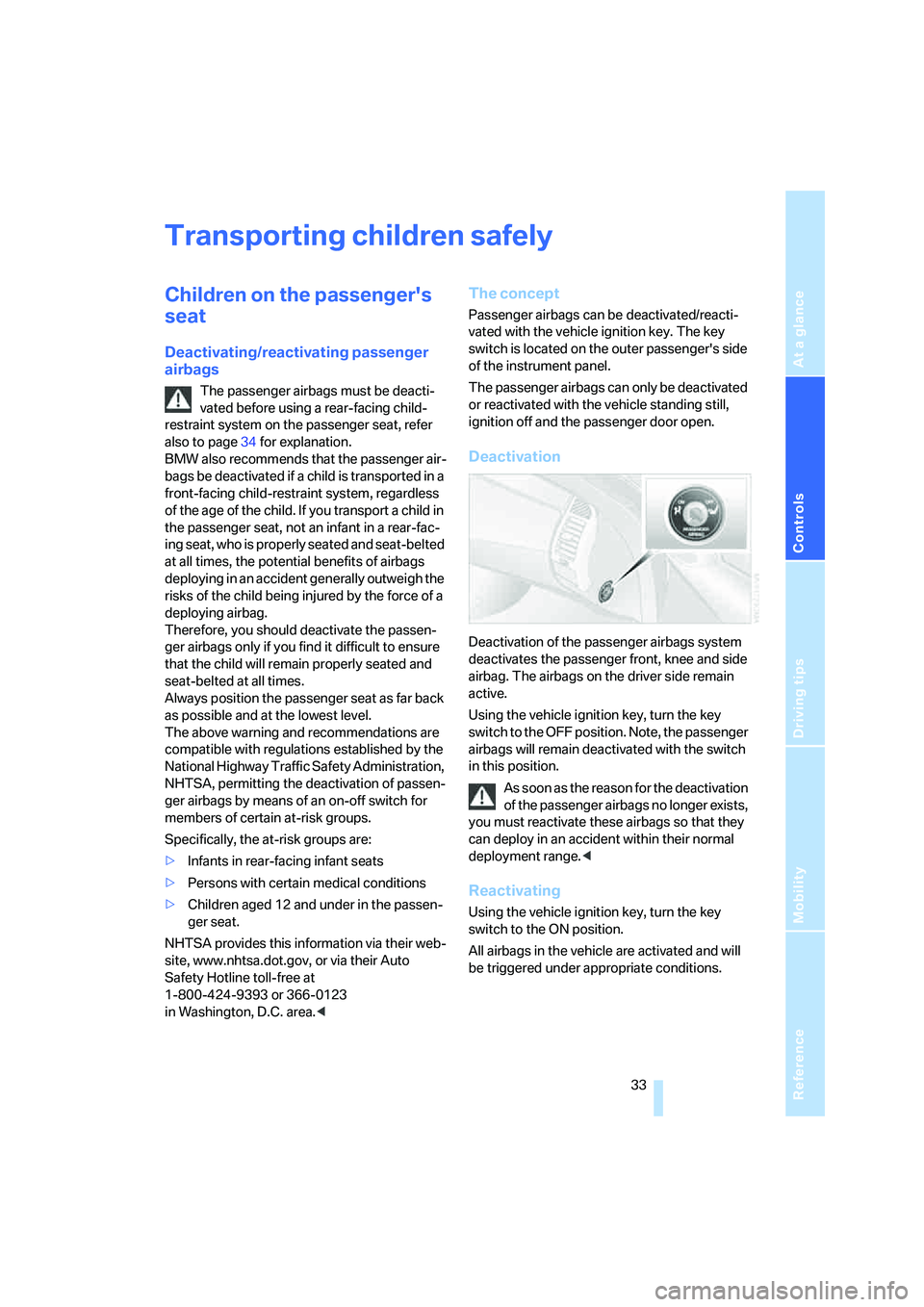
switch is located on the outer passenger's side
of the instrument panel.
The passenger airbags can only be deactivated
or reactivated with the vehicle standing still,
ignition off and the passenger door open.
Deactivation
Deactivation of the passenger airbags system
deactivates the passenger front, knee and side
airbag. The airbags on the driver side remain
active.
Using the vehicle ignition key, turn the key
switch to the OFF position. Note, the passenger
airbags will remain deactivated with the switch
in this position.
As soon as the reason for the deactivation
of the passenger airbags no longer exists,
you must reactivate these airbags so that they
can deploy in an accident within their normal
deployment range.<
Reactivating
Using the vehicle ignition key, turn the key
switch to the ON position.
All airbags in the vehicle are activated and will
be triggered under appropriate conditions.
Page 36 of 120
Transporting children safely
34
Passenger airbags lamp
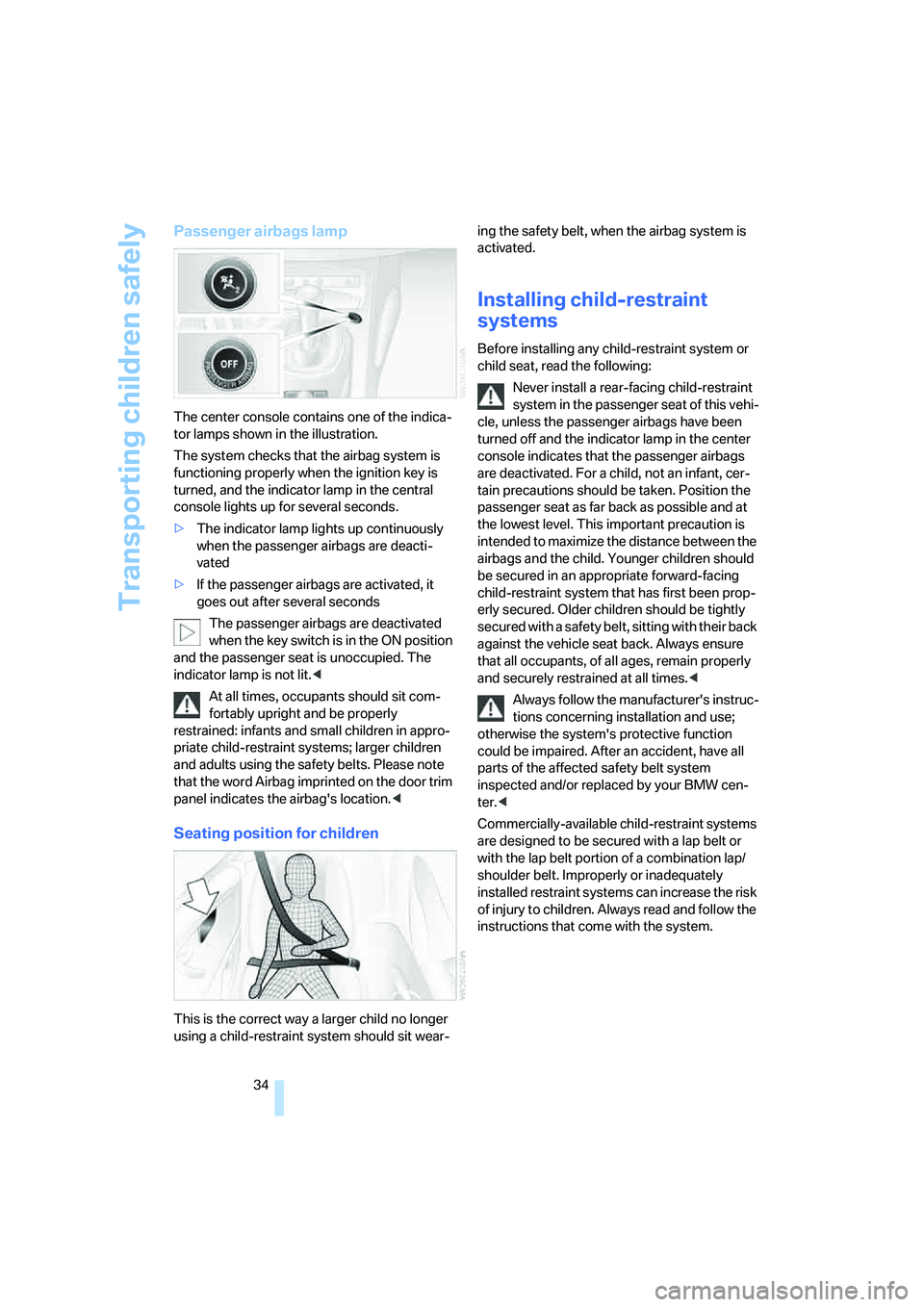
The center console contains one of the indica-
tor lamps shown in the illustration.
The system checks that the airbag system is
functioning properly when the ignition key is
turned, and the indicator lamp in the central
console lights up for several seconds.
>The indicator lamp lights up continuously
when the passenger airbags are deacti-
vated
>If the passenger airbags are activated, it
goes out after several seconds
The passenger airbags are deactivated
when the key switch is in the ON position
and the passenger seat is unoccupied. The
indicator lamp is not lit.<
At all times, occupants should sit com-
fortably upright and be properly
restrained: infants and small children in appro-
priate child-restraint systems; larger children
and adults using the safety belts. Please note
that the word Airbag imprinted on the door trim
panel indicates the airbag's location.<
Seating position for children
This is the correct way a larger child no longer
using a child-restraint system should sit wear-ing the safety belt, when the airbag system is
activated.
Installing child-restraint
systems
Before installing any child-restraint system or
child seat, read the following:
Never install a rear-facing child-restraint
system in the passenger seat of this vehi-
cle, unless the passenger airbags have been
turned off and the indicator lamp in the center
console indicates that the passenger airbags
are deactivated. For a child, not an infant, cer-
tain precautions should be taken. Position the
passenger seat as far back as possible and at
the lowest level. This important precaution is
intended to maximize the distance between the
airbags and the child. Younger children should
be secured in an appropriate forward-facing
child-restraint system that has first been prop-
erly secured. Older children should be tightly
secured with a safety belt, sitting with their back
against the vehicle seat back. Always ensure
that all occupants, of all ages, remain properly
and securely restrained at all times.<
Always follow the manufacturer's instruc-
tions concerning installation and use;
otherwise the system's protective function
could be impaired. After an accident, have all
parts of the affected safety belt system
inspected and/or replaced by your BMW cen-
ter.<
Commercially-available child-restraint systems
are designed to be secured with a lap belt or
with the lap belt portion of a combination lap/
shoulder belt. Improperly or inadequately
installed restraint systems can increase the risk
of injury to children. Always read and follow the
instructions that come with the system.
Page 38 of 120
Driving
36
Driving
Ignition lock
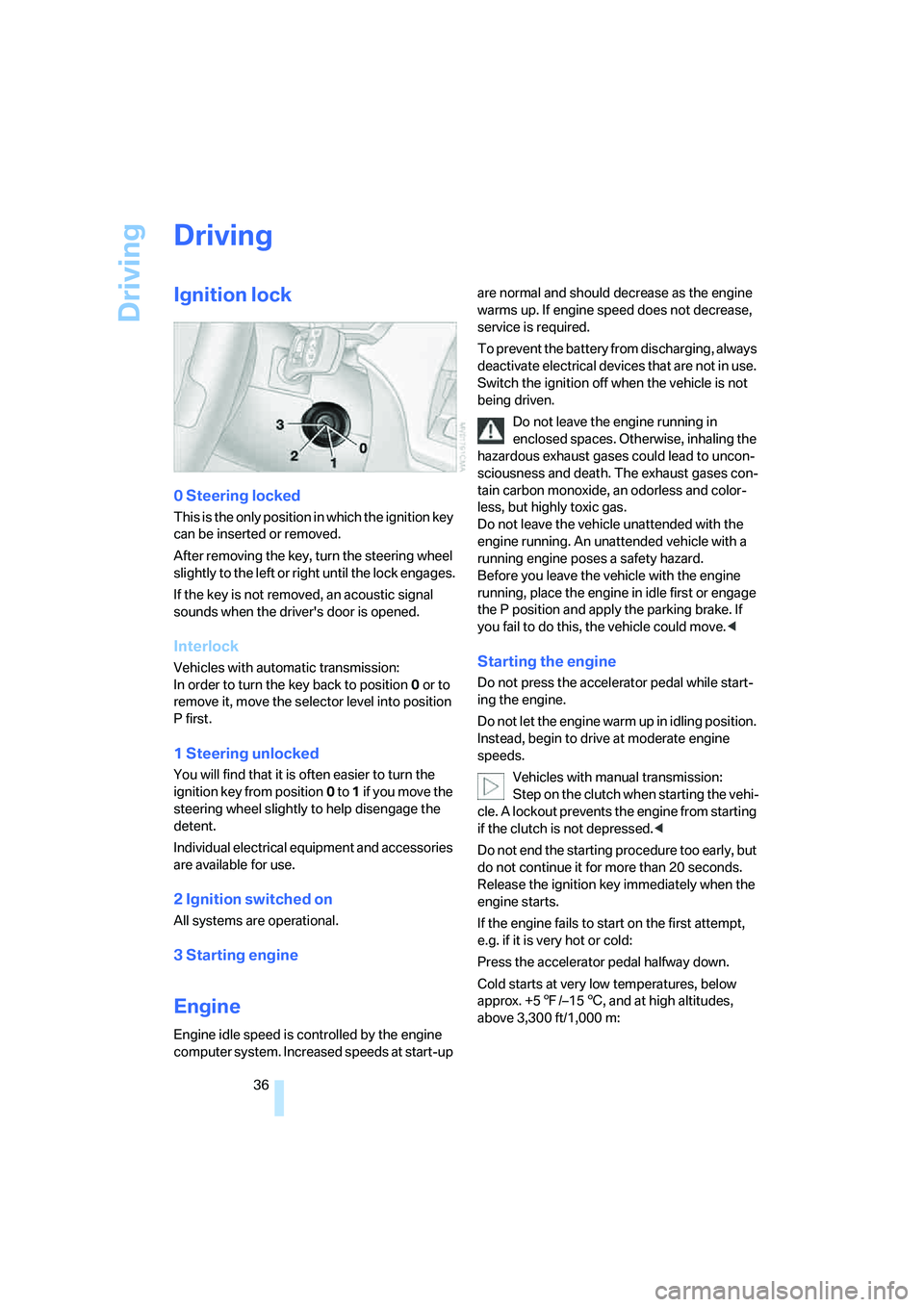
0 Steering locked
This is the only position in which the ignition key
can be inserted or removed.
After removing the key, turn the steering wheel
slightly to the left or right until the lock engages.
If the key is not removed, an acoustic signal
sounds when the driver's door is opened.
Interlock
Vehicles with automatic transmission:
In order to turn the key back to position0 or to
remove it, move the selector level into position
P first.
1 Steering unlocked
You will find that it is often easier to turn the
ignition key from position0 to 1 if you move the
steering wheel slightly to help disengage the
detent.
Individual electrical equipment and accessories
are available for use.
2 Ignition switched on
All systems are operational.
3 Starting engine
Engine
Engine idle speed is controlled by the engine
computer system. Increased speeds at start-up are normal and should decrease as the engine
warms up. If engine speed does not decrease,
service is required.
To prevent the battery from discharging, always
deactivate electrical devices that are not in use.
Switch the ignition off when the vehicle is not
being driven.
Do not leave the engine running in
enclosed spaces. Otherwise, inhaling the
hazardous exhaust gases could lead to uncon-
sciousness and death. The exhaust gases con-
tain carbon monoxide, an odorless and color-
less, but highly toxic gas.
Do not leave the vehicle unattended with the
engine running. An unattended vehicle with a
running engine poses a safety hazard.
Before you leave the vehicle with the engine
running, place the engine in idle first or engage
the P position and apply the parking brake. If
you fail to do this, the vehicle could move.<
Starting the engine
Do not press the accelerator pedal while start-
ing the engine.
Do not let the engine warm up in idling position.
Instead, begin to drive at moderate engine
speeds.
Vehicles with manual transmission:
Step on the clutch when starting the vehi-
cle. A lockout prevents the engine from starting
if the clutch is not depressed.<
Do not end the starting procedure too early, but
do not continue it for more than 20 seconds.
Release the ignition key immediately when the
engine starts.
If the engine fails to start on the first attempt,
e.g. if it is very hot or cold:
Press the accelerator pedal halfway down.
Cold starts at very low temperatures, below
approx. +57/–156, and at high altitudes,
above 3,300 ft/1,000 m:
Page 39 of 120
Reference
At a glance
Controls
Driving tips
Mobility
37
>On the first attempt, engage the starter for
approx. 10 seconds
>Press the accelerator pedal halfway down.
Avoid frequent starting attempts in short
succession or repeated starting attempts
during which the engine does not start. Other-
wise, uncombusted or incompletely combusted
fuel will pose a risk of the catalytic converter
overheating and being damaged.<
Manual transmission
1.Engage the parking brake
2.Gearshift lever in idling position
3.Depress the clutch pedal.
If the clutch pedal is not depressed, the
engine cannot be started
4.Start the engine.
Automatic transmission
1.Depress footbrake
2.Place selector lever in position P or N
3.Start the engine.
Sequential manual gearbox SMG
1.Depress footbrake
2.Move selector lever to neutral position N
3.Start the engine.
If the engine does not start, re-engage the
position last selected, refer to the display
in the instrument cluster, and then engage posi-
tion N again.<
Switching off the engine
Do not remove the ignition key while the
vehicle is still moving. If you did so, the
steering lock would engage when the steering
wheel is turned.
When you leave the vehicle, always remove the
ignition key and engage the steering lock.
Apply the parking brake when parking on steep
gradients, as the vehicle could otherwise start
to roll.<
You can have an acoustic signal set as a
reminder that the ignition key is still in the ignition switch after the driver's door has been
opened.<
Manual transmission
1.Turn the ignition key to position 1 or 0
2.Engage first gear or reverse gear.
Automatic transmission
1.Place the selector lever in position P
2.Turn the ignition key to position 1 or 0.
Sequential manual gearbox SMG
1.Engage a drive position
2.Turn the ignition key to position 1 or 0. An
acoustic signal sounds if the engine is
switched off while position N is engaged.
Parking brake
The parking brake is designed primarily to pre-
vent the vehicle from rolling when parked. It
operates against the rear wheels.
The indicator lamp lights up. As the
vehicle drives off, an acoustic signal
also sounds. The parking brake has
been applied.
Indicator lamp for Canadian models.
To engage
The detent engages automatically and the indi-
cator lamp in the instrument cluster comes on
when the ignition key is in position 2.
Page 40 of 120
Driving
38
To release
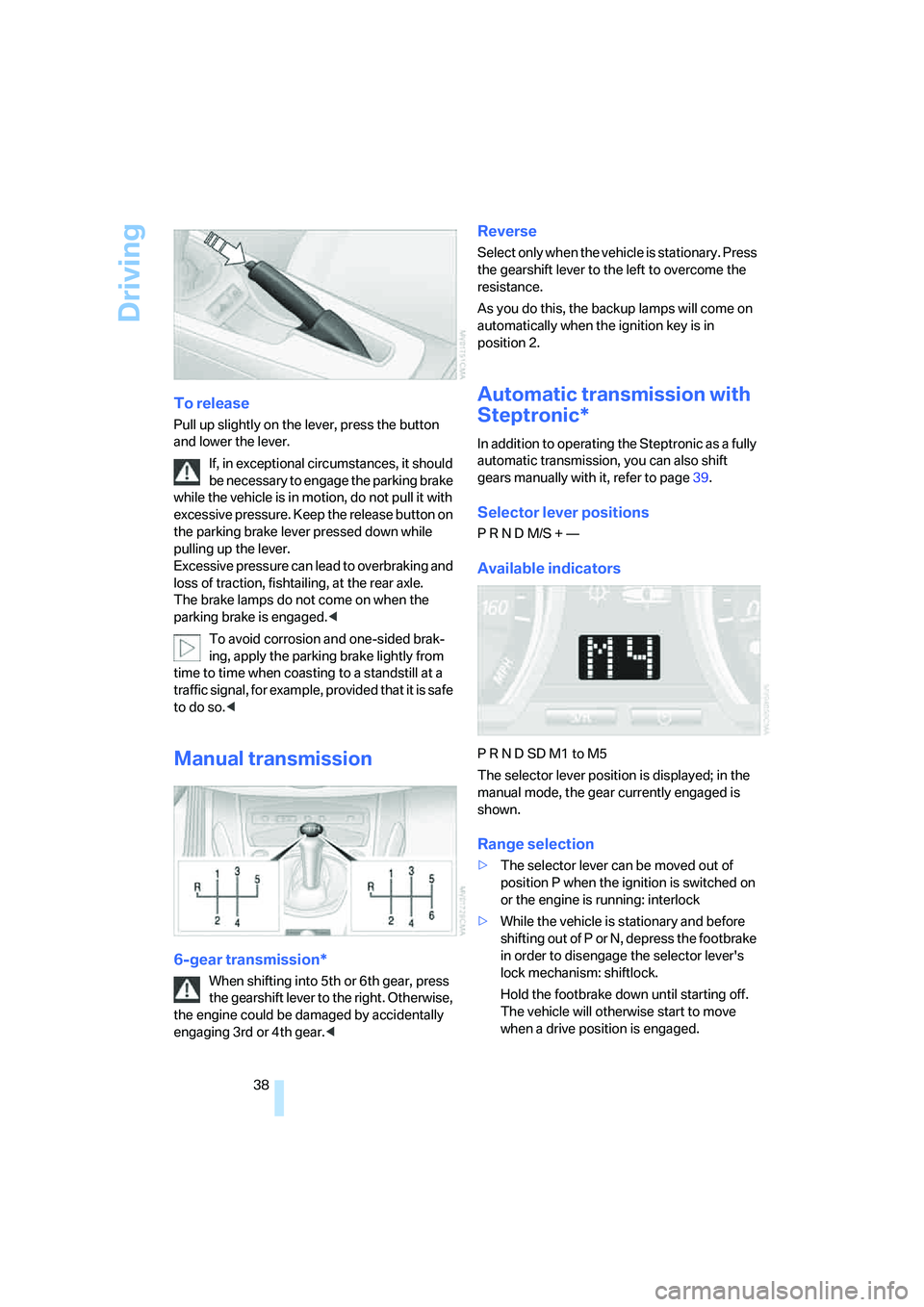
Pull up slightly on the lever, press the button
and lower the lever.
If, in exceptional circumstances, it should
be necessary to engage the parking brake
while the vehicle is in motion, do not pull it with
excessive pressure. Keep the release button on
the parking brake lever pressed down while
pulling up the lever.
Excessive pressure can lead to overbraking and
loss of traction, fishtailing, at the rear axle.
The brake lamps do not come on when the
parking brake is engaged.<
To avoid corrosion and one-sided brak-
ing, apply the parking brake lightly from
time to time when coasting to a standstill at a
traffic signal, for example, provided that it is safe
to do so.<
Manual transmission
6-gear transmission*
When shifting into 5th or 6th gear, press
the gearshift lever to the right. Otherwise,
the engine could be damaged by accidentally
engaging 3rd or 4th gear.<
Reverse
Select only when the vehicle is stationary. Press
the gearshift lever to the left to overcome the
resistance.
As you do this, the backup lamps will come on
automatically when the ignition key is in
position 2.
Automatic transmission with
Steptronic*
In addition to operating the Steptronic as a fully
automatic transmission, you can also shift
gears manually with it, refer to page39.
Selector lever positions
P R N D M/S + —
Available indicators
P R N D SD M1 to M5
The selector lever position is displayed; in the
manual mode, the gear currently engaged is
shown.
Range selection
>The selector lever can be moved out of
position P when the ignition is switched on
or the engine is running: interlock
>While the vehicle is stationary and before
shifting out of P or N, depress the footbrake
in order to disengage the selector lever's
lock mechanism: shiftlock.
Hold the footbrake down until starting off.
The vehicle will otherwise start to move
when a drive position is engaged.
Page 44 of 120
Driving
42
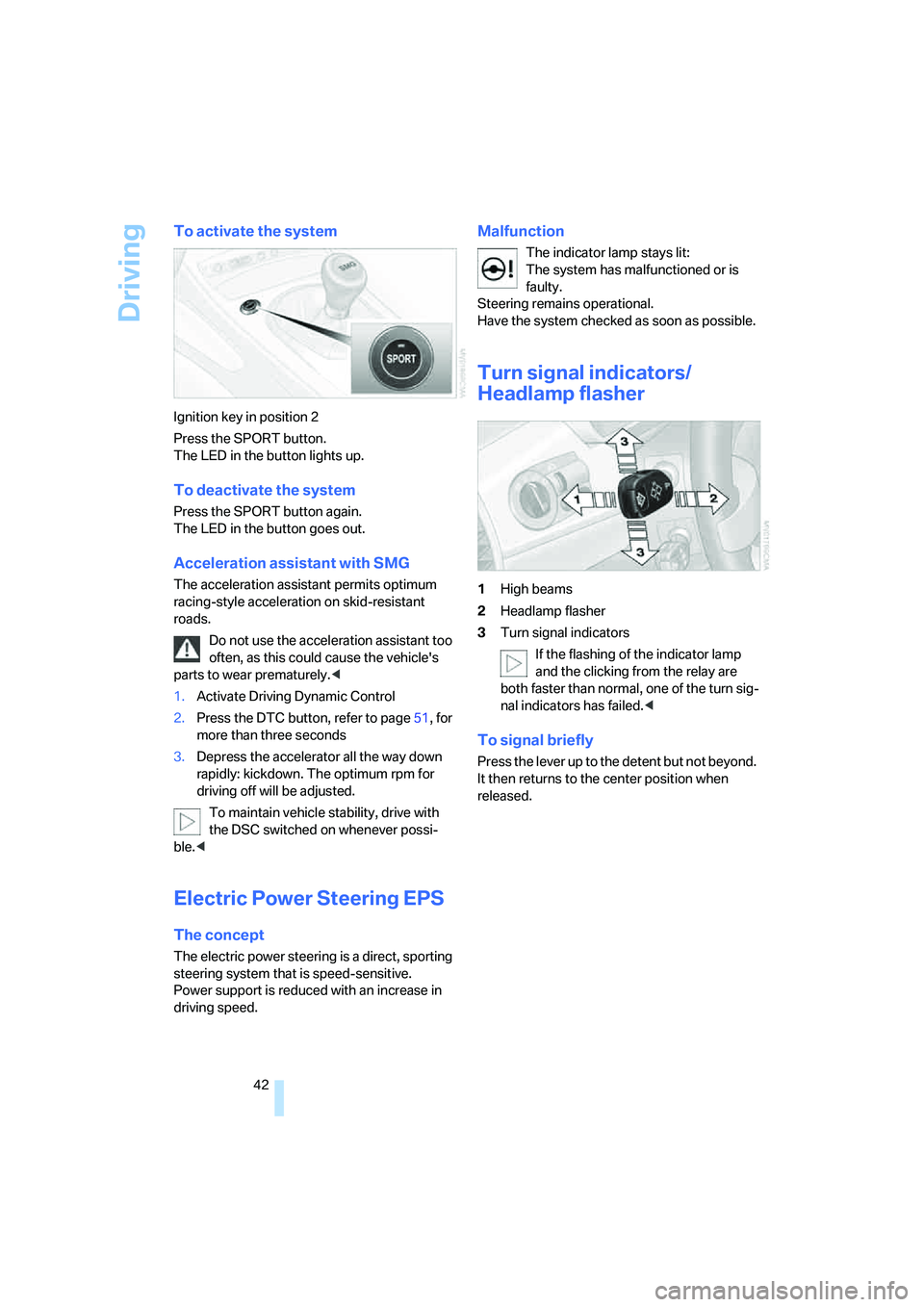
To activate the system
Ignition key in position 2
Press the SPORT button.
The LED in the button lights up.
To deactivate the system
Press the SPORT button again.
The LED in the button goes out.
Acceleration assistant with SMG
The acceleration assistant permits optimum
racing-style acceleration on skid-resistant
roads.
Do not use the acceleration assistant too
often, as this could cause the vehicle's
parts to wear prematurely.<
1.Activate Driving Dynamic Control
2.Press the DTC button, refer to page51, for
more than three seconds
3.Depress the accelerator all the way down
rapidly: kickdown. The optimum rpm for
driving off will be adjusted.
To maintain vehicle stability, drive with
the DSC switched on whenever possi-
ble.<
Electric Power Steering EPS
The concept
The electric power steering is a direct, sporting
steering system that is speed-sensitive.
Power support is reduced with an increase in
driving speed.
Malfunction
The indicator lamp stays lit:
The system has malfunctioned or is
faulty.
Steering remains operational.
Have the system checked as soon as possible.
Turn signal indicators/
Headlamp flasher
1High beams
2Headlamp flasher
3Turn signal indicators
If the flashing of the indicator lamp
and the clicking from the relay are
both faster than normal, one of the turn sig-
nal indicators has failed.<
To signal briefly
Press the lever up to the detent but not beyond.
It then returns to the center position when
released.
Page 45 of 120
Reference
At a glance
Controls
Driving tips
Mobility
43
Washer/wiper system
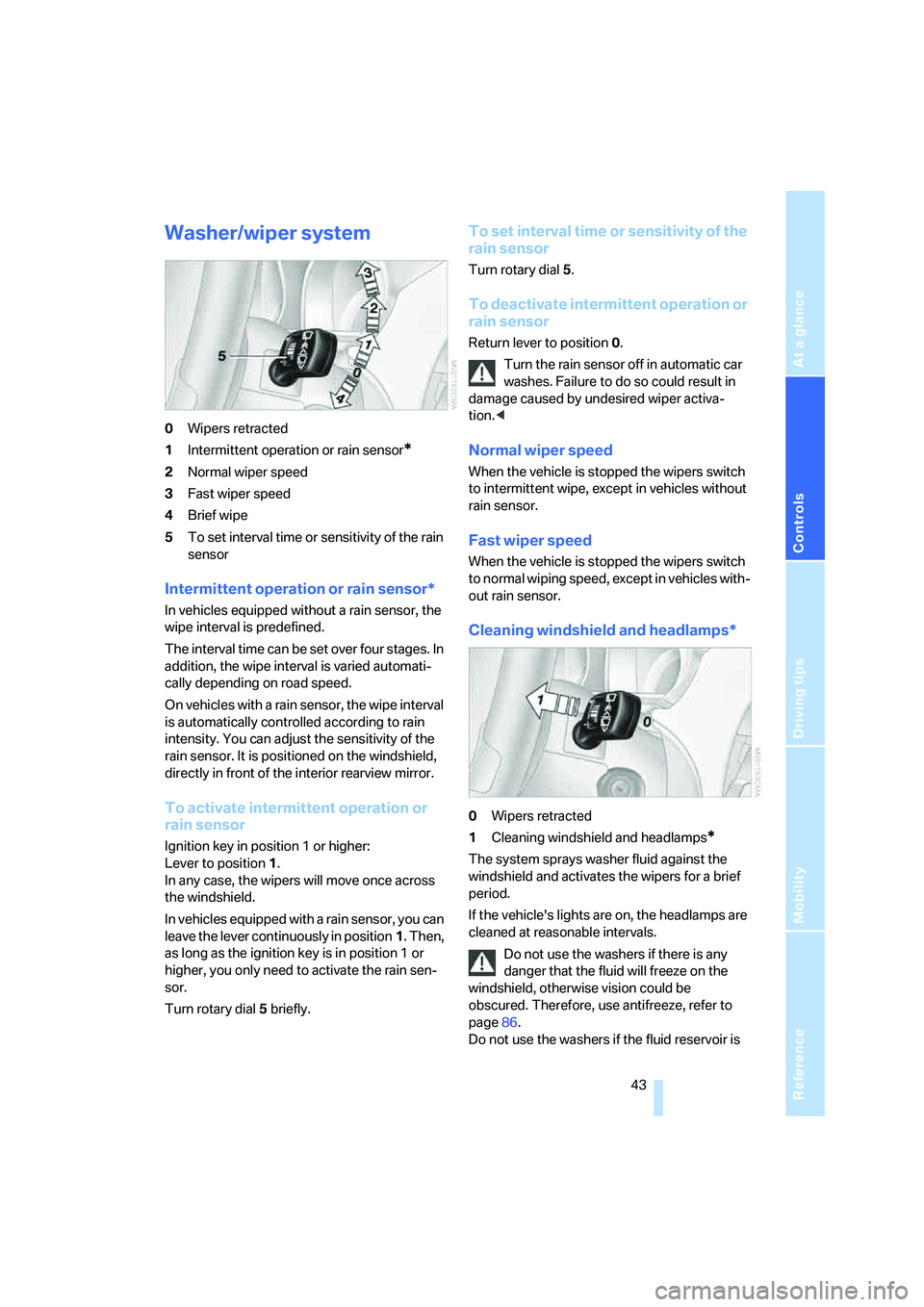
0Wipers retracted
1Intermittent operation or rain sensor
*
2Normal wiper speed
3Fast wiper speed
4Brief wipe
5To set interval time or sensitivity of the rain
sensor
Intermittent operation or rain sensor*
In vehicles equipped without a rain sensor, the
wipe interval is predefined.
The interval time can be set over four stages. In
addition, the wipe interval is varied automati-
cally depending on road speed.
On vehicles with a rain sensor, the wipe interval
is automatically controlled according to rain
intensity. You can adjust the sensitivity of the
rain sensor. It is positioned on the windshield,
directly in front of the interior rearview mirror.
To activate intermittent operation or
rain sensor
Ignition key in position 1 or higher:
Lever to position 1.
In any case, the wipers will move once across
the windshield.
In vehicles equipped with a rain sensor, you can
leave the lever continuously in position1. Then,
as long as the ignition key is in position 1 or
higher, you only need to activate the rain sen-
sor.
Turn rotary dial5 briefly.
To set interval time or sensitivity of the
rain sensor
Turn rotary dial 5.
To deactivate intermittent operation or
rain sensor
Return lever to position 0.
Turn the rain sensor off in automatic car
washes. Failure to do so could result in
damage caused by undesired wiper activa-
tion.<
Normal wiper speed
When the vehicle is stopped the wipers switch
to intermittent wipe, except in vehicles without
rain sensor.
Fast wiper speed
When the vehicle is stopped the wipers switch
to normal wiping speed, except in vehicles with-
out rain sensor.
Cleaning windshield and headlamps*
0Wipers retracted
1Cleaning windshield and headlamps
*
The system sprays washer fluid against the
windshield and activates the wipers for a brief
period.
If the vehicle's lights are on, the headlamps are
cleaned at reasonable intervals.
Do not use the washers if there is any
danger that the fluid will freeze on the
windshield, otherwise vision could be
obscured. Therefore, use antifreeze, refer to
page86.
Do not use the washers if the fluid reservoir is
Page 46 of 120
Driving
44 empty, as the washer pump will otherwise be
damaged.<
Windshield washer nozzles
The windshield washer nozzles are automati-
cally heated
* when the engine is running or the
ignition is switched on.
Cruise control*
Do not use cruise control when unfavor-
able conditions make it inadvisable to
drive at a constant speed. Otherwise, the vehi-
cle could go out of control and an accident
could be caused. Unfavorable conditions
include, for example, twisting roads, high traffic
density, or adverse road conditions such as
snow, rain, ice, or loose surfaces.<
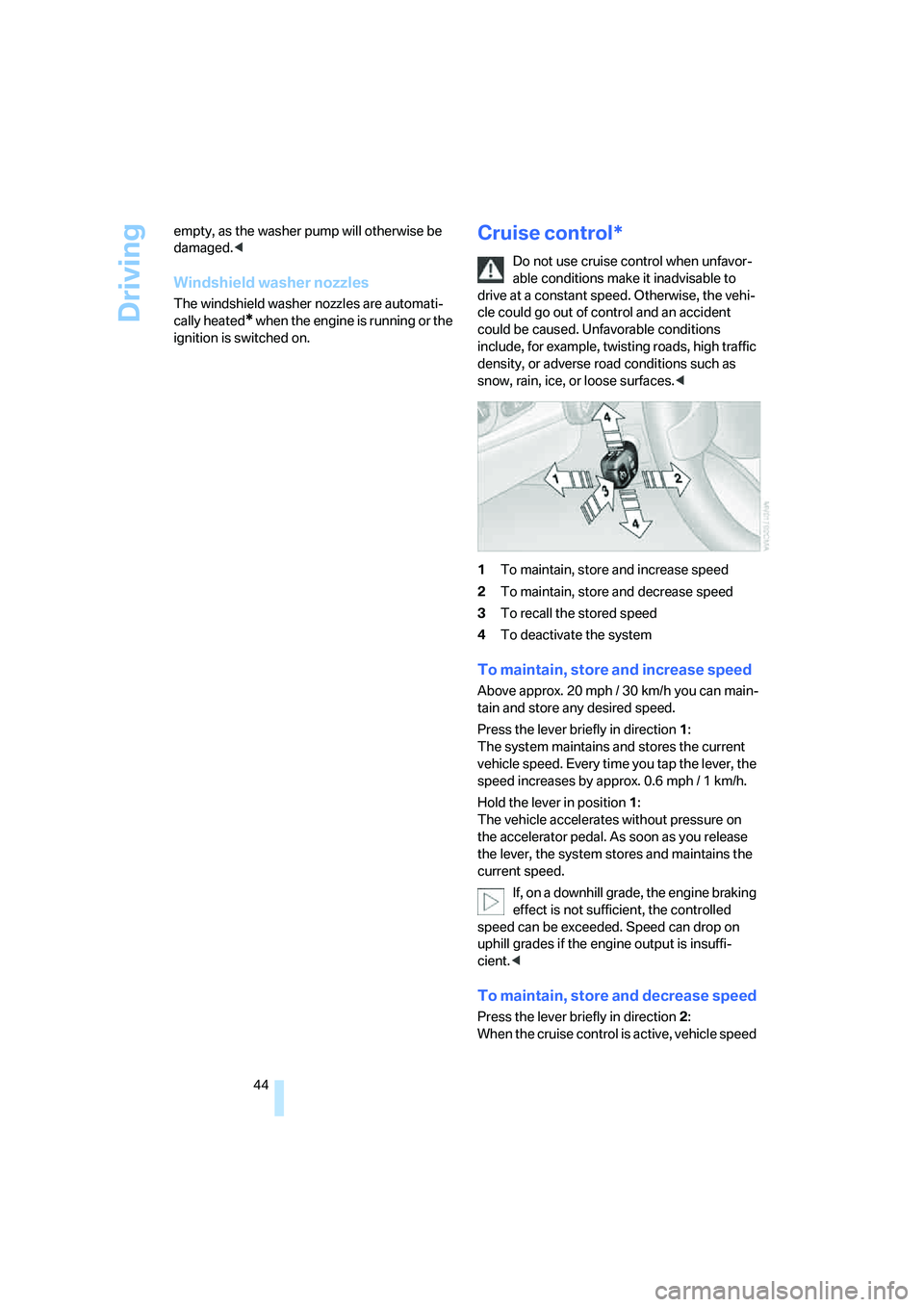
1To maintain, store and increase speed
2To maintain, store and decrease speed
3To recall the stored speed
4To deactivate the system
To maintain, store and increase speed
Above approx. 20 mph / 30 km/h you can main-
tain and store any desired speed.
Press the lever briefly in direction 1:
The system maintains and stores the current
vehicle speed. Every time you tap the lever, the
speed increases by approx. 0.6 mph / 1 km/h.
Hold the lever in position1:
The vehicle accelerates without pressure on
the accelerator pedal. As soon as you release
the lever, the system stores and maintains the
current speed.
If, on a downhill grade, the engine braking
effect is not sufficient, the controlled
speed can be exceeded. Speed can drop on
uphill grades if the engine output is insuffi-
cient.<
To maintain, store and decrease speed
Press the lever briefly in direction 2:
When the cruise control is active, vehicle speed
Page 48 of 120
Everything under control
46
Everything under control
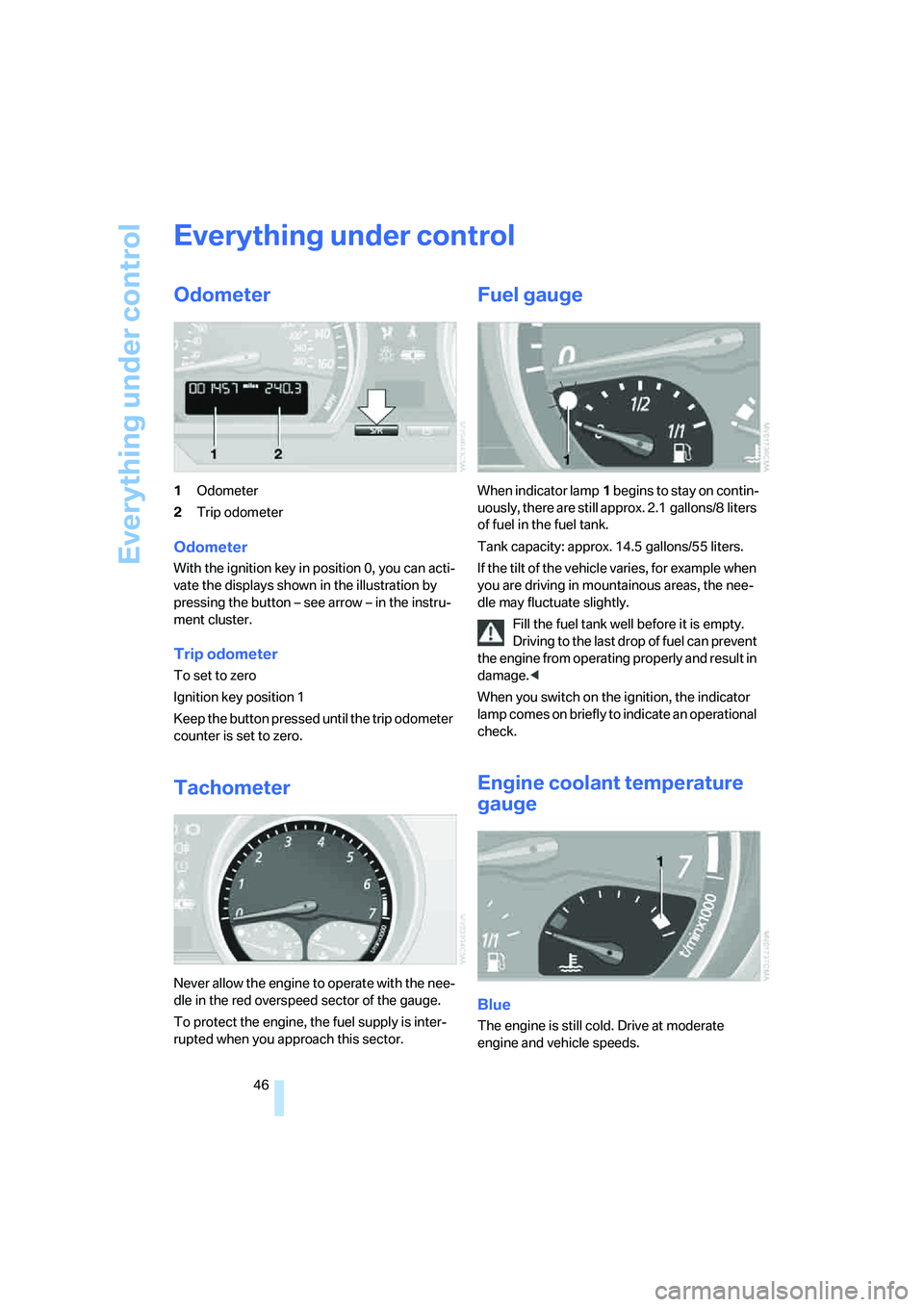
Odometer
1Odometer
2Trip odometer
Odometer
With the ignition key in position 0, you can acti-
vate the displays shown in the illustration by
pressing the button – see arrow – in the instru-
ment cluster.
Trip odometer
To set to zero
Ignition key position 1
Keep the button pressed until the trip odometer
counter is set to zero.
Tachometer
Never allow the engine to operate with the nee-
dle in the red overspeed sector of the gauge.
To protect the engine, the fuel supply is inter-
rupted when you approach this sector.
Fuel gauge
When indicator lamp1 begins to stay on contin-
uously, there are still approx. 2.1 gallons/8 liters
of fuel in the fuel tank.
Tank capacity: approx. 14.5 gallons/55 liters.
If the tilt of the vehicle varies, for example when
you are driving in mountainous areas, the nee-
dle may fluctuate slightly.
Fill the fuel tank well before it is empty.
Driving to the last drop of fuel can prevent
the engine from operating properly and result in
damage.<
When you switch on the ignition, the indicator
lamp comes on briefly to indicate an operational
check.
Engine coolant temperature
gauge
Blue
The engine is still cold. Drive at moderate
engine and vehicle speeds.
Page 49 of 120
Reference
At a glance
Controls
Driving tips
Mobility
47
Between the blue and red zones
Normal operating range. The needle may rise as
far as the edge of the red sector during normal
operation.
Red
When you switch on the ignition, warning
lamp1 comes on briefly to indicate an opera-
tional check.
Comes on while driving:
The engine has overheated. Stop and switch
the engine off immediately and allow it to cool
down.
For checking the coolant level, refer to page87.
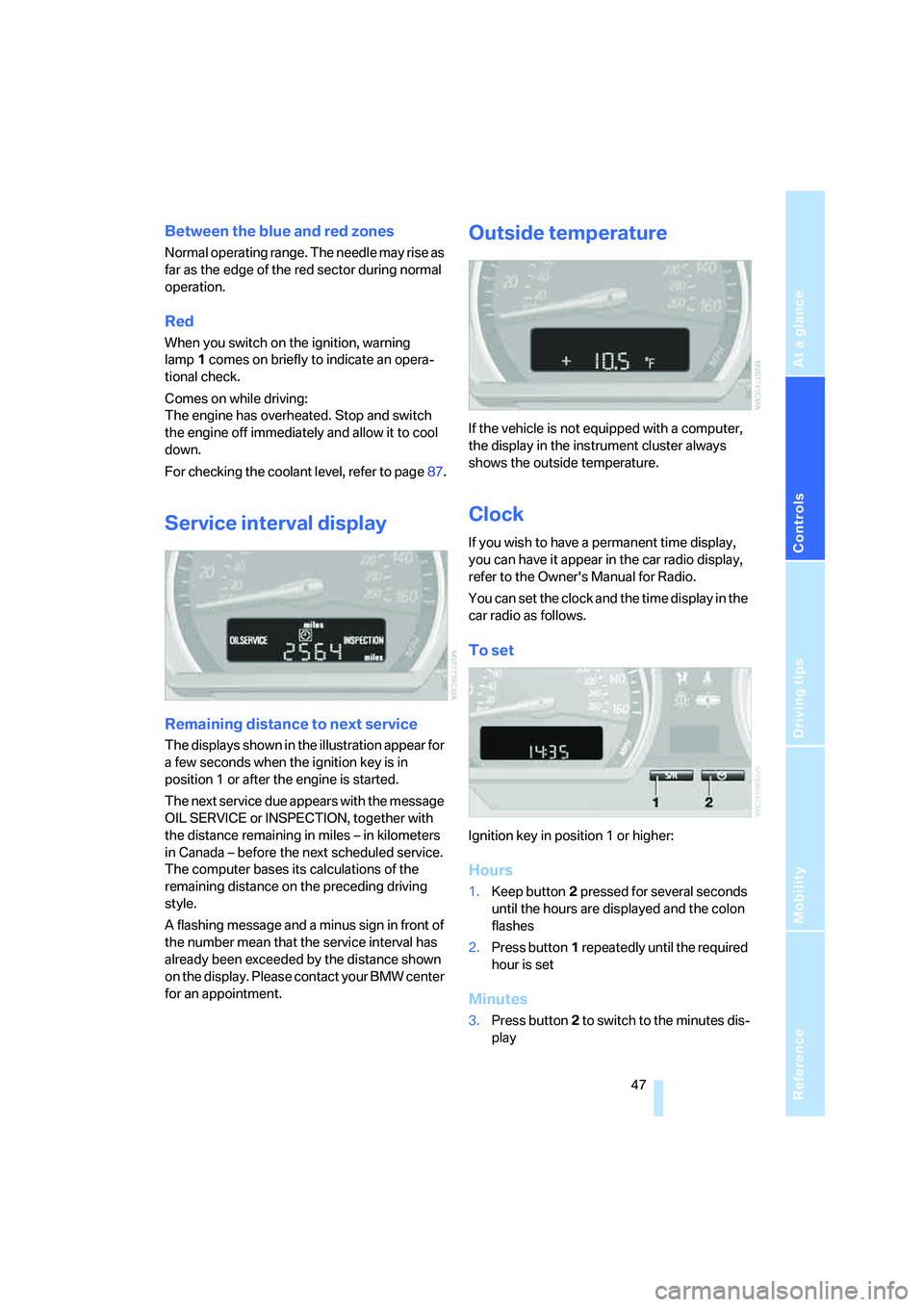
Service interval display
Remaining distance to next service
The displays shown in the illustration appear for
a few seconds when the ignition key is in
position 1 or after the engine is started.
The next service due appears with the message
OIL SERVICE or INSPECTION, together with
the distance remaining in miles – in kilometers
in Canada – before the next scheduled service.
The computer bases its calculations of the
remaining distance on the preceding driving
style.
A flashing message and a minus sign in front of
the number mean that the service interval has
already been exceeded by the distance shown
on the display. Please contact your BMW center
for an appointment.
Outside temperature
If the vehicle is not equipped with a computer,
the display in the instrument cluster always
shows the outside temperature.
Clock
If you wish to have a permanent time display,
you can have it appear in the car radio display,
refer to the Owner's Manual for Radio.
You can set the clock and the time display in the
car radio as follows.
To set
Ignition key in position 1 or higher:
Hours
1.Keep button2 pressed for several seconds
until the hours are displayed and the colon
flashes
2.Press button1 repeatedly until the required
hour is set
Minutes
3.Press button2 to switch to the minutes dis-
play