tow BMW Z4 COUPE 2006 E86 User Guide
[x] Cancel search | Manufacturer: BMW, Model Year: 2006, Model line: Z4 COUPE, Model: BMW Z4 COUPE 2006 E86Pages: 128, PDF Size: 4.41 MB
Page 65 of 128
Reference
At a glance
Controls
Driving tips
Mobility
63
automatic climate control does not have
enough time to achieve the set temperature.<
AUC Automatic recirculated-air
control/Recirculated-air mode
Switch on the desired operating
mode by pressing this button repeat-
edly:
>LEDs off: outside air flows in continuously.
>Left-hand LED on, AUC mode: a sensor
detects pollutants in the outside air. If nec-
essary, the system blocks the supply of out-
side air and recirculates the inside air. As
soon as the concentration of pollutants in
the outside air has decreased sufficiently,
the system automatically switches back to
outside air supply.
>Right-hand LED on, recirculated-air mode:
the inflow of outside air is shut off perma-
nently. The system recirculates the air
within the vehicle.
If the windows fog over in the recircu-
lated-air mode, you should switch it off
and, if necessary, increase the air flow rate.
The recirculated-air mode should not be used
over an extended period of time, otherwise the
air quality inside the car will deteriorate contin-
uously.<
Rear window defroster
The defroster switches off automati-
cally after a certain time.
Ventilation
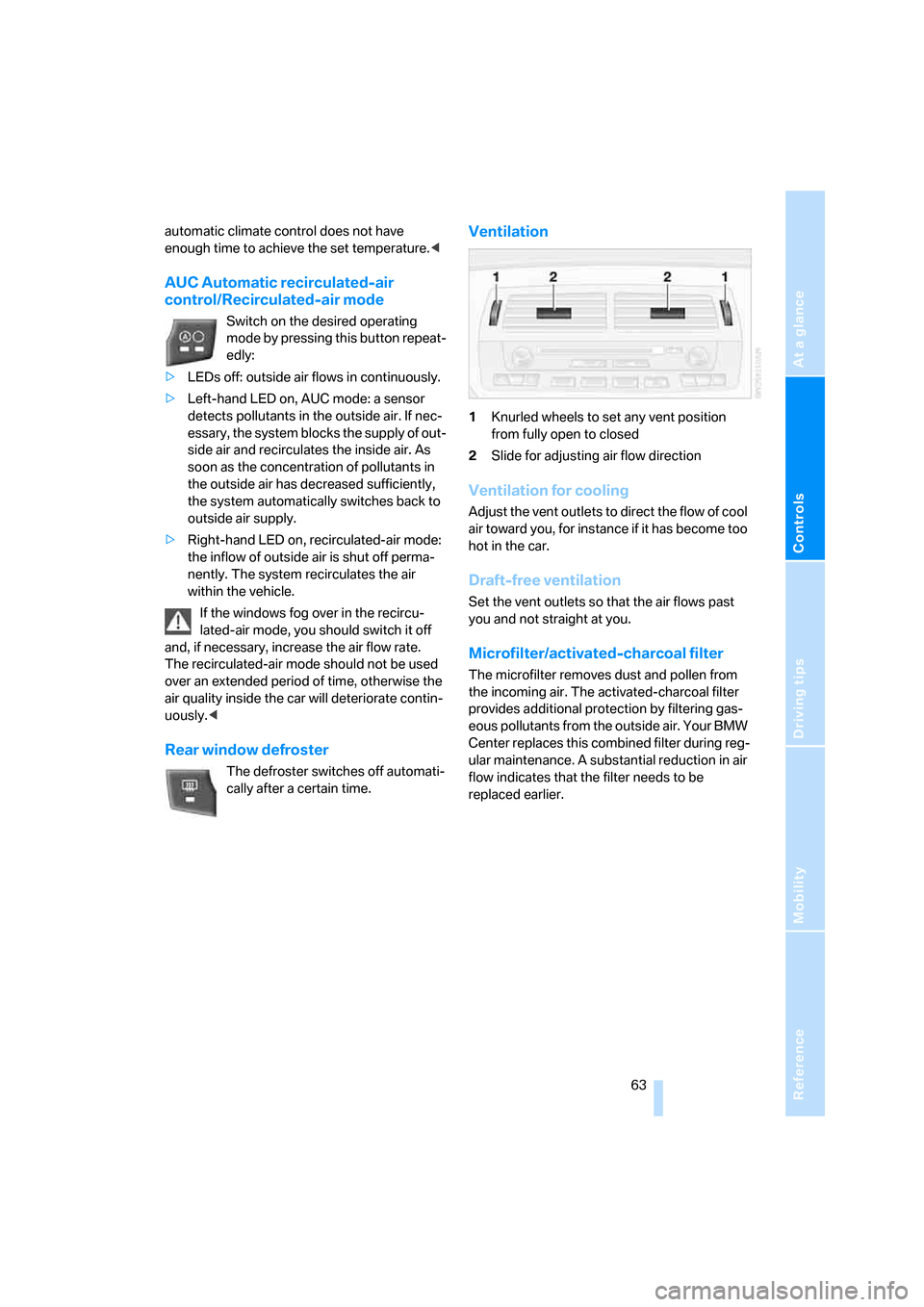
1Knurled wheels to set any vent position
from fully open to closed
2Slide for adjusting air flow direction
Ventilation for cooling
Adjust the vent outlets to direct the flow of cool
air toward you, for instance if it has become too
hot in the car.
Draft-free ventilation
Set the vent outlets so that the air flows past
you and not straight at you.
Microfilter/activated-charcoal filter
The microfilter removes dust and pollen from
the incoming air. The activated-charcoal filter
provides additional protection by filtering gas-
eous pollutants from the outside air. Your BMW
Center replaces this combined filter during reg-
ular maintenance. A substantial reduction in air
flow indicates that the filter needs to be
replaced earlier.
Page 75 of 128
Reference
At a glance
Controls
Driving tips
Mobility
73
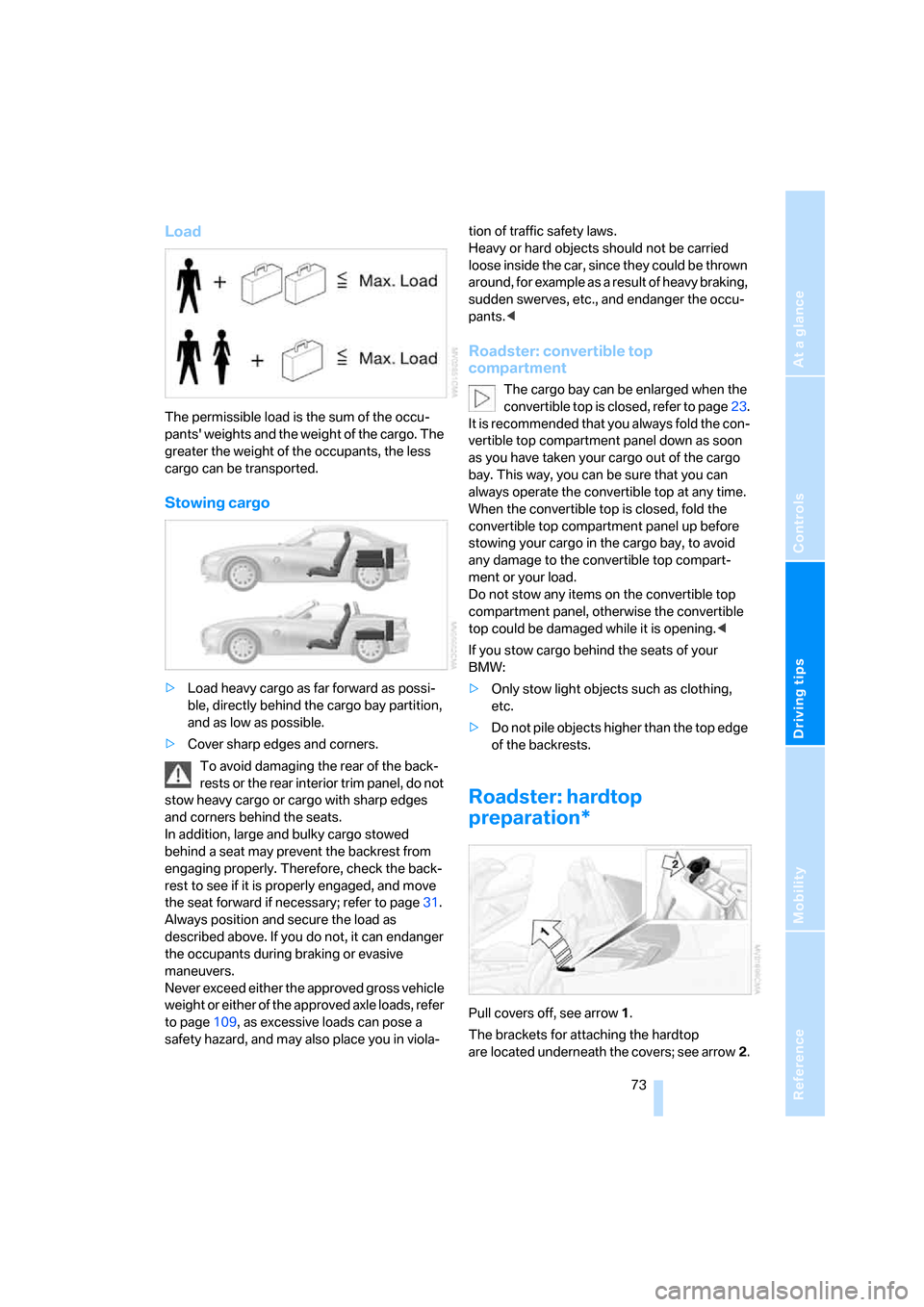
Load
The permissible load is the sum of the occu-
pants' weights and the weight of the cargo. The
greater the weight of the occupants, the less
cargo can be transported.
Stowing cargo
>Load heavy cargo as far forward as possi-
ble, directly behind the cargo bay partition,
and as low as possible.
>Cover sharp edges and corners.
To avoid damaging the rear of the back-
rests or the rear interior trim panel, do not
stow heavy cargo or cargo with sharp edges
and corners behind the seats.
In addition, large and bulky cargo stowed
behind a seat may prevent the backrest from
engaging properly. Therefore, check the back-
rest to see if it is properly engaged, and move
the seat forward if necessary; refer to page31.
Always position and secure the load as
described above. If you do not, it can endanger
the occupants during braking or evasive
maneuvers.
Never exceed either the approved gross vehicle
weight or either of the approved axle loads, refer
to page109, as excessive loads can pose a
safety hazard, and may also place you in viola-tion of traffic safety laws.
Heavy or hard objects should not be carried
loose inside the car, since they could be thrown
around, for example as a result of heavy braking,
sudden swerves, etc., and endanger the occu-
pants.<
Roadster: convertible top
compartment
The cargo bay can be enlarged when the
convertible top is closed, refer to page23.
I t i s r e c o m m e n d ed t h a t y o u a lw a y s f o l d t h e c o n -
vertible top compartment panel down as soon
as you have taken your cargo out of the cargo
bay. This way, you can be sure that you can
always operate the convertible top at any time.
When the convertible top is closed, fold the
convertible top compartment panel up before
stowing your cargo in the cargo bay, to avoid
any damage to the convertible top compart-
ment or your load.
Do not stow any items on the convertible top
compartment panel, otherwise the convertible
top could be damaged while it is opening.<
If you stow cargo behind the seats of your
BMW:
>Only stow light objects such as clothing,
etc.
>Do not pile objects higher than the top edge
of the backrests.
Roadster: hardtop
preparation*
Pull covers off, see arrow1.
The brackets for attaching the hardtop
are located underneath the covers; see arrow2.
Page 80 of 128
Refueling
78
Refueling
Always switch off the engine before refu-
eling. Otherwise the tank cannot be
refilled. The Service Engine Soon warning lamp
will come on.<
Take all precautionary measures and
observe all applicable regulations when
handling fuel. Do not carry any spare fuel con-
tainers in your vehicle. They can develop a leak
and cause an explosion or cause a fire in the
event of an accident.<
Gas cap
Opening
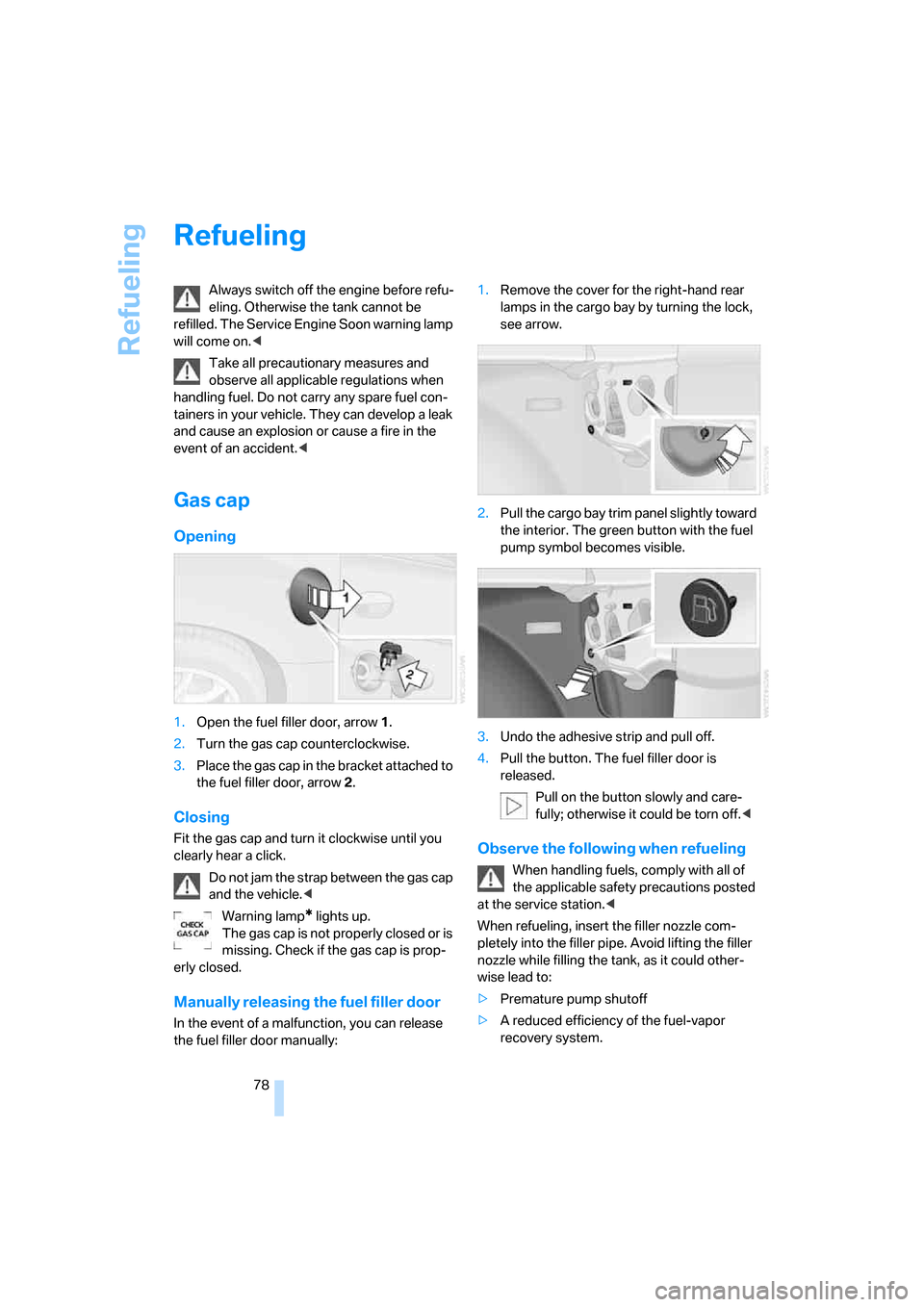
1.Open the fuel filler door, arrow 1.
2.Turn the gas cap counterclockwise.
3.Place the gas cap in the bracket attached to
the fuel filler door, arrow 2.
Closing
Fit the gas cap and turn it clockwise until you
clearly hear a click.
Do not jam the strap between the gas cap
and the vehicle.<
Warning lamp
* lights up.
The gas cap is not properly closed or is
missing. Check if the gas cap is prop-
erly closed.
Manually releasing the fuel filler door
In the event of a malfunction, you can release
the fuel filler door manually:1.Remove the cover for the right-hand rear
lamps in the cargo bay by turning the lock,
see arrow.
2.Pull the cargo bay trim panel slightly toward
the interior. The green button with the fuel
pump symbol becomes visible.
3.Undo the adhesive strip and pull off.
4.Pull the button. The fuel filler door is
released.
Pull on the button slowly and care-
fully; otherwise it could be torn off.<
Observe the following when refueling
When handling fuels, comply with all of
the applicable safety precautions posted
at the service station.<
When refueling, insert the filler nozzle com-
pletely into the filler pipe. Avoid lifting the filler
nozzle while filling the tank, as it could other-
wise lead to:
>Premature pump shutoff
>A reduced efficiency of the fuel-vapor
recovery system.
Page 86 of 128
Wheels and tires
84 the letters TWI, for Tread Wear Indicator, on the
tire's sidewalls identify tires that incorporate
these wear indicators. Once the tire tread has
worn down to the wear indicators, the tire has
worn to a depth of 1/16 in/1.6 mm.
Wheel/tire damage
Due to low-profile tires, please note that
wheels, tires and suspension parts are
more susceptible to road hazards and conse-
quential damages.<
Unusual vibrations encountered during normal
vehicle operation can indicate tire failure or
some other vehicle malfunction. This can, for
example, be caused by driving over curbs. The
same applies to any other abnormal road
behavior, such as pulling severely to the right or
left.
In these cases, reduce speed immedi-
ately and have wheels and tires thor-
oughly checked. To do so, drive carefully to the
nearest BMW Center or tire shop that works
according to BMW repair procedures with cor-
respondingly trained personnel. If necessary,
have the vehicle towed there.
Tire damage can be extremely dangerous for
vehicle occupants and other road users.<
Tire age
For various reasons, such as the development
of brittleness, BMW recommends tire replace-
ment after no more than 6 years, regardless of
the actual wear of the tires.
The date on which the tire was manufactured is
indicated by the code on the sidewall:
DOT … 5005 indicates that the tire was manu-
factured in week 50 of the year 2005.
Run-Flat Tires
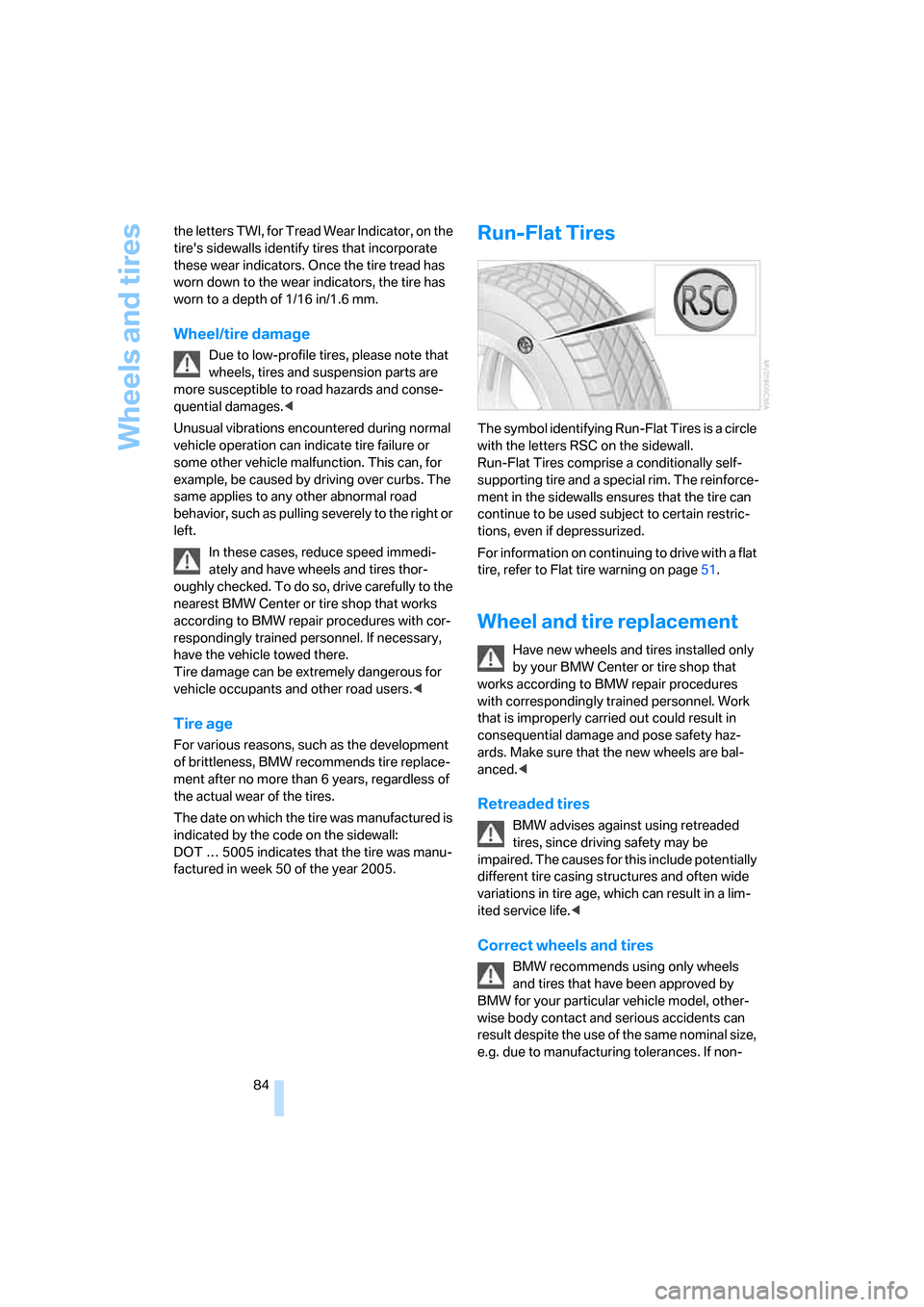
The symbol identifying Run-Flat Tires is a circle
with the letters RSC on the sidewall.
Run-Flat Tires comprise a conditionally self-
supporting tire and a special rim. The reinforce-
ment in the sidewalls ensures that the tire can
continue to be used subject to certain restric-
tions, even if depressurized.
For information on continuing to drive with a flat
tire, refer to Flat tire warning on page51.
Wheel and tire replacement
Have new wheels and tires installed only
by your BMW Center or tire shop that
works according to BMW repair procedures
with correspondingly trained personnel. Work
that is improperly carried out could result in
consequential damage and pose safety haz-
ards. Make sure that the new wheels are bal-
anced.<
Retreaded tires
BMW advises against using retreaded
tires, since driving safety may be
impaired. The causes for this include potentially
different tire casing structures and often wide
variations in tire age, which can result in a lim-
ited service life.<
Correct wheels and tires
BMW recommends using only wheels
and tires that have been approved by
BMW for your particular vehicle model, other-
wise body contact and serious accidents can
result despite the use of the same nominal size,
e.g. due to manufacturing tolerances. If non-
Page 95 of 128
Reference
At a glance
Controls
Driving tips
Mobility
93
Replacing components
Onboard tool kit
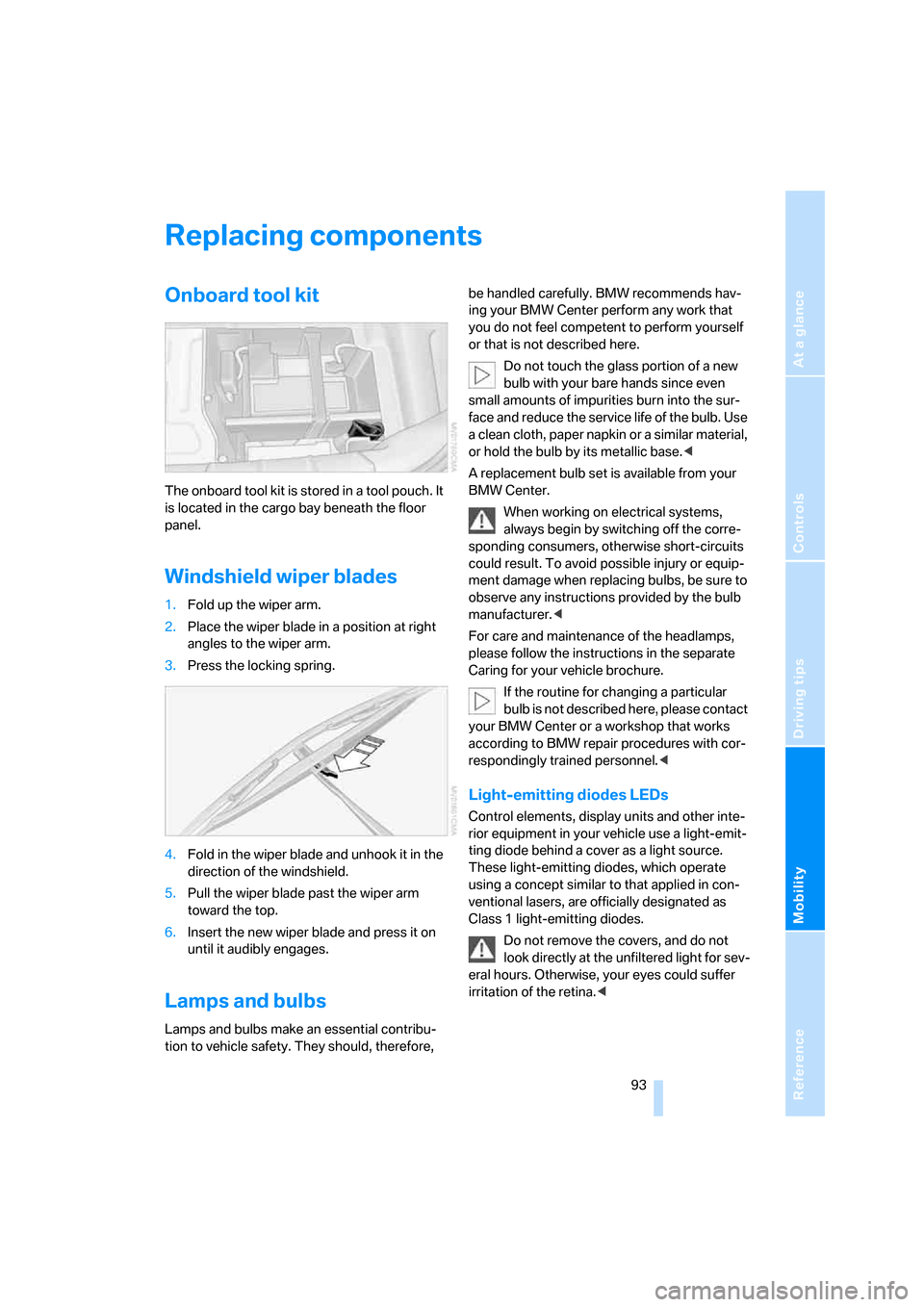
The onboard tool kit is stored in a tool pouch. It
is located in the cargo bay beneath the floor
panel.
Windshield wiper blades
1.Fold up the wiper arm.
2.Place the wiper blade in a position at right
angles to the wiper arm.
3.Press the locking spring.
4.Fold in the wiper blade and unhook it in the
direction of the windshield.
5.Pull the wiper blade past the wiper arm
toward the top.
6.Insert the new wiper blade and press it on
until it audibly engages.
Lamps and bulbs
Lamps and bulbs make an essential contribu-
tion to vehicle safety. They should, therefore, be handled carefully. BMW recommends hav-
ing your BMW Center perform any work that
you do not feel competent to perform yourself
or that is not described here.
Do not touch the glass portion of a new
bulb with your bare hands since even
small amounts of impurities burn into the sur-
face and reduce the service life of the bulb. Use
a clean cloth, paper napkin or a similar material,
or hold the bulb by its metallic base.<
A replacement bulb set is available from your
BMW Center.
When working on electrical systems,
always begin by switching off the corre-
sponding consumers, otherwise short-circuits
could result. To avoid possible injury or equip-
ment damage when replacing bulbs, be sure to
observe any instructions provided by the bulb
manufacturer.<
For care and maintenance of the headlamps,
please follow the instructions in the separate
Caring for your vehicle brochure.
If the routine for changing a particular
bulb is not described here, please contact
your BMW Center or a workshop that works
according to BMW repair procedures with cor-
respondingly trained personnel.<
Light-emitting diodes LEDs
Control elements, display units and other inte-
rior equipment in your vehicle use a light-emit-
ting diode behind a cover as a light source.
These light-emitting diodes, which operate
using a concept similar to that applied in con-
ventional lasers, are officially designated as
Class 1 light-emitting diodes.
Do not remove the covers, and do not
look directly at the unfiltered light for sev-
eral hours. Otherwise, your eyes could suffer
irritation of the retina.<
Page 102 of 128
Giving and receiving assistance
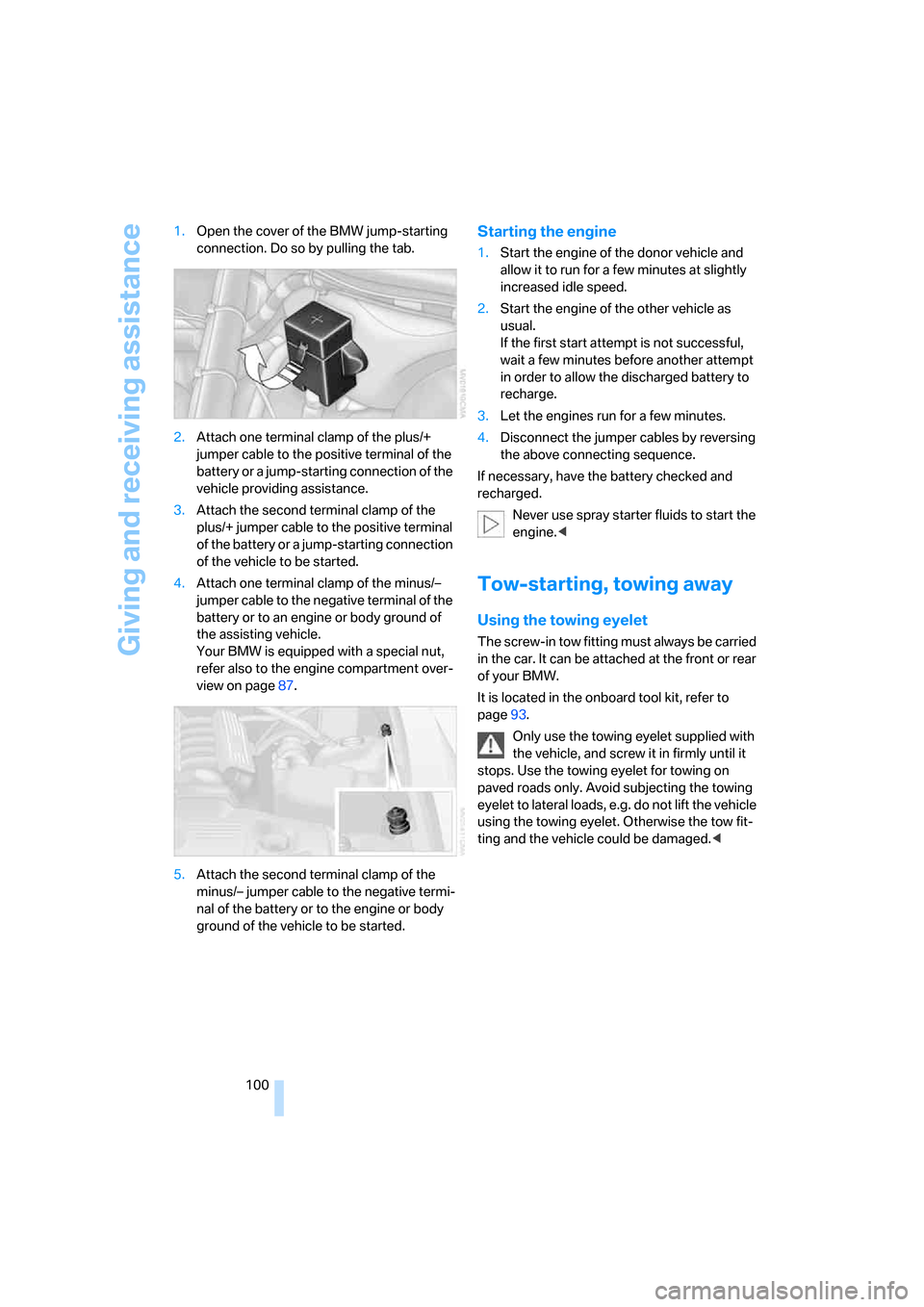
100 1.Open the cover of the BMW jump-starting
connection. Do so by pulling the tab.
2.Attach one terminal clamp of the plus/+
jumper cable to the positive terminal of the
battery or a jump-starting connection of the
vehicle providing assistance.
3.Attach the second terminal clamp of the
plus/+ jumper cable to the positive terminal
of the battery or a jump-starting connection
of the vehicle to be started.
4.Attach one terminal clamp of the minus/–
jumper cable to the negative terminal of the
battery or to an engine or body ground of
the assisting vehicle.
Your BMW is equipped with a special nut,
refer also to the engine compartment over-
view on page87.
5.Attach the second terminal clamp of the
minus/– jumper cable to the negative termi-
nal of the battery or to the engine or body
ground of the vehicle to be started.
Starting the engine
1.Start the engine of the donor vehicle and
allow it to run for a few minutes at slightly
increased idle speed.
2.Start the engine of the other vehicle as
usual.
If the first start attempt is not successful,
wait a few minutes before another attempt
in order to allow the discharged battery to
recharge.
3.Let the engines run for a few minutes.
4.Disconnect the jumper cables by reversing
the above connecting sequence.
If necessary, have the battery checked and
recharged.
Never use spray starter fluids to start the
engine.<
Tow-starting, towing away
Using the towing eyelet
The screw-in tow fitting must always be carried
in the car. It can be attached at the front or rear
of your BMW.
It is located in the onboard tool kit, refer to
page93.
Only use the towing eyelet supplied with
the vehicle, and screw it in firmly until it
stops. Use the towing eyelet for towing on
paved roads only. Avoid subjecting the towing
eyelet to lateral loads, e.g. do not lift the vehicle
using the towing eyelet. Otherwise the tow fit-
ting and the vehicle could be damaged.<
Page 103 of 128
Reference
At a glance
Controls
Driving tips
Mobility
101
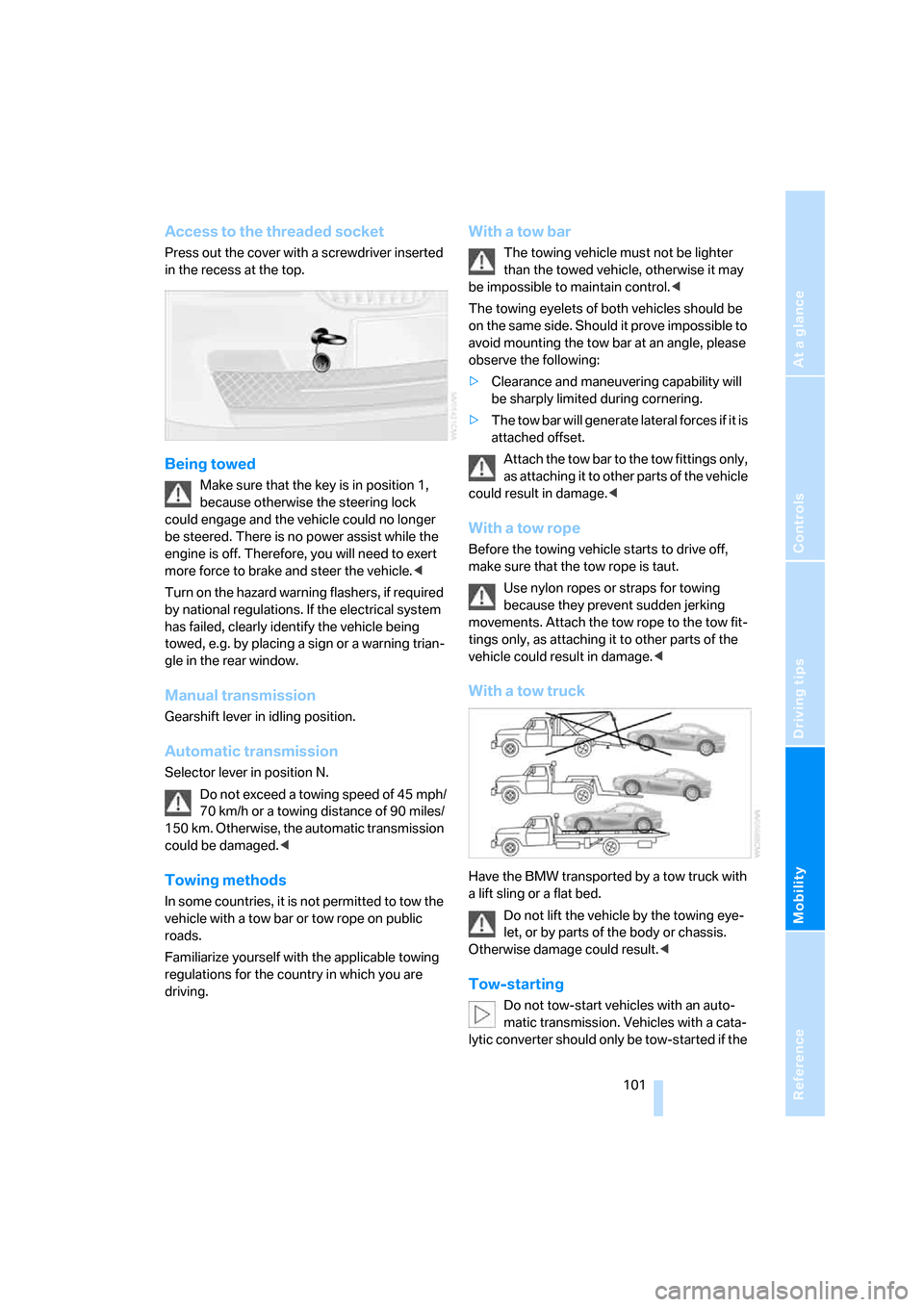
Access to the threaded socket
Press out the cover with a screwdriver inserted
in the recess at the top.
Being towed
Make sure that the key is in position 1,
because otherwise the steering lock
could engage and the vehicle could no longer
be steered. There is no power assist while the
engine is off. Therefore, you will need to exert
more force to brake and steer the vehicle.<
Turn on the hazard warning flashers, if required
by national regulations. If the electrical system
has failed, clearly identify the vehicle being
towed, e.g. by placing a sign or a warning trian-
gle in the rear window.
Manual transmission
Gearshift lever in idling position.
Automatic transmission
Selector lever in position N.
Do not exceed a towing speed of 45 mph/
70 km/h or a towing distance of 90 miles/
150 km. Otherwise, the automatic transmission
could be damaged.<
Towing methods
In some countries, it is not permitted to tow the
vehicle with a tow bar or tow rope on public
roads.
Familiarize yourself with the applicable towing
regulations for the country in which you are
driving.
With a tow bar
The towing vehicle must not be lighter
than the towed vehicle, otherwise it may
be impossible to maintain control.<
The towing eyelets of both vehicles should be
on the same side. Should it prove impossible to
avoid mounting the tow bar at an angle, please
observe the following:
>Clearance and maneuvering capability will
be sharply limited during cornering.
>The tow bar will generate lateral forces if it is
attached offset.
Attach the tow bar to the tow fittings only,
as attaching it to other parts of the vehicle
could result in damage.<
With a tow rope
Before the towing vehicle starts to drive off,
make sure that the tow rope is taut.
Use nylon ropes or straps for towing
because they prevent sudden jerking
movements. Attach the tow rope to the tow fit-
tings only, as attaching it to other parts of the
vehicle could result in damage.<
With a tow truck
Have the BMW transported by a tow truck with
a lift sling or a flat bed.
Do not lift the vehicle by the towing eye-
let, or by parts of the body or chassis.
Otherwise damage could result.<
Tow-starting
Do not tow-start vehicles with an auto-
matic transmission. Vehicles with a cata-
lytic converter should only be tow-started if the
Page 104 of 128
Giving and receiving assistance
102 engine is cold. It is recommended to start the
engine using jumper cables, refer to page99.<
1.Switch on hazard warning flashers, comply
with local regulations.
2.Turn the key to position 2.
3.Shift into 3rd gear.
4.Have the vehicle tow-started with the clutch
depressed and slowly release the clutch.
After the engine starts, immediately
depress the clutch again.
5.Stop at a suitable location, remove the tow
bar or rope and switch off the hazard warn-
ing flashers.
6.Have the vehicle checked.
Page 114 of 128
Everything from A to Z
112
Everything from A to Z
Index
A
ABS Antilock Brake
System49
– indicator lamp12
Accident, refer to Emergency
call98
Acknowledgment signal for
locking/unlocking vehicle19
Activated-charcoal filter for
automatic climate control63
Additives
– coolant89
– engine oil89
Adjusting
– seats30
Adjusting the thigh support32
Airbags52
– deactivating36
– indicator/warning lamp13
– passenger airbags indicator
lamp36
– reactivation36
– safe seating position30
Airbag switch, refer to Key
switch for passenger
airbags35
Air conditioning58
Air-conditioning operation,
refer to Cooling
function59,62
Air distribution
– air conditioning59
– automatic climate control62
– individual59,62
Air flow rate
– air conditioning59
– automatic climate control62
Airing out, refer to
Ventilation59,63
Air outlets, refer to
Ventilation59,63Air pressure, refer to Tire
inflation pressure80
Air recirculation, refer to
Recirculated-air
mode59,63
AKI, refer to Fuel
specifications79
Alarm system23
– avoiding unintentional
alarms24
– interior motion sensor24
– switching off an alarm24
– tilt alarm sensor24
All-season tires, refer to
Winter tires83,85
Ambient air, refer to
Recirculated-air
mode59,63
Ambient temperature
display46
Antenna, refer to the Caring
for your vehicle brochure
Antifreeze44,89
– coolant89
– washer fluids44
Antilock Brake System
ABS49
– indicator/warning lamp12
– indicator lamp13
Anti-theft alarm system, refer
to Alarm system23
Anti-theft protection19,23
Approved engine oils89
Artificial leather, refer to the
Caring for your vehicle
brochure
Ashtray65
Assistance systems, refer to
Driving stability control
systems49
AUC Automatic recirculated-
air control63Automatic
– air distribution62
– air flow rate62
– cruise control44
– headlamp control55
– luggage compartment lid
operation22
– recirculated-air control
AUC63
– tailgate operation21
Automatic car wash, refer to
the Caring for your vehicle
brochure
Automatic climate control61
Automatic convertible top27
Automatic lamps55
Automatic transmission with
Steptronic40
– indicator lamp13
– interlock38,40
– selector lever41
– selector lever lock40
– shiftlock40
– shift paddles on steering
wheel41
– towing the vehicle101
– tow-starting101
AUTO program for automatic
climate control62
Average fuel consumption48
– setting unit of measure48
Average speed48
– setting unit of measure48
Avoiding unintentional
alarms24
Axle loads, refer to
Weights109
B
Backrests, refer to Seat
adjustment31
Page 115 of 128
Reference
At a glance
Controls
Driving tips
Mobility
113
Backup lamps
– bulb replacement96
Bandages, refer to First-aid
kit99
Bar, refer to Towing
methods101
Battery97
– charging97
– disposal97
– indicator/warning
lamp12,97
– jump-starting99
– power supply interruption97
– remote control18
Being towed101
Belts, refer to Safety belts33
Belt tensioner, refer to Safety
belts33
Beverage holders65
Blower, refer to Air flow
rate59,62
BMW Homepage4
BMW Maintenance
System91
Bottle holders, refer to
Beverage holders65
Brake assist, refer to Dynamic
Brake Control DBC49
Brake fluid90
– indicator/warning lamp13
– level90
– warning lamp90
Brake Force Display52
Brake hydraulics, refer to
Brake system90
Brake hydraulic system
– indicator/warning lamp13
Brake lamps
– brake force display52
– bulb replacement96
– indicator lamp, defective
lamp13
Brake pads90
– break-in procedures70
– warning lamp90
Brake pad wear indicator
– brake pads90
– indicator/warning lamp13Brake rotors72
– brake system72
– break-in procedures70
Brakes
– ABS49
– brake fluid90
– brake pads90
– braking safely71
– break-in procedures
70
– indicator/warning
lamps13,50
– parking brake39
Brake system90
– brake fluid90
– brake pads90
– break-in procedures70
– disc brakes72
– indicator/warning lamp13
Brake wear warning90
Breakdown
– Flat Tire Monitor51
Breaking in the clutch70
Breaking in the differential,
refer to Engine and
differential70
Break-in procedures70
Bridging, refer to Jump-
starting99
Bulb changing, refer to Lamps
and bulbs93
Bulb replacement, refer to
Lamps and bulbs93
Burned fuel, refer to
Fuel specifications79
Buttons on the steering
wheel11
C
California laws
– Event Data Recorders92
– Proposition 65 warning5
Can holders, refer to Beverage
holders65
Capacity
– cargo bay, refer to
Weights109
Car battery, refer to Vehicle
battery97Car care, refer to the Caring
for your vehicle brochure
Care, refer to the Caring for
your vehicle brochure
Care products, refer to the
Caring for your vehicle
brochure
Cargo bay23
– capacity109
– floor panel93
– increasing capacity23
– opening and closing21,22
– opening from inside the
vehicle21,22
– opening from the outside21
– roller-blind cover65
Cargo loading
– stowing cargo73
– vehicle72
Car jack
– jacking points97
Car keys, refer to The key
set18
Carpet care, refer to the
Caring for your vehicle
brochure
Car phone, refer to the
separate Owner's Manual
Car radio, refer to the separate
Owner's Manual
Car wash, refer to the Caring
for your vehicle brochure
Catalytic converter, refer to
Hot exhaust system70
CD changer, refer to Owner's
Manual for Radio/Onboard
Computer
CD operation, refer to Owner's
Manual for Radio/Onboard
Computer
Center console, refer to
Around the center
console14
Center high-mount brake
lamp, bulb replacement96
Central locking
– from inside21
Central locking system19