wheel BMW Z4 COUPE 3.0SI 2007 Owner's Manual
[x] Cancel search | Manufacturer: BMW, Model Year: 2007, Model line: Z4 COUPE 3.0SI, Model: BMW Z4 COUPE 3.0SI 2007Pages: 132, PDF Size: 3.14 MB
Page 83 of 132

Mobility
This section helps you maintain your car's
mobility by supplying important information
on vital topics including fuels and lubricants,
wheels and tires, service, maintenance and
breakdown assistance.
Mobility
Page 86 of 132
Wheels and tires
84
Wheels and tires
Tire inflation pressure
Information for your safety
It is not merely the tire's service life, but also
driving safety and driving comfort that largely
depend on the condition of the tires and the
maintenance of the specified tire pressure.
Check tire inflation pressures regularly
and correct them if necessary: at least
every two weeks and before every extended
journey. If you fail to observe this precaution
you may be driving on tires with incorrect tire
pressures, a condition that can not only com-
promise your vehicle's driving stability, but also
lead to tire damage and the risk of an accident.
Do not drive with deflated, i.e. flat tires, except
when using Run-Flat Tires. A flat tire will seri-
ously impair your vehicle's handling and braking
response. Attempts to drive on a flat tire can
lead to loss of control over the vehicle.<
Checking pressure
Check the tire inflation pressures only when the
tires are cold. This means after a maximum of
1.25 miles/2 km driving or when the vehicle has
been parked for at least 2 hours. Warm tires
have higher inflation pressures.
Inflation pressure specifications
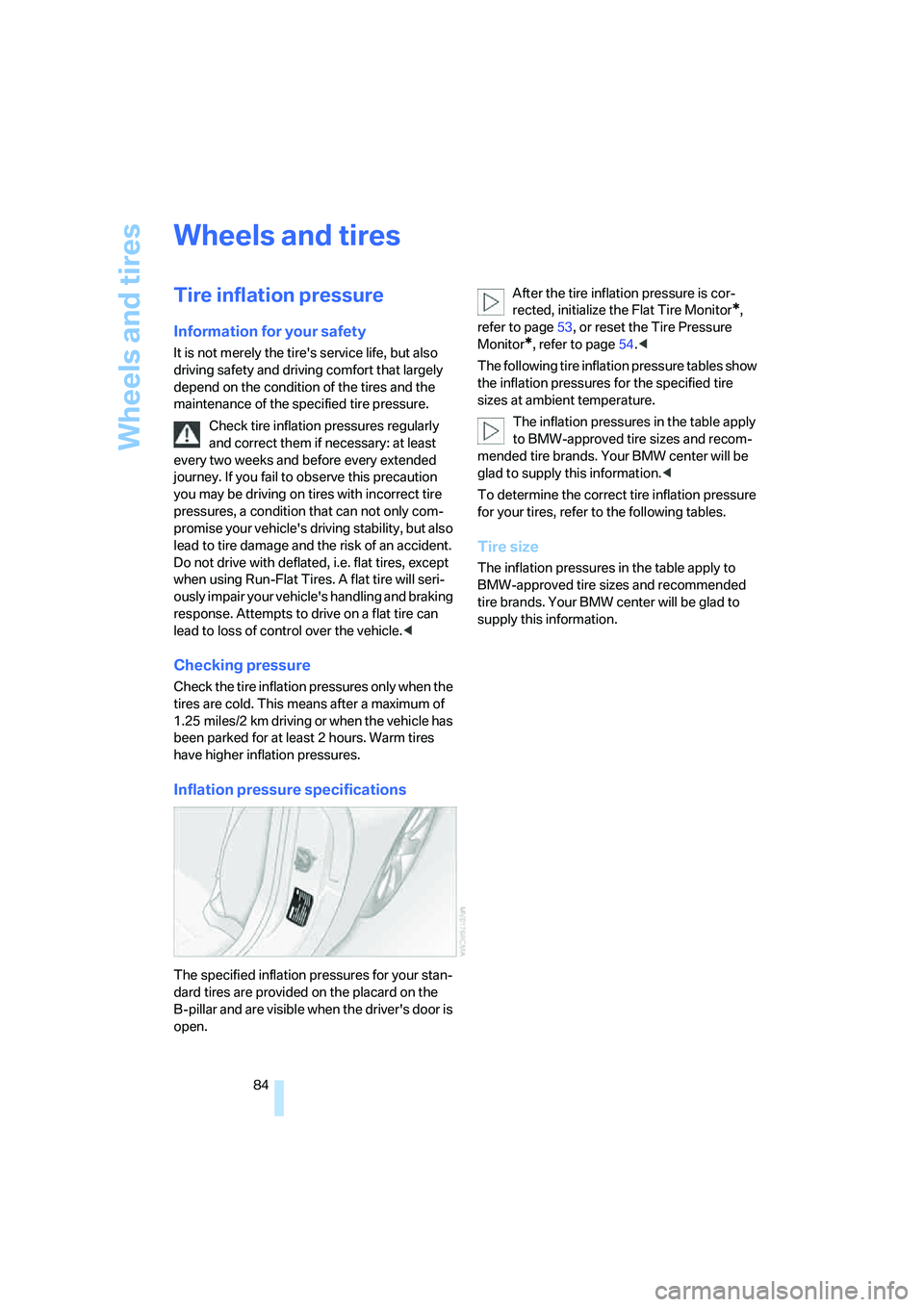
The specified inflation pressures for your stan-
dard tires are provided on the placard on the
B-pillar and are visible when the driver's door is
open.After the tire inflation pressure is cor-
rected, initialize the Flat Tire Monitor
*,
refer to page53, or reset the Tire Pressure
Monitor
*, refer to page54.<
The following tire inflation pressure tables show
the inflation pressures for the specified tire
sizes at ambient temperature.
The inflation pressures in the table apply
to BMW-approved tire sizes and recom-
mended tire brands. Your BMW center will be
glad to supply this information.<
To determine the correct tire inflation pressure
for your tires, refer to the following tables.
Tire size
The inflation pressures in the table apply to
BMW-approved tire sizes and recommended
tire brands. Your BMW center will be glad to
supply this information.
Page 88 of 132

Wheels and tires
86
Z4 Coupe 3.0si
Tire coding
Understanding the lettering on the tire sidewall
makes it easier to identify and choose the cor-
rect tires.
Tire size
Speed code letter
Q = up to 100mph or 160km/h
T = up to 118mph or 190km/h
H = up to 131mph or 210km/h
V = up to 150mph or 240km/h
W = up to 167mph or 270km/h
Y = up to 186mph or 300km/h
Tire Identification Number
Tires with DOT codes meet the guidelines of
the U.S. Department of Transportation.DOT code:
Tire age
The date on which the tire was manufactured is
indicated by the code on the sidewall:
DOT … 5005 indicates that the tire was manu-
factured in week 50 of the year 2005.
BMW recommends the replacement of all tires
every 6 years at the latest, even if a tire usage of
10 years is possible.
Uniform Tire Quality Grading
Quality grades can be found where applicable
on the tire sidewall between tread shoulder and
maximum section width. For example:
Treadwear 200 Traction AA
Temperature A
DOT Quality Grades
Tread wear
Traction AA A B C
Temperature A B C
Tire sizePressure specifications in psi/kPa
All pressure specifications in the table are
indicated in psi/kilopascal with cold tires,
cold = ambient temperature
225/45 R 17 91 W
225/45 R 17 91 H/V M+S33/230 39/270
Front: 225/45 R 17 91W
Rear: 255/40 R 17 94 W33/230
––
39/270
Front: 225/40 R 18 88 W
Rear: 255/35 R 18 90 W33/230
––
39/270
You will find more information about permissible loads and weights on page113.
e.g.
Nominal width in mm
Aspect ratio in Ξ
Radial belt construction
Rim diameter in inches
Load rating,
not on ZR tires
Speed code letter, in
front of the R on ZR tires225/50 R1692 V
e.g.
Manufacturer's code
for tire make
Tire size and
tire design
Tire ageDOT xxxx xxx 5005
Page 89 of 132
Reference
At a glance
Controls
Driving tips
Mobility
87
All passenger car tires must conform to
Federal Safety Requirements in addition
to these grades.<
Tread wear
The tread wear grade is a comparative rating
based on the wear rate of the tire when tested
under controlled conditions on a specified gov-
ernment test course.
For example, a tire graded 150 would wear one
and one-half, 1 γ, times as well on the govern-
ment course as a tire graded 100. The relative
performance of tires depends upon the actual
conditions of their use, however, and may
depart significantly from the norm due to varia-
tions in driving habits, service practices and dif-
ferences in road characteristics and climate.
Traction
The traction grades, from highest to lowest, are
AA, A, B and C.
Those grades represent the tire's ability to stop
on wet pavement as measured under controlled
conditions on specified government test sur-
faces of asphalt and concrete. A tire marked C
may have poor traction performance.
The traction grade assigned to this tire is
based on straight-ahead braking traction
tests, and does not include acceleration, cor-
nering, hydroplaning, or peak traction charac-
teristics.<
Temperature
The temperature grades are A, the highest, B
and C, representing the tire’s resistance to the
generation of heat and its ability to dissipate
heat when tested under controlled conditions
on a specified indoor laboratory test wheel.
Sustained high temperature can cause the
material of the tire to degenerate and reduce
tire life, and excessive temperature can lead to
sudden tire failure. The grade C corresponds to
a level of performance which all passenger car
tires must meet under the Federal Motor Vehi-
cle Safety Standard No. 109. Grades B and A
represent higher levels of performance on the
laboratory test wheel than the minimum
required by law.The temperature grade for this tire is
established for a tire that is properly
inflated and not overloaded. Excessive speed,
underinflation, or excessive loading, either sep-
arately or in combination, can cause heat
buildup and possible tire failure.<
RSC: Run-Flat Tires
Run-Flat tires are labeled on the sidewall with a
circular symbol containing the letters RSC.
Refer to page88.
M+S
Winter and all-season tires.
These have better winter performance proper-
ties than summer tires.
Tire condition
Inspect your tires frequently for tread wear,
signs of damage and for foreign objects lodged
in the tread. Check the tread depth.
Minimum tread depth
The tread depth should not drop below 1/8 in/
3 mm, although, for example, European legisla-
tion only specifies a minimum tread depth of
1/16 in/1.6 mm. At tread depths below 1/8 in/
3 mm there is an increased risk of high-speed
hydroplaning, even when only small amounts of
water are present on the road surface.
When winter tires wear down past a tread depth
of 1/6 in/4 mm, they become perceptibly less
suitable for winter conditions. In the interest of
safety, new tires should be installed.
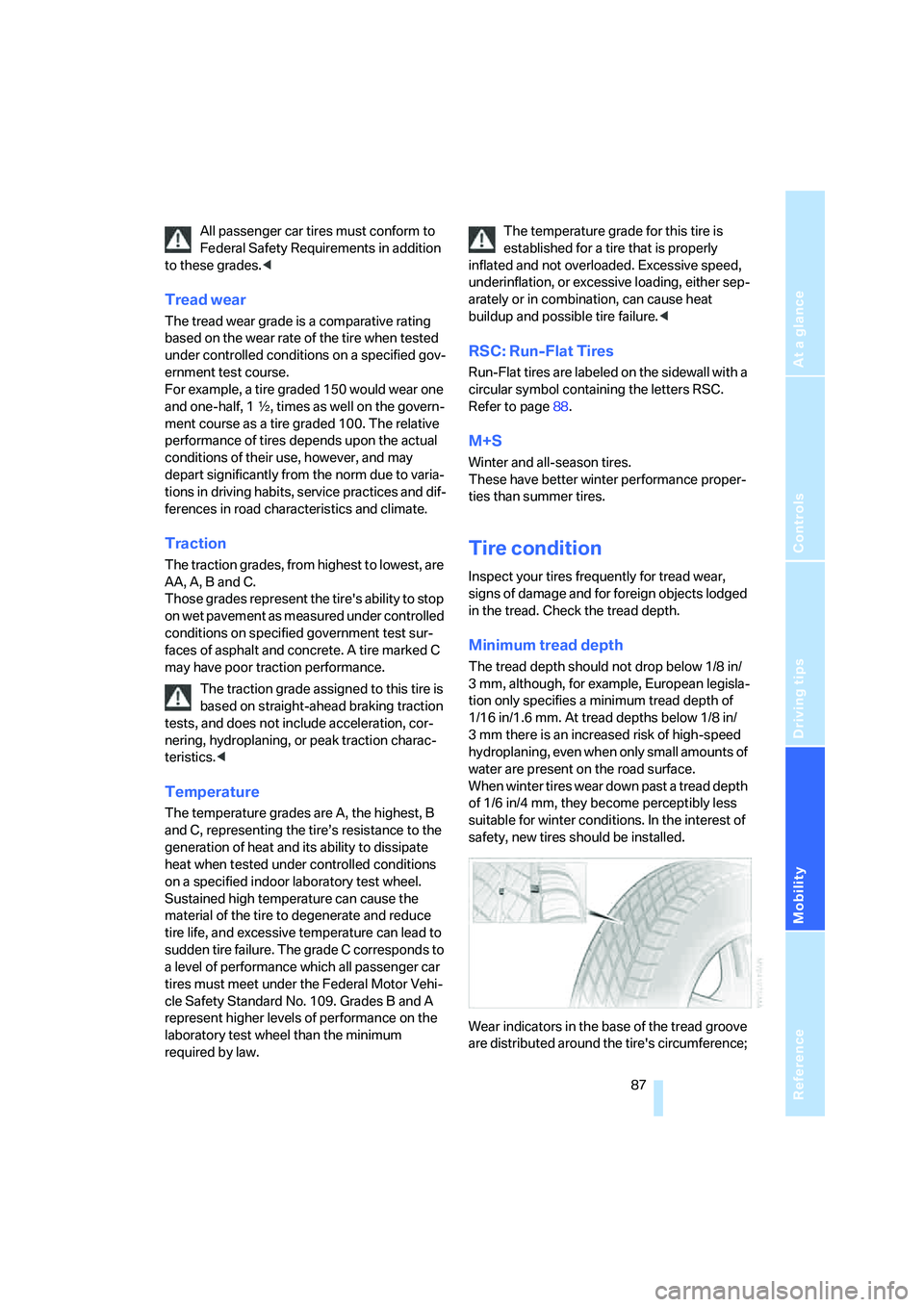
Wear indicators in the base of the tread groove
are distributed around the tire's circumference;
Page 90 of 132
Wheels and tires
88 the letters TWI, for Tread Wear Indicator, on the
tire's sidewalls identify tires that incorporate
these wear indicators. Once the tire tread has
worn down to the wear indicators, the tire has
worn to a depth of 1/16 in/1.6 mm.
Wheel/tire damage
Due to low-profile tires, please note that
wheels, tires and suspension parts are
more susceptible to road hazards and conse-
quential damages.<
Unusual vibrations encountered during normal
vehicle operation can indicate tire failure or
some other vehicle malfunction. This can, for
example, be caused by driving over curbs. The
same applies to any other abnormal road
behavior, such as pulling severely to the right or
left.
In these cases, reduce speed immedi-
ately and have wheels and tires thor-
oughly checked. To do so, drive carefully to the
nearest BMW center or tire shop that works
according to BMW repair procedures with cor-
respondingly trained personnel. If necessary,
have the vehicle towed there.
Tire damage can be extremely dangerous for
vehicle occupants and other road users.<
Tire age
For various reasons, such as the development
of brittleness, BMW recommends tire replace-
ment after no more than 6 years, regardless of
the actual wear of the tires.
The date on which the tire was manufactured is
indicated by the code on the sidewall:
DOT … 5005 indicates that the tire was manu-
factured in week 50 of the year 2005.
Run-Flat Tires
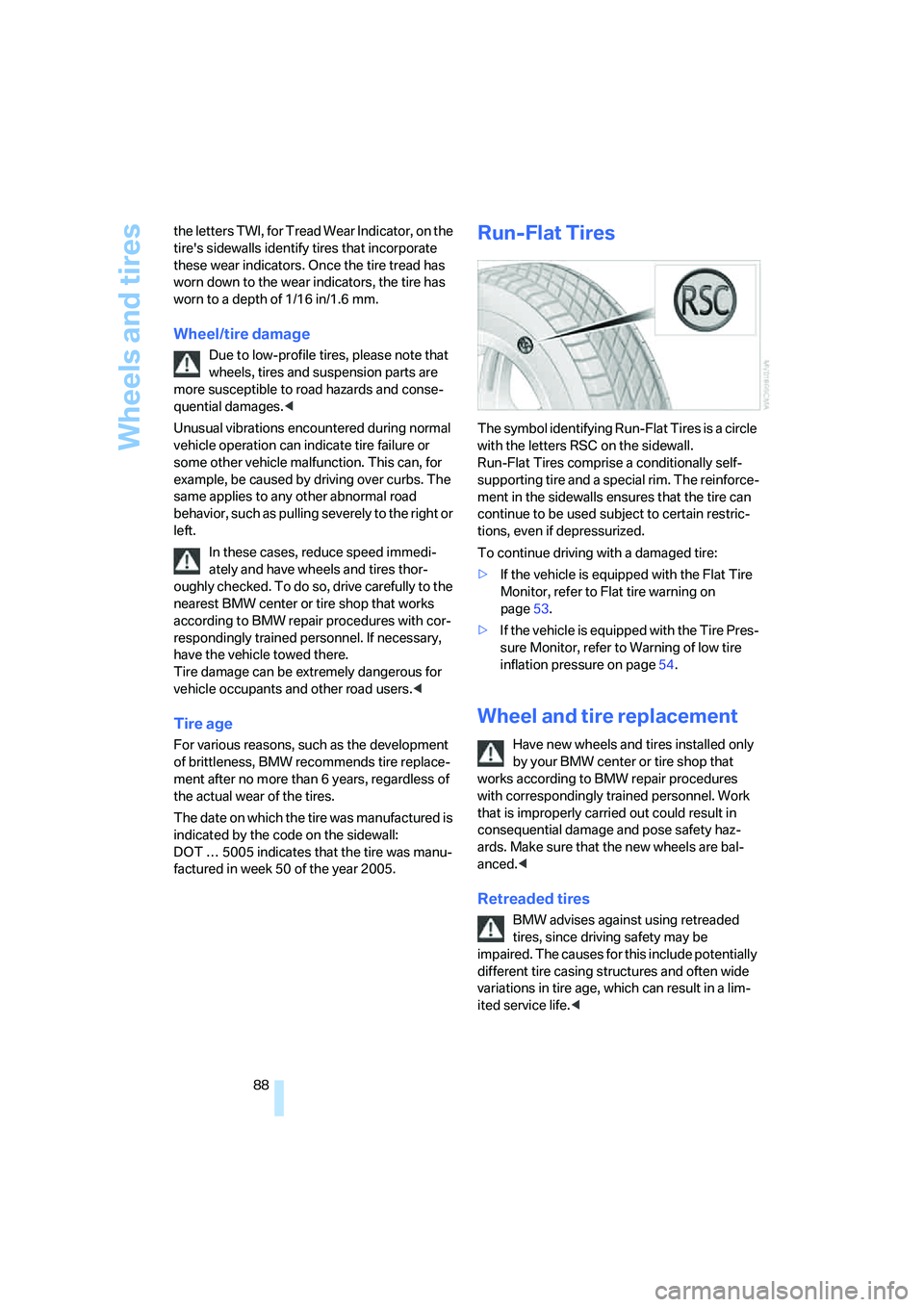
The symbol identifying Run-Flat Tires is a circle
with the letters RSC on the sidewall.
Run-Flat Tires comprise a conditionally self-
supporting tire and a special rim. The reinforce-
ment in the sidewalls ensures that the tire can
continue to be used subject to certain restric-
tions, even if depressurized.
To continue driving with a damaged tire:
>If the vehicle is equipped with the Flat Tire
Monitor, refer to Flat tire warning on
page53.
>If the vehicle is equipped with the Tire Pres-
sure Monitor, refer to Warning of low tire
inflation pressure on page54.
Wheel and tire replacement
Have new wheels and tires installed only
by your BMW center or tire shop that
works according to BMW repair procedures
with correspondingly trained personnel. Work
that is improperly carried out could result in
consequential damage and pose safety haz-
ards. Make sure that the new wheels are bal-
anced.<
Retreaded tires
BMW advises against using retreaded
tires, since driving safety may be
impaired. The causes for this include potentially
different tire casing structures and often wide
variations in tire age, which can result in a lim-
ited service life.<
Page 91 of 132
Reference
At a glance
Controls
Driving tips
Mobility
89
Correct wheels and tires
BMW recommends using only wheels
and tires that have been approved by
BMW for your particular vehicle model, other-
wise body contact and serious accidents can
result despite the use of the same nominal size,
e.g. due to manufacturing tolerances. If non-
approved wheels and tires are used, BMW can-
not evaluate their suitability, and therefore can-
not be held liable for driving safety.<
You can inquire about the correct wheel/tire
combination at your BMW center.
The correct combination of wheels and tires is
also necessary to ensure reliable operation of
various vehicle systems such as ABS and DSC.
To maintain good handling and vehicle
response, only use tires of a single brand and
tread configuration. After a tire has been dam-
aged, for instance, mount the original wheel and
tire combination again as soon as possible.
Wheels with electronics for the Tire
Pressure Monitor TPM
When mounting new tires or changing from
summer to winter tires or vice versa, only use
wheels with TPMS electronics; otherwise the
Tire Pressure Monitor would not be able to
detect a flat tire, refer to page54. Your BMW
center will be glad to provide you with more
information.
Recommended tire brands
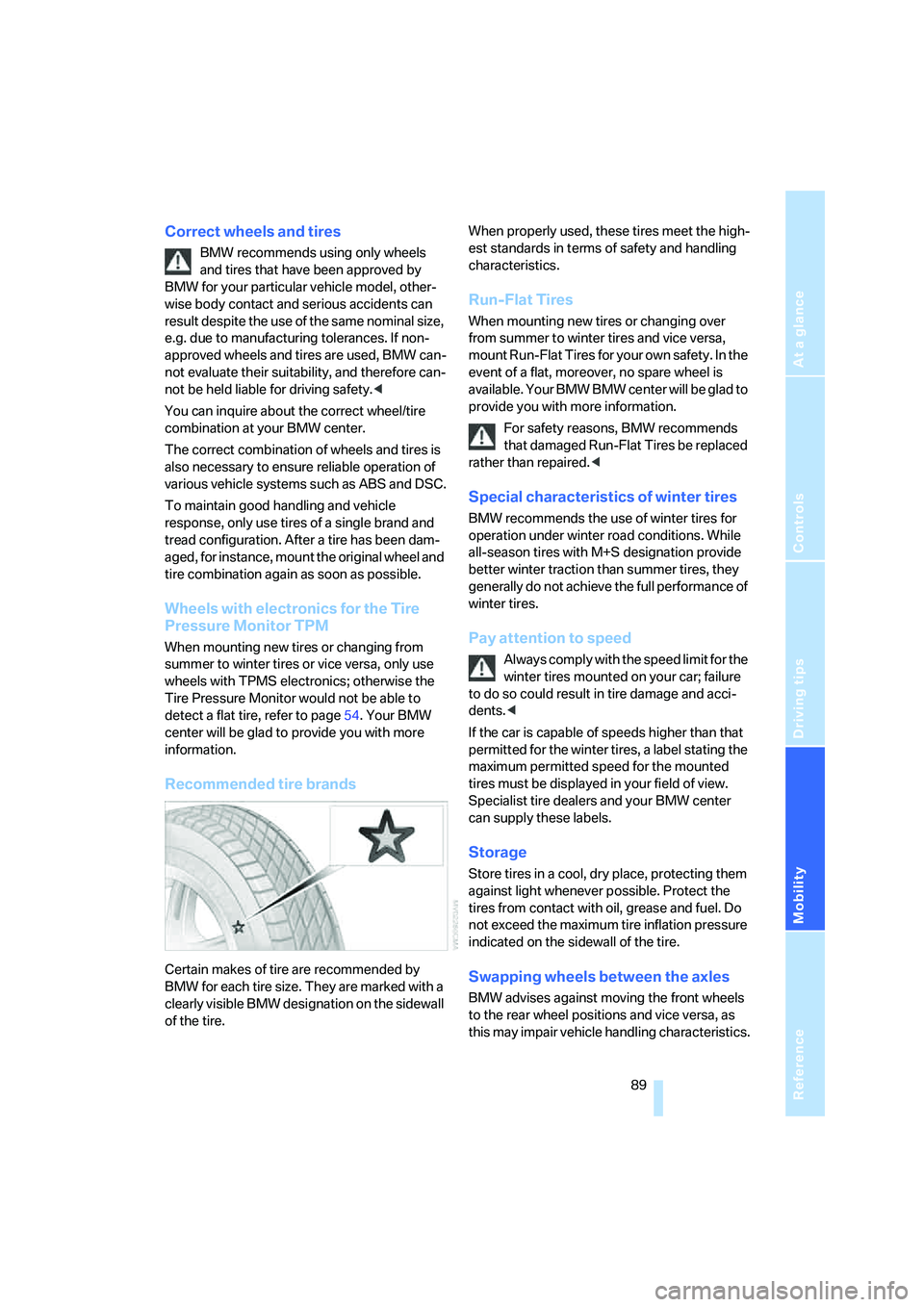
Certain makes of tire are recommended by
BMW for each tire size. They are marked with a
clearly visible BMW designation on the sidewall
of the tire.When properly used, these tires meet the high-
est standards in terms of safety and handling
characteristics.
Run-Flat Tires
When mounting new tires or changing over
from summer to winter tires and vice versa,
mount Run-Flat Tires for your own safety. In the
event of a flat, moreover, no spare wheel is
available. Your BMW BMW center will be glad to
provide you with more information.
For safety reasons, BMW recommends
that damaged Run-Flat Tires be replaced
rather than repaired.<
Special characteristics of winter tires
BMW recommends the use of winter tires for
operation under winter road conditions. While
all-season tires with M+S designation provide
better winter traction than summer tires, they
generally do not achieve the full performance of
winter tires.
Pay attention to speed
Always comply with the speed limit for the
winter tires mounted on your car; failure
to do so could result in tire damage and acci-
dents.<
If the car is capable of speeds higher than that
permitted for the winter tires, a label stating the
maximum permitted speed for the mounted
tires must be displayed in your field of view.
Specialist tire dealers and your BMW center
can supply these labels.
Storage
Store tires in a cool, dry place, protecting them
against light whenever possible. Protect the
tires from contact with oil, grease and fuel. Do
not exceed the maximum tire inflation pressure
indicated on the sidewall of the tire.
Swapping wheels between the axles
BMW advises against moving the front wheels
to the rear wheel positions and vice versa, as
this may impair vehicle handling characteristics.
Page 92 of 132

Wheels and tires
90
Snow chains*
Only certain fine-link snow chains have been
tested by BMW, classified as safe for use and
recommended. Consult your BMW center for
more information. Attach snow chains in pairs
and only to the rear wheels.
Observe the manufacturer's instructions when
mounting snow chains. Do not exceed a speed
of 30 mph/50 km/h when using snow chains.
You are not permitted to mount snow chains to
tires of the following sizes:
>255/40 R 17
>255/35 R 18
Do not initialize the Flat Tire Monitor if
snow chains are mounted
*, as this may
cause the instrument to issue an incorrect read-
ing.
When driving with snow chains, you may find it
helpful to activate DTC temporarily, refer to
page52.<
Page 101 of 132

Reference
At a glance
Controls
Driving tips
Mobility
99
Xenon lamps*
These bulbs have a very long service life and are
unlikely to fail. If one of these bulbs should nev-
ertheless fail, it is possible to continue driving
with great caution using the fog lamps, provided
traffic laws in your area do not prohibit this.
Have work on the xenon lighting system
performed only by your BMW center or a
workshop that works according to BMW repair
procedures with correspondingly trained per-
sonnel. Due to the high electrical voltages
present, there is a risk of potentially fatal acci-
dents if work is performed inappropriate.<
Parking lamps, roadside parking lamps
In the event of a malfunction, please contact
your BMW center or a workshop that works
according to BMW repair procedures with cor-
respondingly trained personnel.
Halogen lamps
For checking and adjusting headlamp
aim, please contact your BMW center.<
Access through the wheel well
1.Turn the wheel outwards.2.Open the flap in the wheel well. To do so,
turn the fastener counterclockwise using a
coin, for example.
3.Open up the flap in the wheel well.
Headlamp cover
1.Pull the wire clamp past the catches, see
arrows, and fold it down.
2.Flip the headlamp cover open and remove.
Reinstall the headlamp cover carefully. If
it is not on tight, the headlamp installation
could be damaged.<
Reinstall the headlamp cover in reverse order.
Low beams and high beams
1Low beams
2High beams
Page 103 of 132

Reference
At a glance
Controls
Driving tips
Mobility
101
Rear lamps
1Turn signal indicators, 21 watts, PY21W
Silver Vision
2Brake lamp, 21 watts, P21W
3Backup lamp, 16 watts, W16W
4Tail lamp, LED
5Brake lamp, 21 watts, H21W
In the event of a malfunction in lamp 4 or 5,
please contact your BMW center or a workshop
that works according to BMW repair proce-
dures with correspondingly trained personnel.
Changing bulbs
1.Remove the cover in the cargo bay by turn-
ing the lock, see arrow.
2.Apply gentle pressure to the bulb socket
while turning it to the left and remove it.
3.Remove and replace the bulb.
4.Insert bulb socket.
5.Reattach the cover.
Side marker lamps, rear
To change the bulbs, please contact your BMW
center or a workshop that works according to
BMW repair procedures with correspondingly
trained personnel.
Center high-mount brake lamp
This lamp uses LED technology for operation.
In the event of a malfunction, please contact
your BMW center or a workshop that works
according to BMW repair procedures with cor-
respondingly trained personnel.
License plate lamps
5-watt bulb, W5W
1.Push out the lamp with a screwdriver and
remove it.
2.Change the bulb and reinsert the lamp.
Changing a wheel
Run-Flat Tires
Your BMW is equipped with Run-Flat Tires as
standard. Therefore, no wheel has to be
changed immediately in the event of a loss in
inflation pressure.
Run-Flat Tires are labeled on the tire sidewall
with a circular symbol containing the letters
RSC. Also observe the information on page88.
When mounting new tires or changing over
from summer to winter tires and vice versa,
mount Run-Flat Tires for your own safety. In the
event of a flat, moreover, no spare wheel is
available. Your BMW center will be glad to
advise you. Refer also to Wheel and tire
replacement, page88.
The tools for changing wheels are avail-
able as optional accessories from your
BMW center.<
Page 118 of 132

Everything from A to Z
116
Everything from A to Z
Index
A
ABS Antilock Brake
System51
– indicator lamp12
Accident, refer to Emergency
call103
Acknowledgment signal for
locking/unlocking vehicle19
Activated-charcoal filter for
automatic climate control67
Additives
– coolant94
– engine oil94
Adjusting
– seats30
Adjusting the thigh support32
Airbags56
– deactivating37
– indicator/warning lamp13
– passenger airbags indicator
lamp37
– reactivation37
– safe seating position30
Airbag switch, refer to Key
switch for passenger
airbags36
Air conditioning62
Air-conditioning operation,
refer to Cooling
function63,66
Air distribution
– air conditioning63
– automatic66
– automatic climate control66
– individual63,66
– manual66
Air flow rate
– air conditioning63
– automatic climate control66
Airing out, refer to
Ventilation63,67Air outlets, refer to
Ventilation63,67
Air pressure, refer to Tire
inflation pressure84
Air recirculation, refer to
Recirculated-air
mode63,67
AKI, refer to Fuel
specifications83
Alarm system23
– avoiding unintentional
alarms24
– interior motion sensor24
– switching off an alarm24
– tilt alarm sensor24
All-season tires, refer to
Winter tires87,89
Ambient air, refer to
Recirculated-air
mode63,67
Ambient temperature
display48
Antenna, refer to the Caring
for your vehicle brochure
Antifreeze46,94
– coolant94
– washer fluids46
Antilock Brake System
ABS51
– indicator/warning lamp12
– indicator lamp13
Anti-theft alarm system, refer
to Alarm system23
Anti-theft protection19,23
Approved engine oils94
Artificial leather, refer to the
Caring for your vehicle
brochure
Ashtray69
Assistance systems, refer to
Driving stability control
systems51AUC Automatic recirculated-
air control67
Audio device, external68
Automatic
– air distribution66
– air flow rate66
– cruise control46
– headlamp control59
– luggage compartment lid
operation22
– recirculated-air control
AUC67
– tailgate operation21
Automatic car wash, refer to
the Caring for your vehicle
brochure
Automatic climate control65
Automatic convertible top27
Automatic lamps59
Automatic transmission with
Steptronic42
– indicator lamp13
– interlock40,42
– selector lever43
– selector lever lock42
– shiftlock42
– shift paddles on steering
wheel43
– towing the vehicle106
– tow-starting106
AUTO program for automatic
climate control66
AUX-In jack68
Average fuel consumption50
– setting unit of measure50
Average speed50
– setting unit of measure50
Avoiding unintentional
alarms24
Axle loads, refer to
Weights113