Rein BMW Z4 ROADSTER 2006 E85 Owner's Manual
[x] Cancel search | Manufacturer: BMW, Model Year: 2006, Model line: Z4 ROADSTER, Model: BMW Z4 ROADSTER 2006 E85Pages: 128, PDF Size: 4.41 MB
Page 27 of 128
Reference
At a glance
Controls
Driving tips
Mobility
25
Switching off tilt alarm sensor and
interior motion sensor
>Press the button on the remote
control twice in a row.
The indicator lamp lights up briefly and then
flashes continuously. The tilt alarm sensor and
the interior motion sensor are deactivated until
the vehicle is again unlocked and locked.
Windows
To prevent injuries, exercise care when
closing the windows and keep them in
your field of vision until they are shut.
Take the key with you when you leave the car,
otherwise children could operate the windows
and possibly injure themselves.<
Opening, closing
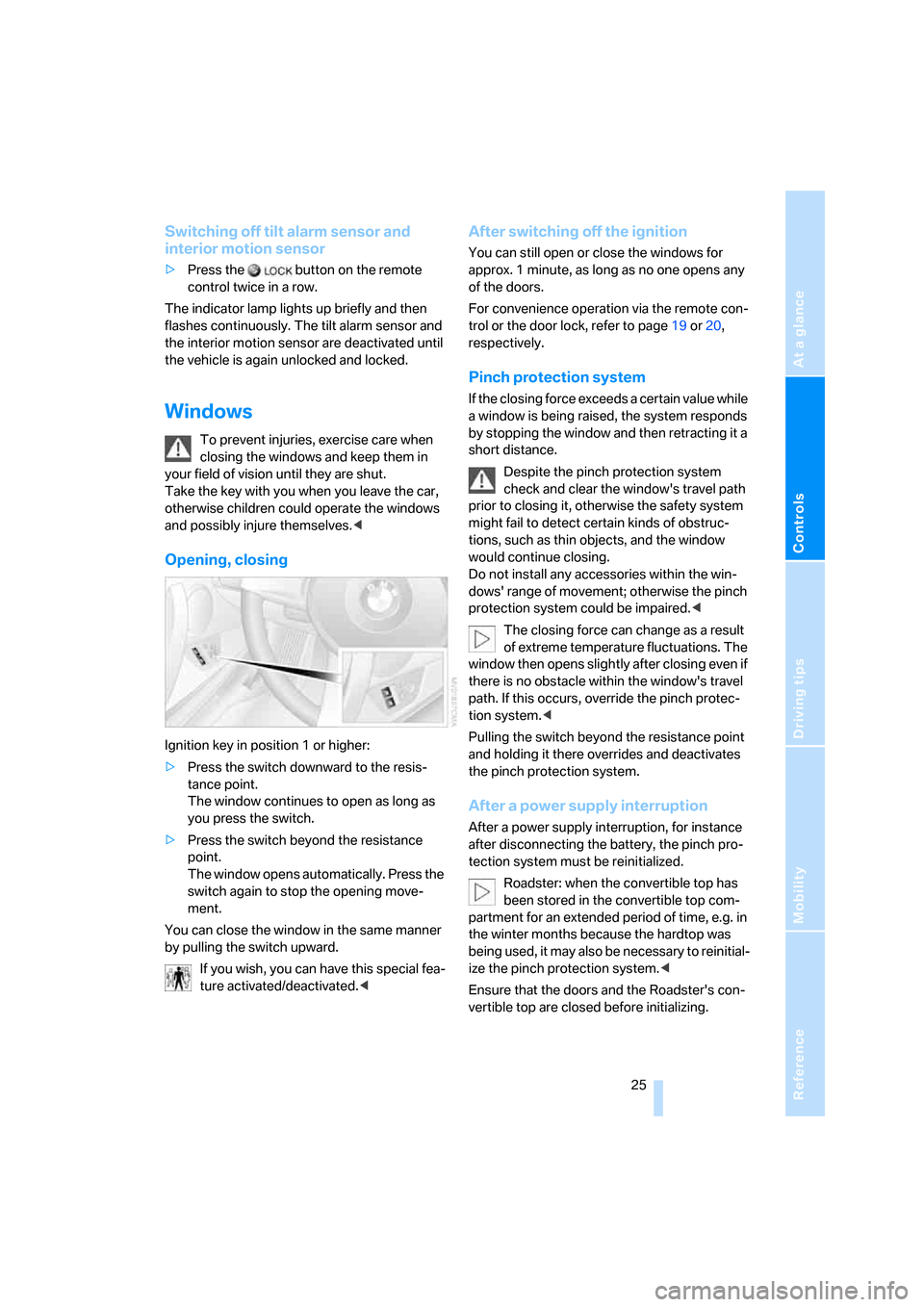
Ignition key in position 1 or higher:
>Press the switch downward to the resis-
tance point.
The window continues to open as long as
you press the switch.
>Press the switch beyond the resistance
point.
The window opens automatically. Press the
switch again to stop the opening move-
ment.
You can close the window in the same manner
by pulling the switch upward.
If you wish, you can have this special fea-
ture activated/deactivated.<
After switching off the ignition
You can still open or close the windows for
approx. 1 minute, as long as no one opens any
of the doors.
For convenience operation via the remote con-
trol or the door lock, refer to page19 or20,
respectively.
Pinch protection system
If the closing force exceeds a certain value while
a window is being raised, the system responds
by stopping the window and then retracting it a
short distance.
Despite the pinch protection system
check and clear the window's travel path
prior to closing it, otherwise the safety system
might fail to detect certain kinds of obstruc-
tions, such as thin objects, and the window
would continue closing.
Do not install any accessories within the win-
dows' range of movement; otherwise the pinch
protection system could be impaired.<
The closing force can change as a result
of extreme temperature fluctuations. The
window then opens slightly after closing even if
there is no obstacle within the window's travel
path. If this occurs, override the pinch protec-
tion system.<
Pulling the switch beyond the resistance point
and holding it there overrides and deactivates
the pinch protection system.
After a power supply interruption
After a power supply interruption, for instance
after disconnecting the battery, the pinch pro-
tection system must be reinitialized.
Roadster: when the convertible top has
been stored in the convertible top com-
partment for an extended period of time, e.g. in
the winter months because the hardtop was
being used, it may also be necessary to reinitial-
ize the pinch protection system.<
Ensure that the doors and the Roadster's con-
vertible top are closed before initializing.
Page 53 of 128
Reference
At a glance
Controls
Driving tips
Mobility
51
Malfunction
The warning lamp for the brake system
lights up in yellow. The drive-off assis-
tant has failed. The car will not be held
in place after the brake is released. Have the
system checked as soon as possible.
Flat Tire Monitor FTM
The concept
The Flat Tire Monitor monitors tire pressures
while the car is being driven. The system
reports any significant loss of pressure in one
tire in relation to another.
In the event of tire pressure loss, the rolling
radius of the tire changes, thereby affecting the
rotational speed of the wheels. This change is
detected, and a flat tire warning is issued to the
driver.
System requirements
To ensure a reliable flat tire warning, the system
must be initialized with the correct tire inflation
pressures.
The system must be reinitialized each
time a tire inflation pressure has been cor-
rected or a wheel or tire has been changed.<
System limitations
The Flat Tire Monitor is unable to warn
the driver of sudden, severe tire damage
caused by external factors, nor can it identify
the gradual loss of pressure that will inevitably
occur in all four tires over a lengthy period of
time.<
The system could issue a false warning or func-
tion in a delayed manner in the following situa-
tions:
>System was not initialized
>Driving on a snow-covered or slippery road
surface
>Performance-oriented driving: slip at the
drive wheels, high levels of lateral accelera-
tion
>Driving with snow chains attached
Initializing the system
The initialization is completed while you
are driving, and can be interrupted at any
time. Initialization is continued automatically
when you continue driving.
When driving with snow chains, do not initialize
the system.<
1.Start the engine immediately before pulling
away, but do not drive off yet.
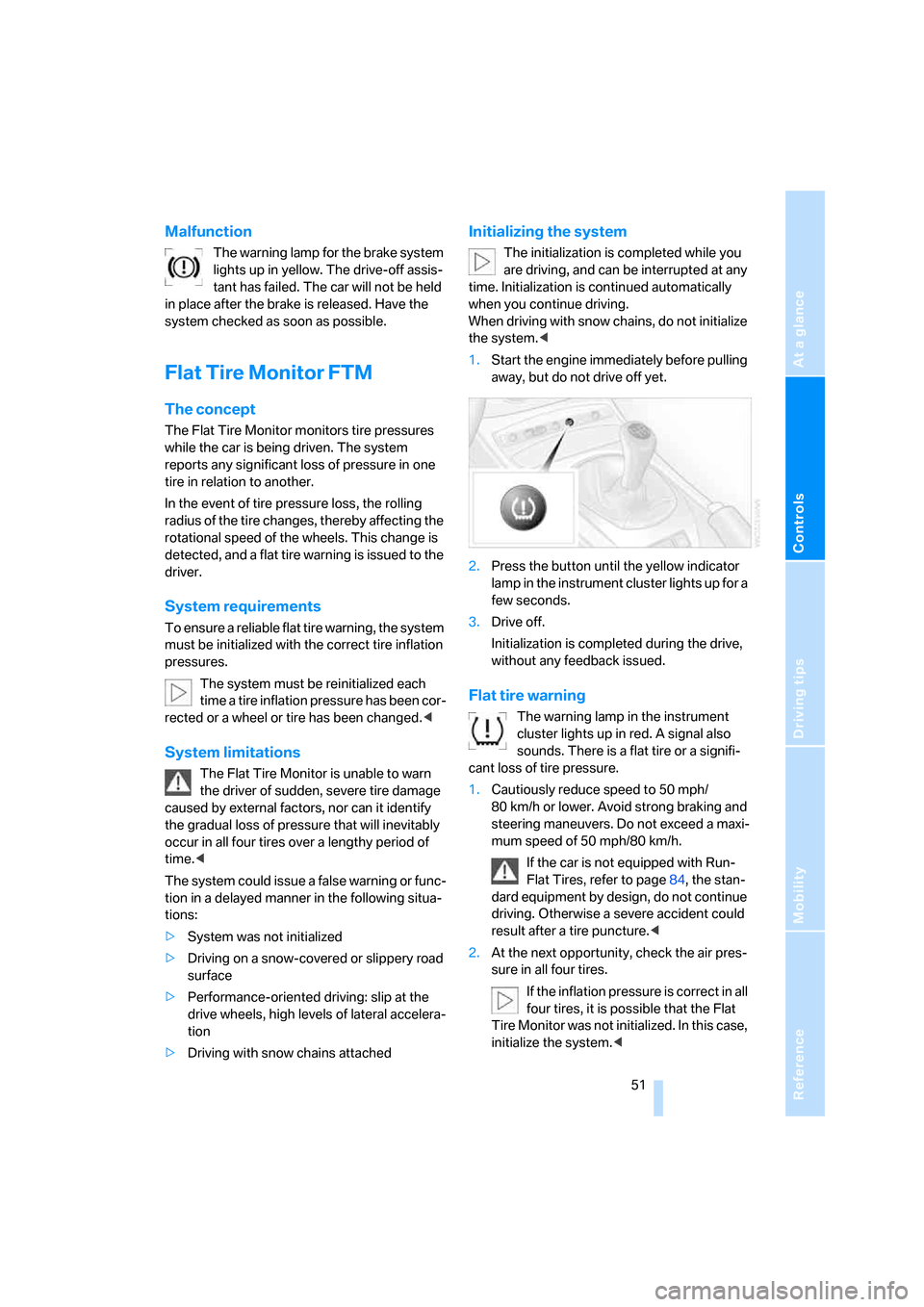
2.Press the button until the yellow indicator
lamp in the instrument cluster lights up for a
few seconds.
3.Drive off.
Initialization is completed during the drive,
without any feedback issued.
Flat tire warning
The warning lamp in the instrument
cluster lights up in red. A signal also
sounds. There is a flat tire or a signifi-
cant loss of tire pressure.
1.Cautiously reduce speed to 50 mph/
80 km/h or lower. Avoid strong braking and
steering maneuvers. Do not exceed a maxi-
mum speed of 50 mph/80 km/h.
If the car is not equipped with Run-
Flat Tires, refer to page84, the stan-
dard equipment by design, do not continue
driving. Otherwise a severe accident could
result after a tire puncture.<
2.At the next opportunity, check the air pres-
sure in all four tires.
If the inflation pressure is correct in all
four tires, it is possible that the Flat
Tire Monitor was not initialized. In this case,
initialize the system.<
Page 82 of 128
Wheels and tires
80
Wheels and tires
Tire inflation pressure
Information for your safety
It is not merely the tire's service life, but also
driving safety and driving comfort that largely
depend on the condition of the tires and the
maintenance of the specified tire pressure.
Check tire inflation pressures regularly
and correct them if necessary: at least
every two weeks and before every extended
journey. If you fail to observe this precaution
you may be driving on tires with incorrect tire
pressures, a condition that can not only com-
promise your vehicle's driving stability, but also
lead to tire damage and the risk of an accident.
Do not drive with deflated, i.e. flat tires, except
when using Run-Flat Tires. A flat tire will seri-
ously impair your vehicle's handling and braking
response. Attempts to drive on a flat tire can
lead to loss of control over the vehicle.<
Checking pressure
Check the tire inflation pressures only when the
tires are cold. This means after a maximum of
1.25 miles/2 km driving or when the vehicle has
been parked for at least 2 hours. Warm tires
have higher inflation pressures.
Inflation pressure specifications
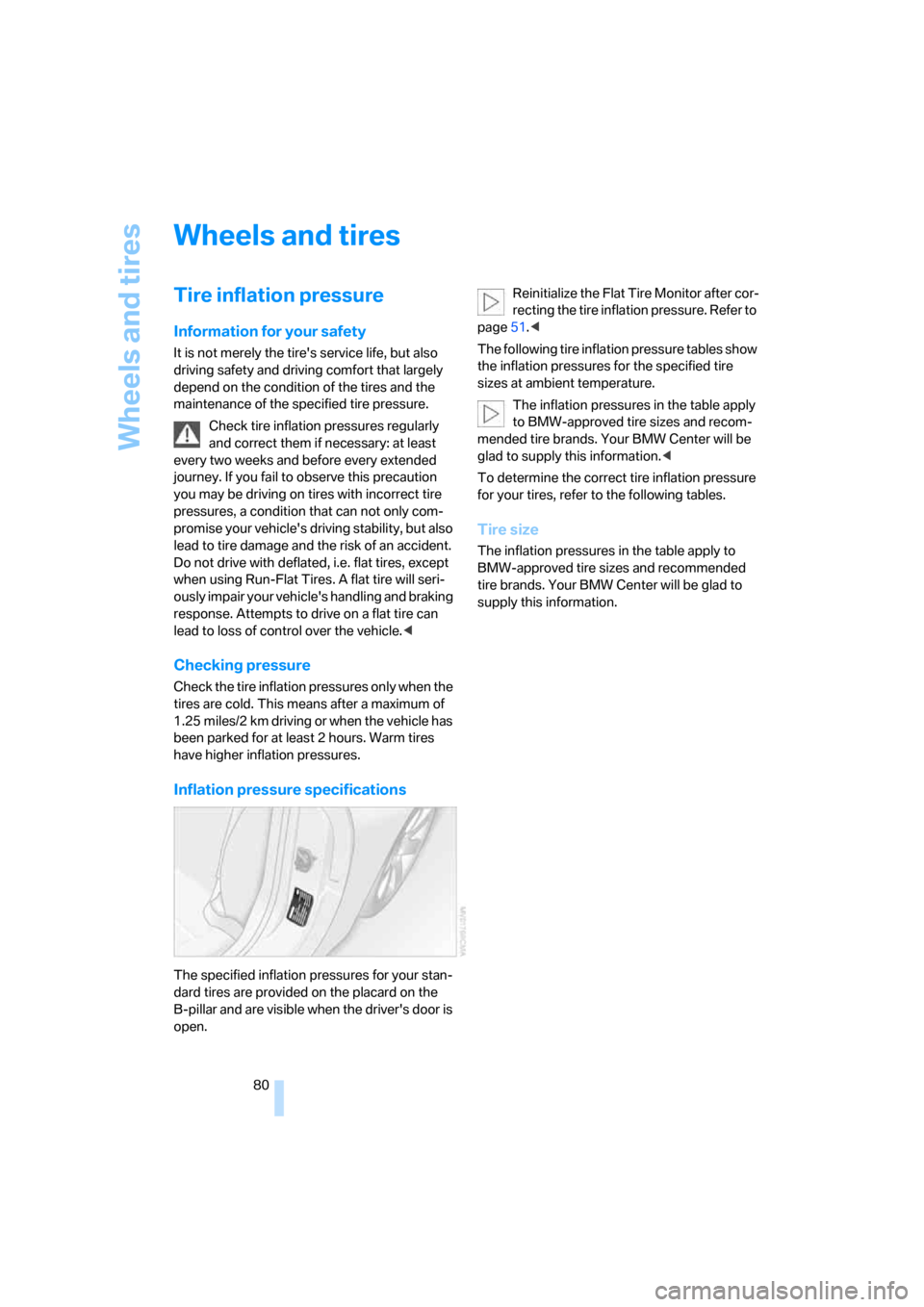
The specified inflation pressures for your stan-
dard tires are provided on the placard on the
B-pillar and are visible when the driver's door is
open.Reinitialize the Flat Tire Monitor after cor-
recting the tire inflation pressure. Refer to
page51.<
The following tire inflation pressure tables show
the inflation pressures for the specified tire
sizes at ambient temperature.
The inflation pressures in the table apply
to BMW-approved tire sizes and recom-
mended tire brands. Your BMW Center will be
glad to supply this information.<
To determine the correct tire inflation pressure
for your tires, refer to the following tables.
Tire size
The inflation pressures in the table apply to
BMW-approved tire sizes and recommended
tire brands. Your BMW Center will be glad to
supply this information.
Page 86 of 128
Wheels and tires
84 the letters TWI, for Tread Wear Indicator, on the
tire's sidewalls identify tires that incorporate
these wear indicators. Once the tire tread has
worn down to the wear indicators, the tire has
worn to a depth of 1/16 in/1.6 mm.
Wheel/tire damage
Due to low-profile tires, please note that
wheels, tires and suspension parts are
more susceptible to road hazards and conse-
quential damages.<
Unusual vibrations encountered during normal
vehicle operation can indicate tire failure or
some other vehicle malfunction. This can, for
example, be caused by driving over curbs. The
same applies to any other abnormal road
behavior, such as pulling severely to the right or
left.
In these cases, reduce speed immedi-
ately and have wheels and tires thor-
oughly checked. To do so, drive carefully to the
nearest BMW Center or tire shop that works
according to BMW repair procedures with cor-
respondingly trained personnel. If necessary,
have the vehicle towed there.
Tire damage can be extremely dangerous for
vehicle occupants and other road users.<
Tire age
For various reasons, such as the development
of brittleness, BMW recommends tire replace-
ment after no more than 6 years, regardless of
the actual wear of the tires.
The date on which the tire was manufactured is
indicated by the code on the sidewall:
DOT … 5005 indicates that the tire was manu-
factured in week 50 of the year 2005.
Run-Flat Tires
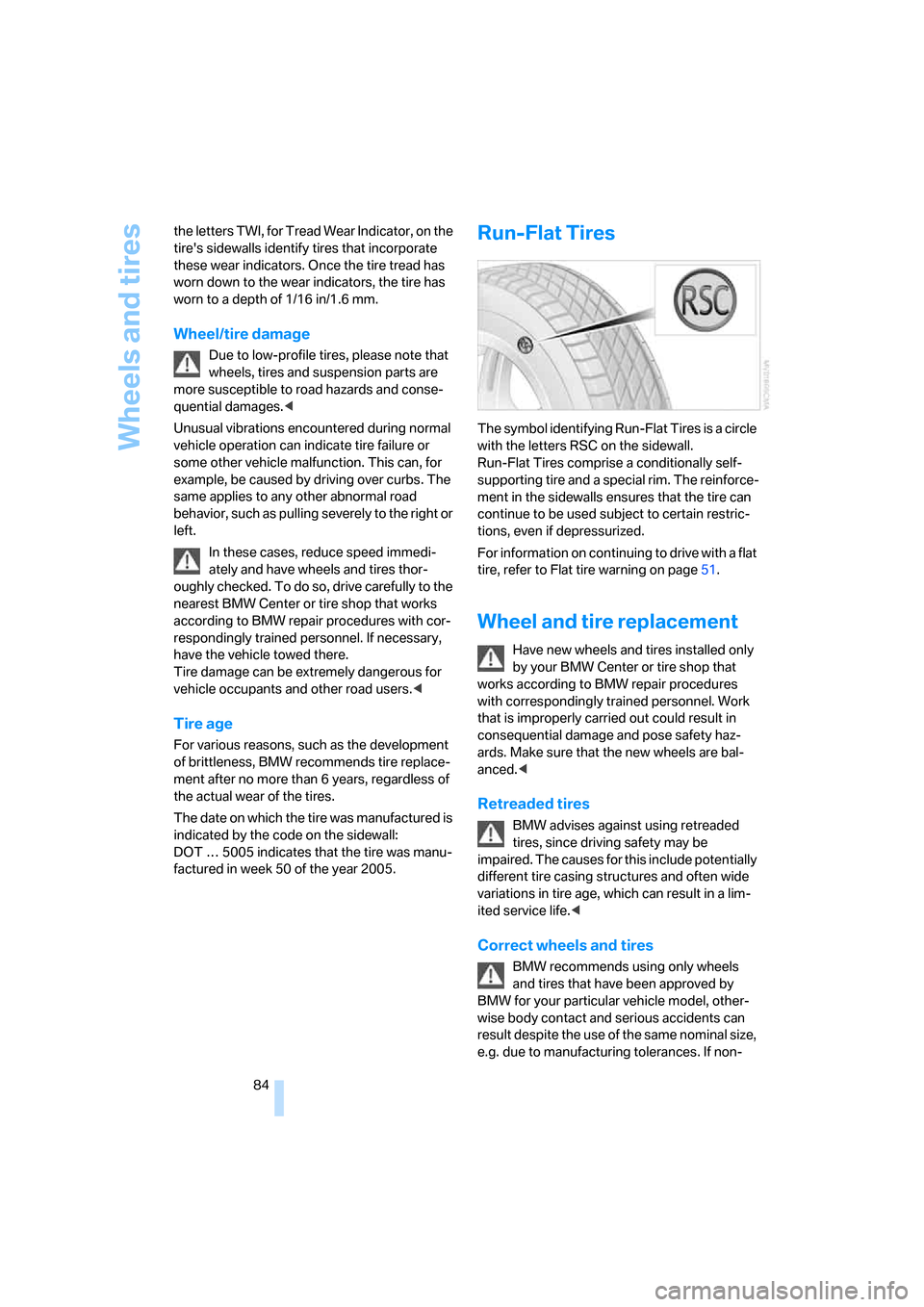
The symbol identifying Run-Flat Tires is a circle
with the letters RSC on the sidewall.
Run-Flat Tires comprise a conditionally self-
supporting tire and a special rim. The reinforce-
ment in the sidewalls ensures that the tire can
continue to be used subject to certain restric-
tions, even if depressurized.
For information on continuing to drive with a flat
tire, refer to Flat tire warning on page51.
Wheel and tire replacement
Have new wheels and tires installed only
by your BMW Center or tire shop that
works according to BMW repair procedures
with correspondingly trained personnel. Work
that is improperly carried out could result in
consequential damage and pose safety haz-
ards. Make sure that the new wheels are bal-
anced.<
Retreaded tires
BMW advises against using retreaded
tires, since driving safety may be
impaired. The causes for this include potentially
different tire casing structures and often wide
variations in tire age, which can result in a lim-
ited service life.<
Correct wheels and tires
BMW recommends using only wheels
and tires that have been approved by
BMW for your particular vehicle model, other-
wise body contact and serious accidents can
result despite the use of the same nominal size,
e.g. due to manufacturing tolerances. If non-
Page 96 of 128
Replacing components
94
Xenon lamps*
These bulbs have a very long service life and are
unlikely to fail. If one of these bulbs should nev-
ertheless fail, it is possible to continue driving
with great caution using the fog lamps, provided
traffic laws in your area do not prohibit this.
Have work on the xenon lighting system
performed only by your BMW Center or a
workshop that works according to BMW repair
procedures with correspondingly trained per-
sonnel. Due to the high electrical voltages
present, there is a risk of potentially fatal acci-
dents if work is performed inappropriate.<
Parking lamps, roadside parking lamps
In the event of a malfunction, please contact
your BMW Center or a workshop that works
according to BMW repair procedures with cor-
respondingly trained personnel.
Halogen lamps
For checking and adjusting headlamp
aim, please contact your BMW Center.<
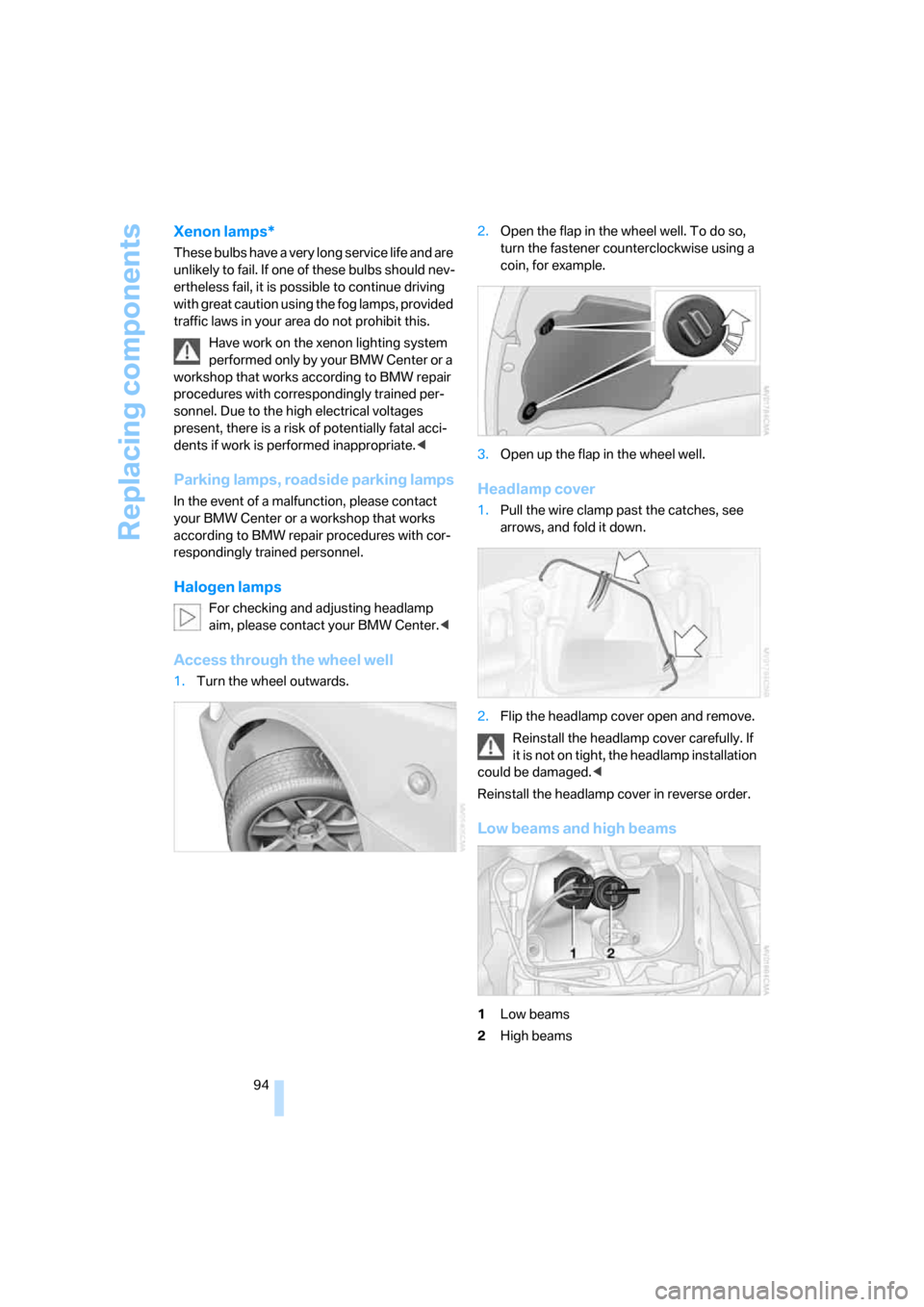
Access through the wheel well
1.Turn the wheel outwards.2.Open the flap in the wheel well. To do so,
turn the fastener counterclockwise using a
coin, for example.
3.Open up the flap in the wheel well.
Headlamp cover
1.Pull the wire clamp past the catches, see
arrows, and fold it down.
2.Flip the headlamp cover open and remove.
Reinstall the headlamp cover carefully. If
it is not on tight, the headlamp installation
could be damaged.<
Reinstall the headlamp cover in reverse order.
Low beams and high beams
1Low beams
2High beams
Page 98 of 128
Replacing components
96
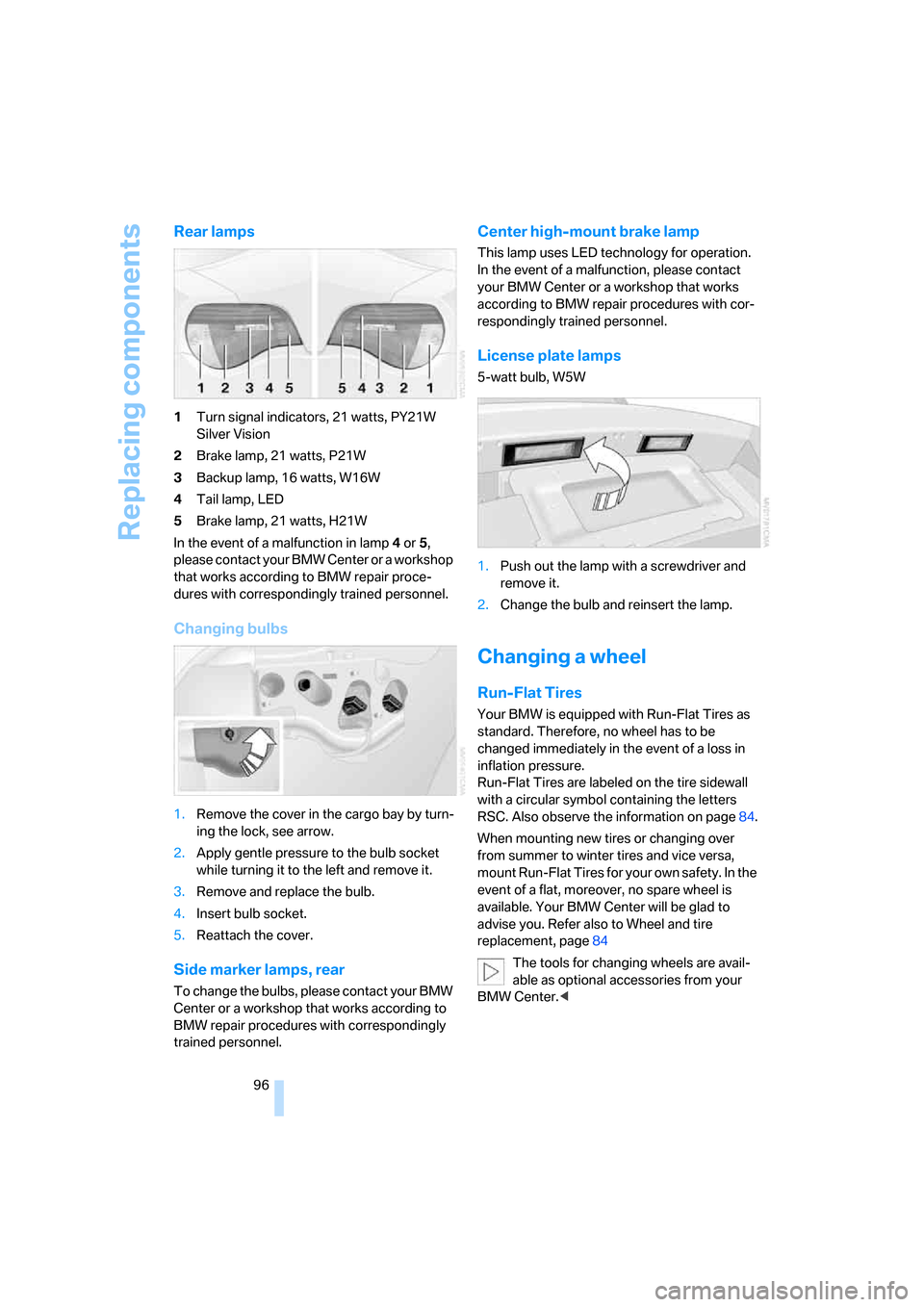
Rear lamps
1Turn signal indicators, 21 watts, PY21W
Silver Vision
2Brake lamp, 21 watts, P21W
3Backup lamp, 16 watts, W16W
4Tail lamp, LED
5Brake lamp, 21 watts, H21W
In the event of a malfunction in lamp 4 or 5,
please contact your BMW Center or a workshop
that works according to BMW repair proce-
dures with correspondingly trained personnel.
Changing bulbs
1.Remove the cover in the cargo bay by turn-
ing the lock, see arrow.
2.Apply gentle pressure to the bulb socket
while turning it to the left and remove it.
3.Remove and replace the bulb.
4.Insert bulb socket.
5.Reattach the cover.
Side marker lamps, rear
To change the bulbs, please contact your BMW
Center or a workshop that works according to
BMW repair procedures with correspondingly
trained personnel.
Center high-mount brake lamp
This lamp uses LED technology for operation.
In the event of a malfunction, please contact
your BMW Center or a workshop that works
according to BMW repair procedures with cor-
respondingly trained personnel.
License plate lamps
5-watt bulb, W5W
1.Push out the lamp with a screwdriver and
remove it.
2.Change the bulb and reinsert the lamp.
Changing a wheel
Run-Flat Tires
Your BMW is equipped with Run-Flat Tires as
standard. Therefore, no wheel has to be
changed immediately in the event of a loss in
inflation pressure.
Run-Flat Tires are labeled on the tire sidewall
with a circular symbol containing the letters
RSC. Also observe the information on page84.
When mounting new tires or changing over
from summer to winter tires and vice versa,
mount Run-Flat Tires for your own safety. In the
event of a flat, moreover, no spare wheel is
available. Your BMW Center will be glad to
advise you. Refer also to Wheel and tire
replacement, page84
The tools for changing wheels are avail-
able as optional accessories from your
BMW Center.<