ECO mode BMW Z8 2000 User Guide
[x] Cancel search | Manufacturer: BMW, Model Year: 2000, Model line: Z8, Model: BMW Z8 2000Pages: 172, PDF Size: 1.9 MB
Page 64 of 172
63n
IndexDataTechnologyRepairsCar careControlsOverview
The conceptDSC maintains vehicle stability even in
critical driving situations. The system
optimizes vehicle stability during accel-
eration and when starting from a full
stop, as well as optimizing traction. In
addition, the system recognizes unsta-
ble vehicle conditions (understeering or
oversteering, for example) and holds
the vehicle on a sure course by inter-
vening via the engine and by braking
intervention at the individual wheels,
within physically feasible limits.
The system starts up automatically
each time you start the engine.Indicator lamp
The indicator lamp in the instru-
ment cluster goes out shortly
after you switch on the ignition.
Refer to page 20.
Indicator lamp flashes:
The system is active and governs drive
force and braking force.
If the indicator lamp does not go out
after the engine is started, or if it comes
on during normal driving and stays on:
There is a system malfunction or the
system was deactivated with the button.
You can continue to drive the vehicle
normally, but without DSC.
Please consult your BMW center for re-
pairs.
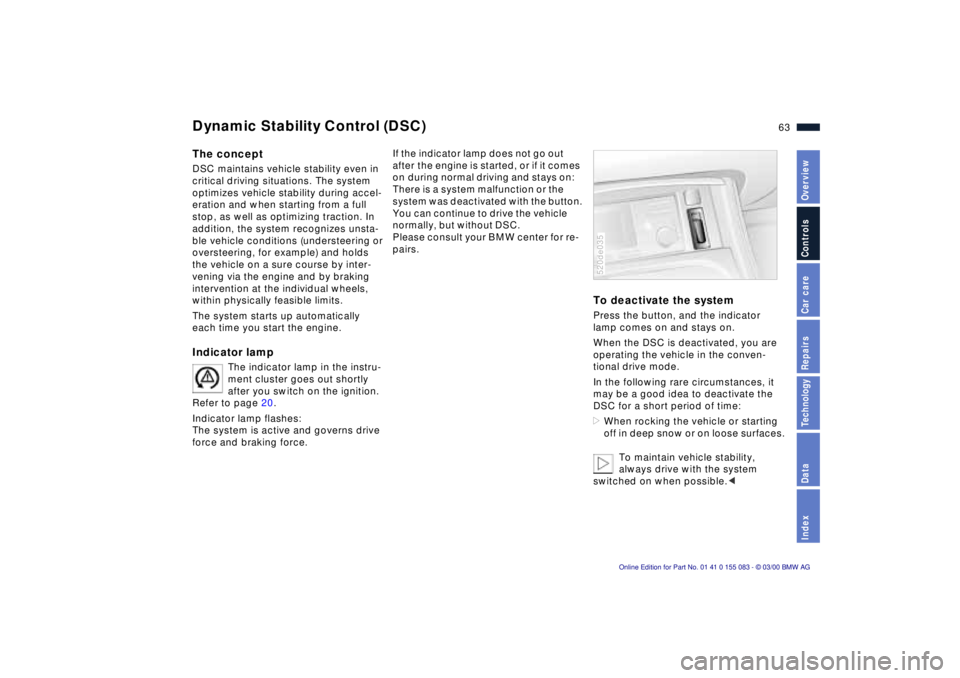
To deactivate the systemPress the button, and the indicator
lamp comes on and stays on.
When the DSC is deactivated, you are
operating the vehicle in the conven-
tional drive mode.
In the following rare circumstances, it
may be a good idea to deactivate the
DSC for a short period of time:
>When rocking the vehicle or starting
off in deep snow or on loose surfaces.
To maintain vehicle stability,
always drive with the system
switched on when possible.<520de035
Dynamic Stability Control (DSC)
Page 73 of 172
72n
Heating and ventilation/Air conditioningAir supply
You can select blower speeds
from 1 to 4. The higher the set-
ting, the greater the amount of
heat and air supply. In position
0, the blower, heating and air condi-
tioner are switched off.
Temperature
In order to increase the inte-
rior temperature, turn to the
right. For rapid heating, turn
completely to the right. Then
select an interior temperature that is
comfortable for you.
Air distribution
You can direct the airflow onto
the windows , toward the
upper body and into the
footwell . You can also make
all intermediate settings. The "6 o'clock"
setting is recommended for normal con-
ditions (refer also to the illustration and
overview on page 70).
Recirculated air mode
If there are unpleasant odors
in the outside air, you can tem-
porarily block the air supply.
The system then recirculates
the air currently within the vehicle.
If the windows fog over when
using recirculated air, turn off the
recirculated air mode and increase the
airflow if necessary, or press the button
for "defrosting and defogging the win-
dows."<
Venting in outside air
Recommended when driving
with the convertible top open.
The degree to which the pas-
senger compartment is
heated depends on temperature selec-
tion and air distribution.
Air conditioner/Venting in outside
air
The air is cooled and dehu-
midified and Ð depending on
the temperature setting Ð
warmed again when the air
conditioner system is switched on.
Depending on the weather, the wind-
shield may fog over briefly when the
engine is started.
Do not turn on the air conditioner if out-
side air temperature is below approx.
41 7 (5 6). This will help to prevent
the windows from fogging.
If the windows fog over after switching
the air conditioner off, switch it back on.
Air conditioner/Recirculated air
mode
Both systems are operating.
Another advantage is that a
hot vehicle cools down more
quickly with the convertible
top closed. This way, you will get the
lowest possible vented air temperature
(turn the temperature rotary dial all the
way to the left).
Page 74 of 172
73n
IndexDataTechnologyRepairsCar careControlsOverview
Heating and ventilation/Air conditioning
If the windows fog over when
using recirculated air, turn off the
recirculated air mode, and increase air-
flow if necessary, or press the button
for "defrosting and defogging the win-
dows."<
To defrost windows and remove
condensation
This operation quickly re-
moves ice and condensation
from the windshield and the
side windows.
Rear window defroster
Whenever the hardtop is on,
the indicator lamp lights up
when the rear window de-
froster is turned on. The rear window
defroster switches off automatically.
Refer to page 58.
The indicator lamp is always
active. The rear window defroster
will not work if the hardtop is not in
place.<
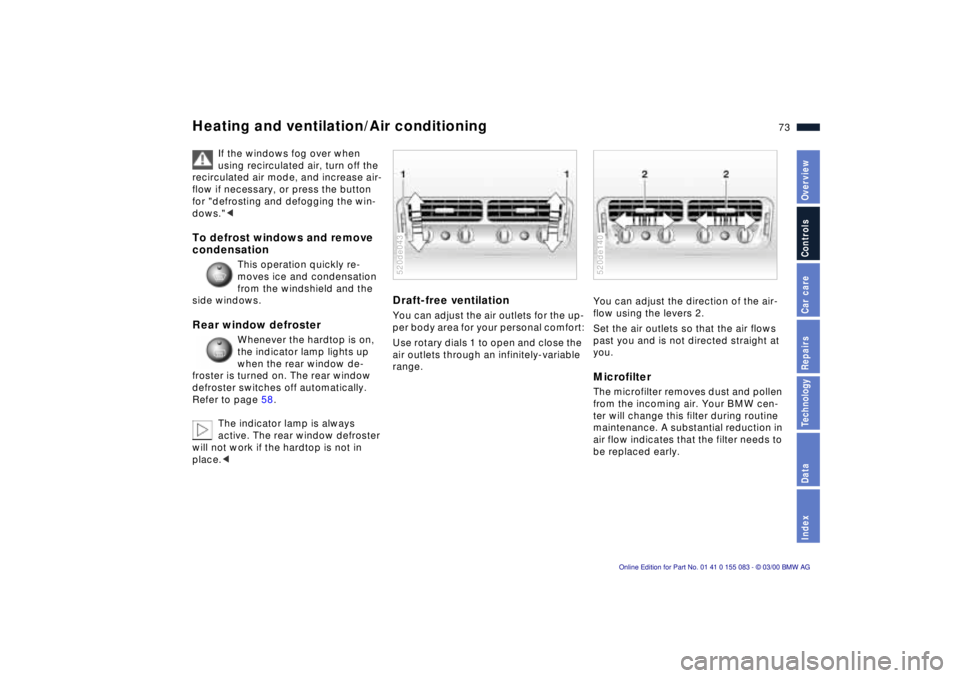
Draft-free ventilation You can adjust the air outlets for the up-
per body area for your personal comfort:
Use rotary dials 1 to open and close the
air outlets through an infinitely-variable
range.520de043
You can adjust the direction of the air-
flow using the levers 2.
Set the air outlets so that the air flows
past you and is not directed straight at
you.MicrofilterThe microfilter removes dust and pollen
from the incoming air. Your BMW cen-
ter will change this filter during routine
maintenance. A substantial reduction in
air flow indicates that the filter needs to
be replaced early.520de140
Page 76 of 172
75n
IndexDataTechnologyRepairsCar careControlsOverview
Heating and ventilation/Air conditioning Seat heatingRapid heating 1 Set the rotary blower switch to
position 3 for air intake
2 Turn the rotary temperature control
completely to the right
3 Rotary control for air distribution in
position
4 Select incoming air mode.520de045
HeatingWhen the windows are free of ice and
condensation, we recommend the fol-
lowing settings:
1 Set the blower speed control for the
air flow rate to position 2
2 Use the rotary temperature control to
select an interior temperature which
is comfortable for you
3 Rotary control for air distribution in
position .520de047
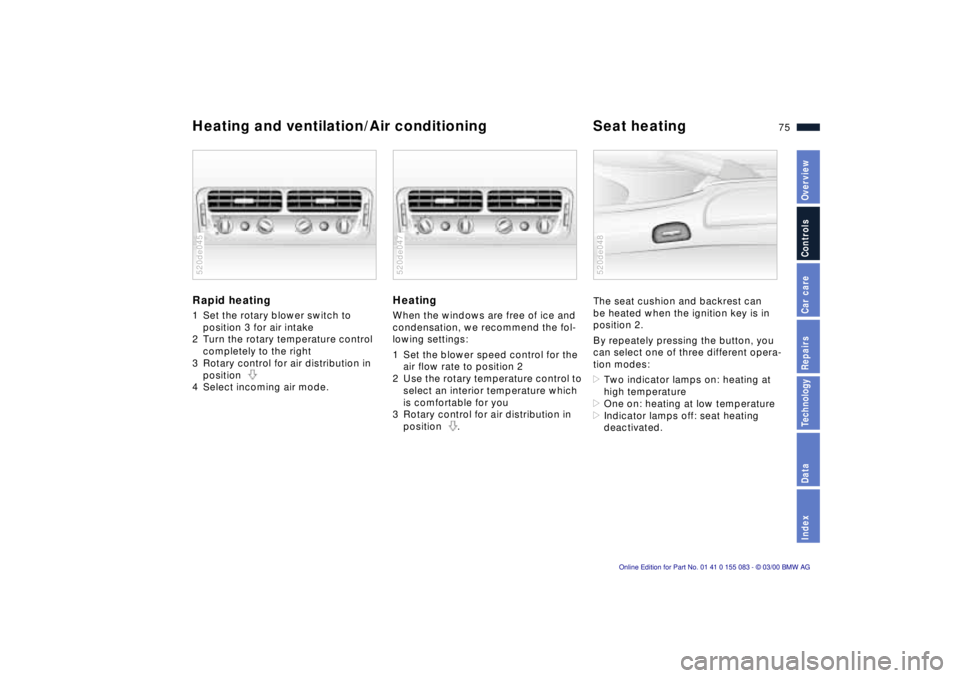
The seat cushion and backrest can
be heated when the ignition key is in
position 2.
By repeately pressing the button, you
can select one of three different opera-
tion modes:
>Two indicator lamps on: heating at
high temperature
>One on: heating at low temperature
>Indicator lamps off: seat heating
deactivated.520de048
Page 90 of 172
89n
IndexDataTechnologyRepairsCar careControlsOverview
Disc brakes Brake systemDriving notesWhen driving in wet conditions and in
heavy rain, it is effective to apply light
pressure to the brakes every few miles
or kilometers. Watch traffic conditions
to ensure that this maneuver does not
endanger other road users. The heat
which is generated by the brake appli-
cations helps to dry the brake pads and
rotors.
Maximum braking force is obtained
while the wheels are not locked, but
rather when they are still barely turning
immediately prior to locking. ABS main-
tains this state automatically. If the ABS
fails, you should revert to the staggered
braking technique (refer to page 91).
Long or steep mountain descents do
not necessarily lead to reduced braking
efficiency if you drive downhill with the
transmission in a gear requiring minimal
brake applications.
Braking effect on the engine can be
further increased by downshifting, into
first gear, if necessary.If engine braking should prove to be
inadequate, you should still avoid ex-
tended, continuous braking. Instead of
maintaining low to moderate pressure
over an extended period of time, you
should decelerate by applying more
substantial pressure to the brake pedal
(watch for following traffic), releasing
the pedal, and then repeating the appli-
cation (staggered braking). The cooling
phases between active braking inter-
vals prevent the brakes from overheat-
ing and retain full braking capacity.
Do not coast with the clutch de-
pressed, the gear-shift lever in
neutral, or, above all, with the engine
shutt off; otherwise, the engine will pro-
vide no braking effect if the transmis-
sion is in neutral, and there is no brak-
ing or steering power assist if the
engine is not running. Do not allow floor
mats, carpets or any other objects to
protrude into the area around the brake
pedal, the clutch or the accelerator
which could obstruct their freedom of
movement.<
Brake fluid level
The brake warning lamp comes
on with the parking brake
released:
The brake fluid level is too low in
the reservoir (refer to page 112).
If the brake fluid level is too low
and brake pedal travel has become no-
ticeably longer, there may be a defect
in one of the brake system's hydraulic
circuits.
Proceed to the nearest BMW cen-
ter. Higher brake application pres-
sure may be necessary under these con-
ditions, and brake pedal travel may be
significantly longer. Please remember to
adapt your driving style accordingly.<
Page 91 of 172

90n
Brake system Winter operationBrake pads
The warning lamp for the brake
pads comes on:
The brake pads have reached
their minimum pad thickness. Proceed
to the nearest BMW center as soon as
possible to have the pads replaced.
For your own safety: use only
brake pads which BMW has ap-
proved for your specific vehicle model.
BMW cannot evaluate non-approved
brake pads to determine if they are
suited for use, and therefore cannot en-
sure the operating safety of the vehicle
if they are installed.<
Winter is often accompanied by rapid
changes in weather, requiring not only
a different driving style, but also certain
preparations to the vehicle itself to en-
sure that your vehicle operates safely
and trouble-free throughout the winter
months. CoolantBe sure that the coolant mixture con-
tains the year-round ratio of 50:50 water
and antifreeze/corrosion protection.
This mixture provides protection against
freezing down to approx. Ð 34 7
(Ð 37 6). LocksBMW door lock deicer can be used to
free doors if frozen. This deicer also
contains lubricant.
After using the deicer, treatment with
BMW lock cylinder grease is recom-
mended.
Rubber seals and components To prevent the weather-stripping from
freezing, apply a spray-on rubber treat-
ment or silicone spray to the door, hood
and luggage compartment lid seals.
A full range of car care products is
available from your BMW center.
on the rear wheels with approved winter
tires. Always follow the manufacturer's
safety precautions. Do not exceed a
maximum speed of 30 mph (50 km/h).
Do not activate the RDW system while
using snow chains. Malfunction warn-
ings and undetected losses in pressure
are possible when driving with snow
chains.
Starting offWhen starting off in deep snow or when
"rocking" the vehicle to free it, it may be
advisable to temporarily deactivate the
DSC system. Refer to page 63.
To maintain vehicle stability,
always drive with the system
switched on whenever possible.<
Page 92 of 172

91n
IndexDataTechnologyRepairsCar careControlsOverview
Winter operationDriving on low-traction road
surfacesDo not activate the Sport Mode (refer to
page 64). Use smooth, gentle pressure
to control the accelerator pedal. Avoid
excessive engine speeds and shift to
the next higher gear at an early point.
Shift down into the next lowest gear
when approaching uphill or downhill
grades. Maintain an adequate distance
between yourself and the vehicle
ahead.BrakesWinter road conditions substantially
reduce the amount of traction available
between the tires and the road surface.
The resulting increases in braking dis-
tance are considerable and should be
kept in mind at all times.
ABS is intended to prevent the wheels
from locking during brake applications,
thus helping to maintain vehicle stability
and steering response.If the ABS does not respond in a critical
braking situation and the wheels lock,
reduce the pressure on the brake pedal
until the wheels just start to roll again
while still maintaining enough force to
continue braking.
Then increase the pressure, reduce the
pressure when the wheels lock, reapply
pressure etc.
This staggered braking procedure will
reduce braking distances while helping
you maintain steering control.
You can always then attempt to steer
around hazards after you have reduced
pressure on the brake pedal.
Do not shift down on slick road
surfaces if you want to decelerate.
Doing so could cause the wheels to
lose traction and skid, thus resulting in
the loss of vehicle control.<
Depress the clutch during hard
braking on road surfaces that pro-
vide only poor or uneven traction.<
Skid control Depress the clutch and release the
accelerator pedal. Countersteer care-
fully and attempt to regain control of the
vehicle.ParkingEngage first or reverse gear. Depending
on the steepness of the incline, you can
apply the parking brake as well. In order
to prevent the parking brake pads from
locking due to frost or corrosion, dry
them by gently applying the parking
brake as the vehicle is coming to a stop.
Make sure that following traffic is not
endangered.
The brake lamps do not come
on when the parking brake is
engaged.<
Page 98 of 172
97n
IndexDataTechnologyRepairsCar careControlsOverview
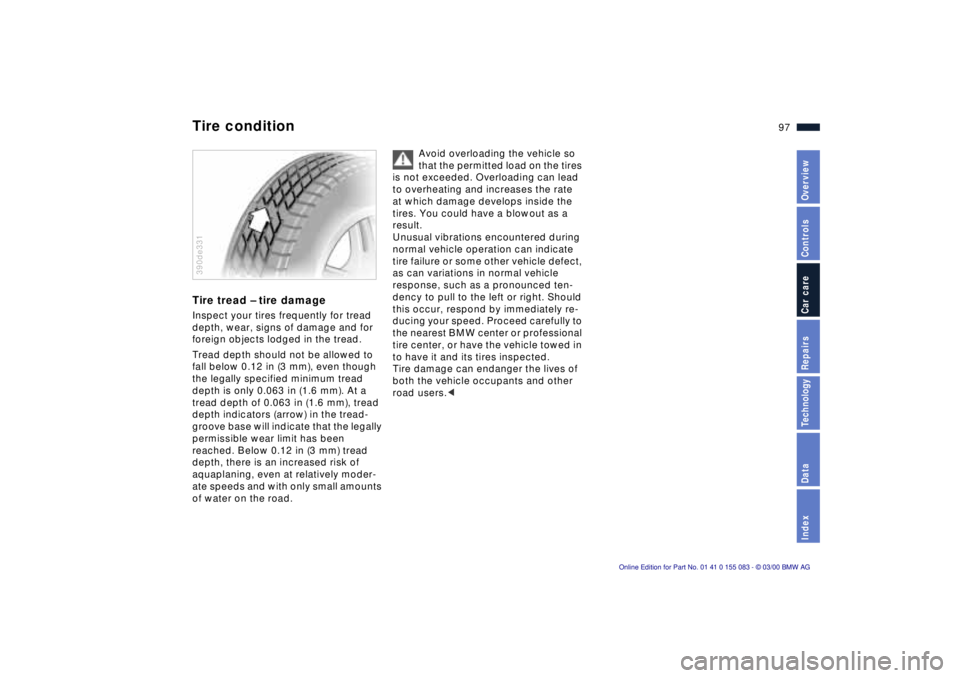
Tire tread Ð tire damageInspect your tires frequently for tread
depth, wear, signs of damage and for
foreign objects lodged in the tread.
Tread depth should not be allowed to
fall below 0.12 in (3 mm), even though
the legally specified minimum tread
depth is only 0.063 in (1.6 mm). At a
tread depth of 0.063 in (1.6 mm), tread
depth indicators (arrow) in the tread-
groove base will indicate that the legally
permissible wear limit has been
reached. Below 0.12 in (3 mm) tread
depth, there is an increased risk of
aquaplaning, even at relatively moder-
ate speeds and with only small amounts
of water on the road.390de331
Avoid overloading the vehicle so
that the permitted load on the tires
is not exceeded. Overloading can lead
to overheating and increases the rate
at which damage develops inside the
tires. You could have a blowout as a
result.
Unusual vibrations encountered during
normal vehicle operation can indicate
tire failure or some other vehicle defect,
as can variations in normal vehicle
response, such as a pronounced ten-
dency to pull to the left or right. Should
this occur, respond by immediately re-
ducing your speed. Proceed carefully to
the nearest BMW center or professional
tire center, or have the vehicle towed in
to have it and its tires inspected.
Tire damage can endanger the lives of
both the vehicle occupants and other
road users.<
Tire condition
Page 166 of 172

Everything from A to Z
165n
IndexDataTechnologyRepairsCar careControlsOverview
Paintwork, minor
repairs118
Paintwork, waxing118
Parking brake55
Parking lamps68
Parking, winter91
Performance154
Pocket flashlight77
Pollen73
Power steering92
Power windows38
Pressure monitoring,
tires65
Pressure, tires24,96
Pre-warmed seats75 R
Radio62
refer also to the radio
Owner's Manual
Radio reception92,148
Radios92
RDW (Tire Pressure
Warning)65
Reading lamps69
Rear foglamps68
Rear lamp130
Rear window
defroster58,73
Rearview mirror45
Recirculated air mode72 Refueling23
Remaining fuel indicator60
Remote control31
Removing condensation
from the windows73
Removing the vehicle from
storage122
Replacement keys28
Reporting Safety Defects5
Restraint systems51
Reverse15,56
Roof load capacity156
Rotating the tires100
Rubber parts90
S
Safety belt tensioner149
Safety belts48
Safety buttons34
Seat heating75
Securing cargo81
Self-defrosting mirrors45
Service and Warranty
Information Booklet
(US models)114
Service Interval
Display61,114
Shelves76,77
Side airbags49
Side lamps67 Side marker lamps67
bulb
replacement129,130
Sliding91
Slippery roads91
Snow chains90,103
Socket80
Spare key28
Spark plugs158
Speaker79
Speed control59
Speedometer16
Starting54
Starting
problems85,143,144
Steel wheels103
Steering92
Steering wheel lock53
Stopping the vehicle54
Storage areas76,77
Storing your vehicle122
Stroke154
Summer tires101
Switching off the engine54
Symbols2,136
T
Tachometer60
Taillamps
bulb replacement130
Tank capacity157
Technical data154 Technical
modifications4,123
Telephone79
Temperature display
outside temperature62
Temperature gauge
engine coolant61
Temperature layering73
Tilt alarm32
Tilt sensor alarm sensor37
Tire codes101
Tire damage97
Tire inflation
pressure24,96
Tire pressure monitoring65
Tire Pressure Warning
(RDW)65
Tire replacement98,99
Tire rotation100
Tire specifications103
Tire tread97
Together19
Tools128
Torque154
Tow fittings144
Tow starting144
Towing144
Track155
Traction Control System
refer to DSC63
Transmission56
Transmitter key28
Tread depth, tires97