parking brake BMW Z8 2000 Owners Manual
[x] Cancel search | Manufacturer: BMW, Model Year: 2000, Model line: Z8, Model: BMW Z8 2000Pages: 172, PDF Size: 1.9 MB
Page 9 of 172

Contents
Overview
Controls and features
Cockpit14
Instrument cluster16
Indicator and warning lamps18
Hazard warning flashers22
Warning triangle22
First-aid kit22
Refueling23
Fuel quality24
Tire inflation pressure24
Locks and security systems:
Keys28
Electronic vehicle
immobilizer29
Central locking system30
Opening and closing Ð from
outside30
Using the key30
Using the remote control31
Opening and closing Ð from
inside34
Luggage compartment lid35
Alarm system36
Electric power windows38
The automatic convertible
top39
Adjustments:
Seats43
Steering wheel45
Mirrors45
Car Memory, Key Memory46
Passenger safety systems:
Safety belts48
Airbags49
Child restraints51
Child seat safety52
Driving:
Steering/Ignition lock53
Starting the engine54
Turning the engine off54
Parking brake55
Manual transmission56
Turn signal indicator/Headlamp
flasher56
Wiper/Washer system57
Rear window defroster58
Cruise control59
Everything under control:
Odometer60
Tachometer60
Fuel gauge60
Coolant temperature gauge61
Service Interval Display61
Clock62
Multi-Information Radio (MIR)62
Technology for safety and
driving convenience:
Dynamic Stability Control
(DSC)63
Dynamic Driving Control64
Tire Pressure Warning (RDW)65
Contents
Page 10 of 172

9n
Controls and features
Operation, care and maintenance
Lamps:
Side lamps/Low beams67
Instrument lighting67
High beams/Parking lamps68
Rear foglamp68
Interior lamps68
Reading lamps69
Controlling the climate for
pleasant driving:
Heating and ventilation/
Air conditioning70
Seat heating75
Interior conveniences:
Glove compartment76
Storage compartments76
Beverage can holder78
Cellular phone79
Ashtray79
Cigarette lighter80
Loading and transporting:
Cargo loading81
Special operating instructions:
Break-in procedures84
Driving notes85
Catalytic converter85
Antilock Brake System (ABS)86
Dynamic Brake Control
(DBC)88
Disc brakes88
Brake system89
Winter operation90
Power steering92
Cellular phone92
Radio reception92
Wind protection93
Hardtop94
Wheels and tires:
Tire inflation pressure96
Tire condition97
Tire replacement98
Tire rotation100
Wheel and tire
combinations101
Winter tires102
Snow chains102
Approved wheel and tire
specifications103
Under the hood:
Hood104
Engine compartment106
Washer fluids108
Washer nozzles108
Engine oil109
Coolant111
Brake fluid112
Vehicle Identification
Number113
Maintenance and care:
The BMW Maintenance
System114
Caring for your vehicle115
Airbags121
Storing your vehicle122
Laws and regulations:
Technical modifications123
California Proposition 65
Warning123
OBD interface socket124
Page 18 of 172

17n
IndexDataTechnologyRepairsCar careControlsOverview
Instrument cluster
1 Fuel gauge with indicator lamp for
fuel reserve60
2 Speedometer with indicator and
warning lamps for
>
Dynamic Stability Control
(DSC)20
>
Engine electronics20
3 Instrument lighting67
4 Tachometer60
with indicator and warning lamps
for
>
Battery charge current18
>
Convertible top operation39
>
Tire Pressure Warning (RDW)18
>
Antilock Brake System (ABS)19
>
Parking brake/Brake hydraulic
system/Cornering Brake Control
(CBC)18
>
Service Engine Soon20
>
Engine oil pressure/Engine oil
level18, 19
5 Engine coolant temperature gauge
with "Coolant temperature too high"
warning lamp61
6 Indicator and warning lamps for
>
Rear foglamps20
>
Turn signal indicator right21
7 Clock628 Control knob for
>
Clock62
>
Trip odometer, reset to zero60
9 Indicator and warning lamps for
>
Please fasten safety belts19
>
High beams21
>
Airbags19
10 Indicator for
>
Odometer60
>
Trip odometer60
>
Service Interval61
11 Indicator and warning lamps for
>
Turn signal indicator left21
>
Brake pads20
Page 19 of 172
18n
Indicator and warning lamps
Technology that monitors itself
Many of the systems for your BMW
monitor themselves automatically, both
during engine starts and while you are
driving. Indicator and warning lamps
that are identified by "
l
" are tested for
proper functioning whenever the igni-
tion key is turned. They each light up
once for different periods of time.
If a fault should occur in one of these
systems, the corresponding lamp does
not go out after the engine is started, or
it lights up while the vehicle is moving.
You will see how to react to this below.
Red: stop immediately
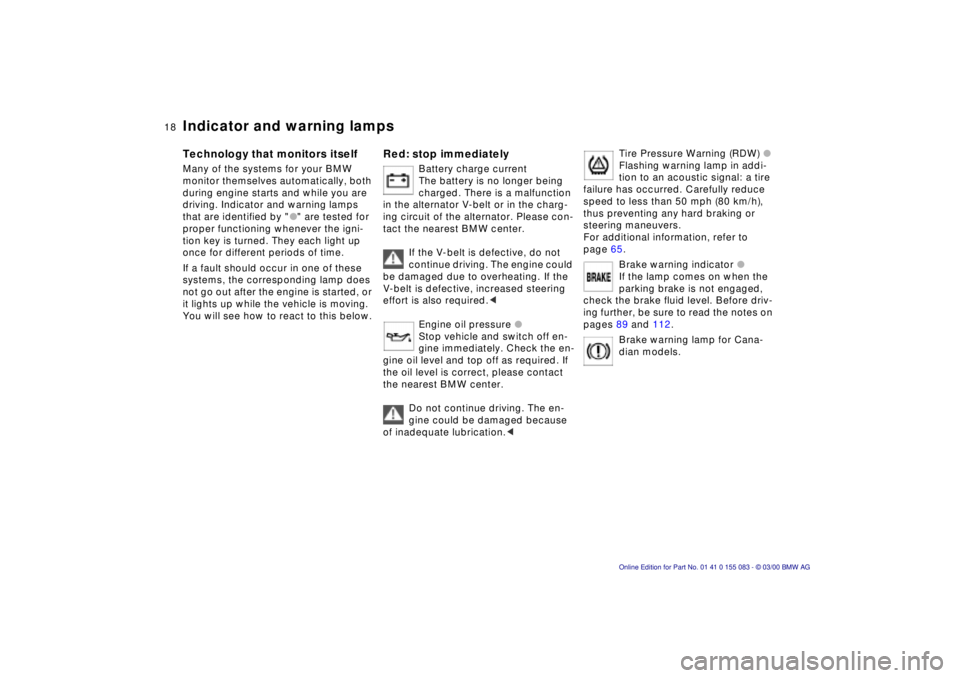
Battery charge current
The battery is no longer being
charged. There is a malfunction
in the alternator V-belt or in the charg-
ing circuit of the alternator. Please con-
tact the nearest BMW center.
If the V-belt is defective, do not
continue driving. The engine could
be damaged due to overheating. If the
V-belt is defective, increased steering
effort is also required.
<
Engine oil pressure
l
Stop vehicle and switch off en-
gine immediately. Check the en-
gine oil level and top off as required. If
the oil level is correct, please contact
the nearest BMW center.
Do not continue driving. The en-
gine could be damaged because
of inadequate lubrication.
<
Tire Pressure Warning (RDW)
l
Flashing warning lamp in addi-
tion to an acoustic signal: a tire
failure has occurred. Carefully reduce
speed to less than 50 mph (80 km/h),
thus preventing any hard braking or
steering maneuvers.
For additional information, refer to
page 65.
Brake warning indicator
l
If the lamp comes on when the
parking brake is not engaged,
check the brake fluid level. Before driv-
ing further, be sure to read the notes on
pages 89 and 112.
Brake warning lamp for Cana-
dian models.
Page 20 of 172
19n
IndexDataTechnologyRepairsCar careControlsOverview
Indicator and warning lamps
Red and yellow: continue driving
cautiously
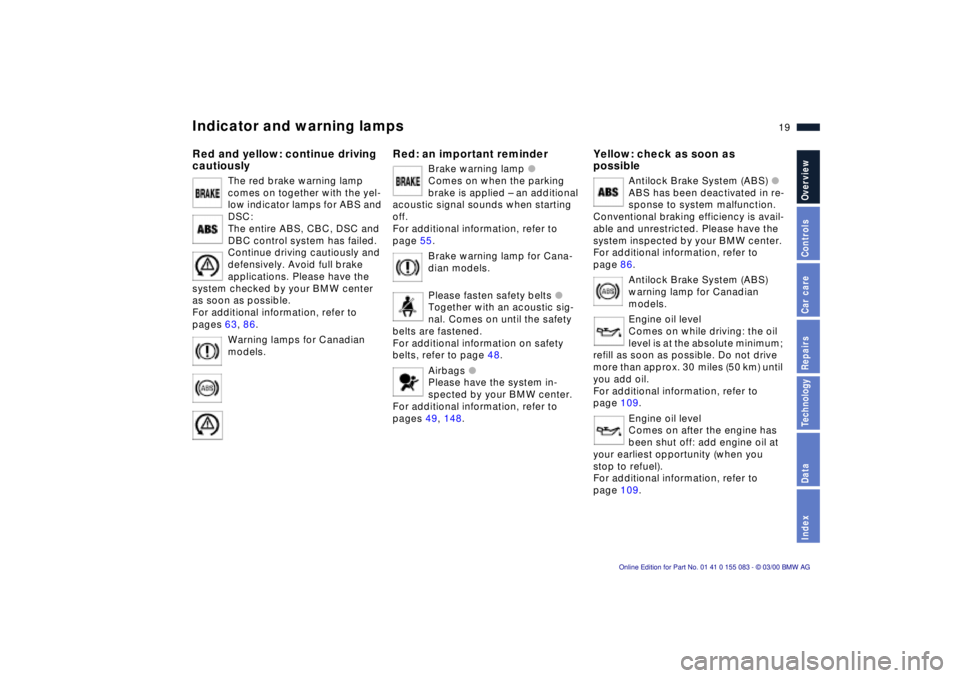
The red brake warning lamp
comes on together with the yel-
low indicator lamps for ABS and
DSC:
The entire ABS, CBC, DSC and
DBC control system has failed.
Continue driving cautiously and
defensively. Avoid full brake
applications. Please have the
system checked by your BMW center
as soon as possible.
For additional information, refer to
pages 63, 86.
Warning lamps for Canadian
models.
Red: an important reminder
Brake warning lamp
l
Comes on when the parking
brake is applied Ð an additional
acoustic signal sounds when starting
off.
For additional information, refer to
page 55.
Brake warning lamp for Cana-
dian models.
Please fasten safety belts
l
Together with an acoustic sig-
nal. Comes on until the safety
belts are fastened.
For additional information on safety
belts, refer to page 48.
Airbags
l
Please have the system in-
spected by your BMW center.
For additional information, refer to
pages 49, 148.
Yellow: check as soon as
possible
Antilock Brake System (ABS)
l
ABS has been deactivated in re-
sponse to system malfunction.
Conventional braking efficiency is avail-
able and unrestricted. Please have the
system inspected by your BMW center.
For additional information, refer to
page 86.
Antilock Brake System (ABS)
warning lamp for Canadian
models.
Engine oil level
Comes on while driving: the oil
level is at the absolute minimum;
refill as soon as possible. Do not drive
more than approx. 30 miles (50 km) until
you add oil.
For additional information, refer to
page 109.
Engine oil level
Comes on after the engine has
been shut off: add engine oil at
your earliest opportunity (when you
stop to refuel).
For additional information, refer to
page 109.
Page 28 of 172
Overview
Controls and features
Operation, care
and maintenance
Owner service procedures
Technical data
Index Advanced technology
27n
IndexDataTechnologyRepairsCar careControlsOverview
Driving:
Steering/Ignition lock53
Starting the engine54
Turning the engine off54
Parking brake55
Manual transmission56
Turn signal indicator/Headlamp
flasher56
Wiper/Washer system57
Rear window defroster58
Cruise control59
Everything under control:
Odometer60
Tachometer60
Fuel gauge60
Coolant temperature gauge61
Service Interval Display61
Clock62
Multi-Information Radio (MIR)62
Technology for safety and
driving convenience:
Dynamic Stability Control
(DSC)63
Dynamic Driving Control64
Tire Pressure Warning (RDW)65Lamps:
Side lamps/Low beams67
Instrument lighting67
High beams/Parking lamps68
Rear foglamp68
Interior lamps68
Reading lamps69
Controlling the climate for
pleasant driving:
Heating and ventilation/
Air conditioning70
Seat heating75
Interior conveniences:
Glove compartment76
Storage compartments76
Beverage can holder78
Cellular phone79
Ashtray79
Cigarette lighter80
Loading and transporting:
Cargo loading81
Page 55 of 172
54n
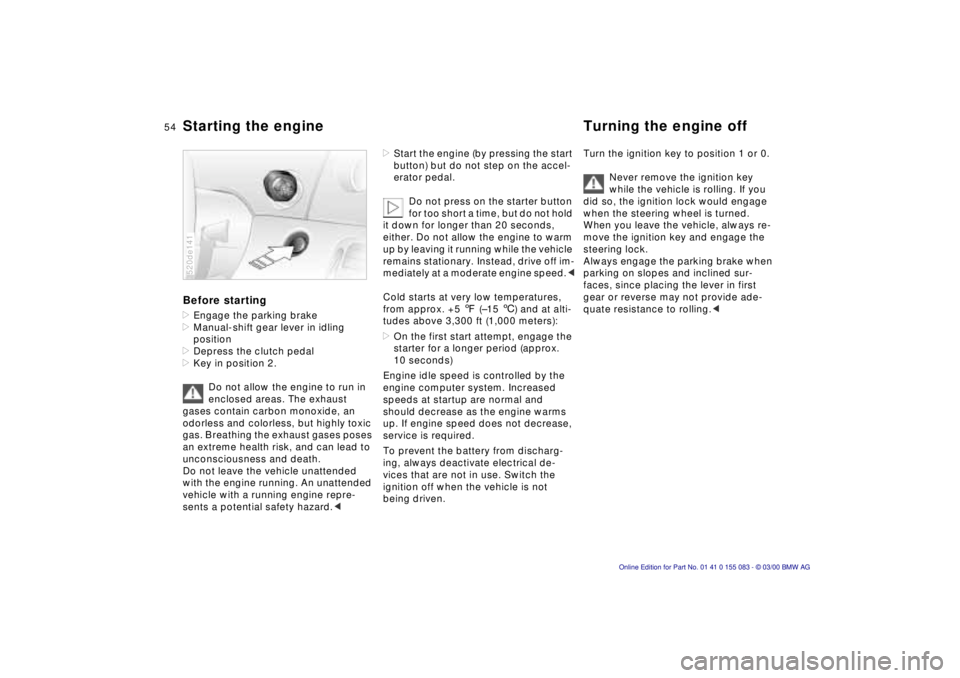
Starting the engine Turning the engine off Before starting>Engage the parking brake
>Manual-shift gear lever in idling
position
>Depress the clutch pedal
>Key in position 2.
Do not allow the engine to run in
enclosed areas. The exhaust
gases contain carbon monoxide, an
odorless and colorless, but highly toxic
gas. Breathing the exhaust gases poses
an extreme health risk, and can lead to
unconsciousness and death.
Do not leave the vehicle unattended
with the engine running. An unattended
vehicle with a running engine repre-
sents a potential safety hazard.<520de141
>Start the engine (by pressing the start
button) but do not step on the accel-
erator pedal.
Do not press on the starter button
for too short a time, but do not hold
it down for longer than 20 seconds,
either. Do not allow the engine to warm
up by leaving it running while the vehicle
remains stationary. Instead, drive off im-
mediately at a moderate engine speed.<
Cold starts at very low temperatures,
from approx. +5 7 (Ð15 6) and at alti-
tudes above 3,300 ft (1,000 meters):
>On the first start attempt, engage the
starter for a longer period (approx.
10 seconds)
Engine idle speed is controlled by the
engine computer system. Increased
speeds at startup are normal and
should decrease as the engine warms
up. If engine speed does not decrease,
service is required.
To prevent the battery from discharg-
ing, always deactivate electrical de-
vices that are not in use. Switch the
ignition off when the vehicle is not
being driven.
Turn the ignition key to position 1 or 0.
Never remove the ignition key
while the vehicle is rolling. If you
did so, the ignition lock would engage
when the steering wheel is turned.
When you leave the vehicle, always re-
move the ignition key and engage the
steering lock.
Always engage the parking brake when
parking on slopes and inclined sur-
faces, since placing the lever in first
gear or reverse may not provide ade-
quate resistance to rolling.<
Page 56 of 172
55n
IndexDataTechnologyRepairsCar careControlsOverview
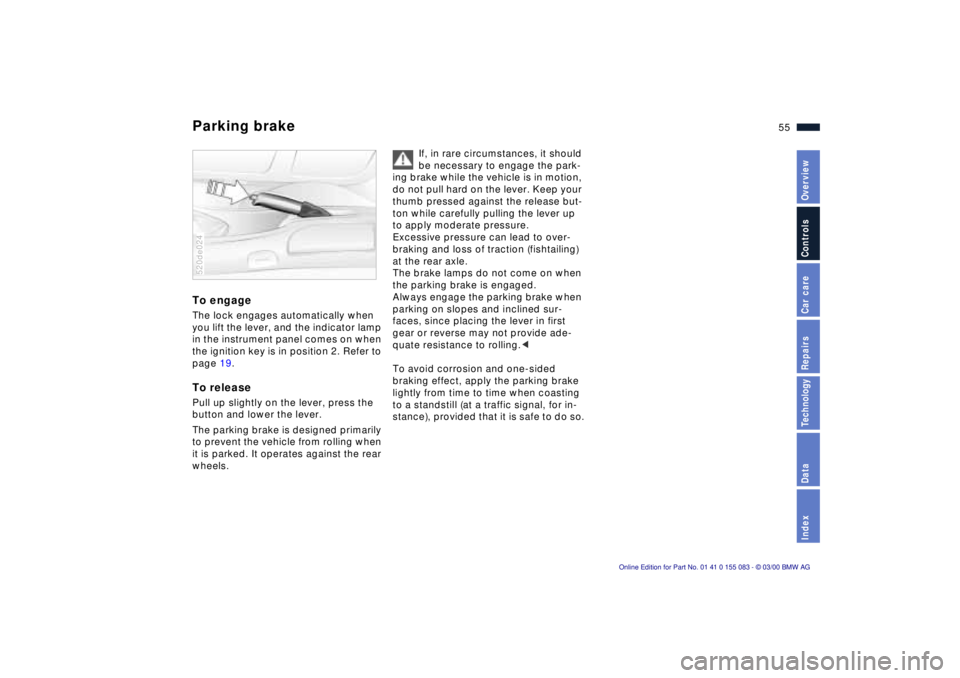
Parking brake To engageThe lock engages automatically when
you lift the lever, and the indicator lamp
in the instrument panel comes on when
the ignition key is in position 2. Refer to
page 19.To releasePull up slightly on the lever, press the
button and lower the lever.
The parking brake is designed primarily
to prevent the vehicle from rolling when
it is parked. It operates against the rear
wheels.520de024
If, in rare circumstances, it should
be necessary to engage the park-
ing brake while the vehicle is in motion,
do not pull hard on the lever. Keep your
thumb pressed against the release but-
ton while carefully pulling the lever up
to apply moderate pressure.
Excessive pressure can lead to over-
braking and loss of traction (fishtailing)
at the rear axle.
The brake lamps do not come on when
the parking brake is engaged.
Always engage the parking brake when
parking on slopes and inclined sur-
faces, since placing the lever in first
gear or reverse may not provide ade-
quate resistance to rolling.<
To avoid corrosion and one-sided
braking effect, apply the parking brake
lightly from time to time when coasting
to a standstill (at a traffic signal, for in-
stance), provided that it is safe to do so.
Page 57 of 172
56n
Manual transmission
Turn signal/Headlamp flasher
Every time you shift gears, always de-
press the clutch pedal all the way down,
pushing the manual-shift gear lever into
the desired position.
Depress the clutch even when starting
the engine, otherwise, a lock will pre-
vent the engine from being started.
The shift lever's neutral plane is located
between third and fourth gear.
When shifting from each gear into
"Neutral," the shift lever returns auto-
matically to this gear plane because of
its spring loading.520de114
When shifting gears in the fifth/
sixth gear, be sure to press the
gear lever to the right in order to pre-
vent inadvertent selection of a gear in
the third/fourth.<
Reverse Select "Reverse" only when the vehicle
is stationary. Press the shift lever to the
left to overcome the resistance.
As you do this, the backup lamp will
turn on automatically when the ignition
key is in position 2.
Do not hold the vehicle in place on
slopes by slipping or "riding" the
clutch. Use the parking brake instead. A
slipping clutch increases clutch wear.<
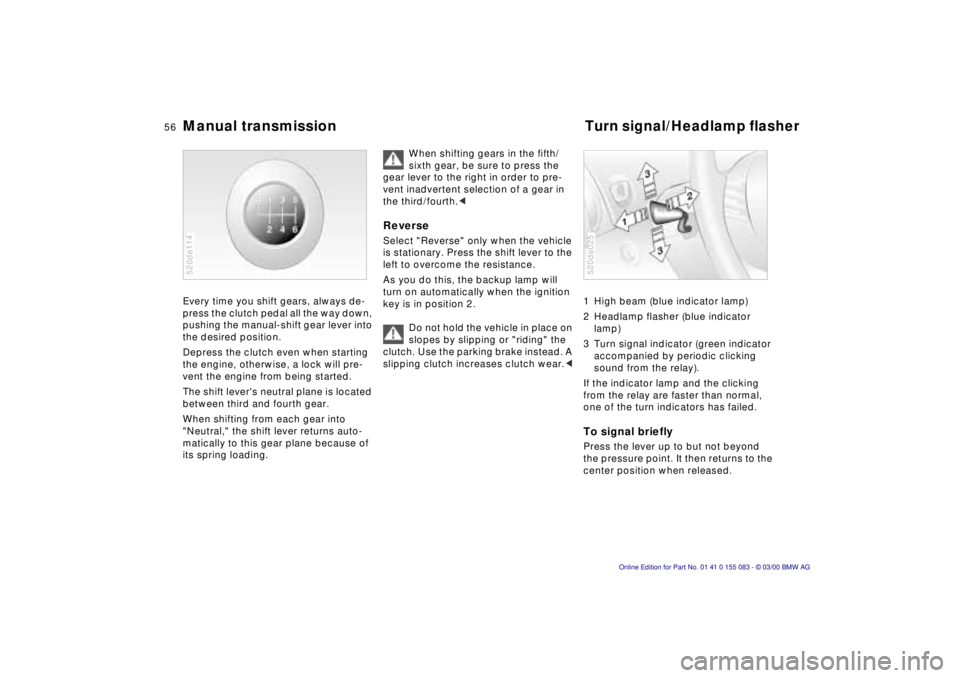
1 High beam (blue indicator lamp)
2 Headlamp flasher (blue indicator
lamp)
3 Turn signal indicator (green indicator
accompanied by periodic clicking
sound from the relay).
If the indicator lamp and the clicking
from the relay are faster than normal,
one of the turn indicators has failed.To signal brieflyPress the lever up to but not beyond
the pressure point. It then returns to the
center position when released.520de025
Page 85 of 172

84n
To ensure that your vehicle provides
maximum economy throughout a long
service life, we request that you
observe the following instructions:
Your BMW Z8 roadster is an espe-
cially high-quality vehicle. It is in
your best interest to follow the break-in
instructions very closely. Doing this will
create the basis for a long, optimum
service life.<
Engine and differentialUp to 1,200 miles (2,000 km):
Drive at varying engine and road
speeds, but do not exceed 4,500 rpm
(4,500/min), or a road speed of 106 mph
(170 km/h).
Obey your local and state maximum
speed limits.
Absolutely refrain from the full-throttle
position with the accelerator.
Once you have driven 1,200 miles
(2,000 km), you can begin to gradually
increase both the engine speed and
road speed.
You should also comply with these
break-in procedures if the engine or
differential is replaced later in the
course of the vehicle service life.TiresDue to technical factors associated
with their manufacture, tires do not
achieve their full traction potential until
an initial break-in period has elapsed.
Thus, drive with extra care during the
initial 200 miles (300 km).
Obey your local and state maximum
speed limits.
When the vehicle is being driven
on wet or slushy roads, a wedge
of water may form between the tire and
the road surface. This phenomenon is
referred to as "aquaplaning," or "hydro-
planing," and can lead to partial or
complete loss of traction, vehicle con-
trol and braking effectiveness. Reduce
your speed on wet roads.<
Brake systemApproximately 300 miles (500 km) must
elapse before the brake pads and
rotors achieve the optimal pad-surface
and wear patterns required for trouble-
free operation and long service life.
To break in the separate parking brake
drums, apply the parking brake lightly
when coasting to a standstill (at a traffic
signal, for instance), provided that traf-
fic conditions allow you to do so.
To avoid corrosion, repeat this proce-
dure from time to time.
The brake lamps do not come
on when the parking brake is en-
gaged.
Vacuum for the brake system servo unit
on your BMW is available only when the
engine is running. When you move the
vehicle with the engine shut off Ð when
towing, for instance Ð substantially
higher levels of pedal force will be
required to brake the vehicle.
Engage the gears carefully and without
high engine speeds during this break-in
period.
Break-in procedures