ignition BMW Z8 2000 User Guide
[x] Cancel search | Manufacturer: BMW, Model Year: 2000, Model line: Z8, Model: BMW Z8 2000Pages: 172, PDF Size: 1.9 MB
Page 54 of 172
53n
IndexDataTechnologyRepairsCar careControlsOverview
Your car has a steering-column lock
driven by an electric motor.Releasing the steering and
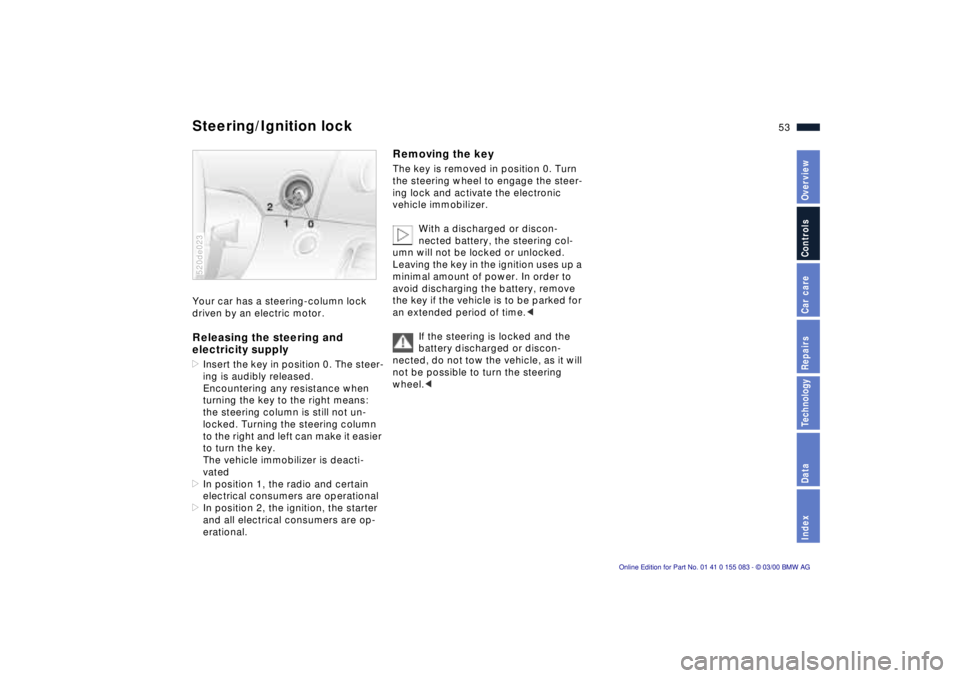
electricity supply>Insert the key in position 0. The steer-
ing is audibly released.
Encountering any resistance when
turning the key to the right means:
the steering column is still not un-
locked. Turning the steering column
to the right and left can make it easier
to turn the key.
The vehicle immobilizer is deacti-
vated
>In position 1, the radio and certain
electrical consumers are operational
>In position 2, the ignition, the starter
and all electrical consumers are op-
erational.520de023
Removing the keyThe key is removed in position 0. Turn
the steering wheel to engage the steer-
ing lock and activate the electronic
vehicle immobilizer.
With a discharged or discon-
nected battery, the steering col-
umn will not be locked or unlocked.
Leaving the key in the ignition uses up a
minimal amount of power. In order to
avoid discharging the battery, remove
the key if the vehicle is to be parked for
an extended period of time.<
If the steering is locked and the
battery discharged or discon-
nected, do not tow the vehicle, as it will
not be possible to turn the steering
wheel.<
Steering/Ignition lock
Page 55 of 172
54n
Starting the engine Turning the engine off Before starting>Engage the parking brake
>Manual-shift gear lever in idling
position
>Depress the clutch pedal
>Key in position 2.
Do not allow the engine to run in
enclosed areas. The exhaust
gases contain carbon monoxide, an
odorless and colorless, but highly toxic
gas. Breathing the exhaust gases poses
an extreme health risk, and can lead to
unconsciousness and death.
Do not leave the vehicle unattended
with the engine running. An unattended
vehicle with a running engine repre-
sents a potential safety hazard.<520de141
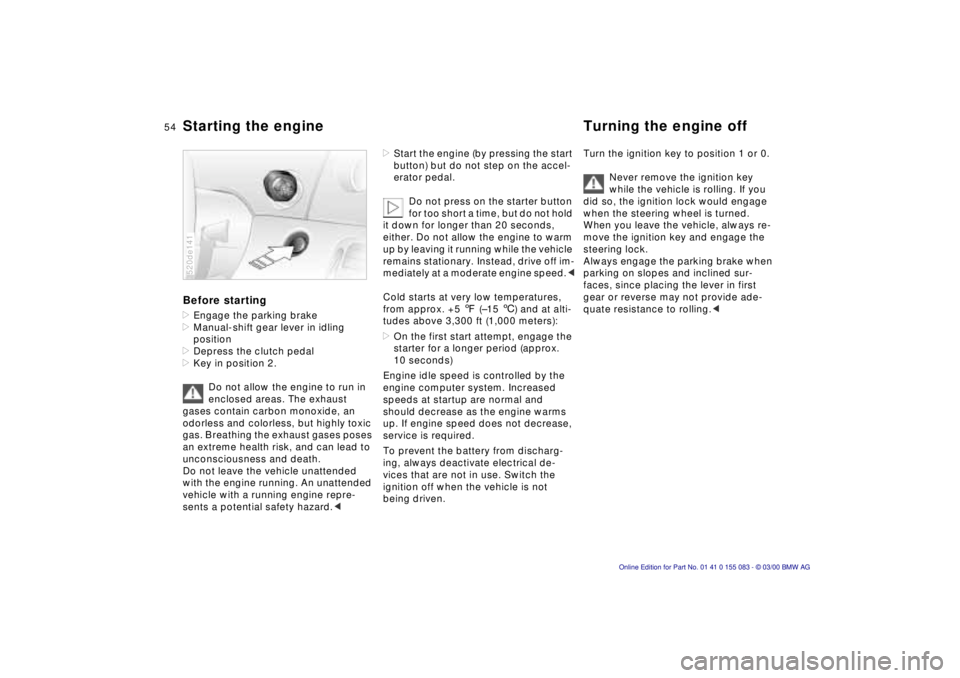
>Start the engine (by pressing the start
button) but do not step on the accel-
erator pedal.
Do not press on the starter button
for too short a time, but do not hold
it down for longer than 20 seconds,
either. Do not allow the engine to warm
up by leaving it running while the vehicle
remains stationary. Instead, drive off im-
mediately at a moderate engine speed.<
Cold starts at very low temperatures,
from approx. +5 7 (Ð15 6) and at alti-
tudes above 3,300 ft (1,000 meters):
>On the first start attempt, engage the
starter for a longer period (approx.
10 seconds)
Engine idle speed is controlled by the
engine computer system. Increased
speeds at startup are normal and
should decrease as the engine warms
up. If engine speed does not decrease,
service is required.
To prevent the battery from discharg-
ing, always deactivate electrical de-
vices that are not in use. Switch the
ignition off when the vehicle is not
being driven.
Turn the ignition key to position 1 or 0.
Never remove the ignition key
while the vehicle is rolling. If you
did so, the ignition lock would engage
when the steering wheel is turned.
When you leave the vehicle, always re-
move the ignition key and engage the
steering lock.
Always engage the parking brake when
parking on slopes and inclined sur-
faces, since placing the lever in first
gear or reverse may not provide ade-
quate resistance to rolling.<
Page 56 of 172
55n
IndexDataTechnologyRepairsCar careControlsOverview
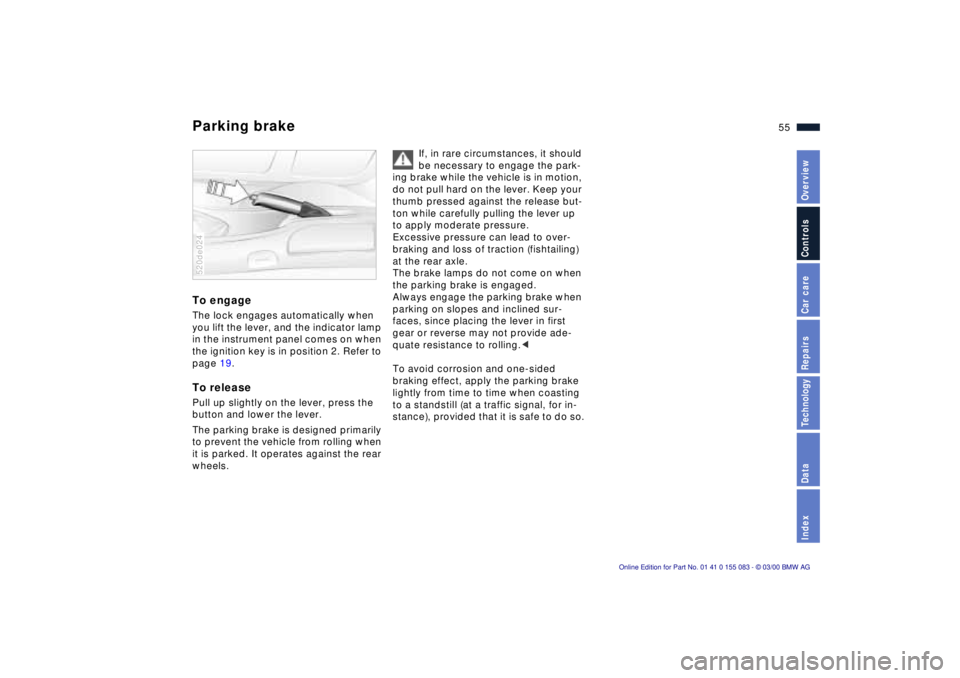
Parking brake To engageThe lock engages automatically when
you lift the lever, and the indicator lamp
in the instrument panel comes on when
the ignition key is in position 2. Refer to
page 19.To releasePull up slightly on the lever, press the
button and lower the lever.
The parking brake is designed primarily
to prevent the vehicle from rolling when
it is parked. It operates against the rear
wheels.520de024
If, in rare circumstances, it should
be necessary to engage the park-
ing brake while the vehicle is in motion,
do not pull hard on the lever. Keep your
thumb pressed against the release but-
ton while carefully pulling the lever up
to apply moderate pressure.
Excessive pressure can lead to over-
braking and loss of traction (fishtailing)
at the rear axle.
The brake lamps do not come on when
the parking brake is engaged.
Always engage the parking brake when
parking on slopes and inclined sur-
faces, since placing the lever in first
gear or reverse may not provide ade-
quate resistance to rolling.<
To avoid corrosion and one-sided
braking effect, apply the parking brake
lightly from time to time when coasting
to a standstill (at a traffic signal, for in-
stance), provided that it is safe to do so.
Page 57 of 172
56n
Manual transmission
Turn signal/Headlamp flasher
Every time you shift gears, always de-
press the clutch pedal all the way down,
pushing the manual-shift gear lever into
the desired position.
Depress the clutch even when starting
the engine, otherwise, a lock will pre-
vent the engine from being started.
The shift lever's neutral plane is located
between third and fourth gear.
When shifting from each gear into
"Neutral," the shift lever returns auto-
matically to this gear plane because of
its spring loading.520de114
When shifting gears in the fifth/
sixth gear, be sure to press the
gear lever to the right in order to pre-
vent inadvertent selection of a gear in
the third/fourth.<
Reverse Select "Reverse" only when the vehicle
is stationary. Press the shift lever to the
left to overcome the resistance.
As you do this, the backup lamp will
turn on automatically when the ignition
key is in position 2.
Do not hold the vehicle in place on
slopes by slipping or "riding" the
clutch. Use the parking brake instead. A
slipping clutch increases clutch wear.<
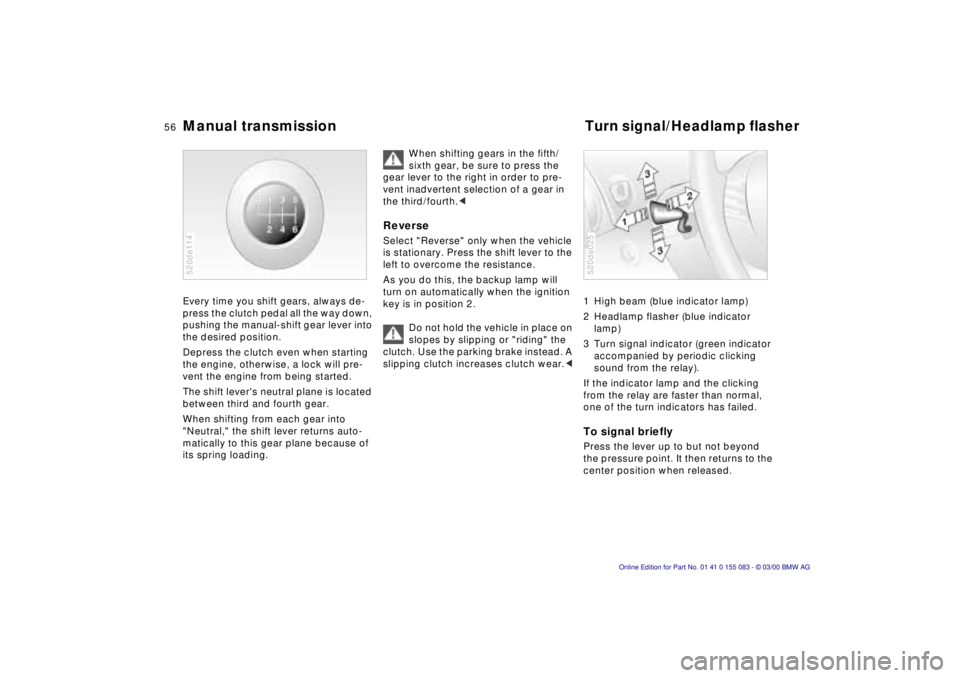
1 High beam (blue indicator lamp)
2 Headlamp flasher (blue indicator
lamp)
3 Turn signal indicator (green indicator
accompanied by periodic clicking
sound from the relay).
If the indicator lamp and the clicking
from the relay are faster than normal,
one of the turn indicators has failed.To signal brieflyPress the lever up to but not beyond
the pressure point. It then returns to the
center position when released.520de025
Page 58 of 172
57n
IndexDataTechnologyRepairsCar careControlsOverview
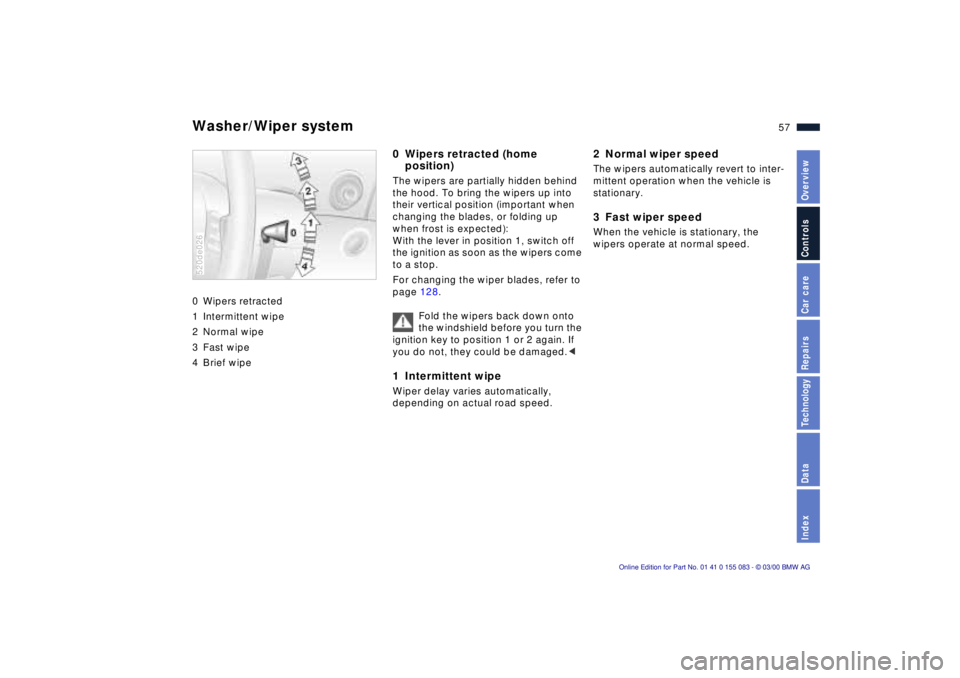
Washer/Wiper system 0 Wipers retracted
1 Intermittent wipe
2 Normal wipe
3 Fast wipe
4 Brief wipe520de026
0 Wipers retracted (home
position) The wipers are partially hidden behind
the hood. To bring the wipers up into
their vertical position (important when
changing the blades, or folding up
when frost is expected):
With the lever in position 1, switch off
the ignition as soon as the wipers come
to a stop.
For changing the wiper blades, refer to
page 128.
Fold the wipers back down onto
the windshield before you turn the
ignition key to position 1 or 2 again. If
you do not, they could be damaged.<1 Intermittent wipe Wiper delay varies automatically,
depending on actual road speed.
2 Normal wiper speedThe wipers automatically revert to inter-
mittent operation when the vehicle is
stationary.3 Fast wiper speedWhen the vehicle is stationary, the
wipers operate at normal speed.
Page 59 of 172
58n
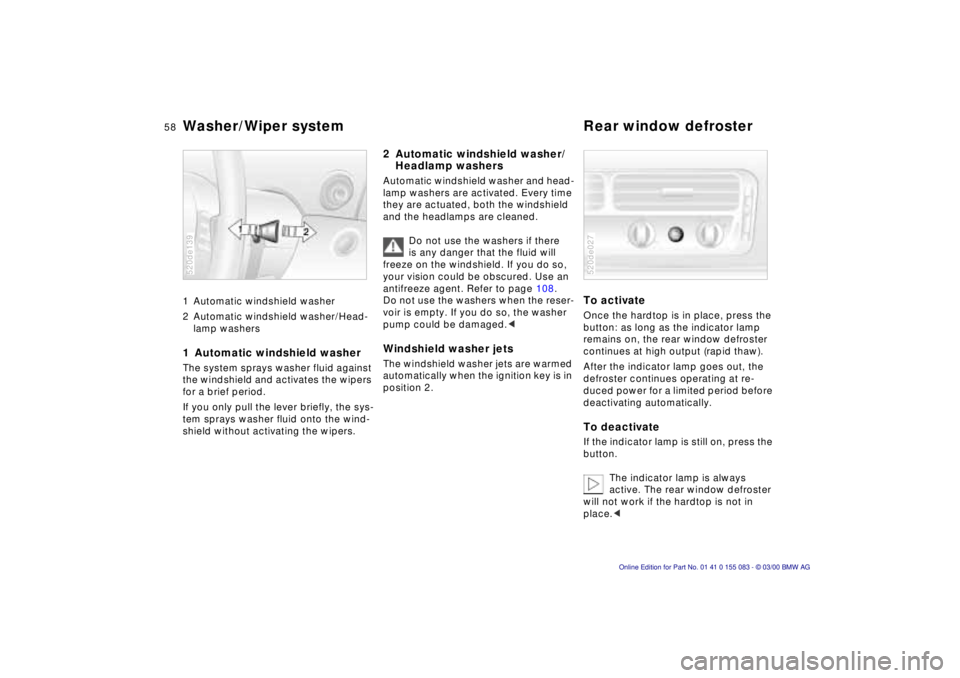
Washer/Wiper system Rear window defroster 1 Automatic windshield washer
2 Automatic windshield washer/Head-
lamp washers1 Automatic windshield washer The system sprays washer fluid against
the windshield and activates the wipers
for a brief period.
If you only pull the lever briefly, the sys-
tem sprays washer fluid onto the wind-
shield without activating the wipers.520de139
2 Automatic windshield washer/
Headlamp washers Automatic windshield washer and head-
lamp washers are activated. Every time
they are actuated, both the windshield
and the headlamps are cleaned.
Do not use the washers if there
is any danger that the fluid will
freeze on the windshield. If you do so,
your vision could be obscured. Use an
antifreeze agent. Refer to page 108.
Do not use the washers when the reser-
voir is empty. If you do so, the washer
pump could be damaged.
position 2.
To activateOnce the hardtop is in place, press the
button: as long as the indicator lamp
remains on, the rear window defroster
continues at high output (rapid thaw).
After the indicator lamp goes out, the
defroster continues operating at re-
duced power for a limited period before
deactivating automatically. To deactivateIf the indicator lamp is still on, press the
button.
The indicator lamp is always
active. The rear window defroster
will not work if the hardtop is not in
place.<520de027
Page 60 of 172
59n
IndexDataTechnologyRepairsCar careControlsOverview
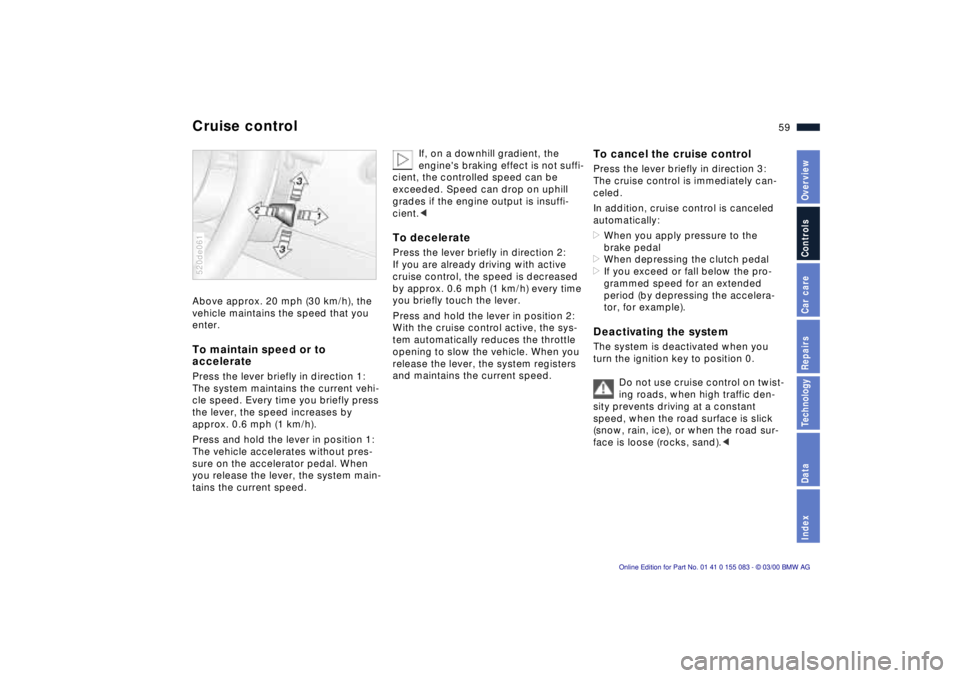
Cruise control Above approx. 20 mph (30 km/h), the
vehicle maintains the speed that you
enter. To maintain speed or to
acceleratePress the lever briefly in direction 1:
The system maintains the current vehi-
cle speed. Every time you briefly press
the lever, the speed increases by
approx. 0.6 mph (1 km/h).
Press and hold the lever in position 1:
The vehicle accelerates without pres-
sure on the accelerator pedal. When
you release the lever, the system main-
tains the current speed.520de061
If, on a downhill gradient, the
engine's braking effect is not suffi-
cient, the controlled speed can be
exceeded. Speed can drop on uphill
grades if the engine output is insuffi-
cient.<
To deceleratePress the lever briefly in direction 2:
If you are already driving with active
cruise control, the speed is decreased
by approx. 0.6 mph (1 km/h) every time
you briefly touch the lever.
Press and hold the lever in position 2:
With the cruise control active, the sys-
tem automatically reduces the throttle
opening to slow the vehicle. When you
release the lever, the system registers
and maintains the current speed.
To cancel the cruise controlPress the lever briefly in direction 3:
The cruise control is immediately can-
celed.
In addition, cruise control is canceled
automatically:
>When you apply pressure to the
brake pedal
>When depressing the clutch pedal
>If you exceed or fall below the pro-
grammed speed for an extended
period (by depressing the accelera-
tor, for example).Deactivating the system The system is deactivated when you
turn the ignition key to position 0.
Do not use cruise control on twist-
ing roads, when high traffic den-
sity prevents driving at a constant
speed, when the road surface is slick
(snow, rain, ice), or when the road sur-
face is loose (rocks, sand).<
Page 61 of 172
60n
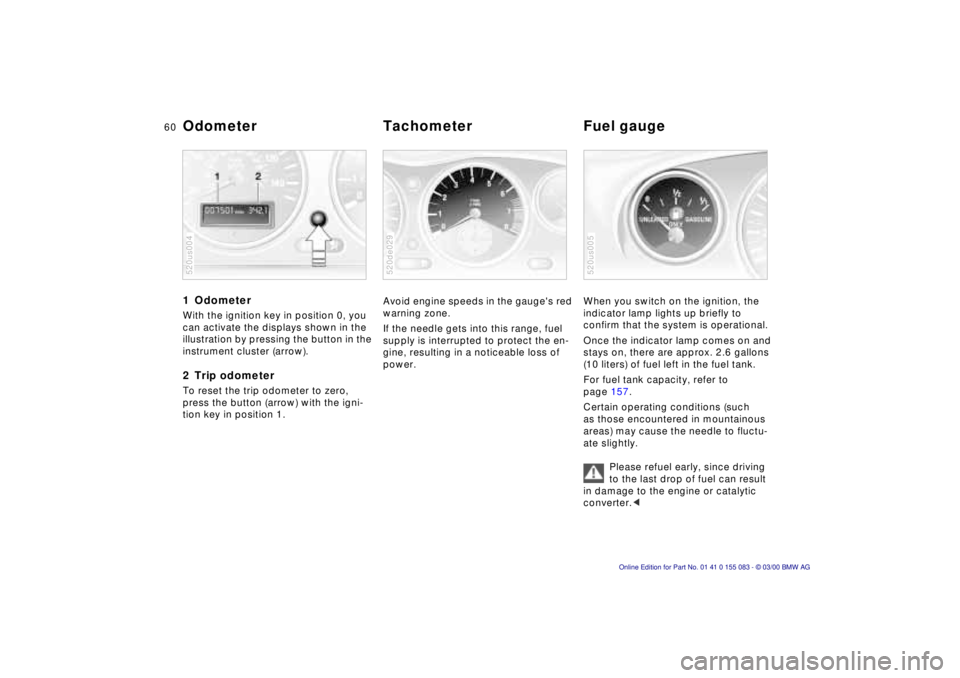
1 Odometer With the ignition key in position 0, you
can activate the displays shown in the
illustration by pressing the button in the
instrument cluster (arrow).2 Trip odometerTo reset the trip odometer to zero,
press the button (arrow) with the igni-
tion key in position 1.520us004
Avoid engine speeds in the gauge's red
warning zone.
If the needle gets into this range, fuel
supply is interrupted to protect the en-
gine, resulting in a noticeable loss of
power.520de029
When you switch on the ignition, the
indicator lamp lights up briefly to
confirm that the system is operational.
Once the indicator lamp comes on and
stays on, there are approx. 2.6 gallons
(10 liters) of fuel left in the fuel tank.
For fuel tank capacity, refer to
page 157.
Certain operating conditions (such
as those encountered in mountainous
areas) may cause the needle to fluctu-
ate slightly.
Please refuel early, since driving
to the last drop of fuel can result
in damage to the engine or catalytic
converter.<520us005
Odometer Tachometer Fuel gauge
Page 62 of 172
61n
IndexDataTechnologyRepairsCar careControlsOverview
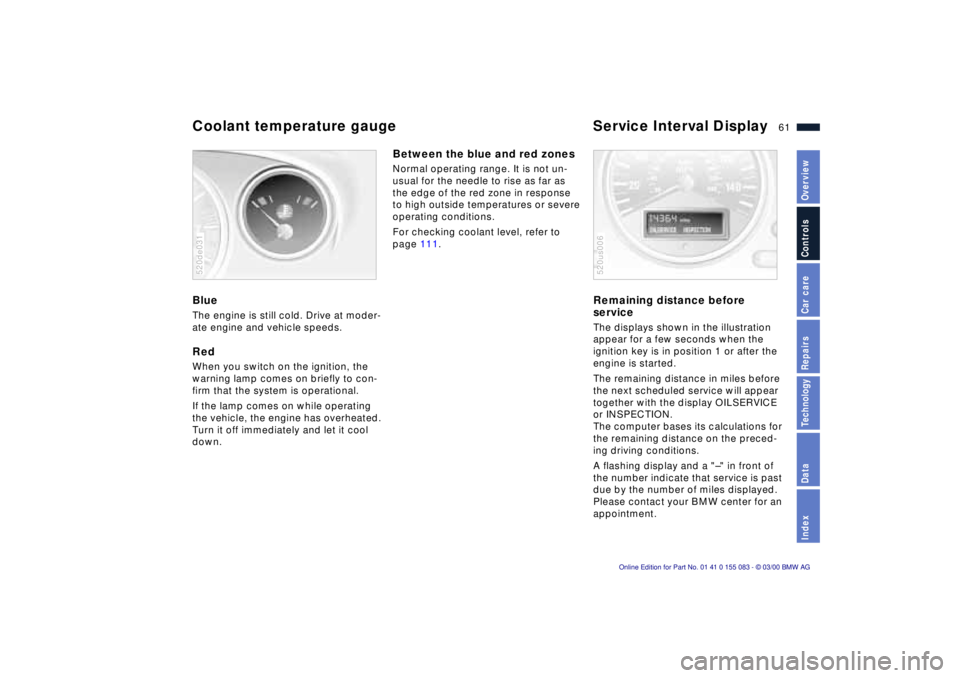
Coolant temperature gauge Service Interval Display BlueThe engine is still cold. Drive at moder-
ate engine and vehicle speeds.RedWhen you switch on the ignition, the
warning lamp comes on briefly to con-
firm that the system is operational.
If the lamp comes on while operating
the vehicle, the engine has overheated.
Turn it off immediately and let it cool
down.520de031
Between the blue and red zonesNormal operating range. It is not un-
usual for the needle to rise as far as
the edge of the red zone in response
to high outside temperatures or severe
operating conditions.
For checking coolant level, refer to
page 111.
Remaining distance before
serviceThe displays shown in the illustration
appear for a few seconds when the
ignition key is in position 1 or after the
engine is started.
The remaining distance in miles before
the next scheduled service will appear
together with the display OILSERVICE
or INSPECTION.
The computer bases its calculations for
the remaining distance on the preced-
ing driving conditions.
A flashing display and a "Ð" in front of
the number indicate that service is past
due by the number of miles displayed.
Please contact your BMW center for an
appointment.520us006
Page 63 of 172
62n
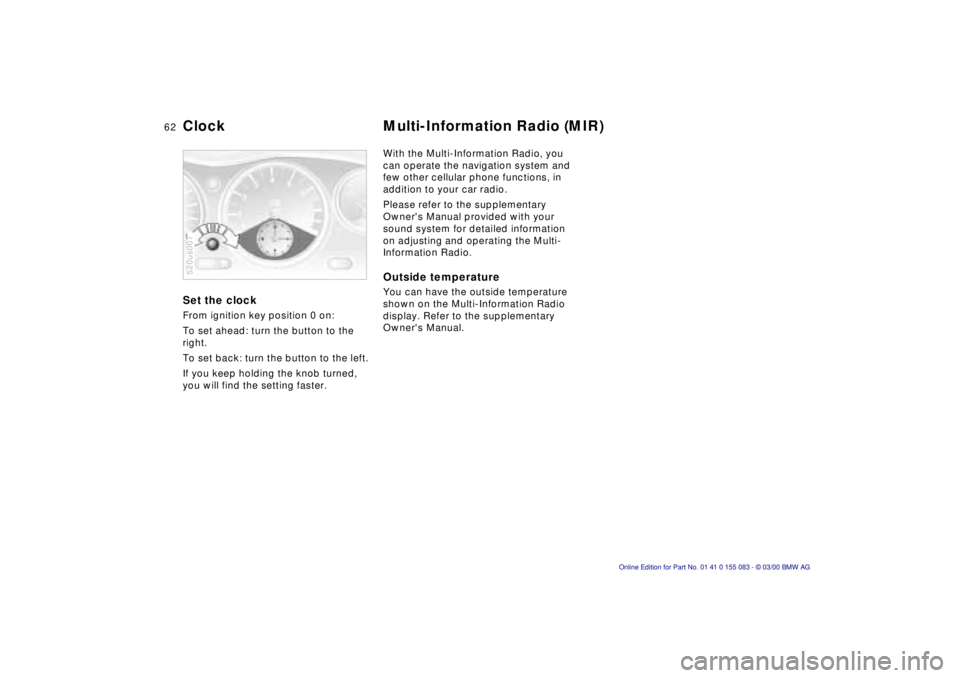
Set the clock From ignition key position 0 on:
To set ahead: turn the button to the
right.
To set back: turn the button to the left.
If you keep holding the knob turned,
you will find the setting faster.520us007
With the Multi-Information Radio, you
can operate the navigation system and
few other cellular phone functions, in
addition to your car radio.
Please refer to the supplementary
Owner's Manual provided with your
sound system for detailed information
on adjusting and operating the Multi-
Information Radio. Outside temperature You can have the outside temperature
shown on the Multi-Information Radio
display. Refer to the supplementary
Owner's Manual.
Clock Multi-Information Radio (MIR)