ignition BMW Z8 2000 Owner's Guide
[x] Cancel search | Manufacturer: BMW, Model Year: 2000, Model line: Z8, Model: BMW Z8 2000Pages: 172, PDF Size: 1.9 MB
Page 129 of 172
128n
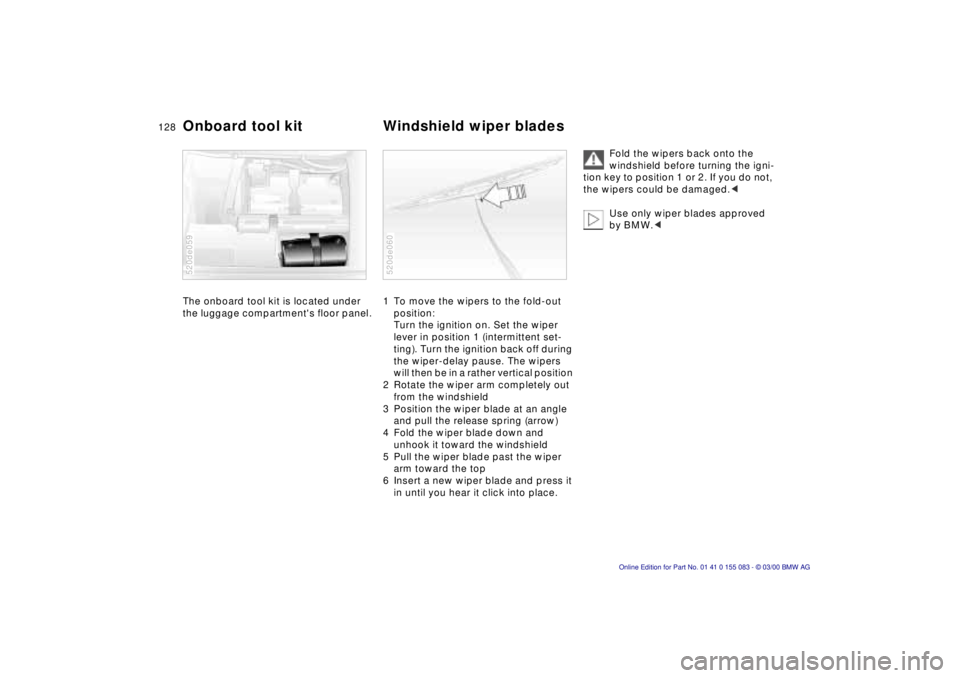
The onboard tool kit is located under
the luggage compartment's floor panel.
520de059
1 To move the wipers to the fold-out
position:
Turn the ignition on. Set the wiper
lever in position 1 (intermittent set-
ting). Turn the ignition back off during
the wiper-delay pause. The wipers
will then be in a rather vertical position
2 Rotate the wiper arm completely out
from the windshield
3 Position the wiper blade at an angle
and pull the release spring (arrow)
4 Fold the wiper blade down and
unhook it toward the windshield
5 Pull the wiper blade past the wiper
arm toward the top
6 Insert a new wiper blade and press it
in until you hear it click into place. 520de060
Fold the wipers back onto the
windshield before turning the igni-
tion key to position 1 or 2. If you do not,
the wipers could be damaged.<
Use only wiper blades approved
by BMW.<
Onboard tool kit Windshield wiper blades
Page 137 of 172
136n
Battery
Battery posts, terminals, and re-
lated accessories contain lead
and lead compounds. Wash hands after
handling.<
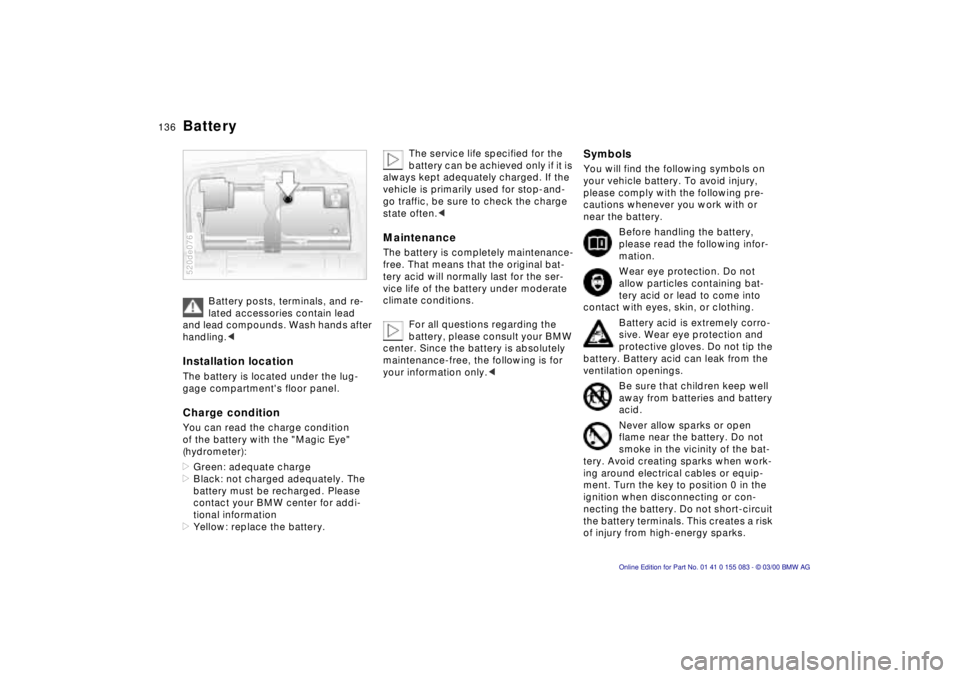
Installation location The battery is located under the lug-
gage compartment's floor panel.Charge conditionYou can read the charge condition
of the battery with the "Magic Eye"
(hydrometer):
>Green: adequate charge
>Black: not charged adequately. The
battery must be recharged. Please
contact your BMW center for addi-
tional information
>Yellow: replace the battery.520de076
The service life specified for the
battery can be achieved only if it is
always kept adequately charged. If the
vehicle is primarily used for stop-and-
go traffic, be sure to check the charge
state often.<
MaintenanceThe battery is completely maintenance-
free. That means that the original bat-
tery acid will normally last for the ser-
vice life of the battery under moderate
climate conditions.
For all questions regarding the
battery, please consult your BMW
center. Since the battery is absolutely
maintenance-free, the following is for
your information only.<
SymbolsYou will find the following symbols on
your vehicle battery. To avoid injury,
please comply with the following pre-
cautions whenever you work with or
near the battery.
Before handling the battery,
please read the following infor-
mation.
Wear eye protection. Do not
allow particles containing bat-
tery acid or lead to come into
contact with eyes, skin, or clothing.
Battery acid is extremely corro-
sive. Wear eye protection and
protective gloves. Do not tip the
battery. Battery acid can leak from the
ventilation openings.
Be sure that children keep well
away from batteries and battery
acid.
Never allow sparks or open
flame near the battery. Do not
smoke in the vicinity of the bat-
tery. Avoid creating sparks when work-
ing around electrical cables or equip-
ment. Turn the key to position 0 in the
ignition when disconnecting or con-
necting the battery. Do not short-circuit
the battery terminals. This creates a risk
of injury from high-energy sparks.
Page 146 of 172
145n
IndexDataTechnologyRepairsCar careControlsOverview
Towing
Avoid "off-center" towing. Be sure
that the tow rope is pulled tightly
when the towing vehicle begins to
move.<
The towed vehicle should always
be the lighter of the two vehicles.
If this is not the case, it is no longer
possible to control vehicle response.<
Tow-startingFor instructions on jump starting, refer
to page 143.
Never attempt to use your vehicle to
push another vehicle, since damage to
the energy-absorbing bumpers could
result.
Towing a vehicle1 Put the manual-shift gear lever in
neutral
2 Towing speed:
Max. 45 mph (70 km/h)
3 Towing distance:
Max. 95 miles (150 km)
4 Leave the ignition key at position 1 to
ensure that the brake lamps, turn sig-
nals, horn and windshield wipers
remain operative, and to prevent the
steering lock detent from engaging
5 Switch on the hazard-warning system
(comply with country-specific regula-
tions).
Find some means of identifying the
vehicle in tow, e. g. place a sign or
warning triangle in the rear window.
Make sure that the ignition key re-
mains in position 1 even when the
electrical system has failed to prevent
the steering lock from engaging. The
steering and brakes are without power
assist when the engine is not running.
This means that increased effort is
required for steering and braking.<
Towing with a commercial tow
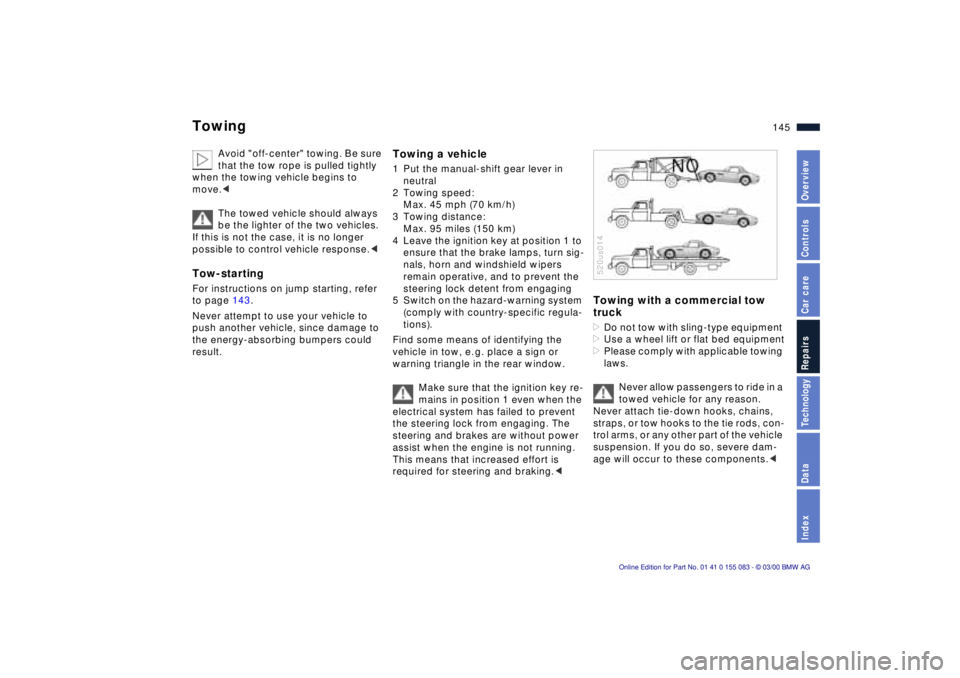
truck>Do not tow with sling-type equipment
>Use a wheel lift or flat bed equipment
>Please comply with applicable towing
laws.
Never allow passengers to ride in a
towed vehicle for any reason.
Never attach tie-down hooks, chains,
straps, or tow hooks to the tie rods, con-
trol arms, or any other part of the vehicle
suspension. If you do so, severe dam-
age will occur to these components.<520us014
Page 149 of 172
148n
Deceleration sensors continuously
monitor the acceleration forces acting
upon the vehicle. If, as the result of a
frontal collision, a deceleration is
reached at which the protection of the
safety belts alone is no longer adequate,
the gas generators of the driver and
passenger airbags are ignited. However,
the passenger airbag is only triggered if
an additional sensor has recognized
that the passenger seat is occupied.
In the event of a side collision, only the
side airbags will be triggered if neces-
sary. And only that airbag for that side
of the vehicle where the collision
occurred will be triggered.
390de012
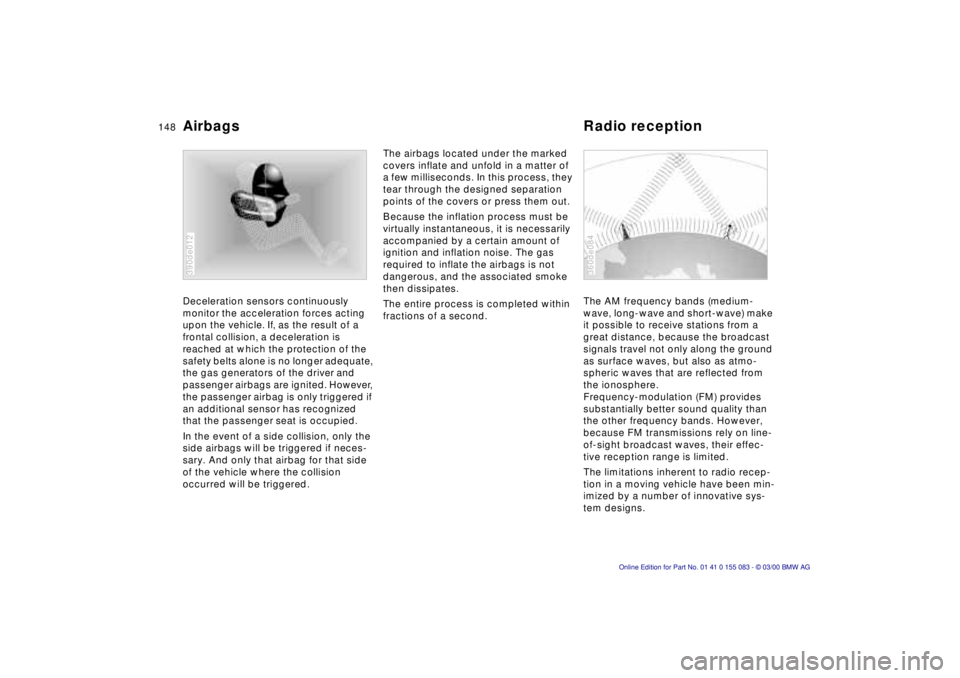
The airbags located under the marked
covers inflate and unfold in a matter of
a few milliseconds. In this process, they
tear through the designed separation
points of the covers or press them out.
Because the inflation process must be
virtually instantaneous, it is necessarily
accompanied by a certain amount of
ignition and inflation noise. The gas
required to inflate the airbags is not
dangerous, and the associated smoke
then dissipates.
The entire process is completed within
fractions of a second.The AM frequency bands (medium-
wave, long-wave and short-wave) make
it possible to receive stations from a
great distance, because the broadcast
signals travel not only along the ground
as surface waves, but also as atmo-
spheric waves that are reflected from
the ionosphere.
Frequency-modulation (FM) provides
substantially better sound quality than
the other frequency bands. However,
because FM transmissions rely on line-
of-sight broadcast waves, their effec-
tive reception range is limited.
The limitations inherent to radio recep-
tion in a moving vehicle have been min-
imized by a number of innovative sys-
tem designs.
360de084
Airbags Radio reception
Page 159 of 172

158n
Electrical system Drive belts Battery 12V, 90 AhSpark plugs NGK BKR 6 EQUP
This spark ignition system meets all
requirements of the Canadian Interfer-
ence-Causing Equipment Regulations
(ICES-2).Water pump Ð Alternator Ð Power
steering
Ribbed V-belt 7 PK 1440
A/C compressor
Ribbed V-belt 5 PK 980You can obtain Original BMW
Parts and Accessories, as well
as professional advice from your BMW
center.<
Page 165 of 172

Everything from A to ZHeadlamp washer
system108,157
Headlamp washers58
Heating and ventilation70
Heating, rapid75
Heavy loads81
Height155
High beams21,56,68
Holder for beverage
cans78
Hood release104
Horn15 I
Identification, tires101
Ignition keys28
Ignition lock53
Indicator lamps18
Inflation pressure24,96
monitoring65
INSPECTION61
Instrument cluster16
Instrument lighting67
Instruments16
Interaxle tire rotation100
Interface socket for On-
Board-Diagnostics124
Interference
cellular phone92
Interior lamps32,68
bulb replacement133
remote control32 Interior motion sensor36
Interior rearview mirror
with automatic
dimmer46,150
Intermittent wipe57
J
Jump starting143 K
Key Memory46
Key with remote control28
Keys28 L
Lamps on warning67
Leather care120
Length155
License plate lamp
bulb replacement131
Light switch67
Light-alloy wheels103
Lighter80
Loading81
Louvers70
Low beam headlamps67
Low beam light inside
rearview mirror46
Low traction road
surfaces91 Luggage compartment
capacity156
emergency release35
remote control33
Luggage compartment lamp
bulb replacement134
Luggage compartment
lid35
emergency release35
M
M+S tires102
Maintenance61,114
Manual transmission56
Microfilter73
MID (Multi-Information
Radio)62
Mirrors45
Mobile cellular phones92
Modifications,
technical4,123
Multi-Information Radio
(MID)62 N
Navigation system, refer to
the radio Owner's Manual
Neckrest44 O
OBD interface socket124 Odometer60
Oil
additives109
consumption109
fill capacity157
quality110
specifications110
viscosity110
Oil change intervals, see the
Service and Warranty
Information Booklet (US
models) or the Warranty
and Service Guide Booklet
(Canadian models)
Oil dipstick109
Oil level
check109
indicator lamp19
Oil pressure
indicator lamp18
OILSERVICE61
Onboard tool kit128
Opening and closing
from inside34
from outside30
Outlets, ventilation70
Outside temperature
display62
P
Paint blemishes117
Paint, care117