alarm BMW Z8 2000 Owners Manual
[x] Cancel search | Manufacturer: BMW, Model Year: 2000, Model line: Z8, Model: BMW Z8 2000Pages: 172, PDF Size: 1.9 MB
Page 5 of 172
4n
For your own safety
Use unleaded gasoline only. Fuels
containing up to and including
10 % ethanol or other oxygenates with
up to 2.8 % oxygen by weight (i. e. 15 %
MTBE or 3 % methanol plus an equiva-
lent amount of co-solvent) will not void
the applicable warranties respecting
defects in materials or workmanship.
Field experience has indicated signifi-
cant differences in fuel quality (volatility,
composition, additives, others) among
gasolines offered for sale in the United
States and Canada. The use of poor-
quality fuels may result in driveability,
starting and stalling problems espe-
cially under certain environmental con-
ditions such as high ambient tempera-
ture and high altitude.
Should you encounter driveability prob-
lems which you suspect could be re-
lated to the fuel you are using, we rec-
ommend that you respond by switching
to a recognized high-quality brand.
Failure to comply with these recom-
mendations may result in unscheduled
maintenance.
Follow the relevant safety rules when
you are handling gasoline.
<
Important safety information.
For your own safety, use genuine parts
and accessories approved by BMW.
When you purchase accessories tested
and approved by BMW and Original
BMW Parts, you simultaneously acquire
the assurance that they have been thor-
oughly tested by BMW to ensure opti-
mum performance when installed on
your vehicle.
BMW warrants these parts to be free
from defects in material and workman-
ship.
BMW will not accept any liability for
damage resulting from installation of
parts and accessories not approved by
BMW.
BMW cannot test every product made
by other manufacturers to verify if it can
be used on a BMW safely and without
risk to either the vehicle, its operation,
or its occupants.
Original BMW Parts, BMW Accessories
and other products approved by BMW,
together with professional advice on
using these items, are available from all
BMW centers.
Installation and operation of non-BMW
approved accessories such as alarms,
radios, amplifiers, radar detectors,
wheels, suspension components, brake
dust shields, telephones (including
operation of any portable cellular phone
from within the vehicle without using an
externally mounted antenna) or trans-
ceiver equipment (such as C.B., walkie-
talkie, ham radio or similar) may cause
extensive damage to the vehicle, com-
promise its safety, interfere with the
vehicle's electrical system or affect the
validity of the BMW Limited Warranty.
See your BMW center for additional
information.
<
Maintenance, replacement, or re-
pair of the emission control de-
vices and systems may be performed
by any automotive repair establishment
or individual using any certified auto-
motive part.
<
Symbol for vehicle parts
Indicates that you should consult
the relevant section of this
Owner's Manual for information on a
particular part or assembly.
For your own safety
Page 9 of 172

Contents
Overview
Controls and features
Cockpit14
Instrument cluster16
Indicator and warning lamps18
Hazard warning flashers22
Warning triangle22
First-aid kit22
Refueling23
Fuel quality24
Tire inflation pressure24
Locks and security systems:
Keys28
Electronic vehicle
immobilizer29
Central locking system30
Opening and closing Ð from
outside30
Using the key30
Using the remote control31
Opening and closing Ð from
inside34
Luggage compartment lid35
Alarm system36
Electric power windows38
The automatic convertible
top39
Adjustments:
Seats43
Steering wheel45
Mirrors45
Car Memory, Key Memory46
Passenger safety systems:
Safety belts48
Airbags49
Child restraints51
Child seat safety52
Driving:
Steering/Ignition lock53
Starting the engine54
Turning the engine off54
Parking brake55
Manual transmission56
Turn signal indicator/Headlamp
flasher56
Wiper/Washer system57
Rear window defroster58
Cruise control59
Everything under control:
Odometer60
Tachometer60
Fuel gauge60
Coolant temperature gauge61
Service Interval Display61
Clock62
Multi-Information Radio (MIR)62
Technology for safety and
driving convenience:
Dynamic Stability Control
(DSC)63
Dynamic Driving Control64
Tire Pressure Warning (RDW)65
Contents
Page 27 of 172
26n
Locks and security systems:
Keys28
Electronic vehicle
immobilizer29
Central locking system30
Opening and closing Ð from
outside30
Using the key30
Using the remote control31
Opening and closing Ð from
inside34
Luggage compartment lid35
Alarm system36
Electric power windows38
The automatic convertible
top39
Adjustments:
Seats43
Steering wheel45
Mirrors45
Car Memory, Key Memory46
Passenger safety systems:
Safety belts48
Airbags49
Child restraints51
Child seat safety52
Controls
Page 31 of 172
30n
Central locking system Opening and closing Ð from outside The conceptThe central locking system is ready for
operation whenever the driver's door is
closed. The system engages and re-
leases the locks on the:
>Doors
>Luggage compartment lid
>Fuel filler door
>Glove compartment
>Storage shelf for the cellular phone.
The central locking system can be
operated:
>From outside via the driver's door
lock, or by using the remote control
>From inside by pressing a button.
If you initiate central locking from in-
side, neither the fuel filler door, glove
compartment, nor the storage shelf for
the cellular phone are locked (refer to
page 34).
If you do set it from outside, the anti-
theft alarm is automatically activated as
well. This prevents the door handles
from unlocking the doors. The alarm
system is also activated or deactivated.
If locked from inside, the central locking
system unlocks automatically in the
event of an accident. In addition, the
hazard warning flashers and interior
lamps come on.
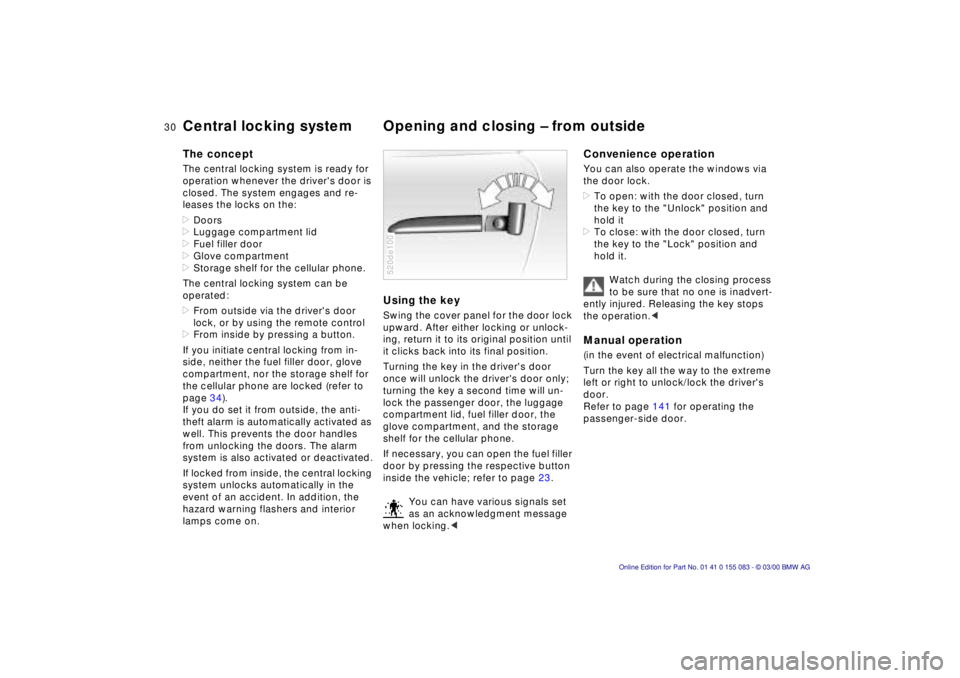
Using the keySwing the cover panel for the door lock
upward. After either locking or unlock-
ing, return it to its original position until
it clicks back into its final position.
Turning the key in the driver's door
once will unlock the driver's door only;
turning the key a second time will un-
lock the passenger door, the luggage
compartment lid, fuel filler door, the
glove compartment, and the storage
shelf for the cellular phone.
If necessary, you can open the fuel filler
door by pressing the respective button
inside the vehicle; refer to page 23.
You can have various signals set
as an acknowledgment message
when locking.<520de100
Convenience operationYou can also operate the windows via
the door lock.
>To open: with the door closed, turn
the key to the "Unlock" position and
hold it
>To close: with the door closed, turn
the key to the "Lock" position and
hold it.
Watch during the closing process
to be sure that no one is inadvert-
ently injured. Releasing the key stops
the operation.
left or right to unlock/lock the driver's
door.
Refer to page 141 for operating the
passenger-side door.
Page 32 of 172
31n
IndexDataTechnologyRepairsCar careControlsOverview
Opening and closing Ð from outsideUsing the remote control The remote control gives you an excep-
tionally convenient method for unlock-
ing and locking your vehicle. Further-
more, it provides three additional
functions that you can only execute by
means of the remote control:
>Switch on the interior lamps
With this function, you can also
"search for" your vehicle Ñ if, for
example, it is parked in an under-
ground garage
>Open the luggage compartment lid
>Panic Mode
In case of danger, you can trigger
an alarm.
The anti-theft system is also deacti-
vated/activated simultaneously with the
unlocking or locking of the vehicle, and
the alarm system is disarmed/armed,
and the interior lamps are turned on/off.
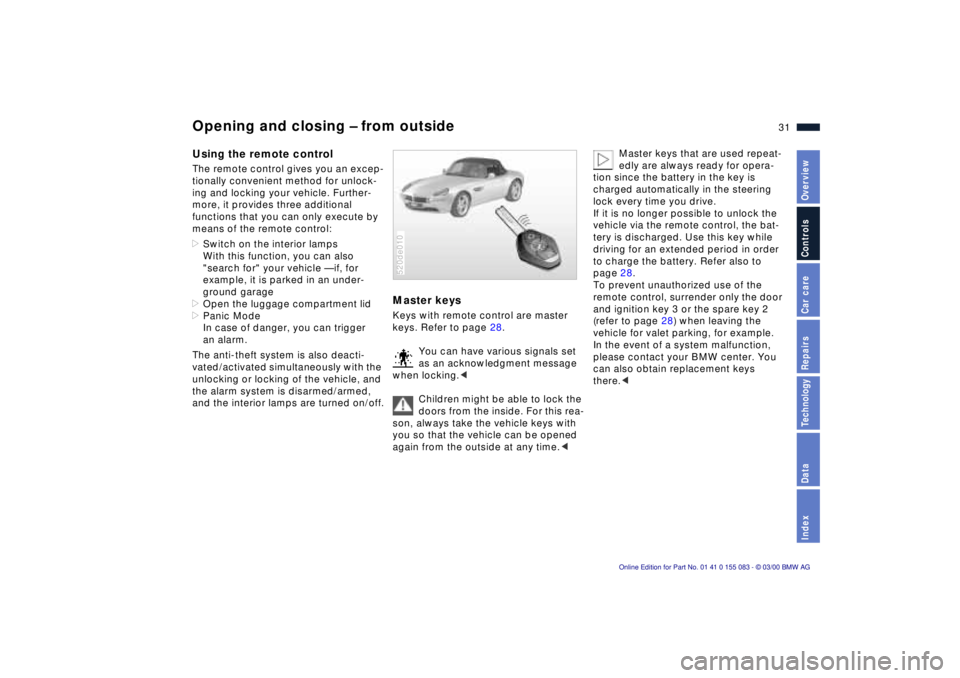
Master keysKeys with remote control are master
keys. Refer to page 28.
You can have various signals set
as an acknowledgment message
when locking.<
Children might be able to lock the
doors from the inside. For this rea-
son, always take the vehicle keys with
you so that the vehicle can be opened
again from the outside at any time.<520de010
Master keys that are used repeat-
edly are always ready for opera-
tion since the battery in the key is
charged automatically in the steering
lock every time you drive.
If it is no longer possible to unlock the
vehicle via the remote control, the bat-
tery is discharged. Use this key while
driving for an extended period in order
to charge the battery. Refer also to
page 28.
To prevent unauthorized use of the
remote control, surrender only the door
and ignition key 3 or the spare key 2
(refer to page 28) when leaving the
vehicle for valet parking, for example.
In the event of a system malfunction,
please contact your BMW center. You
can also obtain replacement keys
there.<
Page 33 of 172
32n
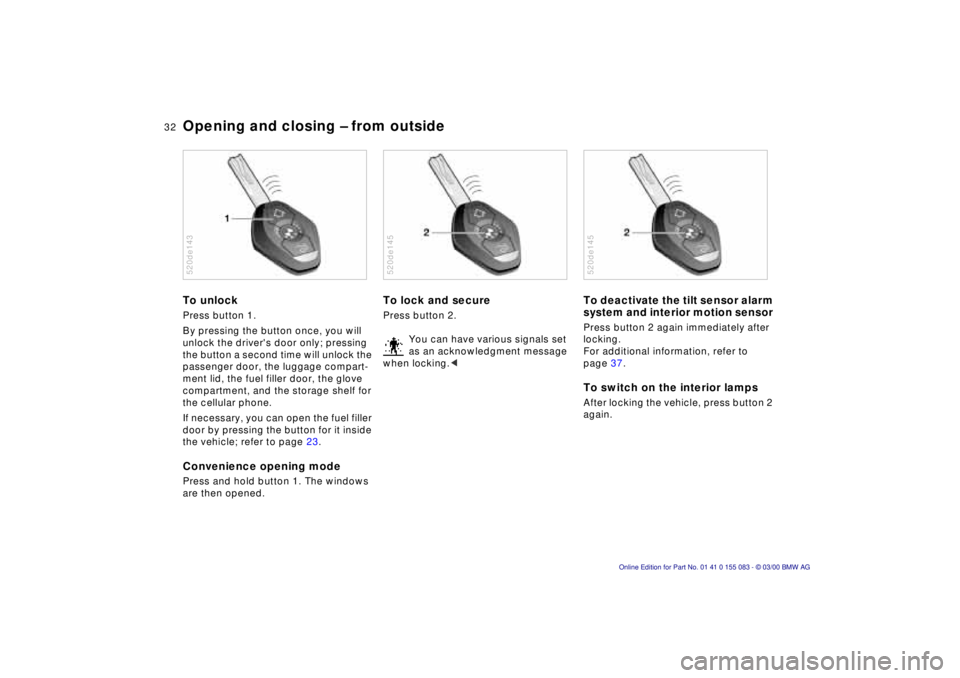
Opening and closing Ð from outsideTo unlock Press button 1.
By pressing the button once, you will
unlock the driver's door only; pressing
the button a second time will unlock the
passenger door, the luggage compart-
ment lid, the fuel filler door, the glove
compartment, and the storage shelf for
the cellular phone.
If necessary, you can open the fuel filler
door by pressing the button for it inside
the vehicle; refer to page 23.Convenience opening modePress and hold button 1. The windows
are then opened.520de143
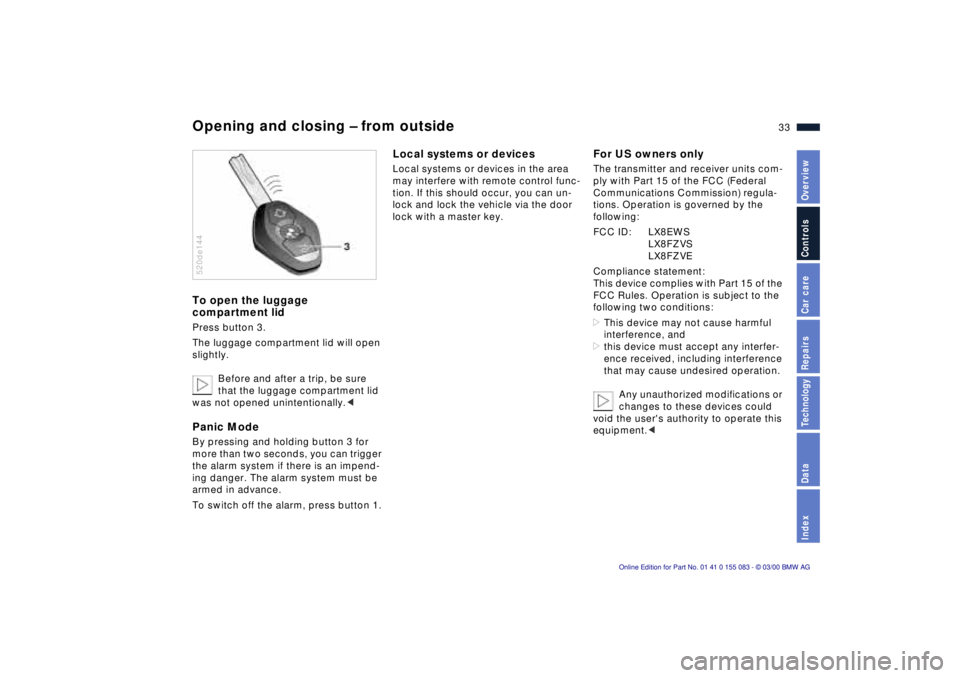
To lock and secure Press button 2.
You can have various signals set
as an acknowledgment message
when locking.<520de145
To deactivate the tilt sensor alarm
system and interior motion sensor Press button 2 again immediately after
locking.
For additional information, refer to
page 37.To switch on the interior lamps After locking the vehicle, press button 2
again.520de145
Page 34 of 172
33n
IndexDataTechnologyRepairsCar careControlsOverview
Opening and closing Ð from outsideTo open the luggage
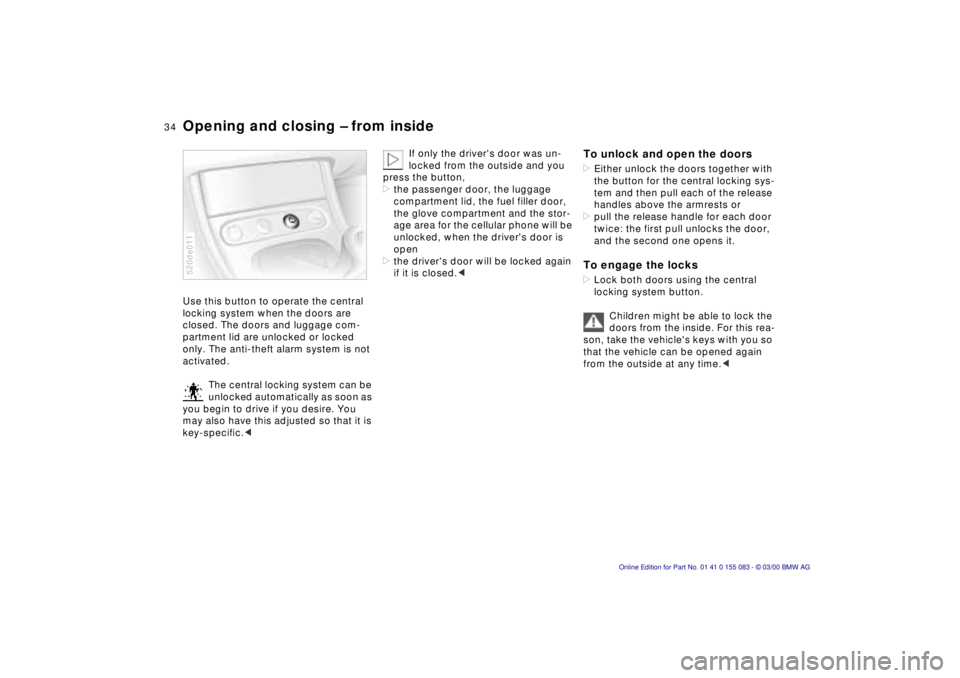
compartment lid Press button 3.
The luggage compartment lid will open
slightly.
Before and after a trip, be sure
that the luggage compartment lid
was not opened unintentionally.
the alarm system if there is an impend-
ing danger. The alarm system must be
armed in advance.
To switch off the alarm, press button 1.520de144
Local systems or devicesLocal systems or devices in the area
may interfere with remote control func-
tion. If this should occur, you can un-
lock and lock the vehicle via the door
lock with a master key.
For US owners onlyThe transmitter and receiver units com-
ply with Part 15 of the FCC (Federal
Communications Commission) regula-
tions. Operation is governed by the
following:
FCC ID: LX8EWS
LX8FZVS
LX8FZVE
Compliance statement:
This device complies with Part 15 of the
FCC Rules. Operation is subject to the
following two conditions:
>This device may not cause harmful
interference, and
>this device must accept any interfer-
ence received, including interference
that may cause undesired operation.
Any unauthorized modifications or
changes to these devices could
void the user's authority to operate this
equipment.<
Page 35 of 172
34n
Opening and closing Ð from inside Use this button to operate the central
locking system when the doors are
closed. The doors and luggage com-
partment lid are unlocked or locked
only. The anti-theft alarm system is not
activated.
The central locking system can be
unlocked automatically as soon as
you begin to drive if you desire. You
may also have this adjusted so that it is
key-specific.<520de011
If only the driver's door was un-
locked from the outside and you
press the button,
>the passenger door, the luggage
compartment lid, the fuel filler door,
the glove compartment and the stor-
age area for the cellular phone will be
unlocked, when the driver's door is
open
>the driver's door will be locked again
if it is closed.<
To unlock and open the doors>Either unlock the doors together with
the button for the central locking sys-
tem and then pull each of the release
handles above the armrests or
>pull the release handle for each door
twice: the first pull unlocks the door,
and the second one opens it.To engage the locks>Lock both doors using the central
locking system button.
Children might be able to lock the
doors from the inside. For this rea-
son, take the vehicle's keys with you so
that the vehicle can be opened again
from the outside at any time.<
Page 37 of 172
36n
Alarm systemThe conceptThe vehicle alarm system responds:
>When a door, the hood or the lug-
gage compartment lid is opened,
>To movement inside the vehicle
(interior motion sensor)
>To variations in the vehicle tilt sensor
such as those occuring during at-
tempts to steal the wheels or tow
the vehicle
>To interruption of battery voltage.
The system responds to unauthorized
vehicle entry and attempted theft by
simultaneously activating the following:
>Sounding an acoustical alarm for
30 seconds
>Activating the hazard warning flash-
ers for approx. five minutes
>Flashing the high beams on and off in
sync with the hazard warning flashers.
To activate and deactivate the
alarm systemWhen the vehicle is locked or unlocked
via a door lock or with the remote con-
trol, the alarm system is also simulta-
neously armed or disarmed.
The interior motion sensor and tilt alarm
sensor are activated approx. 30 sec-
onds after you have finished locking the
vehicle.
The system indicates that it has been
correctly armed by switching on the haz-
ard warning flashers for a single cycle
and by emitting an acoustical signal.
You can have different signals set
as acknowledgment messages for
arming and disarming.<
Indicator lamp displaysThe indicator lamp is located in the
inside rear view mirror's rotary knob.
>When the indicator lamp flashes con-
tinuously, the system is armed
>The indicator lamp flashes during
arming: the door(s), the hood or lug-
gage compartment lid are not com-
pletely closed. Even if you do not
close the alerted area, the remaining
areas are deadlocked, and the indi-
cator lamp flashes continuously after
10 seconds. However, the interior
motion sensor is not activated
>The indicator lamp goes out during
disarming: no manipulation or
attempted intrusions have been
detected in the period since the
system was armed520de014
Page 38 of 172
37n
IndexDataTechnologyRepairsCar careControlsOverview
Alarm system>If the indicator lamp flashes for
10 seconds when the system is dis-
armed, an attempted entry has been
detected in the period since the sys-
tem was armed.
Following triggering of an alarm, the
indicator lamp will flash continuously.Avoiding unintentional alarms The tilt alarm sensor and interior motion
sensor may be switched off at the same
time to prevent a false alarm from being
triggered (in garages with elevator
ramps, for instance), or when the vehi-
cle is transported by trailer or train:
Lock the vehicle twice (= arm the sys-
tem) by pressing button 2 on the re-
mote control twice in succession (refer
to page 32), or lock the vehicle twice
with the key (refer to page 30).
The indicator lamp lights up briefly and
then flashes continuously. The tilt alarm
sensor and the interior motion sensor
are deactivated as long as the system is
armed.
Interior motion sensorIn order for the interior motion sensor
to function properly, the windows and
the luggage compartment lid must be
closed.
Nevertheless, you should deactivate
the interior motion sensor (refer to the
previous column) if
>children or animals are left in the
vehicle
>windows should remain open.
For US vehicles only:
The interior motion sensor is not
installed on US models as it has not re-
ceived FCC (Federal Communications
Comission) approval.<