lock BMW Z8 2000 Owners Manual
[x] Cancel search | Manufacturer: BMW, Model Year: 2000, Model line: Z8, Model: BMW Z8 2000Pages: 172, PDF Size: 1.9 MB
Page 9 of 172

Contents
Overview
Controls and features
Cockpit14
Instrument cluster16
Indicator and warning lamps18
Hazard warning flashers22
Warning triangle22
First-aid kit22
Refueling23
Fuel quality24
Tire inflation pressure24
Locks and security systems:
Keys28
Electronic vehicle
immobilizer29
Central locking system30
Opening and closing Ð from
outside30
Using the key30
Using the remote control31
Opening and closing Ð from
inside34
Luggage compartment lid35
Alarm system36
Electric power windows38
The automatic convertible
top39
Adjustments:
Seats43
Steering wheel45
Mirrors45
Car Memory, Key Memory46
Passenger safety systems:
Safety belts48
Airbags49
Child restraints51
Child seat safety52
Driving:
Steering/Ignition lock53
Starting the engine54
Turning the engine off54
Parking brake55
Manual transmission56
Turn signal indicator/Headlamp
flasher56
Wiper/Washer system57
Rear window defroster58
Cruise control59
Everything under control:
Odometer60
Tachometer60
Fuel gauge60
Coolant temperature gauge61
Service Interval Display61
Clock62
Multi-Information Radio (MIR)62
Technology for safety and
driving convenience:
Dynamic Stability Control
(DSC)63
Dynamic Driving Control64
Tire Pressure Warning (RDW)65
Contents
Page 10 of 172

9n
Controls and features
Operation, care and maintenance
Lamps:
Side lamps/Low beams67
Instrument lighting67
High beams/Parking lamps68
Rear foglamp68
Interior lamps68
Reading lamps69
Controlling the climate for
pleasant driving:
Heating and ventilation/
Air conditioning70
Seat heating75
Interior conveniences:
Glove compartment76
Storage compartments76
Beverage can holder78
Cellular phone79
Ashtray79
Cigarette lighter80
Loading and transporting:
Cargo loading81
Special operating instructions:
Break-in procedures84
Driving notes85
Catalytic converter85
Antilock Brake System (ABS)86
Dynamic Brake Control
(DBC)88
Disc brakes88
Brake system89
Winter operation90
Power steering92
Cellular phone92
Radio reception92
Wind protection93
Hardtop94
Wheels and tires:
Tire inflation pressure96
Tire condition97
Tire replacement98
Tire rotation100
Wheel and tire
combinations101
Winter tires102
Snow chains102
Approved wheel and tire
specifications103
Under the hood:
Hood104
Engine compartment106
Washer fluids108
Washer nozzles108
Engine oil109
Coolant111
Brake fluid112
Vehicle Identification
Number113
Maintenance and care:
The BMW Maintenance
System114
Caring for your vehicle115
Airbags121
Storing your vehicle122
Laws and regulations:
Technical modifications123
California Proposition 65
Warning123
OBD interface socket124
Page 16 of 172

15n
IndexDataTechnologyRepairsCar careControlsOverview
Cockpit
1
d
Turn signal indicator56
>
Parking lamps68
>
High beams68
>
Headlamp flasher56
2 Side lamps/Low beams67
3 Washer/Wiper system57
4 Hazard warning flashers22
5 Central locking system30
6 Rear window defroster for the
hardtop58
7 Shift lever56
To engage reverse gear, press the
lever to the left and overcome the
slight resistance you will encounter
8 Cruise control59
9 Adjusting the steering wheel45
10 Horn: the entire surface functions as
the horn
11 Rear foglamps68
12 Unlocking the hood104
13
d
Unlocking the luggage compart-
ment lid35
>
Unlocking the fuel filler door23
Page 18 of 172

17n
IndexDataTechnologyRepairsCar careControlsOverview
Instrument cluster
1 Fuel gauge with indicator lamp for
fuel reserve60
2 Speedometer with indicator and
warning lamps for
>
Dynamic Stability Control
(DSC)20
>
Engine electronics20
3 Instrument lighting67
4 Tachometer60
with indicator and warning lamps
for
>
Battery charge current18
>
Convertible top operation39
>
Tire Pressure Warning (RDW)18
>
Antilock Brake System (ABS)19
>
Parking brake/Brake hydraulic
system/Cornering Brake Control
(CBC)18
>
Service Engine Soon20
>
Engine oil pressure/Engine oil
level18, 19
5 Engine coolant temperature gauge
with "Coolant temperature too high"
warning lamp61
6 Indicator and warning lamps for
>
Rear foglamps20
>
Turn signal indicator right21
7 Clock628 Control knob for
>
Clock62
>
Trip odometer, reset to zero60
9 Indicator and warning lamps for
>
Please fasten safety belts19
>
High beams21
>
Airbags19
10 Indicator for
>
Odometer60
>
Trip odometer60
>
Service Interval61
11 Indicator and warning lamps for
>
Turn signal indicator left21
>
Brake pads20
Page 20 of 172
19n
IndexDataTechnologyRepairsCar careControlsOverview
Indicator and warning lamps
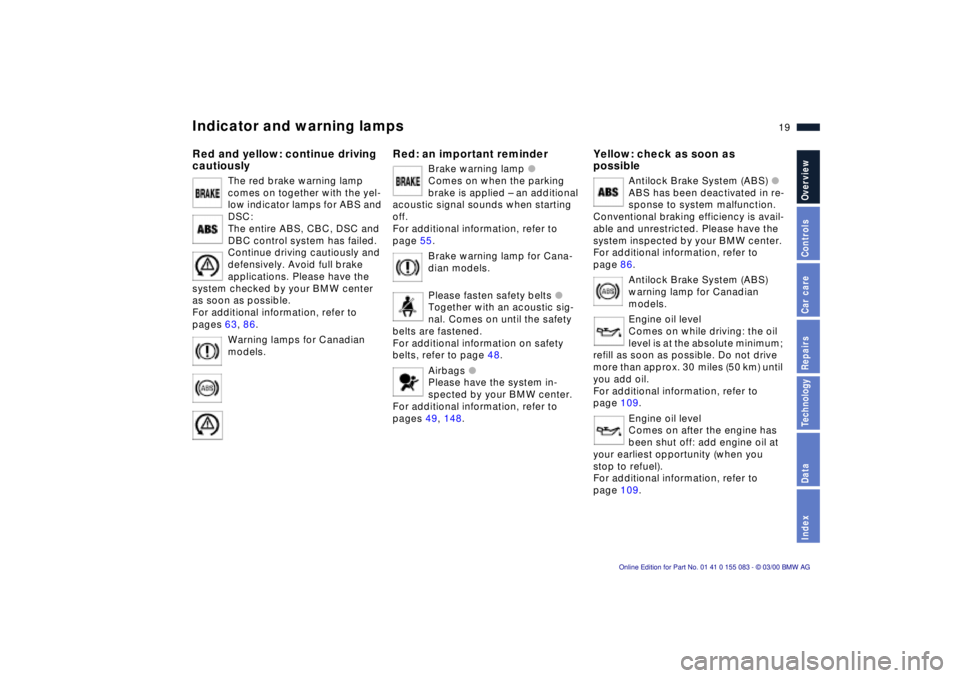
Red and yellow: continue driving
cautiously
The red brake warning lamp
comes on together with the yel-
low indicator lamps for ABS and
DSC:
The entire ABS, CBC, DSC and
DBC control system has failed.
Continue driving cautiously and
defensively. Avoid full brake
applications. Please have the
system checked by your BMW center
as soon as possible.
For additional information, refer to
pages 63, 86.
Warning lamps for Canadian
models.
Red: an important reminder
Brake warning lamp
l
Comes on when the parking
brake is applied Ð an additional
acoustic signal sounds when starting
off.
For additional information, refer to
page 55.
Brake warning lamp for Cana-
dian models.
Please fasten safety belts
l
Together with an acoustic sig-
nal. Comes on until the safety
belts are fastened.
For additional information on safety
belts, refer to page 48.
Airbags
l
Please have the system in-
spected by your BMW center.
For additional information, refer to
pages 49, 148.
Yellow: check as soon as
possible
Antilock Brake System (ABS)
l
ABS has been deactivated in re-
sponse to system malfunction.
Conventional braking efficiency is avail-
able and unrestricted. Please have the
system inspected by your BMW center.
For additional information, refer to
page 86.
Antilock Brake System (ABS)
warning lamp for Canadian
models.
Engine oil level
Comes on while driving: the oil
level is at the absolute minimum;
refill as soon as possible. Do not drive
more than approx. 30 miles (50 km) until
you add oil.
For additional information, refer to
page 109.
Engine oil level
Comes on after the engine has
been shut off: add engine oil at
your earliest opportunity (when you
stop to refuel).
For additional information, refer to
page 109.
Page 24 of 172
23n
IndexDataTechnologyRepairsCar careControlsOverview
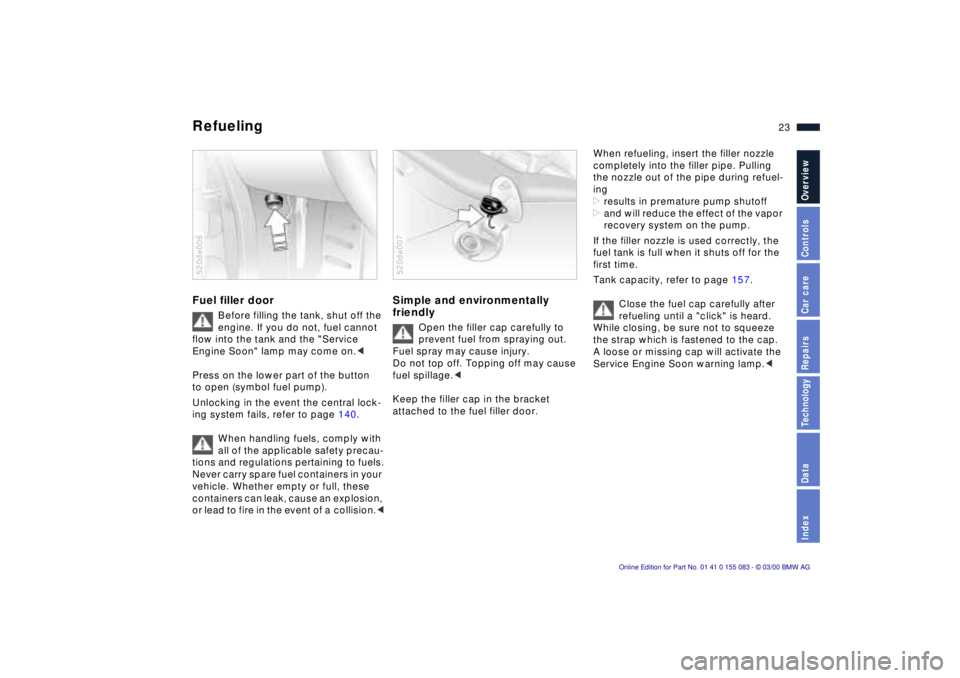
Refueling Fuel filler door
Before filling the tank, shut off the
engine. If you do not, fuel cannot
flow into the tank and the "Service
Engine Soon" lamp may come on.<
Press on the lower part of the button
to open (symbol fuel pump).
Unlocking in the event the central lock-
ing system fails, refer to page 140.
When handling fuels, comply with
all of the applicable safety precau-
tions and regulations pertaining to fuels.
Never carry spare fuel containers in your
vehicle. Whether empty or full, these
containers can leak, cause an explosion,
or lead to fire in the event of a collision.<
520de006
Simple and environmentally
friendly
Open the filler cap carefully to
prevent fuel from spraying out.
Fuel spray may cause injury.
Do not top off. Topping off may cause
fuel spillage.<
Keep the filler cap in the bracket
attached to the fuel filler door.
520de007
When refueling, insert the filler nozzle
completely into the filler pipe. Pulling
the nozzle out of the pipe during refuel-
ing
>results in premature pump shutoff
>and will reduce the effect of the vapor
recovery system on the pump.
If the filler nozzle is used correctly, the
fuel tank is full when it shuts off for the
first time.
Tank capacity, refer to page 157.
Close the fuel cap carefully after
refueling until a "click" is heard.
While closing, be sure not to squeeze
the strap which is fastened to the cap.
A loose or missing cap will activate the
Service Engine Soon warning lamp.<
Page 27 of 172
26n
Locks and security systems:
Keys28
Electronic vehicle
immobilizer29
Central locking system30
Opening and closing Ð from
outside30
Using the key30
Using the remote control31
Opening and closing Ð from
inside34
Luggage compartment lid35
Alarm system36
Electric power windows38
The automatic convertible
top39
Adjustments:
Seats43
Steering wheel45
Mirrors45
Car Memory, Key Memory46
Passenger safety systems:
Safety belts48
Airbags49
Child restraints51
Child seat safety52
Controls
Page 28 of 172
Overview
Controls and features
Operation, care
and maintenance
Owner service procedures
Technical data
Index Advanced technology
27n
IndexDataTechnologyRepairsCar careControlsOverview
Driving:
Steering/Ignition lock53
Starting the engine54
Turning the engine off54
Parking brake55
Manual transmission56
Turn signal indicator/Headlamp
flasher56
Wiper/Washer system57
Rear window defroster58
Cruise control59
Everything under control:
Odometer60
Tachometer60
Fuel gauge60
Coolant temperature gauge61
Service Interval Display61
Clock62
Multi-Information Radio (MIR)62
Technology for safety and
driving convenience:
Dynamic Stability Control
(DSC)63
Dynamic Driving Control64
Tire Pressure Warning (RDW)65Lamps:
Side lamps/Low beams67
Instrument lighting67
High beams/Parking lamps68
Rear foglamp68
Interior lamps68
Reading lamps69
Controlling the climate for
pleasant driving:
Heating and ventilation/
Air conditioning70
Seat heating75
Interior conveniences:
Glove compartment76
Storage compartments76
Beverage can holder78
Cellular phone79
Ashtray79
Cigarette lighter80
Loading and transporting:
Cargo loading81
Page 29 of 172
28n
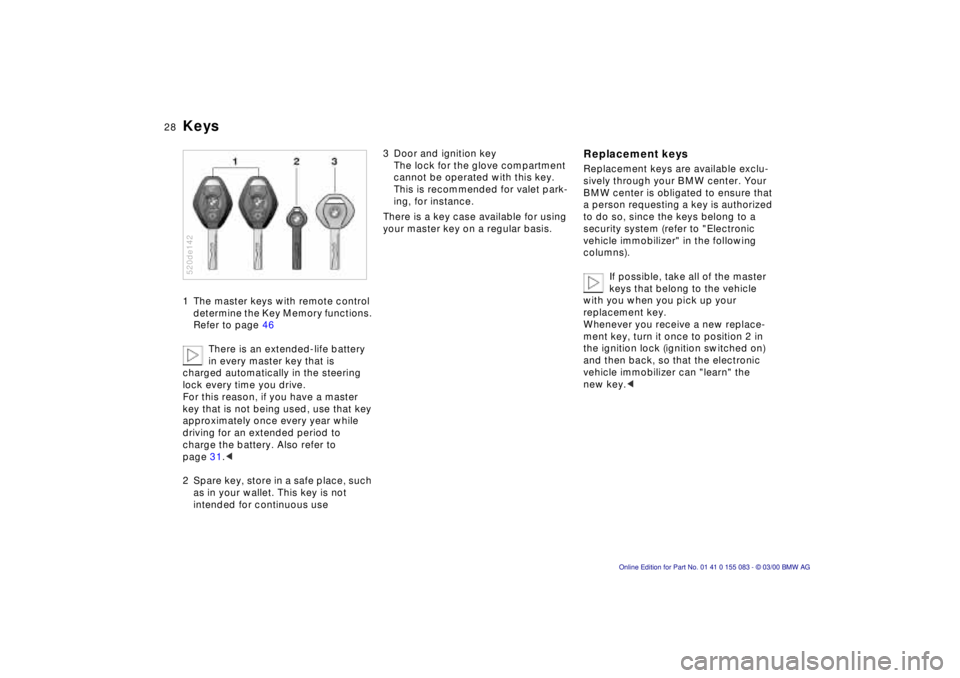
Keys1 The master keys with remote control
determine the Key Memory functions.
Refer to page 46
There is an extended-life battery
in every master key that is
charged automatically in the steering
lock every time you drive.
For this reason, if you have a master
key that is not being used, use that key
approximately once every year while
driving for an extended period to
charge the battery. Also refer to
page 31.<
2 Spare key, store in a safe place, such
as in your wallet. This key is not
intended for continuous use 520de142
3 Door and ignition key
The lock for the glove compartment
cannot be operated with this key.
This is recommended for valet park-
ing, for instance.
There is a key case available for using
your master key on a regular basis.
Replacement keysReplacement keys are available exclu-
sively through your BMW center. Your
BMW center is obligated to ensure that
a person requesting a key is authorized
to do so, since the keys belong to a
security system (refer to "Electronic
vehicle immobilizer" in the following
columns).
If possible, take all of the master
keys that belong to the vehicle
with you when you pick up your
replacement key.
Whenever you receive a new replace-
ment key, turn it once to position 2 in
the ignition lock (ignition switched on)
and then back, so that the electronic
vehicle immobilizer can "learn" the
new key.<
Page 30 of 172
29n
IndexDataTechnologyRepairsCar careControlsOverview
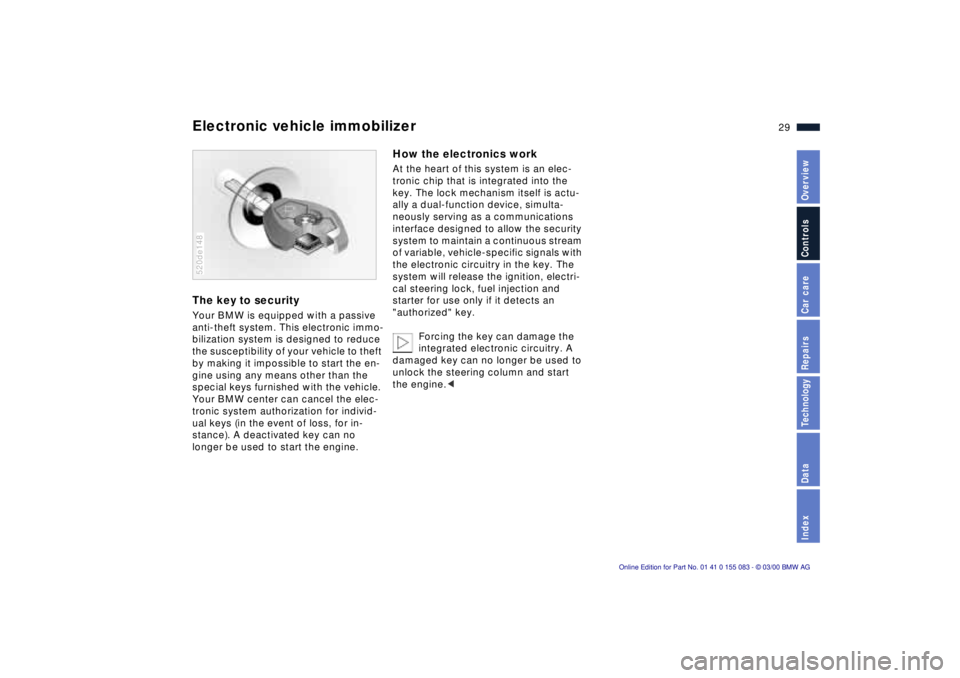
Electronic vehicle immobilizer The key to securityYour BMW is equipped with a passive
anti-theft system. This electronic immo-
bilization system is designed to reduce
the susceptibility of your vehicle to theft
by making it impossible to start the en-
gine using any means other than the
special keys furnished with the vehicle.
Your BMW center can cancel the elec-
tronic system authorization for individ-
ual keys (in the event of loss, for in-
stance). A deactivated key can no
longer be used to start the engine.520de148
How the electronics workAt the heart of this system is an elec-
tronic chip that is integrated into the
key. The lock mechanism itself is actu-
ally a dual-function device, simulta-
neously serving as a communications
interface designed to allow the security
system to maintain a continuous stream
of variable, vehicle-specific signals with
the electronic circuitry in the key. The
system will release the ignition, electri-
cal steering lock, fuel injection and
starter for use only if it detects an
"authorized" key.
Forcing the key can damage the
integrated electronic circuitry. A
damaged key can no longer be used to
unlock the steering column and start
the engine.<