power steering BMW Z8 2000 Owners Manual
[x] Cancel search | Manufacturer: BMW, Model Year: 2000, Model line: Z8, Model: BMW Z8 2000Pages: 172, PDF Size: 1.9 MB
Page 9 of 172

Contents
Overview
Controls and features
Cockpit14
Instrument cluster16
Indicator and warning lamps18
Hazard warning flashers22
Warning triangle22
First-aid kit22
Refueling23
Fuel quality24
Tire inflation pressure24
Locks and security systems:
Keys28
Electronic vehicle
immobilizer29
Central locking system30
Opening and closing Ð from
outside30
Using the key30
Using the remote control31
Opening and closing Ð from
inside34
Luggage compartment lid35
Alarm system36
Electric power windows38
The automatic convertible
top39
Adjustments:
Seats43
Steering wheel45
Mirrors45
Car Memory, Key Memory46
Passenger safety systems:
Safety belts48
Airbags49
Child restraints51
Child seat safety52
Driving:
Steering/Ignition lock53
Starting the engine54
Turning the engine off54
Parking brake55
Manual transmission56
Turn signal indicator/Headlamp
flasher56
Wiper/Washer system57
Rear window defroster58
Cruise control59
Everything under control:
Odometer60
Tachometer60
Fuel gauge60
Coolant temperature gauge61
Service Interval Display61
Clock62
Multi-Information Radio (MIR)62
Technology for safety and
driving convenience:
Dynamic Stability Control
(DSC)63
Dynamic Driving Control64
Tire Pressure Warning (RDW)65
Contents
Page 10 of 172

9n
Controls and features
Operation, care and maintenance
Lamps:
Side lamps/Low beams67
Instrument lighting67
High beams/Parking lamps68
Rear foglamp68
Interior lamps68
Reading lamps69
Controlling the climate for
pleasant driving:
Heating and ventilation/
Air conditioning70
Seat heating75
Interior conveniences:
Glove compartment76
Storage compartments76
Beverage can holder78
Cellular phone79
Ashtray79
Cigarette lighter80
Loading and transporting:
Cargo loading81
Special operating instructions:
Break-in procedures84
Driving notes85
Catalytic converter85
Antilock Brake System (ABS)86
Dynamic Brake Control
(DBC)88
Disc brakes88
Brake system89
Winter operation90
Power steering92
Cellular phone92
Radio reception92
Wind protection93
Hardtop94
Wheels and tires:
Tire inflation pressure96
Tire condition97
Tire replacement98
Tire rotation100
Wheel and tire
combinations101
Winter tires102
Snow chains102
Approved wheel and tire
specifications103
Under the hood:
Hood104
Engine compartment106
Washer fluids108
Washer nozzles108
Engine oil109
Coolant111
Brake fluid112
Vehicle Identification
Number113
Maintenance and care:
The BMW Maintenance
System114
Caring for your vehicle115
Airbags121
Storing your vehicle122
Laws and regulations:
Technical modifications123
California Proposition 65
Warning123
OBD interface socket124
Page 27 of 172
26n
Locks and security systems:
Keys28
Electronic vehicle
immobilizer29
Central locking system30
Opening and closing Ð from
outside30
Using the key30
Using the remote control31
Opening and closing Ð from
inside34
Luggage compartment lid35
Alarm system36
Electric power windows38
The automatic convertible
top39
Adjustments:
Seats43
Steering wheel45
Mirrors45
Car Memory, Key Memory46
Passenger safety systems:
Safety belts48
Airbags49
Child restraints51
Child seat safety52
Controls
Page 54 of 172
53n
IndexDataTechnologyRepairsCar careControlsOverview
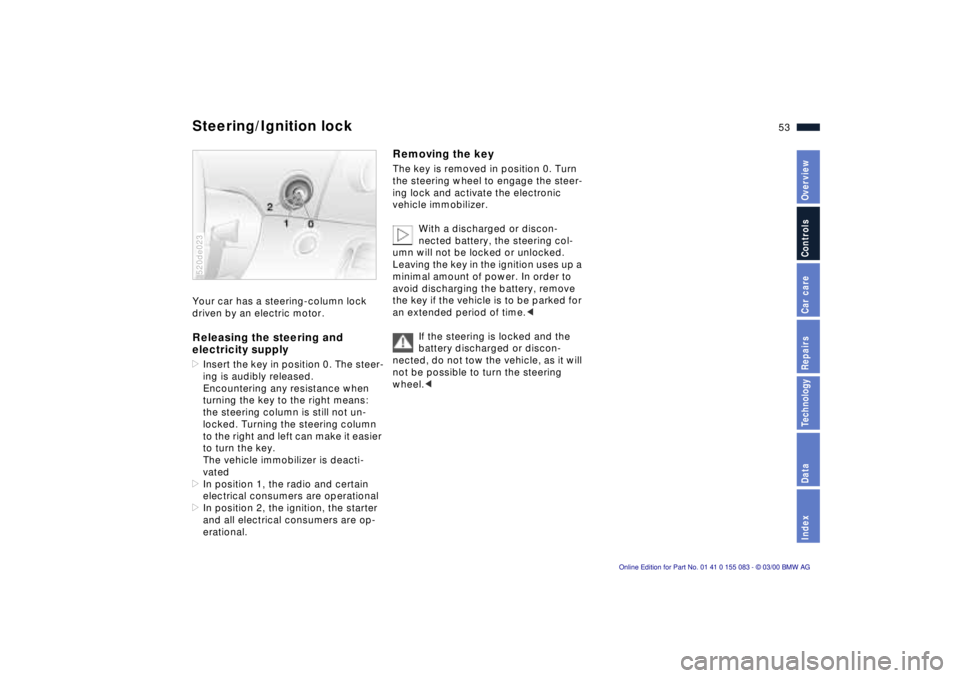
Your car has a steering-column lock
driven by an electric motor.Releasing the steering and
electricity supply>Insert the key in position 0. The steer-
ing is audibly released.
Encountering any resistance when
turning the key to the right means:
the steering column is still not un-
locked. Turning the steering column
to the right and left can make it easier
to turn the key.
The vehicle immobilizer is deacti-
vated
>In position 1, the radio and certain
electrical consumers are operational
>In position 2, the ignition, the starter
and all electrical consumers are op-
erational.520de023
Removing the keyThe key is removed in position 0. Turn
the steering wheel to engage the steer-
ing lock and activate the electronic
vehicle immobilizer.
With a discharged or discon-
nected battery, the steering col-
umn will not be locked or unlocked.
Leaving the key in the ignition uses up a
minimal amount of power. In order to
avoid discharging the battery, remove
the key if the vehicle is to be parked for
an extended period of time.<
If the steering is locked and the
battery discharged or discon-
nected, do not tow the vehicle, as it will
not be possible to turn the steering
wheel.<
Steering/Ignition lock
Page 84 of 172
Overview
Controls and features
Operation, care
and maintenance
Owner service procedures
Technical data
Index Advanced technology
83n
IndexDataTechnologyRepairsCar careControlsOverview
Car care Special operating instructions:
Break-in procedures84
Driving notes85
Catalytic converter85
Antilock Brake System (ABS)86
Dynamic Brake Control
(DBC)88
Disc brakes88
Brake system89
Winter operation90
Power steering92
Cellular phone92
Radio reception92
Wind protection93
Hardtop94
Wheels and tires:
Tire inflation pressure96
Tire condition97
Tire replacement98
Tire rotation100
Wheel and tire
combinations101
Winter tires102
Snow chains102
Approved wheel and tire
specifications103Under the hood:
Hood104
Engine compartment106
Washer fluids108
Washer nozzles108
Engine oil109
Coolant111
Brake fluid112
Vehicle Identification
Number113
Maintenance and care:
The BMW Maintenance
System114
Caring for your vehicle115
Airbags121
Storing your vehicle122
Laws and regulations:
Technical modifications123
California Proposition 65
Warning123
OBD interface socket124
Page 90 of 172

89n
IndexDataTechnologyRepairsCar careControlsOverview
Disc brakes Brake systemDriving notesWhen driving in wet conditions and in
heavy rain, it is effective to apply light
pressure to the brakes every few miles
or kilometers. Watch traffic conditions
to ensure that this maneuver does not
endanger other road users. The heat
which is generated by the brake appli-
cations helps to dry the brake pads and
rotors.
Maximum braking force is obtained
while the wheels are not locked, but
rather when they are still barely turning
immediately prior to locking. ABS main-
tains this state automatically. If the ABS
fails, you should revert to the staggered
braking technique (refer to page 91).
Long or steep mountain descents do
not necessarily lead to reduced braking
efficiency if you drive downhill with the
transmission in a gear requiring minimal
brake applications.
Braking effect on the engine can be
further increased by downshifting, into
first gear, if necessary.If engine braking should prove to be
inadequate, you should still avoid ex-
tended, continuous braking. Instead of
maintaining low to moderate pressure
over an extended period of time, you
should decelerate by applying more
substantial pressure to the brake pedal
(watch for following traffic), releasing
the pedal, and then repeating the appli-
cation (staggered braking). The cooling
phases between active braking inter-
vals prevent the brakes from overheat-
ing and retain full braking capacity.
Do not coast with the clutch de-
pressed, the gear-shift lever in
neutral, or, above all, with the engine
shutt off; otherwise, the engine will pro-
vide no braking effect if the transmis-
sion is in neutral, and there is no brak-
ing or steering power assist if the
engine is not running. Do not allow floor
mats, carpets or any other objects to
protrude into the area around the brake
pedal, the clutch or the accelerator
which could obstruct their freedom of
movement.<
Brake fluid level
The brake warning lamp comes
on with the parking brake
released:
The brake fluid level is too low in
the reservoir (refer to page 112).
If the brake fluid level is too low
and brake pedal travel has become no-
ticeably longer, there may be a defect
in one of the brake system's hydraulic
circuits.
Proceed to the nearest BMW cen-
ter. Higher brake application pres-
sure may be necessary under these con-
ditions, and brake pedal travel may be
significantly longer. Please remember to
adapt your driving style accordingly.<
Page 93 of 172

92n
Power steering Cellular phone Radio reception If there is a change in steering response
Ð e. g. difficult or over-responsive steer-
ing Ð at increasing speeds, consult a
BMW center to have it checked.
If the power steering fails, in-
creased effort will be required to
steer the vehicle.<
Mobile communications systems (cellu-
lar phone, radio, etc.) are permitted
with an output of up to 10 watts only.
Mobile communications devices not
specifically designed for use in your
vehicle may trigger malfunctions while
you are operating your vehicle. BMW
can neither test nor assume responsi-
bility for every individual product being
offered on the market. We recommend
that you consult your BMW center be-
fore purchasing any device of this kind.
To ensure reliable and trouble-free
operation of your BMW, do not use any
cellular phones or other radio devices
where the antenna is located either
inside the passenger compartment or
otherwise not attached to the outside of
the vehicle.
You will find instructions for operating
your cellular phone in a separate man-
ual included with your Owner's Manual. The reception and sound quality ob-
tained from mobile radios vary accord-
ing to a variety of factors, including the
broadcast range of the transmitter and
the directional orientation of the an-
tenna. Interference factors such as high-
tension power lines, structural or natural
obstructions can all lead to unavoidable
reception interference, regardless of
how well the vehicle sound system is
operating. Climatic factors such as in-
tense solar radiation, fog, rain and snow
can also interfere with reception.
Radio interference can also be caused
by either cellular phones not recom-
mended by BMW or by portable phones.
This phenomenon assumes the form of
a low-pitched hum emanating from the
speaker system.
Please refer to the Owner's Manual that
you received for detailed information on
settings and operation of your radio.
Page 110 of 172
109n
IndexDataTechnologyRepairsCar careControlsOverview
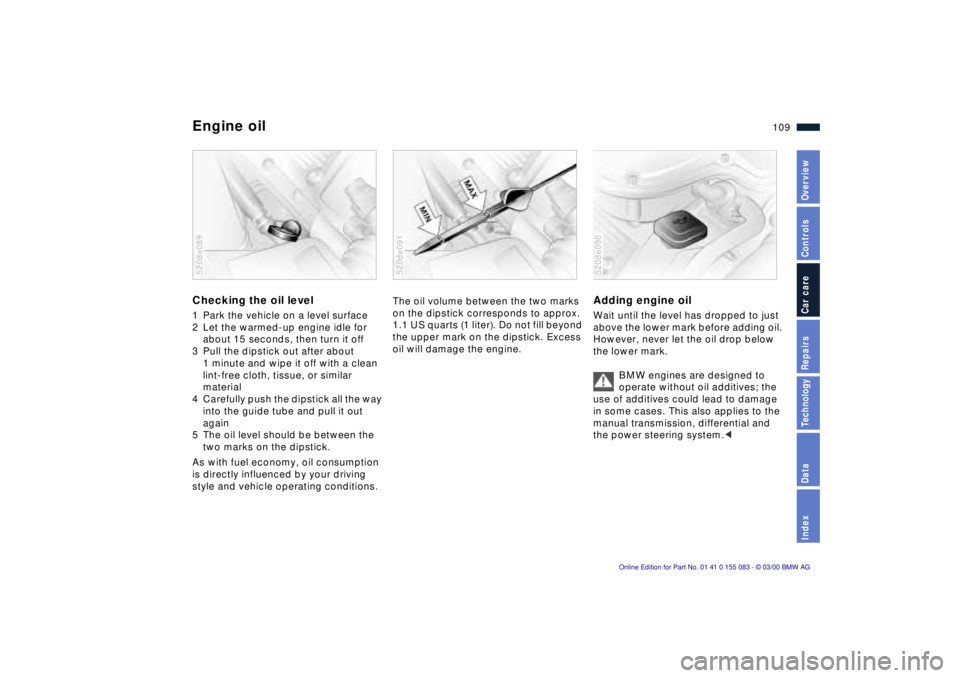
Engine oilChecking the oil level 1 Park the vehicle on a level surface
2 Let the warmed-up engine idle for
about 15 seconds, then turn it off
3 Pull the dipstick out after about
1 minute and wipe it off with a clean
lint-free cloth, tissue, or similar
material
4 Carefully push the dipstick all the way
into the guide tube and pull it out
again
5 The oil level should be between the
two marks on the dipstick.
As with fuel economy, oil consumption
is directly influenced by your driving
style and vehicle operating conditions.520de089
The oil volume between the two marks
on the dipstick corresponds to approx.
1.1 US quarts (1 liter). Do not fill beyond
the upper mark on the dipstick. Excess
oil will damage the engine.520de091
Adding engine oil Wait until the level has dropped to just
above the lower mark before adding oil.
However, never let the oil drop below
the lower mark.
BMW engines are designed to
operate without oil additives; the
use of additives could lead to damage
in some cases. This also applies to the
manual transmission, differential and
the power steering system.<520de090
Page 146 of 172
145n
IndexDataTechnologyRepairsCar careControlsOverview
Towing
Avoid "off-center" towing. Be sure
that the tow rope is pulled tightly
when the towing vehicle begins to
move.<
The towed vehicle should always
be the lighter of the two vehicles.
If this is not the case, it is no longer
possible to control vehicle response.<
Tow-startingFor instructions on jump starting, refer
to page 143.
Never attempt to use your vehicle to
push another vehicle, since damage to
the energy-absorbing bumpers could
result.
Towing a vehicle1 Put the manual-shift gear lever in
neutral
2 Towing speed:
Max. 45 mph (70 km/h)
3 Towing distance:
Max. 95 miles (150 km)
4 Leave the ignition key at position 1 to
ensure that the brake lamps, turn sig-
nals, horn and windshield wipers
remain operative, and to prevent the
steering lock detent from engaging
5 Switch on the hazard-warning system
(comply with country-specific regula-
tions).
Find some means of identifying the
vehicle in tow, e. g. place a sign or
warning triangle in the rear window.
Make sure that the ignition key re-
mains in position 1 even when the
electrical system has failed to prevent
the steering lock from engaging. The
steering and brakes are without power
assist when the engine is not running.
This means that increased effort is
required for steering and braking.<
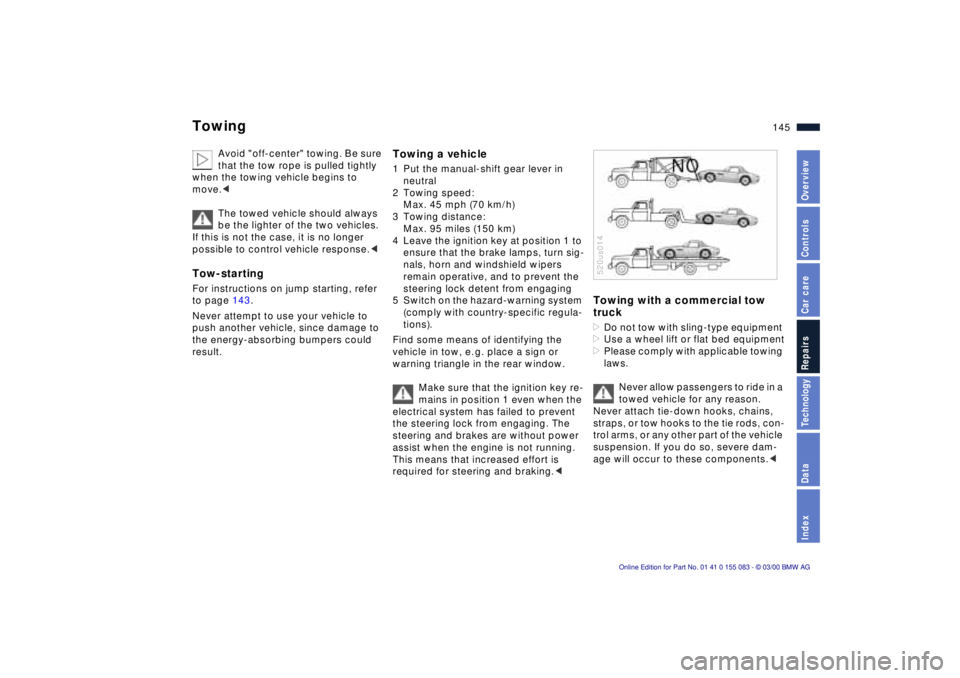
Towing with a commercial tow
truck>Do not tow with sling-type equipment
>Use a wheel lift or flat bed equipment
>Please comply with applicable towing
laws.
Never allow passengers to ride in a
towed vehicle for any reason.
Never attach tie-down hooks, chains,
straps, or tow hooks to the tie rods, con-
trol arms, or any other part of the vehicle
suspension. If you do so, severe dam-
age will occur to these components.<520us014
Page 150 of 172
149n
IndexDataTechnologyRepairsCar careControlsOverview
Highly sensitive sensors monitor the
number of revolutions of the wheels,
steering angle, lateral acceleration,
brake pressure and the movement
of the vehicle around its vertical axis.
If differences in wheel speed should
occur, the system will recognize the
danger this loss of traction causes and
reduce the drive torque going to the
wheels. The system will also apply the
brakes specifically to the rear wheels,
if necessary.
In addition, DSC permanently monitors
the vehicle's current operating condi-
tion and compares it with an ideal con-
dition that is calculated from the sen-
sor's signals. If differences such as
under- or oversteering should occur,
DSC will stabilize the vehicle in frac-
tions of a second by reducing engine
power output, applying the brakes to
individual rear wheels Ð and to specific
front wheels, too, if necessary. As a
result, dangerous skids can be pre-
vented even as they are beginning.You may need some time to become
accustomed to this system's interven-
tion. However, it provides optimum
drive force and vehicle stability.
The braking intervention may be
accompanied by sounds specific to
the system.
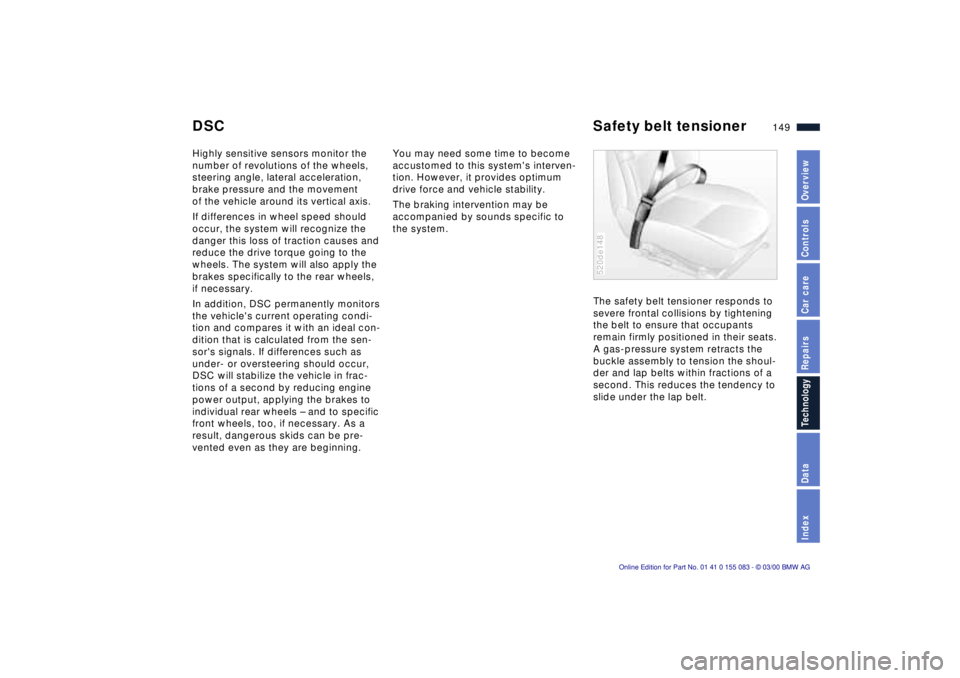
The safety belt tensioner responds to
severe frontal collisions by tightening
the belt to ensure that occupants
remain firmly positioned in their seats.
A gas-pressure system retracts the
buckle assembly to tension the shoul-
der and lap belts within fractions of a
second. This reduces the tendency to
slide under the lap belt.
520de148
DSC Safety belt tensioner