light BMW Z8 2001 Owner's Manual
[x] Cancel search | Manufacturer: BMW, Model Year: 2001, Model line: Z8, Model: BMW Z8 2001Pages: 170, PDF Size: 1.64 MB
Page 70 of 170
70n
High beams/Parking lamps
Rear fog lamp Interior lamps
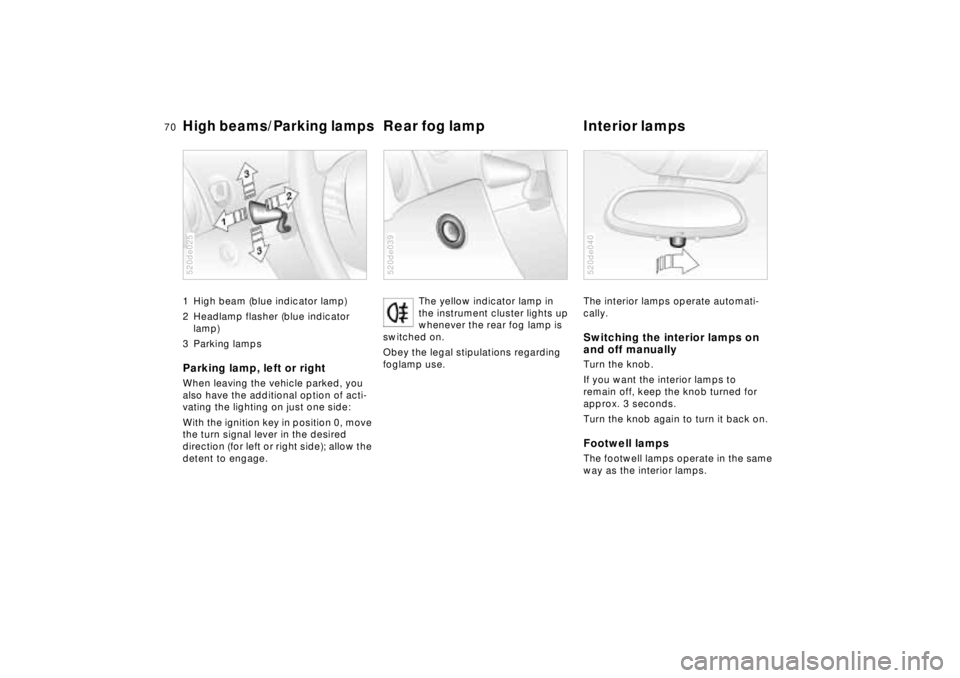
1 High beam (blue indicator lamp)
2 Headlamp flasher (blue indicator
lamp)
3 Parking lampsParking lamp, left or rightWhen leaving the vehicle parked, you
also have the additional option of acti-
vating the lighting on just one side:
With the ignition key in position 0, move
the turn signal lever in the desired
direction (for left or right side); allow the
detent to engage.520de025
The yellow indicator lamp in
the instrument cluster lights up
whenever the rear fog lamp is
switched on.
Obey the legal stipulations regarding
foglamp use.
520de039
The interior lamps operate automati-
cally.Switching the interior lamps on
and off manuallyTurn the knob.
If you want the interior lamps to
remain off, keep the knob turned for
approx. 3 seconds.
Turn the knob again to turn it back on.Footwell lampsThe footwell lamps operate in the same
way as the interior lamps.520de040
Page 75 of 170
75n
IndexDataTechnologyRepairsCar careControlsOverview
Heating and ventilation/Air conditioner
If condensation starts to form on
window surfaces during operation
in the recirculated-air mode, switch it
off and return the ventilation system to
the incoming air mode; turn up the
blower and select the defroster if
necessary to clear the windows.<
To defrost windows and remove
condensation
This operation quickly
removes ice and condensa-
tion from the windshield and
the side windows.
Rear window defroster
Whenever the hardtop is on,
the indicator lamp lights up
when the rear window
defroster is turned on. The rear window
defroster switches off automatically.
Refer to page 60.
The indicator lamp is always
active, however the rear window
defroster will not work if the hardtop is
not in place.<
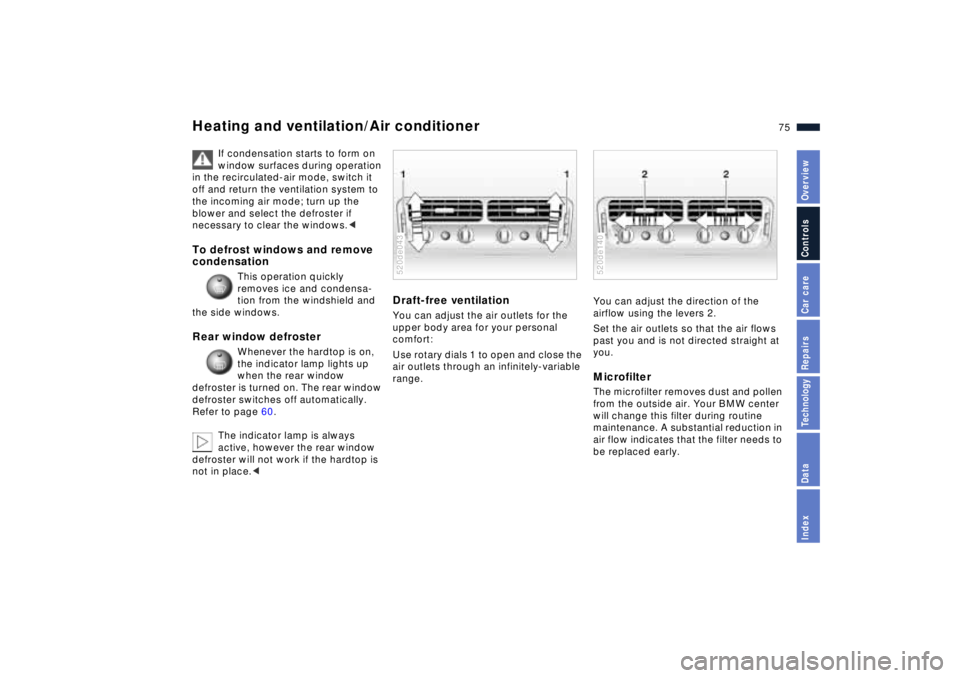
Draft-free ventilation You can adjust the air outlets for the
upper body area for your personal
comfort:
Use rotary dials 1 to open and close the
air outlets through an infinitely-variable
range.520de043
You can adjust the direction of the
airflow using the levers 2.
Set the air outlets so that the air flows
past you and is not directed straight at
you.MicrofilterThe microfilter removes dust and pollen
from the outside air. Your BMW center
will change this filter during routine
maintenance. A substantial reduction in
air flow indicates that the filter needs to
be replaced early.520de140
Page 79 of 170
79n
IndexDataTechnologyRepairsCar careControlsOverview
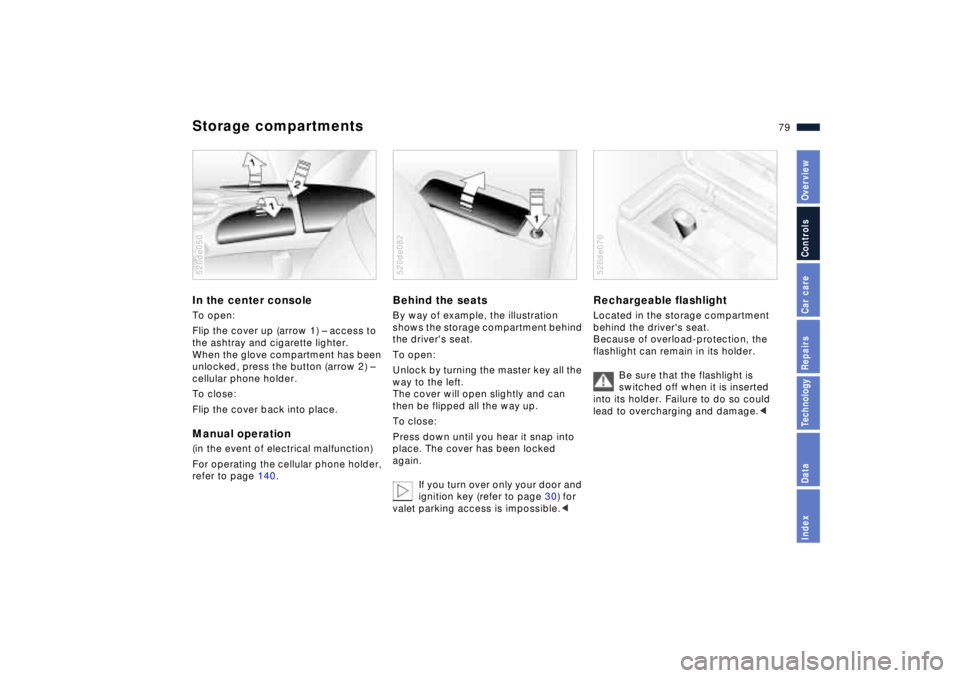
Storage compartmentsIn the center consoleTo open:
Flip the cover up (arrow 1) Ð access to
the ashtray and cigarette lighter.
When the glove compartment has been
unlocked, press the button (arrow 2) Ð
cellular phone holder.
To close:
Flip the cover back into place.Manual operation(in the event of electrical malfunction)
For operating
the cellular phone holder
,
refer to page 140.
520de050
Behind the seatsBy way of example, the illustration
shows the storage compartment behind
the driver's seat.
To open:
Unlock by turning the master key all the
way to the left.
The cover will open slightly and can
then be flipped all the way up.
To close:
Press down until you hear it snap into
place. The cover has been locked
again.
If you turn over only your door and
ignition key (refer to page 30) for
valet parking access is impossible.<520de082
Rechargeable flashlight Located in the storage compartment
behind the driver's seat.
Because of overload-protection, the
flashlight can remain in its holder.
Be sure that the flashlight is
switched off when it is inserted
into its holder. Failure to do so could
lead to overcharging and damage.<520de070
Page 82 of 170
82n
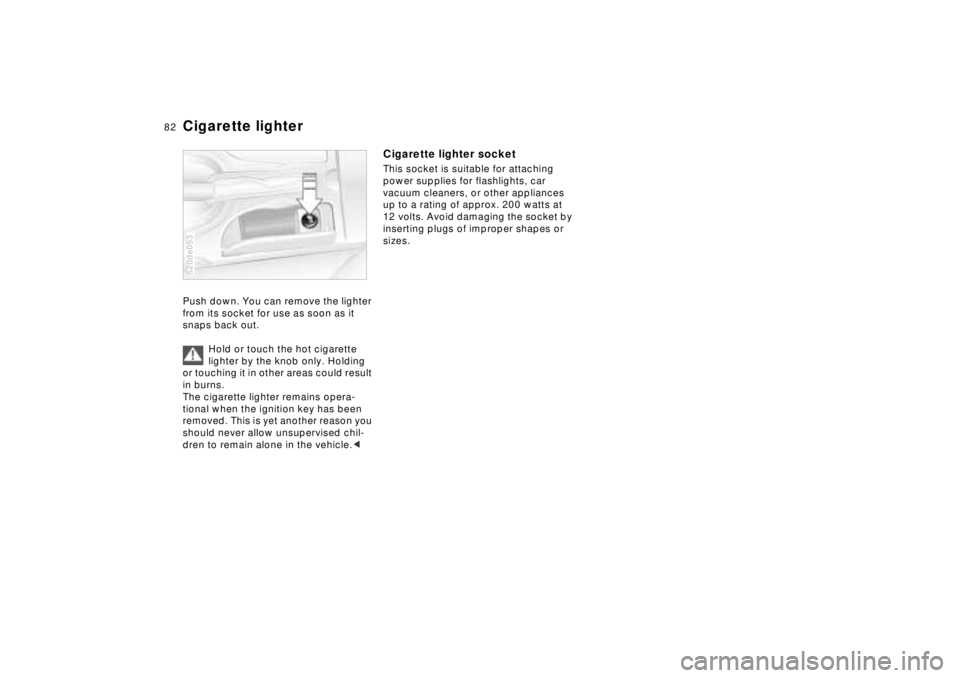
Cigarette lighterPush down. You can remove the lighter
from its socket for use as soon as it
snaps back out.
Hold or touch the hot cigarette
lighter by the knob only. Holding
or touching it in other areas could result
in burns.
The cigarette lighter remains opera-
tional when the ignition key has been
removed. This is yet another reason you
should never allow unsupervised chil-
dren to remain alone in the vehicle.<520de053
Cigarette lighter socketThis socket is suitable for attaching
power supplies for flashlights, car
vacuum cleaners, or other appliances
up to a rating of approx. 200 watts at
12 volts. Avoid damaging the socket by
inserting plugs of improper shapes or
sizes.
Page 83 of 170

83n
IndexDataTechnologyRepairsCar careControlsOverview
Cargo loadingStowing cargo If you are carrying cargo in the luggage
compartment of your BMW Z8 roadster:
>Load heavy cargo as far forward as
possible, directly behind the luggage
compartment partition
>Cover sharp edges and corners.
If you are stowing cargo behind the
seats in your BMW Z8 roadster:
>Stow only lightweight objects, such
as clothing
>Do not pile objects higher than the
top edge of the backrest.
Do not stow either heavy cargo or
cargo with sharp edges and
corners behind the seats, or else they
could damage the back of the seat or
the rear trim panel.
Cargo that is too big or unwieldy and
stowed behind the seats can also
prevent the seat from locking properly
into position. Therefore, check to make
sure that the seat is properly locked
into place, moving the seat forward if
necessary. Refer to page 45.
Always position and secure the load
correctly. If you do not, it can endanger
the vehicle occupants during braking or
evasive maneuvers.
Do not exceed the permissible gross
weight and axle load (refer to page 156),
otherwise the vehicle's operating safety
is no longer assured and you are in
violation of the law.
Make sure to secure heavy or hard
objects you stow in the passenger area,
otherwise, these objects could be flung
about during braking or evasive
maneuvers and possibly injure vehicle
occupants.<
Page 86 of 170

86n
To ensure that your vehicle continues to
provide maximum economy throughout
an extended service life, we request
that you devote careful attention to the
following section.
Your BMW Z8 is a masterpiece of
superlative technology. To ensure
that you derive maximum satisfaction
from its extensive array of advanced
features while simultaneously creating
the basis for many years of driving
pleasure, we urge you to observe the
following precautions during the initial
operation period.<
Engine and differentialUp to 1,200 miles (2,000 km):
Drive at varying engine and road
speeds, but do not exceed 4,500 rpm
(4,500/min), or a road speed of 106 mph
(170 km/h).
Obey your local and state maximum
speed limits.
Avoid depressing the accelerator to the
full-throttle position .
Once you have driven 1,200 miles
(2,000 km), you can begin to gradually
increase both the engine speed and
road speed.
You should also comply with these
break-in procedures if the engine or
differential is replaced later in the
course of the vehicle service life.TiresOwing to technical factors associated
with their manufacture, tires do not
achieve their full traction potential until
an initial break-in period has elapsed.
Thus, drive with extra care during the
initial 200 miles (300 km).
Obey your local and state maximum
speed limits.
When the vehicle is being driven
on wet or slushy roads, a wedge
of water may form between the tire and
the road surface. This phenomenon is
referred to as "aquaplaning" and can
lead to partial or complete loss of trac-
tion, vehicle control and braking effec-
tiveness. Reduce your speed on wet
roads.<
Brake systemApproximately 300 miles (500 km) must
elapse before the brake pads and
rotors achieve the optimal pad-surface
and wear patterns required for trouble-
free operation and long service life.
To break in the separate parking brake
drums, apply the parking brake lightly
when coasting to a standstill (at a traffic
signal, for instance), provided that
traffic conditions allow you to do so.
To avoid corrosion, repeat this proce-
dure from time to time.
The brake lamps do not come
on when the parking brake is
engaged.
Vacuum for the brake system servo unit
on your BMW is available only when the
engine is running. When you move the
vehicle with the engine shut off Ð when
towing, for instance Ð substantially
higher levels of pedal force will be
required to brake the vehicle.
Engage the gears carefully and without
high engine speeds during this break-in
period.
Break-in procedures
Page 87 of 170

87n
IndexDataTechnologyRepairsCar careControlsOverview
Brakes:
Do not rest your foot on the brake
pedal while driving. Even light but
consistent pressure on the brake pedal
could lead to high temperatures, brake
wear, and possibly, to brake system
failure.
Aquaplaning:
Reduce speed while driving on wet or
slushy roads, otherwise, a wedge of
water can form between the tires and
the road surface. This phenomenon is
referred to as "aquaplaning" or "hydro-
planing." It is characterized by a partial
or complete loss of contact between
the tires and the road surface. The ulti-
mate results are loss of steering and
braking control.
Driving through water:
When there is water on the roads, do
not drive in it if it is deeper than 1 ft
(30 cm), and even then, only at walking
speed, otherwise the vehicle can
sustain damage to the engine, the elec-
trical systems and the transmission.<
The catalytic converter reduces harmful
exhaust emissions.
It is designed for use with unleaded fuel
only. Even minute quantities of lead
would be enough to permanently
damage both the catalytic converter
and the system oxygen sensor.To ensure efficient, trouble-free engine
operation and to avoid potential damage:>Be sure to comply with the scheduled
maintenance requirements
>Fill the fuel tank well before it is empty
>Tow-start only when the engine is
cold. If you attempt to tow-start with
a warm engine, unburned residual
fuel in the catalytic converter could
ignite and cause damage. It is better
to start the vehicle with a battery
charger or assistance from another
vehicle
>Avoid other situations where the fuel
is either not burned or burns incom-
pletely, such as engaging the starter
frequently or for extended periods, or
repeated start attempts in which the
engine does not start (stopping and
restarting an engine which is running
properly does not present a pro-
blem). Never allow the engine to run
with any of the spark plug cables
disconnected.Be sure to comply with the
instructions above to prevent
unburned fuel from reaching the cata-
lytic converter. Otherwise, there is the
danger of overheating and damage to
the catalytic converter.
Extreme temperatures are present with
the catalytic converter both on this and
every catalytic converter-equipped
vehicle. Heat shields are installed adja-
cent to some sections of the exhaust
system. Never remove these shields;
do not apply undercoating to their
surfaces. When driving, standing at
idle, and parking the vehicle, take care
to avoid contact between the exhaust
system and flammable materials (grass,
hay, leaves etc.). Such contact could
start a fire, resulting in serious personal
injury and property damage.<
Driving notes Catalytic converter
Page 91 of 170

91n
IndexDataTechnologyRepairsCar careControlsOverview
Disc brakes Brake systemDriving notesWhen driving in heavy rain and on wet
roads it is advisable to apply light pres-
sure to the brake pedal every few miles.
Monitor traffic conditions to ensure that
this maneuver does not pose a hazard
to you or to other road users. The heat
generated in this braking process helps
dry the pads and rotors.
Maximum braking force is obtained
while the wheels are not locked, but
rather when they are still barely turning
immediately prior to locking. ABS main-
tains this state automatically. If the ABS
fails, you should revert to the staggered
braking technique (refer to page 93).
When descending steep hills and
extended grades, downshift to a gear
that will allow you to continue safely
with only a minimal amount of braking.
By minimizing the loads placed on the
brake system, this strategy helps
ensure that optimal brake system
response will remain available at all
times.
You can enhance the engine's braking
effect by engaging a lower gear, down-
shifting as far as first gear when
descending extremely steep slopes. Even if engine braking fails to slow the
vehicle sufficiently, you should still
make every effort to avoid prolonged
braking with continuous application of
low to moderate pressure at the pedal.
It is better to decelerate the vehicle by
applying a higher level of force at the
pedal (watch following traffic!) and then
subsequently pausing to allow the
brakes to cool briefly before starting on
your next braking cycle. By protecting
brake system components against
overheating, the cooling phases
afforded by this staggered, or intermit-
tent braking technique help maintain
consistent availability of optimal braking
response when it is needed.
Do not coast with the clutch
depressed, the gear-shift lever in
neutral, or, above all, with the engine
off; otherwise, the engine will provide
no braking effect if the transmission is
in neutral, and there is no braking or
steering power assist if the engine is
not running. Never allow floor mats,
carpets or any other objects to obstruct
the accelerator, clutch or brake pedals
and pose a safety hazard by reducing
their available travel range.<
Brake fluid level
The brake warning lamp comes
on with the parking brake
released:
The brake fluid level in the reser-
voir is too low, refer to page 112.
If the brake fluid level is too low
and brake pedal travel has become
noticeably longer, there may be a
defect in one of the brake system's
hydraulic circuits.
Proceed to the nearest BMW
center. Higher brake application
pressure may be necessary under these
conditions, and brake pedal travel may
be significantly longer. Please
remember to adapt your driving style
accordingly.<
Page 101 of 170

101n
IndexDataTechnologyRepairsCar careControlsOverview
Wheel and tire combinations The right choice
Use only wheels and tires
approved by BMW for the corre-
sponding vehicle model, as otherwise
the tires may make contact with the
body as the result of tolerances despite
the same nominal size being used,
resulting in serious accidents. If non-
approved wheels and tires are used,
BMW cannot evaluate their suitability,
and therefore cannot be held liable for
driving safety.<
For wheel and tire specifications
approved by BMW, refer to page 103.
The correct wheel-tire combina-
tion affects different systems that
otherwise will not function properly,
e.g. ABS, DSC and RDW.
For this reason, use only tires of the
same brand and tread pattern on the
vehicle and, for example, restore the
approved wheel-tire combination
following a flat tire as soon as
possible.<
Codes on tires and wheels The code on tires has the following
meaning.
Codes on radial tires:
The speed rating indicates the approved
maximum speed for the tire.
Summer tires:
S = up to 112 mph (180 km/h)
T = up to 118 mph (190 km/h)
H = up to 130 mph (210 km/h)
V = up to 150 mph (240 km/h)
W = up to 167 mph (270 km/h)
Y = up to 186 mph (300 km/h)
ZR = over 150 mph (240 km/h) For example:
Nominal width
in mm
Aspect ratio in X
Radial tire code
Rim diameter in inches
Load rating
(not on ZR tires)
Speed rating
(before R on ZR tires)
245/45 R 18 96 W
Winter tires:
Q M+S = up to 100 mph (160 km/h)
T M+S = up to 118 mph (190 km/h)
H M+S = up to 130 mph (210 km/h)
Codes on light-alloy wheels:
Protect tire valves from dirt by using
screw-on valve stem caps. Dirt in the
valves frequently leads to slow leaks.
Tires with emergency driving character-
istics also possess an additional identi-
fication mark that varies by manufac-
turer, e. g.:
Bridgestone RFT
Dunlop DSST
Goodyear EMT
Michelin ZPStorage Store tires in a cool, dry place,
protecting them against light when-
ever possible. Protect the tires against
contact with oil, grease and fuel. For example:
Rim width
in inches
Code letter for
flange type
Symbol for full-drop
center rim
Rim diameter in inches
Hump on the 2 rim shoulders
8x18EH 2
J
Page 103 of 170

103n
IndexDataTechnologyRepairsCar careControlsOverview
Approved wheel and tire specifications Snow chains
*
It is impossible to install snow chains
when using summer tires
275/40 R 18 99 W.
Do not activate the RDW system
while using snow chains.
Malfunction warnings and undetected
losses in pressure are possible when
driving with snow chains.
For further information, refer to
page 67.< BMW tests certain tire brands for each tire size, classifies them as road-safe and
approves them. Your BMW center can provide further information.
Observe any regulations applicable in the country of use, e.g. requiring entry in
the vehicle documents.
Tire specifications Light-alloy wheel
BMW Z8
Summer tires
Front: 245/45 R 18 96 W 8Jx18EH2
Rear: 275/40 R 18 99 W 9Jx18EH2
Winter tires
245/45 R 18 96 H M+S 8Jx18EH2
The use of rims and wheel bolts
that do not meet the specifications
of the original factory-installed equip-
ment will affect the safe operation of
your vehicle and may cause an accident
and personal injury.
Never mix tires of different design, such
as steel-belted radials with radial bias
belted or bias-ply tires, etc. Mixing tire
types will adversely affect roadholding
and can lead to loss of vehicle control.<