steering BMW Z8 2001 Owner's Manual
[x] Cancel search | Manufacturer: BMW, Model Year: 2001, Model line: Z8, Model: BMW Z8 2001Pages: 170, PDF Size: 1.64 MB
Page 94 of 170

94n
Power steering Cellular phone Radio reception If there is a change in steering response
Ð e. g. difficult or over-responsive
steering Ð at increasing speeds, consult
a BMW center to have it checked.
If the power steering fails,
increased effort will be required to
steer the vehicle.<
Mobile communications systems
(cellular phone, radio, etc.) are
permitted with an output of up to 10
watts only. Mobile communications
devices not specifically designed for
use in your vehicle may trigger malfunc-
tions while you are operating your
vehicle. BMW can neither test nor
assume responsibility for every indi-
vidual product being offered on the
market. We recommend that you
consult your BMW center before
purchasing any device of this kind.
To ensure reliable and trouble-free
operation of your BMW, do not use any
cellular phones or other radio devices
where the antenna is located either
inside the passenger compartment or
otherwise not attached to the outside of
the vehicle.
You will find instructions for operating
your cellular phone in the supplemen-
tary Owner's Manual. The reception and sound quality
obtained from mobile radios vary
according to a variety of factors,
including the broadcast range of the
transmitter and the directional orienta-
tion of the antenna. Interference factors
such as high-tension power lines, struc-
tural or natural obstructions can all lead
to unavoidable reception interference,
regardless of how well the vehicle
sound system is operating. Climatic
factors such as intense solar radiation,
fog, rain and snow can also interfere
with reception.
Radio interference can also be caused
by either cellular phones not recom-
mended by BMW or by portable phones.
This phenomenon assumes the form of
a low-pitched hum emanating from the
speaker system.
For information on settings and opera-
tion of your radio, please refer to the
separate Owner's Manual.
Page 102 of 170

102n
Special features of winter tires Snow chains
*
Choosing the right tireFor winter road driving, BMW recom-
mends winter tires (M+S radial belt
tires). Although all-season M+S tires
provide better winter traction than stan-
dard summer tires with H, V, W and ZR
speed ratings, they generally fail to
provide the same levels of performance
as standard snow tires in winter driving.
In the interests of safe tracking and
steering response, install radial tires
made by the same manufacturer and
with the same tread configuration on all
four wheels if you elect to mount winter
tires.
Use only winter tires with emer-
gency driving characteristics as
there is no spare tire available if you get
a flat tire.
For further information, refer to
page 135.<
Do not exceed specified
maximum speeds
Never exceed the maximum speed
for which winter tires are rated.
Unprofessional attempts by laymen to
service tires can lead to damage and
accidents.
Have this work performed by skilled
professionals only. Your BMW center
will be glad to assist you with both their
expertise and the proper equipment for
your vehicle.<
Tire condition, tire pressureOnce the tread depth on winter tires is
less than 0.16 in (4 mm), they are no
longer suitable for winter road driving,
and in the interest of safety should be
replaced.
Comply with the specified tire inflation
pressures Ð and be sure to have the
wheel and tire assemblies balanced
every time you change the tires.
The use of narrow-link BMW snow
chains is permissible in pairs only on
the rear wheels with winter tires with
tire size 245/45 R 18 96 H. Comply with
all manufacturer's safety precautions
when mounting the chains.
Do not activate the RDW system
while using snow chains.
Malfunction warnings and undetected
losses in pressure are possible when
driving with snow chains.
For further information, refer to
page 67.<
Page 109 of 170
109n
IndexDataTechnologyRepairsCar careControlsOverview
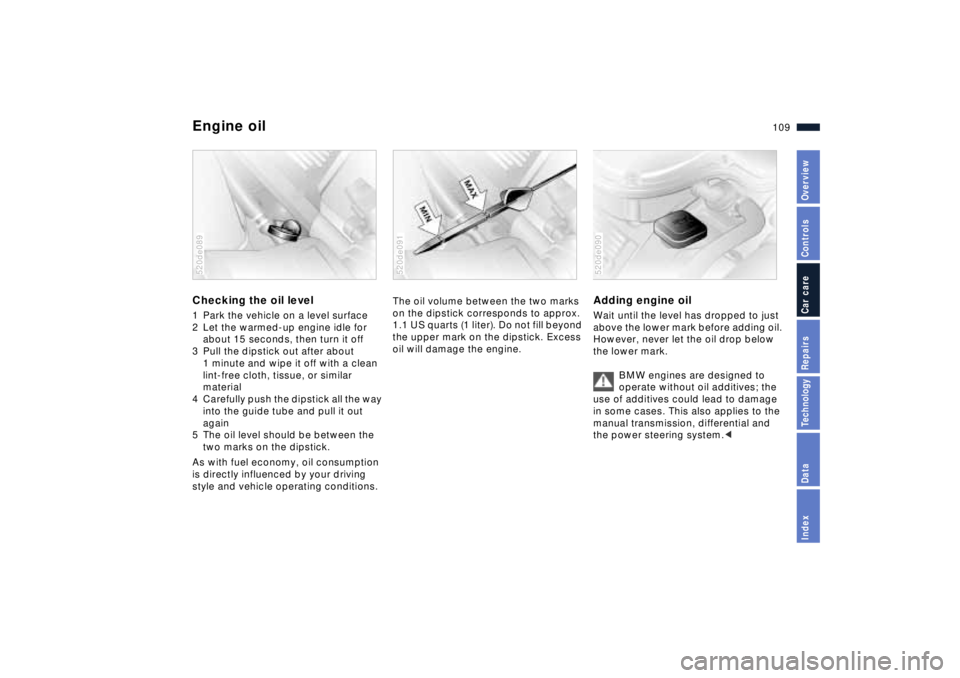
Engine oilChecking the oil level 1 Park the vehicle on a level surface
2 Let the warmed-up engine idle for
about 15 seconds, then turn it off
3 Pull the dipstick out after about
1 minute and wipe it off with a clean
lint-free cloth, tissue, or similar
material
4 Carefully push the dipstick all the way
into the guide tube and pull it out
again
5 The oil level should be between the
two marks on the dipstick.
As with fuel economy, oil consumption
is directly influenced by your driving
style and vehicle operating conditions.520de089
The oil volume between the two marks
on the dipstick corresponds to approx.
1.1 US quarts (1 liter). Do not fill beyond
the upper mark on the dipstick. Excess
oil will damage the engine.520de091
Adding engine oil Wait until the level has dropped to just
above the lower mark before adding oil.
However, never let the oil drop below
the lower mark.
BMW engines are designed to
operate without oil additives; the
use of additives could lead to damage
in some cases. This also applies to the
manual transmission, differential and
the power steering system.<520de090
Page 121 of 170
121n
IndexDataTechnologyRepairsCar careControlsOverview
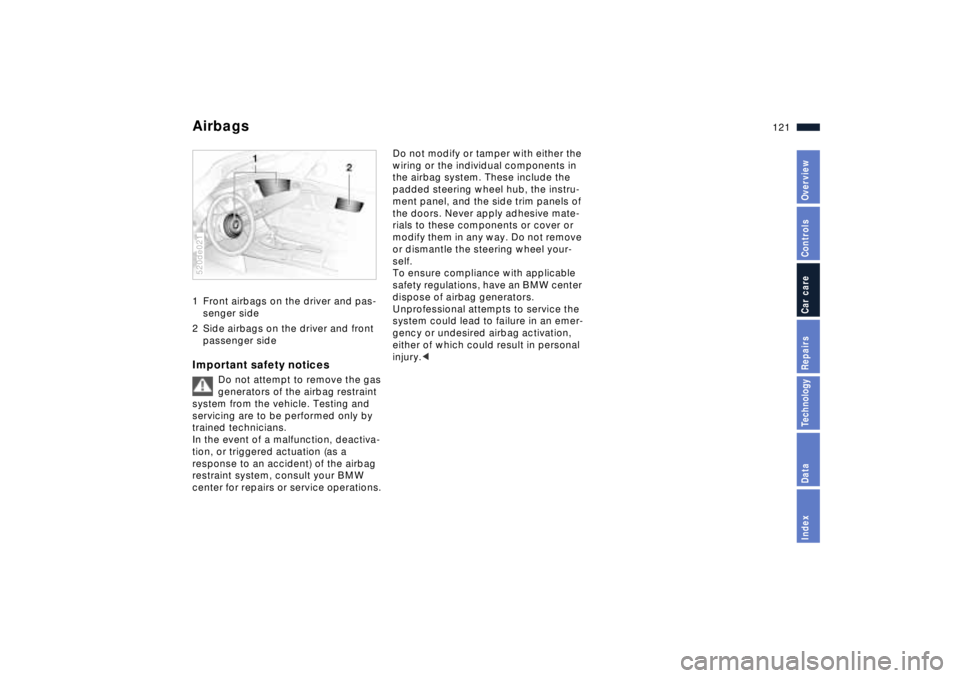
Airbags 1 Front airbags on the driver and pas-
senger side
2 Side airbags on the driver and front
passenger sideImportant safety notices
Do not attempt to remove the gas
generators of the airbag restraint
system from the vehicle. Testing and
servicing are to be performed only by
trained technicians.
In the event of a malfunction, deactiva-
tion, or triggered actuation (as a
response to an accident) of the airbag
restraint system, consult your BMW
center for repairs or service operations.
520de021
Do not modify or tamper with either the
wiring or the individual components in
the airbag system. These include the
padded steering wheel hub, the instru-
ment panel, and the side trim panels of
the doors. Never apply adhesive mate-
rials to these components or cover or
modify them in any way. Do not remove
or dismantle the steering wheel your-
self.
To ensure compliance with applicable
safety regulations, have an BMW center
dispose of airbag generators.
Unprofessional attempts to service the
system could lead to failure in an emer-
gency or undesired airbag activation,
either of which could result in personal
injury.<
Page 135 of 170

135n
IndexDataTechnologyRepairsCar careControlsOverview
Changing a wheel Run-flat tiresYour BMW Z8 roadster is equipped
with run-flat tires.
The assembly consists of self-support-
ing tires mounted on specially-designed
wheel rims. Special reinforcement
elements support the sidewalls in the
event of pressure loss. Although tire
performance is then restricted, the
vehicle can still be driven on the
deflated tire for a limited distance. Your
vehicle is equipped with a tire pressure
monitor that signals you in case of a flat
tire.
In the event of a flat tire The red indicator lamp on the instru-
ment panel will flash in the event of a
flat tire. In addition, a gong will sound.
Refer to page 67.
Carefully reduce speed to less than
50 mph (80 km/h), avoiding any hard
braking or steering maneuvers while
doing so.
You will still be able to drive approx.
155 miles (250 km) on your run-flat tire,
until you can get to a safe place to park,
a gas station, or to the nearest BMW
center. Under minimum vehicle loading,
it could conceivably last more than
155 miles (250 km).
If you cannot immediately determine
which tire is defective just by looking
at it, then check the tire pressure in all
four tires.Have your BMW center replace
your tires. For safety reasons, do
not have run-flat tires repaired. Your
BMW center has been trained to work
with the run-flat tires and is equipped
with the necessary special tools.<
If necessary, please have your
BMW center switch the tires on
your vehicle from summer to winter
tires, or the reverse.<
Page 145 of 170
145n
IndexDataTechnologyRepairsCar careControlsOverview
Towing the vehicle
Avoid "off-center" towing. Be sure
that the tow rope is pulled tightly
when the towing vehicle begins to
move.<
The towed vehicle should always
be the lighter of the two vehicles.
If this is not the case, it is no longer
possible to control vehicle response.<
Tow-startingFor instructions on jump starting, refer
to page 143.
Never attempt to use your vehicle to
push another vehicle, since damage to
the energy-absorbing bumpers could
result.
Towing a vehicle1 Put the manual-shift gear lever in
neutral
2 Towing speed:
Max. 45 mph (70 km/h)
3 Towing distance:
Max. 95 miles (150 km)
4 Leave the ignition key in position 1
to ensure that the brake lamps, turn
signals, horn and windshield wipers
remain operative, and to prevent the
steering lock detent from engaging
5 Switch on the hazard-warning system
(comply with country-specific regula-
tions).
Find some means of identifying the
vehicle in tow, e. g. place a sign or
warning triangle in the rear window.
Make sure that the ignition key
remains in position 1 even
when the electrical system has failed
to prevent the steering lock from
engaging. The steering and brakes are
without power assist when the engine is
not running. This means that increased
effort is required for steering and
braking.<
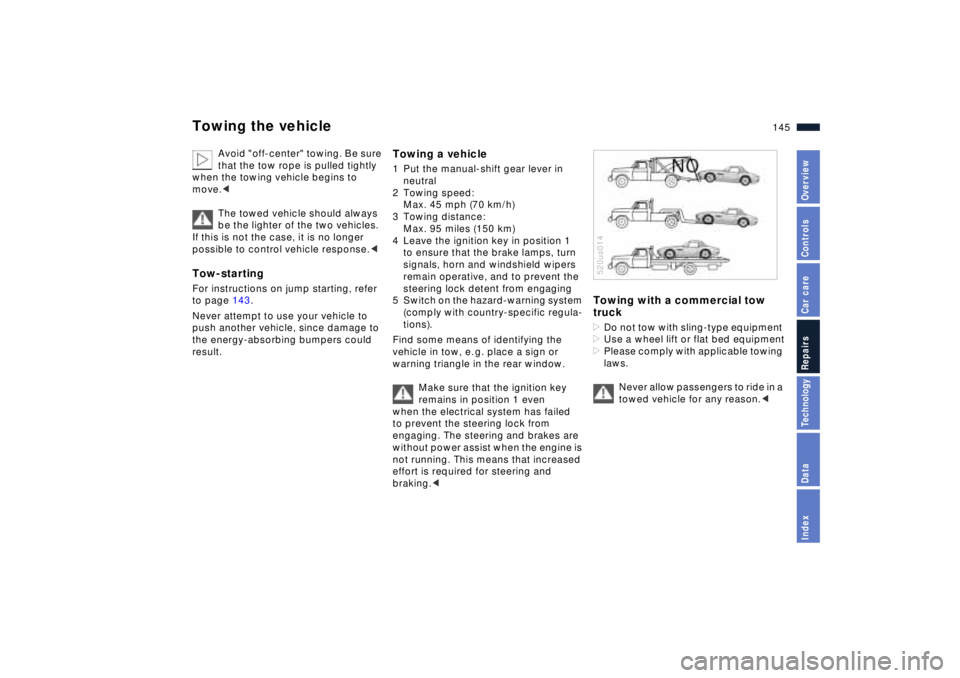
Towing with a commercial tow
truck>Do not tow with sling-type equipment
>Use a wheel lift or flat bed equipment
>Please comply with applicable towing
laws.
Never allow passengers to ride in a
towed vehicle for any reason.<520us014
Page 148 of 170
148n
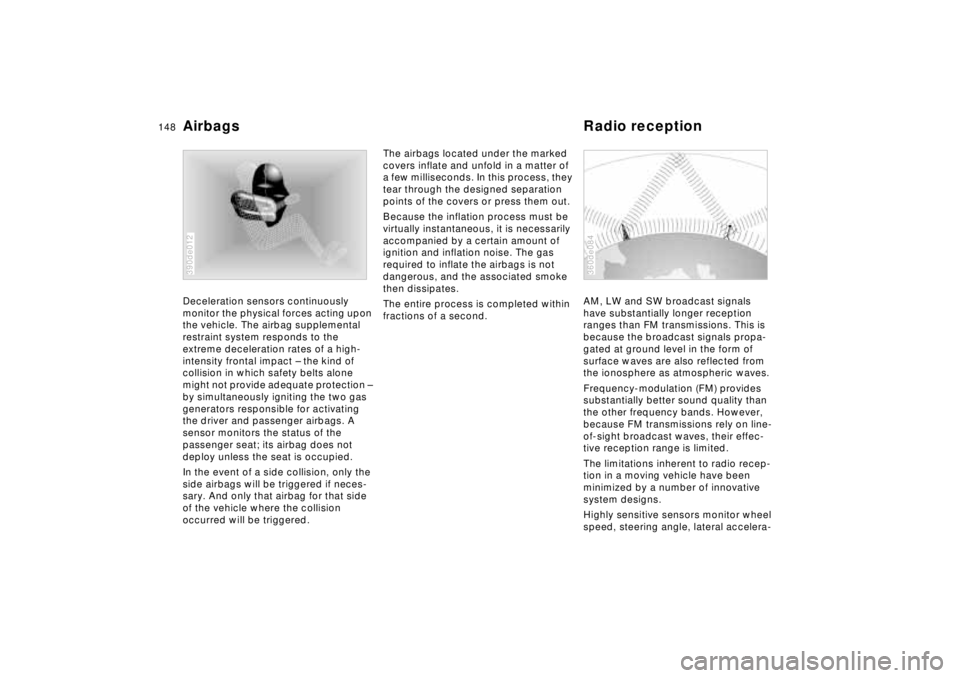
Deceleration sensors continuously
monitor the physical forces acting upon
the vehicle. The airbag supplemental
restraint system responds to the
extreme deceleration rates of a high-
intensity frontal impact Ð the kind of
collision in which safety belts alone
might not provide adequate protection Ð
by simultaneously igniting the two gas
generators responsible for activating
the driver and passenger airbags. A
sensor monitors the status of the
passenger seat; its airbag does not
deploy unless the seat is occupied.
In the event of a side collision, only the
side airbags will be triggered if neces-
sary. And only that airbag for that side
of the vehicle where the collision
occurred will be triggered.
390de012
The airbags located under the marked
covers inflate and unfold in a matter of
a few milliseconds. In this process, they
tear through the designed separation
points of the covers or press them out.
Because the inflation process must be
virtually instantaneous, it is necessarily
accompanied by a certain amount of
ignition and inflation noise. The gas
required to inflate the airbags is not
dangerous, and the associated smoke
then dissipates.
The entire process is completed within
fractions of a second.AM, LW and SW broadcast signals
have substantially longer reception
ranges than FM transmissions. This is
because the broadcast signals propa-
gated at ground level in the form of
surface waves are also reflected from
the ionosphere as atmospheric waves.
Frequency-modulation (FM) provides
substantially better sound quality than
the other frequency bands. However,
because FM transmissions rely on line-
of-sight broadcast waves, their effec-
tive reception range is limited.
The limitations inherent to radio recep-
tion in a moving vehicle have been
minimized by a number of innovative
system designs.
Highly sensitive sensors monitor wheel
speed, steering angle, lateral accelera-
360de084
Airbags Radio reception
Page 158 of 170

158n
Electrical system Drive belts Battery 12V, 90 AhSpark plugs NGK BKR 6 EQUP
This spark ignition system meets all
requirements of the Canadian Interfer-
ence-Causing Equipment Regulations
(ICES-2).Water pump Ð Generator Ð Power
steering
Ribbed V-belt 7 PK 1440
A/C compressor
Ribbed V-belt 5 PK 980You can obtain Original BMW
Parts and Accessories, as well
as professional advice from your BMW
center.<
Page 163 of 170

Everything from A to Z
163n
IndexDataTechnologyRepairsCar careControlsOverview
Controls16
Convertible top41
closing in event of
electrical
malfunction140t
manual operation141t
Coolant111, 157
Coolant temperature
gauge63
Copyright4
Cornering Brake Control
(CBC)21, 89
Curb weight156
Current check indicator20DDashboard16
Data
dimensions155
engine154
technical154
weights156
Daytime-driving lamp69
DBC (Dynamic Brake
Control)90
Deactivating the tilt sensor
alarm system and interior
motion sensor34
Deep water87
Defrosting the
windows60, 75
Difficult steering20, 94Dimensions155
Dipstick109
Disc brakes90
Displacement154
Display lighting69
Displays18
Disposal
engine oil111
used batteries138t
Door keys30
Door warning lamp, bulb
replacement132t
Doors
emergency
actuation32t
mirrors47
remote control33
unlocking and locking32
DOT Quality Grades99
Draft-free ventilation75
Drink holder78, 80
Drive belts158
Driving in winter92
Driving notes87
DSC (Dynamic Stability
Control)22, 65, 149
Dynamic Brake Control
(DBC)90
Dynamic Performance
Control66
Dynamic Stability Control
(DSC)22, 65, 149
EElectric defrosting of
mirrors47
Electric power seat45
Electric power windows40
Electrical equipment
failure138t
Electrical failure
convertible top140t
doors32t
fuel filler door140t
luggage
compartment140t
passenger-side
door141t
Electrical system158
Electronic vehicle
immobilizer31
Emergency operation
convertible top140t
doors32t
fuel filler door140t
luggage
compartment140t
passenger-side
door141t
Engine
coolant111, 157
data154
output154
speed154
starting56
switching off56Engine compartment106
Engine oil109
add109t
consumption109
filling capacity157
filter change157
pressure indicator
lamp20
quality110
specifications110
viscosity110
Engine oil level21
check109
Equipment
options and accessories5
Exit lamps, bulb
replacement132t
Exterior finish117
Exterior mirrors47
FFailure to start144t
Fault in ABS89
Filler cap cover25
Filling capacities157
Filling the washer
reservoir157
First-aid kit24
Fittings, tow starting and
towing144t
Flashlight79
Flat tire135t
Page 165 of 170

Everything from A to Z
165n
IndexDataTechnologyRepairsCar careControlsOverview
MM+S tires102
Maintenance63
Malfunction, ABS89
Manual transmission58
Map lamps71
Microfilter75
Mirrors47
Mobile phones94
Modifications,
technical6, 123
Multi-Information Radio
(MIR)64NNavigation system, refer to
the radio Owner's Manual
Neckrest46
Neon lamps129OOBD interface socket124
Odometer62
Oil
additives109
consumption109
fill capacity157
quality110
specifications110
viscosity110Oil change intervals, see the
Service and Warranty
Information Booklet (US
models) or the Warranty
and Service Guide Booklet
(Canadian models)
Oil dipstick109
Oil filter change157
Oil level
check109
indicator lamp21
Oil pressure
indicator lamp20
OILSERVICE63
Onboard tool kit128t
Opening and closing
from inside36
from outside32
Operation in winter92
Outlets, ventilation72
Outside temperature
display64
PPaint, care117
Paintwork
minor repairs118
waxing118
Parking brake57
Parking lamps70
Parking, winter93Performance154
Phone, refer to cellular
phone94
Pocket flashlight79
Pollen75
Power steering94
Power windows40
Pressure tires26t, 98
monitoring67
RRadio64, 94
refer also to the radio
Owner's Manual
Radio reception94, 148
Rapid heating77
RDW (Tire Pressure
Warning)67
Reading lamps71
Rear fog lamp70
bulb replacement131t
Rear window
defroster60, 75
Rearview mirror47
Recirculated air mode74
Refill washer
reservoir108t
Refueling25
Remaining fuel indicator62
Remote control33Removing condensation
from the windows75t
Removing the vehicle from
storage122
Replacement keys30
Replacing fuses138t
Replacing lamps and
bulbs129t
Replacing windshield wiper
blades128t
Replenish washer
fluid108t
Reporting Safety Defects7
Restraint systems53
Return used
batteries138t
Reverse17, 58
Roof load capacity156
Rotating the tires100
Rubber parts92
SSafety belt tensioner149
Safety belts50
Safety buttons36
Seat adjustment45
Seat heating77
Securing cargo83
Self-defrosting mirrors47
Service Booklet114