fuel pressure BMW Z8 2001 Owners Manual
[x] Cancel search | Manufacturer: BMW, Model Year: 2001, Model line: Z8, Model: BMW Z8 2001Pages: 170, PDF Size: 1.64 MB
Page 10 of 170

Contents
Overview
Controls and features
Cockpit16
Instrument cluster18
Indicator and warning lamps20
Hazard warning flashers24
Warning triangle24
First-aid kit24
Refueling25
Fuel quality26
Tire inflation pressure26
Locks and security systems:
Keys30
Electronic vehicle
immobilizer31
Central locking system32
Opening and closing Ð from the
outside32
Using the key32
Using the remote control33
Opening and closing Ð from the
inside36
Luggage compartment lid37
Alarm system38
Electric power windows40
The automatic convertible
top41
Adjustments:
Seats45
Steering wheel47
Mirrors47
Car Memory, Key Memory48
Passenger safety systems:
Safety belts50
Airbags51
Transporting children safely53
Driving:
Ignition and steering lock55
Starting the engine56
Turning the engine off56
Parking brake57
Manual transmission58
Turn signal indicator/Headlamp
flasher58
Washer/Wiper system59
Rear window defroster60
Cruise control61
Everything under control:
Odometer62
Tachometer62
Fuel gauge62
Coolant temperature gauge63
Service Interval Display63
Clock64
Multi-Information Radio (MIR)64
Technology for safety and
driving convenience:
Dynamic Stability Control
(DSC)65
Dynamic Performance
Control66
Tire Pressure Warning (RDW)67
Contents
Page 15 of 170
Overview
Controls and features
Operation, care
and maintenance
Owner service procedures
Technical data
Index Advanced technology
15n
IndexDataTechnologyRepairsCar careControlsOverview
Cockpit16
Instrument cluster18
Indicator and warning lamps20
Hazard warning flashers24
Warning triangle24
First-aid kit24
Refueling25
Fuel quality26
Tire inflation pressure26
Overview
Page 19 of 170

19n
IndexDataTechnologyRepairsCar careControlsOverview
Instrument cluster
1 Fuel gauge with indicator lamp for
fuel reserve62
2 Speedometer with indicator and
warning lamps for
>
Dynamic Stability Control
(DSC)22
>
Engine electronics22
3 Instrument panel lighting69
4 Tachometer62
with indicator and warning lamps
for:
>
Battery charge current20
>
Convertible top operation41
>
Tire Pressure Warning (RDW)20
>
Antilock Brake System (ABS)21
>
Parking brake/Brake hydraulic
system/Cornering Brake Control
(CBC)20
>
Service Engine Soon22
>
Engine oil pressure/Engine oil
level20, 21
5 Coolant temperature gauge with
"Coolant temperature too high"
warning lamp63
6 Indicator and warning lamps for:
>
Rear fog lamp22
>
Turn signal, right23
7 Clock648 Control knob for:
>
Clock64
>
Trip odometer, reset to zero62
9 Indicator and warning lamps for:
>
Please fasten safety belts21
>
High beam23
>
Airbags21
10 Indicator for:
>
Odometer62
>
Trip odometer62
>
Service Interval63
11 Indicator and warning lamps for:
>
Turn signal, left23
>
Brake pads22
Page 26 of 170
26n
Fuel quality Tire inflation pressure The engine uses lead-free gasoline
only.
Required fuel:
>Premium Unleaded Gasoline,
min. 91 AKI
AKI = Anti Knock Index
Do not use leaded fuels. The use
of leaded fuels will cause perma-
nent damage to the system's oxygen
sensor and the catalytic converter.<
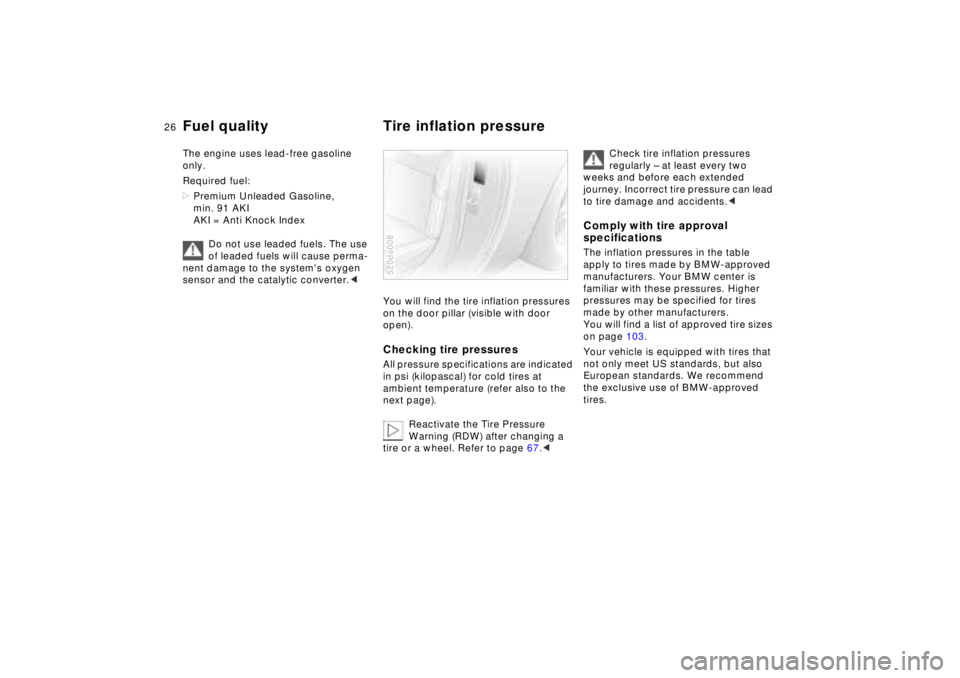
You will find the tire inflation pressures
on the door pillar (visible with door
open).Checking tire pressuresAll pressure specifications are indicated
in psi (kilopascal) for cold tires at
ambient temperature (refer also to the
next page).
Reactivate the Tire Pressure
Warning (RDW) after changing a
tire or a wheel. Refer to page 67.<520de008
Check tire inflation pressures
regularly Ð at least every two
weeks and before each extended
journey. Incorrect tire pressure can lead
to tire damage and accidents.<
Comply with tire approval
specificationsThe inflation pressures in the table
apply to tires made by BMW-approved
manufacturers. Your BMW center is
familiar with these pressures. Higher
pressures may be specified for tires
made by other manufacturers.
You will find a list of approved tire sizes
on page 103.
Your vehicle is equipped with tires that
not only meet US standards, but also
European standards. We recommend
the exclusive use of BMW-approved
tires.
Page 29 of 170
Overview
Controls and features
Operation, care
and maintenance
Owner service procedures
Technical data
Index Advanced technology
29n
IndexDataTechnologyRepairsCar careControlsOverview
Driving:
Ignition and steering lock55
Starting the engine56
Turning the engine off56
Parking brake57
Manual transmission58
Turn signal indicator/Headlamp
flasher58
Washer/Wiper system59
Rear window defroster60
Cruise control61
Everything under control:
Odometer62
Tachometer62
Fuel gauge62
Coolant temperature gauge63
Service Interval Display63
Clock64
Multi-Information Radio (MIR)64
Technology for safety and
driving convenience:
Dynamic Stability Control
(DSC)65
Dynamic Performance
Control66
Tire Pressure Warning (RDW)67Lamps:
Side lamps/Low beams69
Instrument panel lighting69
High beams/Parking lamps70
Rear fog lamp70
Interior lamps70
Reading lamps71
Controlling the climate for
pleasant driving:
Heating and ventilation/
Air conditioner72
Seat heating77
Interior conveniences:
Glove compartment78
Storage compartments78
Drink holder80
Cellular phone81
Ashtray81
Cigarette lighter82
Loading and transporting:
Cargo loading83
Page 87 of 170

87n
IndexDataTechnologyRepairsCar careControlsOverview
Brakes:
Do not rest your foot on the brake
pedal while driving. Even light but
consistent pressure on the brake pedal
could lead to high temperatures, brake
wear, and possibly, to brake system
failure.
Aquaplaning:
Reduce speed while driving on wet or
slushy roads, otherwise, a wedge of
water can form between the tires and
the road surface. This phenomenon is
referred to as "aquaplaning" or "hydro-
planing." It is characterized by a partial
or complete loss of contact between
the tires and the road surface. The ulti-
mate results are loss of steering and
braking control.
Driving through water:
When there is water on the roads, do
not drive in it if it is deeper than 1 ft
(30 cm), and even then, only at walking
speed, otherwise the vehicle can
sustain damage to the engine, the elec-
trical systems and the transmission.<
The catalytic converter reduces harmful
exhaust emissions.
It is designed for use with unleaded fuel
only. Even minute quantities of lead
would be enough to permanently
damage both the catalytic converter
and the system oxygen sensor.To ensure efficient, trouble-free engine
operation and to avoid potential damage:>Be sure to comply with the scheduled
maintenance requirements
>Fill the fuel tank well before it is empty
>Tow-start only when the engine is
cold. If you attempt to tow-start with
a warm engine, unburned residual
fuel in the catalytic converter could
ignite and cause damage. It is better
to start the vehicle with a battery
charger or assistance from another
vehicle
>Avoid other situations where the fuel
is either not burned or burns incom-
pletely, such as engaging the starter
frequently or for extended periods, or
repeated start attempts in which the
engine does not start (stopping and
restarting an engine which is running
properly does not present a pro-
blem). Never allow the engine to run
with any of the spark plug cables
disconnected.Be sure to comply with the
instructions above to prevent
unburned fuel from reaching the cata-
lytic converter. Otherwise, there is the
danger of overheating and damage to
the catalytic converter.
Extreme temperatures are present with
the catalytic converter both on this and
every catalytic converter-equipped
vehicle. Heat shields are installed adja-
cent to some sections of the exhaust
system. Never remove these shields;
do not apply undercoating to their
surfaces. When driving, standing at
idle, and parking the vehicle, take care
to avoid contact between the exhaust
system and flammable materials (grass,
hay, leaves etc.). Such contact could
start a fire, resulting in serious personal
injury and property damage.<
Driving notes Catalytic converter
Page 122 of 170

122n
Vehicle storage
If the vehicle is to be stored for
more than three months, ensure
that the following service operations
are carried out first.<
Preparations for storageHave your BMW center perform the
following procedures:
1 Clean and apply a rust proofing agent
or other treatment to the engine,
engine compartment, undercarriage,
axles and major components in accor-
dance with approved repair proce-
dures. Wash the vehicle, clean the
interior and treat painted and
chromed parts. Clean the weather-
stripping around the hood, luggage
compartment and doors
2 Change engine oil and oil filter at
operating temperature. As an addi-
tional corrosion protection measure,
an anticorrosive agent can be added
to the engine in accordance with the
manufacturer's instructions
3 Check the coolant level and concen-
tration and top off if necessary
4 Check the fluid level of the wind-
shield washer fluid reservoir; top off
if necessary
5 Fill the fuel tank completely to
prevent the formation of condensa-
tion
6 Increase the tire inflation pressure to
51 psi (350 kPa).Before parking the vehicle1 Dry the parking brake and footbrake
by brake applications to prevent the
brake discs and drums from
corroding
2 Park the vehicle in a covered, dry,
and well-ventilated area. Place the
transmission in first gear or, if neces-
sary, chock the wheels to prevent the
vehicle from rolling. Do not engage
the parking brake
3 Remove the battery, charge it
completely and store it in a cool (but
frost-free) room
4 Remove the hardtop and store it
separately, refer to page 96
5 Close the convertible top.
During storageRecharge a battery that has been taken
out of the car every six months. If it is
not recharged, it will not be serviceable.
Every time the battery is discharged,
especially over extended periods, its
service life is reduced.Removing the vehicle from
storageRecharge the battery if the "Magic Eye"
turns black, refer to page 136.
Then have Inspection I performed by
your BMW center, including a brake
fluid replacement, if necessary. Refer to
the Service and Warranty Information
Booklet (US models) or the Warranty
and Service Guide Booklet (Canadian
models).
Page 163 of 170

Everything from A to Z
163n
IndexDataTechnologyRepairsCar careControlsOverview
Controls16
Convertible top41
closing in event of
electrical
malfunction140t
manual operation141t
Coolant111, 157
Coolant temperature
gauge63
Copyright4
Cornering Brake Control
(CBC)21, 89
Curb weight156
Current check indicator20DDashboard16
Data
dimensions155
engine154
technical154
weights156
Daytime-driving lamp69
DBC (Dynamic Brake
Control)90
Deactivating the tilt sensor
alarm system and interior
motion sensor34
Deep water87
Defrosting the
windows60, 75
Difficult steering20, 94Dimensions155
Dipstick109
Disc brakes90
Displacement154
Display lighting69
Displays18
Disposal
engine oil111
used batteries138t
Door keys30
Door warning lamp, bulb
replacement132t
Doors
emergency
actuation32t
mirrors47
remote control33
unlocking and locking32
DOT Quality Grades99
Draft-free ventilation75
Drink holder78, 80
Drive belts158
Driving in winter92
Driving notes87
DSC (Dynamic Stability
Control)22, 65, 149
Dynamic Brake Control
(DBC)90
Dynamic Performance
Control66
Dynamic Stability Control
(DSC)22, 65, 149
EElectric defrosting of
mirrors47
Electric power seat45
Electric power windows40
Electrical equipment
failure138t
Electrical failure
convertible top140t
doors32t
fuel filler door140t
luggage
compartment140t
passenger-side
door141t
Electrical system158
Electronic vehicle
immobilizer31
Emergency operation
convertible top140t
doors32t
fuel filler door140t
luggage
compartment140t
passenger-side
door141t
Engine
coolant111, 157
data154
output154
speed154
starting56
switching off56Engine compartment106
Engine oil109
add109t
consumption109
filling capacity157
filter change157
pressure indicator
lamp20
quality110
specifications110
viscosity110
Engine oil level21
check109
Equipment
options and accessories5
Exit lamps, bulb
replacement132t
Exterior finish117
Exterior mirrors47
FFailure to start144t
Fault in ABS89
Filler cap cover25
Filling capacities157
Filling the washer
reservoir157
First-aid kit24
Fittings, tow starting and
towing144t
Flashlight79
Flat tire135t
Page 164 of 170

Everything from A to ZFog lamp, bulb
replacement131t
Follow-Me-Home
lamps49, 69
Footbrake90
Footwell lamps70
bulb replacement132t
Front seat adjustment45
Frost protection,
radiator111
Fuel26
gauge62
indicator62
quality26
Fuel filler door
manual release after
electrical fault140t
Fuel tank capacity157
Fuel-injection system154
Fuses138GGasoline26
quality26
Glove compartment78
bulb replacement133t
Gross vehicle weight156
HHand lamp79
Handbrake57
Handsfree car phone
system81
Hardtop96
Hazard warning
flashers24t
Hazard warning
triangle24t
Head restraint46
Headlamp covers,
care115t, 129t
Headlamp flasher70
Headlamp washer
system60, 108, 157
Headlamps70
Headlight glare in rearview
mirror48
Heated mirrors47
Heated seats77
Heating and ventilation72
Heating, rapid77
Heavy loads83
Height155
High beams23, 58, 70
Holder for beverage
cans80
Hood release104t, 104
Horn17
Hydraulic system88, 91
IIdentification, tires101
Ignition keys30
Ignition lock55
Imprint4
Incoming air mode74
Indicator lamps20
Inflation pressure26t, 98
monitoring67
INSPECTION63
Instrument cluster18
Instrument panel lighting69
Instruments18
Interaxle tire rotation100
Interface socket for On-
Board-Diagnostics124
Interference
cellular phone94
radio reception94
Interior lamps34, 70
bulb replacement133t
remote control34
Interior motion sensor38
deactivating34
Interior rearview mirror
with automatic
dimmer48, 150
Intermittent mode of wiper
system59
JJump starting143KKey Memory48
Key with remote control30
Keys30LLamps and bulbs129t
Leather care120
Length155
License plate, bulb
replacement131t
Light switch69
Light-alloy wheels103
Lighter82
Loading83
Lock deicer92
Louvers72
Low beam headlamps69
Low traction road
surfaces93
Luggage compartment37
bulb replacement134t
capacity156
remote control35
Luggage compartment
lid37
emergency release37t
Page 165 of 170

Everything from A to Z
165n
IndexDataTechnologyRepairsCar careControlsOverview
MM+S tires102
Maintenance63
Malfunction, ABS89
Manual transmission58
Map lamps71
Microfilter75
Mirrors47
Mobile phones94
Modifications,
technical6, 123
Multi-Information Radio
(MIR)64NNavigation system, refer to
the radio Owner's Manual
Neckrest46
Neon lamps129OOBD interface socket124
Odometer62
Oil
additives109
consumption109
fill capacity157
quality110
specifications110
viscosity110Oil change intervals, see the
Service and Warranty
Information Booklet (US
models) or the Warranty
and Service Guide Booklet
(Canadian models)
Oil dipstick109
Oil filter change157
Oil level
check109
indicator lamp21
Oil pressure
indicator lamp20
OILSERVICE63
Onboard tool kit128t
Opening and closing
from inside36
from outside32
Operation in winter92
Outlets, ventilation72
Outside temperature
display64
PPaint, care117
Paintwork
minor repairs118
waxing118
Parking brake57
Parking lamps70
Parking, winter93Performance154
Phone, refer to cellular
phone94
Pocket flashlight79
Pollen75
Power steering94
Power windows40
Pressure tires26t, 98
monitoring67
RRadio64, 94
refer also to the radio
Owner's Manual
Radio reception94, 148
Rapid heating77
RDW (Tire Pressure
Warning)67
Reading lamps71
Rear fog lamp70
bulb replacement131t
Rear window
defroster60, 75
Rearview mirror47
Recirculated air mode74
Refill washer
reservoir108t
Refueling25
Remaining fuel indicator62
Remote control33Removing condensation
from the windows75t
Removing the vehicle from
storage122
Replacement keys30
Replacing fuses138t
Replacing lamps and
bulbs129t
Replacing windshield wiper
blades128t
Replenish washer
fluid108t
Reporting Safety Defects7
Restraint systems53
Return used
batteries138t
Reverse17, 58
Roof load capacity156
Rotating the tires100
Rubber parts92
SSafety belt tensioner149
Safety belts50
Safety buttons36
Seat adjustment45
Seat heating77
Securing cargo83
Self-defrosting mirrors47
Service Booklet114