door lock BMW Z8 2002 User Guide
[x] Cancel search | Manufacturer: BMW, Model Year: 2002, Model line: Z8, Model: BMW Z8 2002Pages: 174, PDF Size: 2.37 MB
Page 40 of 174
40n
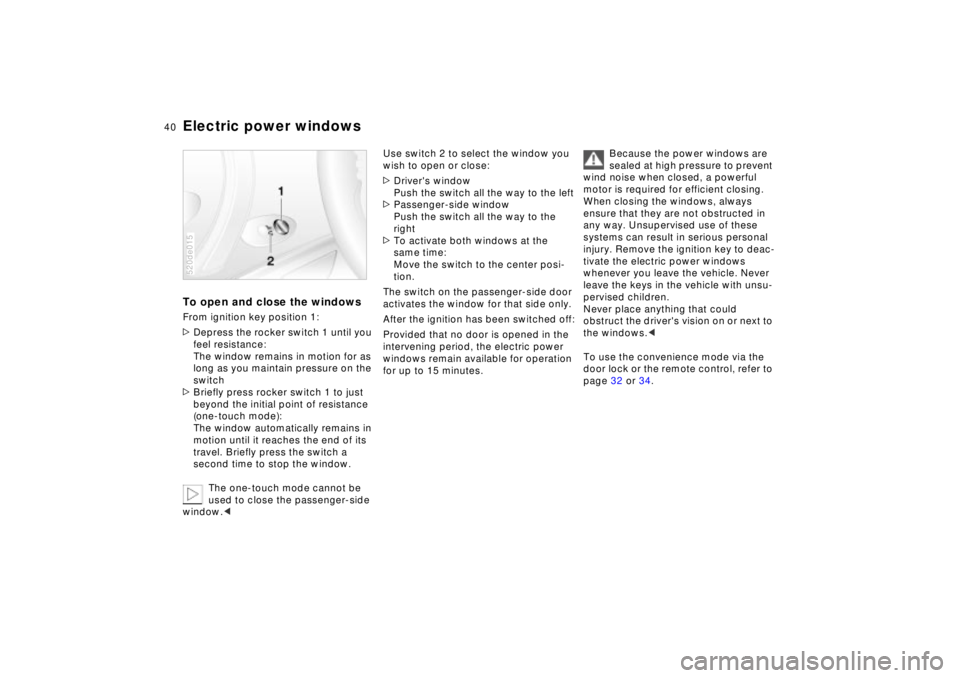
Electric power windowsTo open and close the windowsFrom ignition key position 1:
>Depress the rocker switch 1 until you
feel resistance:
The window remains in motion for as
long as you maintain pressure on the
switch
>Briefly press rocker switch 1 to just
beyond the initial point of resistance
(one-touch mode):
The window automatically remains in
motion until it reaches the end of its
travel. Briefly press the switch a
second time to stop the window.
The one-touch mode cannot be
used to close the passenger-side
window.<520de015
Use switch 2 to select the window you
wish to open or close:
>Driver's window
Push the switch all the way to the left
>Passenger-side window
Push the switch all the way to the
right
>To activate both windows at the
same time:
Move the switch to the center posi-
tion.
The switch on the passenger-side door
activates the window for that side only.
After the ignition has been switched off:
Provided that no door is opened in the
intervening period, the electric power
windows remain available for operation
for up to 15 minutes. Because the power windows are
sealed at high pressure to prevent
wind noise when closed, a powerful
motor is required for efficient closing.
When closing the windows, always
ensure that they are not obstructed in
any way. Unsupervised use of these
systems can result in serious personal
injury. Remove the ignition key to deac-
tivate the electric power windows
whenever you leave the vehicle. Never
leave the keys in the vehicle with unsu-
pervised children.
Never place anything that could
obstruct the driver's vision on or next to
the windows.<
To use the convenience mode via the
door lock or the remote control, refer to
page 32 or 34.
Page 49 of 174

49n
IndexDataTechnologyRepairsCar careControlsOverview
Mirrors Vehicle Memory, Key MemoryThe mirror switches to its clear,
undimmed mode whenever you shift
into reverse.
For trouble-free operation, keep the
photocells clean and do not cover the
area between the interior rearview
mirror and the windshield. Do not
attach any kind of stickers on the wind-
shield in front of the mirror, either.
For a more detailed explanation of the
electrochromatic technology used in
this mirror, please refer to page 153.
The conceptNo doubt you have reflected at one
time or another on how great it would
be if you could permanently configure
your vehicle's various features and
adjustments to mirror your own indi-
vidual preferences. In developing the
Z8, BMW has incorporated a number of
options for personal adjustment that
can be programmed into your vehicle
by your BMW center.
The available configuration data fall into
two categories, according to whether
their primary orientation is the vehicle
("Vehicle Memory") or the individual
("Key Memory"). Provided that each
person has a separate remote-control
key, you can have your BMW center
enter adjustment data for as many as
four different individuals into the
system.
The system then relies on a bilateral
data exchange to identify the individual
user and dial in the selected settings
whenever the remote-control unit is
used to disengage the door locks.
What the system can doYour BMW center can provide you with
details on the capabilities of the Vehicle
Memory and Key Memory systems.
Below a few examples:
A Vehicle Memory sampler:
>Various signals to confirm release
and engagement of the vehicle's
locks.
>Activate/deactivate the "Follow me
home" lamps.
A Key Memory sampler:
>Engage vehicle locks as soon as the
vehicle is underway.
At various points throughout this
Owner's Manual you will find this
symbol, indicating that the equipment
or system described in the adjacent
section can be preset for automatic
adjustment using the Vehicle or Key
Memory.<
Page 78 of 174
78n
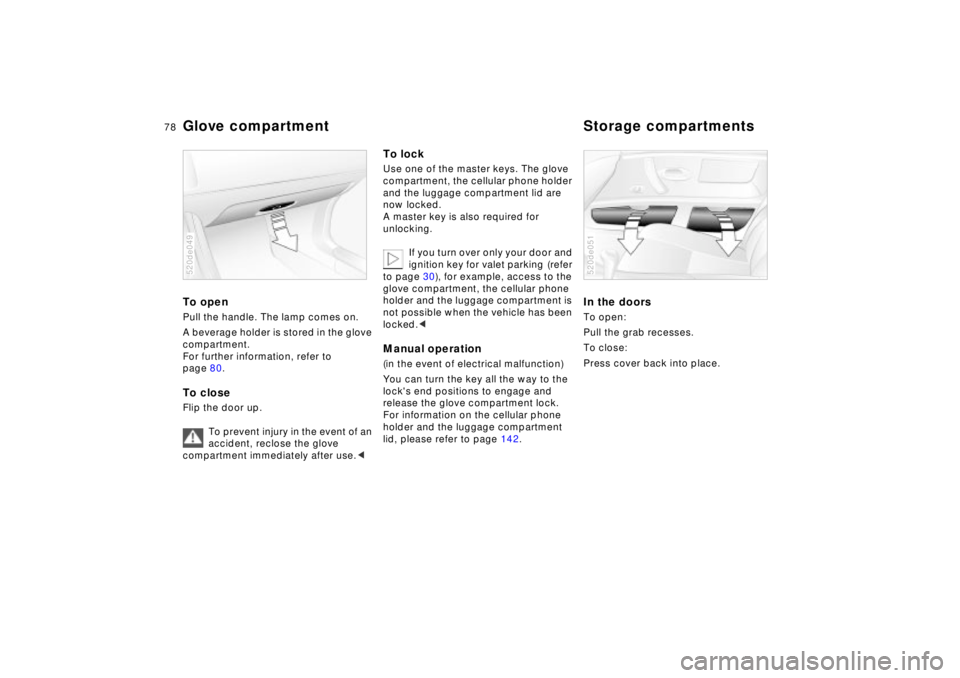
To openPull the handle. The lamp comes on.
A beverage holder is stored in the glove
compartment.
For further information, refer to
page 80.To closeFlip the door up.
To prevent injury in the event of an
accident, reclose the glove
compartment immediately after use.<520de049
To lockUse one of the master keys. The glove
compartment, the cellular phone holder
and the luggage compartment lid are
now locked.
A master key is also required for
unlocking.
If you turn over only your door and
ignition key for valet parking (refer
to page 30), for example, access to the
glove compartment, the cellular phone
holder and the luggage compartment is
not possible when the vehicle has been
locked.
lock's end positions to engage and
release the glove compartment lock.
For information on the cellular phone
holder and the luggage compartment
lid, please refer to page 142.
In the doorsTo open:
Pull the grab recesses.
To close:
Press cover back into place. 520de051
Glove compartment Storage compartments
Page 79 of 174
79n
IndexDataTechnologyRepairsCar careControlsOverview
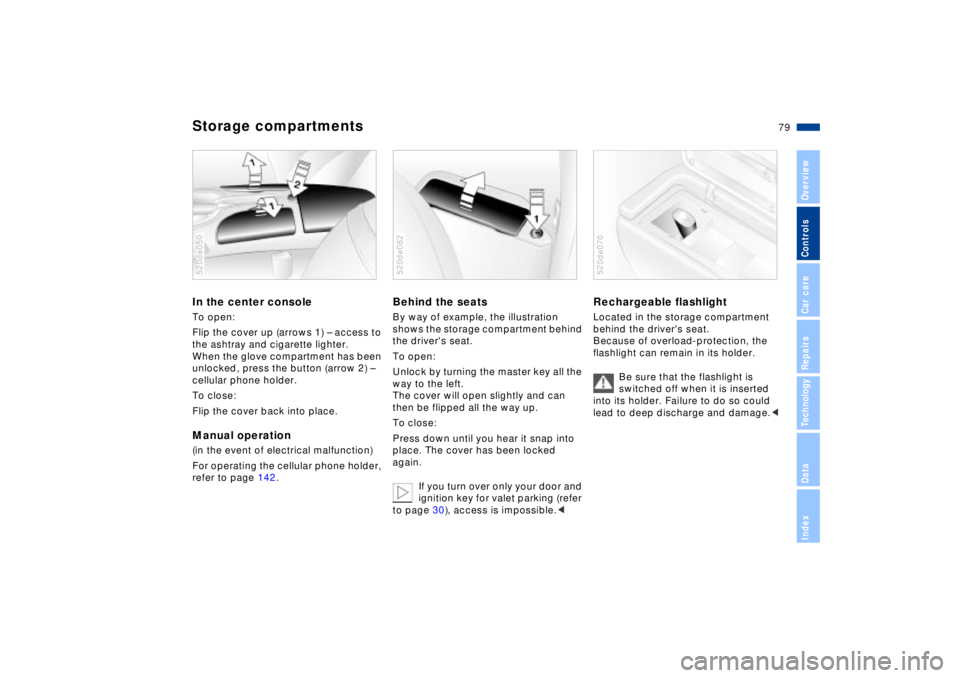
Storage compartmentsIn the center console To open:
Flip the cover up (arrows 1) Ð access to
the ashtray and cigarette lighter.
When the glove compartment has been
unlocked, press the button (arrow 2) Ð
cellular phone holder.
To close:
Flip the cover back into place. Manual operation(in the event of electrical malfunction)
For operating the cellular phone holder,
refer to page 142.520de050
Behind the seatsBy way of example, the illustration
shows the storage compartment behind
the driver's seat.
To open:
Unlock by turning the master key all the
way to the left.
The cover will open slightly and can
then be flipped all the way up.
To close:
Press down until you hear it snap into
place. The cover has been locked
again.
If you turn over only your door and
ignition key for valet parking (refer
to page 30), access is impossible.<520de082
Rechargeable flashlight
Located in the storage compartment
behind the driver's seat.
Because of overload-protection, the
flashlight can remain in its holder.
Be sure that the flashlight is
switched off when it is inserted
into its holder. Failure to do so could
lead to deep discharge and damage.<520de070
Page 92 of 174
92n
Brake system Winter operationBrake fluid level
The brake warning lamp comes
on with the parking brake
released:
The brake fluid level in the
reservoir is too low, refer to
page 114.
If the brake fluid level is too low and
brake pedal travel has become notice-
ably longer, there may be a defect in
one of the brake system's hydraulic
circuits.
Proceed to the nearest BMW
center. Higher brake application
pressure may be necessary under these
conditions, and brake pedal travel may
be significantly longer. Please
remember to adapt your driving style
accordingly.<
Brake pads
The warning lamp for the brake
pads comes on:
The brake pads have reached
their minimum thickness. Proceed to
the nearest BMW center as soon as
possible to have the pads replaced.
For your own safety: use only
brake pads which BMW has
approved for your specific vehicle
model. BMW cannot evaluate non-
approved brake pads to determine if
they are suited for use, and therefore
cannot ensure the operating safety of
the vehicle if they are installed.<
Winter is often accompanied by rapid
changes in weather, requiring not only a
different driving style, but also certain
preparations to the vehicle itself to
ensure that your progress through the
winter months remains safe and
trouble-free. CoolantBe sure that the coolant mixture
contains the year-round ratio of 50:50
water and extended-duty antifreeze
with corrosion inhibitor. This mixture
provides protection against freezing
down to approx. Ð34 7 (Ð37 6).LocksBMW door lock deicer can be used to
free doors if frozen. This deicer also
contains lubricant.
After using the deicer, treatment with
BMW lock cylinder grease is recom-
mended.
Page 93 of 174

93n
IndexDataTechnologyRepairsCar careControlsOverview
Winter operationRubber seals and componentsTo prevent the weather-stripping from
freezing, apply a spray-on rubber treat-
ment or silicone spray to the door, hood
and luggage compartment lid seals.
A full range of car-care products is
available from your BMW center.
on rear tires, complying with the manu-
facturer's safety precautions. Do not
exceed a maximum speed of 30 mph
(50 km/h) while the snow chains are
mounted and refrain from activating the
Flat Tire Monitor, as the snow chains
could trigger false alarms and/or
prevent the system from detecting
actual pressure loss.
Starting off When starting off in deep snow or when
"rocking" the vehicle to free it, it may be
advisable to temporarily deactivate the
DSC. Refer to page 65.
To maintain vehicle stability,
always drive with the system
switched on whenever possible.<
Driving on low-traction road
surfaces Do not activate the Sport mode (refer to
page 66). Use smooth, gentle pressure
to control the accelerator pedal. Avoid
excessive engine speeds and upshift
early. Downshift well in advance when
approaching uphill or downhill grades.
Maintain an adequate distance
between yourself and the vehicle
ahead. BrakesWinter road conditions substantially
reduce the amount of traction available
between the tires and the road surface.
The resulting increases in braking
distance are considerable and should
be kept in mind at all times.
ABS is intended to prevent the wheels
from locking during brake applications,
thus helping to maintain vehicle stability
and steering response. If the ABS does not respond in a critical
braking situation and the wheels lock,
reduce the pressure on the brake pedal
until the wheels just start to roll again
while still maintaining enough force to
continue braking.
Then increase the pressure, reduce the
pressure when the wheels lock, reapply
pressure etc.
This staggered braking procedure will
reduce braking distances while helping
you maintain steering control.
You can always then attempt to steer
around hazards after you have reduced
pressure on the brake pedal.
Never downshift to exploit engine
braking when driving on slippery
road surfaces, as this could lead to a
loss of traction at the rear wheels,
impairing your ability to control the
vehicle.<
Depress the clutch during hard
braking on road surfaces that
provide only poor or uneven traction.<
Page 143 of 174
143n
IndexDataTechnologyRepairsCar careControlsOverview
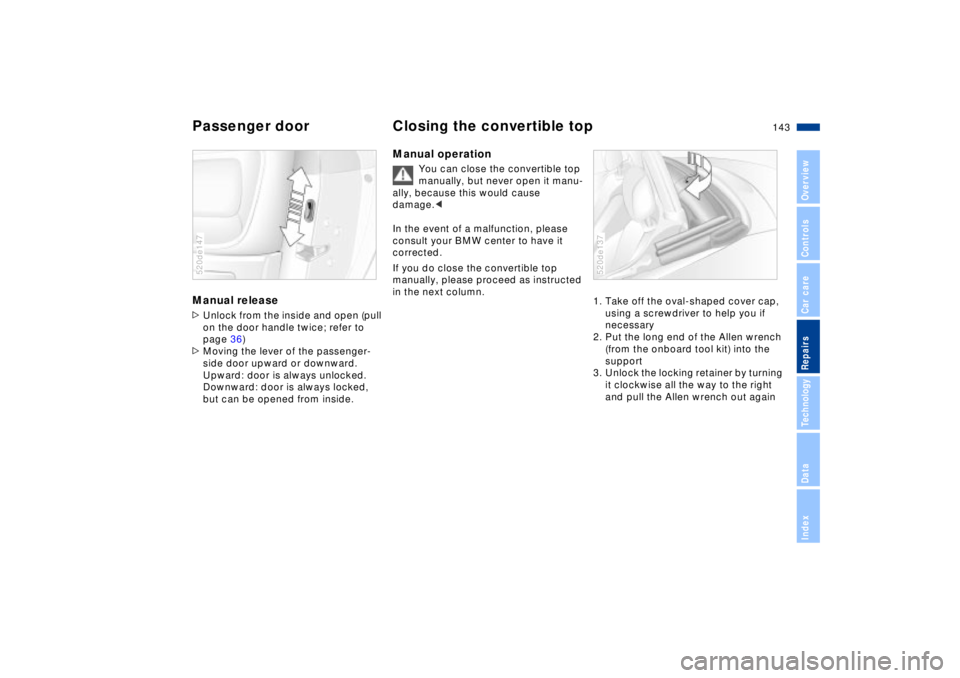
Passenger door Closing the convertible topManual release >Unlock from the inside and open (pull
on the door handle twice; refer to
page 36)
>Moving the lever of the passenger-
side door upward or downward.
Upward: door is always unlocked.
Downward: door is always locked,
but can be opened from inside.520de147
Manual operation
You can close the convertible top
manually, but never open it manu-
ally, because this would cause
damage.<
In the event of a malfunction, please
consult your BMW center to have it
corrected.
If you do close the convertible top
manually, please proceed as instructed
in the next column.
1. Take off the oval-shaped cover cap,
using a screwdriver to help you if
necessary
2. Put the long end of the Allen wrench
(from the onboard tool kit) into the
support
3. Unlock the locking retainer by turning
it clockwise all the way to the right
and pull the Allen wrench out again 520de137
Page 167 of 174

Everything from A to Z
167n
IndexDataTechnologyRepairsCar careControlsOverview
Connector for Onboard
Diagnostic126
Consumption display62
Controls16
Convertible top41
closing in event of
electrical
malfunction143t
manual operation143t
Coolant113, 161
Coolant temperature
gauge63
Copyright4
Cornering Brake Control
(CBC)21, 89
Cruise control61
Curb weight160
Current check indicator20DDashboard16
Data
dimensions159
engine158
technical158
weights160
Daytime driving lamps69
DBC (Dynamic Brake
Control)90
Deactivating the tilt alarm
sensor and interior motion
sensor34Deep water87
Defrosting the
windows60, 75
Difficult steering20, 94
Dimensions159
Dipstick111
Disc brakes90
Displacement158
Display lighting69
Displays18
Disposal
engine oil113
used batteries140t
Door keys30
Door warning lamp, bulb
replacement134t
Doors
emergency
actuation32t
mirrors48
remote control33
unlocking and locking32
DOT Quality Grades100
Draft-free ventilation75
Drink holder78, 80
Drive belts162
Driving in winter92
Driving notes87
DSC (Dynamic Stability
Control)22, 65, 152
Dynamic Brake Control
(DBC)90Dynamic Performance
Control66
Dynamic Stability Control
(DSC)22, 65, 152
EElectric defrosting of
mirrors48
Electric power seats45
Electric power windows40
Electrical equipment
failure140t
Electrical failure
convertible top143t
doors32t
fuel filler door142t
luggage
compartment142t
passenger-side
door143t
Electrical system162
Electronic vehicle
immobilizer31
Emergency operation
convertible top143t
doors32t
fuel filler door142t
luggage
compartment142t
passenger-side
door143tEmergency release from
luggage compartment's
interior38
Engine
coolant113, 161
data158
output158
speed158
starting56
switching off57
Engine compartment108
Engine oil111
add111t
consumption111
filling capacity161
filter change161
pressure indicator
lamp20
quality112
specifications112
viscosity112
Engine oil level
check111
Equipment
options and accessories5
Exit lamps, bulb
replacement134
Exterior finish119
Exterior mirrors48
Page 168 of 174

Everything from A to ZFFailure to start146t
Fault in ABS89
Filler cap cover25
Filling capacities161
Filling the washer
reservoir161
First-aid kit24
Fittings, tow-starting and
towing146t
Flashlight79
Flat tire137t
Flat Tire Monitor67
Fog lamp, bulb
replacement133t
"Follow me home"
lamps49, 69
Footbrake90
Footwell lamps71
bulb replacement134t
Front seat adjustment45
Frost protection,
radiator113
Fuel26
gauge62
indicator62
quality26
Fuel filler door
manual release after
electrical fault142tFuel injection system158
Fuel tank capacity161
Fuses140
GGasoline26
quality26
Glove compartment78
bulb replacement135t
Gross vehicle weight160HHand lamp79
Handbrake57
Hands-free system81
Hardtop96
Hazard warning
flashers24t
Hazard warning
triangle24t
Head restraint46
Headlamp covers,
care117t, 131t
Headlamp flasher70
Headlamp washer
system60, 110, 161
Headlamps70
Headlight glare in rearview
mirror48
Heated mirrors48
Heated seats77
Heating and ventilation72Heating, rapid77
Heavy loads83
Height159
High beams23, 58, 70
Holder for beverage
cans80
Hood release105t
Horn17
Hydraulic system88, 92
IIdentification, tires102
Ignition keys30
Ignition lock55
Imprint4
Incoming-air mode74
Indicator lamps20
Inflation pressure26t, 99
monitoring67
INSPECTION63
Instrument cluster18
Instrument panel lighting69
Instruments18
Interaxle tire rotation101
Interface socket for Onboard
Diagnostic126
Interference
cellular phone94
radio reception95
Interior lamps34, 71
bulb replacement135t
remote control34Interior motion sensor39
deactivating34
Interior rearview mirror with
automatic
dimmer48, 154
Intermittent mode of wiper
system59
JJump-starting145KKey Memory49
Key with remote control30
Keys30LLamps and bulbs131t
Leather care122
Length159
License plate lamp, bulb
replacement133t
Light switch69
Light-alloy wheels104
Lighter82
LIGHTS ON warning69
Loading83
Lock deicer92
Louvers72
Low beam headlamps69