key BMW Z8 2002 User Guide
[x] Cancel search | Manufacturer: BMW, Model Year: 2002, Model line: Z8, Model: BMW Z8 2002Pages: 174, PDF Size: 2.37 MB
Page 39 of 174
39n
IndexDataTechnologyRepairsCar careControlsOverview
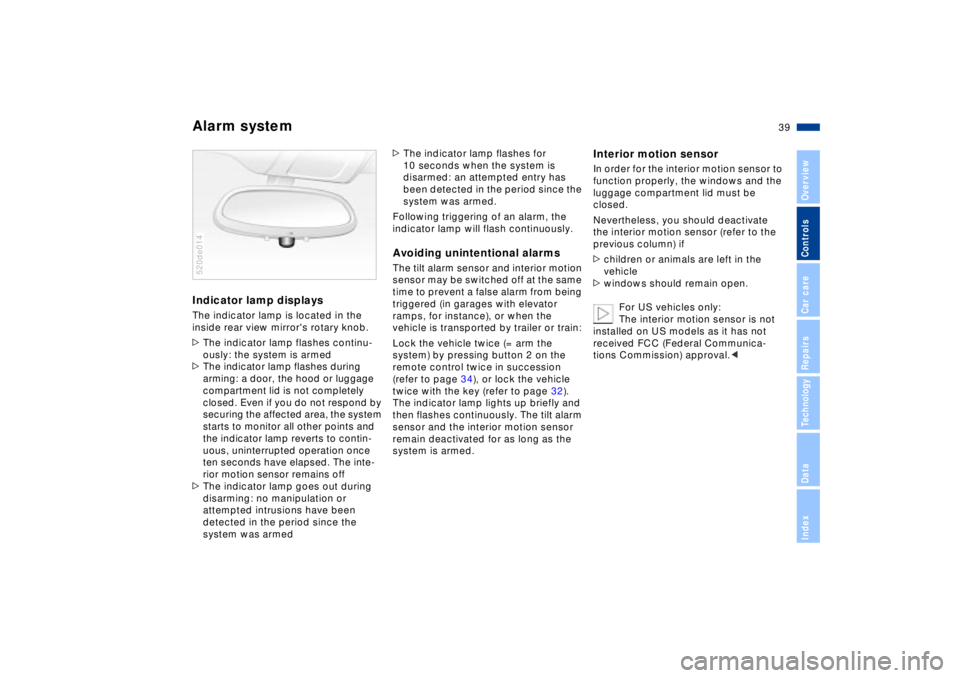
Alarm systemIndicator lamp displaysThe indicator lamp is located in the
inside rear view mirror's rotary knob.
>The indicator lamp flashes continu-
ously: the system is armed
>The indicator lamp flashes during
arming: a door, the hood or luggage
compartment lid is not completely
closed. Even if you do not respond by
securing the affected area, the system
starts to monitor all other points and
the indicator lamp reverts to contin-
uous, uninterrupted operation once
ten seconds have elapsed. The inte-
rior motion sensor remains off
>The indicator lamp goes out during
disarming: no manipulation or
attempted intrusions have been
detected in the period since the
system was armed520de014
>The indicator lamp flashes for
10 seconds when the system is
disarmed: an attempted entry has
been detected in the period since the
system was armed.
Following triggering of an alarm, the
indicator lamp will flash continuously.Avoiding unintentional alarms The tilt alarm sensor and interior motion
sensor may be switched off at the same
time to prevent a false alarm from being
triggered (in garages with elevator
ramps, for instance), or when the
vehicle is transported by trailer or train:
Lock the vehicle twice (= arm the
system) by pressing button 2 on the
remote control twice in succession
(refer to page 34), or lock the vehicle
twice with the key (refer to page 32).
The indicator lamp lights up briefly and
then flashes continuously. The tilt alarm
sensor and the interior motion sensor
remain deactivated for as long as the
system is armed.
Interior motion sensorIn order for the interior motion sensor to
function properly, the windows and the
luggage compartment lid must be
closed.
Nevertheless, you should deactivate
the interior motion sensor (refer to the
previous column) if
>children or animals are left in the
vehicle
>windows should remain open.
For US vehicles only:
The interior motion sensor is not
installed on US models as it has not
received FCC (Federal Communica-
tions Commission) approval.<
Page 40 of 174
40n
Electric power windowsTo open and close the windowsFrom ignition key position 1:
>Depress the rocker switch 1 until you
feel resistance:
The window remains in motion for as
long as you maintain pressure on the
switch
>Briefly press rocker switch 1 to just
beyond the initial point of resistance
(one-touch mode):
The window automatically remains in
motion until it reaches the end of its
travel. Briefly press the switch a
second time to stop the window.
The one-touch mode cannot be
used to close the passenger-side
window.<520de015
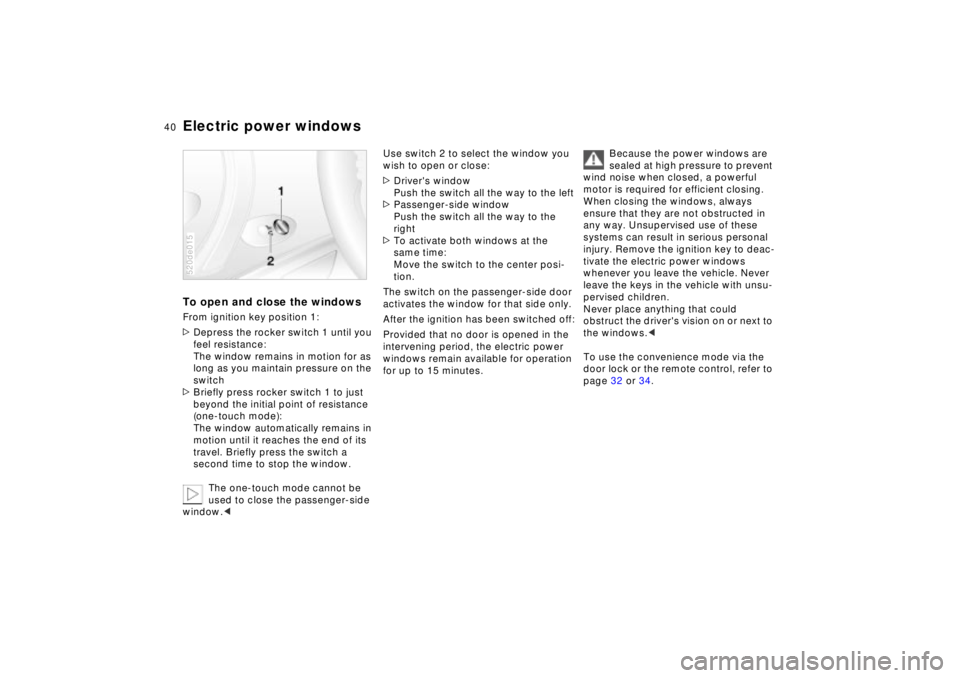
Use switch 2 to select the window you
wish to open or close:
>Driver's window
Push the switch all the way to the left
>Passenger-side window
Push the switch all the way to the
right
>To activate both windows at the
same time:
Move the switch to the center posi-
tion.
The switch on the passenger-side door
activates the window for that side only.
After the ignition has been switched off:
Provided that no door is opened in the
intervening period, the electric power
windows remain available for operation
for up to 15 minutes. Because the power windows are
sealed at high pressure to prevent
wind noise when closed, a powerful
motor is required for efficient closing.
When closing the windows, always
ensure that they are not obstructed in
any way. Unsupervised use of these
systems can result in serious personal
injury. Remove the ignition key to deac-
tivate the electric power windows
whenever you leave the vehicle. Never
leave the keys in the vehicle with unsu-
pervised children.
Never place anything that could
obstruct the driver's vision on or next to
the windows.<
To use the convenience mode via the
door lock or the remote control, refer to
page 32 or 34.
Page 41 of 174
41n
IndexDataTechnologyRepairsCar careControlsOverview
The automatic convertible topWeather protectionThe fabric convertible top combines
reliable protection from the elements
with simple, convenient operation. Here
are a few tips to ensure that you enjoy
your BMW Z8 roadster.
It is advisable to close the convertible
top when the vehicle is parked. The
closed convertible top not only protects
the passenger compartment from
unforeseeable damage from the
weather, it also provides a certain
degree of theft protection. Even if the
convertible top is closed, store your
valuables only in the locked luggage
compartment.
To prevent damage to its rear window,
avoid opening or closing the fabric top
unless the temperature is well above
freezing. Operate the convertible top only
when the vehicle is stationary,
otherwise the procedure will be inter-
rupted. Driving before the opening or
closing procedure has been properly
concluded can lead to damage or
injury.
Do not lay objects on the convertible
top, since they would fall off when the
convertible top is operated and cause
damage or injuries.
Make sure that no objects or people get
in the way while the convertible top is
opening or closing, so that no damage
or injuries occur.
The automatic operating procedure is
interrupted immediately if the switch
for actuating the top is released. The
procedure can be continued in the
desired direction by pressing this
switch.<
To openFrom ignition key position 1:
If at all possible, only operate the
convertible top if the engine is running
to avoid discharging the battery.
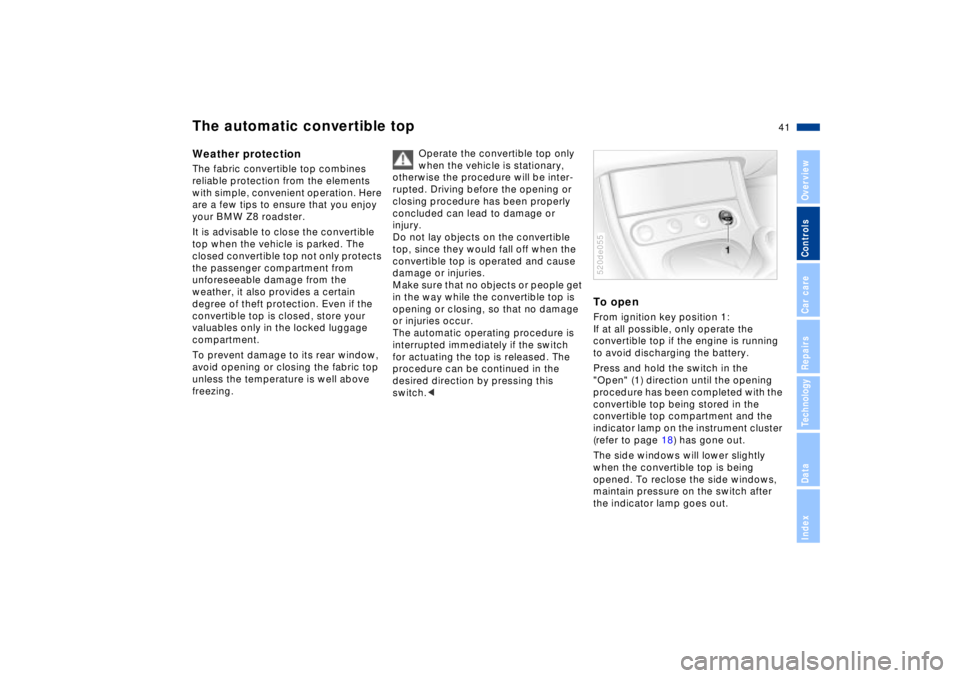
Press and hold the switch in the
"Open" (1) direction until the opening
procedure has been completed with the
convertible top being stored in the
convertible top compartment and the
indicator lamp on the instrument cluster
(refer to page 18) has gone out.
The side windows will lower slightly
when the convertible top is being
opened. To reclose the side windows,
maintain pressure on the switch after
the indicator lamp goes out. 520de055
Page 48 of 174

48n
Mirrors Exterior mirrors1 Switch for 4-way adjustment
2 Selection switch for changing
between mirrors, switch either all the
way to the left or the right520de018
You can also adjust the mirrors manu-
ally by pressing against the outer edges
of their lenses.
When estimating the distance
between yourself and other traffic,
bear in mind that the objects reflected
in the mirror are closer than they
appear. This means that estimates of
the distance to following traffic should
not be regarded as precise.
tion 2.
Interior rearview mirror with
automatic dimmer This mirror automatically responds to
ambient light and headlight glare from
following vehicles by dimming through
an infinitely-variable range. The
dimming function is regulated by two
photocells; one is integrated in the
mirror's frame (arrow), while the other is
located at an offset position on the rear
of the mirror. 520de019
Page 49 of 174

49n
IndexDataTechnologyRepairsCar careControlsOverview
Mirrors Vehicle Memory, Key MemoryThe mirror switches to its clear,
undimmed mode whenever you shift
into reverse.
For trouble-free operation, keep the
photocells clean and do not cover the
area between the interior rearview
mirror and the windshield. Do not
attach any kind of stickers on the wind-
shield in front of the mirror, either.
For a more detailed explanation of the
electrochromatic technology used in
this mirror, please refer to page 153.
The conceptNo doubt you have reflected at one
time or another on how great it would
be if you could permanently configure
your vehicle's various features and
adjustments to mirror your own indi-
vidual preferences. In developing the
Z8, BMW has incorporated a number of
options for personal adjustment that
can be programmed into your vehicle
by your BMW center.
The available configuration data fall into
two categories, according to whether
their primary orientation is the vehicle
("Vehicle Memory") or the individual
("Key Memory"). Provided that each
person has a separate remote-control
key, you can have your BMW center
enter adjustment data for as many as
four different individuals into the
system.
The system then relies on a bilateral
data exchange to identify the individual
user and dial in the selected settings
whenever the remote-control unit is
used to disengage the door locks.
What the system can doYour BMW center can provide you with
details on the capabilities of the Vehicle
Memory and Key Memory systems.
Below a few examples:
A Vehicle Memory sampler:
>Various signals to confirm release
and engagement of the vehicle's
locks.
>Activate/deactivate the "Follow me
home" lamps.
A Key Memory sampler:
>Engage vehicle locks as soon as the
vehicle is underway.
At various points throughout this
Owner's Manual you will find this
symbol, indicating that the equipment
or system described in the adjacent
section can be preset for automatic
adjustment using the Vehicle or Key
Memory.<
Page 51 of 174
51n
IndexDataTechnologyRepairsCar careControlsOverview
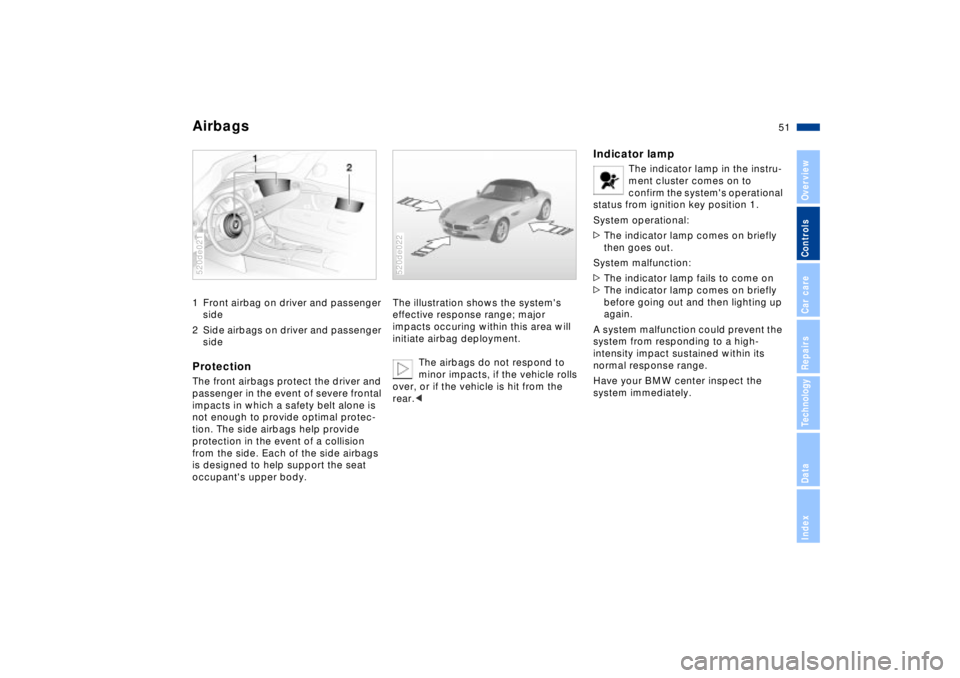
Airbags 1 Front airbag on driver and passenger
side
2 Side airbags on driver and passenger
sideProtectionThe front airbags protect the driver and
passenger in the event of severe frontal
impacts in which a safety belt alone is
not enough to provide optimal protec-
tion. The side airbags help provide
protection in the event of a collision
from the side. Each of the side airbags
is designed to help support the seat
occupant's upper body.520de021
The illustration shows the system's
effective response range; major
impacts occuring within this area will
initiate airbag deployment.
The airbags do not respond to
minor impacts, if the vehicle rolls
over, or if the vehicle is hit from the
rear.<520de022
Indicator lamp
The indicator lamp in the instru-
ment cluster comes on to
confirm the system's operational
status from ignition key position 1.
System operational:
>The indicator lamp comes on briefly
then goes out.
System malfunction:
>The indicator lamp fails to come on
>The indicator lamp comes on briefly
before going out and then lighting up
again.
A system malfunction could prevent the
system from responding to a high-
intensity impact sustained within its
normal response range.
Have your BMW center inspect the
system immediately.
Page 55 of 174
55n
IndexDataTechnologyRepairsCar careControlsOverview
Your vehicle is equipped with an elec-
trically powered steering lock mecha-
nism.To activate the electrical power
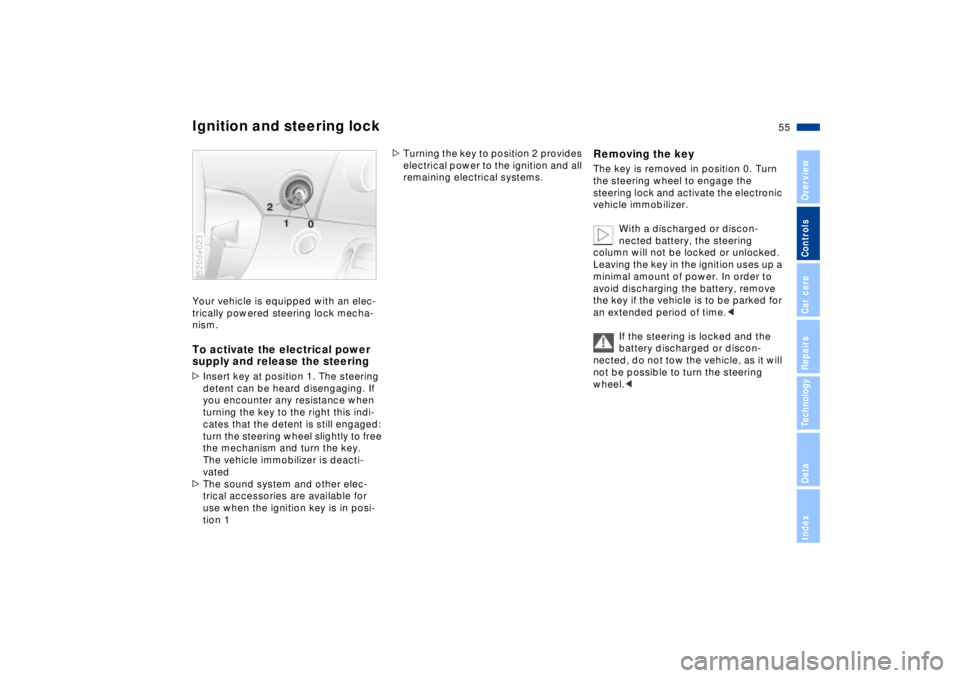
supply and release the steering>Insert key at position 1. The steering
detent can be heard disengaging. If
you encounter any resistance when
turning the key to the right this indi-
cates that the detent is still engaged:
turn the steering wheel slightly to free
the mechanism and turn the key.
The vehicle immobilizer is deacti-
vated
>The sound system and other elec-
trical accessories are available for
use when the ignition key is in posi-
tion 1 520de023
>Turning the key to position 2 provides
electrical power to the ignition and all
remaining electrical systems.
Removing the key The key is removed in position 0. Turn
the steering wheel to engage the
steering lock and activate the electronic
vehicle immobilizer.
With a discharged or discon-
nected battery, the steering
column will not be locked or unlocked.
Leaving the key in the ignition uses up a
minimal amount of power. In order to
avoid discharging the battery, remove
the key if the vehicle is to be parked for
an extended period of time.<
If the steering is locked and the
battery discharged or discon-
nected, do not tow the vehicle, as it will
not be possible to turn the steering
wheel.<
Ignition and steering lock
Page 56 of 174
56n
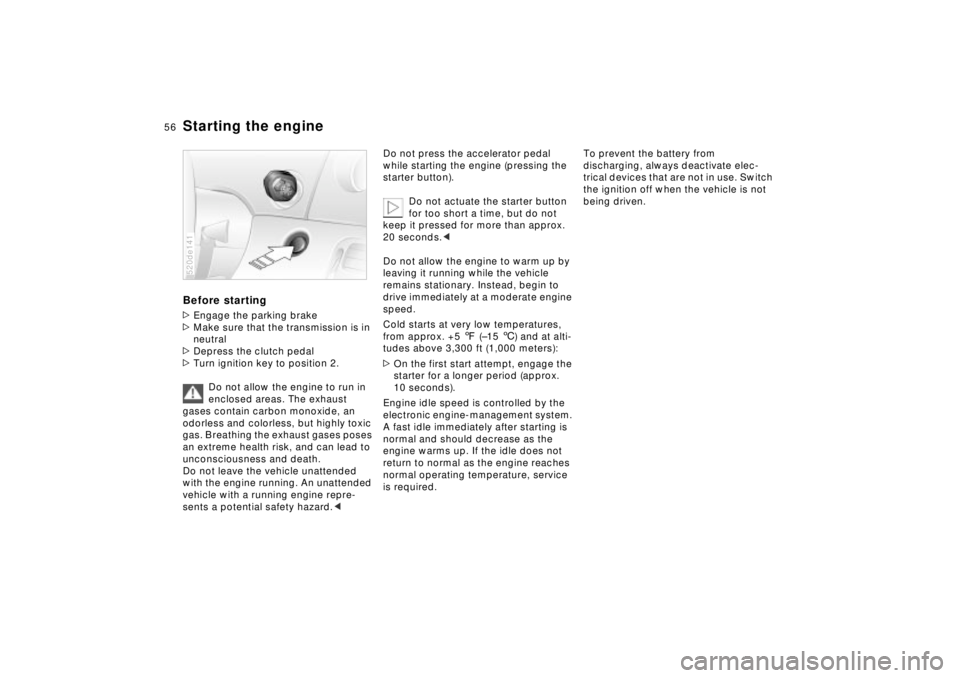
Starting the engine Before starting>Engage the parking brake
>Make sure that the transmission is in
neutral
>Depress the clutch pedal
>Turn ignition key to position 2.
Do not allow the engine to run in
enclosed areas. The exhaust
gases contain carbon monoxide, an
odorless and colorless, but highly toxic
gas. Breathing the exhaust gases poses
an extreme health risk, and can lead to
unconsciousness and death.
Do not leave the vehicle unattended
with the engine running. An unattended
vehicle with a running engine repre-
sents a potential safety hazard.<520de141
Do not press the accelerator pedal
while starting the engine (pressing the
starter button).
Do not actuate the starter button
for too short a time, but do not
keep it pressed for more than approx.
20 seconds.<
Do not allow the engine to warm up by
leaving it running while the vehicle
remains stationary. Instead, begin to
drive immediately at a moderate engine
speed.
Cold starts at very low temperatures,
from approx. +5 7 (Ð15 6) and at alti-
tudes above 3,300 ft (1,000 meters):
>On the first start attempt, engage the
starter for a longer period (approx.
10 seconds).
Engine idle speed is controlled by the
electronic engine-management system.
A fast idle immediately after starting is
normal and should decrease as the
engine warms up. If the idle does not
return to normal as the engine reaches
normal operating temperature, service
is required.
To prevent the battery from
discharging, always deactivate elec-
trical devices that are not in use. Switch
the ignition off when the vehicle is not
being driven.
Page 57 of 174
57n
IndexDataTechnologyRepairsCar careControlsOverview
Switching off the engine Parking brake Turn ignition key to position 1 or 0.
Never remove the ignition key
while the vehicle is rolling. If you
do so, the ignition lock would engage
when the steering wheel is turned.
When you leave the vehicle, always
remove the ignition key and engage the
steering lock.
Always engage the parking brake when
parking on hills and inclined surfaces,
as first gear or reverse may not provide
adequate resistance to rolling.<
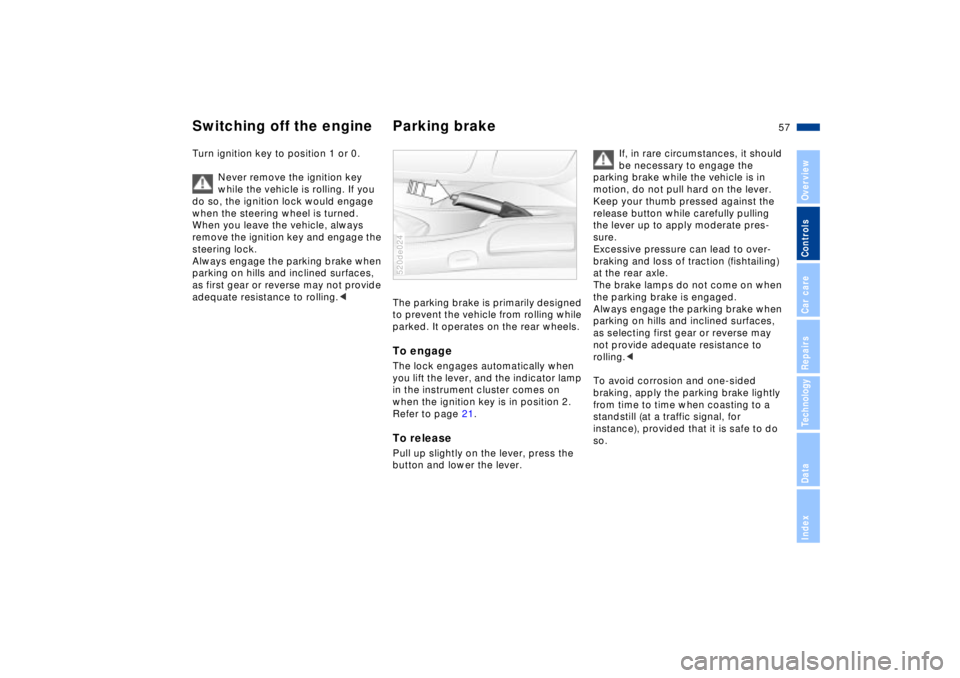
The parking brake is primarily designed
to prevent the vehicle from rolling while
parked. It operates on the rear wheels. To engage The lock engages automatically when
you lift the lever, and the indicator lamp
in the instrument cluster comes on
when the ignition key is in position 2.
Refer to page 21.To releasePull up slightly on the lever, press the
button and lower the lever. 520de024
If, in rare circumstances, it should
be necessary to engage the
parking brake while the vehicle is in
motion, do not pull hard on the lever.
Keep your thumb pressed against the
release button while carefully pulling
the lever up to apply moderate pres-
sure.
Excessive pressure can lead to over-
braking and loss of traction (fishtailing)
at the rear axle.
The brake lamps do not come on when
the parking brake is engaged.
Always engage the parking brake when
parking on hills and inclined surfaces,
as selecting first gear or reverse may
not provide adequate resistance to
rolling.<
To avoid corrosion and one-sided
braking, apply the parking brake lightly
from time to time when coasting to a
standstill (at a traffic signal, for
instance), provided that it is safe to do
so.
Page 58 of 174
58n
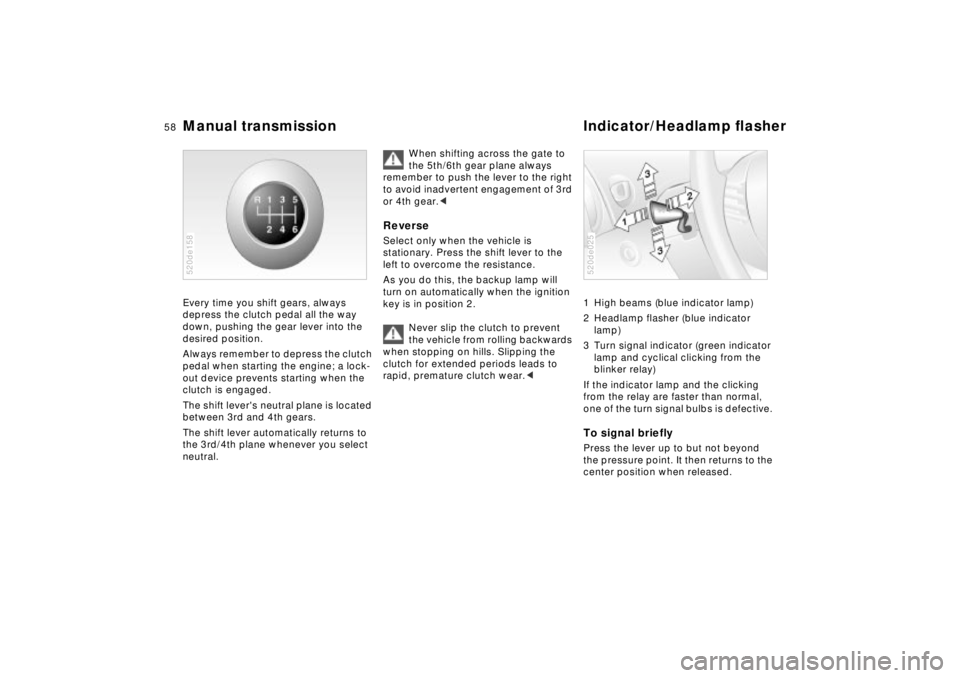
Manual transmission Indicator/Headlamp ßasher Every time you shift gears, always
depress the clutch pedal all the way
down, pushing the gear lever into the
desired position.
Always remember to depress the clutch
pedal when starting the engine; a lock-
out device prevents starting when the
clutch is engaged.
The shift lever's neutral plane is located
between 3rd and 4th gears.
The shift lever automatically returns to
the 3rd/4th plane whenever you select
neutral. 520de158
When shifting across the gate to
the 5th/6th gear plane always
remember to push the lever to the right
to avoid inadvertent engagement of 3rd
or 4th gear.<
Reverse Select only when the vehicle is
stationary. Press the shift lever to the
left to overcome the resistance.
As you do this, the backup lamp will
turn on automatically when the ignition
key is in position 2.
Never slip the clutch to prevent
the vehicle from rolling backwards
when stopping on hills. Slipping the
clutch for extended periods leads to
rapid, premature clutch wear.<
1 High beams (blue indicator lamp)
2 Headlamp flasher (blue indicator
lamp)
3 Turn signal indicator (green indicator
lamp and cyclical clicking from the
blinker relay)
If the indicator lamp and the clicking
from the relay are faster than normal,
one of the turn signal bulbs is defective. To signal brieflyPress the lever up to but not beyond
the pressure point. It then returns to the
center position when released. 520de025