lock BUICK CASCADA 2018 Owner's Manual
[x] Cancel search | Manufacturer: BUICK, Model Year: 2018, Model line: CASCADA, Model: BUICK CASCADA 2018Pages: 303, PDF Size: 5.87 MB
Page 45 of 303
Buick Cascada Owner Manual (GMNA-Localizing-U.S-11373983) - 2018 -
CRC - 7/10/17
44 Keys, Doors, and Windows
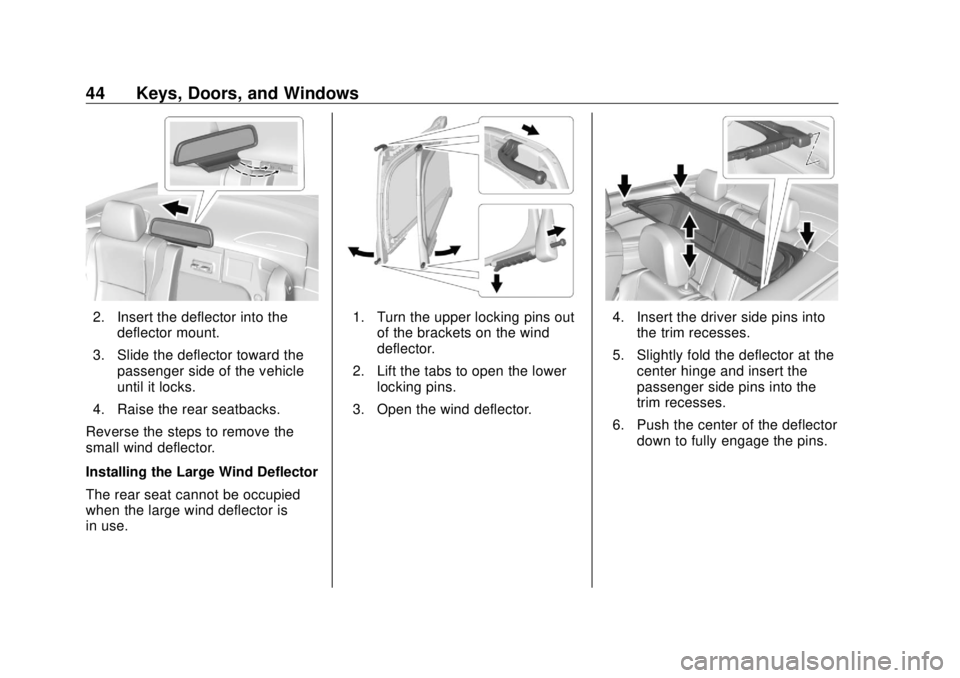
2. Insert the deflector into the
deflector mount.
3. Slide the deflector toward the
passenger side of the vehicle
until it locks.
4. Raise the rear seatbacks.
Reverse the steps to remove the
small wind deflector.
Installing the Large Wind Deflector
The rear seat cannot be occupied
when the large wind deflector is
in use. 1. Turn the upper locking pins out
of the brackets on the wind
deflector.
2. Lift the tabs to open the lower
locking pins.
3. Open the wind deflector. 4. Insert the driver side pins into
the trim recesses.
5. Slightly fold the deflector at the
center hinge and insert the
passenger side pins into the
trim recesses.
6. Push the center of the deflector
down to fully engage the pins.
Page 48 of 303
Buick Cascada Owner Manual (GMNA-Localizing-U.S-11373983) - 2018 -
CRC - 7/10/17
Seats and Restraints 47
Head Restraints
{ WarningWith head restraints that are not
installed and adjusted properly,
there is a greater chance that
occupants will suffer a neck/
spinal injury in a crash. Do not
drive until the head restraints for
all occupants are installed and
adjusted properly. Adjust the head restraint so that the
top of the restraint is at the same
height as the top of the occupant's
head. This position reduces the
chance of a neck injury in a crash.
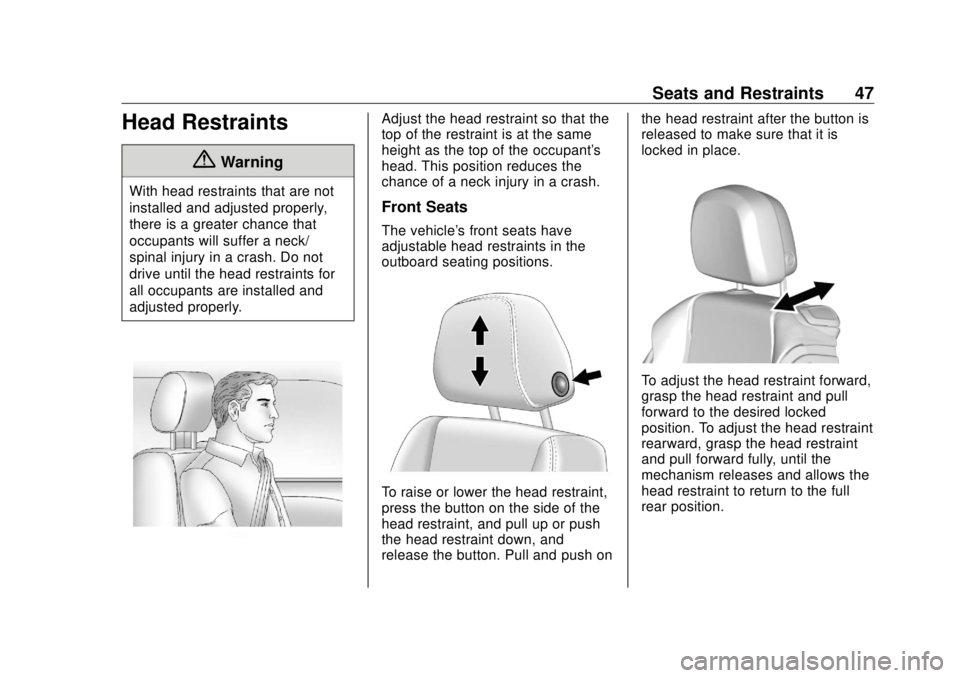
Front Seats The vehicle's front seats have
adjustable head restraints in the
outboard seating positions.
To raise or lower the head restraint,
press the button on the side of the
head restraint, and pull up or push
the head restraint down, and
release the button. Pull and push on the head restraint after the button is
released to make sure that it is
locked in place.
To adjust the head restraint forward,
grasp the head restraint and pull
forward to the desired locked
position. To adjust the head restraint
rearward, grasp the head restraint
and pull forward fully, until the
mechanism releases and allows the
head restraint to return to the full
rear position.
Page 50 of 303
Buick Cascada Owner Manual (GMNA-Localizing-U.S-11373983) - 2018 -
CRC - 7/10/17
Seats and Restraints 49.
Raise or lower the entire seat by
moving the rear of the control up
or down.
Lumbar Adjustment Power Lumbar
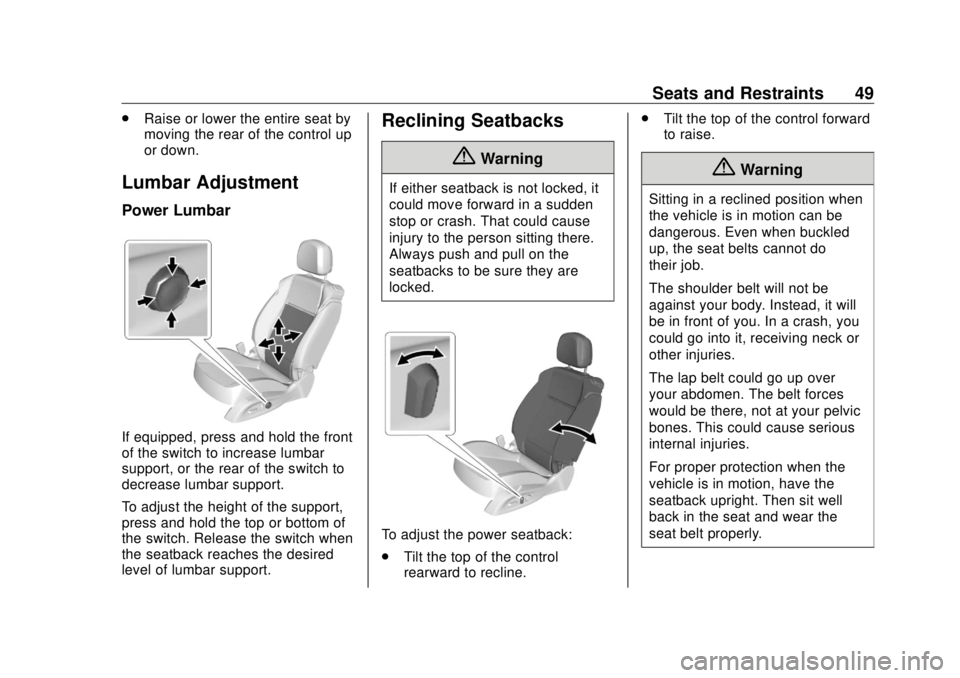
If equipped, press and hold the front
of the switch to increase lumbar
support, or the rear of the switch to
decrease lumbar support.
To adjust the height of the support,
press and hold the top or bottom of
the switch. Release the switch when
the seatback reaches the desired
level of lumbar support. Reclining Seatbacks
{ WarningIf either seatback is not locked, it
could move forward in a sudden
stop or crash. That could cause
injury to the person sitting there.
Always push and pull on the
seatbacks to be sure they are
locked.
To adjust the power seatback:
.
Tilt the top of the control
rearward to recline. .
Tilt the top of the control forward
to raise.
{ WarningSitting in a reclined position when
the vehicle is in motion can be
dangerous. Even when buckled
up, the seat belts cannot do
their job.
The shoulder belt will not be
against your body. Instead, it will
be in front of you. In a crash, you
could go into it, receiving neck or
other injuries.
The lap belt could go up over
your abdomen. The belt forces
would be there, not at your pelvic
bones. This could cause serious
internal injuries.
For proper protection when the
vehicle is in motion, have the
seatback upright. Then sit well
back in the seat and wear the
seat belt properly.
Page 51 of 303

Buick Cascada Owner Manual (GMNA-Localizing-U.S-11373983) - 2018 -
CRC - 7/10/17
50 Seats and Restraints
Do not have a seatback reclined if
the vehicle is moving.
Seatback Latches To fold the seatback, lift the release
lever and fold the seatback forward.
The seat will slide forward.
To raise, lift the seatback to its
upright position until the seat locks.
The seat will slide back to the
original position.
In case the seatback cannot fold
and is blocked by the head restraint,
move the seat backward or
downward slightly, or adjust the
head restraint to a lower position.
See Power Seat Adjustment 0 48 or
Head Restraints 0 47 .
Obstructions
If the seat encounters an
obstruction or resistance while
sliding forward or backward, the
action is stopped and the seat will
move in the opposite direction. Heated Front Seats
{ WarningIf temperature change or pain to
the skin cannot be felt, the seat
heater may cause burns. To
reduce the risk of burns, use care
when using the seat heater,
especially for long periods of
time. Do not place anything on
the seat that insulates against
heat, such as a blanket, cushion,
cover, or similar item. This may
cause the seat heater to
overheat. An overheated seat
heater may cause a burn or may
damage the seat.
Page 53 of 303
Buick Cascada Owner Manual (GMNA-Localizing-U.S-11373983) - 2018 -
CRC - 7/10/17
52 Seats and Restraints Caution (Continued)belts and return them to their
normal stowed position before
folding a rear seat.
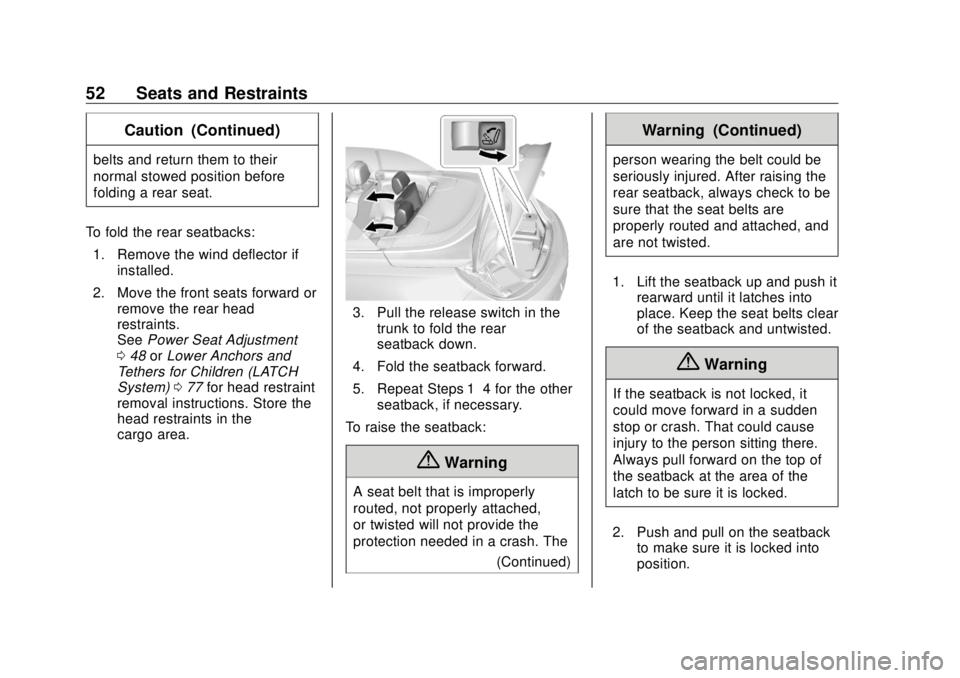
To fold the rear seatbacks:
1. Remove the wind deflector if
installed.
2. Move the front seats forward or
remove the rear head
restraints.
See Power Seat Adjustment
0 48 or Lower Anchors and
Tethers for Children (LATCH
System) 0 77 for head restraint
removal instructions. Store the
head restraints in the
cargo area. 3. Pull the release switch in the
trunk to fold the rear
seatback down.
4. Fold the seatback forward.
5. Repeat Steps 1 – 4 for the other
seatback, if necessary.
To raise the seatback:
{ Warning
A seat belt that is improperly
routed, not properly attached,
or twisted will not provide the
protection needed in a crash. The
(Continued) Warning (Continued) person wearing the belt could be
seriously injured. After raising the
rear seatback, always check to be
sure that the seat belts are
properly routed and attached, and
are not twisted.
1. Lift the seatback up and push it
rearward until it latches into
place. Keep the seat belts clear
of the seatback and untwisted.
{ WarningIf the seatback is not locked, it
could move forward in a sudden
stop or crash. That could cause
injury to the person sitting there.
Always pull forward on the top of
the seatback at the area of the
latch to be sure it is locked.
2. Push and pull on the seatback
to make sure it is locked into
position.
Page 54 of 303

Buick Cascada Owner Manual (GMNA-Localizing-U.S-11373983) - 2018 -
CRC - 7/10/17
Seats and Restraints 533. Reinstall the head restraints,
if necessary. See Lower
Anchors and Tethers for
Children (LATCH System) 0 77
for head restraint reinstallation
instructions.
4. Repeat Steps 1 – 3 for the other
seatback, if necessary
Keep the seat in the upright locked
position when not in use.
Seat Belts This section describes how to use
seat belts properly, and some things
not to do.
{ WarningDo not let anyone ride where a
seat belt cannot be worn properly.
In a crash, if you or your
passenger(s) are not wearing
seat belts, injuries can be much
worse than if you are wearing
seat belts. You can be seriously
injured or killed by hitting things
inside the vehicle harder or by
being ejected from the vehicle. In
addition, anyone who is not
buckled up can strike other
passengers in the vehicle.
It is extremely dangerous to ride
in a cargo area, inside or outside
of a vehicle. In a collision,
passengers riding in these areas
are more likely to be seriously
injured or killed. Do not allow
(Continued) Warning (Continued) passengers to ride in any area of
the vehicle that is not equipped
with seats and seat belts.
Always wear a seat belt, and
check that all passenger(s) are
restrained properly too.
This vehicle has indicators as a
reminder to buckle the seat belts.
See Seat Belt Reminders 0 100 .
Why Seat Belts Work
Page 56 of 303
Buick Cascada Owner Manual (GMNA-Localizing-U.S-11373983) - 2018 -
CRC - 7/10/17
Seats and Restraints 55this applies force to the strong
pelvic bones and you would be
less likely to slide under the lap
belt. If you slid under it, the belt
would apply force on your
abdomen. This could cause
serious or even fatal injuries.
.
Wear the shoulder belt over the
shoulder and across the chest.
These parts of the body are best
able to take belt restraining
forces. The shoulder belt locks if
there is a sudden stop or crash.
{ WarningYou can be seriously injured,
or even killed, by not wearing
your seat belt properly.
.
Never allow the lap or
shoulder belt to become
loose or twisted.
.
Never wear the shoulder
belt under both arms or
behind your back.
.
Never route the lap or
shoulder belt over an
armrest. Lap-Shoulder Belt All seating positions in the vehicle
have a lap-shoulder belt.
The following instructions explain
how to wear a lap-shoulder belt
properly.
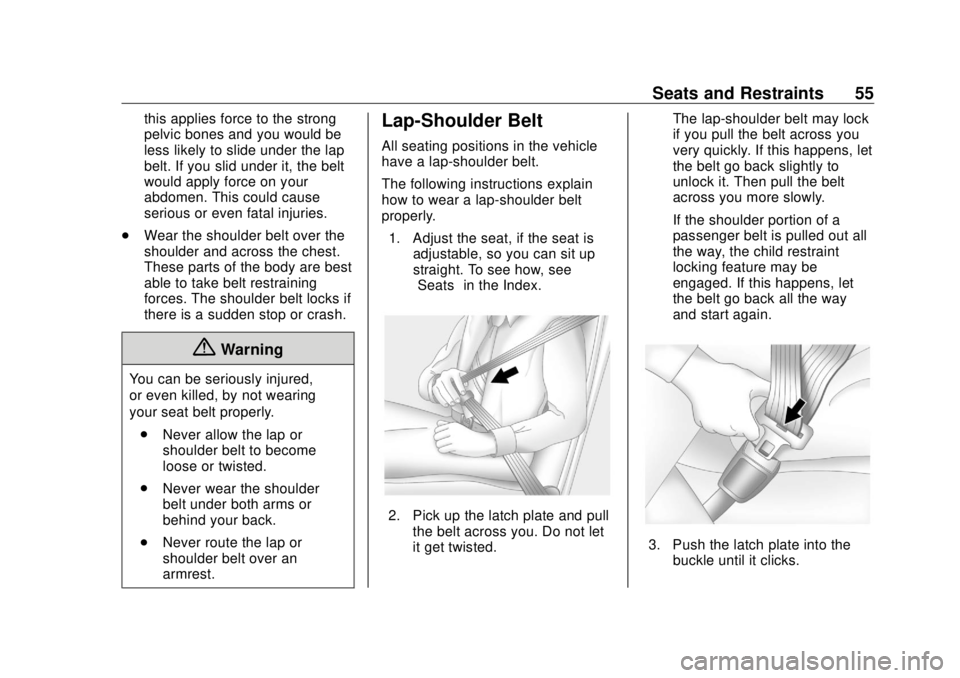
1. Adjust the seat, if the seat is
adjustable, so you can sit up
straight. To see how, see
“ Seats ” in the Index.
2. Pick up the latch plate and pull
the belt across you. Do not let
it get twisted. The lap-shoulder belt may lock
if you pull the belt across you
very quickly. If this happens, let
the belt go back slightly to
unlock it. Then pull the belt
across you more slowly.
If the shoulder portion of a
passenger belt is pulled out all
the way, the child restraint
locking feature may be
engaged. If this happens, let
the belt go back all the way
and start again.
3. Push the latch plate into the
buckle until it clicks.
Page 57 of 303

Buick Cascada Owner Manual (GMNA-Localizing-U.S-11373983) - 2018 -
CRC - 7/10/17
56 Seats and Restraints Pull up on the latch plate to
make sure it is secure. If the
belt is not long enough, see
Seat Belt Extender 0 58 .
Position the release button on
the buckle so that the seat belt
could be quickly unbuckled if
necessary.
4. To make the lap part tight, pull
up on the shoulder belt. To unlatch the belt, push the button
on the buckle. The belt should
return to its stowed position.
Always stow the seat belt slowly.
If the seat belt webbing returns
quickly to the stowed position, the
retractor may lock and cannot be
pulled out. If this happens, pull the
seat belt straight out firmly to unlock
the webbing, and then release it.
If the webbing is still locked in the
retractor, see your dealer.
Before a door is closed, be sure the
seat belt is out of the way. If a door
is slammed against a seat belt,
damage can occur to both the seat
belt and the vehicle. Seat Belt Presenter The seat belt presenters bring the
front outboard seat belts to the front
to help fasten them.
The presenter comes out when:
.
The respective door is closed
and the ignition is turned on.
.
The ignition is on and the door is
closed.
The presenter may automatically
retract when any of the following
occur:
.
The respective door is opened
again.
Page 63 of 303
Buick Cascada Owner Manual (GMNA-Localizing-U.S-11373983) - 2018 -
CRC - 7/10/17
62 Seats and Restraints Warning (Continued)inflating airbag must be kept
clear. Do not put anything
between an occupant and an
airbag, and do not attach or put
anything on the steering wheel
hub or on or near any other
airbag covering.
Do not use seat accessories that
block the inflation path of a
seat-mounted side impact airbag.
When Should an Airbag
Inflate? This vehicle is equipped with
airbags. See Airbag System 0 59 .
Airbags are designed to inflate if the
impact exceeds the specific airbag
system's deployment threshold.
Deployment thresholds are used to
predict how severe a crash is likely
to be in time for the airbags to
inflate and help restrain the
occupants. The vehicle has
electronic sensors that help the
airbag system determine the severity of the impact. Deployment
thresholds can vary with specific
vehicle design.
Frontal airbags are designed to
inflate in moderate to severe frontal
or near frontal crashes to help
reduce the potential for severe
injuries, mainly to the driver's or
front outboard passenger's head
and chest.
Whether the frontal airbags will or
should inflate is not based primarily
on how fast the vehicle is traveling.
It depends on what is hit, the
direction of the impact, and how
quickly the vehicle slows down.
Frontal airbags may inflate at
different crash speeds depending on
whether the vehicle hits an object
straight on or at an angle, and
whether the object is fixed or
moving, rigid or deformable, narrow
or wide.
Frontal airbags are not intended to
inflate during vehicle rollovers, in
rear impacts, or in many side
impacts. In addition, the vehicle has
advanced technology frontal
airbags. Advanced technology
frontal airbags adjust the restraint
according to crash severity.
Knee airbags are designed to inflate
in moderate to severe frontal or
near frontal impacts. Knee airbags
are not designed to inflate during
vehicle rollovers, in rear impacts,
or in many side impacts.
Seat-mounted side impact airbags
are designed to inflate in moderate
to severe side crashes depending
on the location of the impact.
Seat-mounted side impact airbags
are not designed to inflate in frontal
impacts, near frontal impacts,
rollovers, or rear impacts.
A seat-mounted side impact airbag
is designed to inflate on the side of
the vehicle that is struck.
In any particular crash, no one can
say whether an airbag should have
inflated simply because of the
vehicle damage or repair costs.
Page 64 of 303

Buick Cascada Owner Manual (GMNA-Localizing-U.S-11373983) - 2018 -
CRC - 7/10/17
Seats and Restraints 63
What Makes an Airbag
Inflate? In a deployment event, the sensing
system sends an electrical signal
triggering a release of gas from the
inflator. Gas from the inflator fills the
airbag causing the bag to break out
of the cover. The inflator, the airbag,
and related hardware are all part of
the airbag module.
For airbag locations, see Where Are
the Airbags? 0 61 .
How Does an Airbag
Restrain? In moderate to severe frontal or
near frontal collisions, even belted
occupants can contact the steering
wheel or the instrument panel. In
moderate to severe side collisions,
even belted occupants can contact
the inside of the vehicle.
Airbags supplement the protection
provided by seat belts by
distributing the force of the impact
more evenly over the
occupant's body. But airbags would not help in many
types of collisions, primarily
because the occupant's motion is
not toward those airbags. See When
Should an Airbag Inflate? 0 62 .
Airbags should never be regarded
as anything more than a supplement
to seat belts.
What Will You See after
an Airbag Inflates? After the frontal and seat-mounted
side impact airbags inflate, they
quickly deflate, so quickly that some
people may not even realize the
airbags inflated. Some components
of the airbag module may be hot for
several minutes. For location of the
airbags, see Where Are the
Airbags? 0 61 .
The parts of the airbag that come
into contact with you may be warm,
but not too hot to touch. There may
be some smoke and dust coming
from the vents in the deflated
airbags. Airbag inflation does not
prevent the driver from seeing out of the windshield or being able to steer
the vehicle, nor does it prevent
people from leaving the vehicle.
{ WarningWhen an airbag inflates, there
may be dust in the air. This dust
could cause breathing problems
for people with a history of
asthma or other breathing trouble.
To avoid this, everyone in the
vehicle should get out as soon as
it is safe to do so. If you have
breathing problems but cannot
get out of the vehicle after an
airbag inflates, then get fresh air
by opening a window or a door.
If you experience breathing
problems following an airbag
deployment, you should seek
medical attention.
The vehicle has a feature that may
automatically unlock the doors, turn
on the interior lamps and hazard
warning flashers, and shut off the
fuel system after the airbags inflate.
The feature may also activate,