change time BUICK CENTURY 1993 User Guide
[x] Cancel search | Manufacturer: BUICK, Model Year: 1993, Model line: CENTURY, Model: BUICK CENTURY 1993Pages: 324, PDF Size: 17.58 MB
Page 177 of 324
Towing a Trailer
A CAUTION:
If you don’t use the correct equipment and
drive properly, you can lose control when you
pull a traller. For example, If the trailer is too
heavy, the brakes may not work well--or wen
at all. Mu and your passengets could be
seriously Injured. Pull a trailer only if you have
followed all the steps in this section.
hicle and result
Your Buick can tow a trailer. To identify what the vehicle
trailering capacity is for your vehicle, you should read
the information in “Weight of the Trailer” that appears
later
in this section. But trailering is different than just
driving your vehicle
by itself. Trailering means changes
in handling, durability, and fuel economy. Successful,
safe trailering
takes correct equipment, and it has to be
used properly. That’s the reason for this section.
In it are many time-
tested, important trailering tips and safety rules. Many
of
these are important for your safety and that of your
passengers.
So please read this section carefully before
you pull a trailer.
Load-pulling components such as the engine, transaxle,
wheel assemblies, and tires are forced to work harder against the drag of the added weight. The engine is
required to operate at relatively higher speeds and under
greater loads, generating extra heat. What’s more, the
trailer adds considerably
to wind resistance, increasing
the pulling requirements.
All of that means changes in:
Handling
Durability
Fuel economy
175
ProCarManuals.com
Page 181 of 324

Driving with a Trailer
Towing a trailer requires a certain amount of experience.
Before setting out for the open road, you’ll want to get t\
o
know your rig. Acquaint yourself with the
feel of
handling and braking with the added weight of the trailer.
And always keep in mind that the vehicle you
are driving
is now a good deal longer and not nearly
so responsive as
your vehicle is by itself.
Before you
start, check the trailer hitch and platform, safety
chains, electrical connector, lights, tires and mirror
adjustment. If the trailer has electric brakes,
start your vehicle
and trailer moving and then apply the trailer brake controller \
by hand to be sure the brakes
are working. This lets you
check your electrical connection at the same time. During
your trip, check occasionally
to be sure that the load is secure,
and that the lights and any trailer brakes are still working.
Following Distance
Stay at least twice as fit, behind the vehicle ahead as you
would when driving your vehicle without a trailer. This
can help you avoid situations that require heavy braking
and sudden turns.
Passing
You’ll need more passing distance up ahead when you’re
towing
a trailer. And, because you’re a good deal longer,
you’ll
need to go much farther beyond the passed vehicle
before you can return to your lane.
Backing Up
Hold the bottom of the steering wheel with one hand.
Then, to move the trailer to the left, just move that hand
to the left.
To move the trailer to the right, move your
hand to the right. Always back up slowly and, if
possible, have someone guide you.
Making nrns
When you’re turning with a trailer, make wider turns
than normal.
Do this so your trailer won’t strike soft
shoulders, curbs, road signs, trees, or other objects.
Avoid jerky or sudden maneuvers. Signal well in
advance.
Turn Signals When Towing a Mler
When you tow a trailer, your vehicle has to have a
different turn signal flasher and extra wiring. The green arrows on your instrument panel will flash whenever you
signal a turn or lane change. Properly hooked up, the
trailer lights will also flash, telling other drivers you’re \
about to turn, change lanes or stop.
When towing a trailer, the green arrows on your instrument panel will flash for turns even if the bulbs on
the trailer are burned out. Thus, you may think drivers
behind you are seeing your signal when they are not. It’s
important to check occasionally to be sure the trailer
bulbs are still working.
179
ProCarManuals.com
Page 215 of 324
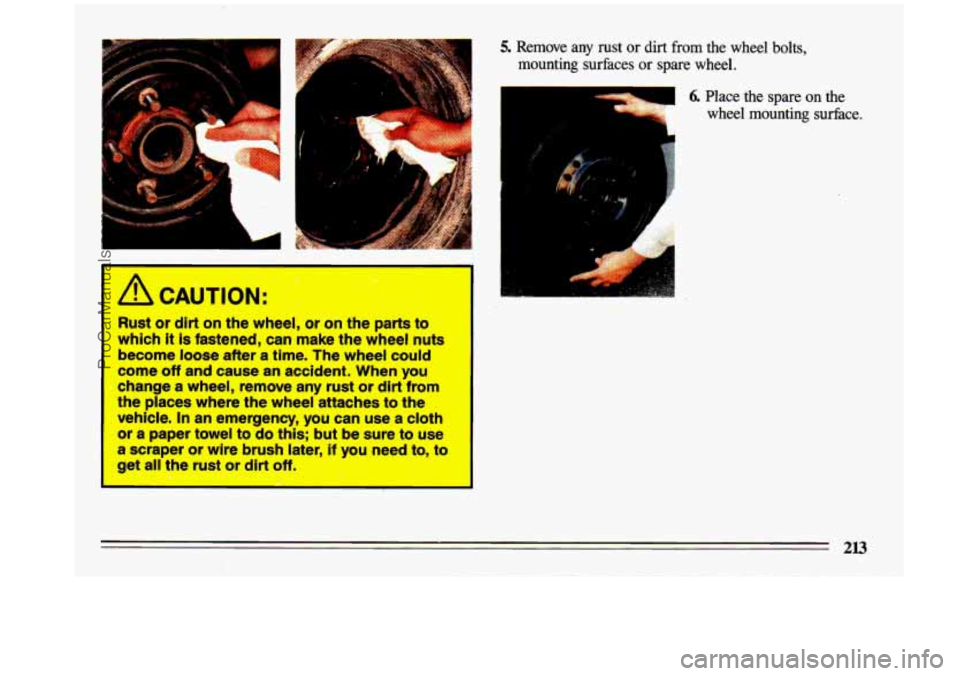
I A CAUTION:
Rust or dirt on the wheel, or on the parts to
which
it is fastened, can make the wheel nuts
become loose after a time. The wheel could
come
off and cause an accident. When you
change a wheel, remove any rust or
dirt from
the places where the wheel attaches to the
vehicle. In an emergency, you can use
a cloth
or a paper towel to do this; but be sure
to use
a scraper or wire brush later, if you need to, to
get all the rust or
dirt off. ’. : .a.
I
5. Remove any rust or dirt from the wheel bolts,
mounting surfaces
or spare wheel.
6. Place the spare on the
wheel mounting surface.
ProCarManuals.com
Page 234 of 324
When to Change Engine Oil: See if any one of these is
true for you:
Most trips are less than 4 miles (6 km).
It’s below freezing outside and most trips are less than
10 miles (16 km).
The engine is at low speed most of the time (as in
door-to-door delivery,
or in stop-and-go traffic).
You tow a trailer often.
Most trips are through dusty places.
If any one of these is true for your vehicle, then you need
to change your oil and filter every 3,000 miles
(5 O00 km) or 3 months-whichever comes first.
If none
of them is true, change the oil every 7,500 miles
(12 500 km) or 12 months-whichever comes first.
Change the fdter at the first oil change and at every other
oil change afier that.
Engine Block Heater: An engine block heater can be a
big help if you have to park outside
in very cold weather,
0°F (-18°C) or colder. If your vehicle has this option, see
“Engine Block Heater”
in the Index.
What to Do with Used Oil:
-
/i CAUTION:
Used engine oil contains things that have
caused skin cancer in laboratory animals.
Don’t let used oil stay on your skin for very
long. Clean your skin and nails with soap and
water or a good hand cleaner. Wash or
properly throw away clothing or rags
containing used engine oil.
Used oil can be a real threat to the environment. If you
change your own oil, be sure to drain all free-flowing oil
from the filter before disposal. Don’t ever dispose of oil
by pouring it on the ground, into sewers, or into streams
or bodies of water. Instead, recycle it ‘by taking
it to a
place that collects used
oil. If you have a problem
properly disposing of your used oil, ask your dealer, a
service station or a local recycling center for help.
232
ProCarManuals.com
Page 238 of 324
Automatic ‘mansaxle Fluid
When to Check and Change:
A good time to check your automatic transaxle fluid level
is when the engine oil is changed. Refer to the
Maintenance Schedule to determine when to change your
fluid. See “Scheduled Maintenance Services” in the
Index.
How to Check:
Because this operation can be a little difficult, you may
choose to have
this done at a Buick dealership Service
Department.
If you do it yourself, be sure to follow all the instructions
here, or you could get a false reading on the dipstick. Wait at least
30 minutes before checking the transaxle
fluid level
if you have been driving:
When outside temperatures are above 90°F (32°C).
At high speed for quite a while.
In heavy traffic-especially in hot weather.
While pulling a trailer.
To get the right reading, the fluid should be at normal
operating temperature, which is
180°F to 200” F (82” C to
93°C).
Get the vehicle warmed up by driving about 15 miles
(24 km) when outside temperatures are above 50°F
(10°C). If it’s colder than 50” F (lO°C), you may have to
drive longer.
To check the fluid level:
Park your vehicle on a level place.
0 Place the shift lever in “P” (Park) with the parking
brake applied.
With your foot on the brake pedal, move the. shift lever
through each gear range, pausing for about three
seconds in each range. Then, position the shift lever in
“P” (Park).
Let the engine run at idle for three to five minutes.
236
ProCarManuals.com
Page 246 of 324
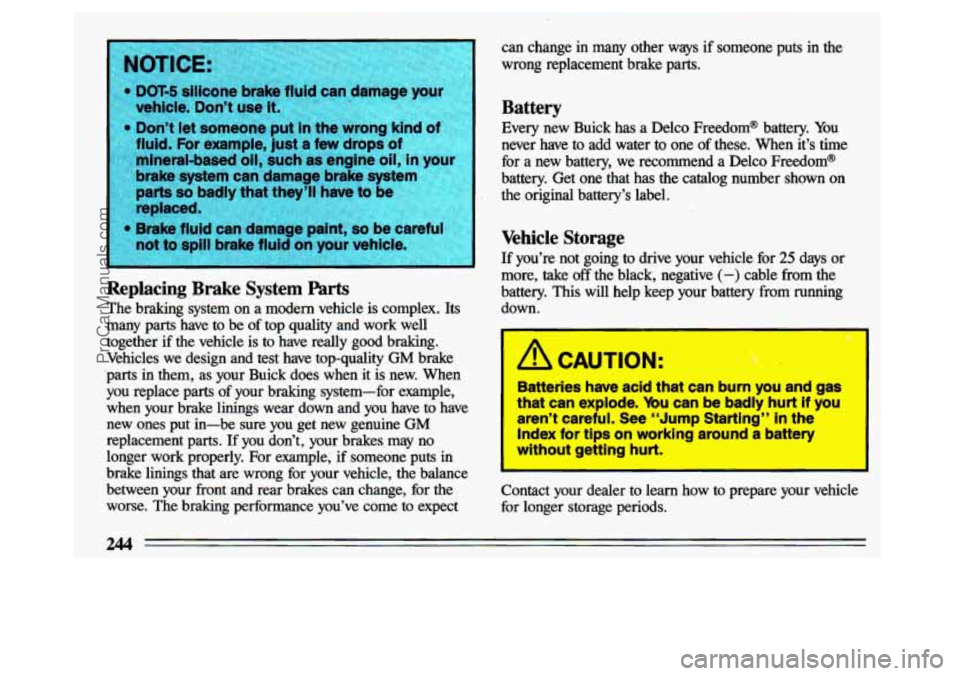
Replacing Brake System Parts
The braking system on a modern vehicle is complex. Its
many parts have to be of top quality and work well’
together
if the vehicle is to have really good braking.
Vehicles we design and test have top-quality
GM brake
‘parts in them, as your Buick does when it is new. When
you replace parts of your braking system-for example,
when your brake linings wear down and you have to have
new ones put in-be sure you get new genuine
GM
replacement parts. If you don’t, your brakes may no
longer work properly. For example, if someone puts in
brake linings that are wrong for your vehicle, the balance
between your front and rear brakes can change, for the worse. The braking performance you’ve come to expect
I
can change in many other ways if someone puts in the
wrong replacement brake parts.
Battery
Every new Buick has a Delco Freedom@ battery. You
never have
to add water to one of these. When it’s time
for a new battery, we recommend a Delco Freedom*
battery. Get one
that has the catalog number shown on
the original battery’s label.
Vehicle Storage
If you’re not ‘going to drive your vehicle for 25 days or
more,
take off the black, negative (-) cable from the
battery. This will help keep your battery from running
down.
A CAUTION:
Batteries have acid that can burn you and gas
that can explode.
Ybu can be badly hurt if you
aren’t careful. See “Jump Starting” in the ldex for tips on working around a battery
without getting hurt.
Contact your dealer to learn how to prepare your vehicle
for longer storage periods.
244
ProCarManuals.com
Page 314 of 324
.
Lane Change Indicator ............................ 87
Lap-Shoulder Safety Belt
Front Automatic
................................. 30
Rear ............................................. 43
Use by Children ............................... .45, 51
Liftgate ...................................... .69, 111
Remote Release Button ........................ .66, 69
Lighter .......................................... 105
Lights Courtesy
....................................... 98
Daytime Running Lights ........................... 96
Halogen Bulbs .................................. 245
Headlights .........................;.. .......... 95
Interior Lights Delay .............................. 97
Map ............................................ 96
Operation ....................................... 95
Parking Lights ................................... 95
Reading ......................................... 97
Removing & Replacing . Bulbs ...................... 245
Replacement Bulbs .............................. 269
Supplemental Inflatable Restraint .................... 36
Taillights ....................................... 95
Warning Lights .................................. 106
Loading Your Vehicle .............................. 249
Lock, Remote Control ............. : ................ 66
Locks ........................................ 65, 69
Long Distance Driving ............................. 164
Low Battery ................................. .108, 185
Low Oil Pressure Warning ........................... 107
Turn Signal and Lane Change Indicator ............... 87
Lubricants and Fluids .............................. 292
Luggage Carrier
Deck
......................................... 100
Roof .......................................... 100
Maintenance Materials ........................... 264
Maintenance Record ............................... 295
Maintenance Schedule .............................. 275
Malfunction Indicator Lamp (Service Engine S&n Light) ... 111
ManualFrontSeat .................................. 14
Map Light ......................................... 96
Master Cylinder, Brake ............................. 243
Methanol in Gasoline ............................... 223
Mileage Chart ...................... 1 .............. 320
Mileage Indicator (see “Odometer”)
Mirrors
Convex Outside Mirror
............................ 99
Inside Manual Day/Night ............................ 98
Inside Rearview Mirror with Reading Lights ........... 98
Manual Adjust ................................... 99.
Power Remote Control ............................ 99
Visor Vanity .................................... 100
MountainDriving ................................. 166
New Vehicle Break-In ............................. 72
Night Driving .................................... 155
312
ProCarManuals.com