service BUICK CENTURY 1993 User Guide
[x] Cancel search | Manufacturer: BUICK, Model Year: 1993, Model line: CENTURY, Model: BUICK CENTURY 1993Pages: 324, PDF Size: 17.58 MB
Page 111 of 324
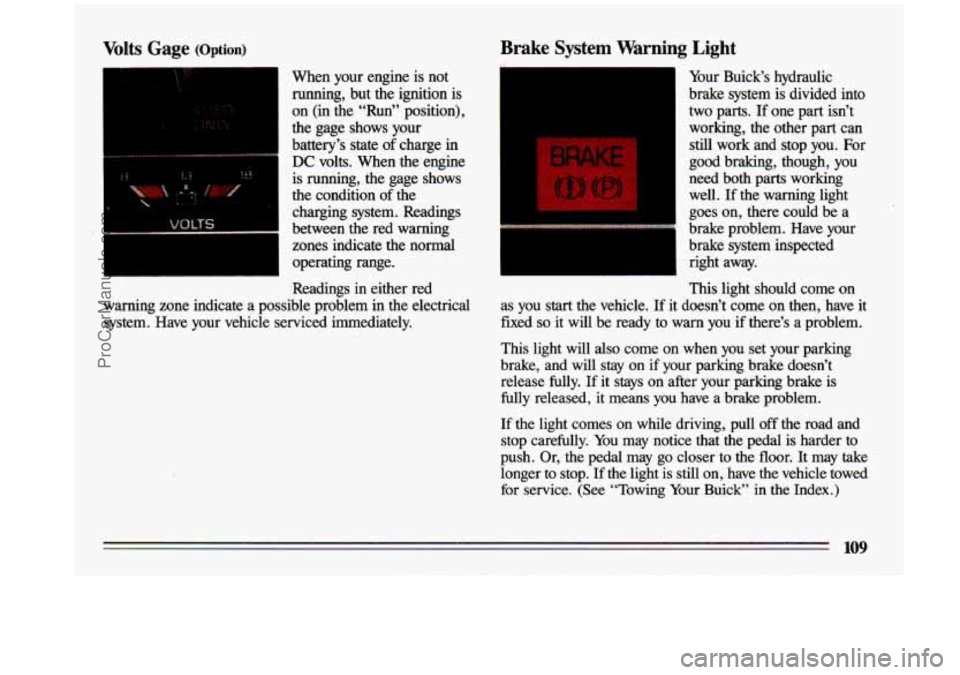
Volts Gage (Option)
When your engine is not
running, but
the ignition is
on (in the “Run” position),
the gage shows your
battery’s state of charge
in
DC volts. When the engine
is running, the gage shows
the condition of the
charging system. Readings
between the red warning
zones indicate the normal
operating range.
Readings in either red
warning zone indicate a possible problem in the electrical
system. Have your vehicle serviced immediately.
Brake System Warning Light
Your Buick‘s hydraulic
brake system is divided into
two parts. If one part isn’t working, the other part can still work and stop you. For
good braking, though, you
need both parts working
well.
If the warning light
goes on, there could be a
brake problem. Have your
brake system inspected right away.
This light should come on
as you start the vehicle. If it doesn’t come on then, have it
fixed
so it will be ready to warn you if there’s a problem.
This light will also come on when you set your parking
brake, and will stay on if your parking brake doesn’t release
fully. If it stays on after your parking brake is
fully released, it means you have a brake problem.
If the light comes on while driving, pull
off the road and
stop carefully.
You may notice that the pedal is harder to
push. Or, the pedal may go closer to -the floor. It may take
longer to stop. If the light is still on, have the vehicle towed
for service. (See “Towing Your Buick” in the Index.)
109
ProCarManuals.com
Page 112 of 324
A CAUTION:
Your brake system may not be working properly
if the brake warning light is on.
Driving with the brake warning light on can
lead to an accident.
If the light is still on after
you’ve pulled
off the road and stopped
carefully, have the vehicle towed
for service.
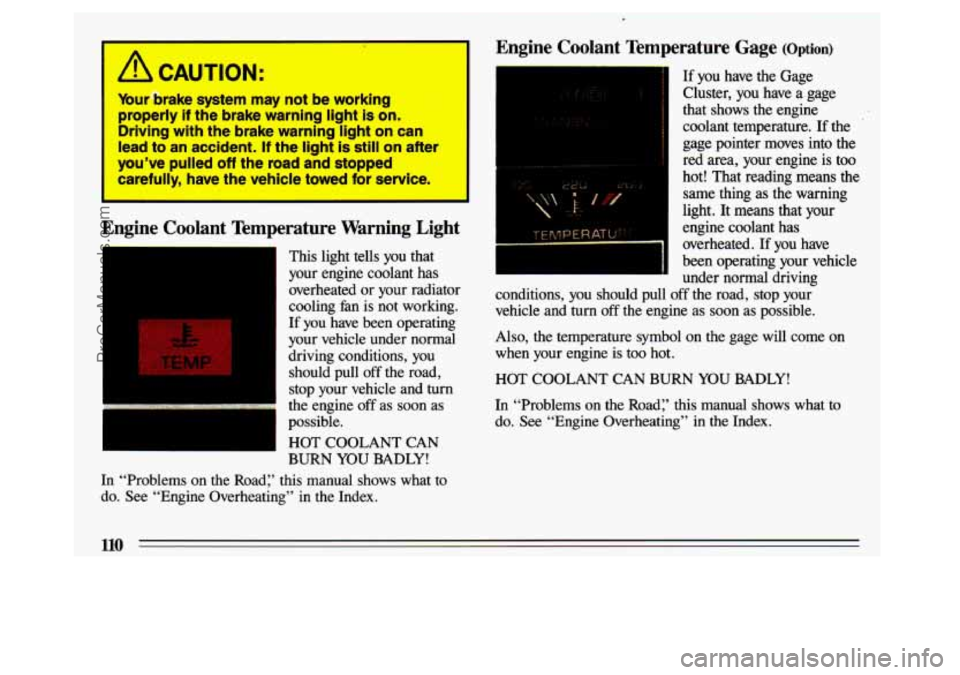
Engine Coolant Temperature Warning Light
---I
This light tells you that
your engine coolant has
overheated or your radiator
cooling
fan is not working.
If you have been operating
your vehicle under normal
driving conditions, you should pull
off the road,
stop your vehicle and
turn
the engine off as soon as
possible.
HOT COOLANT CAN
BURN YOU BADLY!
In “Problems on the Road:’ this manual shows what to
do. See “Engine Overheating” in the Index.
Engine Coolant Temperature Gage (Option)
‘1 If you have the Gage
Cluster, you have a gage
that shows the engine
coolant temperature.
If the
gage pointer moves into the red area, your engine is too
hot! That reading means the same thing as the warning
light. It means that your engine coolant has
overheated. If you have
been operating your vehicle under normal driving
conditions, you should pull off the road, stop your-
vehicle and
turn off the engine as soon as possible.
Also, the temperature symbol on the gage will come on
when your engine is too hot.
HOT COOLANT CAN BURN YOU BADLY!
In “Problems on the Road:’ this manual shows what to
do. See “Engine Overheating” in the Index.
110
ProCarManuals.com
Page 113 of 324
X"' 1 r-l
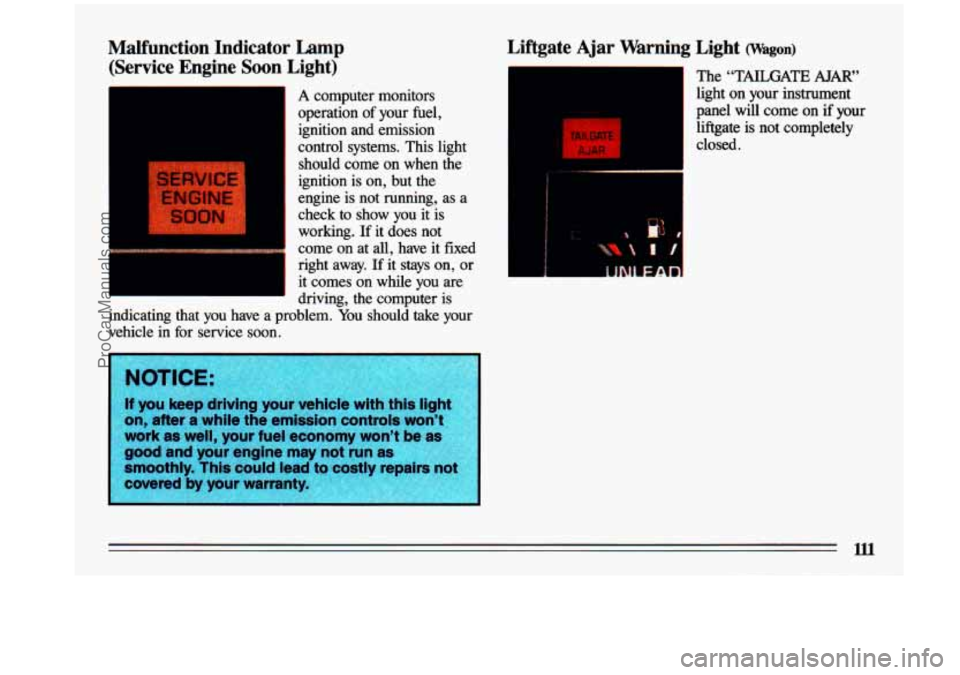
Malfunction Indicator Lamp
(Service Engine Soon Light)
A computer monitors
I operation of your fuel,
ignition and. emission
control systems. This light should come on when the
ignition is on, but the
engine is not running, as a
check to show
you it is
working.
If it does not
come on at all, have it fixed
right away.
If it stays on, or
it comes on while you are
driving, the computer is
I
indicating that you have a problem. You should take your
vehicle in
for service soon.
Liftgate Ajar Warning Light (Wagon)
.-
- The "TAILGATE AJAR"
~ light on your instrument
panel
will come on if your
I
TAI! GAY E
ALAR
liftgate is not completely
1 closed.
ProCarManuals.com
Page 132 of 324
Clean your tape player with a wiping-action, non-
abrasive cleaning cassette, and follow the directions
provided with it.
Cassettes are subject to wear and the sound quality may
degrade over time. Always make sure that the cassette
tape is in good condition before you have the tape player
serviced.
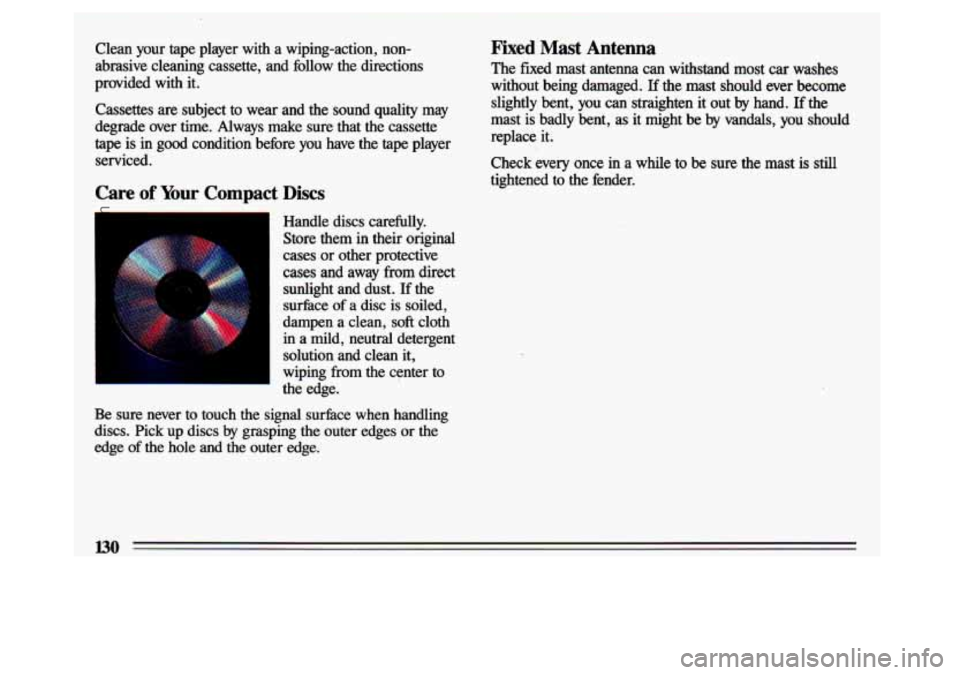
Care of Your Compact Discs
Fixed Mast Antenna
The fixed mast antenna can withstand most car washes
without being damaged.
If the mast should ever become
slightly bent, you can straighten it out
by hand. If the
mast is badly bent, as it might be
by vandals, you should
replace it.
Check every once
in a while to be sure the mast is still
tightened to the fender.
Handle discs carefully. Store them
in their original
cases or other protective
cases and away from direct sunlight and dust. If the
surface of a disc is soiled,
dampen a clean,
soft cloth
in a mild, neutral detergent
solution and clean it,
wiping from the center to
the edge.
Be sure never to touch the signal surface when handling
discs. Pick up discs
by grasping the outer edges or the
edge of the hole
and the outer edge.
130
ProCarManuals.com
Page 138 of 324
H
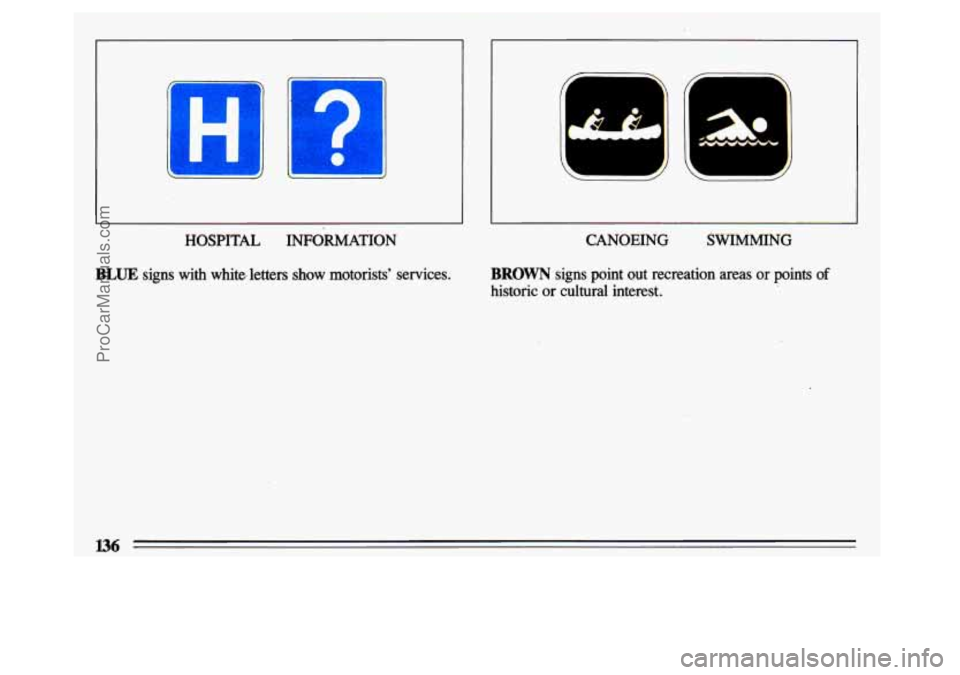
HOSPITAL INFORMATION
BLUE signs with white. letters show motorists’ services.
n
II
L
CANOEING SWIMMING
BROWN signs point out recreation areas or points of
historic or cultural interest.
ProCarManuals.com
Page 150 of 324
If you keep pace with the traffic and allow realistic
following distances, you
will eliminate a lot of
unnecessary braking. That means better braking and
longer brake life.
If your engine ever stops while you're driving, brake
normally but don't pump your brakes. If you do, the
pedal may get harder
to push down. If your engine
stops, you will still have some power brake assist. But
you will use it when
you brake. Once the power assist
is used up, it may take longer to stop and the brake
pedal will be harder to push.
Disc Brake Wear Indicators
Your Buick has front disc brakes and rear drum brakes.
I A CAUTION:
The brake wear wamlng sound means that
sooner or later pur brakes won't work well.
That could lead to an accident. When you hear
the brake wear warning sound, have your
vehlcle serviced.
I
Disc brake pads have built-in wear indicators that make a
high-pitched warning sound when the brake pads are Some driving conditions or climates may cause a brake
worn and new pads
are needed. The sound may come squeal when the brakes are first applied or lightly
and
go or be heard all the time your vehicle is moving applied. This do\
es not mean something is wrong with
(except when you are pushing on the brake pedal firmly). your brakes.
ProCarManuals.com
Page 158 of 324
Night Vision
No one can see as well at night as in the daytime, but as
we get older these differences increase. A 50-year-old
driver may require at least twice as much light to
see the
same thing at night as a 20-year-old.
What you do in the daytime can also afkct your night
vision. For example, if you spend the day in bright
sunshine you are wise to wear sunglasses. Your eyes will
have less trouble adjusting to night.
But if you’re driving, don’t wear sunglasses at night.
They may cut down on glare from headlights, but they
also make a lot of things invisible that should remain
visible-such as parked cars, obstacles, pedestrians, or
even trains blocking railway crossings. You may want to
put on your sunglasses after you have pulled into a
brightly-lighted service or refreshment area. Eyes
shielded from that glare may adjust more quickly to
darkness back on the road. But be sure to remove your
sunglasses before you leave the service area.
You can be temporarily blinded by approaching lights. It
can take
a second or two, or even several seconds, for
your eyes to readjust to the dark. When you
are hced
with severe glare (as from a driver who doesn’t lower the \
high beams, or a vehicle with
misaimed headlights) slow
down a little. Avoid staring directly into the approaching
lights. If there
is a line of opposing traffic, make
occasional glances over the line of headlights to make
certain that. one of the vehicles isn’t starting to move
into
your lane. Once you are past the bright lights, give your
eyes time to readjust before resuming
speed.
156
ProCarManuals.com
Page 167 of 324
Is your vehicle ready for a long trip? If you keep it
serviced and maintained, it’s ready to go. If it needs
service, have it done before starting out.
Of course, you’ll
find experienced and able service experts in Buick
dealerships
all across North America. They’ll be ready
and willing to help if you need it.
Here are some things you can check before
a trip:
Windshield Washer Fluid: Is the reservoir full? Are
all windows clean inside and outside?
Wiper Blades: Are they in good shape?
hel, Engine Oil, Other Fluids: Have you checked all
Lights: Are they all working? Are the lenses clean?
Tires: They are vitally important to a safe, trouble-free
trip.
Is the tread good enough for long-distance
driving? Are the tires all inflated to the recommended
pressure?
Weather Forecasts: What’s the weather outlook along
your route? Should you delay your trip a short time to
avoid a major storm system?
levels?
Maps: Do you have up-to-date maps?
On the Road
Unless you
are the only driver, it is good to share the
driving task with others. Limit
turns behind the wheel to
about
100 miles (160 km) or two hours at a sitting. Then,
either change drivers or stop for some refreshment like
coffee, tea or
sol3 drinks and some limbering up. But do
stop and move around. Eat lightly along the way. Heavier
meals tend
to make some people sleepy.
On two-lane highways or undivided multilane highways
that do not have controlled access, you’ll want to watch for some situations not usually found on freeways.
Examples are: stop signs and signals, shopping centers
with direct access to the highway, no passing zones and school zones, vehicles turning left and right
off the road,
pedestrians, cyclists, parked vehicles, and even animals.
Highway Hypnosis
Is there actually such a condition as “highway hypnosis”?
Or is it just plain falling asleep at the .wheel? Call it
highway hypnosis, lack of awareness, or whatever.
There is something about an easy stretch
of road with the
same scenery, along with the hum
of the tires on the
road, the drone
of the engine, and the rush of the wind
against the vehicle that can make you sleepy. Don’t let it \
happen to you!
If it does, your vehicle can leave the road
in
less than a second, and you could crash and be
injured.
165
ProCarManuals.com
Page 183 of 324
Maintenance When Trailer Towing
Your vehicle will need service more often when you’re
pulling a trailer. See the Maintenance Schedule for more
on this. Things that are especially important in trailer
operation
are automatic transaxle fluid (don’t overfill),
engine oil, belt, cooling. system, and brake adjustment.
Each of these is covered in this manual, and the Index
‘will help you find them quickly.
If you’re trailering, it’s a
good idea to review these sections before you
start your trip.
Check periodically
to see that all hitch nuts and bolts are
tight.
181
ProCarManuals.com
Page 190 of 324
3'.
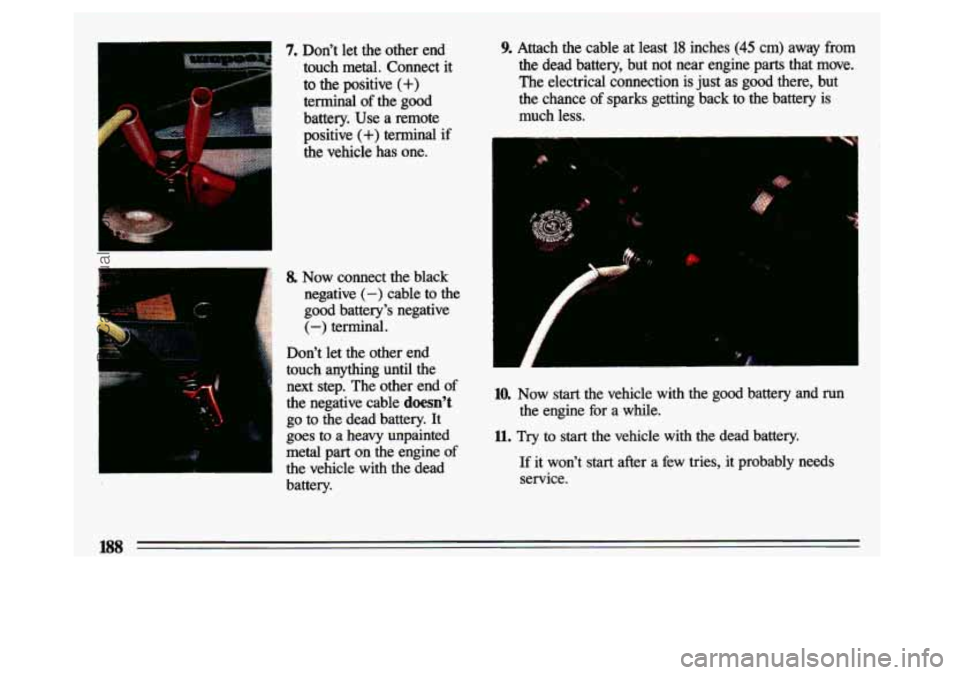
7. Don't let the other end touch metal. Connect it
to the positive (+)
terminal of the good
battery. Use a remote
positive
(+) terminal if
the vehicle has one.
8. Now connect the black negative
(-) cable to the
good battery's negative
(-) terminal.
Don't let the other end
touch anything until the
next step. The other end of
the negative cable
doesn't
go to the dead battery. It
goes to a heavy unpainted
metal part on the engine of
the vehicle with the dead
battery.
9. Attach the cable at least 18 inches (45 cm) away from
the dead battery, but not near engine parts that move.
The electrical connection is just
as good there, but
the chance
of sparks getting back to the battery is
much less.
10. Now start the vehicle with the good battery and run
U. Try to start the vehicle with the dead battery. the engine for a while.
If it won't start after a
few tries,
it probably needs
service.
ProCarManuals.com