tires BUICK CENTURY 1993 User Guide
[x] Cancel search | Manufacturer: BUICK, Model Year: 1993, Model line: CENTURY, Model: BUICK CENTURY 1993Pages: 324, PDF Size: 17.58 MB
Page 173 of 324
Winter Driving
Here are some tips for winter driving:
Have your Buick in good shape for winter. Be sure
your engine coolant mix is correct.
Snow tires can help in loose snow, but they may give
you less traction on ice than regular tires. If you do not
expect to
be driving in deep snow, but may have to
travel over ice,
you may not want to switch to snow
tires at all.
vehicle.
You may want to put winter emergency supplies in your
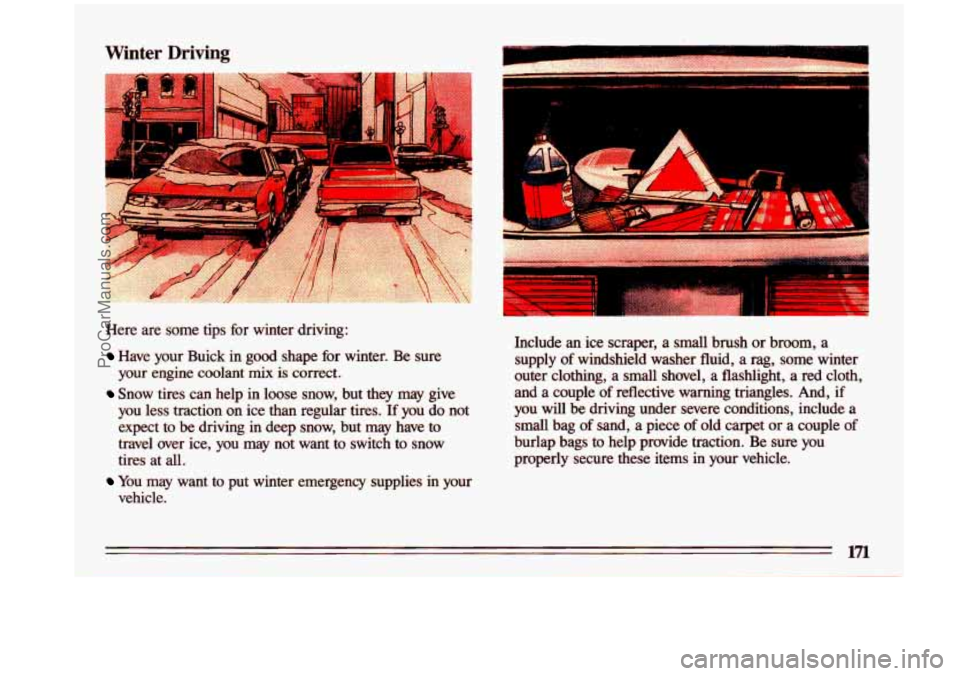
Include an ice scraper, a small brush or broom, a
supply of windshield washer fluid, a rag, some winter
outer clothing, a
small shovel, a flashlight, a red cloth,
and a couple of reflective warning triangles.
And, if
you will
be driving under severe conditions, include a
small bag of sand, a piece of old carpet or a couple of
burlap bags to help provide traction. Be sure you
properly secure these items in your vehicle.
171
ProCarManuals.com
Page 174 of 324
Driving on Snow or Ice
Most of the time, those places where your tires meet the
road probably have’good traction.
However, if there is
snow or ice between your tires and
the road, you can have a
very slippery situation. You’ll
have a lot less traction or “grip” and will need to be very
careful.
r
-
I
.. .
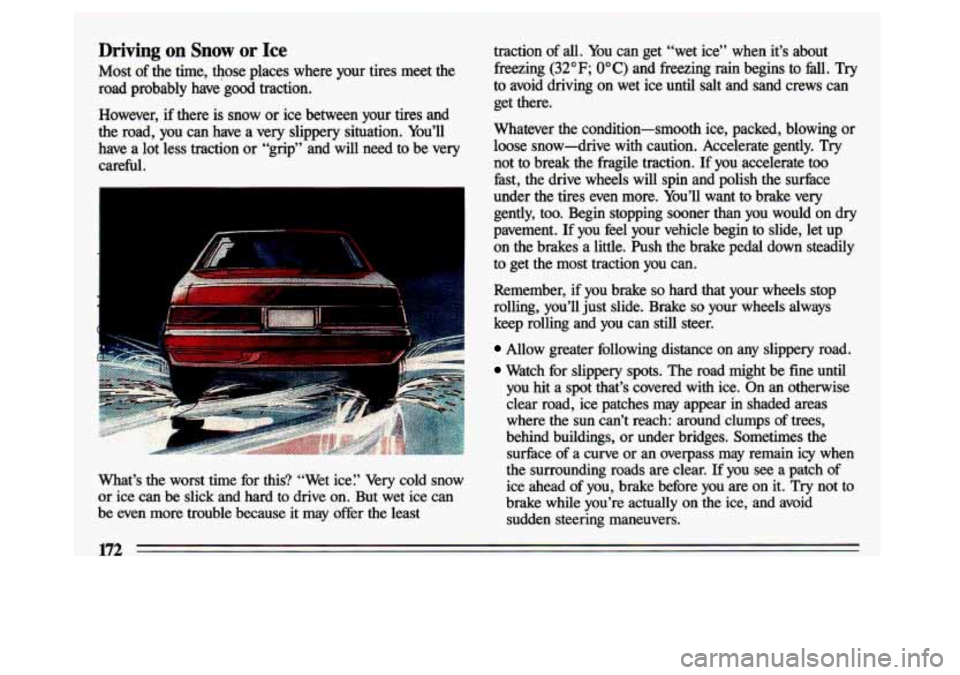
What’s the worst time for this? “Wet ice? Very cold snow
or ice can be slick and hard to drive on. But
wet ice can
be even more trouble because it may offer the least traction
of all. You can get “wet ice” when it’s about
freezing
(32°F; OOC) and freezing rain begins to fall. Try
to avoid driving on
wet ice until salt and sand crews can
get there.
Whatever the condition-smooth ice, packed, blowing or
loose snow-drive with caution. Accelerate gently. Try
not to break the fragile traction. If you acceierate too hst, the drive wheels will spin and polish the surface
under the tires even more. You’ll want to brake very
gently, too. Begin stopping sooner than you would on dry
pavement. If you feel your vehicle begin to slide, let up
on the brakes a little. fish the brake pedal down steadily
to get the most traction you can.
Remember, if you brake
so hard that your wheels stop
rolling, you’ll just slide. Brake
so your wheels always
keep rolling and you can still steer.
Allow greater following distance on any slippery road.
Watch for slippery spots. The road might be fine until
you hit a spot that’s covered with ice. On an otherwise
clear road, ice patches may appear
in shaded areas
where the sun can’t reach: around clumps of trees,
behind buildings, or under bridges. Sometimes the
surfixe of a curve or an overpass may remain icy when
the surrounding roads are clear. If you see a patch
of
ice ahead of you, brake before you are on it. Try not to
brake while you’re actually
on the ice, and avoid
sudden steering maneuvers.
ProCarManuals.com
Page 177 of 324
Towing a Trailer
A CAUTION:
If you don’t use the correct equipment and
drive properly, you can lose control when you
pull a traller. For example, If the trailer is too
heavy, the brakes may not work well--or wen
at all. Mu and your passengets could be
seriously Injured. Pull a trailer only if you have
followed all the steps in this section.
hicle and result
Your Buick can tow a trailer. To identify what the vehicle
trailering capacity is for your vehicle, you should read
the information in “Weight of the Trailer” that appears
later
in this section. But trailering is different than just
driving your vehicle
by itself. Trailering means changes
in handling, durability, and fuel economy. Successful,
safe trailering
takes correct equipment, and it has to be
used properly. That’s the reason for this section.
In it are many time-
tested, important trailering tips and safety rules. Many
of
these are important for your safety and that of your
passengers.
So please read this section carefully before
you pull a trailer.
Load-pulling components such as the engine, transaxle,
wheel assemblies, and tires are forced to work harder against the drag of the added weight. The engine is
required to operate at relatively higher speeds and under
greater loads, generating extra heat. What’s more, the
trailer adds considerably
to wind resistance, increasing
the pulling requirements.
All of that means changes in:
Handling
Durability
Fuel economy
175
ProCarManuals.com
Page 179 of 324
Weight of the Trailer Tongue
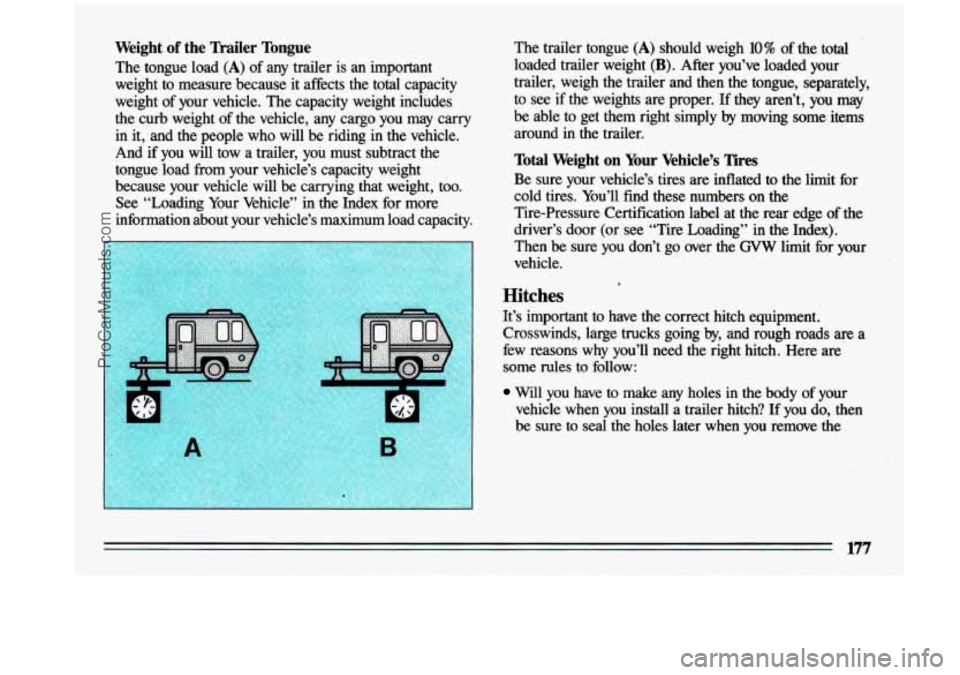
The tongue load (A) of any trailer is an important
weight to measure because it affects the total capacity
weight of your vehicle. The capacity weight includes
the curb weight
of the vehicle, any cargo you may carry
in it, and the people who will be riding in the vehicle.
And if you will tow a trailer, you must subtract the
tongue load from your vehicle’s capacity weight
because your vehicle will be carrying that weight, too. See “Loading Your Vehicle” in the Index for more
information about your vehicle’s maximum load capacity. The trailer tongue
(A) should weigh 10% of
the total
loaded trailer weight
(B). After you’ve loaded your
trailer, weigh the trailer and then the tongue, separately,
to see if the weights are proper.
If they aren’t, you may
be able to get them right simply by moving some items
around in the trailer.
Total Weight on Your Vehicle’s Tires
Be sure your vehicle’s tires are inflated to the limit for
cold tires. You’ll find these numbers on
the
Tire-Pressure Certification label at the rear edge of the
driver’s door (or see “Tire Loading” in the Index). Then be sure you don’t go over the
GVW limit for your
vehicle.
Hitches
It’s important to have the correct hitch equipment.
Crosswinds, large trucks going by,
and rough roads are a
few reasons why you’ll need the right hitch. Here are
some rules
to follow:
Will you have to make any holes in the body of your
vehicle when you install a trailer hitch?
If you do, then
be sure to seal the holes later when you remove the
177
ProCarManuals.com
Page 181 of 324

Driving with a Trailer
Towing a trailer requires a certain amount of experience.
Before setting out for the open road, you’ll want to get t\
o
know your rig. Acquaint yourself with the
feel of
handling and braking with the added weight of the trailer.
And always keep in mind that the vehicle you
are driving
is now a good deal longer and not nearly
so responsive as
your vehicle is by itself.
Before you
start, check the trailer hitch and platform, safety
chains, electrical connector, lights, tires and mirror
adjustment. If the trailer has electric brakes,
start your vehicle
and trailer moving and then apply the trailer brake controller \
by hand to be sure the brakes
are working. This lets you
check your electrical connection at the same time. During
your trip, check occasionally
to be sure that the load is secure,
and that the lights and any trailer brakes are still working.
Following Distance
Stay at least twice as fit, behind the vehicle ahead as you
would when driving your vehicle without a trailer. This
can help you avoid situations that require heavy braking
and sudden turns.
Passing
You’ll need more passing distance up ahead when you’re
towing
a trailer. And, because you’re a good deal longer,
you’ll
need to go much farther beyond the passed vehicle
before you can return to your lane.
Backing Up
Hold the bottom of the steering wheel with one hand.
Then, to move the trailer to the left, just move that hand
to the left.
To move the trailer to the right, move your
hand to the right. Always back up slowly and, if
possible, have someone guide you.
Making nrns
When you’re turning with a trailer, make wider turns
than normal.
Do this so your trailer won’t strike soft
shoulders, curbs, road signs, trees, or other objects.
Avoid jerky or sudden maneuvers. Signal well in
advance.
Turn Signals When Towing a Mler
When you tow a trailer, your vehicle has to have a
different turn signal flasher and extra wiring. The green arrows on your instrument panel will flash whenever you
signal a turn or lane change. Properly hooked up, the
trailer lights will also flash, telling other drivers you’re \
about to turn, change lanes or stop.
When towing a trailer, the green arrows on your instrument panel will flash for turns even if the bulbs on
the trailer are burned out. Thus, you may think drivers
behind you are seeing your signal when they are not. It’s
important to check occasionally to be sure the trailer
bulbs are still working.
179
ProCarManuals.com
Page 191 of 324
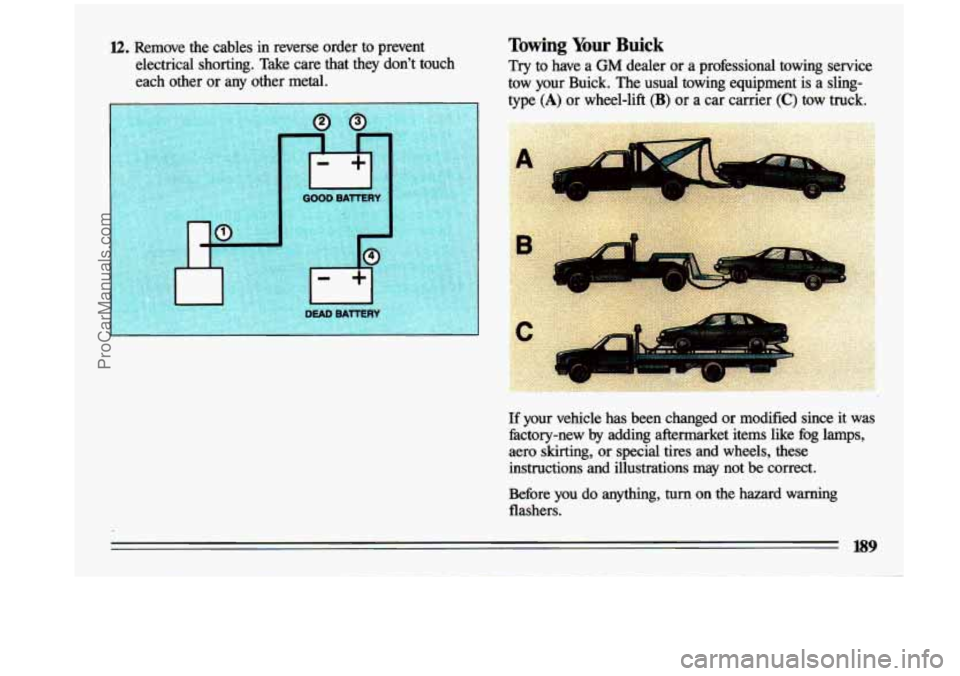
12. Remove the cables in reverse order to prevent
electrical shorting. Take care that they don't touch
each other or any other metal. Towing Your Buick
Try to have a GM dealer or a professional towing service
tow your Buick. The usual towing equipment is
a sling-
tvPe (A) or wheel-lift (B) or a car carrier (C) tow truck.
If your vehicle has been changed or modified since it was
fhctory-new by adding aftermarket items
like fog lamps,
aero skirting, or special tires and wheels, these
instructions and illustrations may not be correct.
Before
you do anything, turn on the hazard warning
flashers.
189
ProCarManuals.com
Page 207 of 324
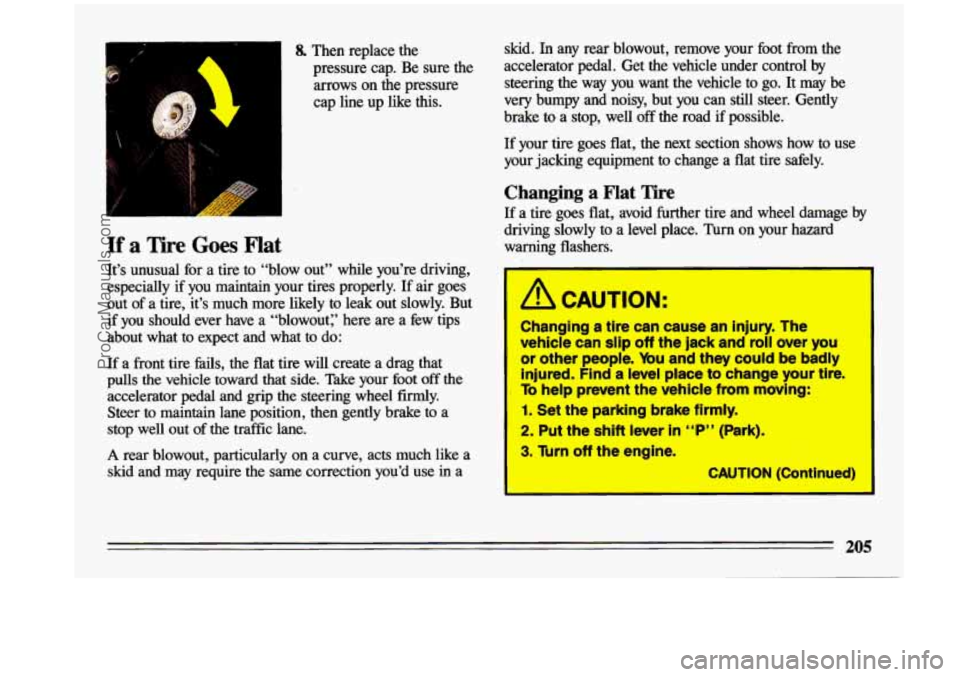
8. Then replace the pressure cap. Be sure
the
arrows on the pressure
cap line up like this.
If a Tire Goes Flat
It’s unusual for a tire to “blow out” while you’re driving,
especially if you maintain your tires properly. If air
goes
out of a tire, it’s much more likely to leak out slowly. But
if you should ever have a “blowout:’ here are a few tips
about what to expect and what to do:
If a front tire fails, the flat tire will create a drag that
pulls
the vehicle toward that side. Take your foot off the
accelerator pedal and grip
the steering wheel firmly.
Steer to maintain lane position, then gently brake to a
stop well out of the traffic lane.
A rear blowout, particularly on a curve, acts much like a
skid and may require the same correction you’d use in a skid.
In any rear blowout, remove your foot from the
accelerator pedal. Get the vehicle under control by
steering the way you want the vehicle
to go. It may be
very bumpy and noisy, but you can still steer. Gently brake
to a stop, well off the road if possible.
If your tire goes flat; the next section shows how to use
your jacking equipment to change a flat tire safely.
Changing a Flat Tire
If a tire goes flat, avoid further tire and wheel damage ~y
driving slowly to a level place. Turn on your hazard
warning flashers.
A CAUTION:
Changing a tire can cause an injury. The vehicle can slip
off the jack and roll over you
or other people. You and they could be badly injured. Find a level place to change your tire.
To help prevent the vehicle from moving:
1. Set the parking brake firmly.
2. Put the shift lever in “P” (Park).
3. Turn off the engine.
CAUTION (Continued)
205
ProCarManuals.com
Page 220 of 324
Compact Spare Tire
Although the compact spare was fully inflated when your
vehicle was new, it can lose air after a time.
Check the
inflation pressure regularly. It should be
60 psi
(420 Wa). The compact spare is made to go up to 3,000
miles (5 0o0 km), so you can finish your trip and have
your full-size tire repaired or replaced where you want.
Of course, it’s best to replace your spare with a full-size
tire as soon as you can. Your spare will last longer and be
in good shape in case you need
it again.
on’t take your compact spare th
utomatic car wash with guide
ompact spare can get caught damage the tire and whe
her parts
of your vehicle.
Don’t use your compact spare on some other vehicle.
And don’t
mix your compact spare or wheel with other
wheels or tires. They won’t
fit. Keep your spare and its
wheel together.
s too. Don’t us
ProCarManuals.com
Page 221 of 324
If You’re Stuck: In Sand, Mud, Ice or Snow
What you don’t want to do when your vehicle is stuck is
to spin your wheels. The method known as “rocking”
can help you get out when you’re stuck, but
you must use
caution.
wneels can destr
If you let your tires spln at high spe& they
can aplode and you or others could be
Injured. And, the,transaxle or other parts of
the vehicle can &wheat. That could muse an
engine compartment fire or other damage.
When you’re stuck, spin the wheels 88 lltek adc
-pssSble. Don’t spln the whwls above 35 mph
(55 Wh) as shown on the speedometer.
Rocking your vehicle to get it out:
First, turn your steering wheel left and right. That will
clear the area around your fiont wheels. Then
shift back
and forth between
“R” (Reverse) and a forward gear,
spinning the wheels as little as possible. Release the
accelerator
pedal while you shift, and press lightly on the
accelerator
pedal when the transaxle is in gear. If that
doesn’t get you out after a few tries, you may need to be
towed out.
If you do need to be towed out, see “Towing
Your Buick”
in the Index.
ProCarManuals.com
Page 223 of 324
.
n
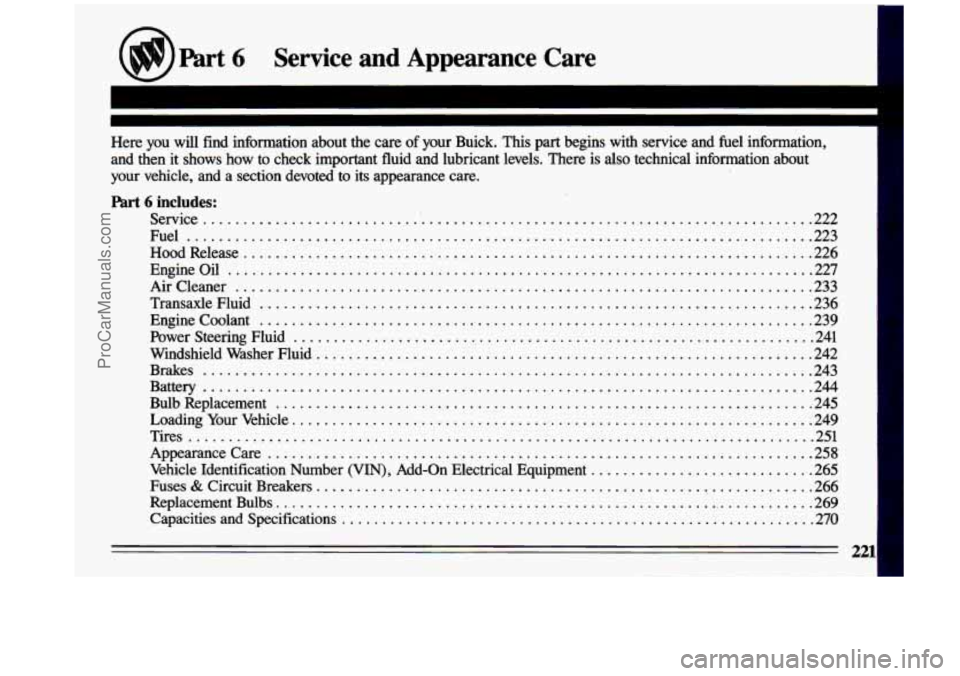
Part 6 Service and Appearance Care
. .
Here you will find information about the care of your Buick . This part begins with service and fuel information.
and then
it shows how to check important fluid and lubricant levels . There is also technical information about
your vehicle. and a section devoted to
its appearance care .
Part 6 includes:
Service ........................................................................\
..... 222
Fuel ........................................................................\
...... 223
HoodRelease ....................................................................... \
226
Engine Oil ........................................................................\
. 227
Aircleaner ........................................................................\
2.3
TransaxleFluid ..................................................................... 236
Enginecoolant ..................................................................... 239
Power Steering Fluid ................................................................. 241
Windshield Washer Fluid .............................................................. 242
Brakes ........................................................................\
.... 243
Battery ........................................................................\
.... 244
BulbReplacement ................................................................... 245
Tires ........................................................................\
...... 251
Loadingyourvehicle ................................................................. 249
Appearancecare .................................................................... 258
Vehicle Identification Number (VIN), Add-on Electrical Equipment ............................ 265
Capacities and Specifications .......................................................... -270
Fuses&CircuitBreakers .............................................................. 266
ReplacementBulbs .................................................................... 269
ProCarManuals.com