towing BUICK CENTURY 1993 User Guide
[x] Cancel search | Manufacturer: BUICK, Model Year: 1993, Model line: CENTURY, Model: BUICK CENTURY 1993Pages: 324, PDF Size: 17.58 MB
Page 183 of 324
Maintenance When Trailer Towing
Your vehicle will need service more often when you’re
pulling a trailer. See the Maintenance Schedule for more
on this. Things that are especially important in trailer
operation
are automatic transaxle fluid (don’t overfill),
engine oil, belt, cooling. system, and brake adjustment.
Each of these is covered in this manual, and the Index
‘will help you find them quickly.
If you’re trailering, it’s a
good idea to review these sections before you
start your trip.
Check periodically
to see that all hitch nuts and bolts are
tight.
181
ProCarManuals.com
Page 185 of 324
I
Here you’ll find what to do about some problems that can occur on the road.
Part 5 includes:
HazardWarningFlashers ..............................................................184
Other Warning Devices . . . . . . . . . . . . . . . . . . . . . . . . . . . . . . . . . . . . . . . . . . . . . . . . . . . . . . . . . . . . . . .185
Jumpstarting
........................................................................\
..
Towing Your Buick . . . . . . . . . . . . . . . . . . . . . . . . . . . . . . . . . . . . . . . . . . . . . . . . . . . . . . . . . . . . . . . . . . .189
Engine Overheating
. . . . . . . . . . . . . . . . . . . . . . . . . . . . . . . . . . . . . . . . . . . . . . . . . . . . . . . . . . . . . . . . . .195
IfaTireGoesFlat
...................................................................205
ChangingaFlatTire ........................................,........................205
CompactSpareTire ..................................................................218
If You’re Stuck: In Sand, Mud, Ice or Snow . . . . . . . . . . . . . . . . . . . . . . . . . . . . . . . . . . . . . . . . . . . . . . .219
ProCarManuals.com
Page 191 of 324
12. Remove the cables in reverse order to prevent
electrical shorting. Take care that they don't touch
each other or any other metal. Towing Your Buick
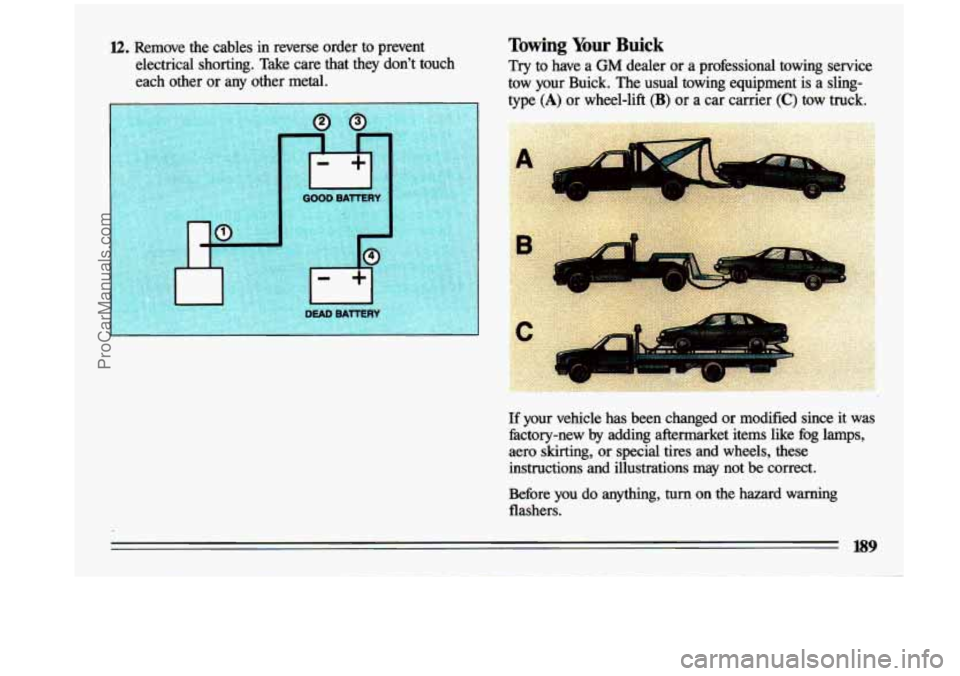
Try to have a GM dealer or a professional towing service
tow your Buick. The usual towing equipment is
a sling-
tvPe (A) or wheel-lift (B) or a car carrier (C) tow truck.
If your vehicle has been changed or modified since it was
fhctory-new by adding aftermarket items
like fog lamps,
aero skirting, or special tires and wheels, these
instructions and illustrations may not be correct.
Before
you do anything, turn on the hazard warning
flashers.
189
ProCarManuals.com
Page 192 of 324
When you call, tell the towing service:
That your vehicle has front-wheel drive.
The make, model, and year of your vehicle.
Whether you can still move the shift lever.
If there was an accident, what was damaged.
When the towing service arrives, let the tow operator
know that
this manual contains detailed towing
instructions and illustrations. The operator
may want to
see them.
-
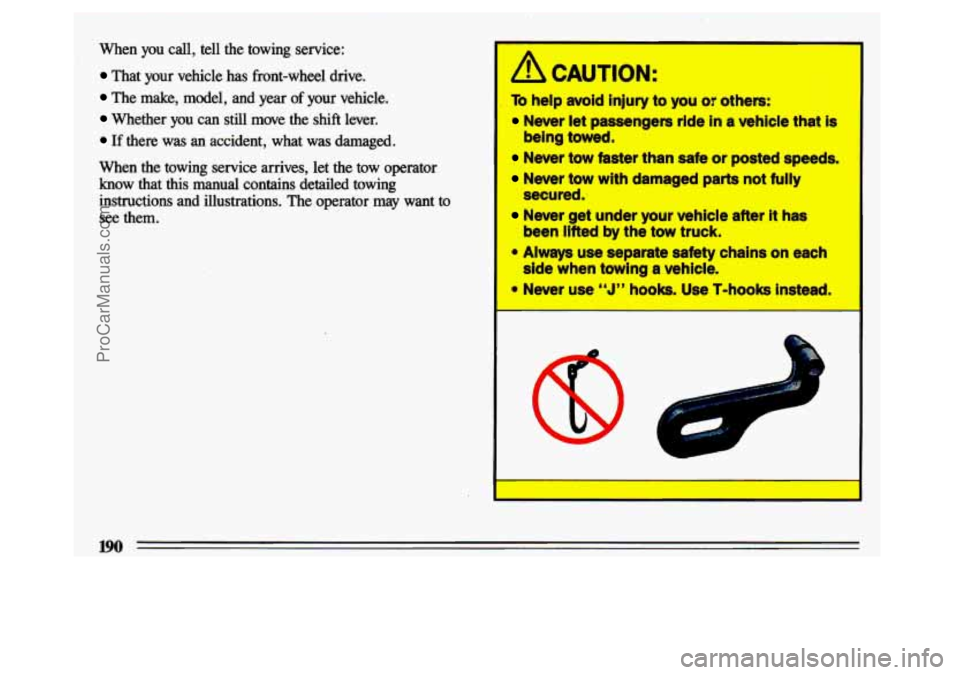
/i CAUTION:
. To help avoid injury to you or othem:
Never let passengers rlde In a vehlcle that is
Never tow faster than safe or posted speeds.
Never tow with damaged parts not fully
Never get under your vehicle after it has
0 Always use separate safety chalns on each
@ Never use “J” hooks. Use T-hooks Instead.
being towed.
Secured:
been lifted by the tow truck.
side when towing
a vehlcle.
ProCarManuals.com
Page 193 of 324
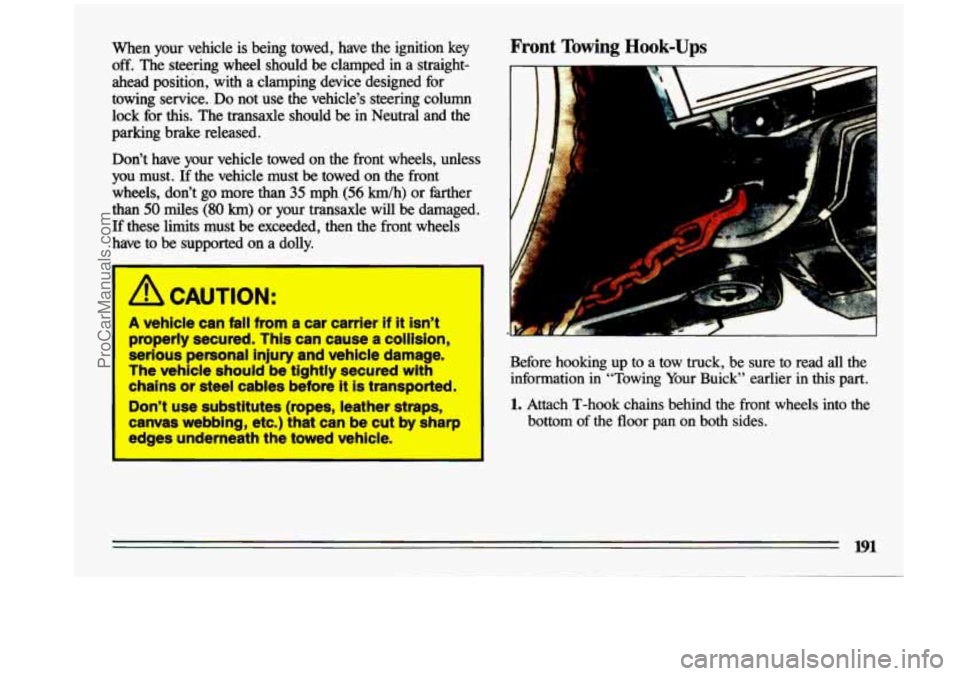
when your vehicle is being towed, have the ignition key Front Towing Hook-Ups
off. The steering wheel should be clamped in a straight-
ahead position, with a clamping device designed for
towing service.
Do not use the vehicle’s steering column
lock for
this. The transaxle should be in Neutral and the
parking brake released.
I
Don’t have your vehicle towed on the front wheels, unless
you must. If the vehicle must be towed on the front
wheels, don’t go more than
35 mph (56 km/h) or farther
than
50 miles (80 km) or your transaxle will be damaged.
If these limits must be exceeded, then the front wheels
have
to be supported on a dolly.
1
I
&!, CAUTION:
A vehicle can fall from a car carrier if It Isn’t
properly secured.
This can cause a colllsion,
serious personal injury and vehicle damage.
The vehicle should be tightly secured with Before hooking up to a tow truck, be sure to read all the
chains or steel cables before it is transported. information in “Towing Your Buick” earlier in this part.
Don’t use substitutes (ropes, leather straps, I
1. Attach T-hook chains behind the front wheels into the
canvas webbing, etc.) that can be cut by sharp bottom of the floor pan on both sides.
edges underneath the towed vehicle. I
191
ProCarManuals.com
Page 195 of 324
I
1;
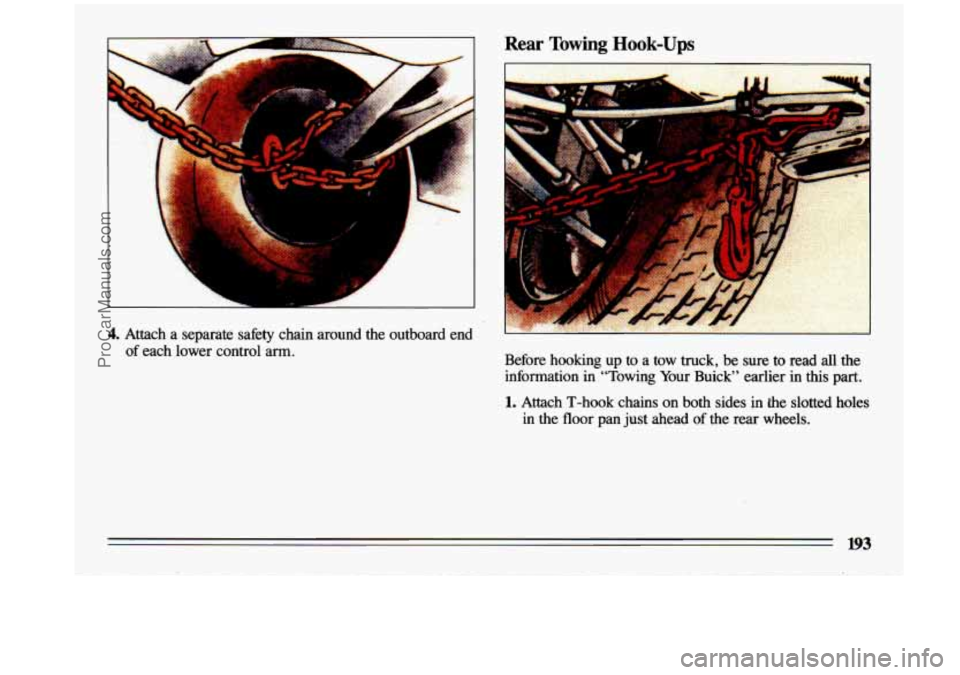
4. Attach a separate safety chain around the outboard end
of each lower control arm. Before hooking up
to a tow truck, be sure to read all the
information in “Towing Your Buick” earlier in this part.
1. Attach T-hook chains on both sides in the slotted holes
in the
floor pan just ahead of the rear wheels.
193
ProCarManuals.com
Page 221 of 324
If You’re Stuck: In Sand, Mud, Ice or Snow
What you don’t want to do when your vehicle is stuck is
to spin your wheels. The method known as “rocking”
can help you get out when you’re stuck, but
you must use
caution.
wneels can destr
If you let your tires spln at high spe& they
can aplode and you or others could be
Injured. And, the,transaxle or other parts of
the vehicle can &wheat. That could muse an
engine compartment fire or other damage.
When you’re stuck, spin the wheels 88 lltek adc
-pssSble. Don’t spln the whwls above 35 mph
(55 Wh) as shown on the speedometer.
Rocking your vehicle to get it out:
First, turn your steering wheel left and right. That will
clear the area around your fiont wheels. Then
shift back
and forth between
“R” (Reverse) and a forward gear,
spinning the wheels as little as possible. Release the
accelerator
pedal while you shift, and press lightly on the
accelerator
pedal when the transaxle is in gear. If that
doesn’t get you out after a few tries, you may need to be
towed out.
If you do need to be towed out, see “Towing
Your Buick”
in the Index.
ProCarManuals.com
Page 282 of 324
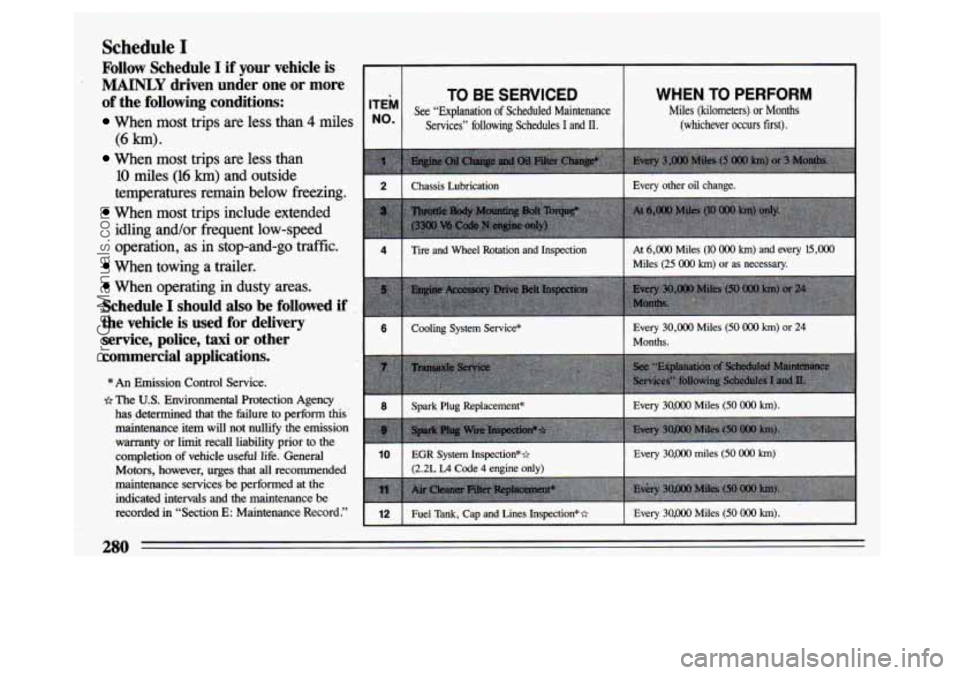
Schedule I
Follow Schedule I if your vehicle is
MAINLY driven under one or more
of the following conditions:
When most trips are less than 4 miles
When most trips are less than
10 miles (16 km) and outside
temperatures remain below freezing.
When most trips include extended
idling and/or frequent low-speed
operation, as
in stop-and-go’ traffic.
(6 km).
When towing a trailer.
When operating in dusty areas.
Schedule I should also be followed if
the vehicle
is used for delivery
service, p?lice,
taxi or other
commercial applications.
* An Emission Control Service.
z2T The U.S. Environmental Protection Agency
has.determined that the failure to perform this
maintenance item will not nullify the emission
wamty
or limit recall liability prior to the
completion of vehicle useful life. General
Motors, however, urges that all recommended
maintenance services
be performed at the
indicated intervals and the maintenance be
recorded in “Section E: Maintenance Record.”
ITEM
NO.
TO BE SERVICED WHEN TO PERFORM
See “Explanation of Scheduled Maintenance Miles (kilometers) or Months
Services” following Schedules
I and D[. (whichever occurs first).
2 I Chassis Lubrication I Every other oil change.
Tire
and Wheel Rotation and Inspection At 6,000 Miles (10 000 km) and every 15,000
Miles (25 000 km) or as necessary. I
61
Cooling System Service* Every 30,000 Miles (50 O00 km) or 24
Months. I
8 I Spark
Plug Replacement* I Every 30,000 Miles (50 000 km). I
EGR System Inspection** Every 30,000 miles (50 OOO km)
(2.2L LA Code 4 engine only)
12 I Fuel Tank, Cap and Lines Inspection** I Every 30,000 Miles (50 OOO km). I
280
ProCarManuals.com
Page 287 of 324
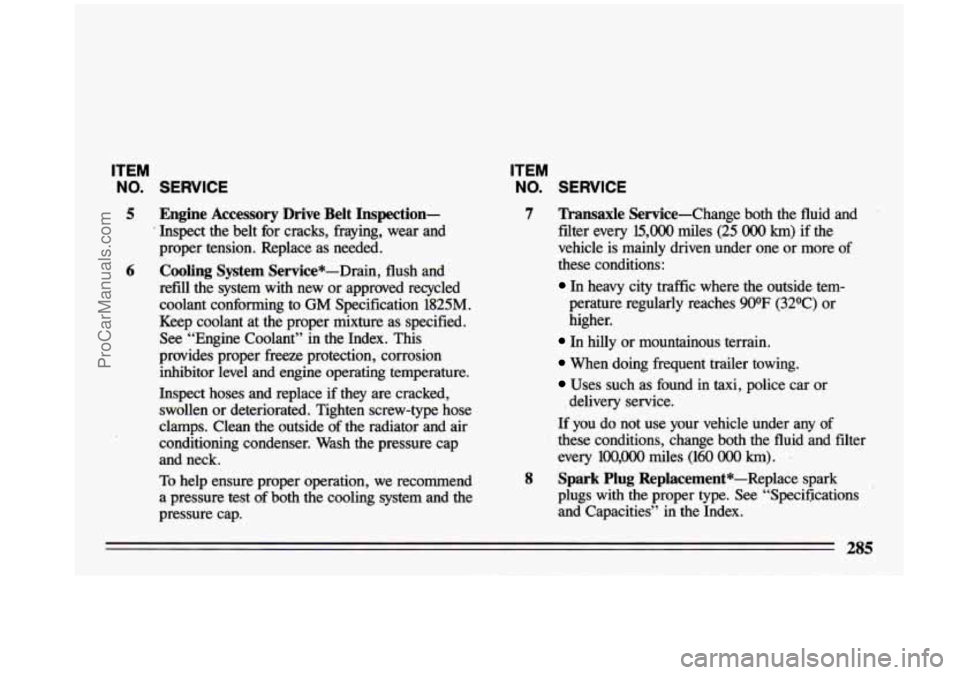
ITEM
NO. SERVICE
5 Engine Accessory Drive Belt Inspection-
* Inspect the belt for cracks, fraying, wear and
proper tension. Replace as needed.
6 Cooling System Service*-Drain, flush and
refill the system with new or approved recycled
coolant conforming to
GM Specification 1825M.
Keep coolant at the proper mixture as specified. See “Engine Coolant” in the Index. This
provides proper freeze protection, corrosion inhibitor level and engine operating temperature.
Inspect hoses and replace if they are cracked,
swollen or deteriorated. Tighten screw-type hose
clamps. Clean the outside of the radiator and air
conditioning condenser. Wash the pressure cap
and neck.
To help ensure proper operation, we recommend
a pressure test of
both the cooling system and the
pressure cap.
ITEM
NO. SERVICE
7 Transaxle Service-Change both the fluid and
filter every
l5,O00 miles (25 O00 km) if the
vehicle is mainly driven under one or more of
these conditions:
In heavy city traffic where the outside tem-
perature regularly reaches
90°F (32OC) or
higher.
In hilly or mountainous terrain.
When doing frequent trailer towing.
Uses such as found in taxi, police car or
If you do’not use your vehicle under any of
these conditions, change both the fluid and filter every
100,000 miles (160 0o0 km).
plugs with the proper type. See “Specifications
‘and Capacities” in the Index. delivery service.
8 Spark
Plug Replacement*-Replace spark
285
ProCarManuals.com
Page 310 of 324
Pedal Travel ...................................... 149
RearDrum
..................................... 149
Replacement
................................... 244
Warning Light-
.................................. 109
Wear Indicators-Disc Brakes ....................... 148
Brake System Wakng Light
......................... 109
Braking in Emergencies .............................. 149
“Break-In:’ New Vehicle
Normd Driving. ................................. 72
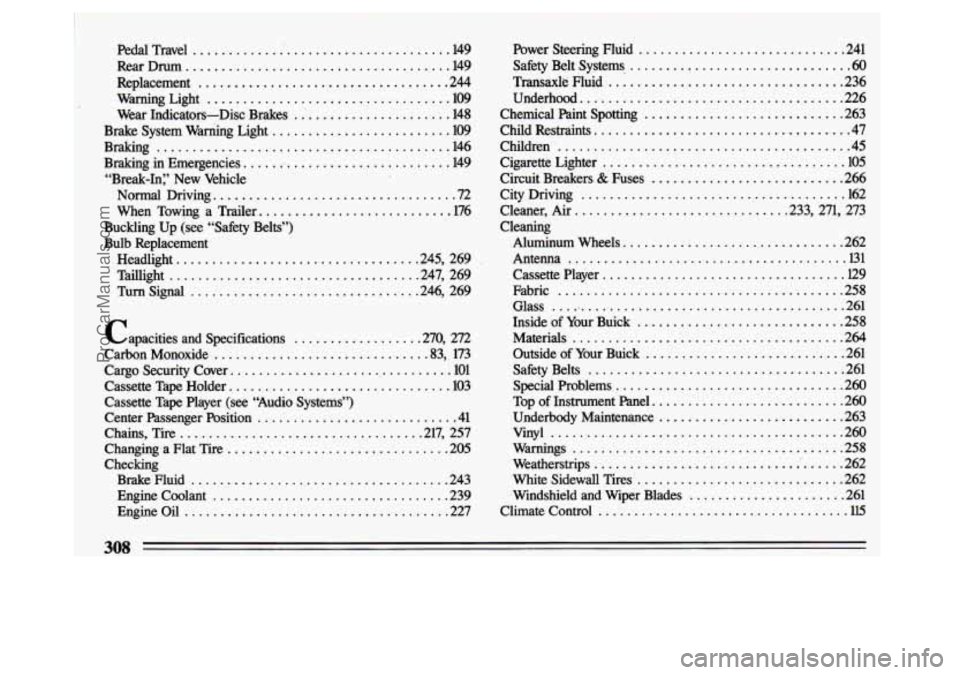
When Towing a Trailer
........................... 176
Braking
......................................... 146
Buckling Up (see “Safety Belts”)
Bulb Replacement
Headlight
................................. .245. 269
Turn Signal ............................... .246, 269
Taillight
.................................. .247. 269
capacities and Specifications
................. .270. 272
CarbonMonoxide
.............................. 83. 173
Cargo Security Cover
................................ 101
Cassette Tape Holder
............................... 103
Cassette Tape Player
(see “Audio Systems”)
Center Passenger Position
............................ 41
Chains. Tire
................................. .217. 257
Changing a Flat Tire
............................... 205
Checking BrakeFluid
.................................... 243
Engine Coolant
................................. 239
Engine0
il ..................................... 227 Power Steering Fluid
............................. 241
Safety Belt Systems
......... ...................... 60
Transaxle Fluid .................................. 236
Underhood
..................................... 226
Chemical paint Spotting
............................ 263
ChildRestraints
.................................... 47
Children’
......................................... 45
Cigarette Lighter
.................................. 105
Circuit Breakers
& Fuses ........................... 266
Cleaner, Air
............................. .233. 271. 273
Cleaning AluminumWheels
............................... 262
Antenna
....................................... 131
Cassette Player .................................. 129
Fabric
........................................ 258
Glass
.......................................... 261
Inside of Your Buick ............................. 258
Materials ........................................ 264
Outside of Your Buick
............................ 261
Safety Belts
.................................... 261
Special Problems
................................ 260
Top of Instrument Panel
........................... 260
Underbody Maintenance
.......................... 263
Vinyl
......................................... 260
Warnings ...................................... 258
Weatherstrips
.................................... ‘262
White Sidewall Tires
............................. 262
Windshield and Wiper Blades
...................... 261
Climate Control
................................... 115
CityDriving ..................................... 162
308
ProCarManuals.com