trailer BUICK CENTURY 1993 User Guide
[x] Cancel search | Manufacturer: BUICK, Model Year: 1993, Model line: CENTURY, Model: BUICK CENTURY 1993Pages: 324, PDF Size: 17.58 MB
Page 181 of 324

Driving with a Trailer
Towing a trailer requires a certain amount of experience.
Before setting out for the open road, you’ll want to get t\
o
know your rig. Acquaint yourself with the
feel of
handling and braking with the added weight of the trailer.
And always keep in mind that the vehicle you
are driving
is now a good deal longer and not nearly
so responsive as
your vehicle is by itself.
Before you
start, check the trailer hitch and platform, safety
chains, electrical connector, lights, tires and mirror
adjustment. If the trailer has electric brakes,
start your vehicle
and trailer moving and then apply the trailer brake controller \
by hand to be sure the brakes
are working. This lets you
check your electrical connection at the same time. During
your trip, check occasionally
to be sure that the load is secure,
and that the lights and any trailer brakes are still working.
Following Distance
Stay at least twice as fit, behind the vehicle ahead as you
would when driving your vehicle without a trailer. This
can help you avoid situations that require heavy braking
and sudden turns.
Passing
You’ll need more passing distance up ahead when you’re
towing
a trailer. And, because you’re a good deal longer,
you’ll
need to go much farther beyond the passed vehicle
before you can return to your lane.
Backing Up
Hold the bottom of the steering wheel with one hand.
Then, to move the trailer to the left, just move that hand
to the left.
To move the trailer to the right, move your
hand to the right. Always back up slowly and, if
possible, have someone guide you.
Making nrns
When you’re turning with a trailer, make wider turns
than normal.
Do this so your trailer won’t strike soft
shoulders, curbs, road signs, trees, or other objects.
Avoid jerky or sudden maneuvers. Signal well in
advance.
Turn Signals When Towing a Mler
When you tow a trailer, your vehicle has to have a
different turn signal flasher and extra wiring. The green arrows on your instrument panel will flash whenever you
signal a turn or lane change. Properly hooked up, the
trailer lights will also flash, telling other drivers you’re \
about to turn, change lanes or stop.
When towing a trailer, the green arrows on your instrument panel will flash for turns even if the bulbs on
the trailer are burned out. Thus, you may think drivers
behind you are seeing your signal when they are not. It’s
important to check occasionally to be sure the trailer
bulbs are still working.
179
ProCarManuals.com
Page 182 of 324
Driving on Grades
Reduce speed and shift to a lower gear before you start
down a long or steep downgrade. If you don’t shift down,
you might have to use your brakes
so much that they
would get hot and no longer work well.
On a long uphill grade, shift down and reduce your speed
to around
45 mph (70 Mh) to reduce the possibility of
engine and transaxle overheating.
If you are towing a trailer that weighs more than 1,OOO
pounds (450 kg) and you have an automatic transaxle
with Overdrive, you may prefer
to drive in “D” instead
of Overdrive.
Parking on Hills
You really should not park your vehicle, with a trailer
attached, on a hill.
If something goes wrong, your rig
could
start to move. People can be injured, and both your
vehicle and the trailer can be damaged.
But if you ever have to park your rig on a hill, here’s how
to do it:
1. Apply your regular brakes, but don’t shift into “P”
2. Have someone place chocks under the trailer wheels. (Park) yet.
3. When the wheel chocks
are in place, release the
regular brakes until the chocks absorb the load.
4. Reapply the regular brakes. Then, apply your parking
5. Release the regular brakes.
When You are Ready to Leave After Parking on a Hill
1. Apply your regular brakes and hold the pedal down
brake, and then shift to
“P” (Park).
while you:
Start your engine;
Shift into a gear; and
Release the parking brake.
2. Let up on the brake pedal.
3. Drive slowly until the trailer is clear of the chocks.
4. Stop and have someone pick up and store the chocks.
ProCarManuals.com
Page 183 of 324
Maintenance When Trailer Towing
Your vehicle will need service more often when you’re
pulling a trailer. See the Maintenance Schedule for more
on this. Things that are especially important in trailer
operation
are automatic transaxle fluid (don’t overfill),
engine oil, belt, cooling. system, and brake adjustment.
Each of these is covered in this manual, and the Index
‘will help you find them quickly.
If you’re trailering, it’s a
good idea to review these sections before you
start your trip.
Check periodically
to see that all hitch nuts and bolts are
tight.
181
ProCarManuals.com
Page 198 of 324
If No Steam Is Coming From Your-Engine:
If you get the overheat warning but see or hear no steam,
the problem
may not be too serious. Sometimes the
engine can get a little too hot when you:
Climb a long hill on a hot day.
Stop after high speed driving.
Idle for long periods in traffic.
Tow a trailer.
If you get the overheat warning with
no sign of steam, try
this for a minute or so:
1. Turn off your air conditioner.
2. Turn on your heater to full hot at the highest fan speed
and open the window as necessary.
3. Try to keep your engine under load (in a drive gear
where the engine runs slower). If you no longer have the overheat warning, you can
drive. Just to be safe, drive slower for about ten minutes.
If the warning doesn’t come back on, you can drive
normally.
If the warning continues, pull over, stop, and park your
vehicle right away.
If there’s still no sign of steam, you can idle the engine\
for two or three minutes while you’re parked, to
see if
the warning stops. But then, if you still have the warning,
TURN OFF THE ENGRVE AND GET EVERYONE
OUT
OF THE VEHICLE until it cools down.
You may decide
not to lift the hood but to get service
help right away.
ProCarManuals.com
Page 234 of 324
When to Change Engine Oil: See if any one of these is
true for you:
Most trips are less than 4 miles (6 km).
It’s below freezing outside and most trips are less than
10 miles (16 km).
The engine is at low speed most of the time (as in
door-to-door delivery,
or in stop-and-go traffic).
You tow a trailer often.
Most trips are through dusty places.
If any one of these is true for your vehicle, then you need
to change your oil and filter every 3,000 miles
(5 O00 km) or 3 months-whichever comes first.
If none
of them is true, change the oil every 7,500 miles
(12 500 km) or 12 months-whichever comes first.
Change the fdter at the first oil change and at every other
oil change afier that.
Engine Block Heater: An engine block heater can be a
big help if you have to park outside
in very cold weather,
0°F (-18°C) or colder. If your vehicle has this option, see
“Engine Block Heater”
in the Index.
What to Do with Used Oil:
-
/i CAUTION:
Used engine oil contains things that have
caused skin cancer in laboratory animals.
Don’t let used oil stay on your skin for very
long. Clean your skin and nails with soap and
water or a good hand cleaner. Wash or
properly throw away clothing or rags
containing used engine oil.
Used oil can be a real threat to the environment. If you
change your own oil, be sure to drain all free-flowing oil
from the filter before disposal. Don’t ever dispose of oil
by pouring it on the ground, into sewers, or into streams
or bodies of water. Instead, recycle it ‘by taking
it to a
place that collects used
oil. If you have a problem
properly disposing of your used oil, ask your dealer, a
service station or a local recycling center for help.
232
ProCarManuals.com
Page 238 of 324
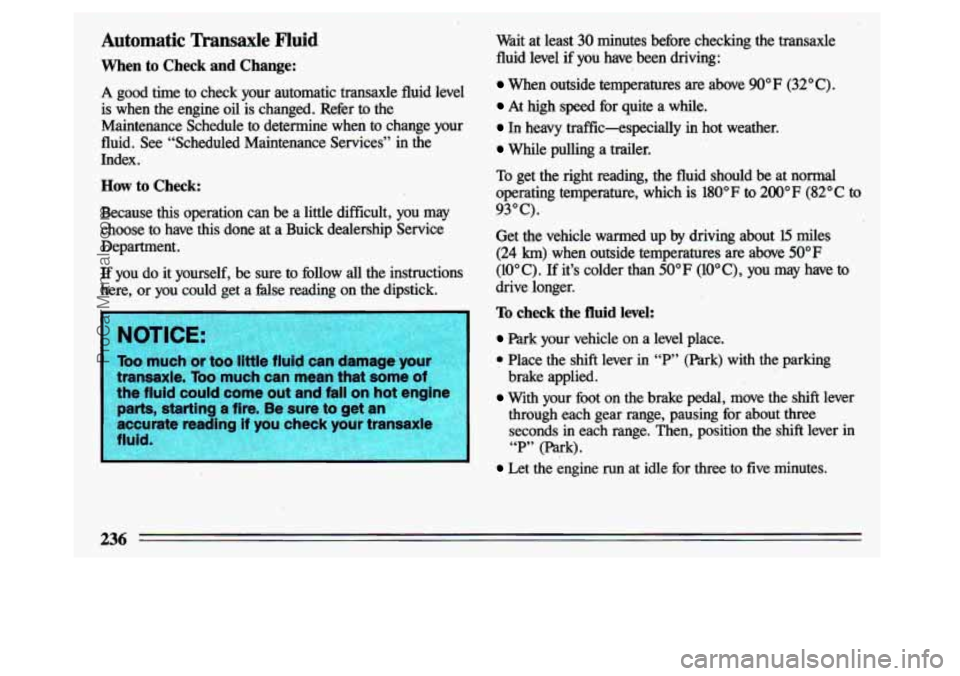
Automatic ‘mansaxle Fluid
When to Check and Change:
A good time to check your automatic transaxle fluid level
is when the engine oil is changed. Refer to the
Maintenance Schedule to determine when to change your
fluid. See “Scheduled Maintenance Services” in the
Index.
How to Check:
Because this operation can be a little difficult, you may
choose to have
this done at a Buick dealership Service
Department.
If you do it yourself, be sure to follow all the instructions
here, or you could get a false reading on the dipstick. Wait at least
30 minutes before checking the transaxle
fluid level
if you have been driving:
When outside temperatures are above 90°F (32°C).
At high speed for quite a while.
In heavy traffic-especially in hot weather.
While pulling a trailer.
To get the right reading, the fluid should be at normal
operating temperature, which is
180°F to 200” F (82” C to
93°C).
Get the vehicle warmed up by driving about 15 miles
(24 km) when outside temperatures are above 50°F
(10°C). If it’s colder than 50” F (lO°C), you may have to
drive longer.
To check the fluid level:
Park your vehicle on a level place.
0 Place the shift lever in “P” (Park) with the parking
brake applied.
With your foot on the brake pedal, move the. shift lever
through each gear range, pausing for about three
seconds in each range. Then, position the shift lever in
“P” (Park).
Let the engine run at idle for three to five minutes.
236
ProCarManuals.com
Page 281 of 324
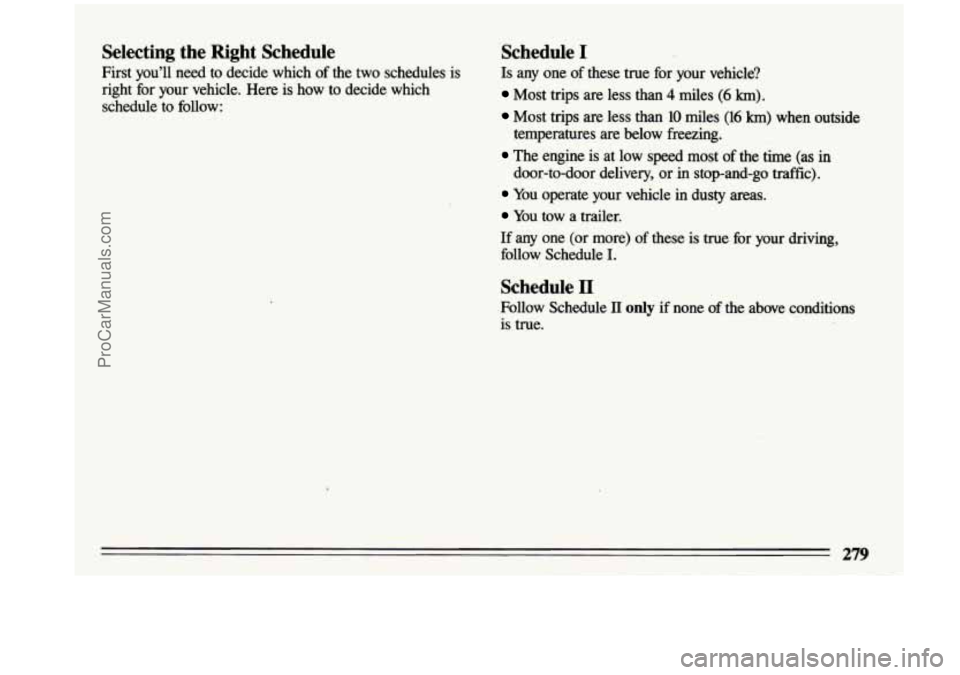
Selecting the Right Schedule
First you’ll need to decide which of the two schedules is
right for your vehicle. Here is how to decide which
schedule to follow:
Schedule I
Is any one of these true for your vehicle?
Most trips are less than 4 miles (6 km).
Most trips are less than 10 miles (16 km) when outside
temperatures are below freezing.
The engine is at low speed most of the time (as in
door-to-door delivery, or
in stop-and-go traffic).
You operate your vehicle in dusty areas.
You tow a trailer.
If any one (or more) of these is true for your driving,
follow Schedule
I.
Schedule 11
Follow Schedule II only if none of the above conditions
is true.
279
ProCarManuals.com
Page 282 of 324
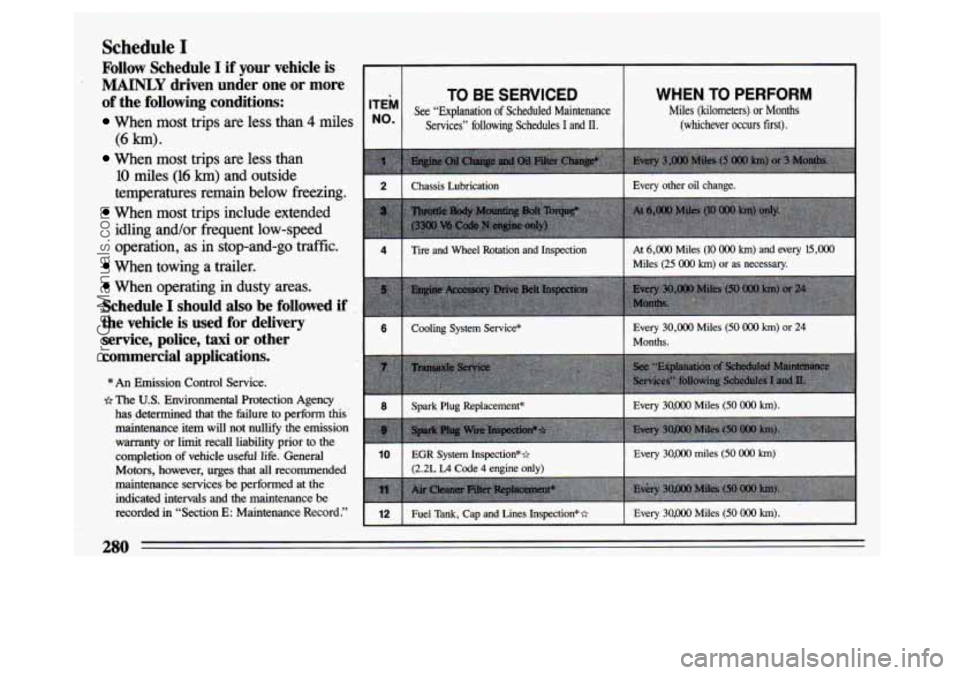
Schedule I
Follow Schedule I if your vehicle is
MAINLY driven under one or more
of the following conditions:
When most trips are less than 4 miles
When most trips are less than
10 miles (16 km) and outside
temperatures remain below freezing.
When most trips include extended
idling and/or frequent low-speed
operation, as
in stop-and-go’ traffic.
(6 km).
When towing a trailer.
When operating in dusty areas.
Schedule I should also be followed if
the vehicle
is used for delivery
service, p?lice,
taxi or other
commercial applications.
* An Emission Control Service.
z2T The U.S. Environmental Protection Agency
has.determined that the failure to perform this
maintenance item will not nullify the emission
wamty
or limit recall liability prior to the
completion of vehicle useful life. General
Motors, however, urges that all recommended
maintenance services
be performed at the
indicated intervals and the maintenance be
recorded in “Section E: Maintenance Record.”
ITEM
NO.
TO BE SERVICED WHEN TO PERFORM
See “Explanation of Scheduled Maintenance Miles (kilometers) or Months
Services” following Schedules
I and D[. (whichever occurs first).
2 I Chassis Lubrication I Every other oil change.
Tire
and Wheel Rotation and Inspection At 6,000 Miles (10 000 km) and every 15,000
Miles (25 000 km) or as necessary. I
61
Cooling System Service* Every 30,000 Miles (50 O00 km) or 24
Months. I
8 I Spark
Plug Replacement* I Every 30,000 Miles (50 000 km). I
EGR System Inspection** Every 30,000 miles (50 OOO km)
(2.2L LA Code 4 engine only)
12 I Fuel Tank, Cap and Lines Inspection** I Every 30,000 Miles (50 OOO km). I
280
ProCarManuals.com
Page 287 of 324
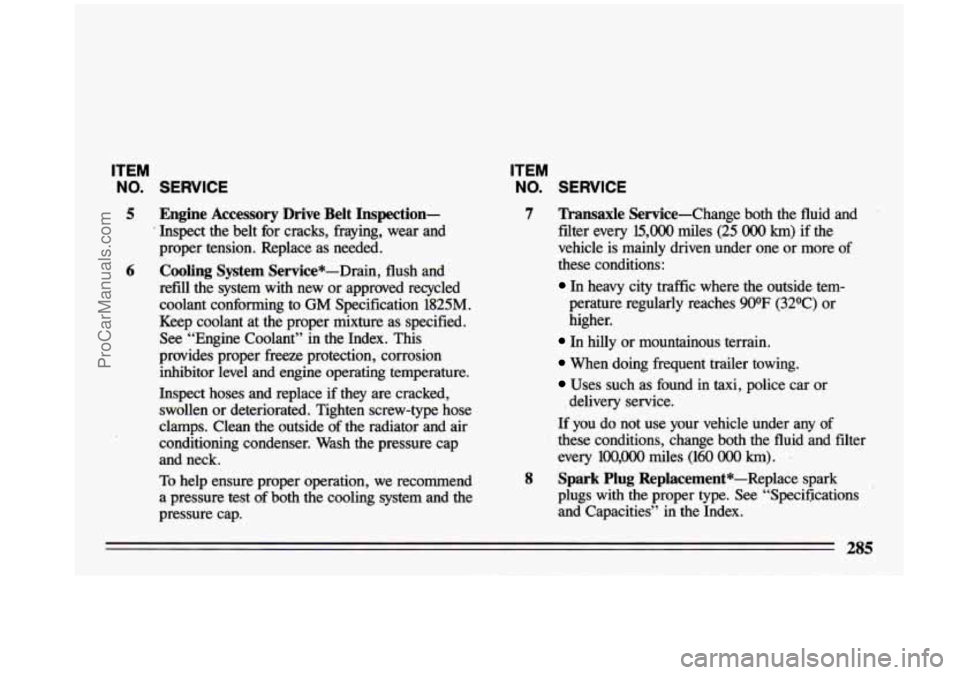
ITEM
NO. SERVICE
5 Engine Accessory Drive Belt Inspection-
* Inspect the belt for cracks, fraying, wear and
proper tension. Replace as needed.
6 Cooling System Service*-Drain, flush and
refill the system with new or approved recycled
coolant conforming to
GM Specification 1825M.
Keep coolant at the proper mixture as specified. See “Engine Coolant” in the Index. This
provides proper freeze protection, corrosion inhibitor level and engine operating temperature.
Inspect hoses and replace if they are cracked,
swollen or deteriorated. Tighten screw-type hose
clamps. Clean the outside of the radiator and air
conditioning condenser. Wash the pressure cap
and neck.
To help ensure proper operation, we recommend
a pressure test of
both the cooling system and the
pressure cap.
ITEM
NO. SERVICE
7 Transaxle Service-Change both the fluid and
filter every
l5,O00 miles (25 O00 km) if the
vehicle is mainly driven under one or more of
these conditions:
In heavy city traffic where the outside tem-
perature regularly reaches
90°F (32OC) or
higher.
In hilly or mountainous terrain.
When doing frequent trailer towing.
Uses such as found in taxi, police car or
If you do’not use your vehicle under any of
these conditions, change both the fluid and filter every
100,000 miles (160 0o0 km).
plugs with the proper type. See “Specifications
‘and Capacities” in the Index. delivery service.
8 Spark
Plug Replacement*-Replace spark
285
ProCarManuals.com
Page 310 of 324
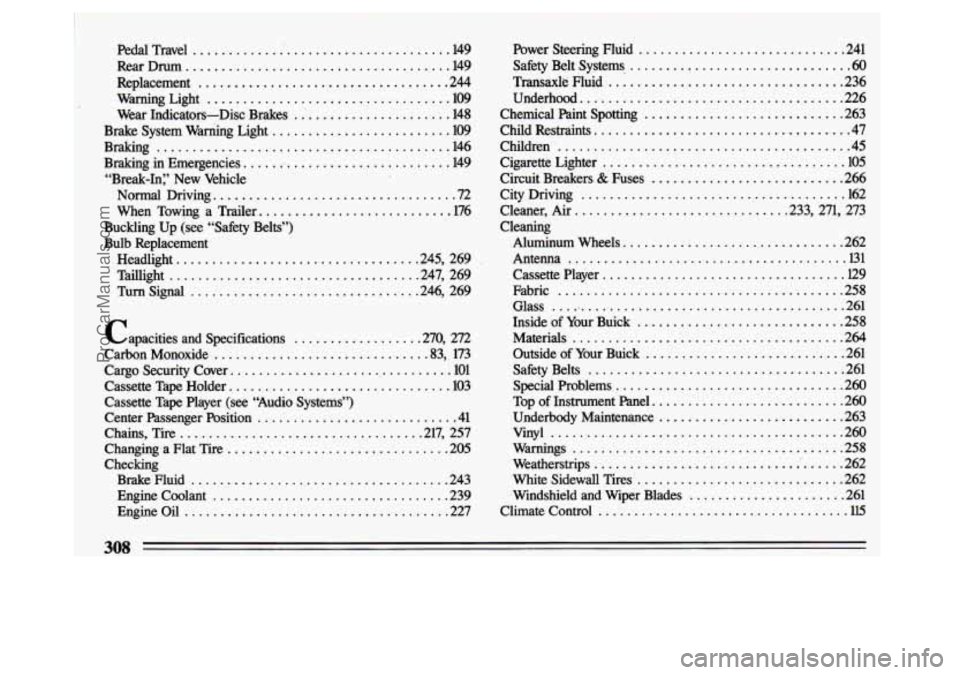
Pedal Travel ...................................... 149
RearDrum
..................................... 149
Replacement
................................... 244
Warning Light-
.................................. 109
Wear Indicators-Disc Brakes ....................... 148
Brake System Wakng Light
......................... 109
Braking in Emergencies .............................. 149
“Break-In:’ New Vehicle
Normd Driving. ................................. 72
When Towing a Trailer
........................... 176
Braking
......................................... 146
Buckling Up (see “Safety Belts”)
Bulb Replacement
Headlight
................................. .245. 269
Turn Signal ............................... .246, 269
Taillight
.................................. .247. 269
capacities and Specifications
................. .270. 272
CarbonMonoxide
.............................. 83. 173
Cargo Security Cover
................................ 101
Cassette Tape Holder
............................... 103
Cassette Tape Player
(see “Audio Systems”)
Center Passenger Position
............................ 41
Chains. Tire
................................. .217. 257
Changing a Flat Tire
............................... 205
Checking BrakeFluid
.................................... 243
Engine Coolant
................................. 239
Engine0
il ..................................... 227 Power Steering Fluid
............................. 241
Safety Belt Systems
......... ...................... 60
Transaxle Fluid .................................. 236
Underhood
..................................... 226
Chemical paint Spotting
............................ 263
ChildRestraints
.................................... 47
Children’
......................................... 45
Cigarette Lighter
.................................. 105
Circuit Breakers
& Fuses ........................... 266
Cleaner, Air
............................. .233. 271. 273
Cleaning AluminumWheels
............................... 262
Antenna
....................................... 131
Cassette Player .................................. 129
Fabric
........................................ 258
Glass
.......................................... 261
Inside of Your Buick ............................. 258
Materials ........................................ 264
Outside of Your Buick
............................ 261
Safety Belts
.................................... 261
Special Problems
................................ 260
Top of Instrument Panel
........................... 260
Underbody Maintenance
.......................... 263
Vinyl
......................................... 260
Warnings ...................................... 258
Weatherstrips
.................................... ‘262
White Sidewall Tires
............................. 262
Windshield and Wiper Blades
...................... 261
Climate Control
................................... 115
CityDriving ..................................... 162
308
ProCarManuals.com