tire pressure BUICK CENTURY 1993 Owners Manual
[x] Cancel search | Manufacturer: BUICK, Model Year: 1993, Model line: CENTURY, Model: BUICK CENTURY 1993Pages: 324, PDF Size: 17.58 MB
Page 151 of 324
Rear Drum Brakes
Your rear drum brakes don’t have wear indicators, but if
you ever hear a rear brake rubbing noise, have the rear
brake linings inspected.
Also, the rear brake drums should
be removed and inspected each time the tires are removed
for rotation or changing. .When you have the front brakes
replaced, have the rear brakes inspected, too.
Brake linings should always be replaced as complete
axle sets.
Braking In Emergencies
At some time, nearly every driver gets into a situation
that requires hard braking. Your first reaction-to
hit the
brake
pedal hard and hold it down-may be the wrong
thing to do. Your wheels can stop rolling. Once they
do,
the vehicle can’t respond to your steering. Momentum
will carry it
in whatever direction it was headed when the
wheels stopped rolling. That could be
off the road, into
the very thing you were trying
to avoid, or into traffic.
Use a “squeeze” braking technique. This will give you
maximum braking while maintaining steering control.
You do
this by pushing on the brake pedal with steadily
increasing pressure.
Brake Pedal Travel
See your dealer if the brake pedal does not return to
normal height, or if there is a rapid increase in
pedal
travel. This could be a sign of brake trouble.
Brake Adjustment
Every time you make a moderate brake stop, your disc
brakes adjust for wear.
If you rarely make a moderate or
heavier stop, then your brakes might not adjust correctly.’
If you drive in that way, then-very carefully-make a
few moderate brake stops about every
1,0oO miles
(1 600 km), so your brakes will adjust properly.
If your brake pedal goes down farther than normal, your rear drum brakes may need adjustment. Adjust them by
backing up and
firmly applying the brakes a few times. In an emergency you will probably want
to “squeeze”
the
brakes hard without locking the wheels.
If you hear or
feel the wheels sliding, ease off the brake pedal. This will
help you retain steering control.
In many emergencies, steering can help you more than
even the very best braking.
149
ProCarManuals.com
Page 157 of 324
In a braking skid (where the wheels are no longer
rolling), release enough pressure on the brakes to get the
wheels rolling again.
This restores steering control. Push
the brake
pedal down steadily when you have to stop
suddenly.
As long as the wheels are rolling, you will have
steering control. Steer the way you want to go.
Driving at Night
Night driving is more dangerous than day driving. One
reason is that some drivers are likely to be impaired-by
alcohol or drugs, with night vision problems, or by fatigue.
Here are some tips on night driving.
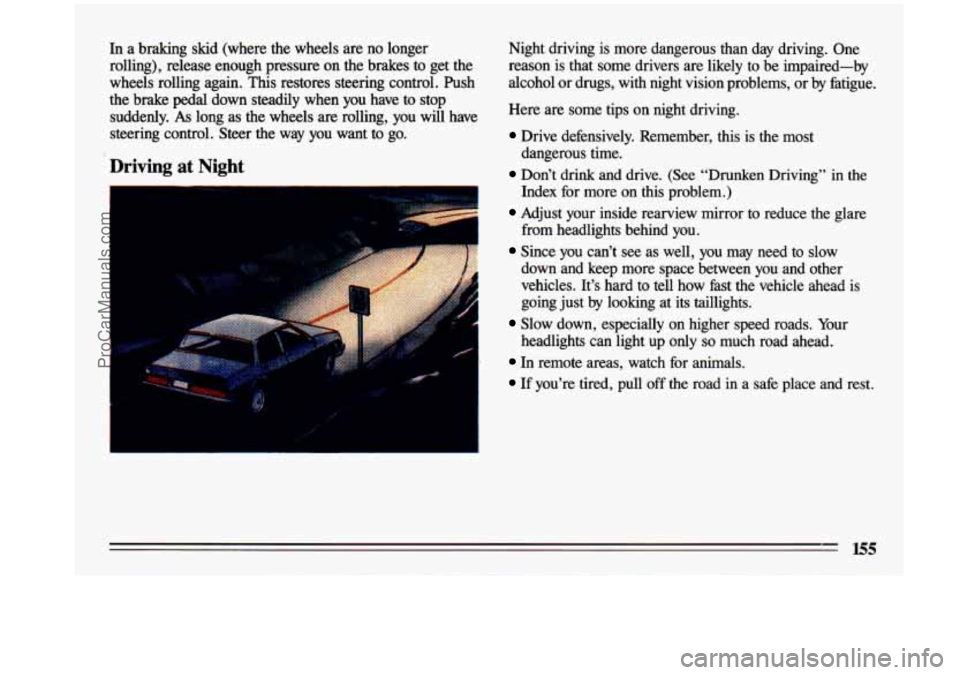
Drive defensively. Remember, this is the most
dangerous time.
Don’t drink and drive. (See “Drunken Driving” in the
Index for more on this problem.)
Adjust your inside rearview mirror to reduce the glare
from headlights behind you.
Since you can’t see as well, you may need to slow
down and keep more space between you and other
vehicles. It’s hard to tell how fast the vehicle ahead is
going just by looking at its taillights.
Slow down, especially on higher speed roads. Your
headlights can light up only
so much road ahead.
In remote areas, watch for animals.
If you’re tired, pull off the road in a safe place and rest.
ProCarManuals.com
Page 161 of 324
Driving too fast through large water puddles or even
going through some car washes can cause problems, too.
The water may affect your brakes. Try to avoid puddles.
But if you can’t, try to slow down before you hit them.
A CAUTION:
Wet brakes can cause accidents. They-won’t
work well in
a quick stop and may cause
pulling to one side. Ybu could lose control
of
the vehicle.
After driving through a large puddle of water
or I car wash, apply your brake pedal lightly
until your
brakes work normally.
Hydroplaning
Hydroplaning is dangerous. So much water can build up
under your tires that they can actually ride on the water.
This can happen if the road is wet enough and you’re
going fast enough. When your vehicle
is hydroplaning, it
has
little or no contact with the road.
You might not be aware of hydroplaning. You could drive
along for some time without realizing your tires aren’t in
constant contact with the road. You could
find out the
hard way: when you have’to slow, turn, move out to
pass-or if you get hit
by a gust of wind. You could
suddenly find yourself out
of control.
Hydroplaning doesn’t happen at higher
speeds. But it can
if your tires haven’t much tread or
if the pressure in one
or
more is low. It can happen if a lot of water is standing
on the road.
If you can see reflections from trees,
telephone poles, or other vehicles, and raindrops
“dimple” the water’s surface, there could be
hydroplaning.
Hydroplaning usually happens at higher speeds. There
just isn’t a hard and
fast rule about hydroplaning. The
best advice is to slow down when it is raining, and be careful.
159
ProCarManuals.com
Page 167 of 324
Is your vehicle ready for a long trip? If you keep it
serviced and maintained, it’s ready to go. If it needs
service, have it done before starting out.
Of course, you’ll
find experienced and able service experts in Buick
dealerships
all across North America. They’ll be ready
and willing to help if you need it.
Here are some things you can check before
a trip:
Windshield Washer Fluid: Is the reservoir full? Are
all windows clean inside and outside?
Wiper Blades: Are they in good shape?
hel, Engine Oil, Other Fluids: Have you checked all
Lights: Are they all working? Are the lenses clean?
Tires: They are vitally important to a safe, trouble-free
trip.
Is the tread good enough for long-distance
driving? Are the tires all inflated to the recommended
pressure?
Weather Forecasts: What’s the weather outlook along
your route? Should you delay your trip a short time to
avoid a major storm system?
levels?
Maps: Do you have up-to-date maps?
On the Road
Unless you
are the only driver, it is good to share the
driving task with others. Limit
turns behind the wheel to
about
100 miles (160 km) or two hours at a sitting. Then,
either change drivers or stop for some refreshment like
coffee, tea or
sol3 drinks and some limbering up. But do
stop and move around. Eat lightly along the way. Heavier
meals tend
to make some people sleepy.
On two-lane highways or undivided multilane highways
that do not have controlled access, you’ll want to watch for some situations not usually found on freeways.
Examples are: stop signs and signals, shopping centers
with direct access to the highway, no passing zones and school zones, vehicles turning left and right
off the road,
pedestrians, cyclists, parked vehicles, and even animals.
Highway Hypnosis
Is there actually such a condition as “highway hypnosis”?
Or is it just plain falling asleep at the .wheel? Call it
highway hypnosis, lack of awareness, or whatever.
There is something about an easy stretch
of road with the
same scenery, along with the hum
of the tires on the
road, the drone
of the engine, and the rush of the wind
against the vehicle that can make you sleepy. Don’t let it \
happen to you!
If it does, your vehicle can leave the road
in
less than a second, and you could crash and be
injured.
165
ProCarManuals.com
Page 179 of 324
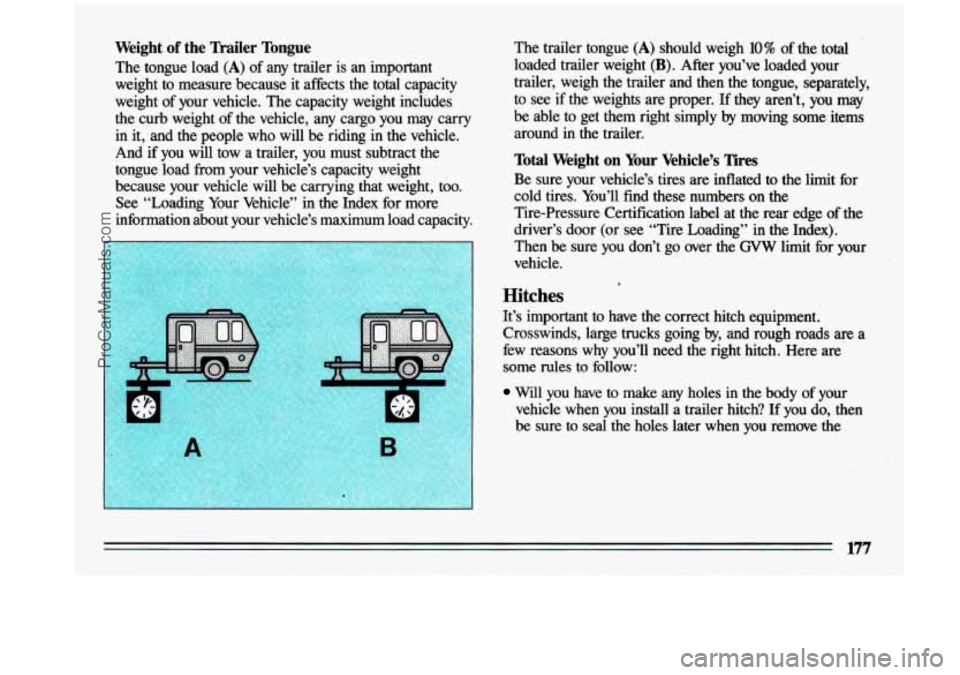
Weight of the Trailer Tongue
The tongue load (A) of any trailer is an important
weight to measure because it affects the total capacity
weight of your vehicle. The capacity weight includes
the curb weight
of the vehicle, any cargo you may carry
in it, and the people who will be riding in the vehicle.
And if you will tow a trailer, you must subtract the
tongue load from your vehicle’s capacity weight
because your vehicle will be carrying that weight, too. See “Loading Your Vehicle” in the Index for more
information about your vehicle’s maximum load capacity. The trailer tongue
(A) should weigh 10% of
the total
loaded trailer weight
(B). After you’ve loaded your
trailer, weigh the trailer and then the tongue, separately,
to see if the weights are proper.
If they aren’t, you may
be able to get them right simply by moving some items
around in the trailer.
Total Weight on Your Vehicle’s Tires
Be sure your vehicle’s tires are inflated to the limit for
cold tires. You’ll find these numbers on
the
Tire-Pressure Certification label at the rear edge of the
driver’s door (or see “Tire Loading” in the Index). Then be sure you don’t go over the
GVW limit for your
vehicle.
Hitches
It’s important to have the correct hitch equipment.
Crosswinds, large trucks going by,
and rough roads are a
few reasons why you’ll need the right hitch. Here are
some rules
to follow:
Will you have to make any holes in the body of your
vehicle when you install a trailer hitch?
If you do, then
be sure to seal the holes later when you remove the
177
ProCarManuals.com
Page 207 of 324
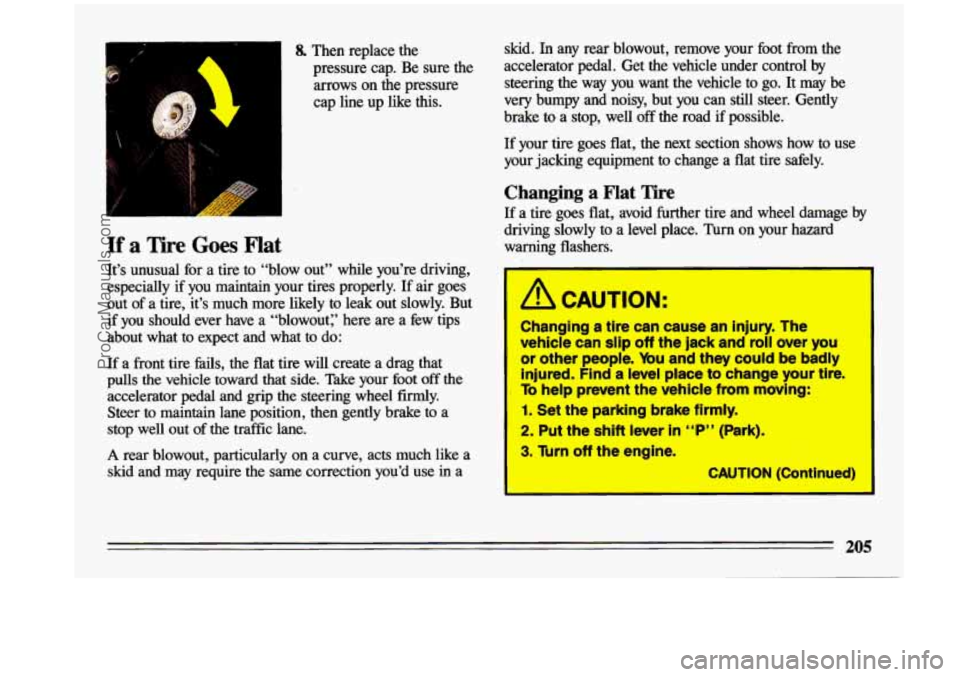
8. Then replace the pressure cap. Be sure
the
arrows on the pressure
cap line up like this.
If a Tire Goes Flat
It’s unusual for a tire to “blow out” while you’re driving,
especially if you maintain your tires properly. If air
goes
out of a tire, it’s much more likely to leak out slowly. But
if you should ever have a “blowout:’ here are a few tips
about what to expect and what to do:
If a front tire fails, the flat tire will create a drag that
pulls
the vehicle toward that side. Take your foot off the
accelerator pedal and grip
the steering wheel firmly.
Steer to maintain lane position, then gently brake to a
stop well out of the traffic lane.
A rear blowout, particularly on a curve, acts much like a
skid and may require the same correction you’d use in a skid.
In any rear blowout, remove your foot from the
accelerator pedal. Get the vehicle under control by
steering the way you want the vehicle
to go. It may be
very bumpy and noisy, but you can still steer. Gently brake
to a stop, well off the road if possible.
If your tire goes flat; the next section shows how to use
your jacking equipment to change a flat tire safely.
Changing a Flat Tire
If a tire goes flat, avoid further tire and wheel damage ~y
driving slowly to a level place. Turn on your hazard
warning flashers.
A CAUTION:
Changing a tire can cause an injury. The vehicle can slip
off the jack and roll over you
or other people. You and they could be badly injured. Find a level place to change your tire.
To help prevent the vehicle from moving:
1. Set the parking brake firmly.
2. Put the shift lever in “P” (Park).
3. Turn off the engine.
CAUTION (Continued)
205
ProCarManuals.com
Page 220 of 324
Compact Spare Tire
Although the compact spare was fully inflated when your
vehicle was new, it can lose air after a time.
Check the
inflation pressure regularly. It should be
60 psi
(420 Wa). The compact spare is made to go up to 3,000
miles (5 0o0 km), so you can finish your trip and have
your full-size tire repaired or replaced where you want.
Of course, it’s best to replace your spare with a full-size
tire as soon as you can. Your spare will last longer and be
in good shape in case you need
it again.
on’t take your compact spare th
utomatic car wash with guide
ompact spare can get caught damage the tire and whe
her parts
of your vehicle.
Don’t use your compact spare on some other vehicle.
And don’t
mix your compact spare or wheel with other
wheels or tires. They won’t
fit. Keep your spare and its
wheel together.
s too. Don’t us
ProCarManuals.com
Page 251 of 324
Windshield Wiper Blade Replacement
-1
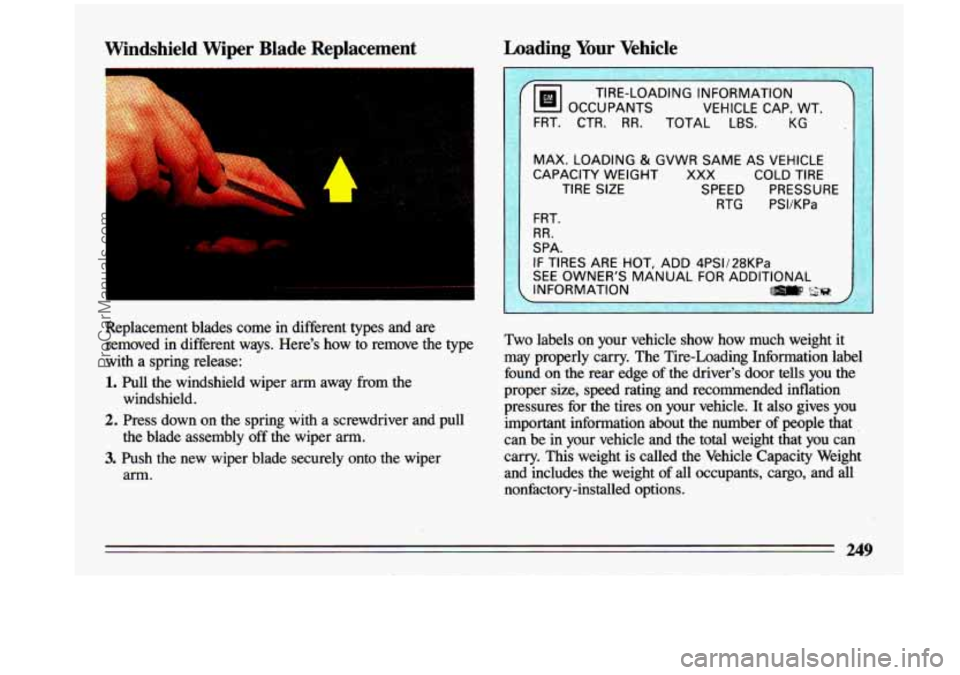
Replacement blades come in different types and are
removed in different ways. Here’s how to remove the type
with a spring release:
1. Pull the windshield wiper arm away from the
2. Press down on the spring with a screwdriver and pull
3. Push the new wiper blade securely onto tL wiper
windshield.
the blade assembly off the wiper
arm.
arm.
Loading Your Vehicle
G INFORMATION
VEHICLE CAP. WT.
FRT. CTR.
RR. TOTAL LBS. KG
MAX. LOADING
& GVWR SAME AS VEHICLE
1 CAPACITY WEIGHT XXX COLD TIRE
TIRE SIZE SPEED PRESSURE
RTG PSI/KPa
Two labels on your vehicle show how much weight it
may properly carry. The Tire-Loading Information label
found on the rear edge of the driver’s door tells you the
proper size, speed rating and recommended inflation
pressures for the tires on your vehicle. It also gives you
important information about the number of people that
,
can be in your vehicle and the total weight that you can
carry. This weight is called the Vehicle Capacity Weight
and includes the weight
of all occupants, cargo, and all
nonfactory-installed options.
249
ProCarManuals.com
Page 253 of 324
n
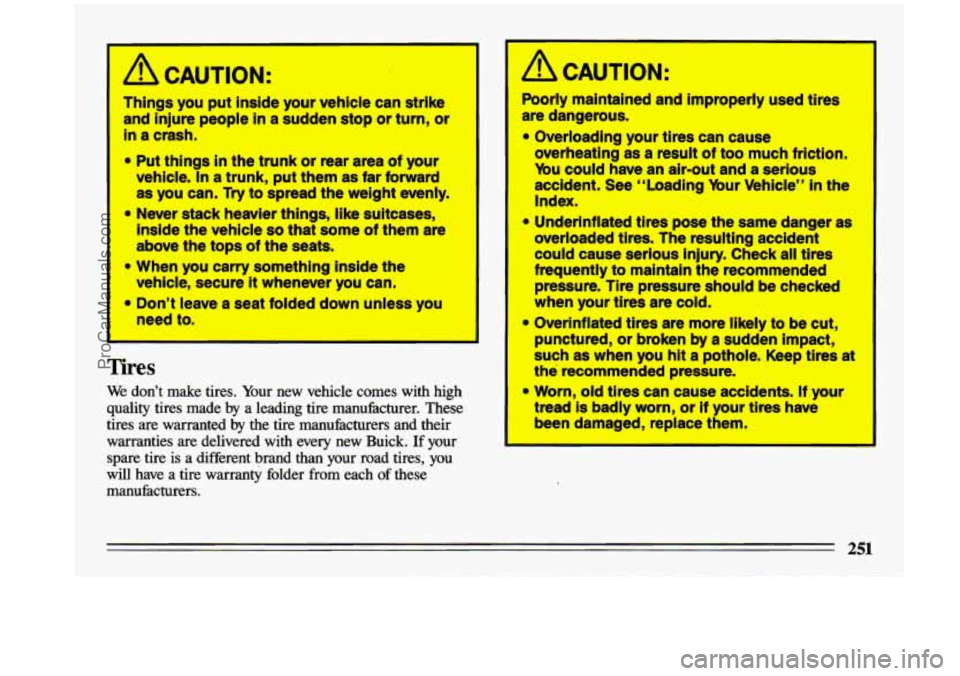
ACAUTION:
Things you put inside your vehicle can strike
and injure people
in a sudden stop or turn, or
In a crash.
* Put things In the trunk or rear area of your
vehicle. In
a trunk, put them as far forward
as you can. Try to spread the weight evenly.
* Never stack heavier things, IPke suitcases,
inside the vehicle
so that some of them are
above the tops
of the seats.
* When you carry something inside the
vehicle, secure
it whenever you can.
* Don’t leave a seat folded down unless you
need to.
Tires
We don’t make tires. Your new vehicle comes with high
quality tires made
by a leading tire manufacturer. These
tires are warranted by the tire manufacturers and their
warranties are delivered with every new Buick. If your spare tire is a different brand than your road tires, you
will have a tire warranty folder from each
of these
manufacturers.
A CAUTION:
Poorly maintained and improperly used tires
are dangerous.
0 Overloading your tires can cause
overheating as a ngsult
of too much friction.
Mu could
have an air-out and a serious
accident.
See “Loading bur Vehicle” in the
Index.
* Underlnflated tires pose the same danger as
overloaded tires. The resulting accident
could cause serious injury. Check
all tires
frequently to maintain the recornmended
pressure. Tire pressure should
be checked
when your tires are cold.
* Overinflated tires are more likely to be cut,
punctured, or broken
by a sudden Impact,
such as when you
hit a pothole. Keep tires at
the recommended pressure.
tread
Is badly worn, or If your tlps have
been damaged, replace them.
* Worn, old tires can cause accidents. If your
251
ProCarManuals.com
Page 254 of 324
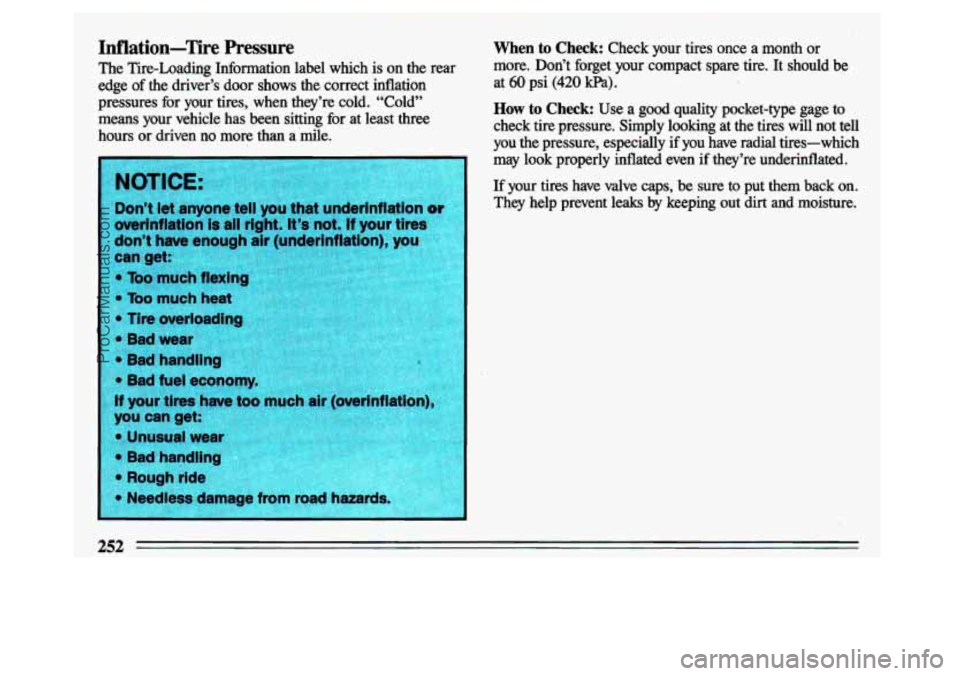
Inflation-Tire Pressure When to Check: Check your tires once a month’or
The Tire-Loading Inforlnation label which is on the rear
’ more. Don’t forget your compact spare tire. It should be
edge of the driver’s door shows
the correct inflation at 60 psi (420 kPa).
pressures for your tires, when they’re cold. “Cold”
means your vehicle has been sitting for at least
three
hours or driven no more than a ‘mile.
How to Check: Use a good quality pocket-type gage to
check tire pressure. Simply looking at the tires will not tell
you the pressure, especially if you have radial tires-which
may look properly inflated even if they’re underinflated.
If your tires have valve caps, be sure to put them back on. \
They help prevent
leaks by keeping out dirt and moisture.
252
ProCarManuals.com