ignition BUICK CENTURY 1993 Owner's Guide
[x] Cancel search | Manufacturer: BUICK, Model Year: 1993, Model line: CENTURY, Model: BUICK CENTURY 1993Pages: 324, PDF Size: 17.58 MB
Page 131 of 324
Disabling the Anti-Theft System:
1. Press the 1 and 4 buttons together for five seconds
with ignition on and radio power off. The display will
show
SEC, indicating the unit is in the secure mode.
2. Press the SET button. The display will show 0o0.
3. Enter the first three digits of the code following step 6
of the preceding paragraphs. The display will show the
numbers as entered.
4. Press the lower (BAND) knob. The radio will display
OOO.
5. Enter the second three digits of the code. The display
will show the numbers as entered.
6. Press the lower (BAND) knob. If the display shows
‘‘- - - ,” the disabling sequence was successful (the
numbers matched the user-selected code or the factory
back-up code) and the unit is in the
UNSECURED
mode. If the display shows SEC, the disabling
sequence was unsuccessful and the numbers did not
match either. of the codes and the unit will remain in
the
SECURED mode.
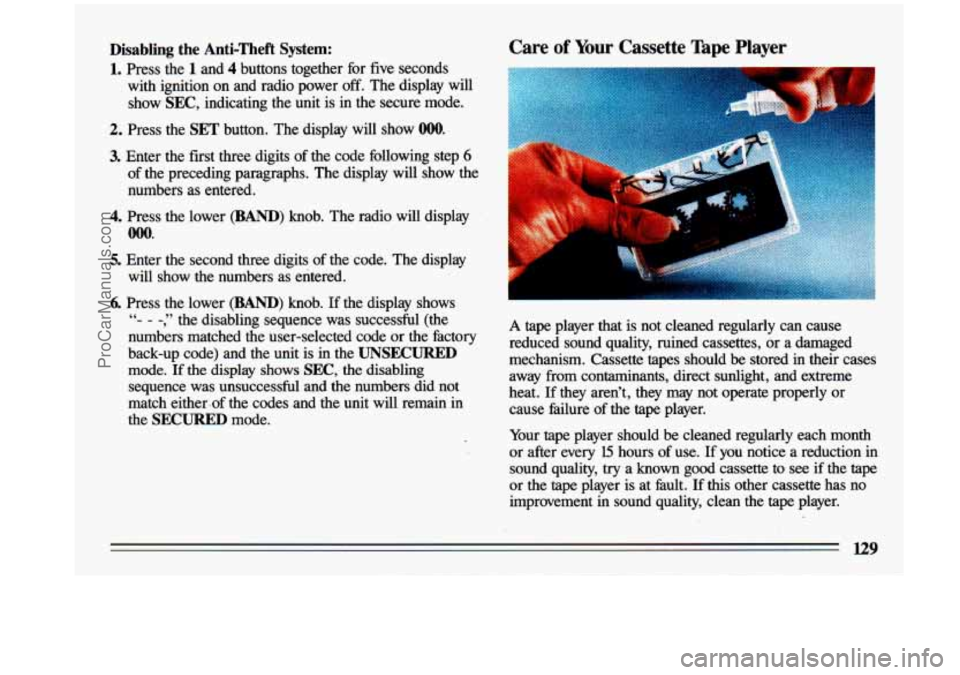
Care of Your Cassette Tape Player
A tape player that is not cleaned regularly can cause
reduced sound quality, ruined cassettes, or a damaged
mechanism. Cassette tapes should be stored
in their cases
away from contaminants, direct sunlight, and extreme
heat. If they aren’t, they may not operate properly or
cause failure
of the tape player.
Your tape player should be cleaned regularly each month or after every
15 hours of use. If you notice a reduction in
sound quality,
try a known good cassette to see if the tape
or the tape player is at fault. If this other cassette has n\
o
improvement in sound quality, clean the tape player.
1 /.Y
ProCarManuals.com
Page 133 of 324
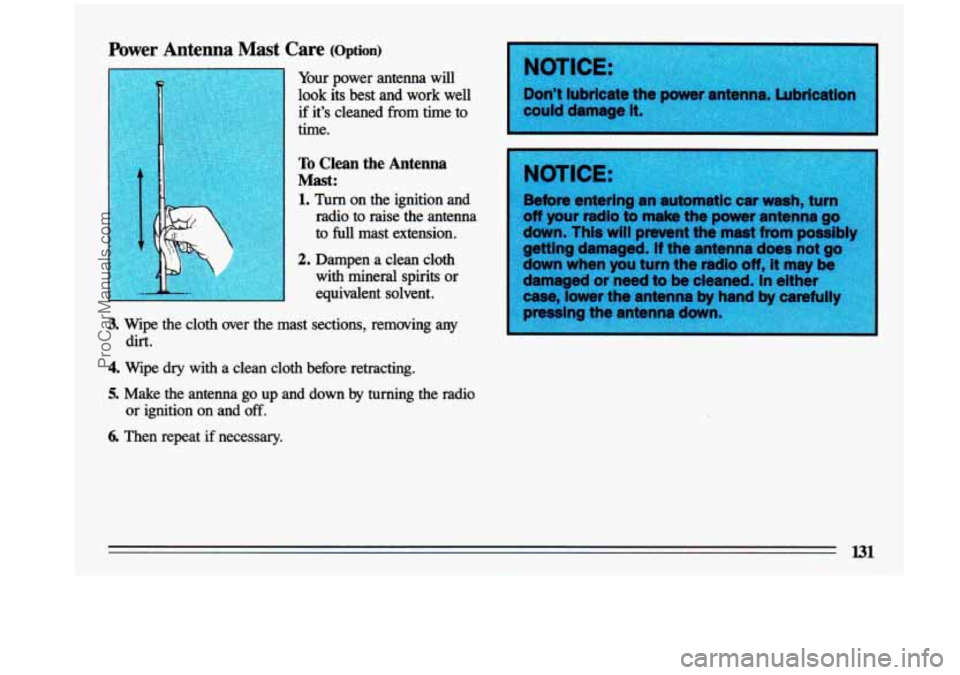
Power Antenna Mast Care (Option)
Your power antenna will
look its best and work well
if it’s cleaned from time to
time.
To Clean the Antenna
Mast:
1. Turn on the ignition and
radio to raise the antenna
to
full mast extension.
2. Dampen a clean cloth
with mineral spirits or
equivalent solvent.
3. Wipe the cloth over the mast sections, removing any
dirt.
4. Wipe dry with a clean cloth before retracting.
5. Make the antenna go up and down by turning the radio
or ignition
on and off.
r could damage i
6. Then repeat if necessary.
l31
ProCarManuals.com
Page 169 of 324
Know how to go down hills. The most important thing
to know is this: let your engine do some of the slowing
down. Don’t make your brakes do
it all. Shift to a
lower gear when you go down a steep or long hill.
That way, you will slow down without excessive use
of
your brakes.
I A CAUTION:
If you don’t shift down, your brakes could get
so hot that they wouldn’t work well. You would
then have poor braking or even none going
down
a hill. You could crash. Shift down to let
your engine assist your brakes on a steep
downhil lope.
Coasting downhill in
“N” (Neutral) or with the
ignition off is dangerous. Your brakes will have
to do
all the work of slowing down. They could
get
so hot that they wouldn’t work well. You
could crash. Always have your engine running
and your vehicle in gear when you go
downhill.
Know how to go uphill. You may want to shift down to
a lower gear. The lower gears help cool your engine
and transaxle, and you can climb the
hill better.
Stay in your own lane when driving on two-lane roads
in hills or mountains. Don’t swing wide or cut across
the center
of the road. Drive at speeds that let you stay
in your own lane. That way, you won’t be surprised by
a vehicle coming toward you in the same lane.
going uphill. You’ll want to leave extra
room to pass. If
a vehicle is passing you and doesn’t have enough room,
slow down to
make it easier for the other vehicle to get by.
be something in your lane, like a stalled car or an
accident.
It takes longer to pass another vehicle when you’re
As you go over the top of a hill, be alert. There could
You may see highway signs on mountains that warn of
special problems. Examples are long grades, passing or
no-passing zones, a Ming rocks area, or winding
roads. Be alert to these and
take appropriate action.
Winter driving can present special problems. See
“Winter Driving” in the Index.
167
ProCarManuals.com
Page 193 of 324
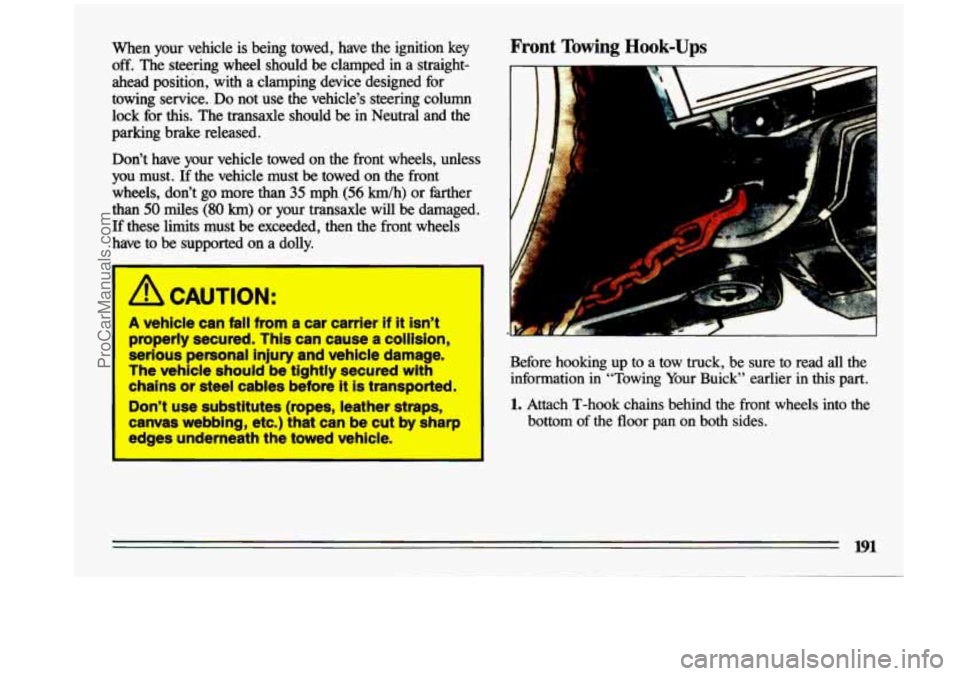
when your vehicle is being towed, have the ignition key Front Towing Hook-Ups
off. The steering wheel should be clamped in a straight-
ahead position, with a clamping device designed for
towing service.
Do not use the vehicle’s steering column
lock for
this. The transaxle should be in Neutral and the
parking brake released.
I
Don’t have your vehicle towed on the front wheels, unless
you must. If the vehicle must be towed on the front
wheels, don’t go more than
35 mph (56 km/h) or farther
than
50 miles (80 km) or your transaxle will be damaged.
If these limits must be exceeded, then the front wheels
have
to be supported on a dolly.
1
I
&!, CAUTION:
A vehicle can fall from a car carrier if It Isn’t
properly secured.
This can cause a colllsion,
serious personal injury and vehicle damage.
The vehicle should be tightly secured with Before hooking up to a tow truck, be sure to read all the
chains or steel cables before it is transported. information in “Towing Your Buick” earlier in this part.
Don’t use substitutes (ropes, leather straps, I
1. Attach T-hook chains behind the front wheels into the
canvas webbing, etc.) that can be cut by sharp bottom of the floor pan on both sides.
edges underneath the towed vehicle. I
191
ProCarManuals.com
Page 313 of 324
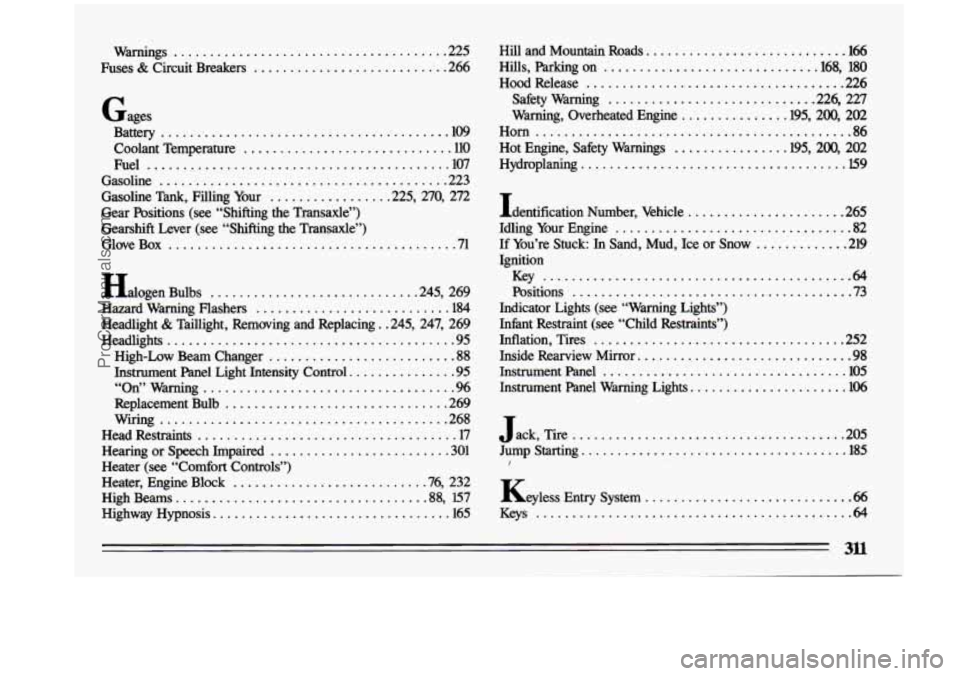
Warnings ...................................... 225
Fuses
& Circuit Breakers ........................... 266
Gages Battery
......................................... 109
Coolant Temperature
............................. 110
Fuel
.......................................... 107
Gasoline
........................................ 223
Gasoline Tank. Filling Your
................ .225. 270. 272
Gear Positions (see “Shifting the Transaxle”) Gearshift Lever
(see “Shifting the Transaxle”)
GloveBox
........................................ 71
Halogen Bulbs ............................ .245. 269
Hazard Warning Flashers
........................... 184
Headlight
& Taillight. Removing and Replacing . .245. 247. 269
Headlights
........................................ 95
High-Low Beam Changer
.......................... 88
Instrument Panel Light Intensity Control ............... 95
“0n”Warning
................................... 96
Replacement Bulb ............................... 269
Head Restraints
.................................... 17
Hearing or Speech Impaired
......................... 301
Heater (see “Comfort Controls”)
Heater, Engine Block
.......................... .76. 232
HighBeams
................................... 88, 157
Highway Hypnosis ................................. 165
Wiring
........................................ 268 HillandMountainRoads
............................ 166
Hills. Parking on ............................. .168. 180
Hood Release .................................... 226
Safety Warning
............................ .226. 227
Warning. Overheated Engine
.............. .195. 200. 202
Horn ............................................ 86
Hot Engine. Safety Warnings
............... .195. 200. 202
Hydroplaning ..................................... 159
Identification Number. Vehicle
...................... 265
Idling Your Engine
................................. 82
If You’re Stuck: In Sand. Mud. Ice or Snow ............. 219
Ignition Key
........................................... 64
Positions ....................................... 73
Indicator Lights
(see “Warning Lights”)
Infant Restraint (see “Child Restraints”)
Inflation. Tires
................................... 252
Inside Rearview Mirror
.............................. 98
Instrument Panel .................................. 105
Instrument Panel Warning Lights ...................... 106
...................................... J ack. Ti re 205
Jump Starting
..................................... 185
Keyless Entry System
............................. 66
I
Keys ............................................ 64
ProCarManuals.com