ignition BUICK CENTURY 1993 User Guide
[x] Cancel search | Manufacturer: BUICK, Model Year: 1993, Model line: CENTURY, Model: BUICK CENTURY 1993Pages: 324, PDF Size: 17.58 MB
Page 76 of 324
I I.
If your key &ems suwn in ‘‘Lu~n IU Y~U
can’t turn it, be sure it is all the way in. If it is,
then turn the steering wheel left and right
while you turn the key hard. But turn the key
only with your hand. Using
a tool to force it
could break the key or the ignition switch. If
none
of this works, then your vehicle needs
service.
I
Starting Your Engine
Engines start differently. The 8th digit of your Vehicle
Identification Number (VIN) shows the code letter or
number for your engine. You will find the VIN at the top
left of your instrument panel. (See “Vehicle Identification
Number” in the Index.) Follow the proper steps to
start
the engine.
Move your shift lever to
“P” (Park) or “N” (Neutral).
Your engine won’t
start in any other position-that’s a
safety feature.
To restart when you’re already moving,
use “N” (Neutral) only.
To start your 2.2L L4 (Code 4) engine:
1. Don’t push the accelerator pedal before starting your
engine. In some other vehicles you might need to do
this, but because
of your vehicle’s computer systems,
you don’t.
starts, let go of the key. The idle speed will go down
as your engine gets warm.
3. If it doesn’t start right away, push the accelerator pedal
about one-quarter of the way down while you turn the
key
to “Start;’ Do this until the engine starts. As soon
as it does, let go of the key and the accelerator pedal.
2. Turn your ignition key to “Start:’ When the engine
74
ProCarManuals.com
Page 77 of 324
4. If your engine still won’t start (or starts but then
stops), it could be flooded with too much gasoline.
Try pushing your accelerator pedal all the way to the
floor and holding it there as you hold the key in
“Start” for about three seconds. If the car starts
briefly but then stops again, do the same thing, but
this time keep the pedal down for five or six seconds.
This clears the extra gasoline from the engine.
To start your 3300 V6 (Code N) engine:
1. Don’t push the accelerator pedal before starting your
engine. In some other vehicles you might need to do
this, but because of yourwehicle’s computer systems,
you don’t.
starts, let go of the key. The idle
speed will go down
as your engine gets warm.
2. Turn your ignition key to “Start? When the engine
3. If it doesn’t start right away, push the accelerator pedal
about one-quarter of the way down while you turn the
key to “Start;’ Do
this until the engine starts. As soon
as it does, let go of the key and the accelerator pedal.
seconds-at a time will cause your battery to b
drained much sooner. And the excessive hea
can damage your starter motor,
4. If your engine still won’t start (or starts but then
stops), it could be flooded with too much gasoline.
Try pushing your accelerator pedal all the way to the
floor and holding it there as you hold the key in
“Start” for about
15 seconds. This clears the extra
gasoline from the engine. Turn the ignition
key to
“Off’ Wait 10 seconds, then repeat Step 3.
I
I
75
ProCarManuals.com
Page 82 of 324
Parking Brake
The parking brake uses the brakes on the rear wheels.
I
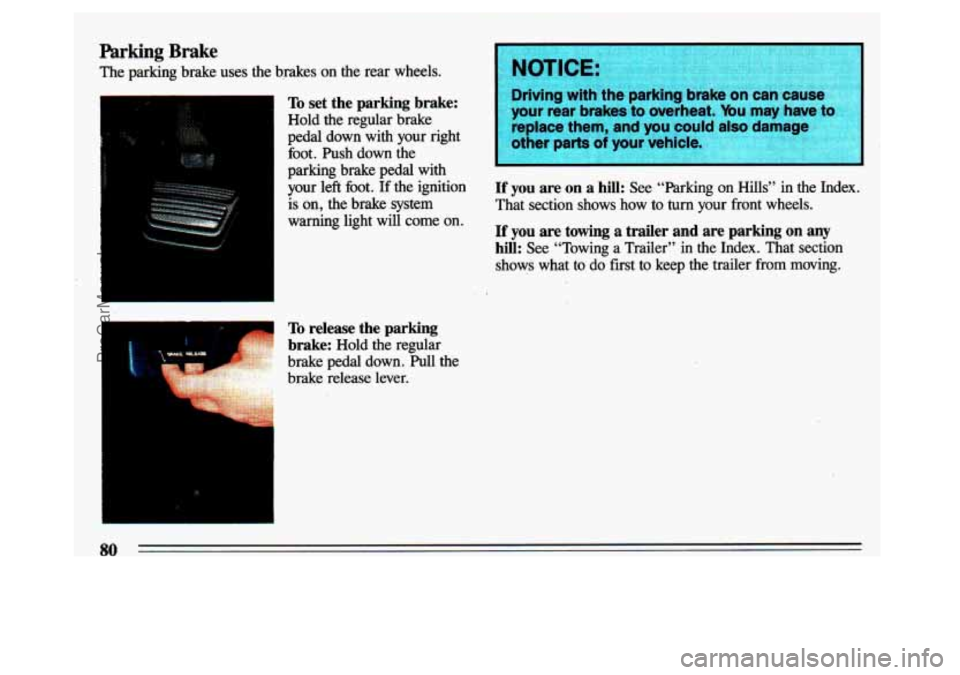
To set the parking brake:
Hold the regular brake
pedal down with your right
foot. Push down the
parking brake pedal with
your left foot.
If the ignition
is on, the brake system
I warning light will come on.
L
I
To release the parking
brake:
Hold the regular
brake pedal down. Pull the
brake release lever.
NOTICE:
Driving with thiparl ‘g brake or )use
your rear brakesto oveFheat. ybu may have
-
replace them, and you could alse damage
other parts
of your vehicle.
If you are on a hill: See “Parking on Hills” in the Index.
That section shows
how to turn your front wheels.
If you are towing a trailer and are parking on any
hill: See “Towing a Trailer” in the Index. That section
shows what to do first to keep the trailer from
moving.
80
ProCarManuals.com
Page 84 of 324
F- LA- 1
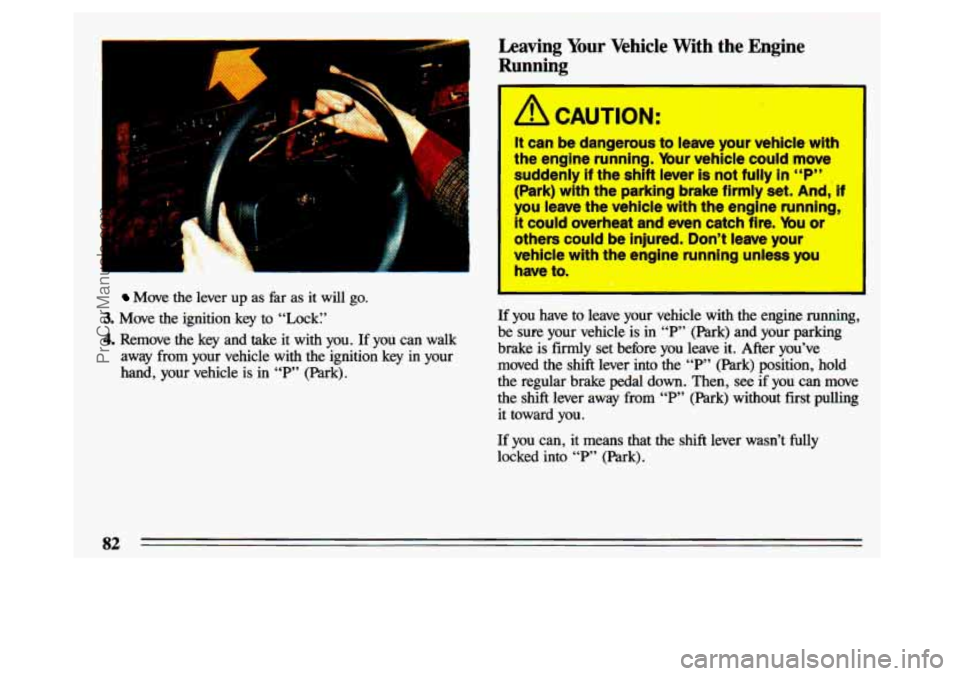
Move the lever up as far as it will go.
3. Move the ignition key to “Lock:’
4. Remove the key and take it with you. If you can walk
away from your vehicle with the ignition key in your
hand, your vehicle is
in “P” (Park).
Leaving Your Vehicle With the Engine
Running
It can be dangerous to leave your vehicle with
the engine running. Your vehicle could move
suddenly if the shift lever is not fully in
“P”
(Park) with the parking brake firmly set. And, if
you leave the vehicle with the engine running,
it could overheat and even catch fire. Ybu or
others could be injured. Don’t leave your
vehicle with the engine running unless you
have to.
If you have to leave your vehicle with the engine running,
be sure your vehicle
is in “P” (Park) and your parking
brake is firmly set before you leave it. After you’ve
moved the shift lever into
the “P” (Park) position, hold
the regular brake pedal down. Then, see if you can move
the shift lever away from
“P” (Park) without first pulling
it toward you.
If you can, it means that the shift lever wasn’t hlly
locked into
“P’ (Park).
82
ProCarManuals.com
Page 87 of 324
Power Windows (Option)
*.”
._
Flip-Open Rear Vent Windows (Option, Wagon)
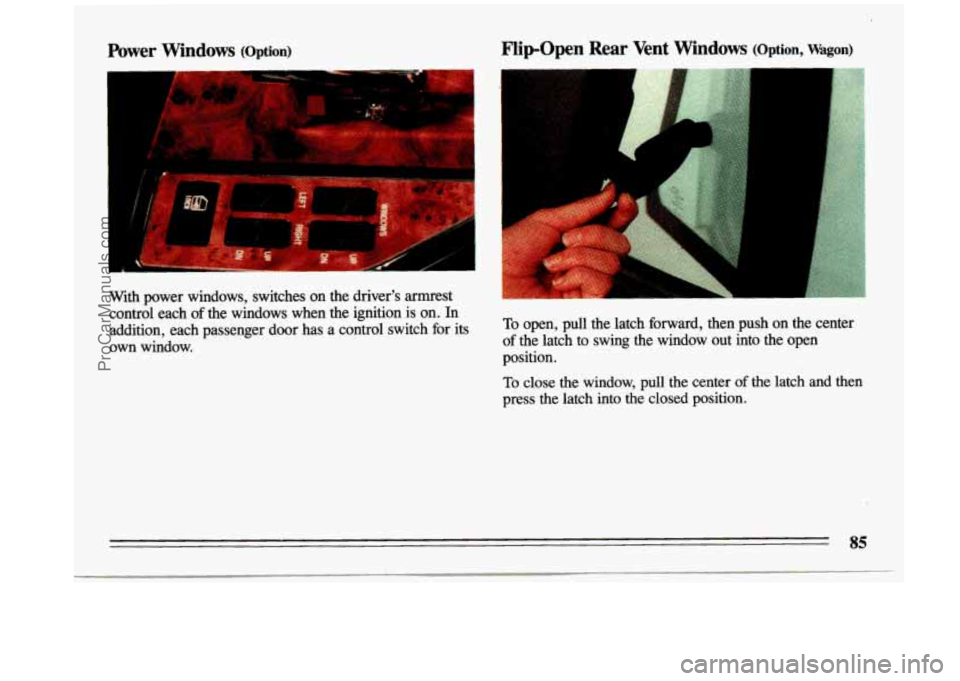
With power windows, switches on the driver’s armrest
control each
of the windows when the ignition is on. In
addition, each passenger door has a control switch for its
own window. To open, pull the latch forward, then push on the center
of the latch to swing the window out into the open
position.
To close the window, pull the center of the latch and then
press the latch into the closed position.
85
ProCarManuals.com
Page 96 of 324
Passing Another Vehicle While Using Cruise Control
Use the accelerator pedal to increase your speed. When
you take your foot
off the pedal, your vehicle will slow
down
to the Cruise Control speed you set earlier.
Using Cruise Control on Hills
How well your Cruise Control will work on hills
depends upon your speed, load, and the steepness
of the
hills. When going up steep hills, you may have
to step on
the accelerator
pedal to maintain your speed. When going
downhill, you may have to brake or shift
to a lower gear
to keep your speed down.
Of course, applying the brake
takes you out
of Cruise Control. Many drivers fmd this to
be too much trouble and don’t use Cruise Control on
steep hills.
To Get Out of Cruise Control
L
-.
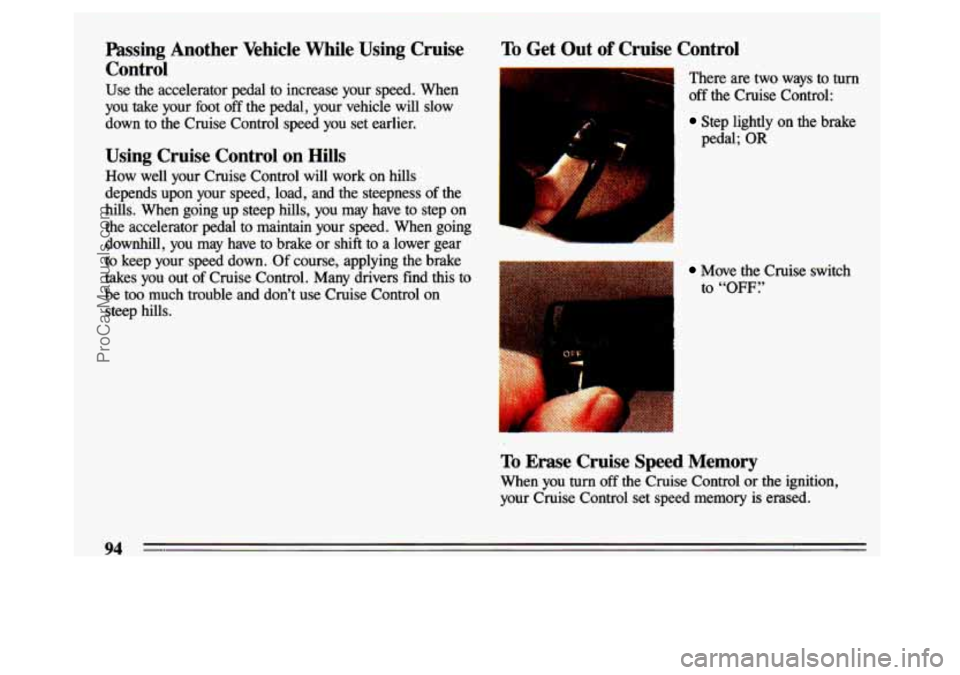
There are two ways to turn
off the Cruise Control:
Step lightly on the brake
pedal;
OR
Move the Cruise switch
to
“OFF?
To Erase Cruise Speed Memory
When you turn off the Cruise Control or the ignition,
your Cruise Control set speed memory is erased.
94
ProCarManuals.com
Page 98 of 324
Headlight “On” Warning
If you open the door while leaving the lights on, you will
hear a warning chime.
Daytime Running Lights (Canada Only)
The Canadian Federal Government has decided that “Daytime Running Lights” (DRL)
are a useful feature, in
that DIU can make your vehicle more visible to
pedestrians and other drivers during daylight hours. DRL
are required on new vehicles sold in Canada.
Your DRL work with a light sensor on top
of the
instrument panel. Don’t cover it up. The low beam
headlights will come on at reduced brightness
in daylight
when:
The ignition is on
The headlight switch is off, and
The parking brake is released.
At dusk, the exterior. lights will come bn &.nomatically
and the low
beams will change to full brightness. At
dawn, the exterior lights will go out and the low beams
will change to
the reduced brightness of DRL (if the
headlight switch is off).
Of course, you may still turn on the headlights any time
you need to.
To idle your vehicle with DRL off, set the parking brake
while the ignition is in the
“Off’ or “Lock” position.
Then start the vehicle. The
DRL will stay off until you
release the parking brake.
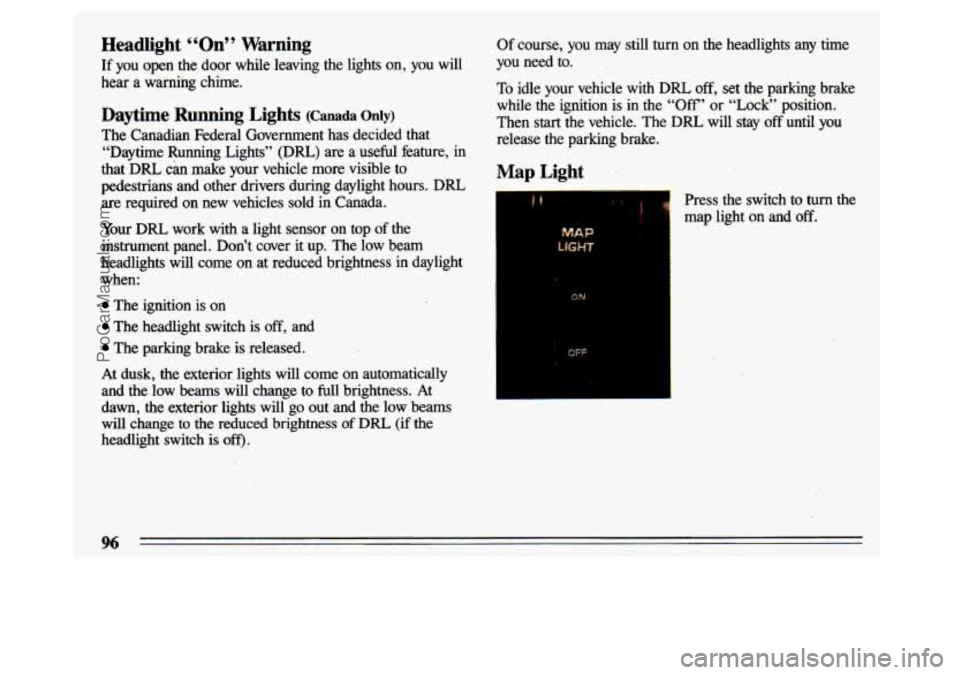
Map Light
& Press the switch to turn the
map light on and
off.
MAP
ON
OFF
96
ProCarManuals.com
Page 99 of 324
Front Seat Reading Lights (Option) Rear Reading Light (Wagon)
I
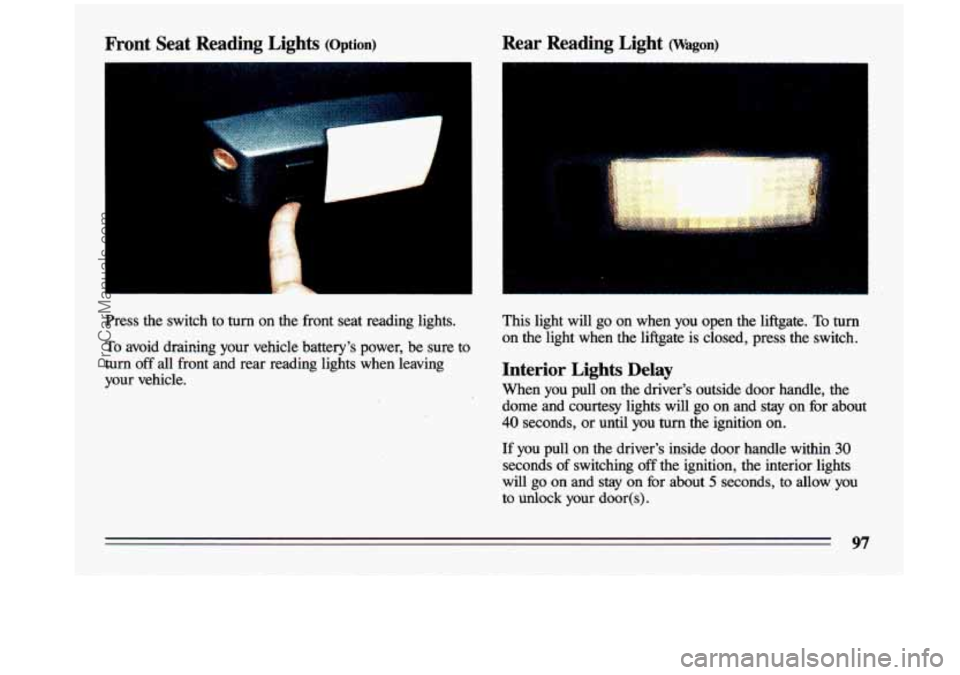
Press the switch to turn on the front seat reading lights.
To avoid drair.ing your vehicle battery's power,
be sure to
turn off all front and rear reading lights when leaving
your vehicle. This light will go
on when you open the liftgate. To turn
on
the light when the liftgate is closed, press the switch.
Interior Lights Delay
When you pull on the driver's outside door handle, the
dome and courtesy lights will go on and stay on for about
40 seconds, or until you turn the ignition on.
If you pull on the driver's inside door handle within 30
seconds of switching off the ignition, the interior lights
will go
on and stay on for about 5 seconds, to allow you
to unlock your door(s).
97
ProCarManuals.com
Page 108 of 324
Speedometer and Odometer
Your speedometer lets you see your speed in both miles per
hour (mph) and kilometers per hour (ludh). Your odometer
shows how
fkr your vehicle has been driven, in either
miles (used
in the U.S.) or kilometers (used in Canada).
Your Buick has a “tamper-resistant odometer? If you can
see silver lines between the numbers, probably someone
has
tried to turn it back. The numbers may not be true.
You
may wonder what happens if a vehicle has to have a
new odometer installed. If possible, the new one has to
be set to the same reading the old one had. If it can’t \
be,
then it’s set at zero, but a label on the driver’s door\
must show the old reading and when the new one was installed.
Trip Odometer
The trip odometer can tell
you how
far your vehicle
has been driven since you last set the trip odometer to
zero.
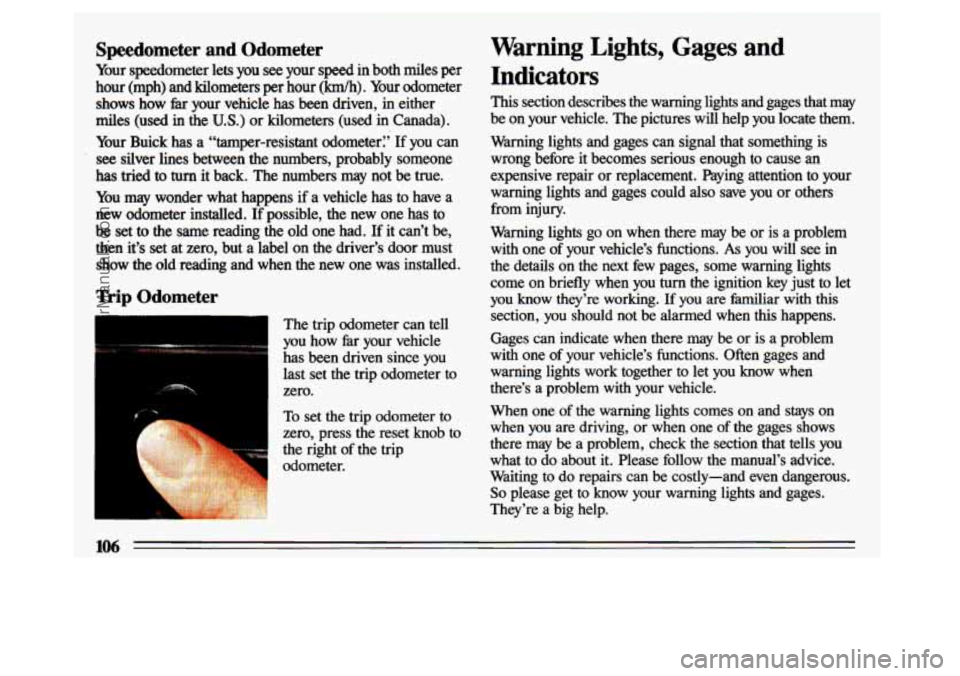
To set the trip odometer to
zero, press the reset knob to
the right of the trip
odometer.
Warning Lights, Gages and
Indicators
This section describes the warning lights and gages that may
be on your vehicle. The pictures will help you locate them.
Warning lights and gages can signal that something is
wrong before it becomes serious enough to cause an
expensive repair or replacement. Paying attention to your
warning lights and gages could
also save you or others
from injury.
Warning lights go on when there may be or is a problem
with one
of your vehicle’s functions. As you will see in
the details on the next few pages, some warning lights
come on briefly when you
turn the ignition key just to let
you know they’re working. If you are familiar with this
section, you should not be alarmed when this happens.
Gages can indicate when there may be or is a problem
with one of your vehicle’s functions. Often gages and
warning lights work together to let you know when
there’s a problem with your vehicle.
When one of the warning lights comes on and stays on
when you are driving, or when one of the gages shows
there may be a problem, check the section that tells you
what to do about it. Please follow the manual’s advice.
Waiting to do repairs can be costly-and even dangerous.
So please get to know your warning lights and gages.
They’re a big help.
ProCarManuals.com
Page 109 of 324
Fuel Gage
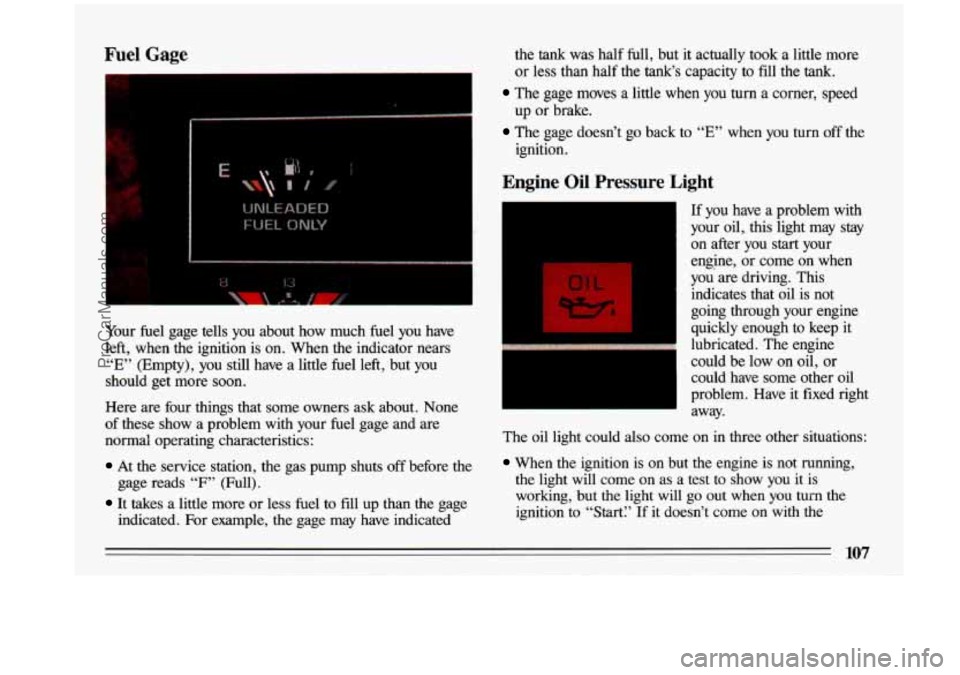
Your fuel gage tells you about how much fuel you have
left, when the ignition is on. When the indicator nears
“E” (Empty), you still have a little fuel left, but you
should get more
soon.
Here are four things that some owners ask about. None
of these show a problem with your fuel gage and are
normal operating characteristics:
At the service station, the gas pump shuts off before the
gage reads
“F” (Full).
It takes a little more or less fuel to fill up than the gage
indicated. For example, the gage may have indicated the tank was half
full, but it actually took
a little more
or less than half the
tank‘s capacity to fill the tank.
The gage moves a little when you turn a corner, speed
up or brake.
The gage doesn’t go back to “E” when you turn off the
ignition.
Engine Oil Pressure Light
If you have a problem with
your
oil, this light may stay
on after you start your
engine, or come on when
you are driving.
This
indicates that oil is not
going through your engine
quickly enough to keep it
lubricated. The engine could be low on oil, or
could have some other oil
problem. Have it fixed right
away.
The
oil light could also come on in three other situations:
When the ignition is on but the engine is not funning,
the light will come on as a test to show you it is
working, but the light will go out when
you turn the
ignition to “Start? If it doesn’t come on with the
107
ProCarManuals.com