lock BUICK CENTURY 1993 Service Manual
[x] Cancel search | Manufacturer: BUICK, Model Year: 1993, Model line: CENTURY, Model: BUICK CENTURY 1993Pages: 324, PDF Size: 17.58 MB
Page 158 of 324
Night Vision
No one can see as well at night as in the daytime, but as
we get older these differences increase. A 50-year-old
driver may require at least twice as much light to
see the
same thing at night as a 20-year-old.
What you do in the daytime can also afkct your night
vision. For example, if you spend the day in bright
sunshine you are wise to wear sunglasses. Your eyes will
have less trouble adjusting to night.
But if you’re driving, don’t wear sunglasses at night.
They may cut down on glare from headlights, but they
also make a lot of things invisible that should remain
visible-such as parked cars, obstacles, pedestrians, or
even trains blocking railway crossings. You may want to
put on your sunglasses after you have pulled into a
brightly-lighted service or refreshment area. Eyes
shielded from that glare may adjust more quickly to
darkness back on the road. But be sure to remove your
sunglasses before you leave the service area.
You can be temporarily blinded by approaching lights. It
can take
a second or two, or even several seconds, for
your eyes to readjust to the dark. When you
are hced
with severe glare (as from a driver who doesn’t lower the \
high beams, or a vehicle with
misaimed headlights) slow
down a little. Avoid staring directly into the approaching
lights. If there
is a line of opposing traffic, make
occasional glances over the line of headlights to make
certain that. one of the vehicles isn’t starting to move
into
your lane. Once you are past the bright lights, give your
eyes time to readjust before resuming
speed.
156
ProCarManuals.com
Page 172 of 324
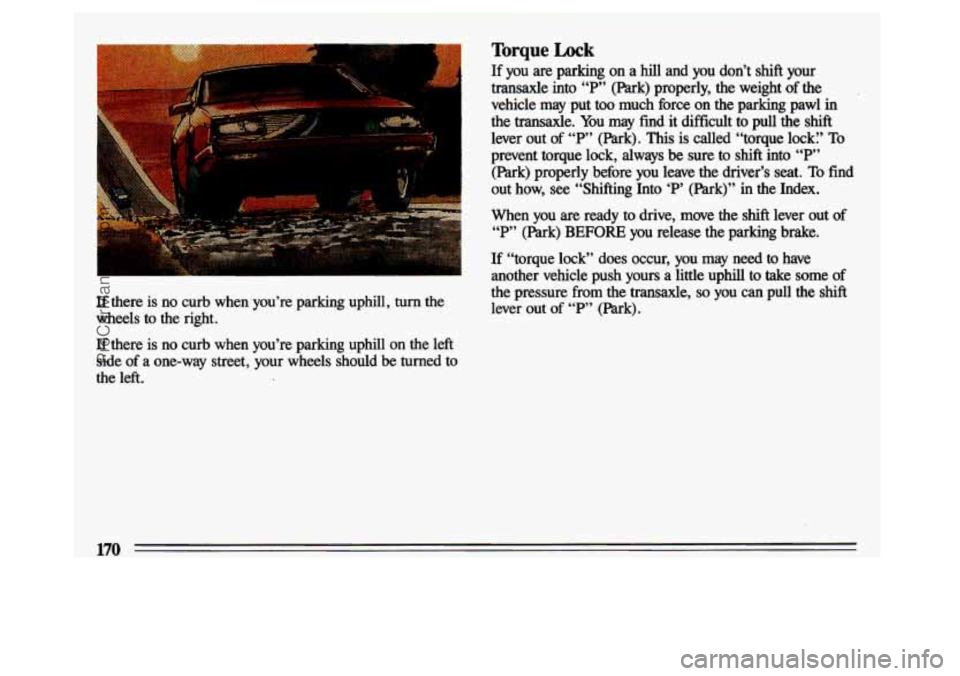
If there is no curb when you’re parking uphill, turn the
wheels to the right.
If there is no curb when you’re parking uphill on the left
side of
a one-way street, your wheels should be turned to
the left.
Torque Lock
If you are parking on a hill and you don’t shift your
transaxle into
“P” mk) properly, the weight of the
vehicle may put
too much force on the parking pawl in
the transaxle. You may find it difficult to pull the shift
lever out of “I”’ (Park). This is called “torque lock:’ To
prevent torque lock, always be sure to shift into “P”
(Park) properly before you leave the driver’s seat. To find
out how, see “Shifting Into ‘P’ (Park)” in the Index.
When you are ready
to drive, move the shift lever out of
“P” (Park) BEFORE you release the parking brake.
If “torque lock” does occur, you may need to have
another vehicle push yours a little uphill to take some of
the pressure from the transaxle,
so you can pull the shift
lever out of “P” (Park).
170
ProCarManuals.com
Page 175 of 324
If You’re Caught in a Blizzard
J 1
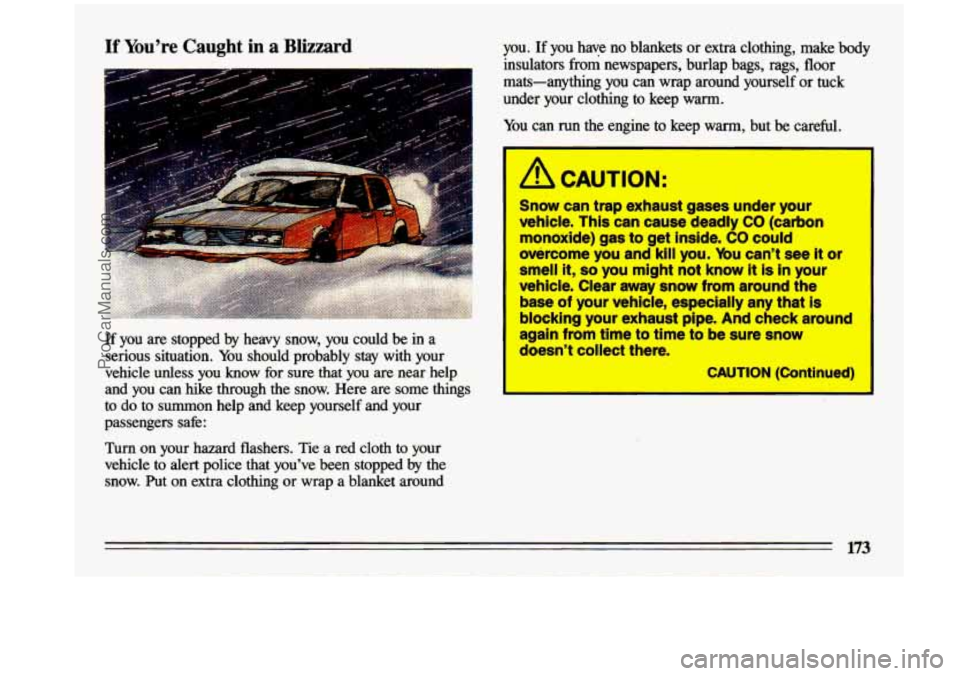
If you are stopped by heavy snow, you could be in a
serious situation. You should probably stay with your
vehicle unless you
know for sure that you are near help
and you can hike through the snow. Here are some things
to do to summon help and keep yourself and your passengers safe:
Turn on your hazard flashers. Tie a red cloth to your
vehicle to alert police that you’ve been stopped by the
snow.
Put on extra clothing or wrap a blanket around
you. If you have no blankets or extra clothing, make body
insulators from newspapers, burlap bags, rags,
floor
mats-anything you can wrap around yourself or tuck
under your clothing
to keep warm.
You can run the engine to keep
warm, but be careful.
I-
I A CAUTION:
Snow can trap exhaust gases under your
vehicle. This can cause deadly
CO (carbon
monoxide) gas
to get inside. CO could
overcome you and kill you. You can’t see
it or
smell it, so you might not know it is in your
vehicle. Clear away snow from around the
base
of your vehicle, especially any that is
blocking your exhaust pipe.
And check around
again from time to time to be sure snow
doesn’t collect there.
I CAUTION (Continued)
173
ProCarManuals.com
Page 193 of 324
when your vehicle is being towed, have the ignition key Front Towing Hook-Ups
off. The steering wheel should be clamped in a straight-
ahead position, with a clamping device designed for
towing service.
Do not use the vehicle’s steering column
lock for
this. The transaxle should be in Neutral and the
parking brake released.
I
Don’t have your vehicle towed on the front wheels, unless
you must. If the vehicle must be towed on the front
wheels, don’t go more than
35 mph (56 km/h) or farther
than
50 miles (80 km) or your transaxle will be damaged.
If these limits must be exceeded, then the front wheels
have
to be supported on a dolly.
1
I
&!, CAUTION:
A vehicle can fall from a car carrier if It Isn’t
properly secured.
This can cause a colllsion,
serious personal injury and vehicle damage.
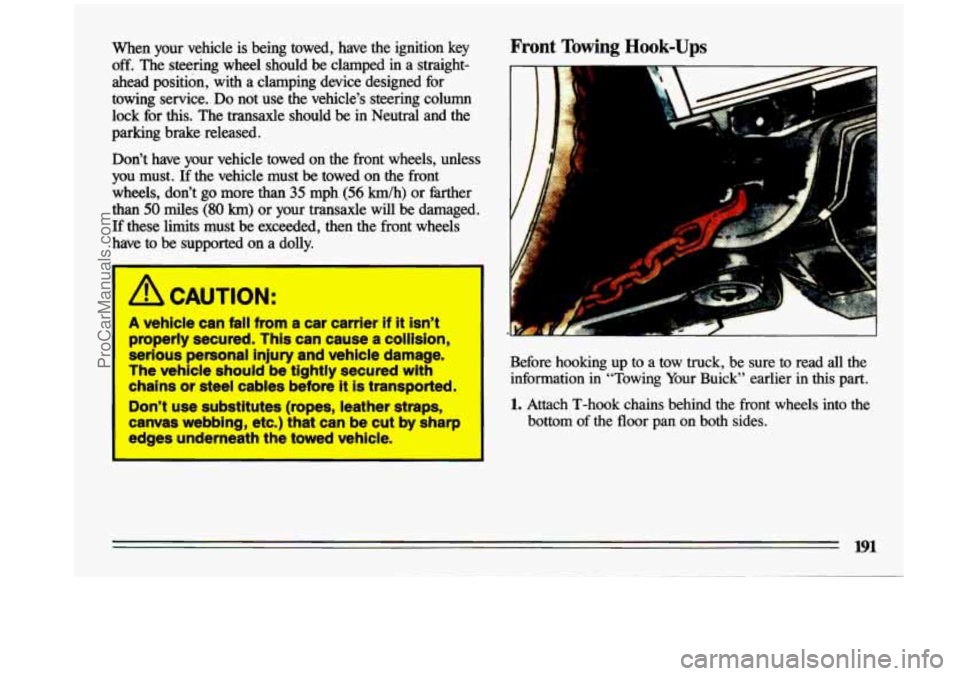
The vehicle should be tightly secured with Before hooking up to a tow truck, be sure to read all the
chains or steel cables before it is transported. information in “Towing Your Buick” earlier in this part.
Don’t use substitutes (ropes, leather straps, I
1. Attach T-hook chains behind the front wheels into the
canvas webbing, etc.) that can be cut by sharp bottom of the floor pan on both sides.
edges underneath the towed vehicle. I
191
ProCarManuals.com
Page 194 of 324
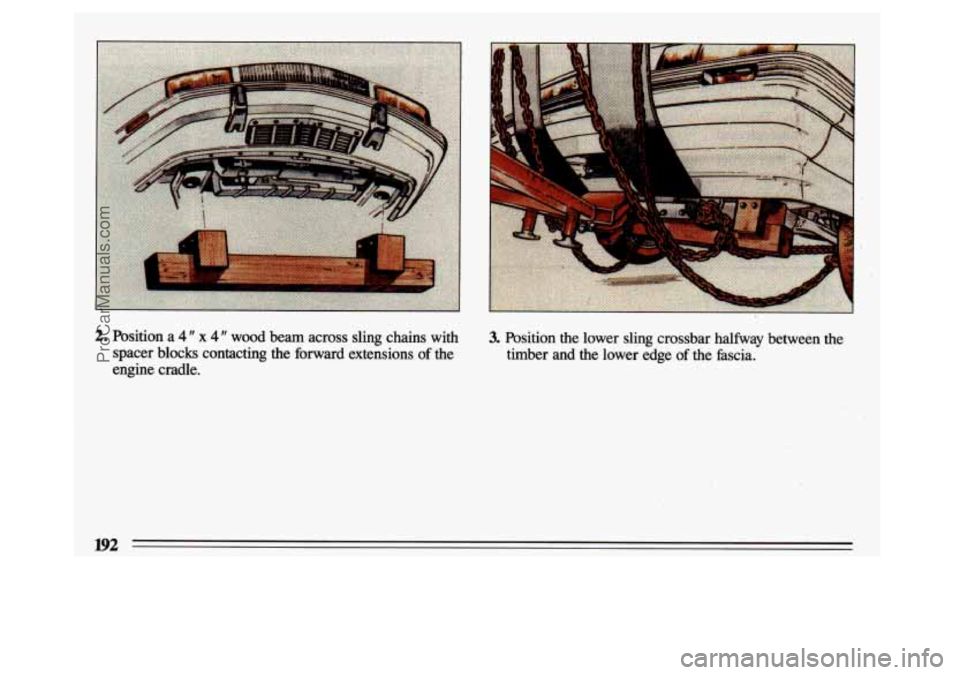
2. Position a 4 I' x 4 I' wood beam across sling chains with
spacer blocks contacting the forward extensions
of the
engine cradle.
3. Position the lower sling crossbar halfway between the
timber
and the lower edge of the fascia.
192
ProCarManuals.com
Page 208 of 324
CAUTION (Continued)
To be even more certain the vehicle won't
move, you can put chocks at the front and rear
of the tire farthest away from the one being
changed. That would be the tire on the other
side of the vehicle, at the opposite end.
I
The following steps will tell you how to use the jack and
change a tire.
Some steps apply to all models, others
to just the Century
coupe or sedan or to the Century wagon.
Follow the
steps listed for your vehicle.
Century Coupe or Sedan
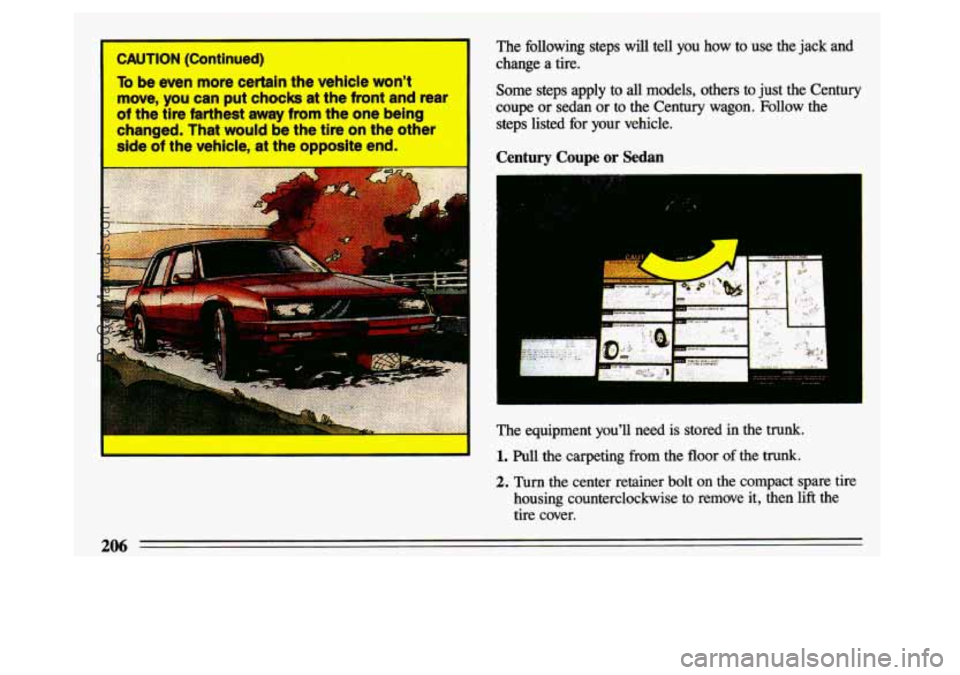
The equipment you'll need is stored in the trunk.
1. Pull the carpeting from the floor of the trunk.
2. Turn the center retainer bolt on the compact spare tire
housing counterclockwise to remove it, then lift the
tire cover.
206
ProCarManuals.com
Page 211 of 324
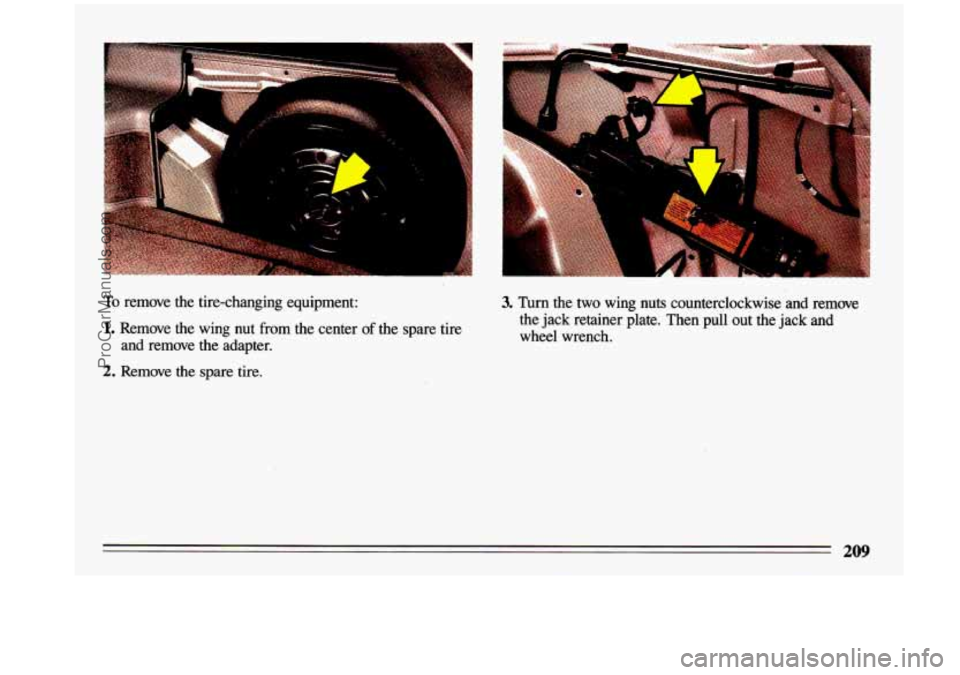
To remove the tire-changing equipment:
1. Remove the wing nut from the center of the spare tire
2. Remove the spare tire.
and remove the adapter.
3. Turn the two wing nuts counterclockwise and remove
the jack retainer plate. Then pull out the jack and
wheel wrench.
209
ProCarManuals.com
Page 214 of 324
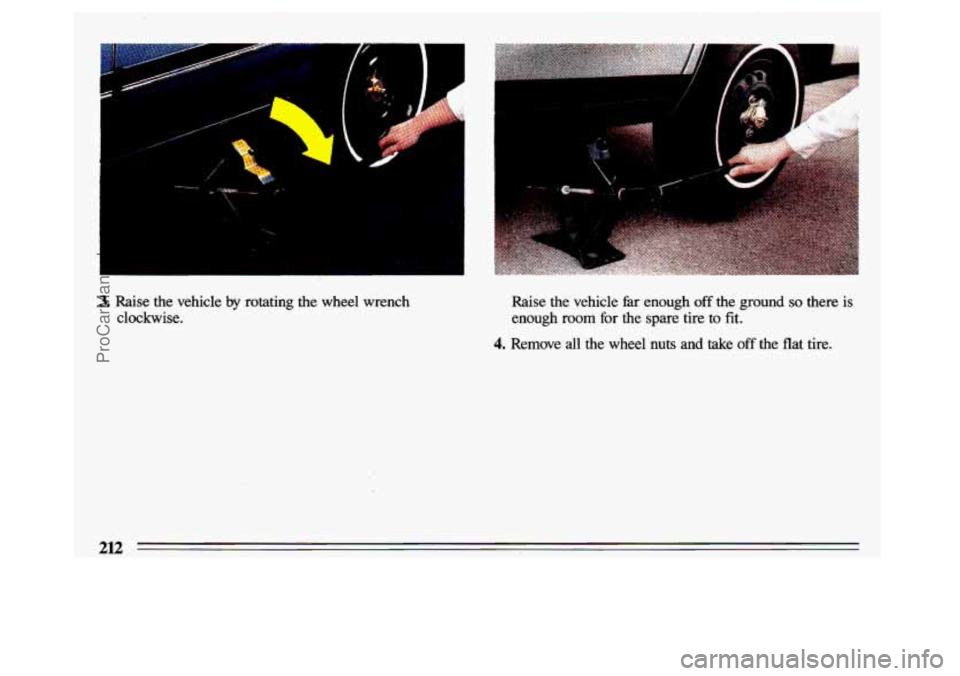
3. Raise the vehicle by rotating the wheel wrench
clockwise. Raise the
vehicle far enough off the ground so there is
enough
room for the spare tire to fit.
4. Remove all the wheel nuts and take off the flat tire.
2x2
ProCarManuals.com
Page 216 of 324
I A CAUTION:
Never use oil or grease on studs or nuts. If you
do, the nuts might come loose. Your wheel
could fall
off, causing a serious accident.
c
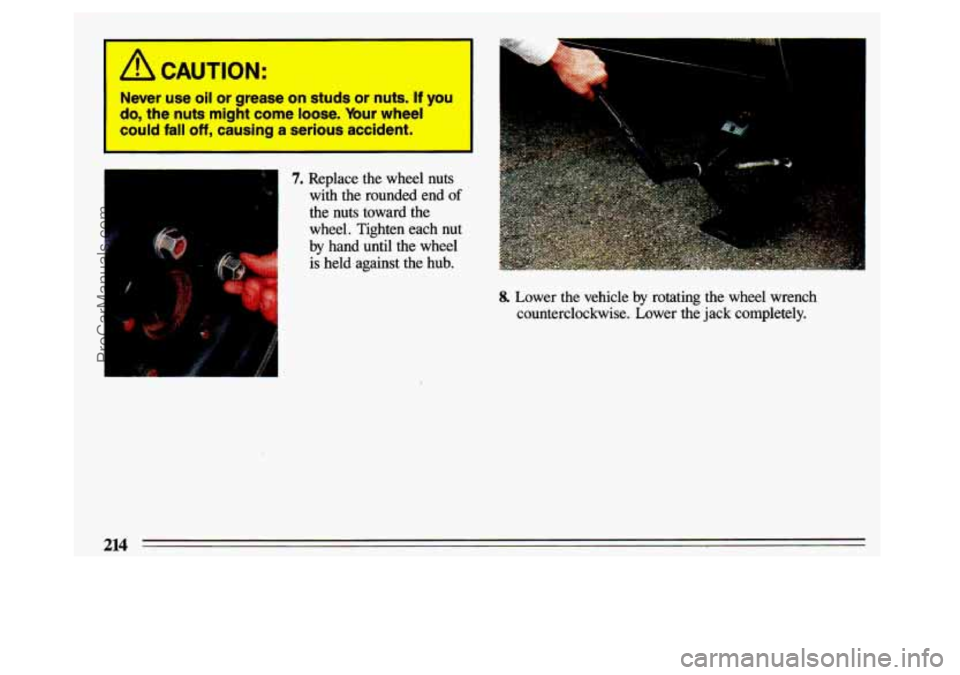
7. Replace the wheel nuts
with
the rounded end of
the nuts toward the
wheel. Tighten each nut
by hand until the wheel
is held against the hub.
m
8. Lower the vehicle by rotating the wheel wrench
counterclockwise. Lower the jack completely.
214
ProCarManuals.com
Page 227 of 324
Filling Your Tank
1
A CAUTION:
Gasoline vapor is highly flammable. It burns
violently, and that can cause very
bad injuries.
Don’t smoke
if you’re near gasoline or
refueling your vehicle. Keep sparks, flames,
and smoking materials away from gasoline.
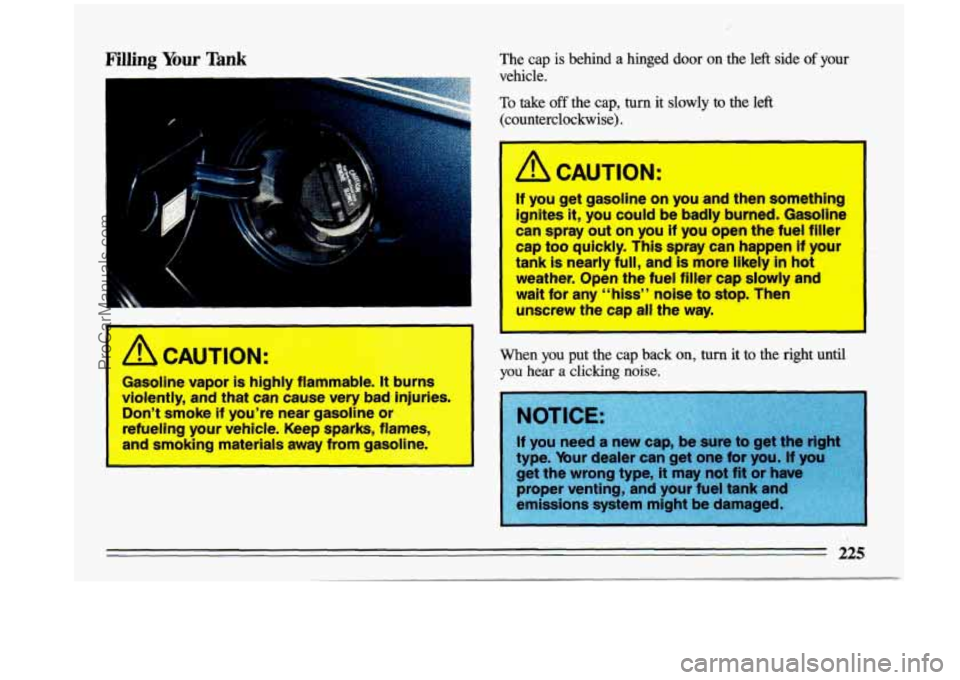
The cap is behind a hinged door on the left side of your
vehicle.
To take
off the cap, turn it slowly to the left
(counterclockwise).
If you get gasoline on you and then something
ignites
it, you could be badly burned. Gasoline
can spray out on you if you open the fuel filler
cap too quickly. This spray can happen if your
tank is nearly full, and is more likely
in hot
weather. Open the fuel filler cap slowly and
wait for any “hiss” noise to stop. Then
unscrew the cap
all the way.
When you put the cap back on, turn it to the right until
you hear a clicking
noise.
225
ProCarManuals.com