night vision BUICK CENTURY 1993 Owners Manual
[x] Cancel search | Manufacturer: BUICK, Model Year: 1993, Model line: CENTURY, Model: BUICK CENTURY 1993Pages: 324, PDF Size: 17.58 MB
Page 157 of 324
In a braking skid (where the wheels are no longer
rolling), release enough pressure on the brakes to get the
wheels rolling again.
This restores steering control. Push
the brake
pedal down steadily when you have to stop
suddenly.
As long as the wheels are rolling, you will have
steering control. Steer the way you want to go.
Driving at Night
Night driving is more dangerous than day driving. One
reason is that some drivers are likely to be impaired-by
alcohol or drugs, with night vision problems, or by fatigue.
Here are some tips on night driving.
Drive defensively. Remember, this is the most
dangerous time.
Don’t drink and drive. (See “Drunken Driving” in the
Index for more on this problem.)
Adjust your inside rearview mirror to reduce the glare
from headlights behind you.
Since you can’t see as well, you may need to slow
down and keep more space between you and other
vehicles. It’s hard to tell how fast the vehicle ahead is
going just by looking at its taillights.
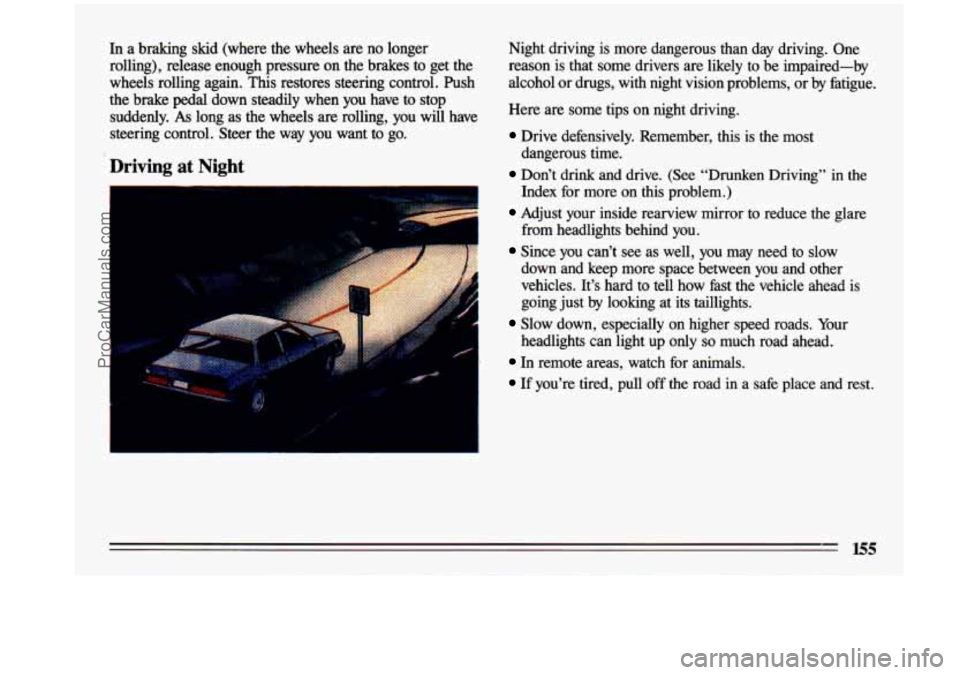
Slow down, especially on higher speed roads. Your
headlights can light up only
so much road ahead.
In remote areas, watch for animals.
If you’re tired, pull off the road in a safe place and rest.
ProCarManuals.com
Page 158 of 324
Night Vision
No one can see as well at night as in the daytime, but as
we get older these differences increase. A 50-year-old
driver may require at least twice as much light to
see the
same thing at night as a 20-year-old.
What you do in the daytime can also afkct your night
vision. For example, if you spend the day in bright
sunshine you are wise to wear sunglasses. Your eyes will
have less trouble adjusting to night.
But if you’re driving, don’t wear sunglasses at night.
They may cut down on glare from headlights, but they
also make a lot of things invisible that should remain
visible-such as parked cars, obstacles, pedestrians, or
even trains blocking railway crossings. You may want to
put on your sunglasses after you have pulled into a
brightly-lighted service or refreshment area. Eyes
shielded from that glare may adjust more quickly to
darkness back on the road. But be sure to remove your
sunglasses before you leave the service area.
You can be temporarily blinded by approaching lights. It
can take
a second or two, or even several seconds, for
your eyes to readjust to the dark. When you
are hced
with severe glare (as from a driver who doesn’t lower the \
high beams, or a vehicle with
misaimed headlights) slow
down a little. Avoid staring directly into the approaching
lights. If there
is a line of opposing traffic, make
occasional glances over the line of headlights to make
certain that. one of the vehicles isn’t starting to move
into
your lane. Once you are past the bright lights, give your
eyes time to readjust before resuming
speed.
156
ProCarManuals.com
Page 159 of 324
High Beams
If the vehicle approaching you has its high beams on,
signal by flicking yours to high and then back to low
beam. This is the usual signal to lower the headlight
beams. If the other driver still doesn’t lower the beams,
resist the temptation to put your high beams on. This
only makes two half-blinded drivers.
On a freeway, use your high beams
only in remote areas
where you won’t impair approaching drivers.
In some
places, like cities, using high beams is illegal.
When you follow another vehicle on a freeway or
highway, use low beams. True, most vehicles now have
day-night mirrors that enable the driver to reduce glare.
But outside mirrors are not
of this type and high beams
from behind can bother the driver ahead.
A Few More Night Driving Suggestions
Keep your windshield and all the glass on your vehicle
clean-inside and out. Glare at night is made much
worse by dirt on the glass. Even the inside of the glass
can build up
a fdm caused by dust. Tobacco smoke also
makes inside glass surfaces very filmy and can be a
vision hazard
if it’s left there.
Dirty glass makes lights dazzle and flash more than clean
glass would, making the pupils
of your eyes contract
repeatedly. You might even want to keep a cloth and
some glass cleaner in your vehicle if you need to clean
your glass frequently.
Remember that your headlights light up
fhr less of a
roadway when you are in a turn or curve.
Keep your eyes moving; that way, it’s easier to pick out
dimly lighted objects.
Just as your headlights should be checked regularly for
proper aim,
so should your eyes be examined regularly.
Some drivers suffer from night blindness-the inability to
see in dim light-and aren’t even aware of it.
ProCarManuals.com