oil level BUICK CENTURY 1993 Owners Manual
[x] Cancel search | Manufacturer: BUICK, Model Year: 1993, Model line: CENTURY, Model: BUICK CENTURY 1993Pages: 324, PDF Size: 17.58 MB
Page 79 of 324
NOTICE:
After you’ve
How long should you keep the block heater plugged in? The
answer depends on the weather, the kind of
oil you have,
and some other things. Instead of trying
to list everything
here, we ask that you contact a Buick dealer, in the area
where you’ll be parking your vehicle. The dealer can give
you the best advice for that particular area.
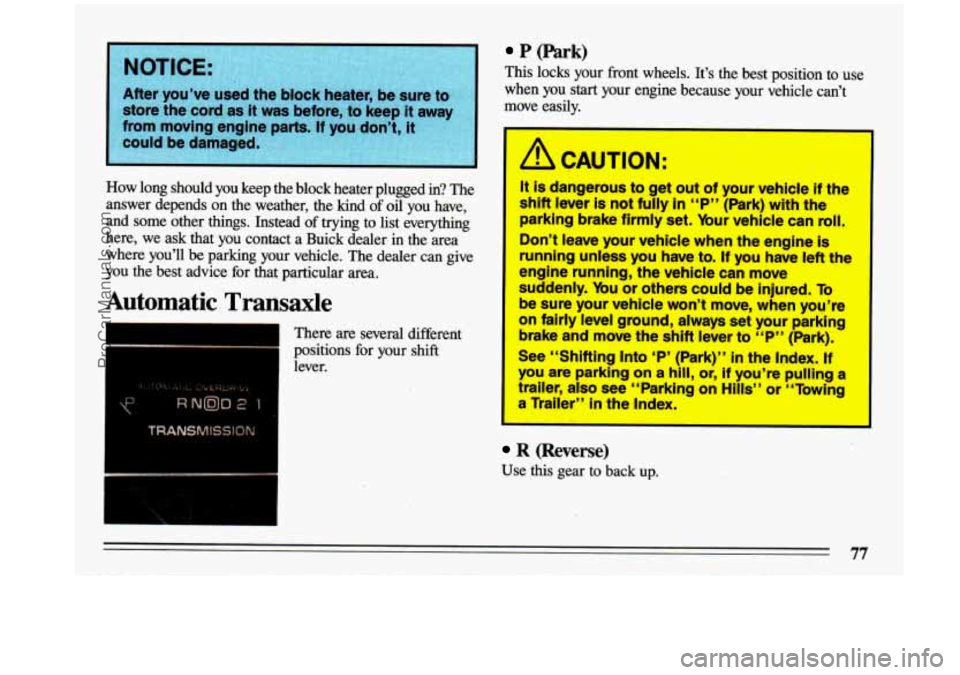
Automatic .Transaxle
There are several different
positions for your
shift
lever.
P (Park)
This locks your front wheels. It’s the best position to use\
when you
start your engine because your vehicle can’t
move easily.
I- -
I a CAUTION:
It is dangerous to get out of your vehicle if the
shift lever is
not fully in “P” (Park) with the
parking brake firmly set.
Your vehicle can roll.
Don’t leave your vehicle when the engine is
running unless you have to. If you have left the
engine running, the vehicle can move
suddenly. You
or others could be injured. To I
be sure your vehicle won’t move, when you’re
on fairly level
ground, always set your parking
brake and move the shift lever to “P” (Park).
See “Shifting
Into ‘P’ (Park)” in the Index. If
you are parking
on a hill, or, if you’re pulling a
trailer, also see “Parking
on Hills” or “Towing
a Trailer”
in the Index.
R (Reverse)
Use this gear to back up.
ProCarManuals.com
Page 167 of 324
Is your vehicle ready for a long trip? If you keep it
serviced and maintained, it’s ready to go. If it needs
service, have it done before starting out.
Of course, you’ll
find experienced and able service experts in Buick
dealerships
all across North America. They’ll be ready
and willing to help if you need it.
Here are some things you can check before
a trip:
Windshield Washer Fluid: Is the reservoir full? Are
all windows clean inside and outside?
Wiper Blades: Are they in good shape?
hel, Engine Oil, Other Fluids: Have you checked all
Lights: Are they all working? Are the lenses clean?
Tires: They are vitally important to a safe, trouble-free
trip.
Is the tread good enough for long-distance
driving? Are the tires all inflated to the recommended
pressure?
Weather Forecasts: What’s the weather outlook along
your route? Should you delay your trip a short time to
avoid a major storm system?
levels?
Maps: Do you have up-to-date maps?
On the Road
Unless you
are the only driver, it is good to share the
driving task with others. Limit
turns behind the wheel to
about
100 miles (160 km) or two hours at a sitting. Then,
either change drivers or stop for some refreshment like
coffee, tea or
sol3 drinks and some limbering up. But do
stop and move around. Eat lightly along the way. Heavier
meals tend
to make some people sleepy.
On two-lane highways or undivided multilane highways
that do not have controlled access, you’ll want to watch for some situations not usually found on freeways.
Examples are: stop signs and signals, shopping centers
with direct access to the highway, no passing zones and school zones, vehicles turning left and right
off the road,
pedestrians, cyclists, parked vehicles, and even animals.
Highway Hypnosis
Is there actually such a condition as “highway hypnosis”?
Or is it just plain falling asleep at the .wheel? Call it
highway hypnosis, lack of awareness, or whatever.
There is something about an easy stretch
of road with the
same scenery, along with the hum
of the tires on the
road, the drone
of the engine, and the rush of the wind
against the vehicle that can make you sleepy. Don’t let it \
happen to you!
If it does, your vehicle can leave the road
in
less than a second, and you could crash and be
injured.
165
ProCarManuals.com
Page 223 of 324
.
n
Part 6 Service and Appearance Care
. .
Here you will find information about the care of your Buick . This part begins with service and fuel information.
and then
it shows how to check important fluid and lubricant levels . There is also technical information about
your vehicle. and a section devoted to
its appearance care .
Part 6 includes:
Service ........................................................................\
..... 222
Fuel ........................................................................\
...... 223
HoodRelease ....................................................................... \
226
Engine Oil ........................................................................\
. 227
Aircleaner ........................................................................\
2.3
TransaxleFluid ..................................................................... 236
Enginecoolant ..................................................................... 239
Power Steering Fluid ................................................................. 241
Windshield Washer Fluid .............................................................. 242
Brakes ........................................................................\
.... 243
Battery ........................................................................\
.... 244
BulbReplacement ................................................................... 245
Tires ........................................................................\
...... 251
Loadingyourvehicle ................................................................. 249
Appearancecare .................................................................... 258
Vehicle Identification Number (VIN), Add-on Electrical Equipment ............................ 265
Capacities and Specifications .......................................................... -270
Fuses&CircuitBreakers .............................................................. 266
ReplacementBulbs .................................................................... 269
ProCarManuals.com
Page 226 of 324
Gasolines for Cleaner Air
Your use of gasoline with detergent additives will help
prevent deposits
from forming in your engine and fuel
system. That helps keep your engine in tune and your
emission control system working properly. It’s good for
your vehicle, and you’ll be doing your part for cleaner
air.
Many gasolines
are now blended with materials called
oxygenates. General Motors recommends that you use gasolines
with these blending materials, such as MTBE
and ethanol.
By doing so, you can help clean the air,
especially
in those parts of the country that have high
carbon monoxide levels.
In addition, some gasoline suppliers are now producing
reformulated gasolines. These gasolines are specially
designed to reduce vehicle emissions. General Motors recommends that you use reformulated gasoline. By
doing
so, you can help clean the air, especially in those
parts of the country that have high ozone levels.
You should ask your service station operators if their
gasolines contain detergents and oxygenates, and if they
have been reformulated to reduce vehicle emissions.
F’uels in Foreign Countries
If you plan on driving in another country outside the U.S.
or Canada, unleaded fuel may be hard to find.
Do not use leaded gasoline. If you use even one tankful,
your emission controls won’t work well or at
all. With
continuous use, spark plugs can get fouled, the exhaust
system can corrode, and your engine oil can deteriorate
quickly. Your vehicle’s oxygen sensor will be damaged.
All of that
means costly repairs that wouldn’t be covered
by your warranty.
To check on fuel availability, ask an auto club, or contact
a major oil company that does business in the country
where
you’ll be driving.
You
can also write us at the following address for advice.
Just tell us where you’re going and give your Vehicle Identification Number
(VIN) .
General Motors of Canada Ltd.
International Export Sales
P. 0. Box 828
Oshawa, Ontario L1H 7N1, Canada
I
224
ProCarManuals.com
Page 229 of 324
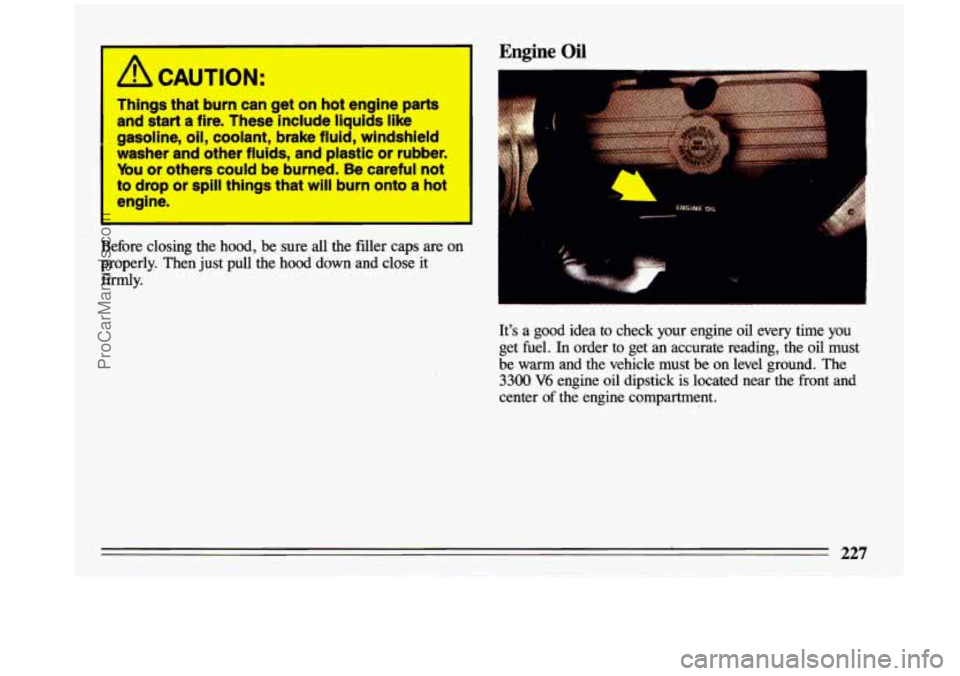
/i CAUTION:
Things that burn can get on hot engine parts
and start
a fire. These include liquids like
gasoline, oil, coolant, brake fluid, windshield
washer and other fluids, and plastic or rubber.
You or others could be burned. Be careful not
to drop
or spill things that will burn onto a hot
engine.
Before closing the hood, be sure all the filler caps are on
properly. Then just pull the hood down and close it
firmly.
Engine Oil
I‘
I
It’s a good idea to check your engine oil every time you
get fuel. In order to get an accurate reading, the oil must
be warm and the vehicle must be on level ground. The
3300 V6 engine oil dipstick is located near the front and
center
of the engine compartment.
ProCarManuals.com
Page 230 of 324
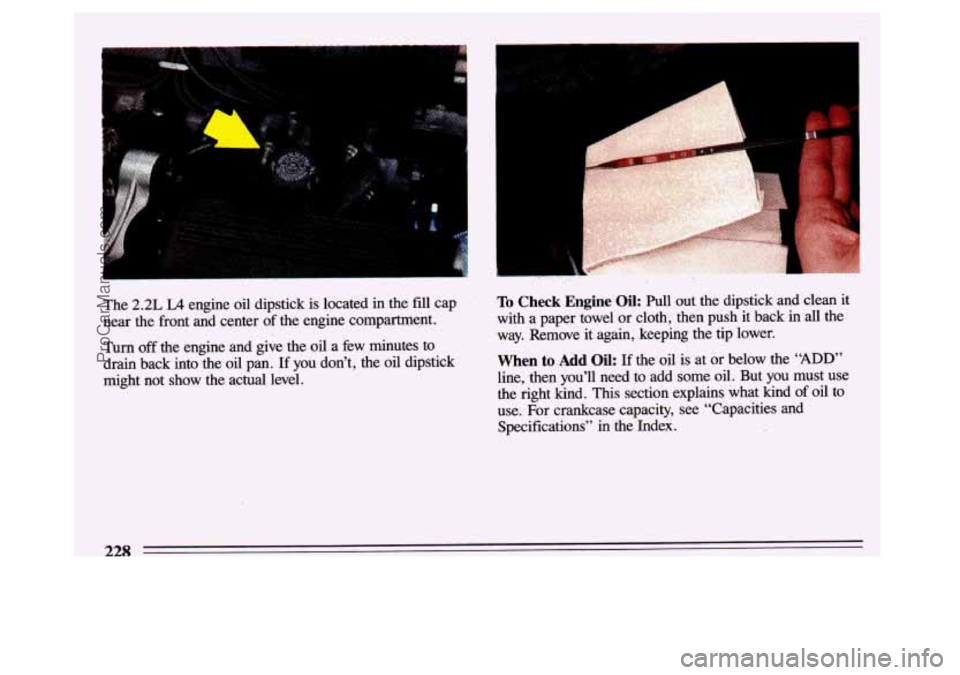
The 2.2L LA engine oil dipstick is located in the fill cap
near the front and center of the engine compartment.
Turn off the engine and give the oil a few minutes to
drain back into the oil pan.
If you don’t, the oil dipstick
might not show the actual level.
To Check Engine Oil: Pull out the dipstick and dean it
with a paper towel or cloth, then push it back in
all the
way. Remove it again, keeping the tip lower.
When to Add Oil: If the oil is at or below the “ADD”
line, then you’ll need to add some oil. But you must use
the right kind. This section explains what kind of
oil to
use. For crankcase capacity, see “Capacities and Specifications”
in the Index.
228 i
ProCarManuals.com
Page 231 of 324
Just fd it enough to put the level somewhere in the
proper operating range. Push the dipstick all the way
back in when you’re through.
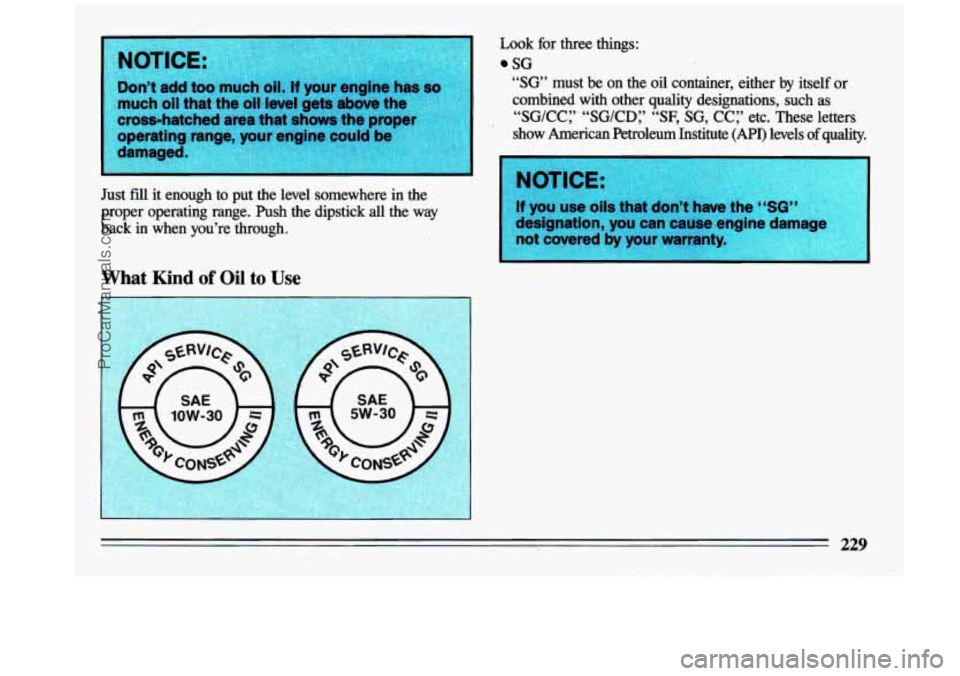
What Kind of Oil to Use
Look for three things:
SG
“SG”
must be on the oil container, either by itself or
combined with other quality designations, such as
“SG/CC:’ “SG/CD:’ “SF, SG, CC:’ etc. These letters
show American Petroleum Institute
(API) levels of quality.
229
ProCarManuals.com
Page 238 of 324
Automatic ‘mansaxle Fluid
When to Check and Change:
A good time to check your automatic transaxle fluid level
is when the engine oil is changed. Refer to the
Maintenance Schedule to determine when to change your
fluid. See “Scheduled Maintenance Services” in the
Index.
How to Check:
Because this operation can be a little difficult, you may
choose to have
this done at a Buick dealership Service
Department.
If you do it yourself, be sure to follow all the instructions
here, or you could get a false reading on the dipstick. Wait at least
30 minutes before checking the transaxle
fluid level
if you have been driving:
When outside temperatures are above 90°F (32°C).
At high speed for quite a while.
In heavy traffic-especially in hot weather.
While pulling a trailer.
To get the right reading, the fluid should be at normal
operating temperature, which is
180°F to 200” F (82” C to
93°C).
Get the vehicle warmed up by driving about 15 miles
(24 km) when outside temperatures are above 50°F
(10°C). If it’s colder than 50” F (lO°C), you may have to
drive longer.
To check the fluid level:
Park your vehicle on a level place.
0 Place the shift lever in “P” (Park) with the parking
brake applied.
With your foot on the brake pedal, move the. shift lever
through each gear range, pausing for about three
seconds in each range. Then, position the shift lever in
“P” (Park).
Let the engine run at idle for three to five minutes.
236
ProCarManuals.com
Page 277 of 324
I
I
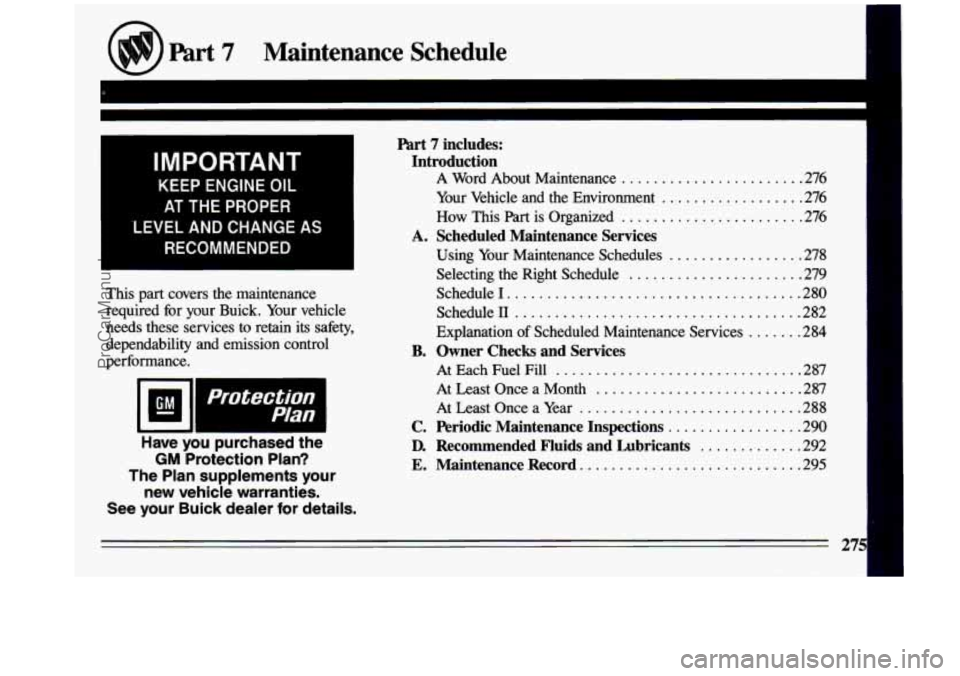
Part 7 Maintenance Schedule
IMPORTANT
KEEP ENGINE OIL
AT THE PROPER
'LEVEL AND CHANGE
AS
RECOMMENDED
This part covers the maintenance
required for your Buick. Your vehicle
needs these services to retain
its safety,
dependability and emission control
performance.
Have you purchased the
GM Protection Plan?
The Plan supplements your
new vehicle warranties.
See your Buick dealer
for details.
part 7 includes:
Introduction
A Word About Maintenance ...................... .276
Your Vehicle and the Environment ................. ,276
How This Part is Organized ...................... .276
A.. Scheduled Maintenance Services
Using Your Maintenance Schedules ................ .278
Selecting the Right Schedule ...................... ,279
Schedule1 ..................................... 280
Schedule I1 ................................... .282
Explanation of Scheduled Maintenance Services .... -284
At Each Fuel Fill .............................. .287
B. Owner Checks and Services
At Least Once a Month ......................... .287
At Least Once a Year ........................... .288
C. Periodic Maintenance Inspections ................ .290
D. Recommended Fluids and Lubricants ............ .292
E. Maintenance Record. .......................... .295
ProCarManuals.com
Page 289 of 324
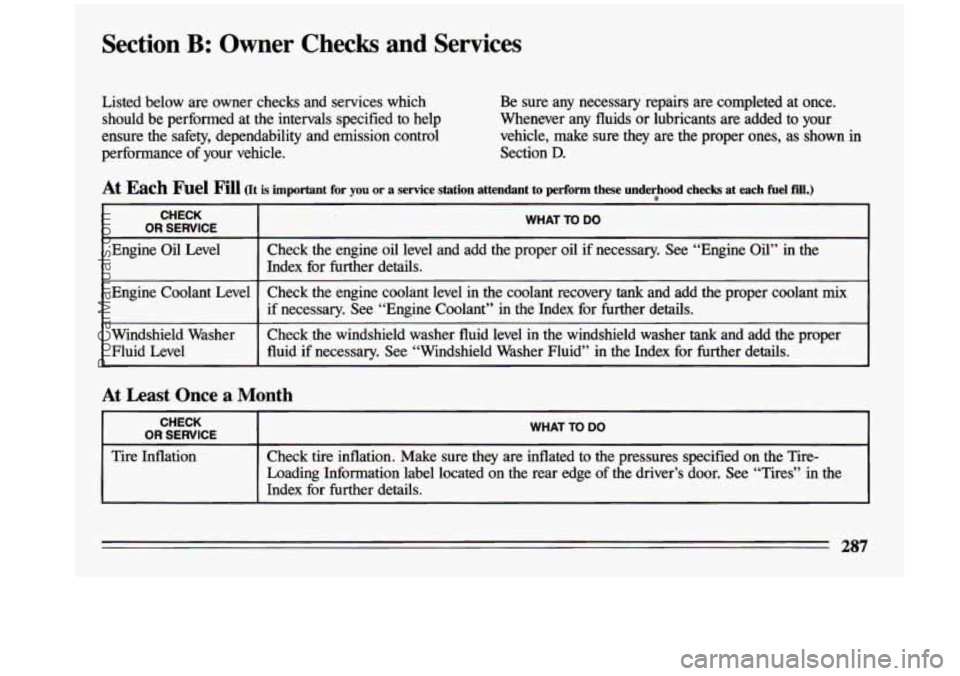
Section B: Owner Checks and Services
Listed below are owner checks and services which should be performed at the intervals specified to help
ensure the safety, dependability and emission control
performance of your vehicle. Be
sure any necessary repairs are completed at once.
Whenever any fluids or lubricants are added to your
vehicle, make sure they are the proper ones, as shown in
Section
D.
At Each Fuel Fill (It is important for you or a service station attendant to perform these undechd checks at each fuel fill.)
CHECK
I OR SERVICE I WHAT TO DO
Engine Oil Level
Check the engine oil level and add the proper oil if necessar\
y. See “Engine Oil” in the
Index for further details.
Engine Coolant Level Check the engine coolant level in the coolant recovery tank and add \
the proper coolant mix
I if necessary. See “Engine Coolant” in the Index for furth\
er details. I
Windshield Washer Check the windshield washer fluid level in th\
e windshield washer tank and add the proper
Fluid Level
I fluid if necessary. See “Windshield Washer Fluid” in the \
Index for further details. I
At Least Once a Month
CHECK
I OR SERVICE I WHAT TO DO
Tire Inflation Check tire inflation. Make sure they are inflate\
d to the pressures specified on the Tire-
Loading Information label located on the rear edge of the driv\
er’s door. See “Tires”
in the
Index
for further details.
287
ProCarManuals.com