engine oil BUICK CENTURY 1994 User Guide
[x] Cancel search | Manufacturer: BUICK, Model Year: 1994, Model line: CENTURY, Model: BUICK CENTURY 1994Pages: 308, PDF Size: 16.3 MB
Page 217 of 308
When to Add Oil
If the oil is at or below the ADD line, then you’ll need
to add some oil. But you must
use the right kind. This
section explains what kind
of oil to use. For crankcase
capacity, see “Capacities and Specifications” in the
Index.
NOTICE:
Don’t add too much oil. If your engine has so
much oil that the oil level gets above the
cross-hatched area that shows the proper
operating range, your engine could be damaged.
Just fill it enough to put the level somewhere in the
proper operating range. Push the dipstick all the way
back in when you’re through.
What Kind of Oil to Use
Beginning midyear 1993, oils of the proper quality for
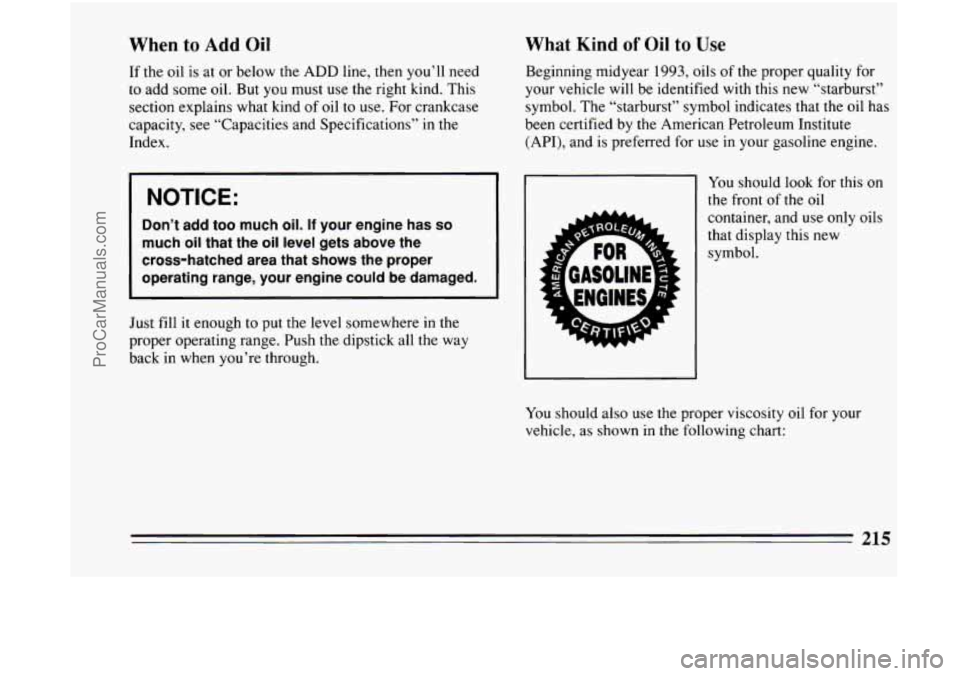
your vehicle will be identified with this new “starburst”
symbol, The “starburst” symbol indicates that the oil has
been certified by the American Petroleum Institute
(API), and is preferred for use in your gasoline engine.
I
You should look for this on
the front of the oil
container, and use
only oils
that display this new
symbol.
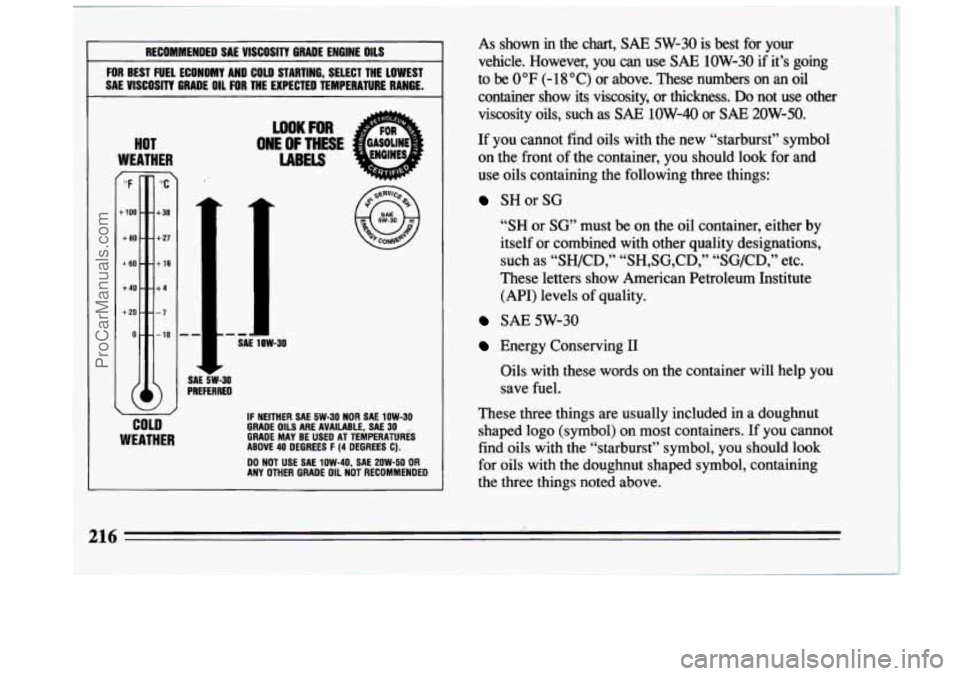
You should also use the proper viscosity oil for your
vehicle,
as shown in the following chart:
215
ProCarManuals.com
Page 218 of 308
RECOMMENDED SAE VISCOSITY GRADE ENGINE OILS
FOR BEST FUEL ECONOMY AND COLD Sw“nwl’l li, SELECT THE LOWEST
SAE
VISCOSITY GRADE OIL FOR THE EX. _____ TEMPERATURE RANGE.
HOT
WEATHER 7
”F
t 100
+ 80
+ 60
+ 40
+ 20
0
f
SAE 5W-30 PREFERRED
IF NEITHER SAE 5W-30 NOR SAE 1OW-30
GRADE OILS ARE AVAILABLE, SAE 30 .,. GRADE MAY BE USED AT TEMPERATURES
ABOVE 40 DEGREES F (4 DEGREES C).
ANY OTHER GRADE OIL NOT RECOMMENDED DO NOT USE SAE 1OW-40, SAE 2OW-50 OR
WEATHER
As shown in the chart, SAE 5W-30 is best for your
vehicle. However, you
can use SAE 1OW-30 if it’s going
to be
0°F (-18°C) or above. These numbers on an oil
container show it.+ viscosity, or thickness. Do not use other
viscosity
oils, such as SAE low-40 or SAE 20W-50.
If you cannot find oils with the new “starburst”symbo1
on the front of the-container, you should look for and
use oils containing the following three things:
SHor SG
“SH or SG” must be on the oil container, either by
itself
or combined with other quality designations,
such as
“SH/CD,” “SH,SG,CD,” “SG/CD,” etc.
These letters show American Petroleum Institute
(API) levels of quality.
SAE 5W-30
Energy Conserving I1
Oils with these words on the container will help you
save fuel.
These three things are usually included in
a doughnut
shaped logo (symbol) on most containers. If you cannot
find oils with the “starburst” symbol, you should look
for oils with the doughnut shaped symbol, containing
the three things noted above.
216
ProCarManuals.com
Page 219 of 308
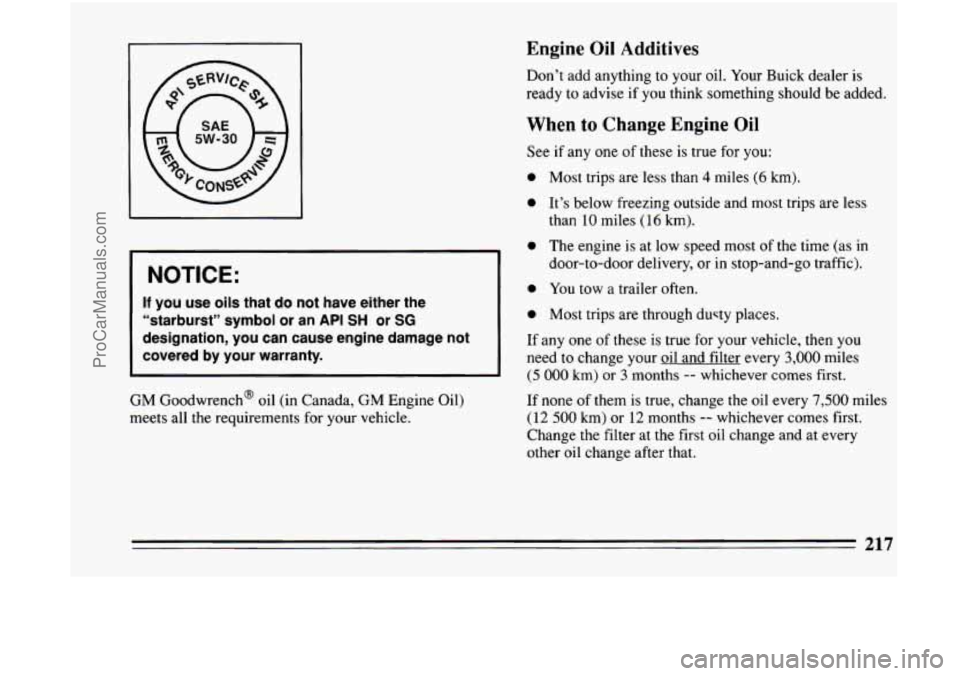
NOTICE:
If you use oils that do not have either the
“starburst” symbol or an
API SH or SG
designation, you can cause engine damage not
covered by your warranty.
GM Goodwrench@ oil (in Canada, GM Engine Oil)
meets all the requirements for your vehicle.
Engine Oil Additives
Don’t add anything to your oil. Your Buick dealer is
ready to advise if you think something should be added.
When to Change Engine Oil
See if any one of these is true for you:
0 Most trips are less than 4 miles (6 km).
0 It’s below freezing outside and most trips are less
0 The engine is at low speed most of the time (as in
0 You tow a trailer often.
0 Most trips are through dwty places.
If any one of these is true for your vehicle, then you
need to change your oil and filter every
3,000 miles
(5 000 km) or 3 months -- whichever comes first.
If none
of them is true, change the oil every 7,500 miles
(12 500 km) or 12 months -- whichever comes first.
Change the filter at the first oil change and at every
other oil change after that.
than
10 miles (1 6 km).
door-to-door delivery,
or in stop-and-go traffic).
217
ProCarManuals.com
Page 220 of 308
Engine Coolant Heater (Engine
Block Heater)
An engine coolant heater can be a big help if you have
to park outside in very cold weather,
0°F (- 18 “C) or
colder. If your vehicle has this option, see “Engine
Coolant Heater” in
the Index.
What to Do with Used Oil
Did you know that used engine oil contains certain
elements that may be unhealthy for
your skin and could
even cause cancer? Don’t let used oil stay on your skin
for very long. Clean your skin and nails with soap and
water, or a good hand cleaner. Wash or properly throw
away clothing or rags containing used engine
oil. (See
the manufacturer’s warnings about the use and disposal
of oil products.)
Used oil can be a real threat to the environment. If you
change your own oil, be sure
to drain all free-flowing
oil from the filter before disposal. Don’t ever dispose of
oil by putting it
in the trash, pouring it on the ground,
into sewers, or into streams or bodies of water. Instead,
recycle it by taking
it to a place that collects used oil. If
you have a problem properly disposing of your used oil,
ask your dealer, a service station
or a local recycling
center for help.
Air Cleaner
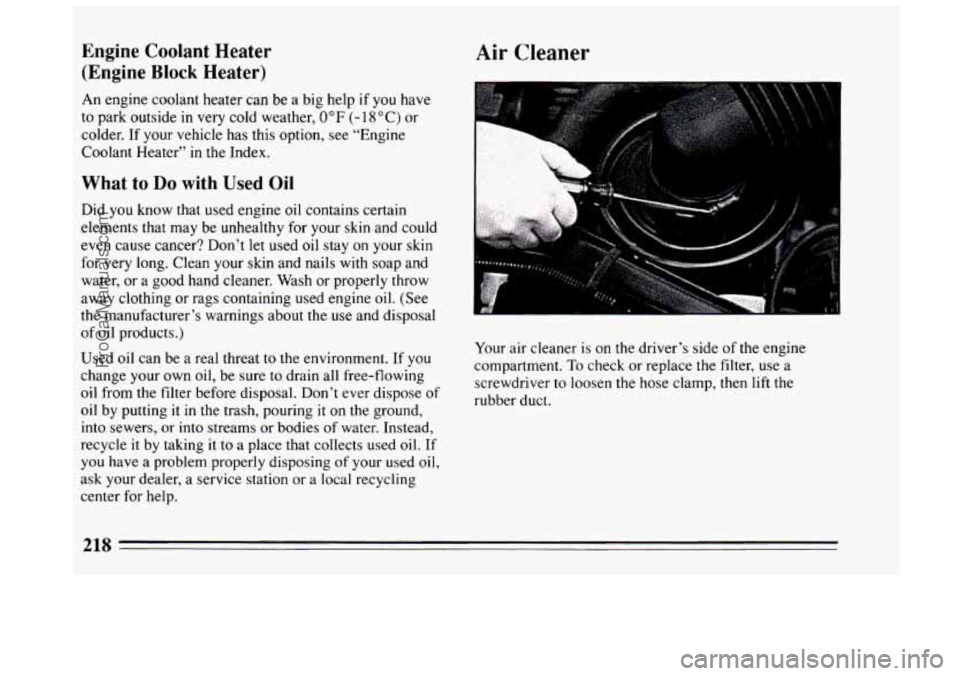
Your air cleaner is on the driver’s side of the engine
compartment.
To check or replace the filter, use a
screwdriver to loosen
the hose clamp, then lift the
rubber duct.
218
ProCarManuals.com
Page 222 of 308
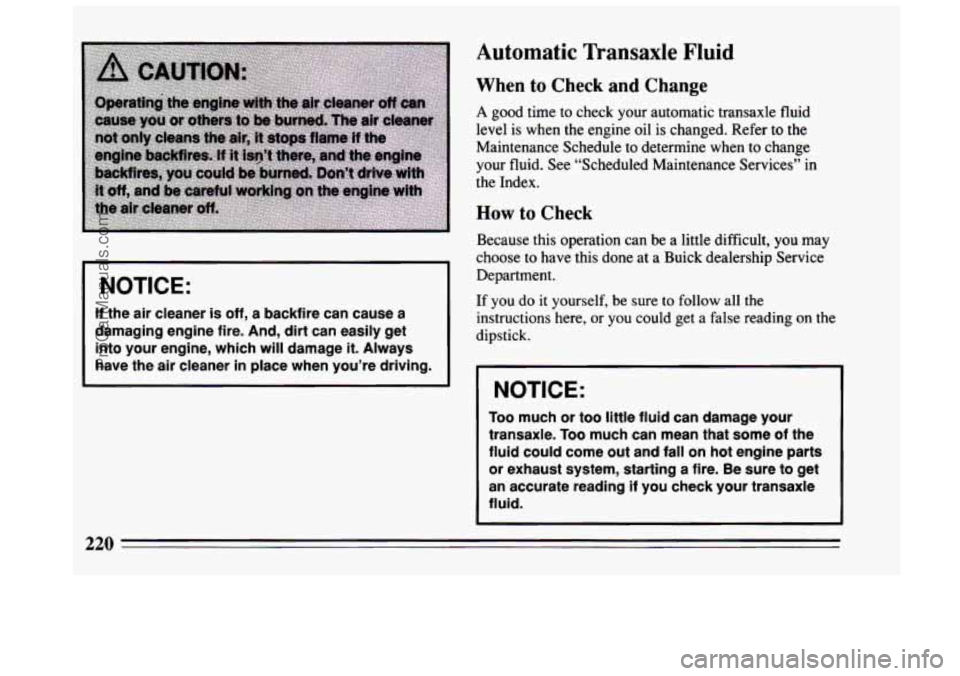
I NOTICE:
If the air cleaner is off, a backfire can cause a
damaging engine fire.
And, dirt can easily get
into your engine, which will damage
it. Always
have the air cleaner
in place when you’re driving.
Automatic Transaxle Fluid
When to Check and Change
A good time to check your automatic transaxle fluid
level
is when the engine oil is changed. Refer to the
Maintenance Schedule to determine when to change
your fluid. See “Scheduled Maintenance Services” in
the Index.
How to Check
Because this operation can be a little difficult, you may
choose to have this done at a Buick dealership Service
Department.
If you do it yourself, be sure to follow all the
instructions here, or you could get a false reading on the
dipstick.
I NOTICE:
loo much or too little fluid can damage your
transaxle.
Too much can mean that some of the
fluid could come
out and fall on hot engine parts
or exhaust system, starting a fire. Be sure to get
an accurate reading
if you check your transaxle
fluid.
220
ProCarManuals.com
Page 225 of 308
How to Add Fluid
Refer to the Maintenance Schedule to determine what
kind of transaxle fluid
to use. See “Recommended
Fluids and Lubricants” in the Index.
Engine Coolant
If the fluid level is low, add only enough of the proper
fluid to bring the level into the cross-hatched area on the
dipstick.
1. Pull
out the dipstick.
2. Using a long-neck funnel, add enough fluid at the
It doesn’t take much fluid, generally less than a pint
(OSL).
Don’t overfill. We recommend you use only
fluid labeled DEXRON@-I11 or DEXRON@-IIE,
because fluids with that label are made especially for
your automatic transaxle. Damage caused by fluid other
than DEXRON@-I11 or DEXRON@-IIE is
not covered
by your new vehicle warranty. dipstick
hole
to bring it to the proper level.
After adding fluid, recheck the fluid level as
described under “How to Check.”
0 When the correct fluid level is obtained, push the
dipstick back in all the way. The following explains
your cooling system and how to
add coolant when it is low. If you have a problem with
engine overheating or if
you need to add coolant to your
radiator, see “Engine Overheating” in the Index.
The proper coolant for your Buick will:
0 Give freezing protection down to -34°F (-37°C).
0 Give boiling protection up to 262 “F ( 128 “C).
0 Protect against rust and corrosion.
Help keep the proper engine temperature.
0 Let the warning lights work as they should.
What to Use
Use a mixture of one-half clean water (preferably
distilled) and one-half antifreeze that meets “GM
Specification 1825-M,” which won’t damage aluminum
parts.
You can also use a recycled coolant conforming to
GM Specification 1825-M with a complete coolant flush
and refill. If you use this mixture,
you don’t need to add
anything else.
223
ProCarManuals.com
Page 231 of 308
should have your brake system fixed, since a leak means
that sooner or later your brakes won’t work well,
or
won’t work at all. So, it isn’t a good idea to “top off’
your brake fluid. Adding brake fluid won’t correct a
leak. If you add fluid when your linings are worn, then
you’ll have too much fluid when you get new brake
linings. You should add (or remove) brake fluid, as
necessary, only when work
is done on the brake
hydraulic system.
When
your brake fluid falls to a low level, your brake
warning light will come on. See “Brake System Warning
Light” in the Index.
What to Add
When you do need brake fluid, use only DOT-3 brake
fluid
-- such as Delco Supreme 11 @ (GM Part
No. 1052535). Use new brake fluid from a sealed
container only, and always clean the brake fluid
reservoir cap before removing it.
NOTICE:
DOT-5 silicone brake fluid can damage
your vehicle. Don’t use
it.
a Don’t let someone put in the wrong kind of
fluid. For example,
just a few drops of
mineral-based
oil, such as engine oil, in
your brake system can damage brake
system parts
so badly that they’ll have to
be replaced.
Brake fluid can damage paint, so be careful
not to spill brake
fluid on your vehicle. If
,you do, wash it off immediately. See
“Appearance Care” in the Index.
229
ProCarManuals.com
Page 257 of 308
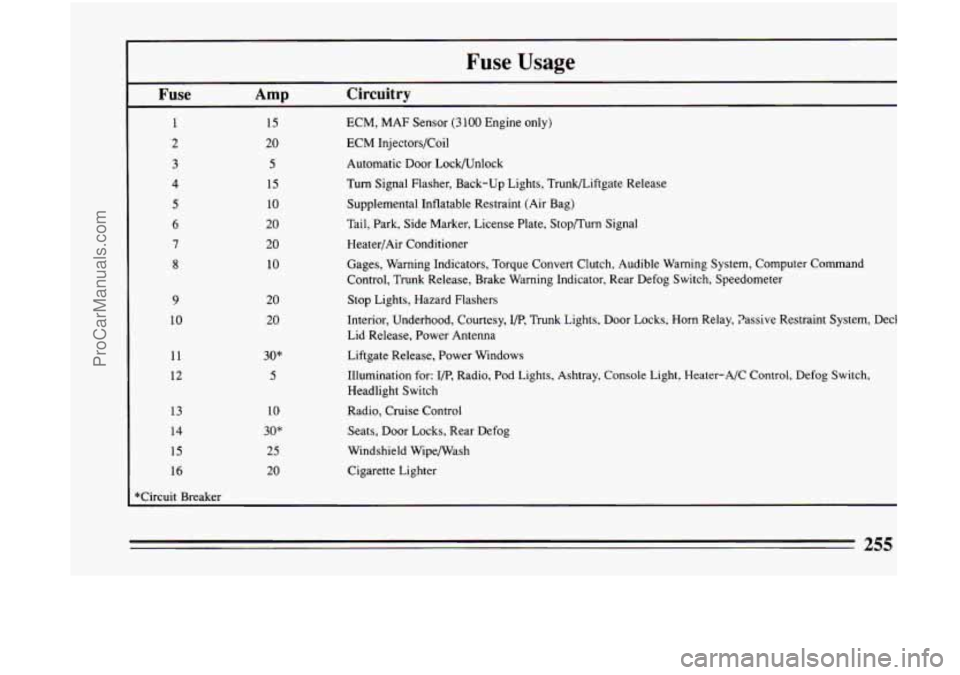
r Fuse Usage
I
Fuse Amp Circuitry
1 15 ECM, MAF Sensor (3 100 Engine only)
2 20 ECM Injectors/Coil
3
4
5
6
7
8
9
10
11
12
13
14
15
I 16
5
15
10
20
20
10
20 20
30"
5
10
30"
25
20
Automatic Door LockAJnlock
Turn Signal Flasher, Back-up Lights, Trunkbiftgate Release
Supplemental Inflatable Restraint (Air Bag)
Tail, Park, Side Marker, License Plate, Stop/Turn Signal Heater/Air Conditioner
Gages, Warning Indicators, Torque Convert Clutch, Audible Warning\
System, Computer Command
Control, Trunk Release, Brake Warning Indicator, Rear Defog Swit\
ch, Speedometer
Stop Lights, Hazard Flashers
Interior, Underhood, Courtesy,
I/P, Trunk Lights, Door Locks, Horn Relay, Passive Restraint System, \
Deck
Lid Release, Power Antenna
Liftgate Release, Power Windows
Illumination for:
I/P, Radio, Pod Lights, Ashtray, Console Light, Heater-A/C Control, D\
efog Switch,
Headlight Switch
Radio, Cruise Control
Seats, Door Locks, Rear Defog
Windshield WipefWash
Cigarette Lighter
255
ProCarManuals.com
Page 261 of 308
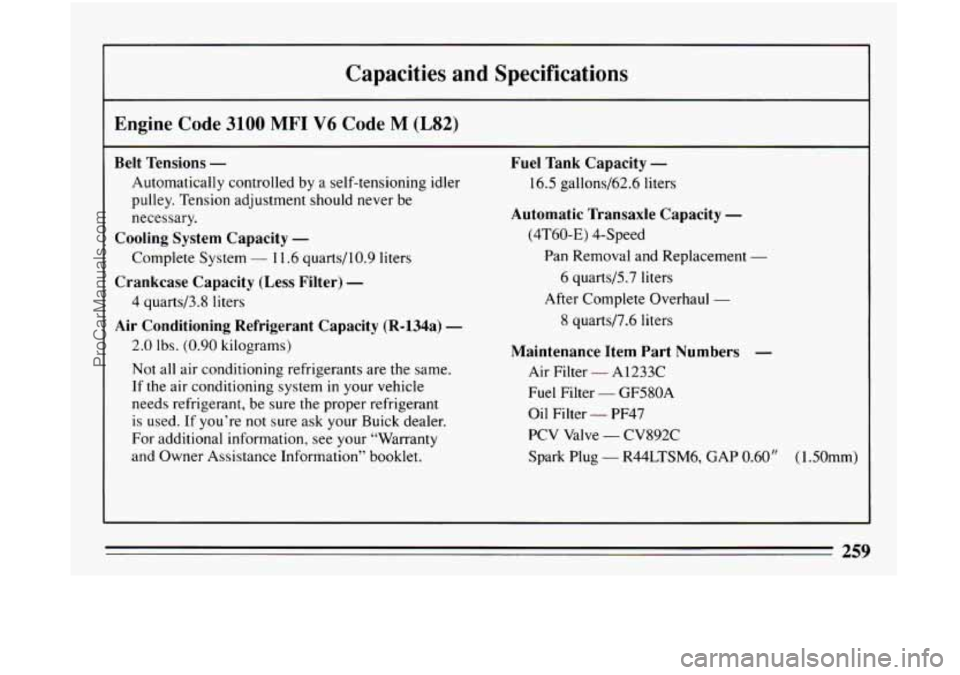
Capacities and Specifications
Engine Code 3100 MFI V6 Code M (L82)
Belt Tensions - Fuel Tank Capacity -
Automatically controlled by a self-tensioning idler 16.5 gallons/62.6 liters
pulley. Tension adjustment should never be
Automatic Transaxle Capacity -
(4T60-E) 4-Speed
necessary.
Complete System
- 1 1.6 quarts/l0.9 1
Cooling System Capacity -
Crankcase Capacity (Less Filter) -
4 quarts/3.8 liters iters
Air
Conditioning Refrigerant Capacity (R-134a) -
2.0 lbs. (0.90 kilograms)
Not all air conditioning refrigerants are the same.
If the air conditioning system
in your vehicle
needs refrigerant, be sure
the proper refrigerant
is used.
If you’re not sure ask your Buick dealer.
For additional information, see your “Warranty
and Owner Assistance Information’’ booklet. Pan
Removal and Replacement
-
6 quarts/5.7 liters
8 quarts/7.6 liters
After
Complete Overhaul
-
Maintenance Item Part Numbers -
Air Filter - A1233C
Fuel Filter
- GF580A
Oil Filter
- PF47
PCV Valve
- CV892C
Spark Plug
- R44LTSM6, GAP 0.60” (1 SOmm)
3 rn
ProCarManuals.com
Page 262 of 308
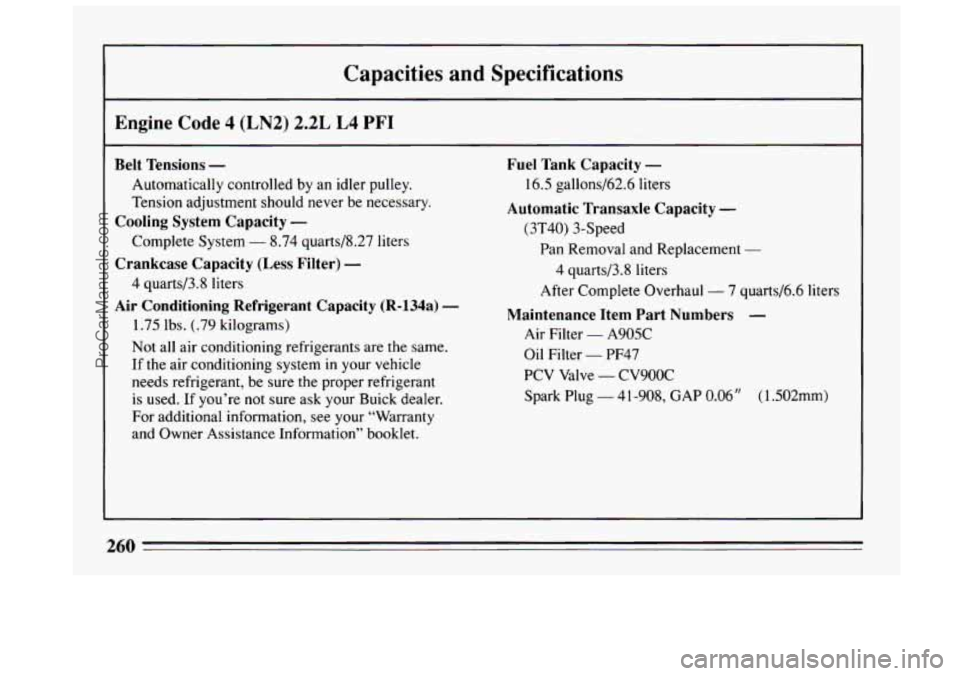
Capacities and Specifications
I
I Engine Code 4 (LN2) 2.2L L4 PFI
Belt Tensions -
Automatically controlled by an idler pulley.
Tension adjustment should never be necessary.
Cooling System Capacity -
Complete System - 8.74 quarts/8.27 liters
Crankcase Capacity (Less Filter) -
4 quarts/3.8 liters
Air Conditioning Refrigerant Capacity (R-134a) -
1.75 lbs. (.79 kilograms)
Not all air conditioning refrigerants are
the same.
If the air conditioning system in your vehicle
needs refrigerant, be sure the proper refrigerant
is used.
If you’re not sure ask your Buick dealer.
For additional information, see your “Warranty
and Owner Assistance Information” booklet.
Fuel Tank Capacity -
Automatic Transaxle Capacity -
16.5 gallons/62.6 liters
(3T40) 3-Speed
Pan Removal and Replacement
-
After Complete Overhaul - 7 quarts/6.6 liters
4 quarts/3.8 liters
Maintenance Item Part Numbers -
Air Filter - A905C
Oil Filter - PF47
PCV Valve - CV9OOC
Spark Plug
- 41-908, GAP 0.06” (1.502mm)
260
ProCarManuals.com