oil level BUICK CENTURY 1994 User Guide
[x] Cancel search | Manufacturer: BUICK, Model Year: 1994, Model line: CENTURY, Model: BUICK CENTURY 1994Pages: 308, PDF Size: 16.3 MB
Page 231 of 308
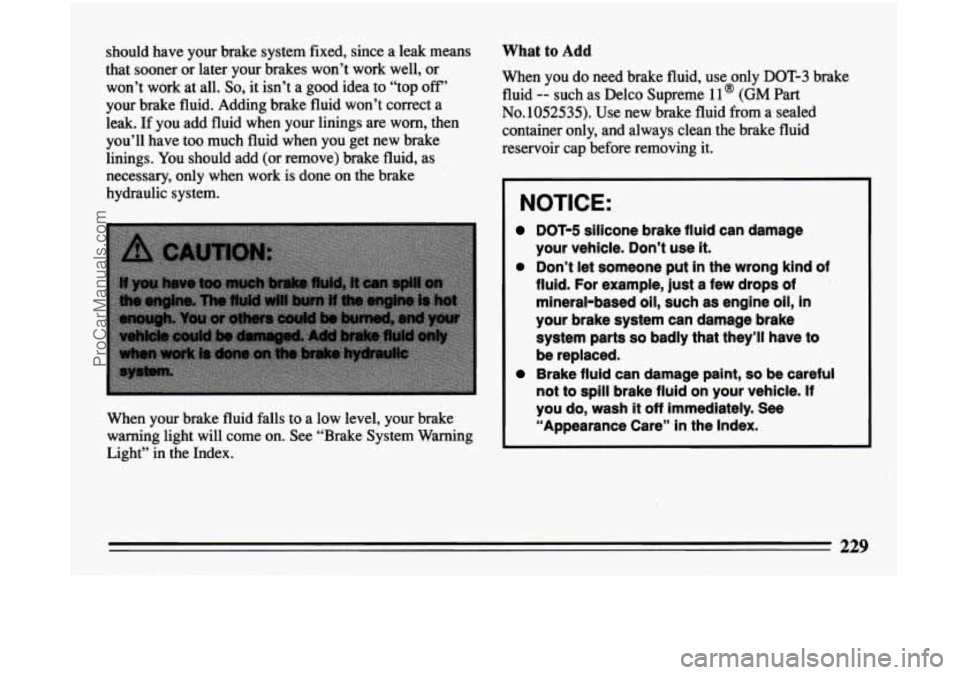
should have your brake system fixed, since a leak means
that sooner or later your brakes won’t work well,
or
won’t work at all. So, it isn’t a good idea to “top off’
your brake fluid. Adding brake fluid won’t correct a
leak. If you add fluid when your linings are worn, then
you’ll have too much fluid when you get new brake
linings. You should add (or remove) brake fluid, as
necessary, only when work
is done on the brake
hydraulic system.
When
your brake fluid falls to a low level, your brake
warning light will come on. See “Brake System Warning
Light” in the Index.
What to Add
When you do need brake fluid, use only DOT-3 brake
fluid
-- such as Delco Supreme 11 @ (GM Part
No. 1052535). Use new brake fluid from a sealed
container only, and always clean the brake fluid
reservoir cap before removing it.
NOTICE:
DOT-5 silicone brake fluid can damage
your vehicle. Don’t use
it.
a Don’t let someone put in the wrong kind of
fluid. For example,
just a few drops of
mineral-based
oil, such as engine oil, in
your brake system can damage brake
system parts
so badly that they’ll have to
be replaced.
Brake fluid can damage paint, so be careful
not to spill brake
fluid on your vehicle. If
,you do, wash it off immediately. See
“Appearance Care” in the Index.
229
ProCarManuals.com
Page 264 of 308
IMPORTANT:
KEEP ENGINE OIL
AT THE PROPER
LEVEL
AND CHANGE AS
RECOMMENDED
I protection
Plan
Have you purchased the GM Protection Plan? The
Plan supplements
your new vehicle warranties. See
your Buick dealer
for details.
Introduction
A Word About Maintenance
We at General Motors want to help you keep your
vehicle in good working condition. But we don’t know
exactly how you’ll drive it.
You may drive very short
distances only a few times a week. Or you may drive
long distances all the time in very hot, dusty weather.
You may use your vehicle in making deliveries. Or you
may drive it to work, to do errands
or in many other
ways.
Because of all the different ways people use their GM
vehicles, maintenance needs vary.
You may even need
more frequent checks and replacements
than you will
find in the schedules in this part.
So please read this
part and note how you drive.
If you have any questions
on
how to keep your vehicle in good condition, see your
Buick dealer, the place many GM owners choose to
have their maintenance work done.
Your dealer can be
relied upon to use proper parts and practices.
262
ProCarManuals.com
Page 272 of 308
Explanation of Scheduled Maintenance
Services
Below are explanations of the services listed in Schedule
I and Schedule
11.
The proper fluids and lubricants to use are listed in
Section D. Make sure whoever services your vehicle uses
these. All parts should
be replaced and all necessary
repairs done before you or anyone else drives the vehicle.
NOTE: To determine your engine’s displacement and
code, see “Engine Identification” in the Index.
1. Engine Oil and Filter Change* -- Always use SH
or SG Energy Conserving I1 oils of proper viscosity.
The
“SH or SG’ designation may be shown alone or
in combination with others, such as “SH/CD’ or
“SH, SG, CD,” “SG/CD,”etc. To determine the
preferred viscosity for your vehicle’s engine (e.g.,
SAE 5W-30 or SAE 10W-30), see “Engine Oil” in
the Index.
2. Chassis Lubrication -- Lubricate the transaxle shift
linkage, parking brake cable guides, underbody
contact points and linkage. If your vehicle is equipped with grease fittings, lubricate the suspension and steering linkage. 3.
Tire and Wheel Rotation and Inspection -- For
proper wear and maximum tire life, rotate your tires
following the instructions in this manual. See “Tires,
Inspection
& Rotation” in the Index. Check the tires
for uneven wear or damage. If you see irregular or
premature wear, check the wheel alignment. Check
for damaged wheels also.
4. Engine Accessory Drive Belt(s) Inspection --
Inspect the belt(s) for cracks, fraying, wear and
proper tension. Replace as needed.
5. Cooling System Service* -- Drain, flush and refill
the system with new or approved recycled coolant
conforming to GM Specification 1825M. Keep coolant
at the proper mixture as specified.
See “Coolant” in the
Index.
This provides proper freeze protection and boil
protection, corrosion inhibitor level and maintain
proper engine operating temperature.
Inspect hoses and replace if they are cracked,
swollen or deteriorated. Tighten screw type hose
clamps. Clean the outside of the radiator and air
conditioning condenser. Wash the pressure cap and
neck
To help ensure proper operation, we recommend a
pressure test
of both the cooling system and the
pressure cap.
270
ProCarManuals.com
Page 274 of 308
Section B: Owner Checks and
Services
Listed below are owner checks and services which should
be performed at the intervals specified to help
ensure the safety, dependability and emission control
performance of your vehicle.
Be sure any necessary repairs are completed at once.
Whenever any fluids
or lubricants are added to your
vehicle, make sure they are the proper ones, as shown in Section
D.
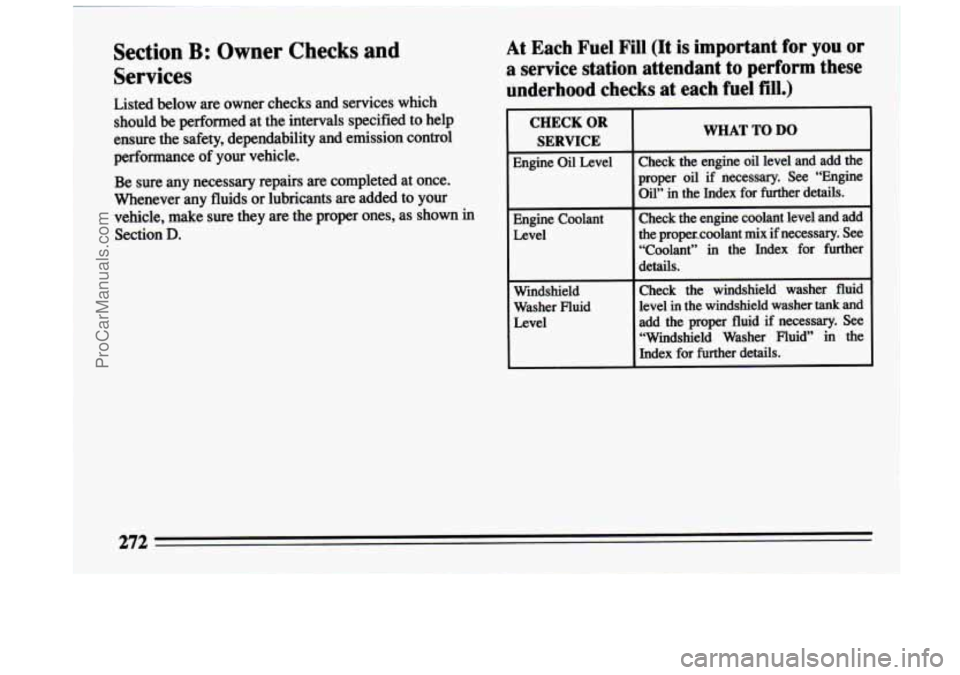
At Each Fuel Fill (It is important for you or
a service station attendant to perform these
underhood checks at each fuel fill.)
WHAT TO DO
~
Engine Oil Level
Engine Coolant Level
Windshield
Washer Fluid Level Check the engine oil level and add the
proper oil if necessary. See “Engine
Oil” in the Index for further details.
Check the engine coolant level and add
the propexcoolant mix if necessary. See “Coolant” in the Index for further
details.
Check the windshield washer fluid
level in the windshield washer
tank and
add the proper fluid if necessary. See “Windshield Washer Fluid” in the
Index for further details.
272
ProCarManuals.com