air condition BUICK CENTURY 1994 Owners Manual
[x] Cancel search | Manufacturer: BUICK, Model Year: 1994, Model line: CENTURY, Model: BUICK CENTURY 1994Pages: 308, PDF Size: 16.3 MB
Page 14 of 308
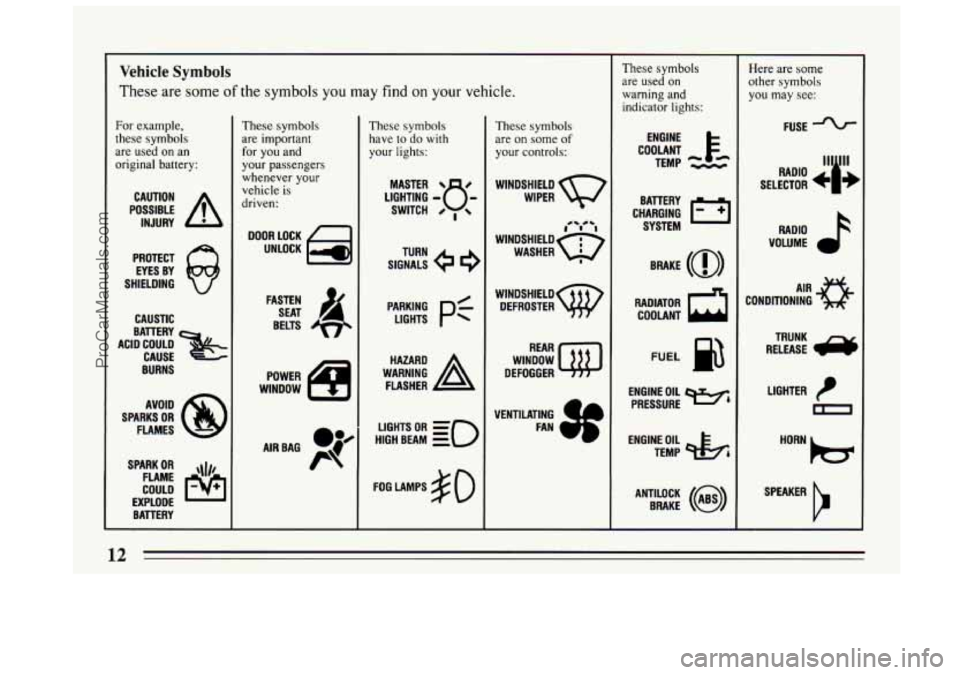
Vehicle Symbols
These are some of the symbols you may find on your vehicle.
Fur example,
these symbols
are used on an
original battery:
POSSIBLE A
CAUTION
INJURY
PROTECT EYES BY
SHIELDING
Q
CAUSTIC
BURNS AVOID
SPARKS
OR
FLAMES
SPARK
OR ,\I/,
COULD FLAME
EXPLODE BATTERY
These symbols
are important
for you and
your passengers whenever your
vehicle is
driven:
FASTEN SEAT 4
BELTS
POWER
WINDOW
AIRBAG P
These symbols have
to do with
your lights:
SIGNALS e
TURN
HIGH BEAM
OR = =o
FOG LAMPS $0
These symbols
are
on some of
your controls:
WIPER v
WINDSHIELDw DEFROSTER
WINDOW
DEFOGGER
VENTILATING FAN
These symbols
are used
on
warning and
indicator lights:
COOLANT F&
TEMP -.--
ENGINE
CHARGING
I-1
BAllERY SYSTEM
RADIATOR COOLANT
a
FUEL
ENGINE OIL e,
PRESSURE
TEMP
OIL 4%
ANTILOCK (@)
BRAKE
Here are some
other symbols
you may see:
FUSE
RADIO
k
VOLUME J
CONDITIONING A'R 0
RELEASE 6
TRUNK
LIGHTER
m
ProCarManuals.com
Page 120 of 308
NOTICE:
Damage to your engine from neglected oil
problems can be costly and is not covered by
your warranty.
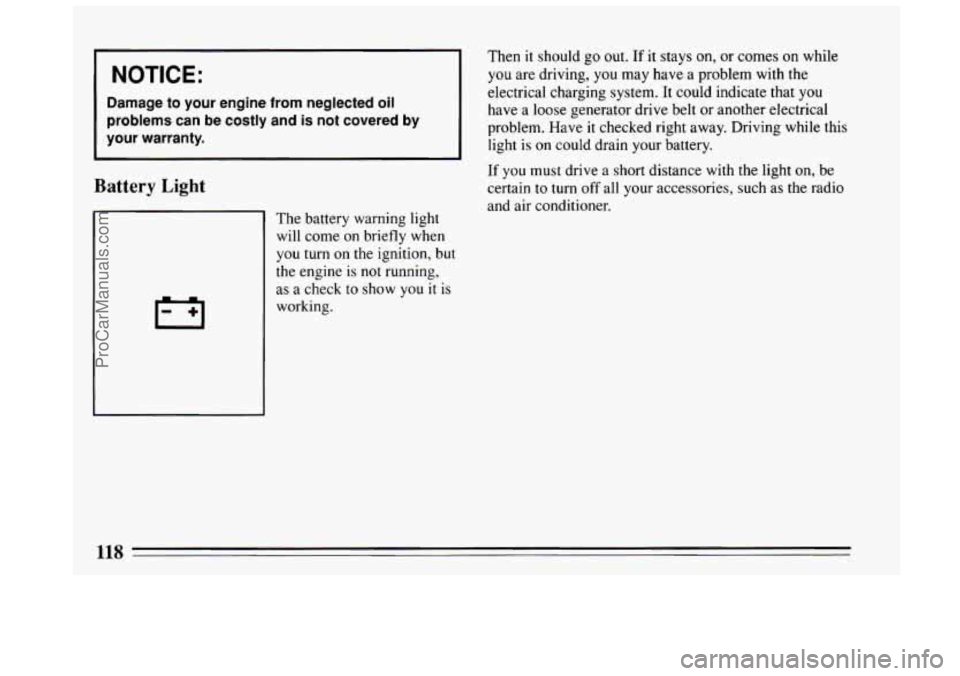
Battery Light
Then it should go out. If it stays on, or corn-es 6n %bile
you are driving, you may have a problem with the
electrical charging system. It could indicate that
you
have a loose generator drive belt or another electrical
problem. Have
it checked right away. Driving while this
light is on could drain your battery.
If you must drive a short distance with the light on, be
certain
to turn off all your accessories, such as the radio
and air conditioner.
The battery warning light
will come on briefly when
you turn on the ignition, but
the engine
is not running,
as a check to
show you it is
working.
118
ProCarManuals.com
Page 123 of 308
Part 3 Comfort Controls and Audio Systems
In this part you’ll find out how to operate the comfort control systems and audio systems offered with your Buick .
Be sure to read about the particular system supplied with your vehicle .
Part 3 includes:
Comfort Control System .......................................................... i22
Airconditioner ............................................................... 122
Ventilation
................................................................... 123
Heater and Defroster
........................................................... 123
RearWindowDefogger
........................................................ 123
Audiosystems
.................................................................... 125
Radio Controls
....................................................... 126. 128. 130
TapePlayerControls ........................................................... 130
CDPlayerControls
............................................................ 132
Care of Cassette Tape Player and Tapes
............................................ 136
CareofCompactDiscs
......................................................... 136
Power Antenna Mast Care
...................................................... 137
ProCarManuals.com
Page 124 of 308
Your Buick Comfort Control System
The air conditioner and heater work best if you keep
your windows closed while using them. Your vehicle
also has the flow-through ventilation system described
later in this section.
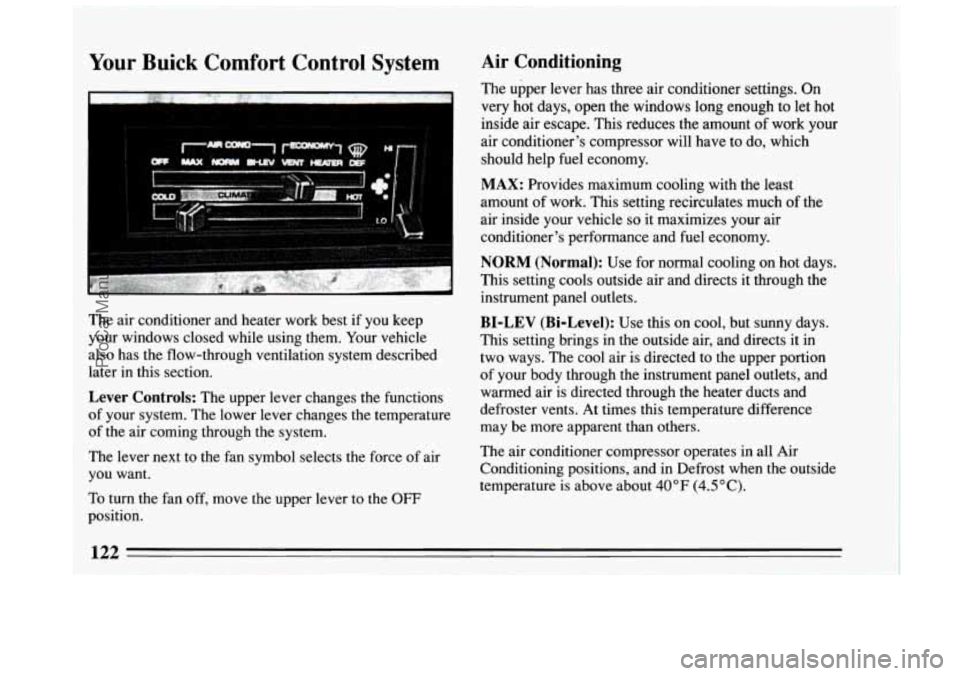
Lever Controls: The upper lever changes the functions
of your system. The lower lever changes the temperature
of the air coming through the system.
The lever next to the fan symbol selects the force of air
you want.
To turn the fan off, move the upper lever to the OFF
Air Conditioning
The upper lever has three air conditioner settings. On
very hot days, open the windows long enough to let hot
inside air escape. This reduces the amount of work your
air conditioner's compressor will have to do, which
should help fuel economy.
MAX: Provides maximum cooling with the least
amount of work. This setting recirculates much
of the
air inside your vehicle
so it maximizes your air
conditioner's performance and fuel economy.
NORM (Normal): Use for normal cooling on hot days.
This setting cools outside air and directs it through the
instrument panel outlets.
BI-LEV (Bi-Level): Use this on cool, but sunny days.
This setting brings in the outside air, and directs it in
two ways. The cool air is directed to the upper portion
of your body through the instrument panel outlets, and
warmed air is directed through the heater ducts and
defroster vents. At times this temperature difference
may be more apparent than others.
The air conditioner compressor operates in all Air
Conditioning positions, and in Defrost when the outside
temperature is above about 40°F (4.5"C).
position.
__
ProCarManuals.com
Page 125 of 308
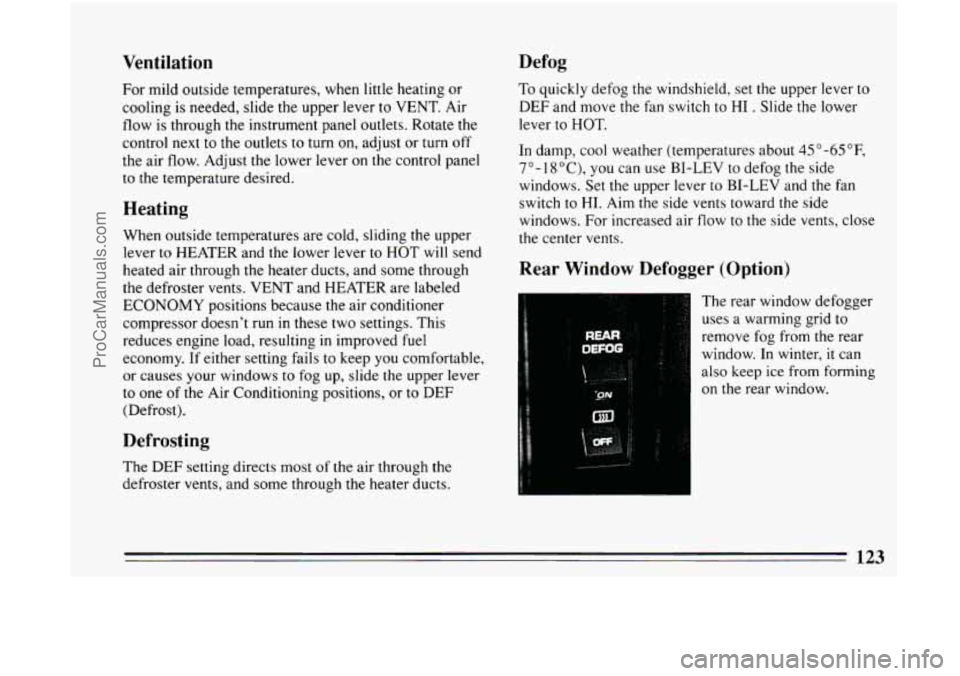
Ventilation
For mild outside temperatures, when little heating or
cooling is needed, slide the upper lever
to VENT. Air
flow is through the instrument panel outlets. Rotate the
control next to the outlets to turn on, adjust or
turn off
the air flow. Adjust the lower lever
on the control panel
to the temperature desired.
Heating
When outside temperatures are cold, sliding the upper
lever
to HEATER and the lower lever to HOT will send
heated air through the heater ducts, and some through
the defroster vents. VENT and HEATER are labeled
ECONOMY positions because the air conditioner
compressor doesn't run in these two settings. This
reduces engine load, resulting in improved fuel
economy. If either setting fails to keep you comfortable,
or causes your windows
to fog up, slide the upper lever
to one of the Air Conditioning positions, or to DEF
(Defrost).
Defrosting
The DEF setting directs most of the air through the
defroster vents, and some through the heater ducts.
Defog
To quickly defog the windshield, set the upper lever to
DEF and move the fan switch to HI . Slide the lower
lever to
HOT.
In damp, cool weather (temperatures about 45 "-65"F,
7"- 1 8"C), you can use BI-LEV to defog the side
windows. Set the upper lever to BI-LEV and the fan
switch to
HI. Aim the side vents toward the side
windows. For increased air flow to the side vents, close
the center vents.
Rear Window Defogger (Option)
The rear window defogger
uses a warming grid to
remove fog from the rear
window. In winter, it can
also keep ice from forming
on the rear window.
132
ProCarManuals.com
Page 126 of 308
Press the ON portion of the switch. The indicator light
will glow. The rear window defogger will turn off
automatically after about
10 minutes of use. You can
also turn it off by turning
off the ignition or pressing the
OFF portion of the switch.
I NOTICE:
Don’t use a razor blade or somerning else sharp
on the inside
of the rear window. If you do, you
could cut or damage the warming grid, and the repairs wouldn’t be covered by your warranty.
Flow-Through Ventilation System
Your Buick’s flow-through ventilation system supplies
outside air into the vehicle when it
is moving. Outside
air will also enter the vehicle when the heater or the air
conditioning fan is running.
Ventilation Tips
Keep the hood and front air inlet free of ice, snow, or
any other obstruction (such as leaves). The heater
and defroster will work far better, reducing the
chance of fogging the inside of your windows.
When you enter a vehicle in cold weather, turn the
blower fan
to HI for a few moments before driving
off. This helps clear the intake ducts of snow and
moisture, and reduces
the chance of fogging the
inside of your windows.
Keep the air path under the front seats clear of
objects. This helps air to circulate throughout your
vehicle.
124
ProCarManuals.com
Page 154 of 308
If your vehicle starts to slide, ease your foot off the
accelerator pedal and quickly steer the way you want the
vehicle to
go. If you start steering quickly enough, your
vehicle may straighten out. Always be ready for a
second skid
if it occurs.
Of course, traction is reduced when water, snow, ice,
gravel, or other material is
on the road. For safety, you’ll
want to slow down and adjust your driving to these
conditions. It is important
to slow down on slippery
surfaces because stopping distance will be longer and
vehicle control more limited.
While driving on a surface with reduced traction, try
your best
to avoid sudden steering, acceleration, or
braking (including engine braking by shifting to a lower
gear). Any sudden changes could cause the tires to slide.
You may not realize the surface is slippery
until your
vehicle is skidding. Learn to recognize warning clues --
such as enough water, ice or packed snow on the road to
make a “mirrored surface’’
-- and slow down when you
have any doubt.
Remember: Any anti-lock braking system
(ABS) helps
avoid only the braking skid.
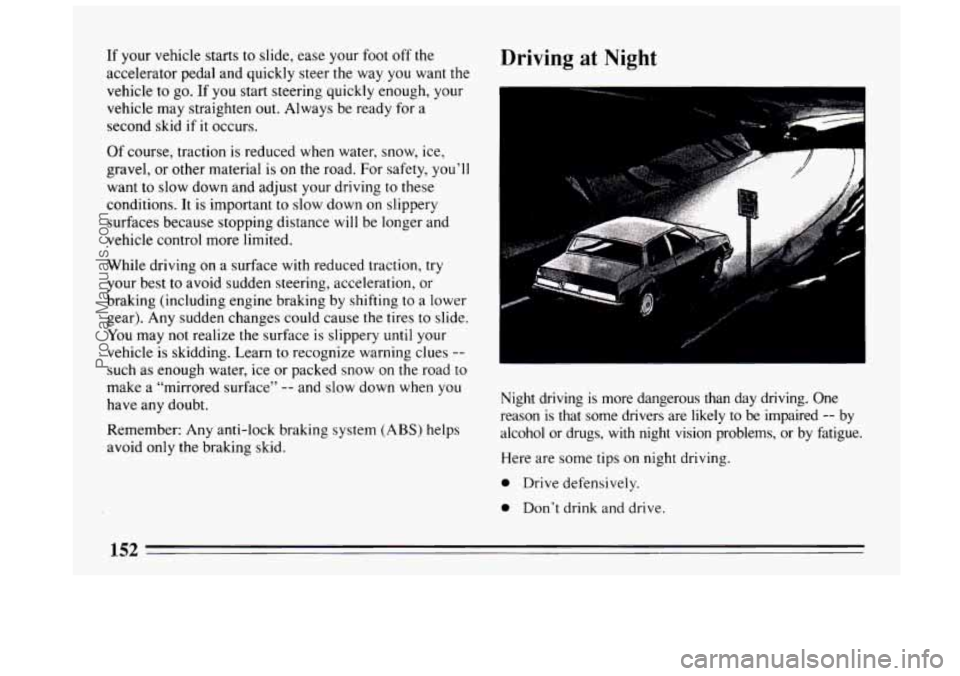
Driving at Night
Night driving is more dangerous than day driving. One
reason is that some drivers are likely to be impaired
-- by
alcohol or drugs, with night vision problems, or by fatigue.
Here are some
tips on night driving.
0 Drive defensively.
0 Don’t drink and drive.
152
ProCarManuals.com
Page 187 of 308
If you get the overheat warning with no sign of steam,
try this for a minute or
so:
1. Turn off your air conditioner.
2. Turn on your heater to full hot at the highest fan
speed and open the window as necessary.
3. Try to keep your engine under load (in a drive gear
where the engine runs slower).
If you no longer have the overheat warning, you can
drive. Just to be safe, drive slower for about ten minutes.
If the warning doesn't come back on, you can drive
normally.
If the warning continues, pull over, stop, and park your
vehicle right away.
If there's still no sign of steam, you can idle the engine
for two or three minutes while you're parked, to see
if the
warning stops.
But then, if you still have the warning,
TURN OFF THE ENGINE AND GET EVERYONE
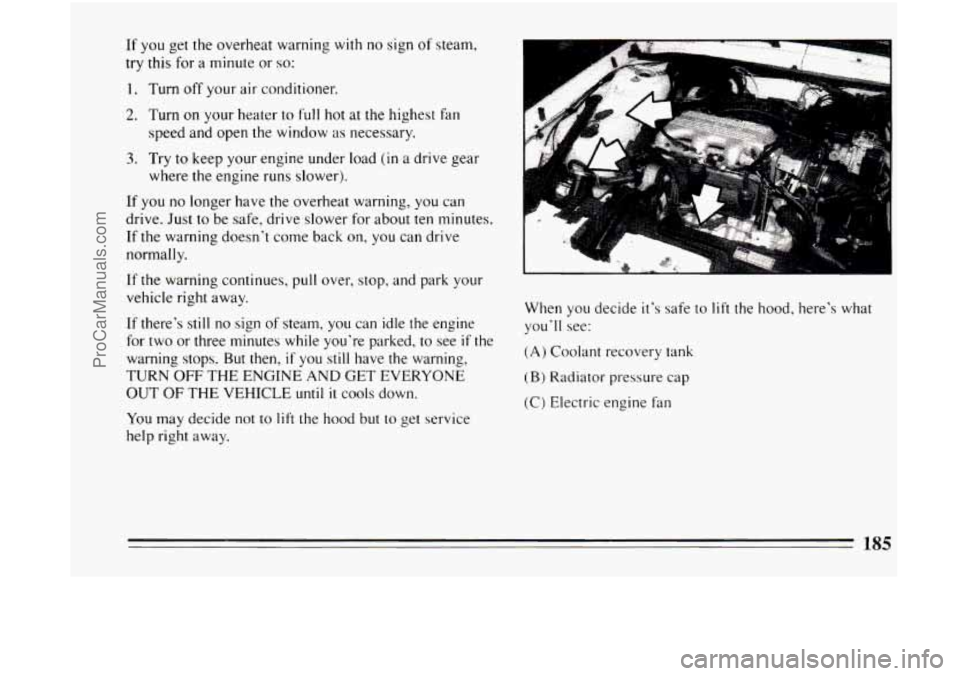
OUT OF THE VEHICLE until it cools down. When you
decide it's safe to
lift the hood, here's what
you'll see:
(A) Coolant recovery tank
(B) Radiator pressure cap
(C) Electric engine fan
You may decide not to
lift the hood but to get service
help right away.
185
ProCarManuals.com
Page 232 of 308
Brake Wear
Your Buick has front disc brakes and rear drum brakes.
Disc brake pads have built-in wear indicators that make
a high-pitched warning sound when the brake pads are
worn and new pads are needed. The sound may come
and
go or be heard all the time your vehicle is moving
(except when
you are pushing on the brake pedal
firmly).
Continuing to drive with worn-out brake pads
could result in costly brake repair.
Some driving conditions or climates may cause a brake
squeal when the brakes are first applied or lightly
applied. This does not mean something
is wrong with
your brakes.
Your rear drum brakes don’t have wear indicators, but if
you ever hear a rear brake rubbing noise, have the rear
brake linings inspected. Also, the rear brake drums
should be removed and inspected each time the tires are
removed for rotation or changing. When you have the
front brakes replaced, have the rear brakes inspected,
too.
Brake linings should always be replaced as complete
axle sets.
Brake Pedal Travel
See your dealer if the brake pedal does not return to
normal height, or
if there is a rapid increase in pedal
travel. This could be a sign of brake trouble.
Brake Adjustment
Every time you apply the brakes moderately, with or
without the vehicle moving, your brakes adjust for wear.
230
ProCarManuals.com
Page 245 of 308
Temperature - A, B, C
The temperature grades are A (the highest), B, and C,
representing the tire’s resistance to the generation of
heat and its ability to dissipate heat when tested under
controlled conditions
on a specified indoor laboratory
test wheel. Sustained high temperature can cause the
material of
the tire to degenerate and reduce tire life, and
excessive temperature can lead
to sudden tire failure.
The grade
C corresponds to a level of performance
which all passenger car tires must meet under the
Federal Motor Vehicle Safety Standard
No. 109. Grades
B and A represent higher levels of performance on the
laboratory test wheel than the minimum required by law.
Warning: The temperature grade for
this tire is
established for a tire that is properly inflated and not
overloaded. Excessive speed, underinflation, or
excessive loading, either separately or in combination,
can cause heat buildup and possible tire failure.
These grades are molded
on the sidewalls of passenger
car tires.
While the tires available as standard or optional
equipment
on General Motors vehicles may vary with
respect to these grades, all such tires meet General
Motors performance standards and have been approved
for use
on General Motors vehicles. All passenger type
(P Metric) tires must conform to Federal safety
requirements in addition to these grades.
Wheel Alignment and Tire Balance
The wheels on your vehicle were aligned and balanced
carefully
at the factory to give you the longest tire life
and best overall performance.
In most cases, you will not need to have your wheels
aligned again. However, if
you notice unusual tire wear
or your vehicle pulling one way or the other, the
alignment may need
to be reset. If you notice your
vehicle vibrating when driving on a smooth road, your
wheels may need to be rebalanced.
Wheel Replacement
Replace any wheel that is bent, cracked or badly rusted.
If wheel nuts keep coming loose, the wheel, wheel bolts,
and wheel nuts should be replaced. If the wheel leaks
air, replace it (except some aluminum wheels, which can
sometimes be repaired). See your Buick dealer if any of
these conditions
exist.
Your dealer will know the kind of wheel you need.
Each new wheel should have the same load carrying
capacity, diameter, width, offset, and be mounted the same way as
the one it replaces.
243
ProCarManuals.com