lights BUICK CENTURY 1994 Owner's Manual
[x] Cancel search | Manufacturer: BUICK, Model Year: 1994, Model line: CENTURY, Model: BUICK CENTURY 1994Pages: 308, PDF Size: 16.3 MB
Page 170 of 308
The bumpers on your vehicle are not intended for
hitches.
Do not attach rental hitches or other
bumper-type hitches to them. Use only a
frame-mounted hitch that does not attach to the
bumper.
Safety Chains
You should always attach chains between your vehicle
and your trailer. Cross the safety chains under the
tongue of the trailer
so that the tongue will not drop to
the road if it becomes separated from the hitch.
Instructions about safety chains may be provided by the
hitch manufacturer or by the trailer manufacturer.
Follow the manufacturer’s recommendation for
attaching safety chains. Always leave just enough slack
so you can turn with your rig. And, never allow safety
chains
to drag on the ground.
Trailer Brakes
Does your trailer have its own brakes? Be sure to read
and follow the instructions for the trailer brakes
so
you’ll be able to install, adjust and maintain them
properly. Because you have anti-lock brakes, do not try
to tap into your vehicle’s brake system. If you do, both
brake systems won’t work well, or at all.
Driving with a Trailer
Towing a trailer requires a certain amount of experience.
Before setting out for the open road, you’ll want to get
to know your rig. Acquaint yourself with the feel
of
handling and braking with the added weight of the
trailer. And always keep in mind that the vehicle you are
driving is now a good deal longer and not nearly
so
responsive as your vehicle is by itself.
Before
you start, check the trailer hitch and platform,
safety chains, electrical connector, lights, tires and
mirror adjustment. If the trailer has electric brakes, start
your vehicle and trailer moving and
then apply the
trailer brake controller by hand to be sure the brakes are
working. This lets
you check your electrical connection
at the same time.
During your trip, check occasionally to be sure that the
load is secure, and that the lights and any trailer brakes
are still working.
Following Distance
Stay at least twice as far behind the vehicle ahead as you
would when driving your vehicle without a trailer. This
can help
you avoid situations that require heavy braking
and sudden turns.
168
ProCarManuals.com
Page 171 of 308
Passing
You’ll need more passing distance up ahead when
you’re towing a trailer. And, because you’re a good deal
longer, you’ll need to go much farther beyond the
passed vehicle before you can return to
your lane.
Backing Up
Hold the bottom of the steering wheel with one hand.
Then, to move the trailer to the left, just move that hand
to the left.
To move the trailer to the right, move your
hand to the right. Always back up slowly and,
if
possible, have someone guide you.
Making Turns
When you’re turning with a trailer, make wider turns
than normal.
Do this so your trailer won’t strike soft
shoulders, curbs, road signs, trees, or other objects.
Avoid jerky
or sudden maneuvers. Signal well in
advance.
Turn Signals When Towing a Trailer
When you tow a trailer, your vehicle has to have a
different turn signal flasher and extra wiring. The green arrows
on your instrument panel
will flash whenever
you signal
a turn or lane change. Properly hooked up,
the trailer lights
will also flash, telling other drivers
you’re about to turn, change lanes or stop.
When towing a trailer, the green arrows on your
instrument panel
will flash for turns even if the bulbs on
the trailer are burned out. Thus, you may
think drivers
behind you are seeing your signal when they are not. It’s
important to check occasionally to be sure
the trailer
bulbs are still working.
Driving On Grades
Reduce speed and shift to a lower gear before you start
down a long or steep downgrade.
If you don’t shift
down, you might have
to use your brakes so much that
they would get hot and no longer work well.
On a long
uphill grade, shift down and reduce your
speed to around 45
mph (70 km/h) to reduce the
possibility
of engine and transaxle overheating.
If you are towing a trailer that weighs more than 1,000
pounds (450
kg) and you have an automatic transaxle
with Overdrive, you may prefer to drive in “D” instead
of Overdrive.
An overdrive transmission is required if
towing a trailer more than 1,000 pounds (450 kg).
ProCarManuals.com
Page 174 of 308
Hazard Warning Flashers
m
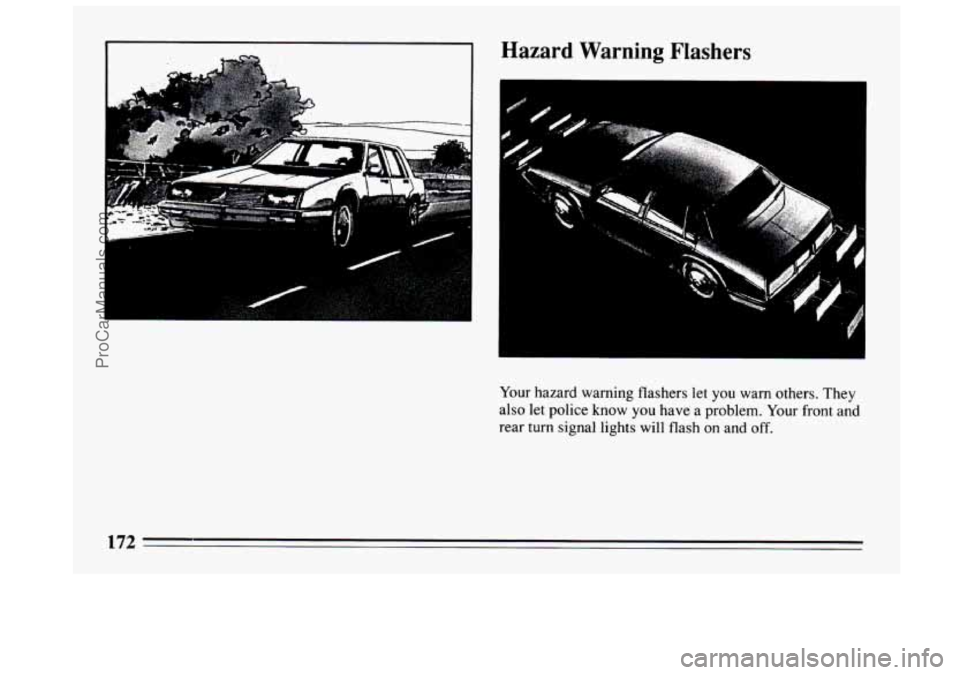
Your hazard warning flashers let you warn others. They
also let police know you have
a problem. Your front and
rear turn signal lights will flash on and
off.
172
ProCarManuals.com
Page 175 of 308
.-
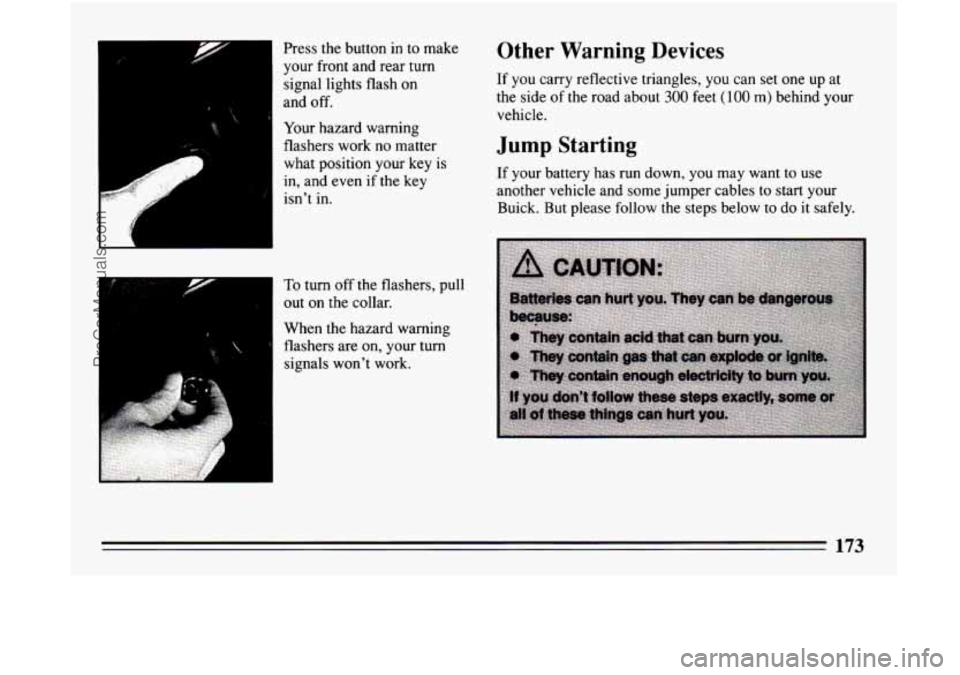
Press the button in to make
your front and rear turn
signal lights flash on
and off.
Your hazard warning
flashers work no matter
what position your key is
in, and even if the key
isn't in.
To turn off the flashers, pull
out on the collar.
When
the hazard warning
flashers are on, your turn
signals won't work.
Other Warning Devices
If you carry reflective triangles, you can set one up at
the side of the road about 300 feet (100 m) behind your
vehicle.
Jump Starting
If your battery has run down, you may want to use
another vehicle and some jumper cables to start your
Buick. But please follow the steps below
to do it safely.
173
ProCarManuals.com
Page 176 of 308
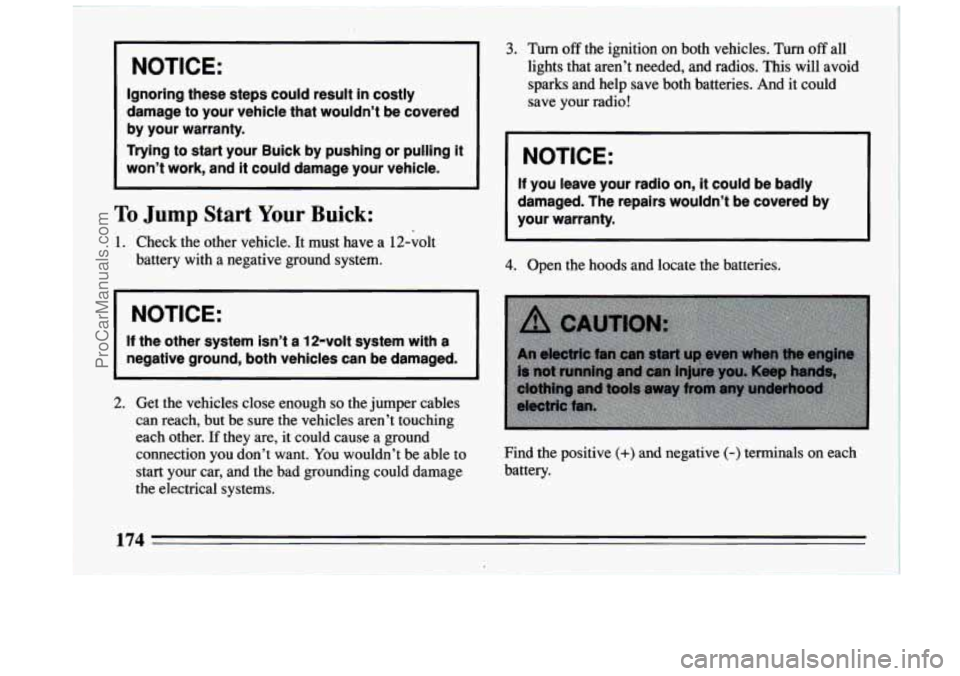
NOTICE:
Ignoring these steps could result in costly
damage to your vehicle that wouldn’t be covered
by your warranty.
Trying to start your Buick by pushing or pulling
it
won’t work, and it could damage your vehicle.
To Jump Start Your Buick:
1. Check the other vehicle. It must have a 12-volt
battery with a negative ground system.
I NOTICE:
I
If the other system isn’t a 12-volt system with a
negative ground, both vehicles can be damaged.
2. Get the vehicles close enough so the jumper cables
can reach, but be sure the vehicles aren’t touching
each other.
If they are, it could cause a ground
connection
you don’t want. You wouldn’t be able to
start your car, and the bad grounding could damage
the electrical systems.
3. Turn off the ignition on both vehicles. Turn off all
lights that aren’t needed, and radios. This will avo
sparks and help save both batteries. And it could
save your radio! ‘id
I NOTICE:
If you
leave your radio on, it could be badly
damaged. The repairs wouldn’t be covered by
your warranty.
4. Open the hoods and locate the batteries.
Find the positive
(+) and nenative (-) terminals on each
battery.
174
ProCarManuals.com
Page 225 of 308
How to Add Fluid
Refer to the Maintenance Schedule to determine what
kind of transaxle fluid
to use. See “Recommended
Fluids and Lubricants” in the Index.
Engine Coolant
If the fluid level is low, add only enough of the proper
fluid to bring the level into the cross-hatched area on the
dipstick.
1. Pull
out the dipstick.
2. Using a long-neck funnel, add enough fluid at the
It doesn’t take much fluid, generally less than a pint
(OSL).
Don’t overfill. We recommend you use only
fluid labeled DEXRON@-I11 or DEXRON@-IIE,
because fluids with that label are made especially for
your automatic transaxle. Damage caused by fluid other
than DEXRON@-I11 or DEXRON@-IIE is
not covered
by your new vehicle warranty. dipstick
hole
to bring it to the proper level.
After adding fluid, recheck the fluid level as
described under “How to Check.”
0 When the correct fluid level is obtained, push the
dipstick back in all the way. The following explains
your cooling system and how to
add coolant when it is low. If you have a problem with
engine overheating or if
you need to add coolant to your
radiator, see “Engine Overheating” in the Index.
The proper coolant for your Buick will:
0 Give freezing protection down to -34°F (-37°C).
0 Give boiling protection up to 262 “F ( 128 “C).
0 Protect against rust and corrosion.
Help keep the proper engine temperature.
0 Let the warning lights work as they should.
What to Use
Use a mixture of one-half clean water (preferably
distilled) and one-half antifreeze that meets “GM
Specification 1825-M,” which won’t damage aluminum
parts.
You can also use a recycled coolant conforming to
GM Specification 1825-M with a complete coolant flush
and refill. If you use this mixture,
you don’t need to add
anything else.
223
ProCarManuals.com
Page 257 of 308
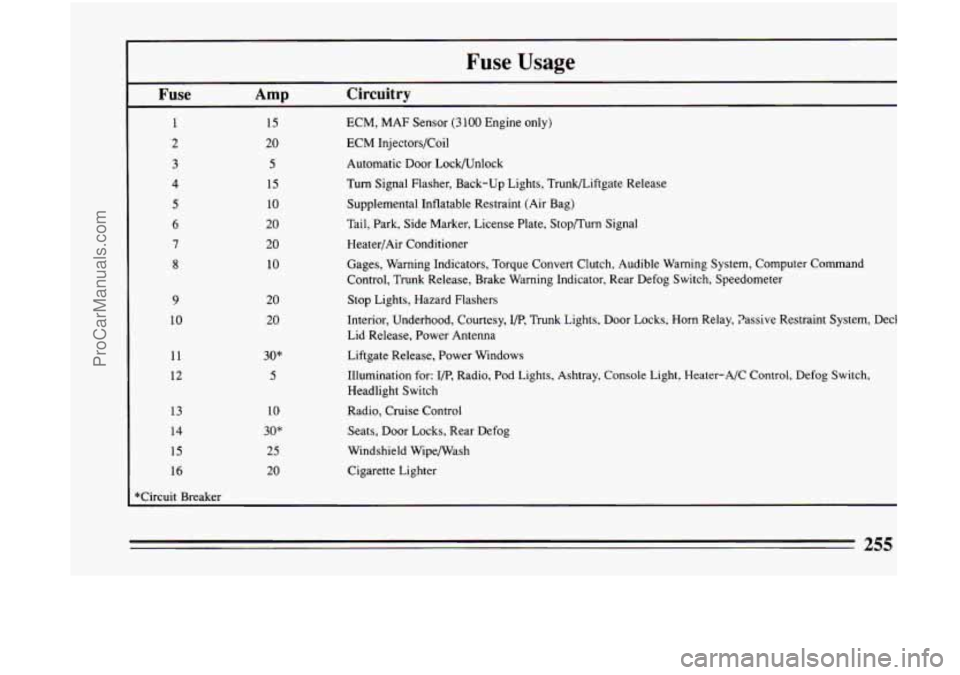
r Fuse Usage
I
Fuse Amp Circuitry
1 15 ECM, MAF Sensor (3 100 Engine only)
2 20 ECM Injectors/Coil
3
4
5
6
7
8
9
10
11
12
13
14
15
I 16
5
15
10
20
20
10
20 20
30"
5
10
30"
25
20
Automatic Door LockAJnlock
Turn Signal Flasher, Back-up Lights, Trunkbiftgate Release
Supplemental Inflatable Restraint (Air Bag)
Tail, Park, Side Marker, License Plate, Stop/Turn Signal Heater/Air Conditioner
Gages, Warning Indicators, Torque Convert Clutch, Audible Warning\
System, Computer Command
Control, Trunk Release, Brake Warning Indicator, Rear Defog Swit\
ch, Speedometer
Stop Lights, Hazard Flashers
Interior, Underhood, Courtesy,
I/P, Trunk Lights, Door Locks, Horn Relay, Passive Restraint System, \
Deck
Lid Release, Power Antenna
Liftgate Release, Power Windows
Illumination for:
I/P, Radio, Pod Lights, Ashtray, Console Light, Heater-A/C Control, D\
efog Switch,
Headlight Switch
Radio, Cruise Control
Seats, Door Locks, Rear Defog
Windshield WipefWash
Cigarette Lighter
255
ProCarManuals.com
Page 258 of 308
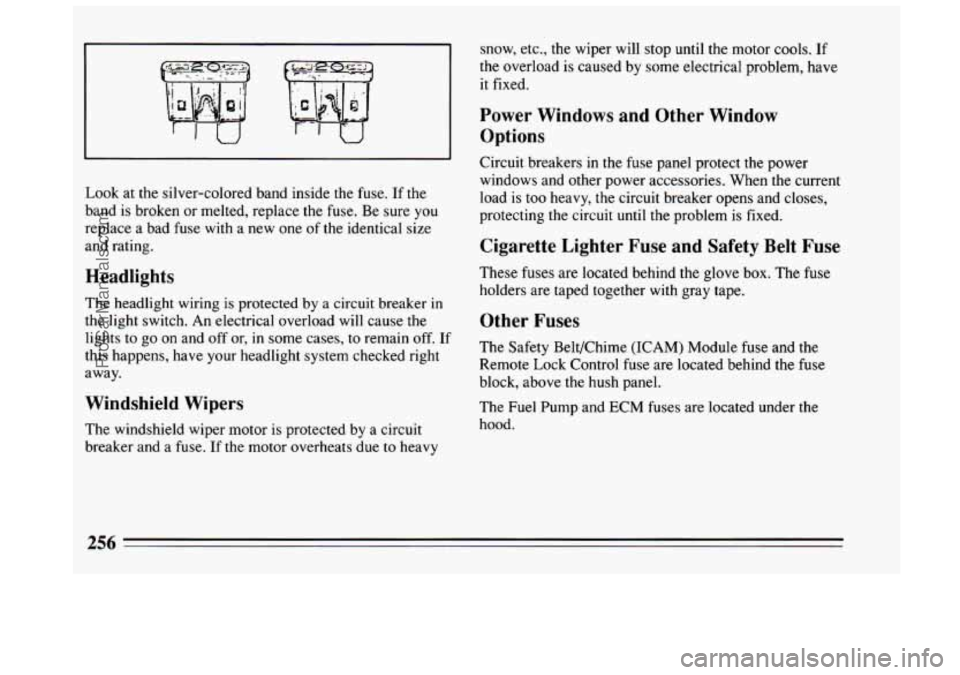
Look at the silver-colored band inside the fuse. If the
band is broken or melted, replace the fuse. Be sure you
replace a bad fuse with a new one of the identical size
and rating.
Headlights
The headlight wiring is protected by a circuit breaker in
the light switch. An electrical overload will cause the
lights
to go on and off or, in some cases, to remain off. If
this happens, have your headlight system checked right
away.
Windshield Wipers
The windshield wiper motor is protected by a circuit
breaker and a fuse.
If the motor overheats due to heavy snow, etc.,
the wiper will stop until the motor cools.
If
the overload is caused by some electrical problem, have
it fixed.
Power Windows and Other Window
Options
Circuit breakers in the fuse panel protect the power
windows and other power accessories. When the current
load is too heavy, the circuit breaker opens and closes,
protecting
the circuit until the problem is fixed.
Cigarette Lighter Fuse and Safety Belt Fuse
These fuses are located behind the glove box. The fuse
holders are taped together with gray tape.
Other Fuses
The Safety Belt/Chime (ICAM) Module fuse and the
Remote Lock Control fuse are located behind the fuse
block, above the hush panel.
The Fuel Pump and
ECM fuses are located under the
hood.
256
ProCarManuals.com
Page 295 of 308
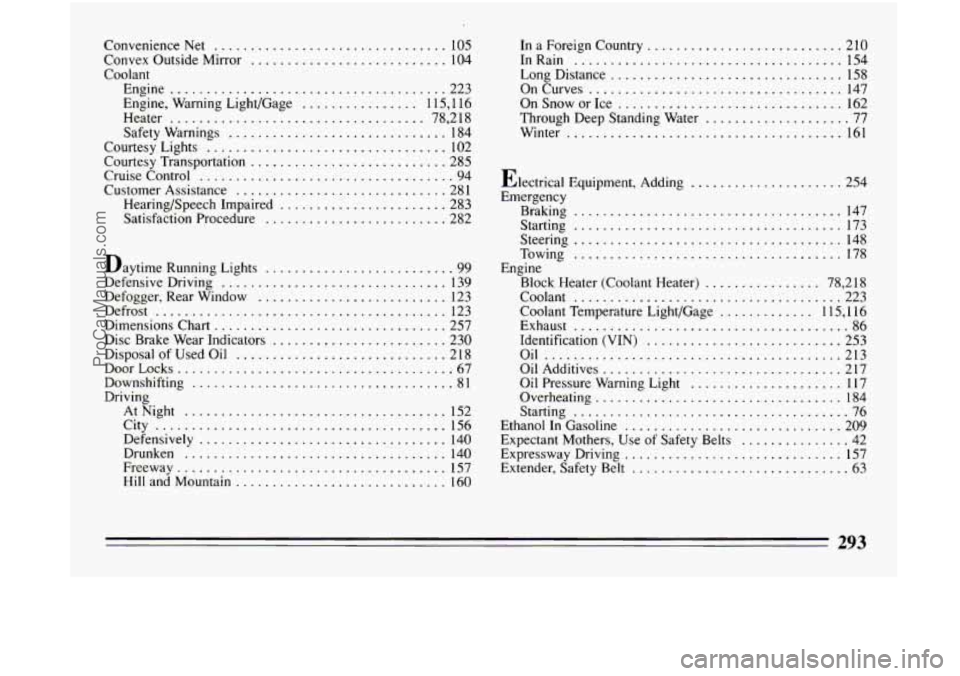
ConvenienceNet ................................ 105
Convex Outside Mirror
........................... 104
Coolant Engine
...................................... 223
Engine. Warning Light/Gage
................ 115. 116
Heater
................................... 78. 2 1 8
Safety Warnings
.............................. 184
Courtesy Lights
................................. 102
Courtesy Transportation
........................... 285
Cruise Control
................................... 94
Customer Assistance
............................. 28 1
HearindSpeech Impaired
....................... 283
Satisfaction Procedure
......................... 282
Daytime Running Lights
.......................... 99
Defensive Driving
............................... 139
Defogger. Rear Window
.......................... 123
Defrost
........................................ 123
Dimensions Chart
................................ 257
Disc Brake Wear Indicators
........................ 230
DoorLocks
...................................... 67
Driving Disposal of Used Oil
............................. 218
Downshifting
.................................... 8 1
AtNight .................................... 152
City
........................................ 156
Defensively
.................................. 140
Drunken
.................................... 140
Freeway
..................................... 157
Hill and Mountain ............................. 160 In
a Foreign Country
........................... 210
InRain
..................................... 154
Long Distance
................................ 158
OnCurves
................................... 147
On Snow or Ice
............................... 162
Through Deep Standing Water
.................... 77
Winter
...................................... 161
Electrical Equipment. Adding
..................... 254
Emergency Braking
..................................... 147
Starting
..................................... 173
Steering
..................................... 148
Towing
..................................... 178
Engine Block Heater (Coolant Heater)
................ 78. 218
Coolant
..................................... 223
Coolant Temperature Light/Gage
............. 1116 15.
Exhaust
...................................... 86
Identification
(VIN) ........................... 253
Oil
......................................... 213
Oil Additives
................................. 217
Oil Pressure Warning Light ..................... 117
Overheating
.................................. 184
Starting
...................................... 76
Ethanol
In Gasoline .............................. 209
Expectant Mothers. Use
of Safety Belts ............... 42
Expressway Driving
.............................. 157
Extender. Safety Belt
.............................. 63
293
ProCarManuals.com
Page 296 of 308
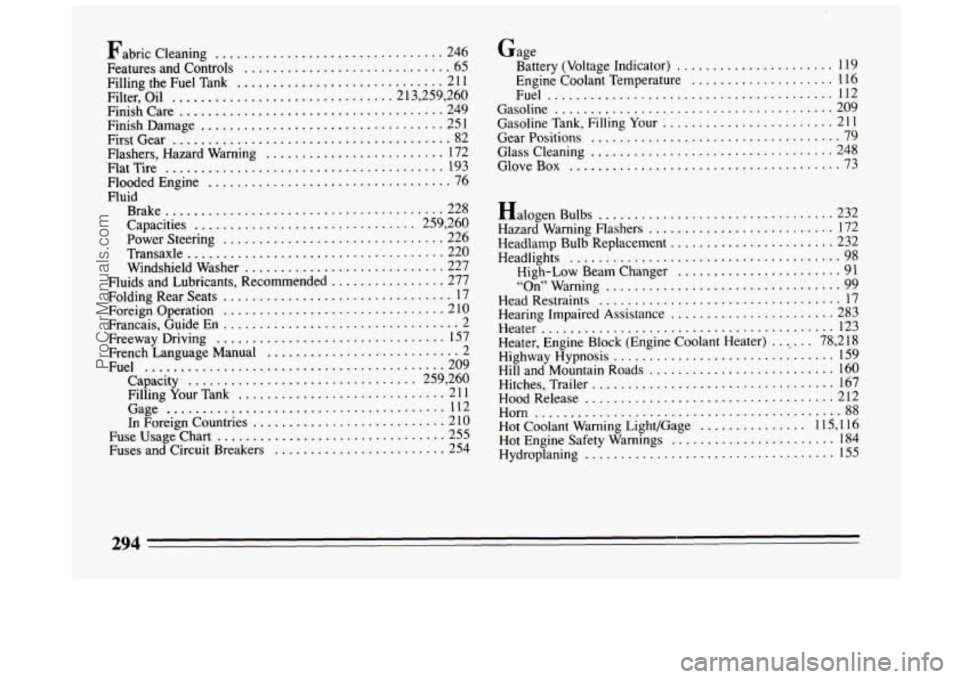
Fabric Cleaning ................................ 246
Features and Controls ............................. 65
Filling
the Fuel Tank ............................. 21 1
Filter. Oil ............................... 2 13.259. 260
Finish Care
..................................... 249
Finish Damage
.................................. 25 1
First Gear
....................................... 82
Flashers. Hazard Warning
......................... 172
Flat Tire
....................................... 193
FloodedEngine
.................................. 76
Fluid Brake
....................................... 228
Capacities
............................... 259. 260
Power Steering ............................... 226
Transaxle
.................................... 220
Windshield Washer
............................ 227
Fluids and Lubricants. Recommended
................ 277
Folding Rear Seats
................................ 17
Foreign Operation
............................... 2 10
Francais. Guide En ................................. 2
Freeway Driving
................................ 157
French Language Manual ........................... 2
Fuel
.......................................... 209
Capacity
................................ 259. 260
FillingYourTank
............................. 211
Gage
....................................... 112
In Foreign Countries
........................... 210
Fuse Usage Chart ................................ 255
Fuses and Circuit Breakers ........................ 254
Gage
Battery (Voltage Indicator)
...................... 119
Engine Coolant Temperature
.................... 116
Fuel ........................................ 112
Gasoline
....................................... 209
Gasoline Tank. Filling Your
........................ 211
Gear Positions
................................... 79
Glass Cleaning
.................................. 248
GloveBox
...................................... 73
Halogen Bulbs
................................. 232
Hazard Warning Flashers
.......................... 172
Headlamp Bulb Replacement
....................... 232
High-Low Beam Changer
....................... 91
“On” Warning ................................. 99
Head Restraints
.................................. 17
Hearing Impaired Assistance
....................... 283
Heater
......................................... 123
Highway Hypnosis
............................... 159
Hill and Mountain Roads
.......................... 160
Hitches. Trailer .................................. 167
Hood Release
................................... 212
Hot Coolant Warning Light/Gage
............... 11 5. 116
Hot Engine Safety Warnings
....................... 184
Headlights
...................................... 98
Heater. Engine Block (Engine Coolant Heater)
.. ., ... 78, 218
Horn
........................................... 88
Hydroplaning ................................... 155
294
ProCarManuals.com