lights BUICK CENTURY 1994 User Guide
[x] Cancel search | Manufacturer: BUICK, Model Year: 1994, Model line: CENTURY, Model: BUICK CENTURY 1994Pages: 308, PDF Size: 16.3 MB
Page 103 of 308
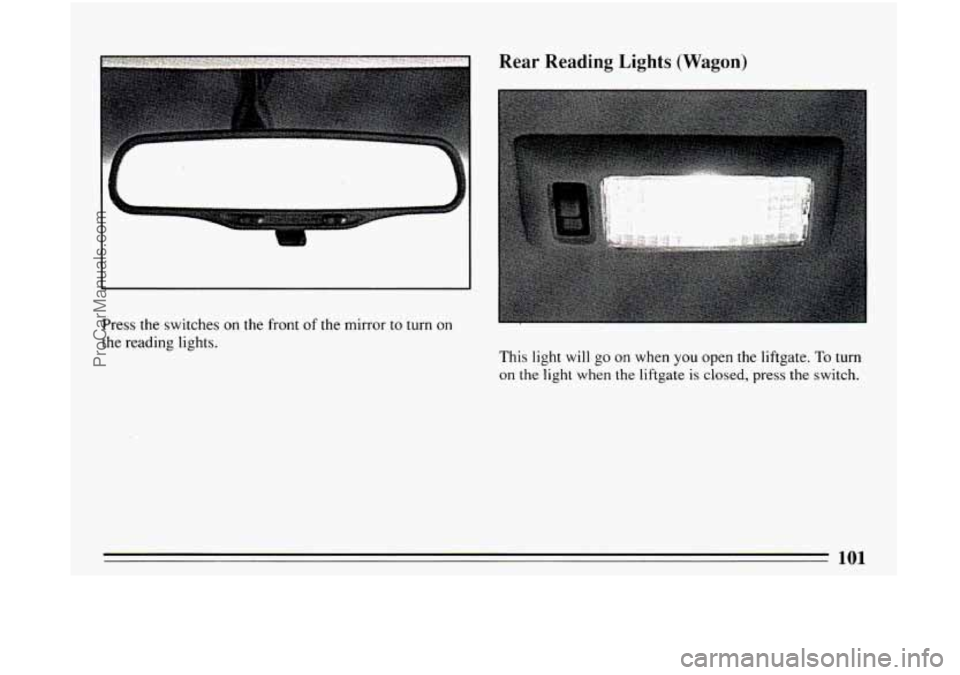
Press the switches on the front of the mirror to turn on
the reading lights.
Rear Reading Lights (Wagon)
This light will go on when you open the liftgate. To turn
on the light when the liftgate is closed, press the switch.
1 A1
ProCarManuals.com
Page 104 of 308
Interior Lights Delay
When you pull on the driver’s outside door handle, the
dome and courtesy lights will go on and stay on for
about
40 seconds, or until you turn the ignition on.
If you pull on the driver’s inside door handle within 30
seconds of switching off the ignition, the interior lights
will go
on and stay on for about 5 seconds, to allow you
to unlock your door(s).
Courtesy Lights
When any door is opened, several lights go on. These
lights are under
the instrument panel. Optional lights are
on the rear doors. They make it easy for you to enter and
leave
the vehicle. You also can turn these lights on by
rotating the interior lights switch to
“HI.”
Mirrors
Inside Mirror
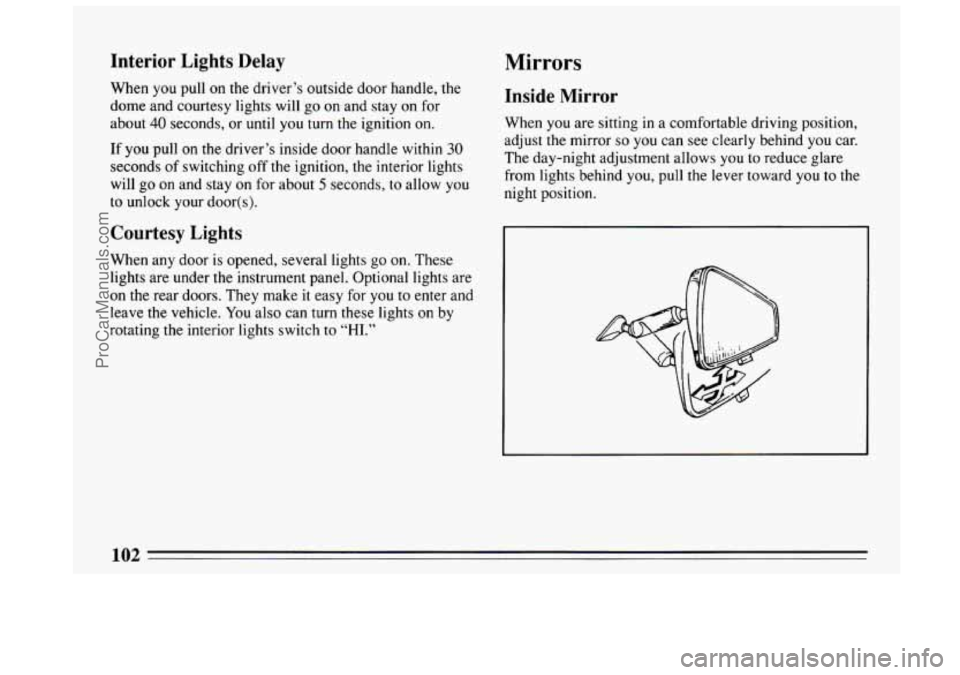
When you are sitting in a comfortable driving position,
adjust the mirror
so you can see clearly behind you car.
The day-night adjustment allows
you to reduce glare
from lights behind you, pull the lever toward
you to the
night position.
1 A3
ProCarManuals.com
Page 106 of 308
Convex Outside Mirror Lighted Visor Vanity Mirror (Option)
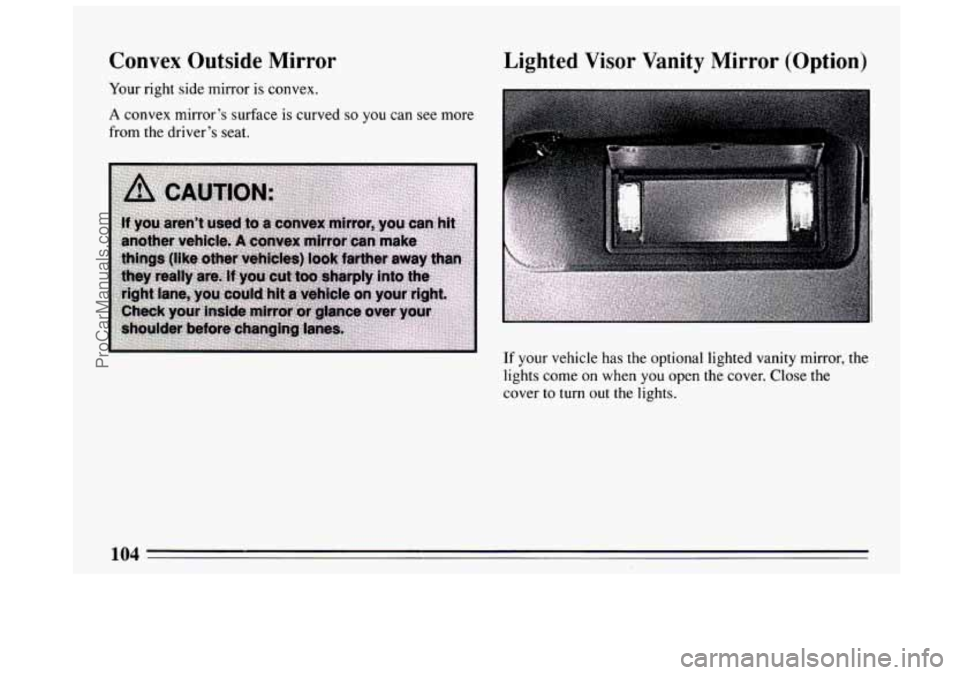
Your right side mirror is convex.
A convex mirror’s surface is curved so you can see more
from the driver’s seat.
If your vehicle has the optional lighted vanity mirror, the
lights come
on when you open the cover. Close the
cover
to turn out the lights.
104
ProCarManuals.com
Page 113 of 308
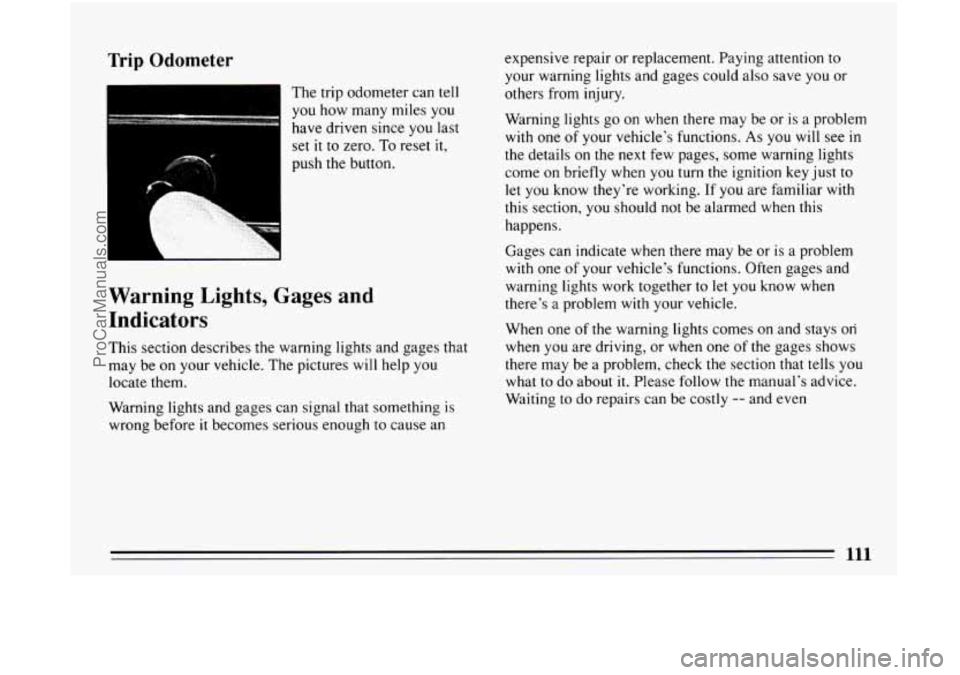
Trip Odometer
The trip odometer can tell
you how many miles you
have driven since you last
set
it to zero. To reset it,
push the button.
L
Warning Lights, Gages and
Indicators
This section describes the warning lights and gages that
may be on your vehicle. The pictures will help you
locate them.
Warning lights and gages can signal that something
is
wrong before it becomes serious enough to cause an expensive
repair or replacement. Paying attention to
your warning lights and gages could also save you or
others from injury.
Warning lights go on when there may be or is a problem
with one of
your vehicle’s functions. As you will see in
the details on the next few pages, some warning lights
come
on briefly when you turn the ignition key just to
let you know they’re working. If you are familiar with
this section,
you should not be alarmed when this
happens.
Gages can indicate when there may be
or is a problem
with one
of your vehicle’s functions. Often gages and
warning lights work together to let you know when
there’s a problem with your vehicle.
When one of the warning lights comes on and stays
on
when you are driving, or when one of the gages shows
there may be a problem, check
the section that tells you
what to do about it. Please follow the manual’s advice.
Waiting to
do repairs can be costly -- and even
111
ProCarManuals.com
Page 114 of 308
dangerous. So please get to know your warning lights
and gages. They’re a big help.
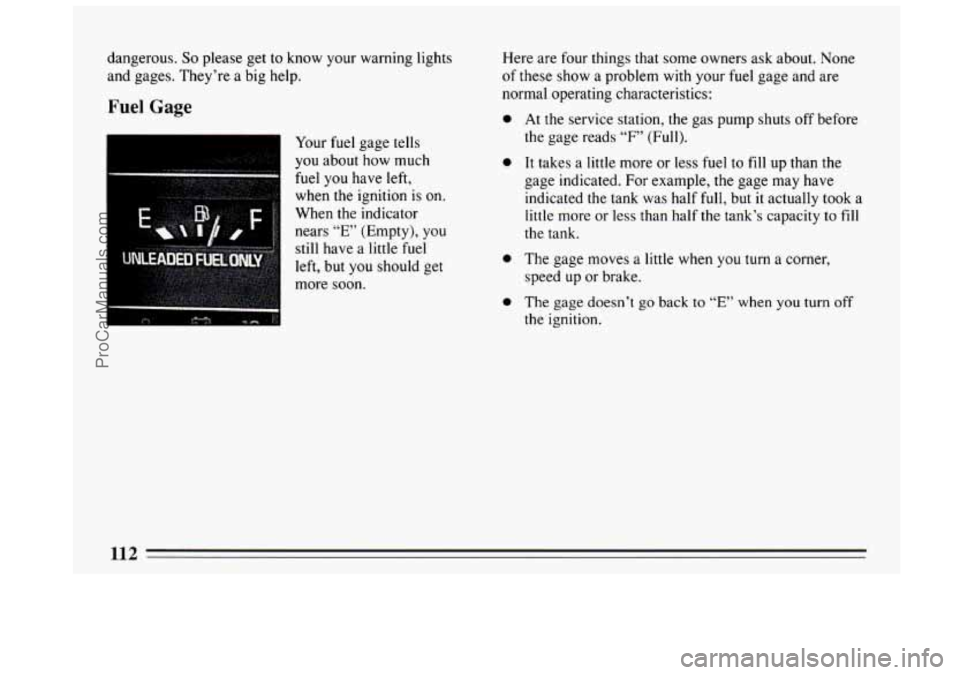
Fuel Gage
I
Your fuel gage tells
you about how much
fuel you have left,
when
the ignition is on.
When the indicator
nears
“E” (Empty), you
still have a little fuel
left, but you should get
more soon. Here
are four things that some owners ask about. None
of these show a problem with your fuel gage and are
normal operating characteristics:
0
0
0
0
At the service station, the gas pump shuts off before
the gage reads
“F” (Full).
It takes a
little more or less fuel to fill up than the
gage indicated. For example,
the gage may have
indicated the tank was half
full, but it actually took a
little more or less than half the tank’s capacity to
fill
the tank.
The gage moves a little when you
turn a corner,
speed up or brake.
The gage doesn’t go back to
“E” when you turn off
the ignition.
112
ProCarManuals.com
Page 153 of 308
e If other cars are lined up to pass a slow vehicle, wait
your turn. But take care that someone isn’t trying to
pass you as you pull
out to pass the slow vehicle.
Remember to glance over your shoulder and check
the blind spot.
e Check your mirrors, glance over your shoulder, and
start your left lane change signal before moving out
of the right lane to pass. When
you are far enough
ahead of the passed vehicle to see
its front in your
inside mirror, activate your right lane change signal
and move back into the right lane. (Remember that
your right outside mirror is convex. The vehicle you
just passed may seem to be farther away from you
than
it really is.)
two-lane roads. Reconsider before passing the next
vehicle.
Try not to pass more than one vehicle at a time on
e Don’t overtake a slowly moving vehicle too rapidly.
Even though the brake lights are
not flashing, it may
be slowing down or starting to
turn.
If you’re being passed, make it easy for the
following driver to get ahead of you. Perhaps you
can ease a
little to the right.
Loss of Control
Let’s review what driving experts say about what
happens when the three control systems (brakes, steering
and acceleration) don’t have enough friction where the
tires meet the road to do what the driver has asked.
In any emergency, don’t give
up. Keep trying to steer
and constantly seek an escape route or area
of less
danger.
Skidding
In a skid, a driver can lose control of the vehicle.
Defensive drivers avoid most skids by taking reasonable
care suited to existing conditions, and by not
“overdriving” those Conditions. But skids are always
possible.
The three types
of skids correspond to your Buick’s
three control systems. In the braking skid your wheels
aren’t rolling. In the steering
or cornering skid, too
much speed or steering
in a curve causes tires to slip and
lose cornering force. And in the acceleration skid too
much
throttle causes the driving wheels to spin.
A cornering skid and an acceleration skid are best
handled by easing your foot off the accelerator pedal.
151
ProCarManuals.com
Page 155 of 308
0
0
0
0
0
Adjust your inside rearview mirror to reduce the
glare from headlights behind you.
Since you can’t see as well, you may need to slow
down and keep more space between you and other
vehicles.
Slow down, especially on higher speed roads. Your
headlights can light up only
so much road ahead.
In remote areas, watch for animals.
If you’re tired,
pull off the road in a safe place and
rest.
Night Vision
No one can see as well at night as in the daytime. But as
we get older these differences increase. A 50-year-old
driver may require at least twice as much light
to see the
same thing at night as a 20-year-old.
What you
do in the daytime can also affect your night
vision. For example,
if you spend the day in bright
sunshine you are wise to wear sunglasses. Your eyes
will
have less trouble adjusting to night. But if you’re
driving, don’t wear sunglasses at night. They may cut
down on glare from headlights, but they also make a lot
of things invisible. You
can be temporarily blinded by approaching lights.
It can take a second or two, or
even several seconds, for
your eyes to readjust to the dark. When
you are faced
with severe glare (as from a driver who doesn’t lower
the high beams, or a vehicle with misaimed headlights),
slow down a little. Avoid staring directly into the
approaching lights.
Keep your windshield and all the glass on your vehicle
clean
-- inside and out. Glare at night is made much
worse by dirt
on the glass. Even the inside of the glass
can build up a film caused by dust. Dirty glass makes
lights dazzle and flash more than clean glass would,
making the pupils of your eyes contract repeatedly.
Remember that your headlights light up far less of a
roadway when
you are in a turn or curve. Keep your
eyes moving; that way, it’s easier to pick
out dimly
lighted objects. Just as your headlights should be
checked regularly
for proper aim, so should your eyes
be examined regularly. Some drivers suffer from night
blindness
-- the inability to see in dim light -- and
aren’t even aware
of it.
153
ProCarManuals.com
Page 158 of 308
more is low. It can happen if a lot of water is standing
on the road. If you can see reflections from trees,
telephone poles, or other vehicles, and raindrops
“dimple” the water’s surface, there could be
hydroplaning.
Hydroplaning usually happens at higher speeds. There
just isn’t a hard and fast rule about hydroplaning. The
best advice is to slow down when it is raining.
Some Other Rainy Weather Tips
0 Turn on your low-beam headlights -- not just your
parking lights
-- to help make you more visible to
others.
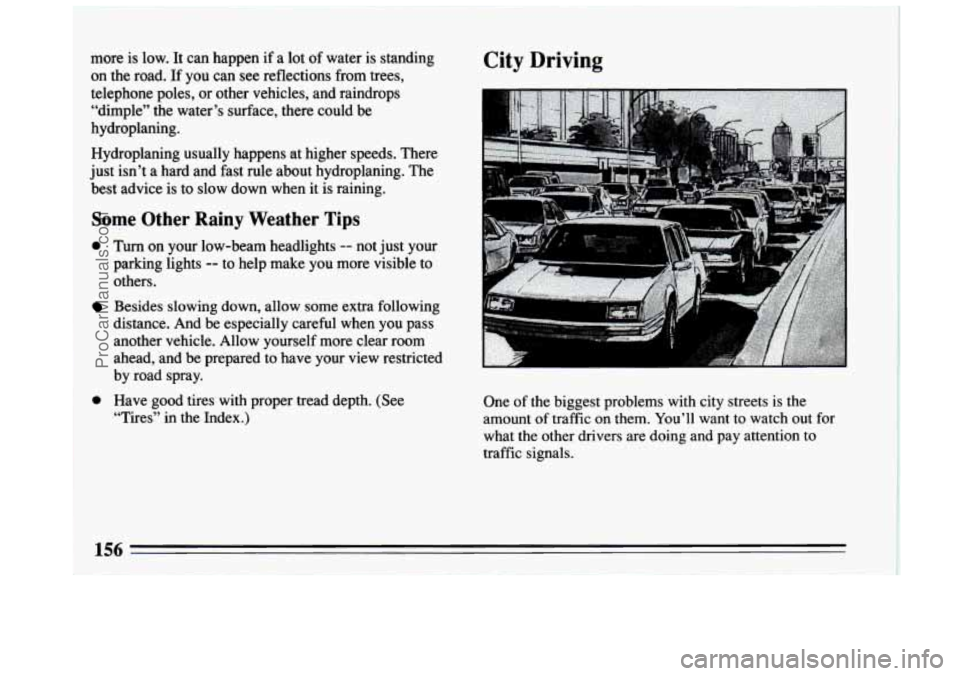
City Driving
I
Besides slowing down, allow some extra following
distance. And be especially careful when you pass
another vehicle. Allow yourself more clear room
ahead, and be prepared to have your view restricted
by road spray.
0 Have good tires with proper tread depth. (See
“Tires” in the Index.) One
of the biggest problems with city streets is the
amount of traffic on them. You’ll want
to watch out for
what the other drivers are doing and pay attention to
traffic signals.
156
ProCarManuals.com
Page 161 of 308
Here are some things you can check before a trip:
Windshield Washer Fluid: Is the reservoir full? Are
all windows clean inside and outside?
0 Wiper Blades: Are they in good shape?
Fuel. Engine Oil. Other Fluids: Have you checked all
levels?
Lights: Are they all working? Are the lenses clean?
0 Tires: They are vitally important to a safe,
trouble-free trip.
Is the tread good enough for
long-distance driving? Are the tires all inflated to the
recommended pressure?
0 Weather Forecasts: What’s the weather outlook along
your route? Should you delay your trip a short time
to avoid
a major storm system?
0 Maps: Do you have up-to-date maps?
Highway Hypnosis
Is there actually such a condition as “highway
hypnosis”? Or is it
just plain falling asleep at the wheel?
Call it highway hypnosis, lack of awareness,
or
whatever. There
is something
about an easy stretch of road with
the same scenery, along with the hum of the tires on the
road, the drone of the engine, and the rush of the wind
against the vehicle that can make you sleepy. Don’t let it
happen to
you! If it does, your vehicle can leave the
road
in less than a second, and you could crash and be
injured.
What can you
do about highway hypnosis? First, be
aware that it can happen.
Then here are some tips:
Make sure your vehicle is well ventilated, with a
comfortably cool interior.
0 Keep your eyes moving. Scan the road ahead and to
the sides. Check your rearview mirrors and your
instruments frequently.
0 If you get sleepy, pull off the road into a rest, service,
or parking area and take a nap, get some exercise, or
both. For safety, treat drowsiness on the highway as
an emergency.
159
ProCarManuals.com
Page 166 of 308
bags, rags, floor mats -- anything you can wrap around
yourself or tuck under your clothing
to keep warm.
You
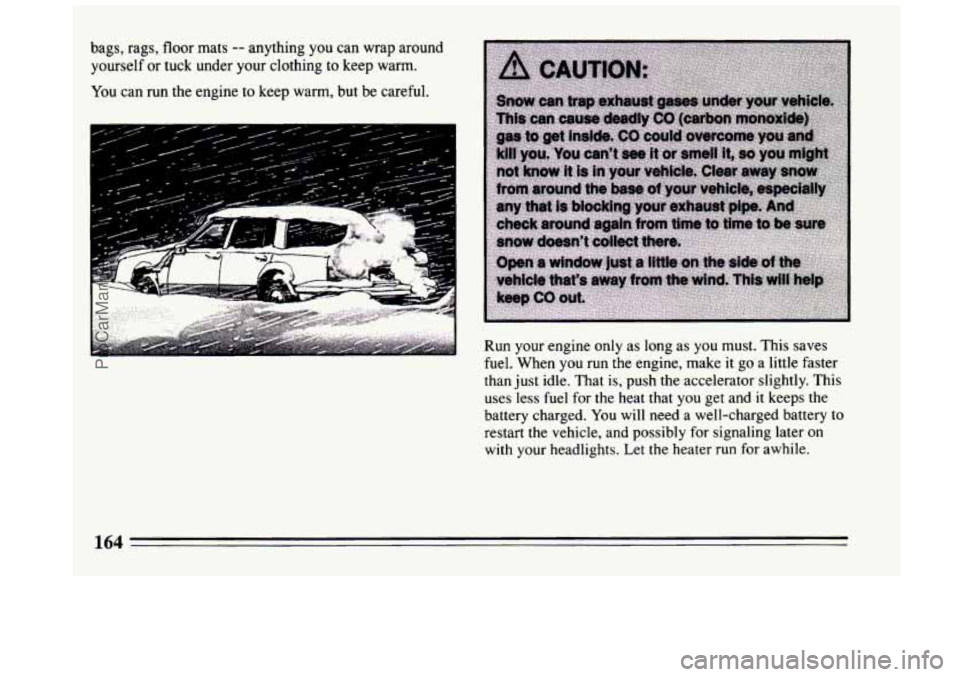
can run the engine to keep warm, but be careful.
Run your engine only as long as
you must. This saves
fuel. When you run the engine, make it go a little faster
than just idle. That is, push the accelerator slightly. This
uses less fuel for the heat that you get and it keeps the
battery charged.
You will need a well-charged battery to
restart the vehicle, and possibly for signaling later
on
with your headlights. Let the heater run for awhile.
164
ProCarManuals.com