belt BUICK CENTURY 1994 Service Manual
[x] Cancel search | Manufacturer: BUICK, Model Year: 1994, Model line: CENTURY, Model: BUICK CENTURY 1994Pages: 308, PDF Size: 16.3 MB
Page 120 of 308
NOTICE:
Damage to your engine from neglected oil
problems can be costly and is not covered by
your warranty.
Battery Light
Then it should go out. If it stays on, or corn-es 6n %bile
you are driving, you may have a problem with the
electrical charging system. It could indicate that
you
have a loose generator drive belt or another electrical
problem. Have
it checked right away. Driving while this
light is on could drain your battery.
If you must drive a short distance with the light on, be
certain
to turn off all your accessories, such as the radio
and air conditioner.
The battery warning light
will come on briefly when
you turn on the ignition, but
the engine
is not running,
as a check to
show you it is
working.
118
ProCarManuals.com
Page 142 of 308
Defensive Driving
The best advice anyone can give about driving is: Drive
defensively.
Please start with a very important safety device
in your
Buick: Buckle up. (See “Safety Belts”
in the Index.)
Defensive driving really means “be ready for anything.”
On city streets, rural roads, or freeways, it means
“always expect the unexpected.” Assume that pedestrians
or other drivers are going
to be
careless and make mistakes. Anticipate what they might
do. Be ready for their mistakes. -.
Rear-end collisions are about the most preventable of
accidents. Yet they are common. Allow enough
following distance. It’s the best defensive driving
maneuver,
in both city and rural driving. You never
know when the vehicle
in front of you is going to brake
or turn suddenly.
Drunken Driving
Death and injury associated with drinking and driving is
a national tragedy. It’s the number one contributor to the
highway death toll, claiming thousands of victims every
year. Alcohol takes away three things that anyone needs
to drive a vehicle:
Judgment
0 Muscular Coordination
Vision
Police records show that almost half of all motor
vehicle-related deaths involve alcohol
- a driver, a
passenger or someone else, such
as a pedestrian, had
140
ProCarManuals.com
Page 151 of 308
Off-Road Recovery
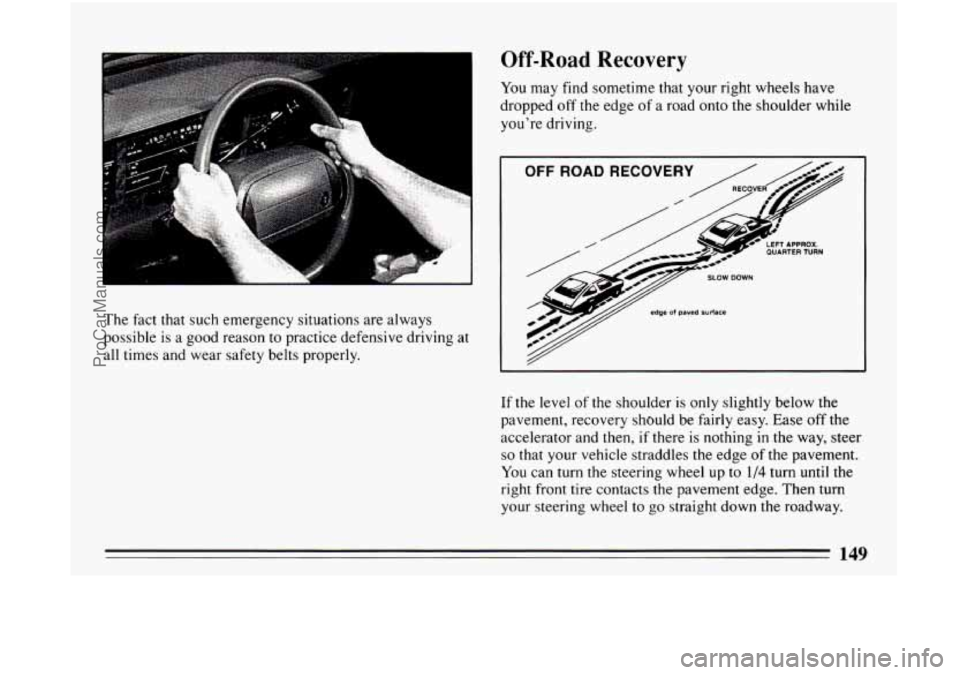
You may find sometime that your right wheels have
dropped off the edge of
a road onto the shoulder while
you're driving.
OFF ROAD RECOVERY
/ /
The fact that such emergency situations are always
possible is a good reason
to practice defensive driving at
all times and wear safety belts properly.
If the level of the shoulder is only slightly below the
pavement, recovery should be fairly easy. Ease off the
accelerator and then,
if there is nothing in the way, steer
so that your vehicle straddles the edge of the pavement.
You can turn the steering wheel up to
1/4 turn until the
right front tire contacts the pavement edge. Then
turn
your steering wheel to go straight down the roadway.
149
ProCarManuals.com
Page 172 of 308
Parking on Hills
You really should not park your vehicle, with a trailer
attached, on
a hill. If something goes wrong, your rig
could
start to move. People can be injured, and both
your,vehicle and the trailer can be damaged.
But if
you ever have to park your rig on a hill, here’s
how to do it:
1. Apply your regular brakes, but don’t shift into
“P”
(Park) yet.
2. Have someone place chocks under the trailer wheels.
3. When the wheel chocks are in place, release the
regular brakes until the chocks absorb
the load.
4. Reapply the regular brakes. Then, apply your
parking brake, and then shift to
“P” (Park).
5. Release the regular brakes.
When You Are Ready to Leave After
Parking on a Hill
1. Apply your regular brakes and hold the pedal down
while you:
Start your engine;
Shift into a gear; and
Release the parking brake.
2. Let up on the brake pedal.
3. Drive slowly until the trailer is clear of the chocks.
4. Stop and have someone pick up and store the chocks.
Maintenance When Trailer Towing
Your vehicle will need service more often when you’re
pulling a trailer. See the Maintenance Schedule for more
on this. Things that are especially important in trailer
operation are automatic transaxle fluid (don’t overfill),
engine oil, belt, cooling system, and brake adjustment.
Each of these
is covered in this manual, and the Index
will help
you find them quickly. If you’re trailering, it’s
a good idea to review these sections before you start
your trip.
Check periodically to see that all hitch nuts and bolts are
tight.
170
ProCarManuals.com
Page 243 of 308
When It’s Time for New Tires
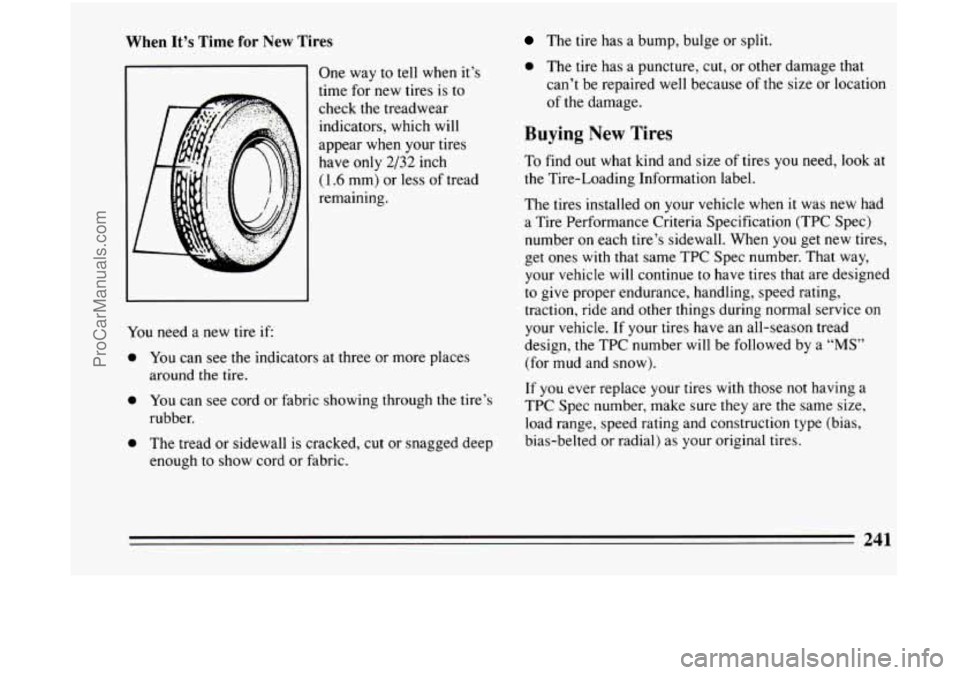
One way to tell when it’s
time for new tires is to
check the treadwear
indicators, which will
appear when your tires
have
only 2/32 inch
(1.6 mm) or less of tread
remaining.
You need a new tire if
0 You can see the indicators at three or more places
around the tire.
0 You can see cord or fabric showing through the tire’s
rubber.
0 The tread or sidewall is cracked, cut or snagged deep
enough to show cord or fabric.
The tire has a bump, bulge or split.
0 The tire has a puncture, cut, or other damage that
can’t be repaired well because of the size or location
of the damage.
Buying New Tires
To find out what kind and size of tires you need, look at
the Tire-Loading Information label.
The tires installed on your vehicle when it was new had
a Tire Performance Criteria Specification (TPC Spec)
number on each tire’s sidewall. When you get new tires,
get ones with that same TPC Spec number. That way,
your vehicle will continue to have tires that are designed
to give proper endurance, handling, speed rating,
traction, ride and other things during normal service on
your vehicle. If your tires have an all-season tread
design, the TPC number
will be followed by a “MS”
(for mud and snow).
If you ever replace your tires with those not having a
TPC Spec number, make sure they are the same size,
load range, speed rating and construction type (bias,
bias-belted or radial) as your original tires.
241
ProCarManuals.com
Page 250 of 308
Cleaning Leather
Use a soft cloth with lukewarm water and a mild soap or
saddle soap.
For stubborn stains, use a mild solution of 10%
isopropyl alcohol (rubbing alcohol) and
90% water.
Never use oils, varnishes, solvent-based or abrasive
cleaners, furniture polish or shoe polish on leather.
Soiled leather should be cleaned immediately. If dirt
is allowed to work into finish, it can harm the
leather.
Cleaning the Top of the Instrument Panel
Use only mild soap and water to clean the top surfaces
of the instrument panel. Sprays containing silicones or
waxes may cause annoying reflections in
the windshield
and even make it difficult to see through the windshield
under certain conditions.
Care of Safety Belts
Keep belts clean and dry.
Glass
Glass should be cleaned often. GM Glass Cleaner (GM
Part No. 1050427) or a liquid household glass cleaner
will remove normal tobacco smoke and
dust films.
Don’t use abrasive cleaners on glass, because they may
cause scratches. Avoid placing decals on the inside rear
window, since they may have to be scraped
off later. If
abrasive cleaners are used on the inside of the rear
window, an electric defogger element may be damaged.
Any temporary license should not be attached across the
defogger grid.
248
ProCarManuals.com
Page 258 of 308
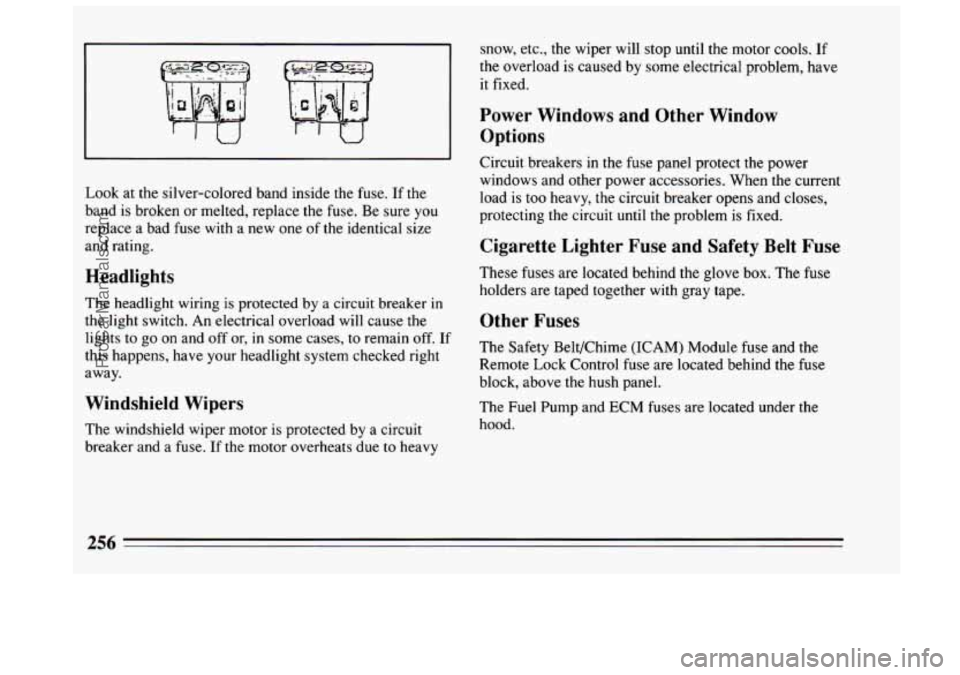
Look at the silver-colored band inside the fuse. If the
band is broken or melted, replace the fuse. Be sure you
replace a bad fuse with a new one of the identical size
and rating.
Headlights
The headlight wiring is protected by a circuit breaker in
the light switch. An electrical overload will cause the
lights
to go on and off or, in some cases, to remain off. If
this happens, have your headlight system checked right
away.
Windshield Wipers
The windshield wiper motor is protected by a circuit
breaker and a fuse.
If the motor overheats due to heavy snow, etc.,
the wiper will stop until the motor cools.
If
the overload is caused by some electrical problem, have
it fixed.
Power Windows and Other Window
Options
Circuit breakers in the fuse panel protect the power
windows and other power accessories. When the current
load is too heavy, the circuit breaker opens and closes,
protecting
the circuit until the problem is fixed.
Cigarette Lighter Fuse and Safety Belt Fuse
These fuses are located behind the glove box. The fuse
holders are taped together with gray tape.
Other Fuses
The Safety Belt/Chime (ICAM) Module fuse and the
Remote Lock Control fuse are located behind the fuse
block, above the hush panel.
The Fuel Pump and
ECM fuses are located under the
hood.
256
ProCarManuals.com
Page 261 of 308
Capacities and Specifications
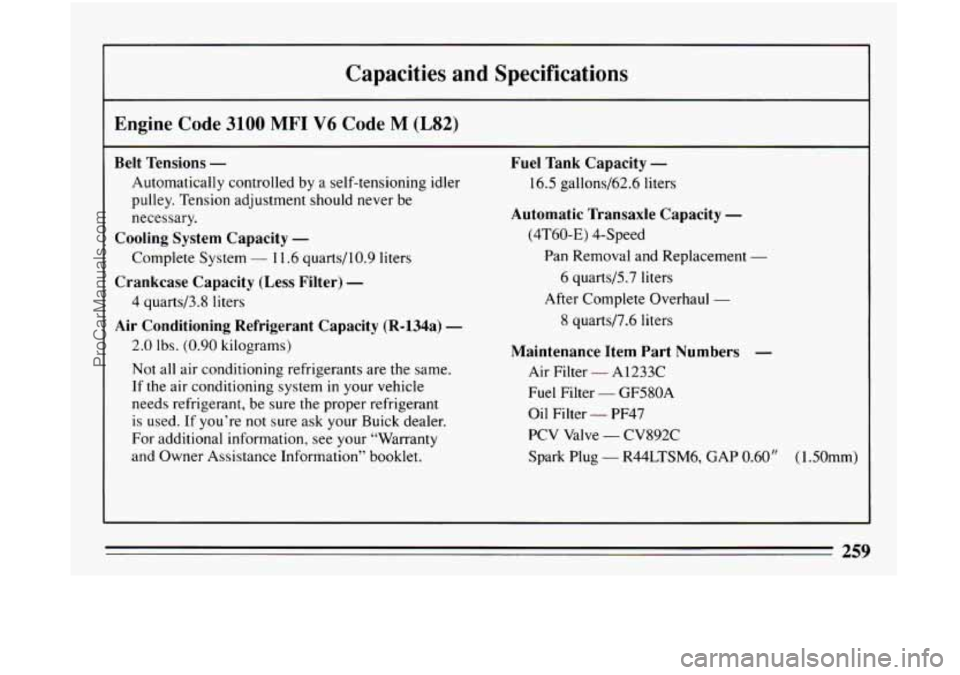
Engine Code 3100 MFI V6 Code M (L82)
Belt Tensions - Fuel Tank Capacity -
Automatically controlled by a self-tensioning idler 16.5 gallons/62.6 liters
pulley. Tension adjustment should never be
Automatic Transaxle Capacity -
(4T60-E) 4-Speed
necessary.
Complete System
- 1 1.6 quarts/l0.9 1
Cooling System Capacity -
Crankcase Capacity (Less Filter) -
4 quarts/3.8 liters iters
Air
Conditioning Refrigerant Capacity (R-134a) -
2.0 lbs. (0.90 kilograms)
Not all air conditioning refrigerants are the same.
If the air conditioning system
in your vehicle
needs refrigerant, be sure
the proper refrigerant
is used.
If you’re not sure ask your Buick dealer.
For additional information, see your “Warranty
and Owner Assistance Information’’ booklet. Pan
Removal and Replacement
-
6 quarts/5.7 liters
8 quarts/7.6 liters
After
Complete Overhaul
-
Maintenance Item Part Numbers -
Air Filter - A1233C
Fuel Filter
- GF580A
Oil Filter
- PF47
PCV Valve
- CV892C
Spark Plug
- R44LTSM6, GAP 0.60” (1 SOmm)
3 rn
ProCarManuals.com
Page 262 of 308
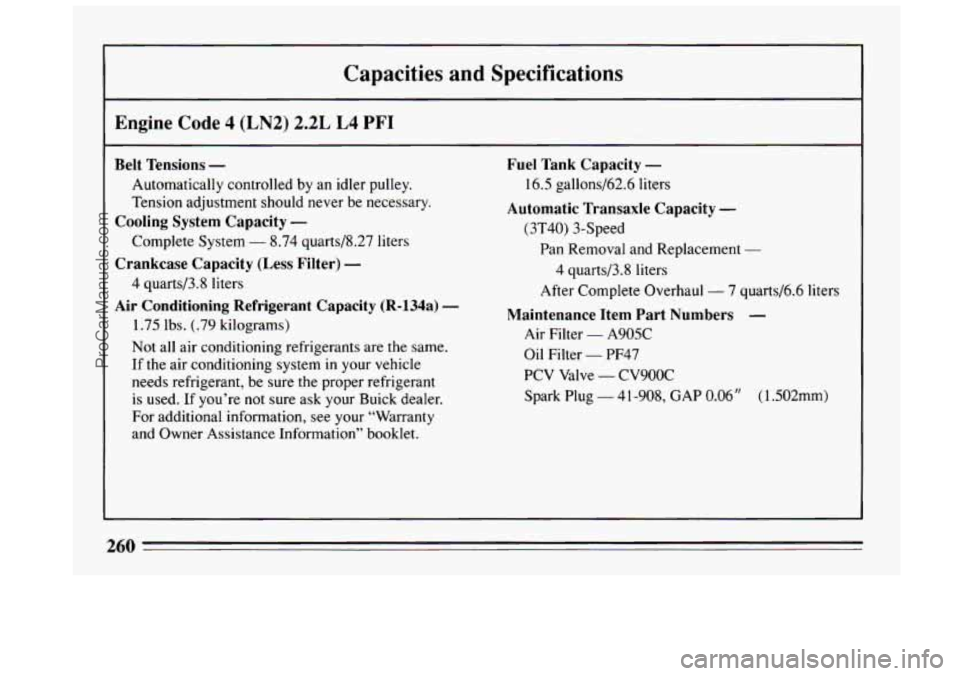
Capacities and Specifications
I
I Engine Code 4 (LN2) 2.2L L4 PFI
Belt Tensions -
Automatically controlled by an idler pulley.
Tension adjustment should never be necessary.
Cooling System Capacity -
Complete System - 8.74 quarts/8.27 liters
Crankcase Capacity (Less Filter) -
4 quarts/3.8 liters
Air Conditioning Refrigerant Capacity (R-134a) -
1.75 lbs. (.79 kilograms)
Not all air conditioning refrigerants are
the same.
If the air conditioning system in your vehicle
needs refrigerant, be sure the proper refrigerant
is used.
If you’re not sure ask your Buick dealer.
For additional information, see your “Warranty
and Owner Assistance Information” booklet.
Fuel Tank Capacity -
Automatic Transaxle Capacity -
16.5 gallons/62.6 liters
(3T40) 3-Speed
Pan Removal and Replacement
-
After Complete Overhaul - 7 quarts/6.6 liters
4 quarts/3.8 liters
Maintenance Item Part Numbers -
Air Filter - A905C
Oil Filter - PF47
PCV Valve - CV9OOC
Spark Plug
- 41-908, GAP 0.06” (1.502mm)
260
ProCarManuals.com
Page 268 of 308
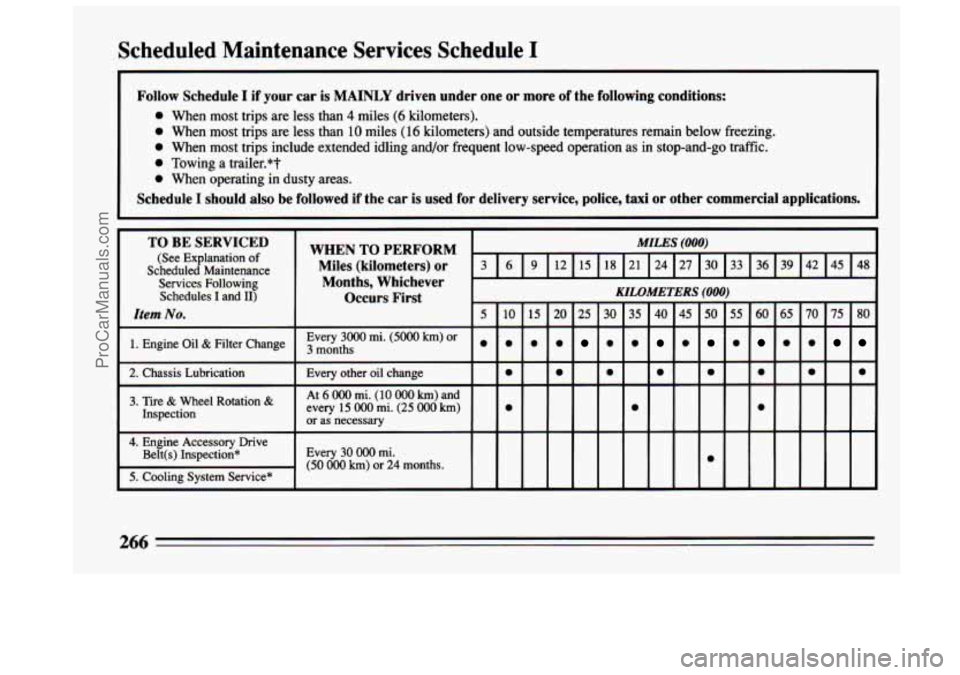
Scheduled Maintenance Services Schedule I
~
Follow Schedule I if your car is MAINLY driven under one or more of the following conditions:
0 When most trips are less than 4 miles (6 kilometers).
0 When most trips are less than 10 miles (16 kilometers) and outside temperatures remain below fr\
eezing.
0 When most trips include extended idling and/or frequent low-spee\
d operation as in stop-and-go traffic.
0 Towing a trailer.*?
0 When operating in dusty areas.
Schedule I should also be followed if the car is used for delivery service, police, taxi or other commercial applications. \
TO BE SERVICED
(See Explanation of
Scheduled Maintenance Miles (kilometers) or
Services Following Months, Whichever
Schedules I and 11) Occurs First KILOMETERS (000)
WHEN TO PERFORM MILES (000)
3
Item No.
Every30oOmi.(50@)km)or months 0 0 0 0 0 0 0 0 0 0 1. Engine oil & Filter Change
5 10 15 20 25 30 35 40 45 50 55 60 65 70 75 80
3. Tire & Wheel Rotation &
Every other oil change 0 0 0 0 0 0 0 0 2. Chassis Lubrication
every 15 ooo mi. (25 ooo km)
At 6 OOO mi. (10 000 km) and
or as necessary
4. Engine Accessory Drive
5. Cooling System Service"
Inspection
0 0 0
Belt(s)
Inspection* Every 30 OOO mi.
(50 000 km) or 24 months. 0
266
ProCarManuals.com