light BUICK CENTURY 1994 Workshop Manual
[x] Cancel search | Manufacturer: BUICK, Model Year: 1994, Model line: CENTURY, Model: BUICK CENTURY 1994Pages: 308, PDF Size: 16.3 MB
Page 171 of 308
Passing
You’ll need more passing distance up ahead when
you’re towing a trailer. And, because you’re a good deal
longer, you’ll need to go much farther beyond the
passed vehicle before you can return to
your lane.
Backing Up
Hold the bottom of the steering wheel with one hand.
Then, to move the trailer to the left, just move that hand
to the left.
To move the trailer to the right, move your
hand to the right. Always back up slowly and,
if
possible, have someone guide you.
Making Turns
When you’re turning with a trailer, make wider turns
than normal.
Do this so your trailer won’t strike soft
shoulders, curbs, road signs, trees, or other objects.
Avoid jerky
or sudden maneuvers. Signal well in
advance.
Turn Signals When Towing a Trailer
When you tow a trailer, your vehicle has to have a
different turn signal flasher and extra wiring. The green arrows
on your instrument panel
will flash whenever
you signal
a turn or lane change. Properly hooked up,
the trailer lights
will also flash, telling other drivers
you’re about to turn, change lanes or stop.
When towing a trailer, the green arrows on your
instrument panel
will flash for turns even if the bulbs on
the trailer are burned out. Thus, you may
think drivers
behind you are seeing your signal when they are not. It’s
important to check occasionally to be sure
the trailer
bulbs are still working.
Driving On Grades
Reduce speed and shift to a lower gear before you start
down a long or steep downgrade.
If you don’t shift
down, you might have
to use your brakes so much that
they would get hot and no longer work well.
On a long
uphill grade, shift down and reduce your
speed to around 45
mph (70 km/h) to reduce the
possibility
of engine and transaxle overheating.
If you are towing a trailer that weighs more than 1,000
pounds (450
kg) and you have an automatic transaxle
with Overdrive, you may prefer to drive in “D” instead
of Overdrive.
An overdrive transmission is required if
towing a trailer more than 1,000 pounds (450 kg).
ProCarManuals.com
Page 174 of 308
Hazard Warning Flashers
m
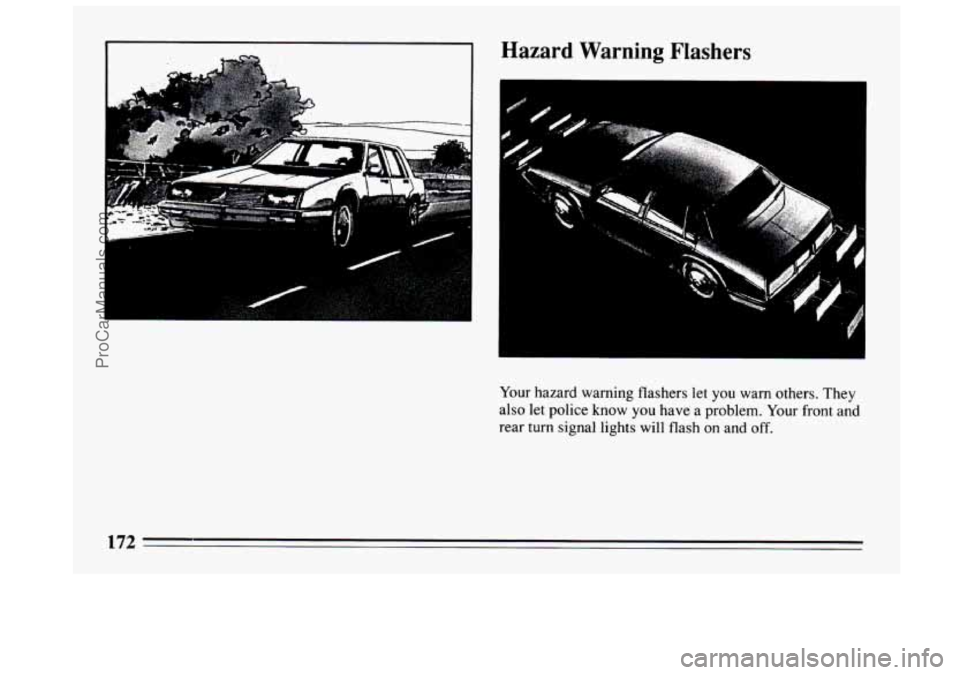
Your hazard warning flashers let you warn others. They
also let police know you have
a problem. Your front and
rear turn signal lights will flash on and
off.
172
ProCarManuals.com
Page 175 of 308
.-
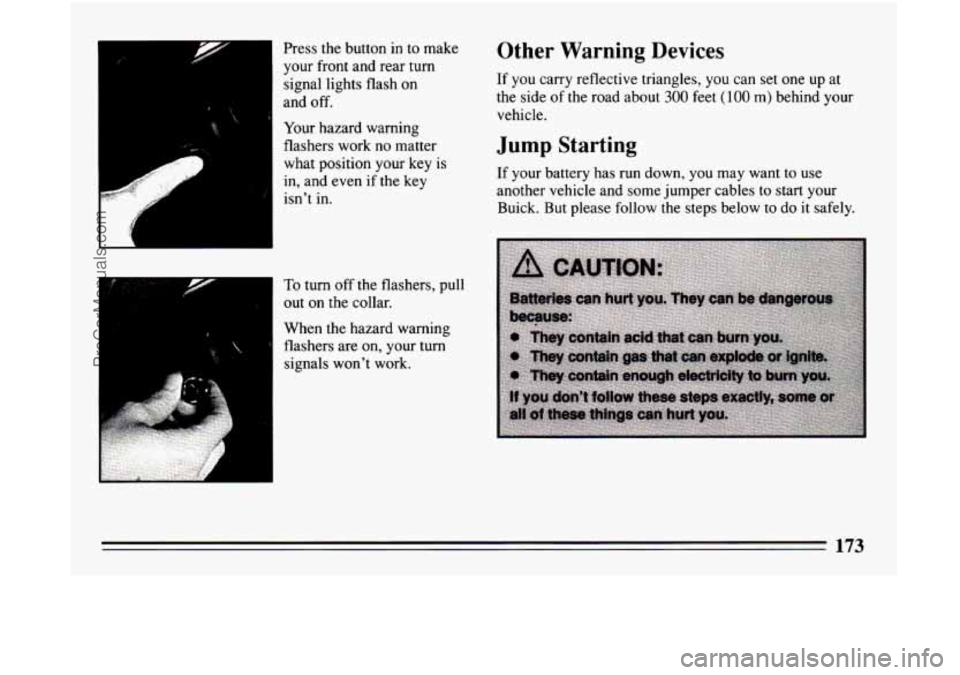
Press the button in to make
your front and rear turn
signal lights flash on
and off.
Your hazard warning
flashers work no matter
what position your key is
in, and even if the key
isn't in.
To turn off the flashers, pull
out on the collar.
When
the hazard warning
flashers are on, your turn
signals won't work.
Other Warning Devices
If you carry reflective triangles, you can set one up at
the side of the road about 300 feet (100 m) behind your
vehicle.
Jump Starting
If your battery has run down, you may want to use
another vehicle and some jumper cables to start your
Buick. But please follow the steps below
to do it safely.
173
ProCarManuals.com
Page 176 of 308
NOTICE:
Ignoring these steps could result in costly
damage to your vehicle that wouldn’t be covered
by your warranty.
Trying to start your Buick by pushing or pulling
it
won’t work, and it could damage your vehicle.
To Jump Start Your Buick:
1. Check the other vehicle. It must have a 12-volt
battery with a negative ground system.
I NOTICE:
I
If the other system isn’t a 12-volt system with a
negative ground, both vehicles can be damaged.
2. Get the vehicles close enough so the jumper cables
can reach, but be sure the vehicles aren’t touching
each other.
If they are, it could cause a ground
connection
you don’t want. You wouldn’t be able to
start your car, and the bad grounding could damage
the electrical systems.
3. Turn off the ignition on both vehicles. Turn off all
lights that aren’t needed, and radios. This will avo
sparks and help save both batteries. And it could
save your radio! ‘id
I NOTICE:
If you
leave your radio on, it could be badly
damaged. The repairs wouldn’t be covered by
your warranty.
4. Open the hoods and locate the batteries.
Find the positive
(+) and nenative (-) terminals on each
battery.
174
ProCarManuals.com
Page 186 of 308
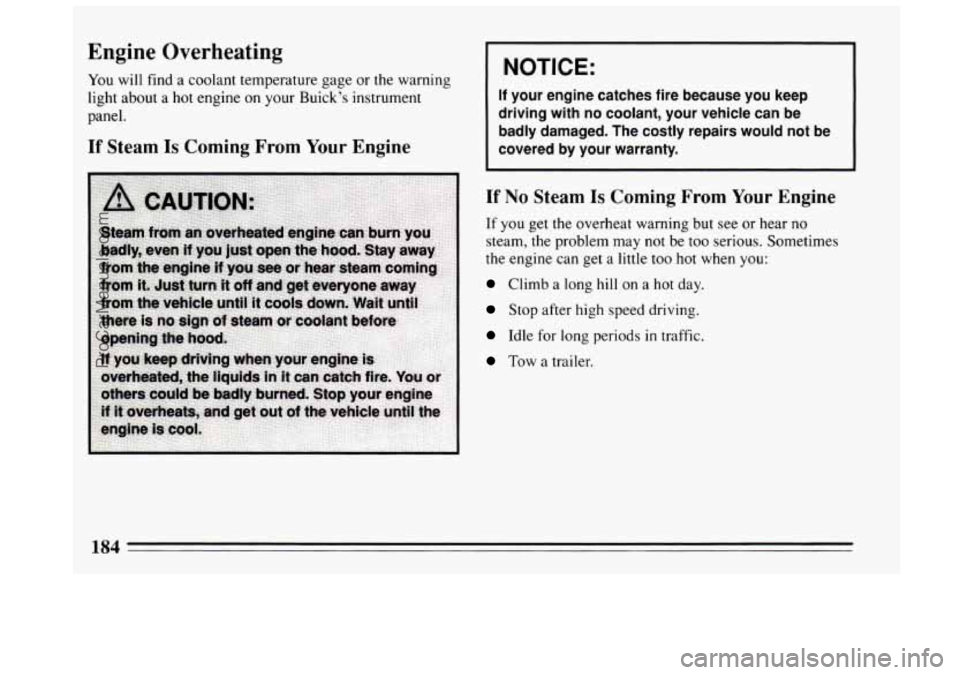
Engine Overheating
You will find a coolant temperature gage or the warning
light about a hot engine on
your Buick’s instrument
panel.
If Steam Is Coming From Your Engine
I NOTICE:
If your engine catches fire because you keep
driving with no coolant, your vehicle can be
badly damaged. The costly repairs would not be
covered by your warranty.
If No Steam Is Coming From Your Engine
If you get the overheat warning but see or hear no
steam, the problem may not be too serious. Sometimes
the engine can get a little too hot when
you:
Climb a long hill on a hot day.
Stop after high speed driving.
Idle for long periods in traffic.
Tow a trailer.
184
ProCarManuals.com
Page 208 of 308
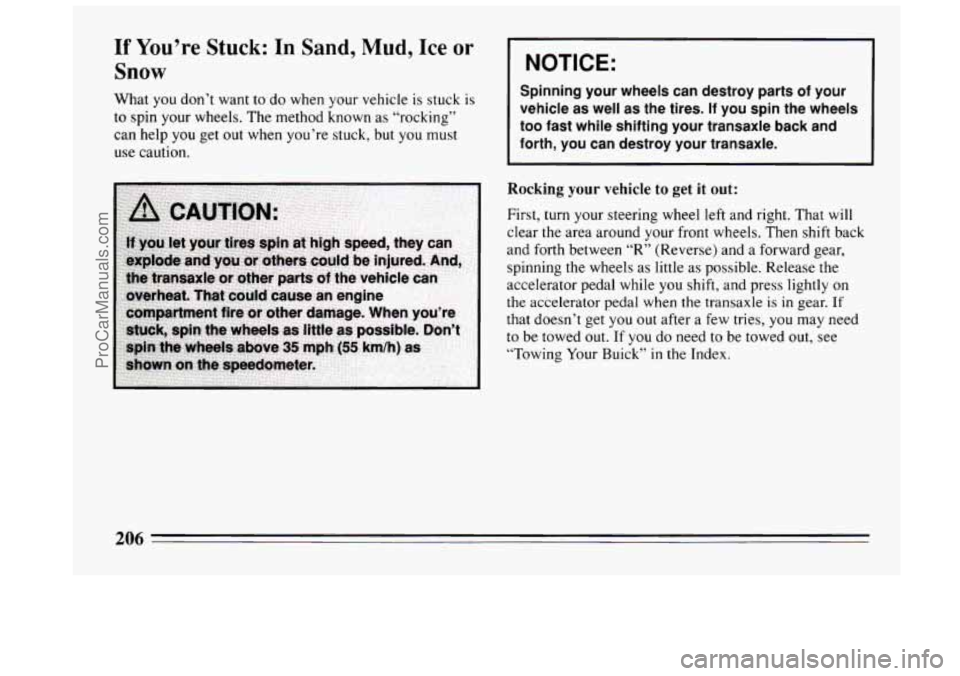
If You’re Stuck: In Sand, Mud, Ice or
Snow
What you don’t want to do when your vehicle is stuck is
to spin your wheels. The method known as “rocking”
can help you get out when you’re stuck, but you must
use caution.
I NOTICE:
Spinning your wheels can destroy parts of your
vehicle as well as the tires. If you spin the wheels
too fast while shifting your transaxle back and
forth, you can destroy your transaxle.
Rocking your vehicle to get it out:
First, turn your steering wheel left and right. That will
clear the area around your front wheels. Then shift back
and forth between
“R” (Reverse) and a forward gear,
spinning the wheels as little
as possible. Release the
accelerator pedal while you shift, and press lightly on
the accelerator pedal when
the transaxle is in gear. If
that doesn’t get you out after a few tries, you may need
to be towed
out. If you do need to be towed out, see
“Towing Your Buick”
in the Index.
206
ProCarManuals.com
Page 225 of 308
How to Add Fluid
Refer to the Maintenance Schedule to determine what
kind of transaxle fluid
to use. See “Recommended
Fluids and Lubricants” in the Index.
Engine Coolant
If the fluid level is low, add only enough of the proper
fluid to bring the level into the cross-hatched area on the
dipstick.
1. Pull
out the dipstick.
2. Using a long-neck funnel, add enough fluid at the
It doesn’t take much fluid, generally less than a pint
(OSL).
Don’t overfill. We recommend you use only
fluid labeled DEXRON@-I11 or DEXRON@-IIE,
because fluids with that label are made especially for
your automatic transaxle. Damage caused by fluid other
than DEXRON@-I11 or DEXRON@-IIE is
not covered
by your new vehicle warranty. dipstick
hole
to bring it to the proper level.
After adding fluid, recheck the fluid level as
described under “How to Check.”
0 When the correct fluid level is obtained, push the
dipstick back in all the way. The following explains
your cooling system and how to
add coolant when it is low. If you have a problem with
engine overheating or if
you need to add coolant to your
radiator, see “Engine Overheating” in the Index.
The proper coolant for your Buick will:
0 Give freezing protection down to -34°F (-37°C).
0 Give boiling protection up to 262 “F ( 128 “C).
0 Protect against rust and corrosion.
Help keep the proper engine temperature.
0 Let the warning lights work as they should.
What to Use
Use a mixture of one-half clean water (preferably
distilled) and one-half antifreeze that meets “GM
Specification 1825-M,” which won’t damage aluminum
parts.
You can also use a recycled coolant conforming to
GM Specification 1825-M with a complete coolant flush
and refill. If you use this mixture,
you don’t need to add
anything else.
223
ProCarManuals.com
Page 231 of 308
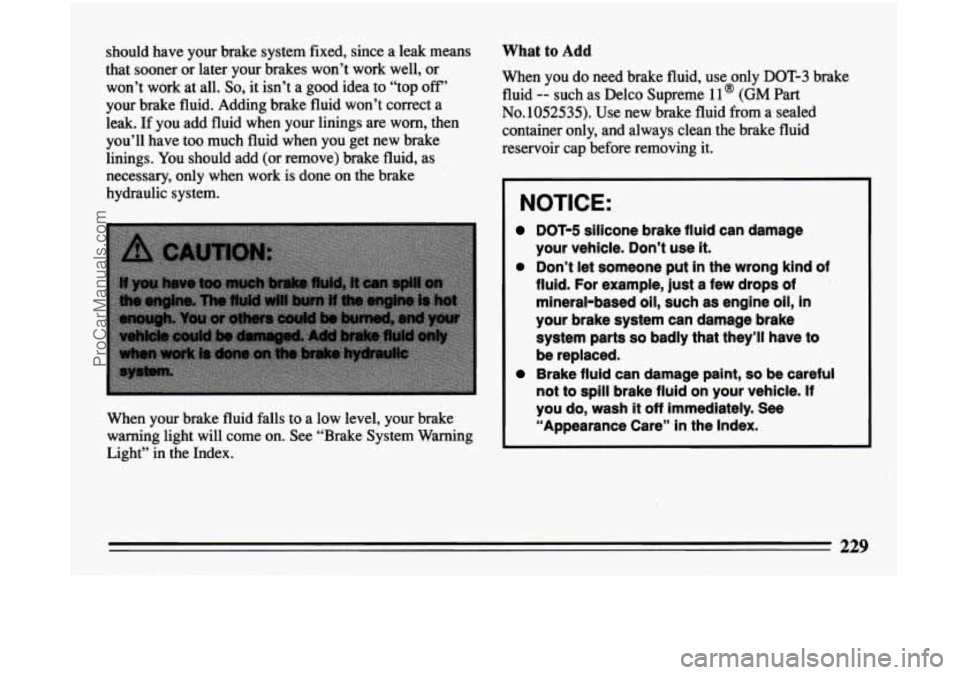
should have your brake system fixed, since a leak means
that sooner or later your brakes won’t work well,
or
won’t work at all. So, it isn’t a good idea to “top off’
your brake fluid. Adding brake fluid won’t correct a
leak. If you add fluid when your linings are worn, then
you’ll have too much fluid when you get new brake
linings. You should add (or remove) brake fluid, as
necessary, only when work
is done on the brake
hydraulic system.
When
your brake fluid falls to a low level, your brake
warning light will come on. See “Brake System Warning
Light” in the Index.
What to Add
When you do need brake fluid, use only DOT-3 brake
fluid
-- such as Delco Supreme 11 @ (GM Part
No. 1052535). Use new brake fluid from a sealed
container only, and always clean the brake fluid
reservoir cap before removing it.
NOTICE:
DOT-5 silicone brake fluid can damage
your vehicle. Don’t use
it.
a Don’t let someone put in the wrong kind of
fluid. For example,
just a few drops of
mineral-based
oil, such as engine oil, in
your brake system can damage brake
system parts
so badly that they’ll have to
be replaced.
Brake fluid can damage paint, so be careful
not to spill brake
fluid on your vehicle. If
,you do, wash it off immediately. See
“Appearance Care” in the Index.
229
ProCarManuals.com
Page 232 of 308
Brake Wear
Your Buick has front disc brakes and rear drum brakes.
Disc brake pads have built-in wear indicators that make
a high-pitched warning sound when the brake pads are
worn and new pads are needed. The sound may come
and
go or be heard all the time your vehicle is moving
(except when
you are pushing on the brake pedal
firmly).
Continuing to drive with worn-out brake pads
could result in costly brake repair.
Some driving conditions or climates may cause a brake
squeal when the brakes are first applied or lightly
applied. This does not mean something
is wrong with
your brakes.
Your rear drum brakes don’t have wear indicators, but if
you ever hear a rear brake rubbing noise, have the rear
brake linings inspected. Also, the rear brake drums
should be removed and inspected each time the tires are
removed for rotation or changing. When you have the
front brakes replaced, have the rear brakes inspected,
too.
Brake linings should always be replaced as complete
axle sets.
Brake Pedal Travel
See your dealer if the brake pedal does not return to
normal height, or
if there is a rapid increase in pedal
travel. This could be a sign of brake trouble.
Brake Adjustment
Every time you apply the brakes moderately, with or
without the vehicle moving, your brakes adjust for wear.
230
ProCarManuals.com
Page 235 of 308
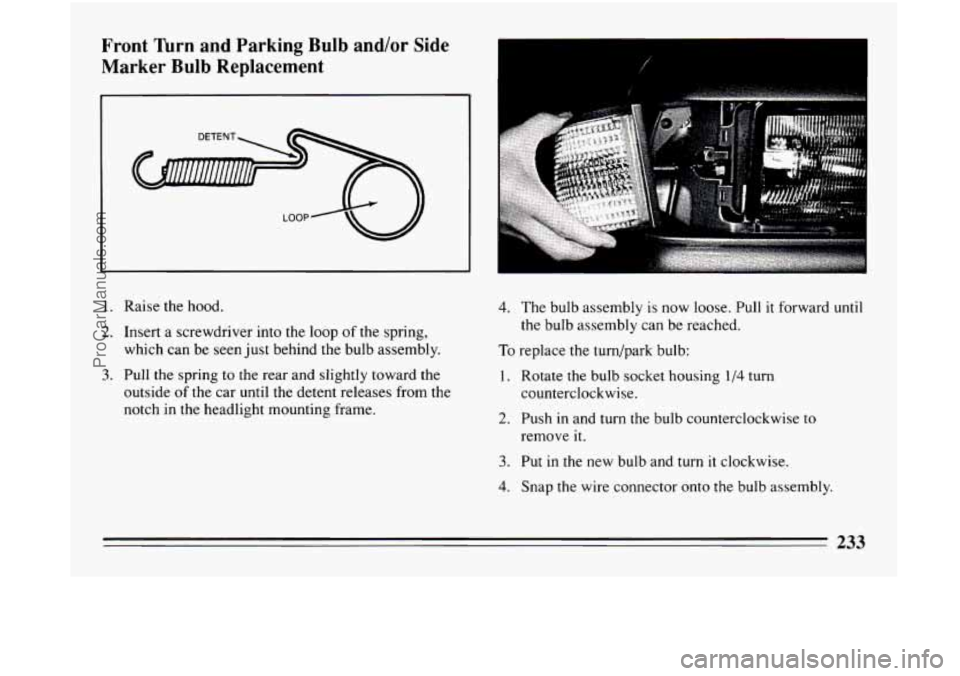
Front Turn and Parking Bulb and/or Side
Marker Bulb Replacement
1. Raise the hood.
2. Insert a screwdriver into the loop of the spring,
which can be seen just behind the bulb assembly.
3. Pull the spring to the rear and slightly toward the
outside
of the car until the detent releases from the
notch in the headlight mounting frame.
,I'
4. The bulb assembly is now loose. Pull it forward until
the bulb assembly can be reached.
To replace the turn/park bulb:
1. Rotate the bulb socket housing 1/4 turn
counterclockwise.
2. Push in and turn the bulb counterclockwise to
remove
it.
3. Put in the new bulb and turn it clockwise.
4. Snap the wire connector onto the bulb assembly.
233
ProCarManuals.com