overheating BUICK CENTURY 1994 Owners Manual
[x] Cancel search | Manufacturer: BUICK, Model Year: 1994, Model line: CENTURY, Model: BUICK CENTURY 1994Pages: 308, PDF Size: 16.3 MB
Page 11 of 308

@ Table of Contents
How to Use this Manual ................................................................ 10
This part tells you how to use your manual and includes safet\
y and vehicle damage warnings and symbols.
Seats and Restraint Systems ............................................................. 13
This part tells you how to use your seats and safety belts p\
roperly. It also explains the “SRS” system.
This part explains how
to start and operate your Buick.
This part tells you how to adjust the ventilation and comfort \
controls and how to operate your sound system.
YourDrivingandtheRoad .............................................................. 139
Here you’ll find helpful information and tips about the road\
and how to drive under different conditions.
ProblemsontheRoad .................................................................. 171
This part tells you what to do if you have a problem while driving, such as a flat tire or engine
overheating, etc.
Here the manual tells you how to keep your Buick running prop\
erly and looking good.
This part tells you when to perform vehicle maintenance and wh\
at fluids and lubricants to use.
This part tells you how to contact Buick for assistance and h\
ow
to get service publications. It also
gives
you information on “Reporting Safety Defects” on page 283.
Here’s an alphabetical listing of almost every subject in this manual. You can use it to quickly find
something
you want to read.
FeaturesandControls .................................................................. 65
Comfort Controls and Audio Systems ..................................................... 121
ServiceandAppearanceCare ............................................................ 207
Maintenanceschedule .................................................................. 261
Customer Assistance Information
........................................................ 281
Index
........................................................................\
........ 291
7
ProCarManuals.com
Page 117 of 308
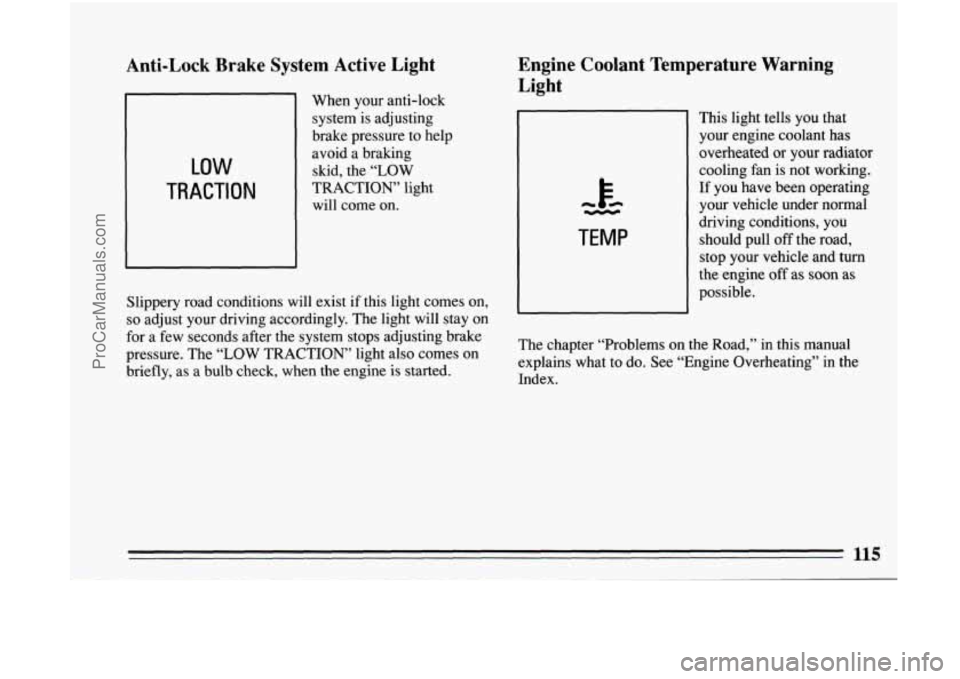
Anti-Lock Brake System Active Light
LOW
TRACTION
When your anti-lock
system is adjusting
brake pressure to help
avoid a braking
skid, the
“LOW
TRACTION’ light
will come on.
Slippery road conditions will exist if this light comes on,
so adjust your driving accordingly. The light will stay on
for
a few seconds after the system stops adjusting brake
pressure. The
“LOW TRACTION” light also comes on
briefly, as a
bulb check, when the engine is started.
Engine Coolant Temperature Warning
Light
k F- 4ccN
TEMP
This light tells you that
your engine coolant has
overheated or your radiator
cooling fan is not working.
If you have been operating
your vehicle under normal
driving conditions, you
should pull off the road,
stop your vehicle and turn
the engine
off as soon as
possible.
The chapter “Problems on the Road,” in this manual
explains what to do. See “Engine Overheating” in the
Index.
ProCarManuals.com
Page 118 of 308
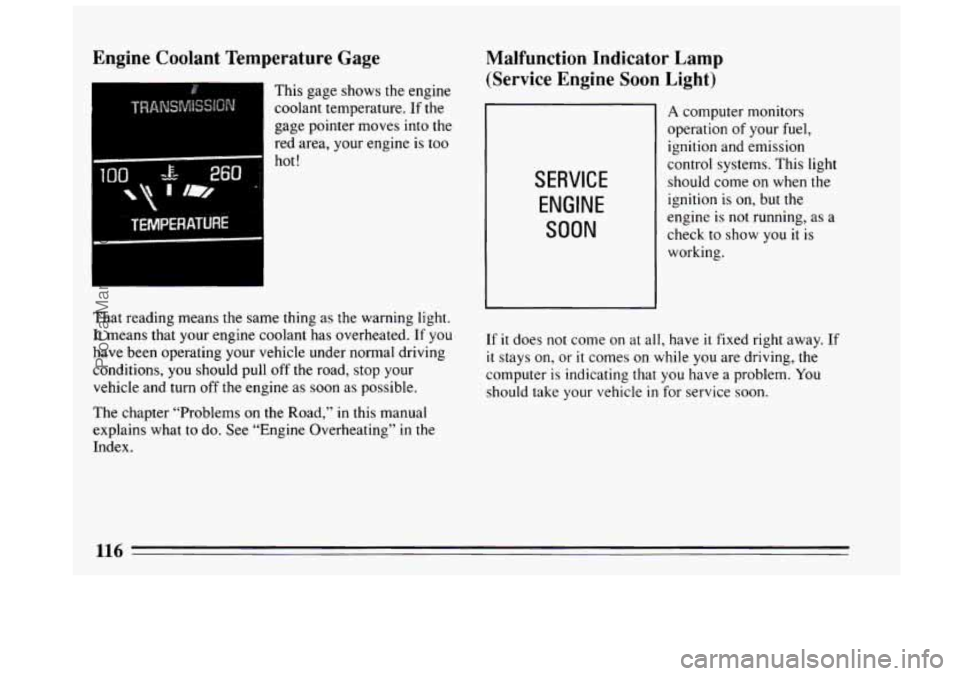
Engine Coolant Temperature Gage
This gage shows the engine
coolant temperature. If the
gage pointer moves into the
red area, your engine is too
100 -E- 260 i
T lm,
hot!
TEMPERATURE
That reading means the same thing as the warning light.
It means that your engine coolant has overheated. If you
have been operating your vehicle under normal driving
conditions, you should pull off the road, stop your
vehicle and
turn off the engine as soon as possible.
The chapter “Problems on the Road,”
in this manual
explains what
to do. See “Engine Overheating” in the
Index.
Malfunction Indicator Lamp
(Service Engine Soon Light)
SERVICE
ENGINE
SOON
A computer monitors
operation of your fuel,
ignition and emission
control systems. This light
should come on when the
ignition is on, but the
engine is not running, as
a
check to show you it is
working.
If it does not come on at all, have it fixed right away. If
it stays on, or it comes on while you are driving, the
computer is indicating that
you have a problem. You
should take your vehicle
in for service soon.
116
ProCarManuals.com
Page 171 of 308
Passing
You’ll need more passing distance up ahead when
you’re towing a trailer. And, because you’re a good deal
longer, you’ll need to go much farther beyond the
passed vehicle before you can return to
your lane.
Backing Up
Hold the bottom of the steering wheel with one hand.
Then, to move the trailer to the left, just move that hand
to the left.
To move the trailer to the right, move your
hand to the right. Always back up slowly and,
if
possible, have someone guide you.
Making Turns
When you’re turning with a trailer, make wider turns
than normal.
Do this so your trailer won’t strike soft
shoulders, curbs, road signs, trees, or other objects.
Avoid jerky
or sudden maneuvers. Signal well in
advance.
Turn Signals When Towing a Trailer
When you tow a trailer, your vehicle has to have a
different turn signal flasher and extra wiring. The green arrows
on your instrument panel
will flash whenever
you signal
a turn or lane change. Properly hooked up,
the trailer lights
will also flash, telling other drivers
you’re about to turn, change lanes or stop.
When towing a trailer, the green arrows on your
instrument panel
will flash for turns even if the bulbs on
the trailer are burned out. Thus, you may
think drivers
behind you are seeing your signal when they are not. It’s
important to check occasionally to be sure
the trailer
bulbs are still working.
Driving On Grades
Reduce speed and shift to a lower gear before you start
down a long or steep downgrade.
If you don’t shift
down, you might have
to use your brakes so much that
they would get hot and no longer work well.
On a long
uphill grade, shift down and reduce your
speed to around 45
mph (70 km/h) to reduce the
possibility
of engine and transaxle overheating.
If you are towing a trailer that weighs more than 1,000
pounds (450
kg) and you have an automatic transaxle
with Overdrive, you may prefer to drive in “D” instead
of Overdrive.
An overdrive transmission is required if
towing a trailer more than 1,000 pounds (450 kg).
ProCarManuals.com
Page 173 of 308
@) Part 5 Problems on the Road
I
I
Here you’ll find what to do about some problems that can occur on the road .
Part 5 includes:
HazardWarningFlashers ............................................................ 172
OtherWarningDevices
............................................................. 173
“Jump”Starting
................................................................... 174
TowingYourBuick
................................................................ 178
Engineoverheating
................................................................ 184
IfaTireGoesFlat
................................................................. 193
ChangingaFlatTire
................................................................ 194
CompactSpareTire
................................................................ 205
If You’re Stuck in Sand, Mud, Ice or Snow .............................................. 206
1 I1
ProCarManuals.com
Page 186 of 308
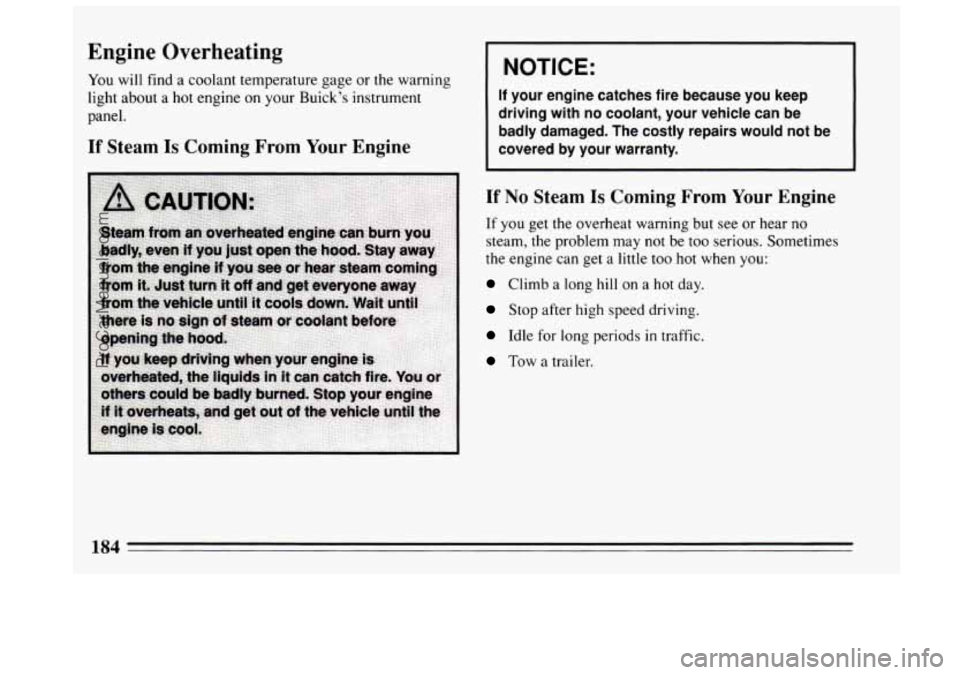
Engine Overheating
You will find a coolant temperature gage or the warning
light about a hot engine on
your Buick’s instrument
panel.
If Steam Is Coming From Your Engine
I NOTICE:
If your engine catches fire because you keep
driving with no coolant, your vehicle can be
badly damaged. The costly repairs would not be
covered by your warranty.
If No Steam Is Coming From Your Engine
If you get the overheat warning but see or hear no
steam, the problem may not be too serious. Sometimes
the engine can get a little too hot when
you:
Climb a long hill on a hot day.
Stop after high speed driving.
Idle for long periods in traffic.
Tow a trailer.
184
ProCarManuals.com
Page 189 of 308
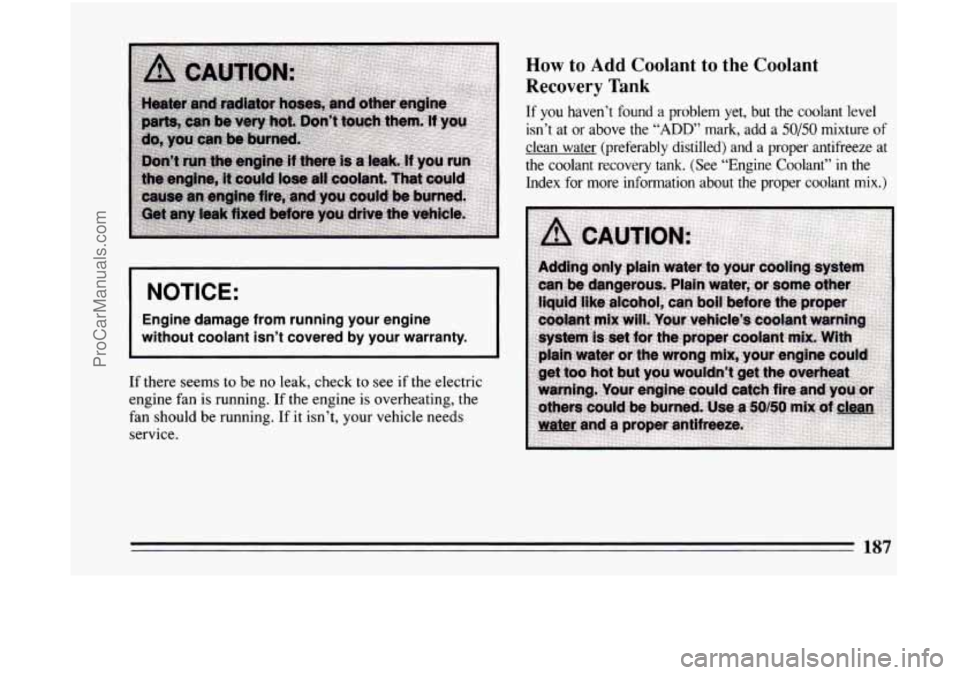
1 NOTICE: I
I
Engine damage from running your engine
without coolant isn’t covered by your warranty.
If there seems to be no leak, check to see if the electric
engine fan is running. If the engine
is overheating, the
fan should be running. If
it isn’t, your vehicle needs
service.
How to Add Coolant to the Coolant
Recovery Tank
If you haven’t found a problem yet, but the coolant level
isn’t at or above the
“ADD” mark, add a 50/50 mixture of
clean water (preferably distilled) and a proper antifreeze at \
the coolant recovery
tank. (See “Engine Coolant” in the
Index for more information about the proper coolant mix.)
187
ProCarManuals.com
Page 225 of 308
How to Add Fluid
Refer to the Maintenance Schedule to determine what
kind of transaxle fluid
to use. See “Recommended
Fluids and Lubricants” in the Index.
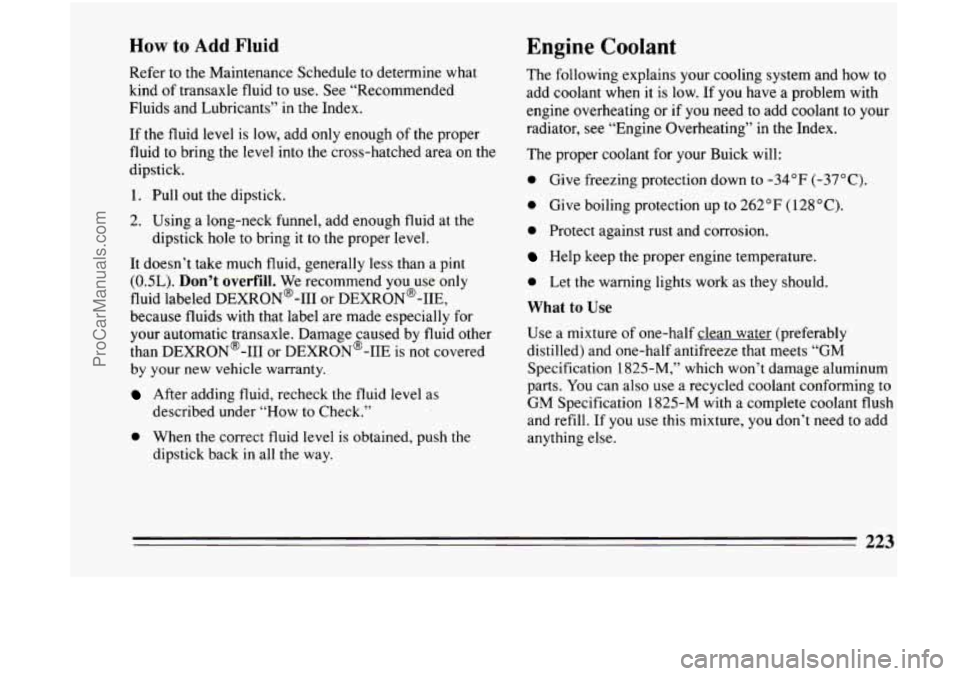
Engine Coolant
If the fluid level is low, add only enough of the proper
fluid to bring the level into the cross-hatched area on the
dipstick.
1. Pull
out the dipstick.
2. Using a long-neck funnel, add enough fluid at the
It doesn’t take much fluid, generally less than a pint
(OSL).
Don’t overfill. We recommend you use only
fluid labeled DEXRON@-I11 or DEXRON@-IIE,
because fluids with that label are made especially for
your automatic transaxle. Damage caused by fluid other
than DEXRON@-I11 or DEXRON@-IIE is
not covered
by your new vehicle warranty. dipstick
hole
to bring it to the proper level.
After adding fluid, recheck the fluid level as
described under “How to Check.”
0 When the correct fluid level is obtained, push the
dipstick back in all the way. The following explains
your cooling system and how to
add coolant when it is low. If you have a problem with
engine overheating or if
you need to add coolant to your
radiator, see “Engine Overheating” in the Index.
The proper coolant for your Buick will:
0 Give freezing protection down to -34°F (-37°C).
0 Give boiling protection up to 262 “F ( 128 “C).
0 Protect against rust and corrosion.
Help keep the proper engine temperature.
0 Let the warning lights work as they should.
What to Use
Use a mixture of one-half clean water (preferably
distilled) and one-half antifreeze that meets “GM
Specification 1825-M,” which won’t damage aluminum
parts.
You can also use a recycled coolant conforming to
GM Specification 1825-M with a complete coolant flush
and refill. If you use this mixture,
you don’t need to add
anything else.
223
ProCarManuals.com
Page 227 of 308
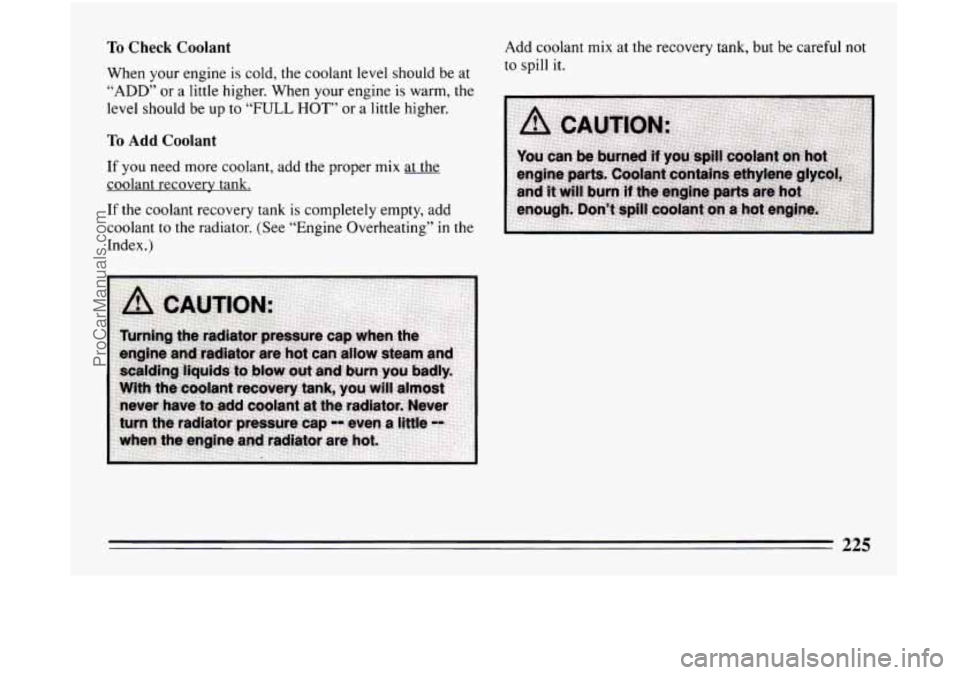
To Check Coolant
When your engine is cold, the coolant level should be at
“ADD” or a little higher. When your engine is warm, the
level should be up to
“FULL HOT’’ or a little higher.
To Add Coolant
If you need more coolant, add the proper mix at the
coolant recovery tank.
If the coolant recovery tank is completely empty, add
coolant to the radiator. (See “Engine Overheating” in the
Index.) Add
coolant mix at the recovery tank, but be careful not
to spill it.
225
ProCarManuals.com
Page 228 of 308
Radiator Pressure Cap
I NOTICE:
Your radiator cap is a 15 psi (105 kPa)
pressure-type cap and must be tightly installed
to prevent coolant
loss and possible engine
damage from overheating. Be sure the arrows on
the cap line up with the overflow tube on the radiator filler neck.
When you replace your radiator pressure cap, an AC@
cap is recommended.
Thermostat
Engine coolant temperature is controlled by a thermostat
in the engine coolant system. The thermostat stops the
flow
of coolant through the radiator until the coolant
reaches a preset temperature.
When
you replace your thermostat, an AC@ thermostat
is recommended.
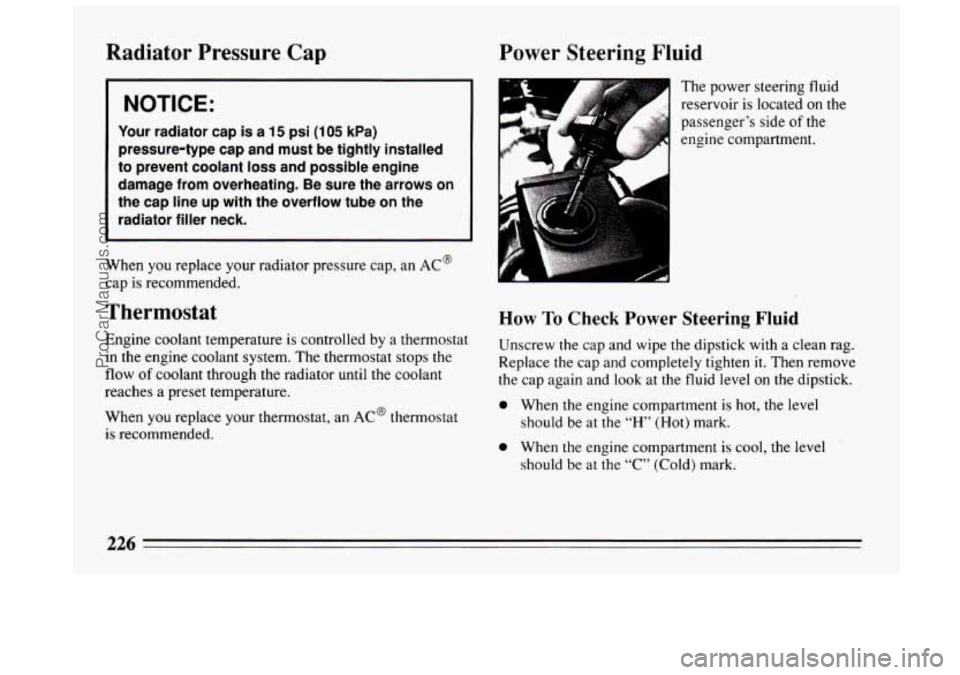
Power Steering Fluid
The power steering fluid
reservoir
is located on the
passenger’s side
of the
engine compartment.
How To Check Power Steering Fluid
Unscrew the cap and wipe the dipstick with a clean rag.
Replace the cap and completely tighten it. Then remove
the cap again and look at the fluid level
on the dipstick.
0 When the engine compartment is hot, the level
should be at the
“H” (Hot) mark.
0 When the engine compartment is cool, the level
should be at the “C” (Cold) mark.
ProCarManuals.com