door lock BUICK CENTURY 1996 User Guide
[x] Cancel search | Manufacturer: BUICK, Model Year: 1996, Model line: CENTURY, Model: BUICK CENTURY 1996Pages: 340, PDF Size: 17.61 MB
Page 69 of 340
OFF (C): Unlocks the steering wheel, ignition, and
transaxle, but does not send electrical power
to any
accessories. Use this position if your vehicle must be
pushed
or towed, but never try to push-start your
vehicle.
A warning chime will sound if you open the
driver’s door when the ignition is off and the key is in
the ignition.
RUN (D): Position to which the switch returns after you
start your engine and release the switch. The switch
stays in the RUN position when the engine is running.
But even when the engine is not running, you can
use
RUN to operate your electrical power accessories, and
to display some instrument panel warning lights.
START (E): Starts the engine. When the engine starts,
release the key. The ignition switch will return
to RUN
for normal driving.
NOTICE:
If your key seems stuck in LOCK and you can’t
turn it, be sure it is all the way in.
If it is, then
turn the steering wheel left and right while you
turn the key hard. But turn the key only with
your hand. Using a tool to force it could break
the key or the ignition switch.
If none of this
works, then your vehicle needs service.
2-11
ProCarManuals.com
Page 80 of 340
Leaving Your Vehicle With the
Engine
Running
A CAUTION
It can be dangerous to leave your vehicle with the
engine running. Your vehicle could move
suddenly if the shift lever
is not fully in PARK (P)
with the parking brake firmly set. And, if you
leave the vehicle with the engine running, it could
overheat and even catch fire. You or others could
be injured. Don’t leave your vehicle with the
engine running unless you have to.
If you have to leave your vehicle with the engine
running, be sure your vehicle is in PARK (P) and your
parking brake is firmly set before you leave it. After
you’ve moved the shift lever into the PARK (P)
position, hold the regular brake pedal down. Then, see if
you can move the shift lever away from PARK (P)
without first pulling it toward
you. If you can, it means
that the shift lever wasn’t fully locked into PARK
(P).
Note: If for some reason you leave your vehicle running
and
it is not in PARK (P) and the parking brake is
applied, your doors will automatically lock when you
close the door.
Torque Lock
If you are parking on a hill and you don’t shift your
transaxle into PARK (P) properly, the weight of the
vehicle may put too much force on the parking pawl in
the transaxle. You may find it difficult to pull the shift
lever
out of PARK (P). This is called “torque lock.” To
prevent torque lock, set the parking brake and then shift
into PARK (P) properly before
you leave the driver’s
seat.
To find out how, see “Shifting Into PARK (P)” in
the Index.
When you are ready
to drive, move the shift lever out of
PARK (P) before you release the parking brake.
If torque lock does occur, you may need to have another
vehicle push yours
a little uphill to take some of the
pressure from the transaxle,
so you can pull the shift
lever out of PARK (P).
2-22
ProCarManuals.com
Page 92 of 340
Headlamps on Warning
If you open the door while leaving the lamps on, you
will hear a warning chime.
Daytime Running Lamps (Option)
Daytime Running Lamps (DRL) can make it easier for
others to see the front of your vehicle during the day.
DRL can be helpful in many different driving
conditions, but they can be especially helpful in the
short periods after dawn and before sunset.
A light sensor in the instrument panel cluster makes the
DRL work, so be sure it isn’t covered.
The DRL system will make your low-beam headlamps
come on at reduced brightness when:
the ignition is on,
the headlamp switch is off, and
the parking brake is released.
When the
DRL are on, only your low-beam headlamps
will be
on. The taillamps, sidemarker and other lamps
won’t be on. Your instrument panel won’t be lit up either.
When it’s dark enough outside, your headlamps will
come on to full brightness. The other lamps that come
on with your headlamps will also come on. When
it’s bright enough outside, the regular lamps will
go off, and your low-beam headlamps will come
on at a
reduced brightness.
To idle your vehicle with the DRL off, set the parking
brake while the ignition is in the
OFF or LOCK
position. Then start the vehicle. The DRL will stay off
until you release the parking brake.
As with any vehicle, you should turn on the regular
headlamp system when
you need it.
Interior Lamps
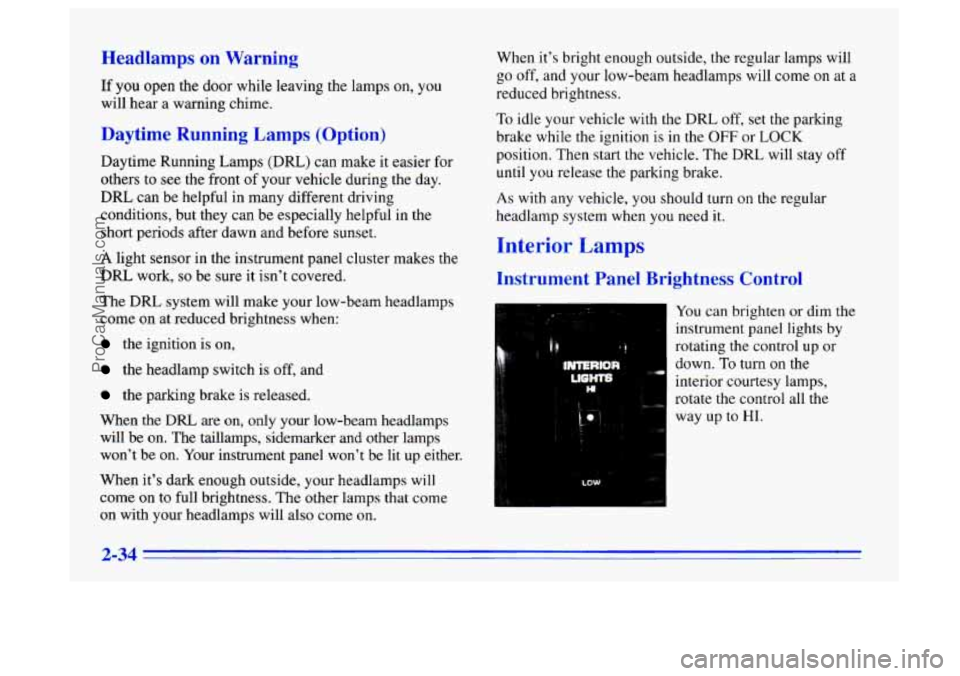
Instrument Panel Brightness Control
., . I. .
1.r
LOW
You can brighten or dim the
instrument panel lights by
rotating the control up or
down.
To turn on the
interior courtesy lamps,
rotate the control all the way
up to HI.
2-34
ProCarManuals.com
Page 93 of 340
Courtesy Lamps
When any door is opened, several lamps go on. These
lamps are under the instrument panel. They make it
easy for you to enter and leave the vehicle. You also
can turn these lamps on by rotating the interior lamps
switch
to HI.
Interir -- amps Delay
Front Seat Reading Lamps
When you purl on the driver's outside door handle, the
dome and courtesy lamps will
go on and stay on for
about
40 seconds, or until you turn the ignition on.
If you pull on the driver's inside door handle within
30 seconds of switching off the ignition, the interior
lamps will go on and stay on for about five seconds,
to
allow you to unlock your door(s).
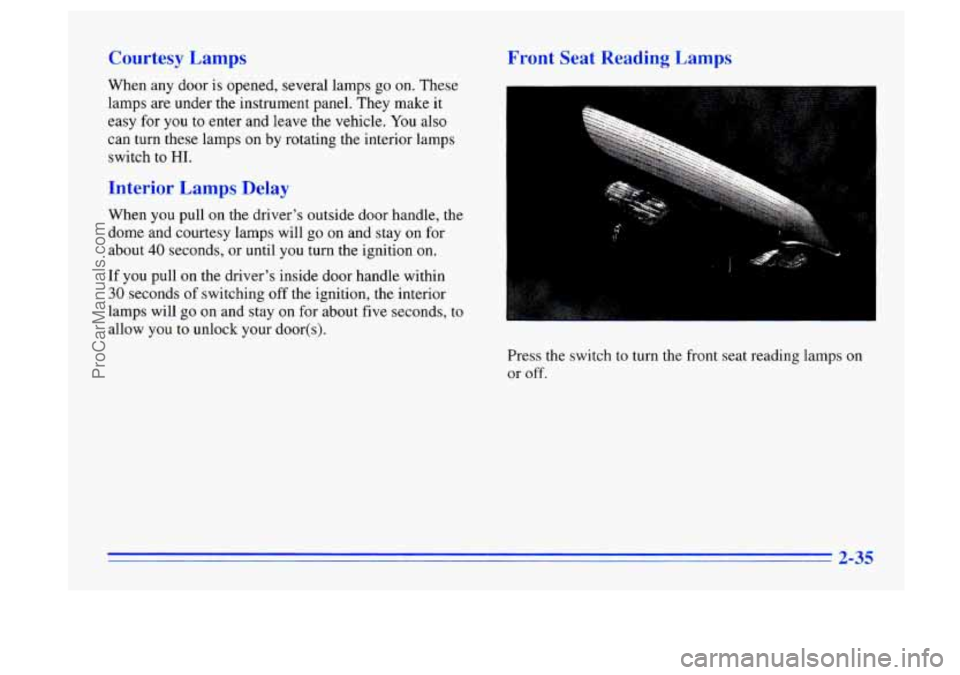
Press the switch
to turn the front seat reading lamps on
or
off.
2-35
ProCarManuals.com
Page 96 of 340
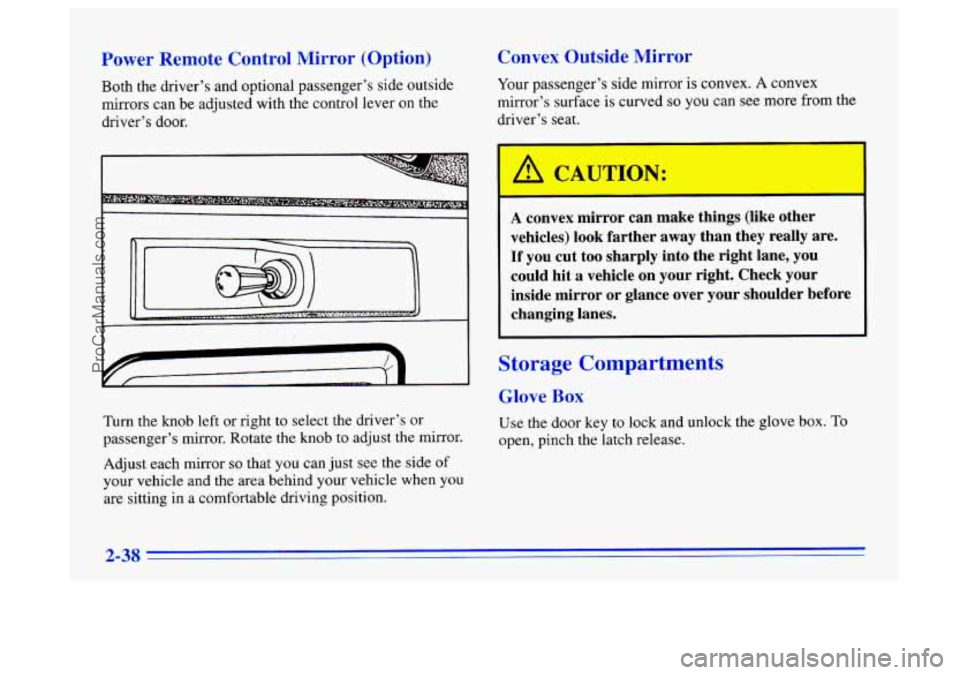
Power Remote Control Mirror (Option)
Both the driver’s and optional passenger’s side outside
mirrors can be adjusted with the control lever on the
driver’s door.
Turn the knob left or right
to select the driver’s or
passenger’s mirror. Rotate the knob to adjust the mirror.
Adjust each mirror
so that you can just see the side of
your vehicle and the area behind your vehicle when
you
are sitting in a comfortable driving position.
Convex Outside Mirror
Your passenger’s side mirror is convex. A convex
mirror’s surface
is curved so you can see more from the
driver’s seat.
1 A CAUTION:
A convex mirror can make things (like other
vehicles) look farther away than they really are.
If you cut too sharply into the right lane, you
could hit a vehicle on your right. Check your
inside mirror or glance over your shoulder before changing lanes.
Storage Compartments
Glove Box
Use the door key to lock and unlock the glove box. To
open, pinch the latch release.
2-38
ProCarManuals.com
Page 97 of 340
Storage Armrest Rear Locking Storage Compartment
(Wagon)
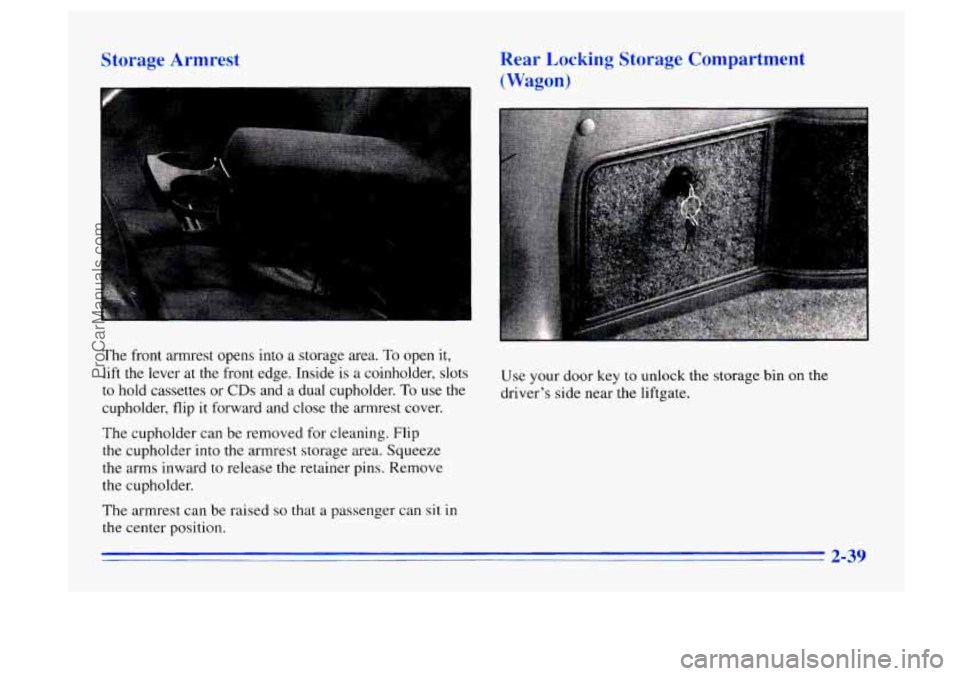
Use your door key to unlock the storage bin on the
driver’s side near the liftgate.
The front armrest opens into
a storage area.
To open it,
lift the lever at the front edge. Inside is a coinholder, slots
to hold cassettes or
CDs and a dual cupholder. To use the
cupholder, flip it forward and close the armrest cover.
The cupholder can be removed
for cleaning. Flip
the cupholder into
the armrest storage area. Squeeze
the arms inward to release
the retainer pins. Remove
the cupholder.
The armrest can be raised so that a passenger can sit in
the center position.
2-39
ProCarManuals.com
Page 211 of 340
- -
Gasoline vapor is highly flammable. It burns
violently, and that can cause very bad injuries.
Don’t smoke
if you’re near gasoline or refueling
your vehicle. Keep sparks, flames, and smoking
materials away from gasoline.
I ne cap is behind a hinged door on the left side of
your vehicle.
To take off the cap, turn it slowly to the left
(counterclockwise). I
If you get gasoline on yourself and then
something ignites it, you could
be badly burned.
Gasoline can spray out on you
if you open, the
fuel filler cap too quickly.
This spray can happen
if your tank is nearly full, and is more likely in
hot weather. Open the fuel filler cap slowly and
wait for any “hiss” noise to stop. Then unscrew
the cap all the way.
I Be careful not to spill gasoline. Clean gasoline from
painted surfaces as soon as possible. See “Cleaning the
Outside
of Your Buick” in the Index.
6-5
ProCarManuals.com
Page 264 of 340
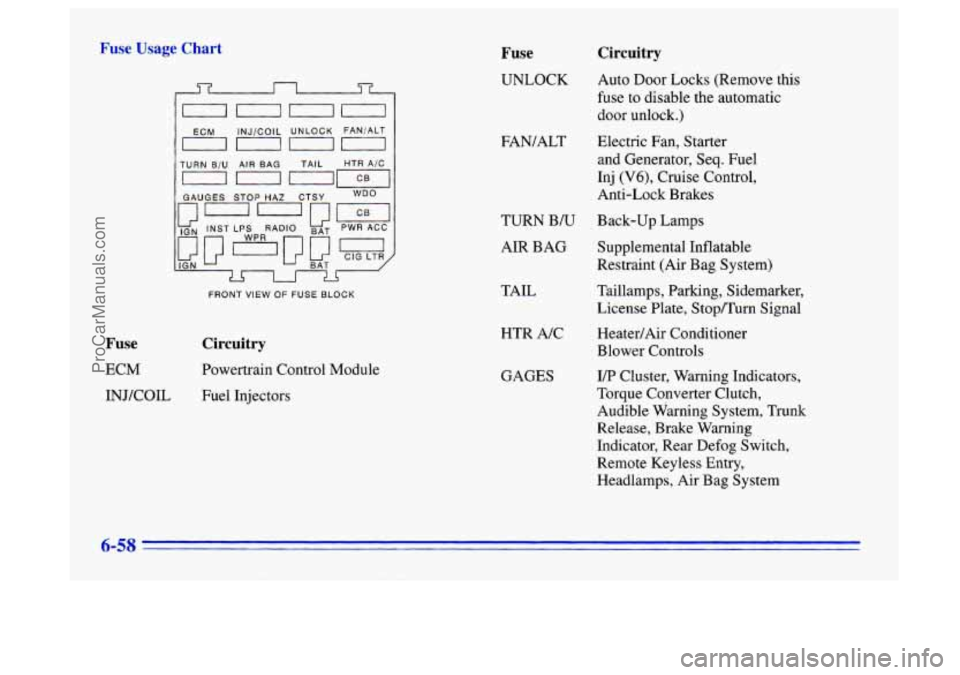
Fuse I qe Chart Fuse Circuitry
I----
ECM INJ/COIL UNLOCK FANiALT
GAUGES
STOP HAZ CTSY WDo
FRONT VIEW OF FUSE BLOCK
Fuse
ECM INJ/COIL
Circuitry
Powertrain Control Module Fuel Injectors UNLOCK Auto
Door Locks (Remove
this
fuse to disable the automatic
door unlock.)
FAN/ALT Electric Fan, Starter
and Generator, Seq. Fuel
Inj
(V6), Cruise Control,
Anti-Lock Brakes
TURN B/U Back-up Lamps
AIR BAG Supplemental Inflatable
Restraint (Air Bag System)
TAIL
HTR A/C
GAGES Taillamps,
Parking, Sidemarker,
License Plate, Stopflurn Signal
Heater/Air Conditioner
Blower Controls
IA? Cluster, Warning Indicators,
Torque Converter Clutch,
Audible Warning System, Trunk
Release, Brake Warning
Indicator, Rear Defog Switch,
Remote Keyless
Entry,
Headlamps, Air Bag System
6-58
ProCarManuals.com
Page 265 of 340
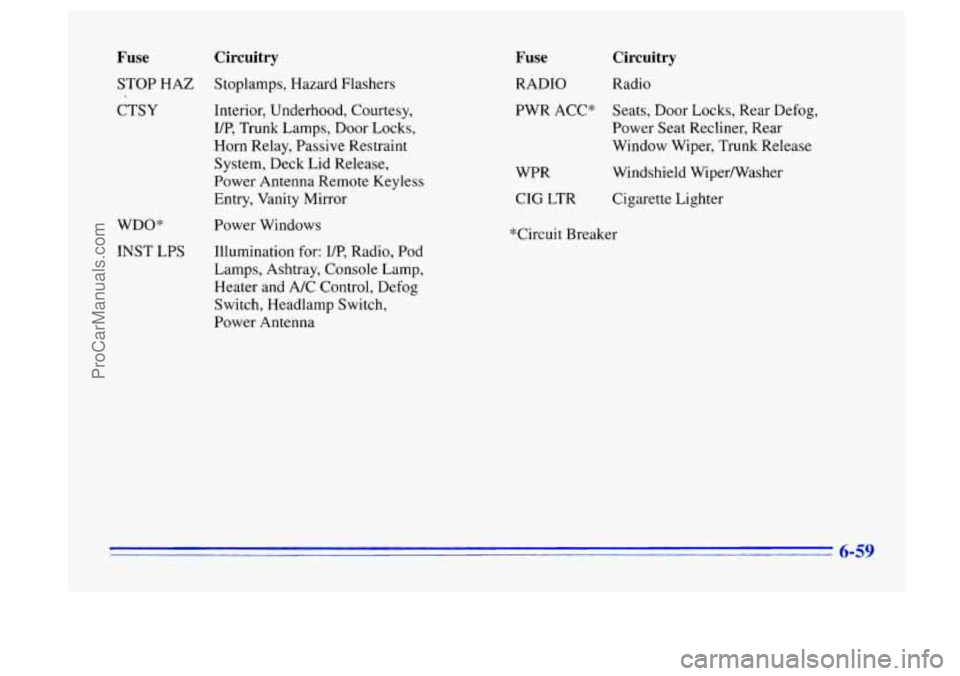
Fuse Circuitry
STOP HA2 Stoplamps, Hazard Flashers
CTSY Interior, Underhood, Courtesy,
UP, Trunk Lamps, Door Locks,
Horn Relay, Passive Restraint
System, Deck Lid Release,
Power Antenna Remote Keyless
Entry, Vanity Mirror
WDO* Power Windows
INST LPS Illumination for:
I/P, Radio, Pod
Lamps, Ashtray, Console Lamp,
Heater and A/C Control, Defog
Switch, Headlamp Switch,
Power Antenna
Fuse Circuitry
RADIO Radio
PWR ACC* Seats, Door Locks, Rear Defog,
Power Seat Recliner, Rear
Window Wiper, Trunk Release
WPR
CIG LTR Windshield
Wiperwasher
Cigarette Lighter
*Circuit Breaker
6-59
ProCarManuals.com
Page 307 of 340
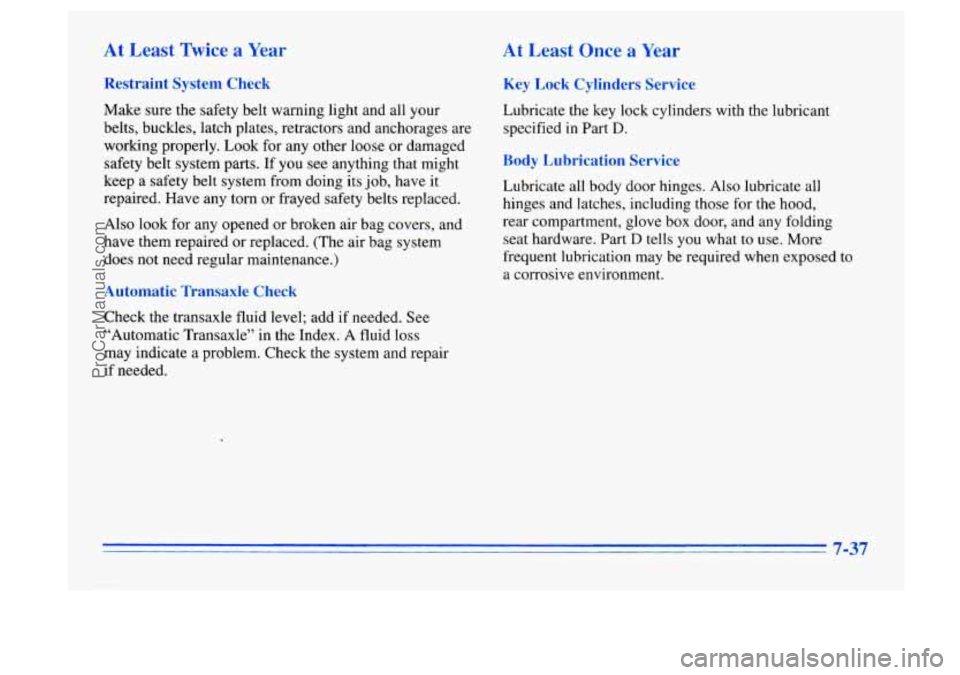
At Least Twice a Year
Restraint System Check
Make sure the safety belt warning light and all your
belts, buckles, latch plates, retractors and anchorages are
working properly. Look for any other loose or damaged
safety belt system parts. If you see anything that might
keep a safety belt system from doing its job, have it
repaired. Have any torn or frayed safety belts replaced.
Also look for
any opened or broken air bag covers, and
have them repaired or replaced. (The air bag system
does not need regular maintenance.)
Automatic Transaxle Check
Check the transaxle fluid level; add if needed. See
“Automatic Transaxle” in the Index. A fluid loss
may indicate a problem. Check the system and repair
if needed.
At Least Once a Year
Key Lock Cylinders Service
Lubricate the key lock cylinders with the lubricant
specified
in Part D.
Body Lubrication Service
Lubricate all body door hinges. Also lubricate all
hinges and latches, including those for the hood,
rear compartment, glove box door, and any folding
seat hardware. Part
D tells you what to use. More
frequent lubrication may be required when exposed to
a corrosive environment.
7-37
ProCarManuals.com