engine BUICK CENTURY 1996 Manual Online
[x] Cancel search | Manufacturer: BUICK, Model Year: 1996, Model line: CENTURY, Model: BUICK CENTURY 1996Pages: 340, PDF Size: 17.61 MB
Page 234 of 340
Adc J Washer 1
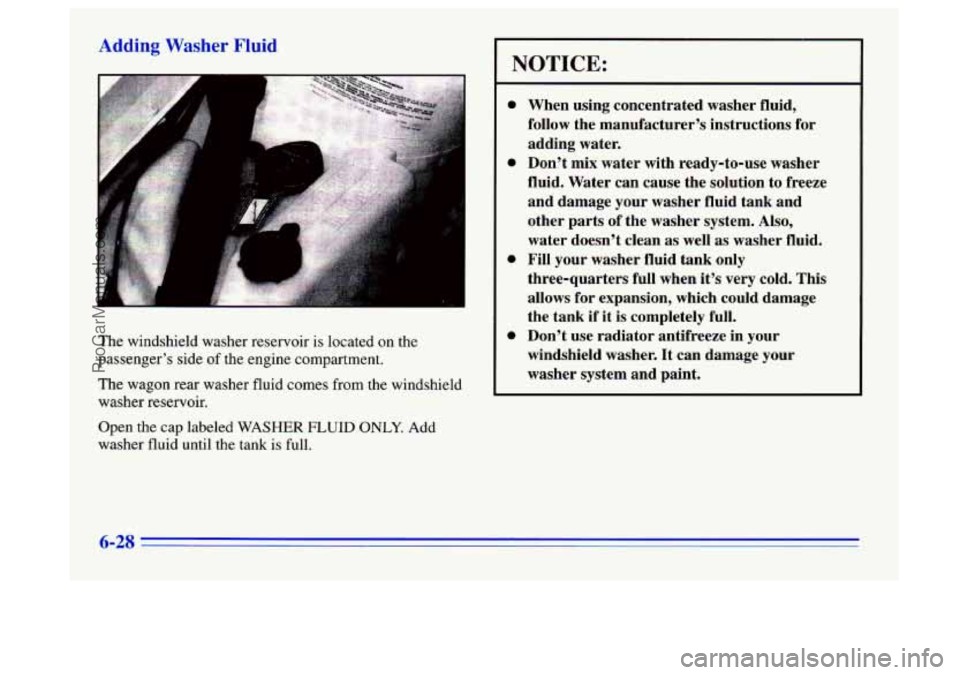
The windshield washer reservoir is located on the
passenger’s side
of the engine compartment.
The wagon rear washer fluid
comes from the windshield
washer reservoir.
Open the cap labeled
WASHER FLUID ONLY. Add
washer fluid until the tank
is full.
NOTICE:
0
0
0
0
When using concentrated washer fluid,
follow the manufacturer’s instructions for
adding water.
Don’t mix water with ready-to-use washer
fluid. Water can cause the solution to freeze
and damage your washer fluid tank and
other parts of the washer system. Also,
water doesn’t clean
as well as washer fluid.
Fill your washer fluid tank only
three-quarters full when it’s very cold. This
allows for expansion, which could damage
the tank if it is completely full.
Don’t use radiator antifreeze in your
windshield washer. It can damage your
washer system and paint.
6-28
ProCarManuals.com
Page 235 of 340
Brakes
Bra
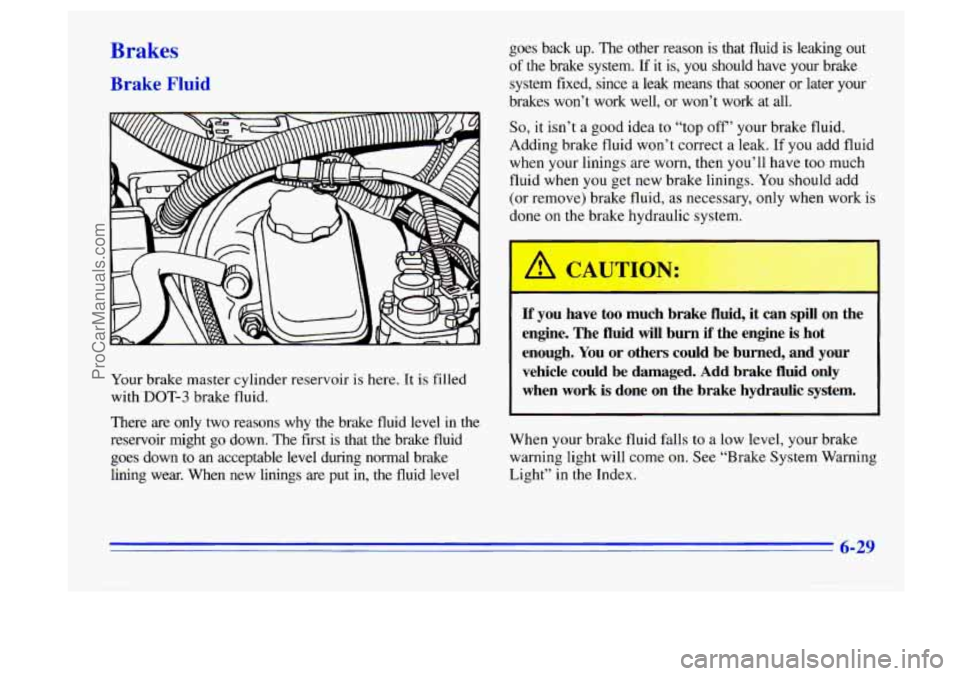
Your brake master cylinder reservoir is here. It is filled
with
DOT-3 brake fluid.
There are
only two reasons why the brake fluid level in the
reservoir might go down. The first is that the brake fluid
goes down to an acceptable level during normal brake
lining wear. When new linings are put in, the fluid level goes
back up. The other reason is that fluid is leaking out
of the brake system. If it is, you should have your brake
system fixed, since a leak means that sooner or later your
brakes won’t work well, or won’t work at all.
So, it isn’t a good idea to “top off’ your brake fluid.
Adding brake fluid won’t correct a leak.
If you add fluid
when your linings are worn, then you’ll have too much
fluid when you get new brake linings.
You should add
(or remove) brake fluid,
as necessary, only when work is
done on the brake hydraulic system.
If you have too much brake fluid, it can spill on the
engine. The fluid
will burn if the engine is hot
enough. You or others could be burned, and your
vehicle could be damaged. Add brake fluid
only
when work is done on the brake hydraulic system.
When your brake fluid falls to a low level, your brake
warning light will come on.
See “Brake System Warning
Light”
in the Index.
ProCarManuals.com
Page 236 of 340
What to Add
When you do need brake fluid, use only DOT-3 brake
fluid -- such as Delco Supreme 11 @ (GM Part
No. 1052535). Use new brake fluid from a sealed
container only, and always clean the brake fluid
reservoir
cap before removing it.
I
I A CAUTION:
With the wrong kind of fluid in your brake
system, your brakes may not work well, or they
may not even work at all. This could cause
a
crash. Always use the proper brake fluid.
NOTICE:
0 Using the wrong fluid can badly damage
brake system parts. For example, just
a few
drops of mineral-based oil, such as engine
oil, in your brake system can damage brake
system parts
so badly that they’ll have to be
replaced. Don’t let someone put in the
wrong kind of fluid.
0 If you spill brake fluid on your vehicle’s
painted surfaces, the paint finish can be
damaged. Be careful not to spill brake fluid
on your vehicle.
If you do, wash it off
immediately. See “Appearance Care’’
in
the Index.
6-30
ProCarManuals.com
Page 261 of 340
Vehicle Identification Number (VIN)
~C. SAMPLE4UXTM072675 -
CODE- MODEL YEAR PLANT I
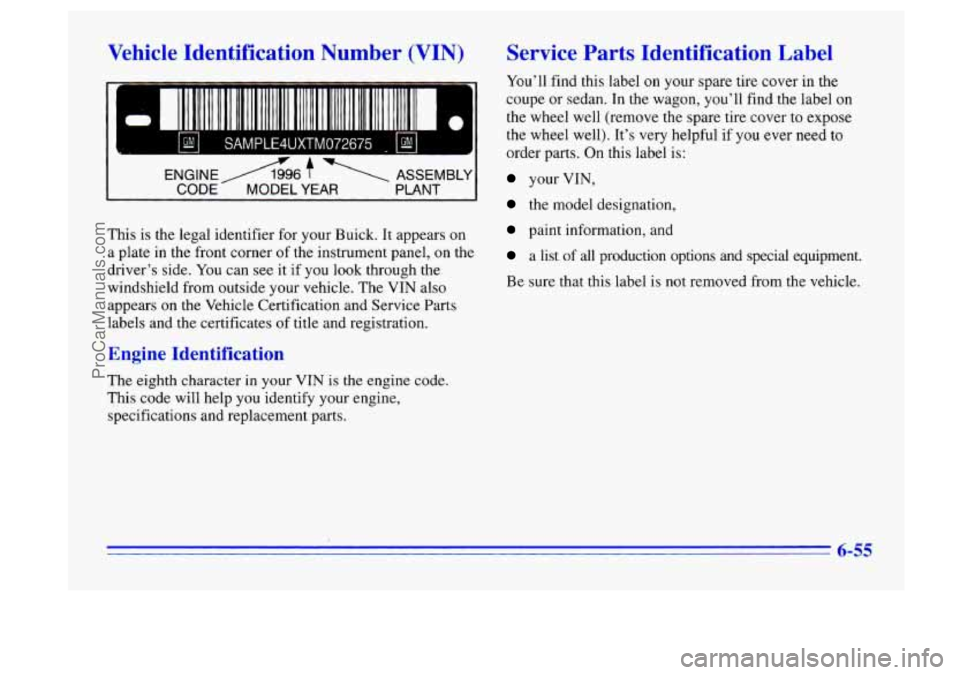
This is the legal identifier for your Buick. It appears on
a plate in the front corner of the instrument panel,
on the
driver’s side. You can see it if
you look through the
windshield from outside your vehicle. The
VIN also
appears on the Vehicle Certification and Service Parts
labels and the certificates
of title and registration.
Engine Identification
The eighth character in your VIN is the engine code.
This code will help you identify your engine,
specifications and replacement parts.
Service Parts Identification Label
You’ll find this label on your spare tire cover in the
coupe
or sedan. In the wagon, you’ll find the label on
the wheel well (remove the spare tire cover to expose
the wheel well). It’s very helpful
if you ever need to
order parts. On this label
is:
your VIN,
the model designation,
paint information, and
a list of all production options and special equipment.
Be sure that this label is not removed from the vehicle.
6-55
ProCarManuals.com
Page 262 of 340
Electrical System
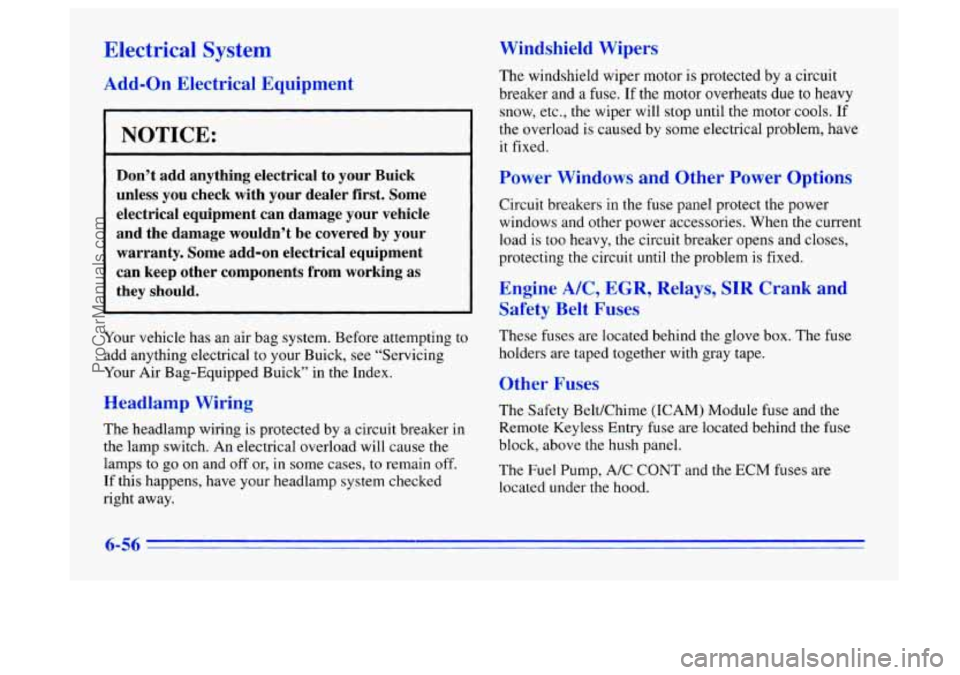
Add-on Electrical Equipment
I NOTICE:
Don’t add anything electrical to your Buick
unless you check with your dealer first. Some
electrical equipment can damage your vehicle
and the damage wouldn’t be covered by your
warranty. Some add-on electrical equipment
can keep other components from working as
they should.
Your vehicle has an air bag system. Before attempting to
add anything electrical to your Buick, see “Servicing
Your Air Bag-Equipped Buick” in the Index.
Headlamp Wiring
The headlamp wiring is protected by a circuit breaker in
the lamp switch. An electrical overload will cause the
lamps to
go on and off or, in some cases, to remain off.
If this happens, have your headlamp system checked
right away.
Windshield Wipers
The windshield wiper motor is protected by a circuit
breaker and a fuse.
If the motor overheats due to heavy
snow, etc., the wiper will stop until the motor cools. If
the overload is caused by some electrical problem, have
it fixed.
Power Windows and Other Power Options
Circuit breakers in the fuse panel protect the power
windows and other power accessories. When the current
load is too heavy, the circuit breaker opens and closes,
protecting the circuit until the problem is fixed.
Engine A/C, EGR, Relays, SIR Crank and
Safety Belt Fuses
These fuses are located behind the glove box. The fuse
holders are taped together with gray tape.
Other - uses
The Safety Belt/Chime (ICAM) Module fuse and the
Remote Keyless Entry fuse are located behind the fuse
block, above the hush panel.
The Fuel Pump, A/C CONT and the ECM fuses are
located under the hood.
6-56
ProCarManuals.com
Page 267 of 340
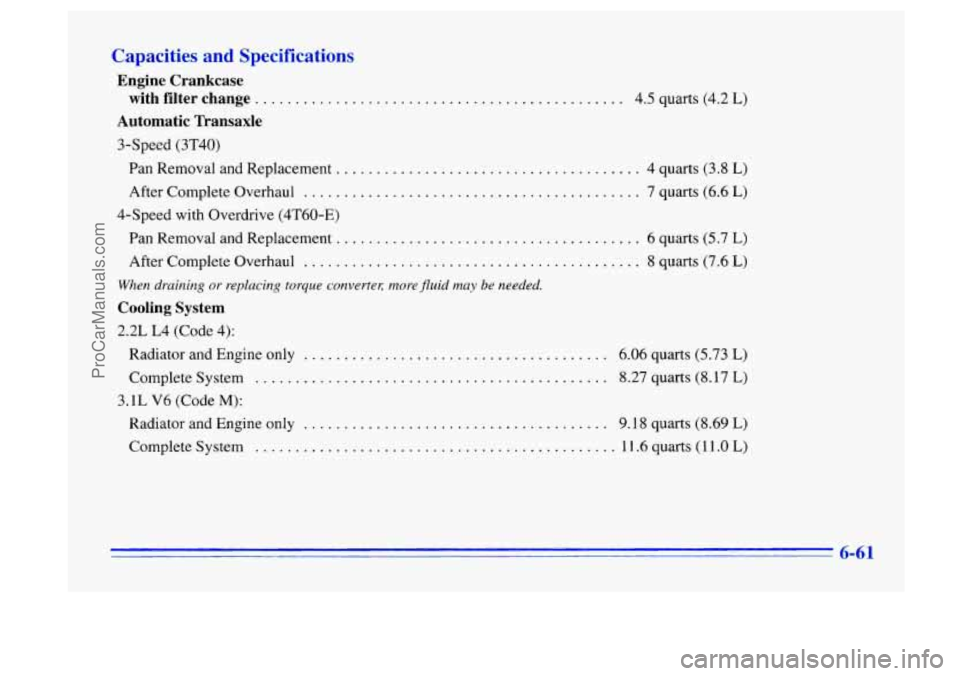
Capacities and Specifications
Engine Crankcase with filter change
.............................................. 4.5 quarts (4.2 L)
Automatic Transaxle
3-Speed (3T40)
Pan Removal and Replacement
...................................... 4 quarts (3.8 L)
After Complete Overhaul .......................................... 7 quarts (6.6 L)
4-Speed with Overdrive (4T60-E)
Pan Removal and Replacement
...................................... 6 quarts (5.7 L)
After Complete Overhaul
.......................................... 8 quarts (7.6 L)
When draining or replacing torque convertel; more fluid may be needed.
Cooling System
2.2L L4 (Code 4):
Radiator and Engine only
...................................... 6.06 quarts (5.73 L)
Complete System ............................................ 8.27 quarts (8.17 L)
3.1L V6 (Code
M):
Radiator and Engine only ...................................... 9.18 quarts (8.69 L)
Complete System ............................................. 11.6 quarts (1 1 .O L)
6-61
ProCarManuals.com
Page 269 of 340
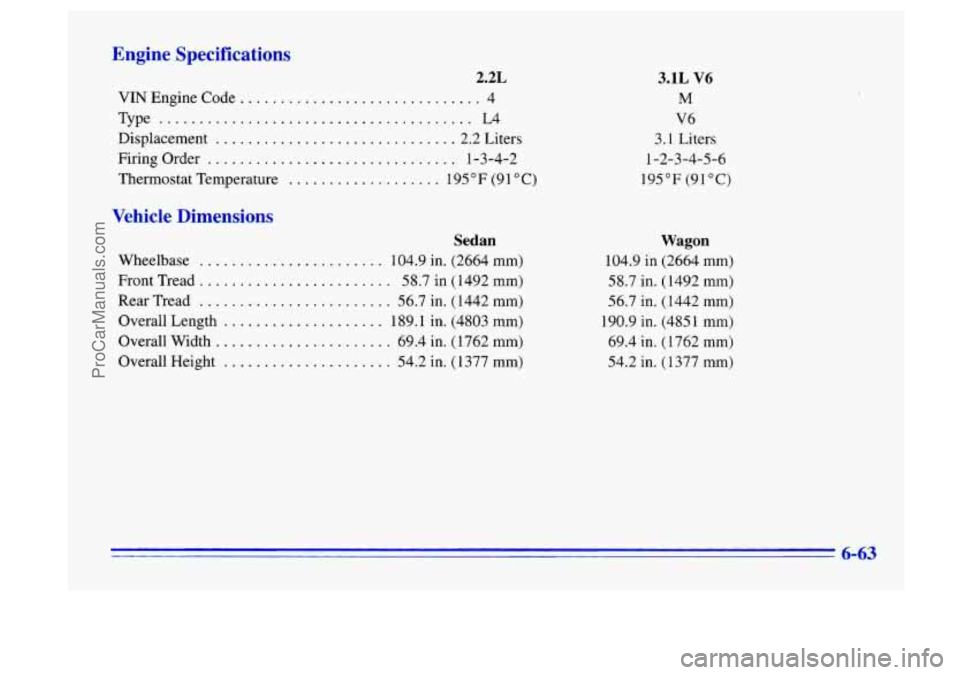
Engine Specifications
2.2L
VIN Engine Code .............................. 4
Type
....................................... L4
Displacement .............................. 2.2 Liters
Firing Order
............................... 1-3-4-2
Thermostat Temperature
................... 195°F (91 "C)
Vehicle Dimensions
Sedan
Wheelbase ....................... 104.9 in. (2664 mm)
Front Tread
........................ 58.7 in (1492 mm)
Rear Tread
........................ 56.7 in. ( 1442 mm)
Overall Length
.................... 189.1 in. (4803 mm)
Overall Width
...................... 69.4 in. (1762 mm)
Overall Height
..................... 54.2 in. ( 1377 mm)
3.1L V6
M
V6
3.1 Liters
1-2-3-4-5-6
195°F (91OC)
Wagon
104.9 in (2664 mm)
58.7 in. (1492 mm)
56.7 in. (1442 mm)
190.9
in. (4851 mm)
69.4 in. (1762 rnm)
54.2 in. (1377 mm)
6-63
ProCarManuals.com
Page 270 of 340
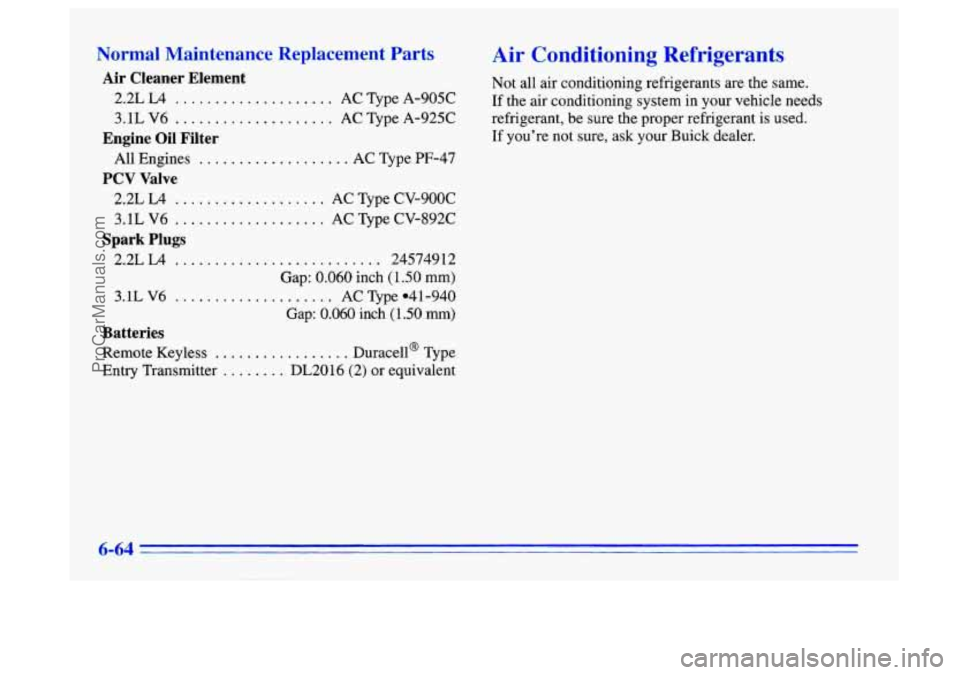
Normal Maintenance Replacement Parts
Air Cleaner Element
2.2L L4 .................... AC Type A-905C
3.1L
V6 .................... AC Qpe A-925C
All Engines
................... AC Type PF-47
2.2L L4 ................... AC Type CV-900C
3.1L
V6 ................... AC Type CV-892C
2.2LL4
.......................... 24574912
Gap:
0.060 inch (1.50 mm)
3.1L V6 .................... AC Type 041-940
Gap:
0.060 inch (1 SO mm)
Batteries
Remote Keyless Duracell Type
Entry Transmitter ........ DL2016 (2) or equivalent
Engine Oil Filter
PCV Valve
Spark Plugs
8 .................
Air Conditioning Refrigerants
Not all air conditioning refrigerants are the same.
If the air conditioning system in your vehicle needs
refrigerant, be sure the proper refrigerant is used.
If you’re not sure, ask your Buick dealer.
6-64
__
ProCarManuals.com
Page 271 of 340
Section 7 Maintenance Schedule
I
LE
IMPORTANT:
KEEP ENGINE OIL
AT THE PROPER
,VEL AND CHANGE
RECOMMENDED
AS
This section covers the maintenance required for your
Buick. Your vehicle needs these services to retain its
safety, dependability and emission control performance.
Protectiob.
Plan
Have you purchased the GM Protection Plan? The Plan
supplements
your new vehicle warranties. See your
Warranty and Owner Assistance booklet, or your Buick
dealer
for details.
Introduction
Your Vehicle and the Environment
Proper vehicle maintenance not only helps to keep your
vehicle in good working condition, but also helps the
environment. All recommended maintenance procedures
are important. Improper vehicle maintenance can even
affect the quality
of the air we breathe. Improper fluid
levels or the wrong tire inflation can increase the level
of emissions from your vehicle.
To help protect our
environment, and to keep your vehicle
in good
condition, please maintain your vehicle properly.
7-1
ProCarManuals.com
Page 274 of 340
Maintenance Scl aule
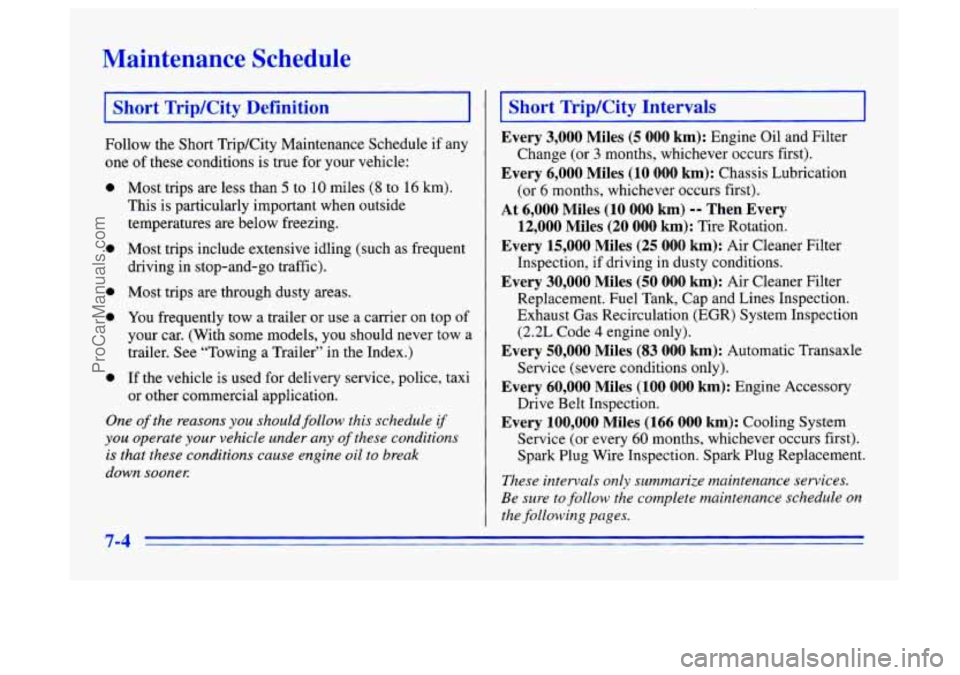
1 Short Trip/City Definition 1
Follow the Short Trip/City Maintenance Schedule if any
one
of these conditions is true for your vehicle:
a
a
a
a
0
Most trips are less than 5 to 10 miles (8 to 16 km).
This is particularly important when outside
temperatures
are below freezing.
Most trips include extensive idling (such as frequent
driving
in stop-and-go traffic).
Most trips are through dusty
areas.
You frequently tow a trailer or use a carrier on top of
your car. (With some models, you should never tow a
trailer. See “Towing a Trailer” in the Index.)
If the vehicle is used for delivery service, police, taxi
or other commercial application.
One
of the reasons you should follow this schedule if
you operate your vehicle under any of these conditions
is that these conditions cause engine oil to break
down sooneE
Short Trip/City Intervals -
Every 3,000 Miles (5 000 km): Engine Oil and Filter
Change (or
3 months, whichever occurs first).
Every 6,000 Miles (10 000 km): Chassis Lubrication
(or
6 months, whichever occurs first).
At 6,000 Miles (10 000 km) -- Then Every
12,000 Miles (20 000 km): Tire Rotation.
Every 15,000 Miles (25 000 km): Air Cleaner Filter
Inspection, if driving in dusty conditions.
Every 30,000 Miles (50 000 km): Air Cleaner Filter
Replacement. Fuel Tank, Cap and Lines Inspection.
Exhaust Gas Recirculation (EGR) System Inspection
(2.2L Code 4 engine only).
Every 50,000 Miles (83 000 km): Automatic Transaxle
Service (severe conditions only).
Every 60,000 Miles (100 000 km): Engine Accessory
Drive Belt Inspection.
Every 100,000 Miles (166 000 km): Cooling System
Service
(or every 60 months, whichever occurs first).
Spark Plug Wire Inspection. Spark Plug Replacement.
These intervals only summarize maintenance services.
Be sure to follow the complete maintenance schedule on
the following pages.
7-4
ProCarManuals.com