engine BUICK CENTURY 1996 Service Manual
[x] Cancel search | Manufacturer: BUICK, Model Year: 1996, Model line: CENTURY, Model: BUICK CENTURY 1996Pages: 340, PDF Size: 17.61 MB
Page 161 of 340
If You Do Decide To Pull A Trailer
If you do, here are some important points:
e There are many different laws, including speed limit
restrictions, having to do with trailering. Make sure
your rig will be legal, not only where you live but
also where you’ll be driving. A good source for this
information can be state or provincial police.
Consider using a sway control. You can ask a hitch
dealer about sway controls.
Don’t tow a trailer at all during the first 1,000 miles
(1 600 km) your new vehicle is driven. Your engine,
axle or other parts could be damaged.
Then, during the first 500 miles (800 km) that you
tow a trailer, don’t drive over
50 mph (80 kmh) and
don’t make starts at full throttle. This helps your
engine and other parts of your vehicle wear in at
the
heavier loads.
Obey speed limit restrictions when towing a trailer.
Don’t drive faster than the maximum posted speed
for trailers (or no more than
55 mph (88 km/h)) to
save wear on your vehicle’s parts.
Three important considerations have to do with weight:
the weight of the trailer,
the weight of the trailer tongue
and the total weight on your vehicle’s tires.
Weight of the Trailer
Your vehicle can tow normally up to 1,000 lbs. (450 kg).
If your vehicle has a
3.1 L V6 engine with a four-speed
automatic transaxle and is equipped with the optional
heavy-duty engine cooling system, it can tow up to
2,000 lbs. (900 kg).
It depends on how you plan to use your rig. For
example, speed, altitude, road grades, outside
temperature and how much your vehicle is used to pull a
trailer are all important. And,
it can also depend on any
special equipment that
you have on your vehicle.
You can ask your dealer for our trailering information or
advice, or you can write
us at:
Buick Motor Division
Customer Assistance Center
902 E. Hamilton Ave.
Flint, MI
48550
In Canada, write to:
General Motors of Canada Limited
Customer Assistance Center
1908 Colonel Sam Drive
Oshawa, Ontario
LlH 8P7
4-31
ProCarManuals.com
Page 165 of 340
Making Turns
I NOTICE:
Making very sharp turns while trailering could cause the trailer to come in contact with the
vehicle. Your vehicle could be damaged. Avoid
making very sharp turns while trailering.
When you’re turning with a trailer, make wider
turns than normal.
Do this so your trailer won’t
strike soft shoulders, curbs, road signs, trees or other
objects. Avoid jerky or sudden maneuvers. Signal
well in advance.
Turn Signals When Towing a Trailer
When you tow a trailer, your vehicle may need a
different turn signal flasher and/or extra wiring. Check
with your Buick dealer. The arrows on your instrument
panel will flash whenever
you signal a turn or lane
change. Properly hooked up, the trailer lamps will also
flash, telling other drivers you’re about
to turn, change
lanes or stop. When towing
a trailer, the arrows on your instrument
panel will flash for turns even if the bulbs on the trailer
are burned
out. Thus, you may think drivers behind
you are seeing your signal when they are not. It’s
important to check occasionally to be sure the trailer
bulbs are still working.
Driving On Grades
Reduce speed and shift to a lower gear before you start
down a long or steep downgrade. If you don’t shift
down, you might have
to use your brakes so much that
they would get hot and no longer work well.
On a long uphill grade, shift down and reduce your
speed to around
45 mph (70 km/h) to reduce the
possibility
of engine and transaxle overheating.
If you are towing a trailer that weighs more than
1,000 lbs. (450 kg) and you have an automatic transaxle
with overdrive, you may prefer to drive in
THIRD (3)
instead of AUTOMATIC OVERDRIVE (@I). An
overdrive transmission is required if towing a trailer more
than
1,000 lbs. (450 kg).
4-35
ProCarManuals.com
Page 166 of 340
Parking on Hills
You really should not parK your vehicle, with a trailer
attached,
on a hill. If something goes wrong, your rig
could start to move. People can be injured, and both
your vehicle and the trailer can be damaged.
But if
you ever have to park your rig on a hill, here’s
how to do it:
1. Apply your regular brakes, but don’t shift into
2. Have someone place chocks under the trailer wheels.
PARK
(P) yet.
3. When the wheel
chocks are in place, release the
regular brakes until the chocks absorb the load.
4. Reapply the regular brakes. Then, apply your
parking brake, and then shift
to PARK (P).
5. Release the regular brakes.
When You Are Ready to Leave After
Parking on
a Hill
1. Apply your regular brakes and hold the pedal down
while
you:
m Start your engine;
0 Shift into a gear; and
Release the parking brake.
2. Let up on the brake pedal.
3. Drive slowly until the trailer is clear of the chocks.
4. Stop and have someone pick up and store the chocks.
Maintenance When Trailer Towing
Your vehicle will need service more often when you’re
pulling a trailer. See the Maintenance Schedule for more
on this. Things that are especially important in trailer
operation are automatic transaxle fluid (don’t overfill),
engine oil, belt, cooling system and brake adjustment.
Each of these is covered in this manual, and the Index
will help
you find them quickly. If you’re trailering, it’s
a good idea to review these sections before you start
your trip.
Check periodically to see that all hitch nuts and bolts
are tight.
4-
ProCarManuals.com
Page 169 of 340
2.
3.
Get the vehicles close enough so the jumper cables
can reach, but be sure the vehicles aren’t touching
each other.
If they are, it could cause a ground
connection you don’t want. You wouldn’t be able to
start your Buick, and the bad grounding could
damage the electrical systems.
Turn
off the ignition on both vehicles. Unplug
unnecessary accessories plugged into the cigarette
lighter. Turn
off all lamps that aren’t needed as well
as as radios. This will avoid sparks and help save
both batteries. In addition, it could save your radio!
NOTICE:
If you leave your radio on, it could be badly
damaged. The repairs wouldn’t be covered by
your warranty.
4. Open the hoods and locate the batteries.
Find the positive
(+) and negative (-) terminals on
each battery.
A
I CAUTION:
An electric fan can start up even when the engine
is not running and can injure you. Keep hands, clothing and tools away from any underhood
electric fan.
5-3
ProCarManuals.com
Page 170 of 340
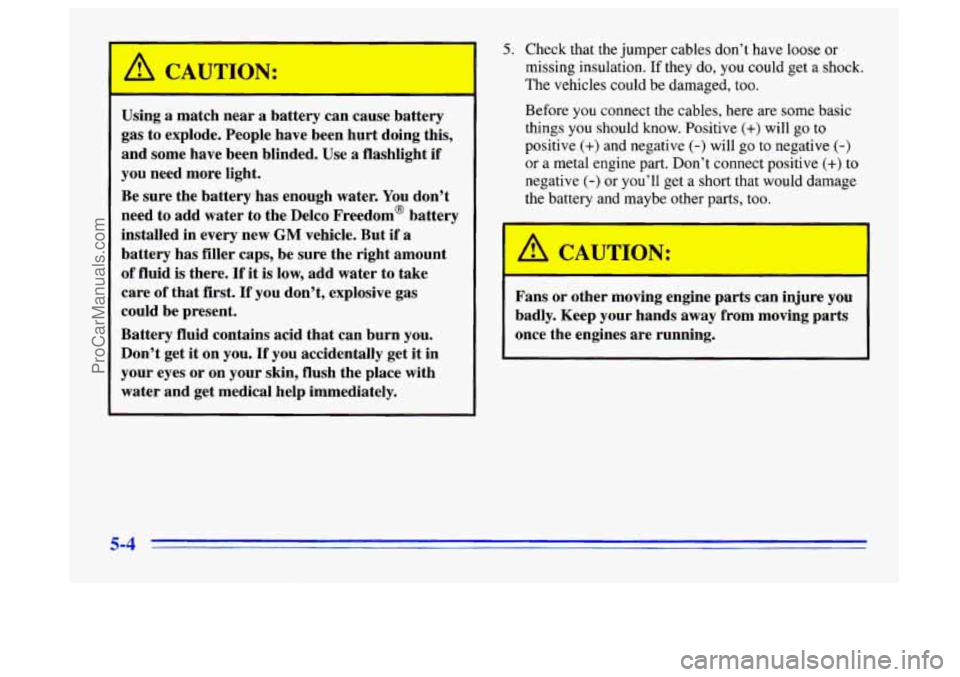
Using a match near a battery can cause battery
gas to explode. People have been hurt doing this,
and some have been blinded. Use a flashlight if
you need more light.
Be sure the battery has enough water. You don’t
need
to add water to the Delco Freedom@ battery
installed in every new
GM vehicle. But if a
battery has filler caps, be sure the right amount
of fluid is there. If it is low, add water to take
care of that
first. If you don’t, explosive gas
could be present.
Battery fluid contains acid that can burn you.
Don’t get
it on you. If you accidentally get it in
your eyes or on your skin, flush the place with
water and get medical help immediately.
5. Check that the jumper cables don’t have loose or
missing insulation.
If they do, you could get a shock.
The vehicles could be damaged, too.
Before you connect the cables, here are some basic
things you should know. Positive
(+) will go to
positive
(+) and negative (-) will go to negative (-)
or a metal engine part. Don’t connect positive (+) to
negative (-) or you’ll get a short that would damage
the battery and maybe other parts, too.
Fans or other moving engine parts can injure you
badly. Keep your hands away from moving parts
once the engines are running.
ProCarManuals.com
Page 172 of 340
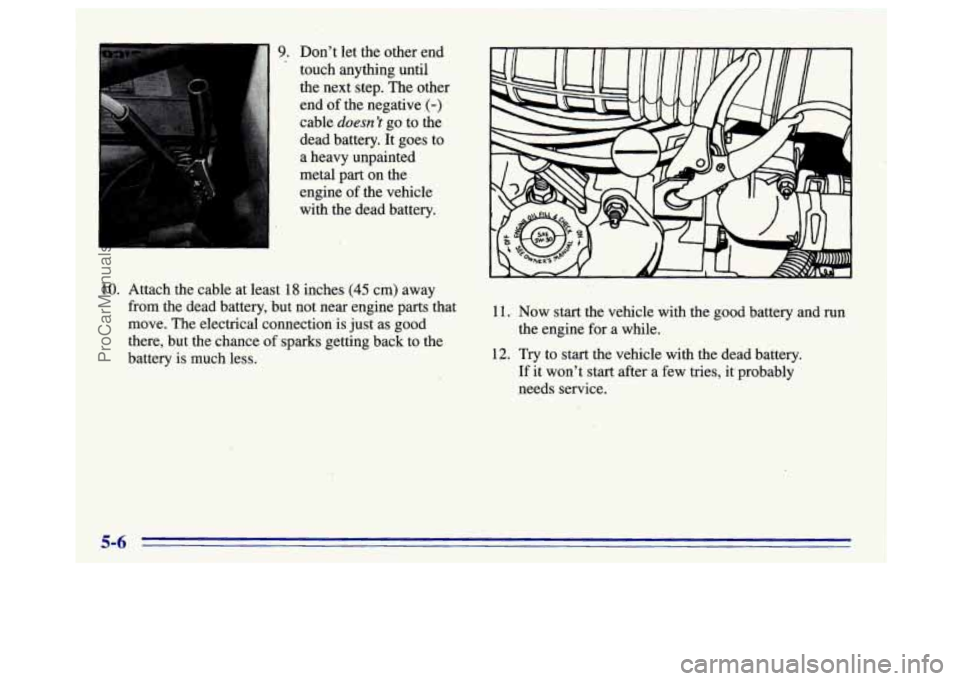
9. Don't let the other end
touch anything until
the next step. The other
end of the negative
,(-)
cable doesn't go to the
dead battery. It goes to
a heavy unpainted
metal part on the
engine
of the vehicle
with the dead battery.
10. Attach the cable at least 18 inches (45 cm) away
from the dead battery, but not near engine parts that
move. The electrical connection is just as good
there, but the chance of sparks getting back to the
battery is much less.
11 .. Now start the vehicle with the good battery and run
12. Try to start the vehicle with the dead battery.
the engine
for a
while.
If it won't start after a few tries, it probably
needs service.
5-6
ProCarManuals.com
Page 173 of 340
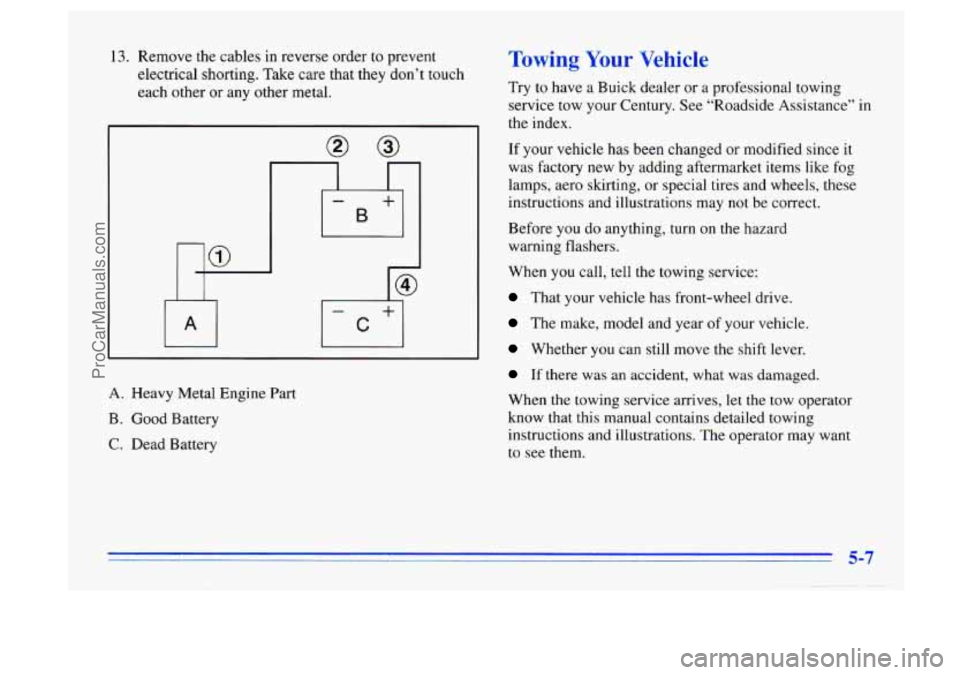
13. Remove the cables in reverse order to prevent
electrical shorting. Take care that they don’t touch
each other
or any other metal.
A. Heavy Metal Engine Part
B. Good Battery
C. Dead Battery
Towing Your Vehicle
Try to have a Buick dealer or a professional towing
service tow your Century. See “Roadside Assistance” in
the index.
If your vehicle has been changed or modified since it
was factory new by adding aftermarket items like fog
lamps, aero skirting, or special tires and wheels, these
instructions and illustrations may
not be correct.
Before you do anything, turn on the hazard
warning flashers.
When you call, tell the towing service:
That your vehicle has front-wheel drive.
The make, model and year of your vehicle.
Whether you can still move the shift lever.
If there was an accident, what was damaged.
When
the towing service arrives, let the tow operator
know that this manual contains detailed towing
instructions and illustrations. The operator may want
to see them.
ProCarManuals.com
Page 176 of 340
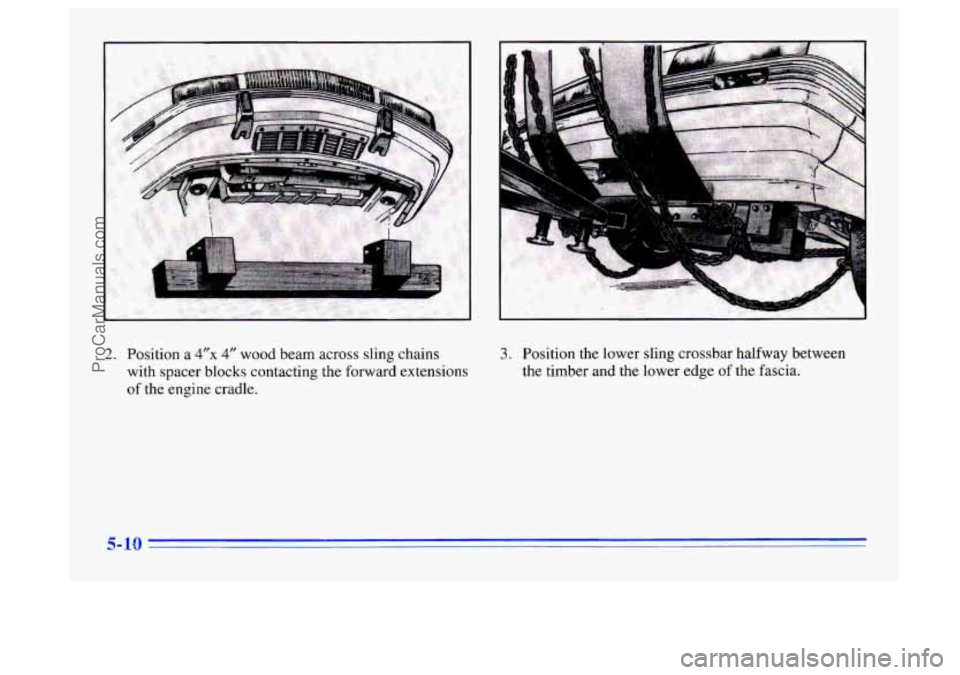
2. Position a 4”x 4” wood beam across sling chains
with spacer blocks contacting the forward extensions
of the engine cradle.
5-10
3. Position the lower sling crossbar halfway between
the timber and the lower edge
of the fascia.
ProCarManuals.com
Page 179 of 340
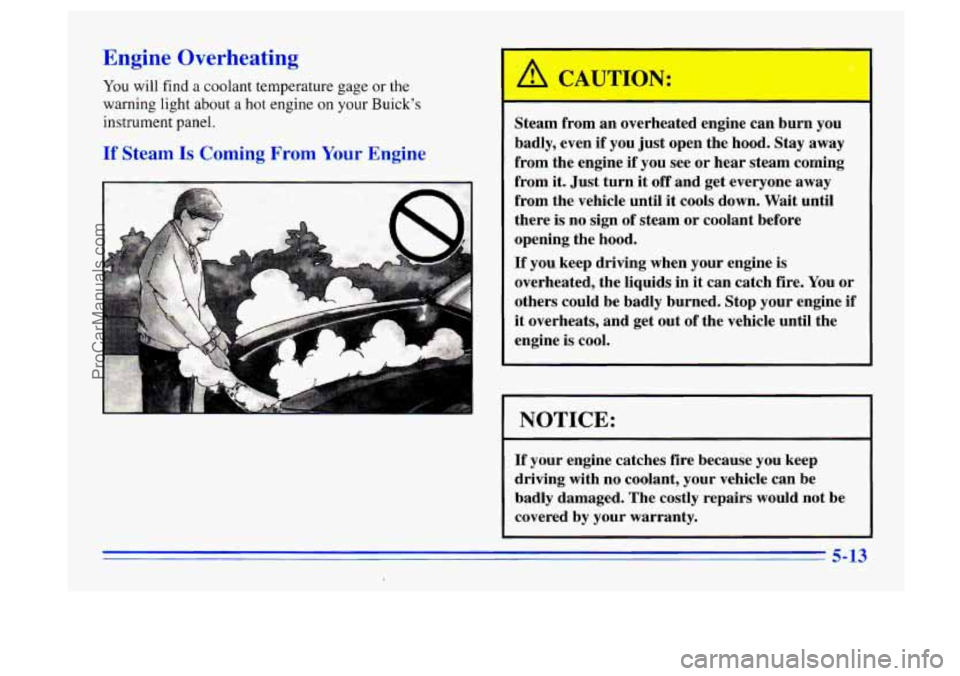
Engine Overheating
You will find a coolant temperature gage or the
warning light about a hot engine on
your Buick’s
instrument panel.
If St1 .-m Is 1 - - ng Fro Your Engine
Steam from an overheated engine can burn you
badly, even if you just open the hood. Stay away
from the engine if you see or hear steam coming
from it. Just turn
it off and get everyone away
from the vehicle until
it cools down. Wait until
there is no sign of steam or coolant before
opening the hood.
If you keep driving when your engine is
overheated, the liquids in it can catch fire. You or
others could be badly burned. Stop your engine if
it overheats, and get out of the vehicle until the
engine is cool.
NOTICE:
If your engine catches fire because you keep
driving with no coolant, your vehicle can be
badly damaged. The costly repairs would not be
covered by your warranty.
5-13
ProCarManuals.com
Page 180 of 340
If No Steam Is Coming From Your Engine
If you get the overheat warning but see or hear no
steam, the problem may not be
too serious. Sometimes
the engine can get a little too hot when you:
Climb a long hill on a hot day.
Stop after high-speed driving.
Idle for long periods in traffic.
Tow a trailer.
If you get the overheat warning with no sign
of steam,
try this for a minute or
so:
1. Turn off your air conditioner.
2. Turn on your heater to full hot at the highest fan
speed and open the window as necessary.
3. If you’re in a traffic jam, shift to NEUTRAL (N);
otherwise, shift to the highest gear while
driving
-- AUTOMATIC OVERDRIVE (@)
or DRIVE (D). If
you no longer have the overheat warning, you
can drive. Just to be safe, drive slower for about
10 minutes. If
the warning doesn’t come back on,
you can drive normally.
If the warning continues, pull over, stop, and park your
vehicle right away.
If there’s still no sign
of steam, you can idle the engine
for two or three minutes while you’re parked, to see if
the warning stops. But then, if you still have the
warning,
turn ofthe engine and get everyone out of the
vehicle until it cools down.
You may decide not to lift the
hood but to get service
help right away.
5-14
ProCarManuals.com