warning light BUICK CENTURY 1997 User Guide
[x] Cancel search | Manufacturer: BUICK, Model Year: 1997, Model line: CENTURY, Model: BUICK CENTURY 1997Pages: 406, PDF Size: 20.64 MB
Page 140 of 406
Have you recently changed brands of fuel?
If
so, be sure to fuel your vehicle with quality fuel (see
“Fuel” in the Index). Poor fuel quality will cause your
engine not to run as efficiently as designed. You may
notice this as stalling after start-up, stalling when
you
put the vehicle into gear, misfiring, hesitation on
acceleration or stumbling on acceleration. (These
conditions may
go away once the engine is warmed up.)
This will be detected by the system and cause the light
to turn on.
If
you experience one or more of these conditions,
change the fuel brand
you use. It will require at least one
full tank of the proper fuel to turn the light off.
If none of the above steps have made the light turn off,
have your dealer or qualified service center check the
vehicle. Your dealer has the proper test equipment and
diagnostic tools
to fix any mechanical or electrical
problems that may have developed.
Oil Warning Light
If you have a problem with
your oil, this light may stay
on after you start your
engine, or come on when
you are driving.
This indicates that oil is not going through your engine
quickly enough
to keep it lubricated. The engine could
be low on oil or could have some other oil problem.
Have it fixed right away.
The oil light could also come on in the
following situations:
The light will come on briefly when you turn on the
ignition to show
you that it is working properly. (If it
doesn’t come
on with the ignition on, you may have
a problem with the fuse or bulb. Have it fixed
right away.)
Sometimes when the engine is idling at a stop, the
light may blink on and off. This is normal.
ProCarManuals.com
Page 143 of 406
Cruise Light
The CRUISE light comes
on whenever you
set your
cruise control.
See “Cruise
CRUISE
Control” in the Index.
Service Vehicle Soon Light
SERVICE VEHICLE
SOON
This light will come on if
you have certain
non-emission related
vehicle problems. These
problems may
not be obvious and may affect
vehicle performance or durability. Consult
a qualified
Buick dealership for necessary repairs to maintain top
vehicle performance. The light will come on briefly
when your ignition is turned
on to show that it is
working properly.
Low Washer Fluid Warning Light
This light will come on
when your windshield
washers are working and
the
fluid container is low. The
light will also come
on
briefly when your ignition
is turned on
to show that it
is working properly.
2-67
ProCarManuals.com
Page 144 of 406

Door/Trunk Ajar Warning Light
DOORDRUNK
Fuel Gage
This light will come on if
your trunk
or any door is
not completely closed.
Your fuel gage tells you
about how much fuel you
have left when the ignition
is on. When the indicator
nears
EMPTY (E), you still
have a little fuel left, but
you should get more soon. Here
are some things owners
ask about. All these
situations are normal and
do not show a problem with
your
fuel gage:
0
0
0
At the service station, the pump shuts off before the
gage reads
FULL (F).
It takes a little more or less fuel to fill up than the
gage indicated. For example, the gage may have
indicated
the tank was half full, but it actually took a
little more or less than half the tank’s capacity to
fill it.
The gage moves
a little when you turn a corner or
speed
up.
Low Fuel Light
If your fuel is low, a circular
light on your instrument
panel cluster will come on
and stay on and a chime will
sound periodically until you
add fuel.
It will also come
on for a few seconds when
you first turn on the ignition
as a check to show you it’s
working.
If it doesn’t come
on then, have
it fixed.
2-68
ProCarManuals.com
Page 193 of 406
Avoid needless heavy bralung. Some people drive in
spurts
-- heavy acceleration followed by heavy
braking
-- rather than keeping pace with traffic. This is a
mistake. Your brakes may not have time to cool between
hard stops. Your brakes will wear out much faster if you
do
a lot of heavy braking. If you keep pace with the
traffic and allow realistic following distances,
you will
eliminate a lot
of unnecessary braking. That means
better braking and longer brake life.
If your engine ever stops while you’re driving, brake
normally but don’t pump your brakes.
If you do, the
pedal may get harder to push down.
If your engine
stops,
you will still have some power brake assist. But
you will
use it when you brake. Once the power assist is
used up, it may take longer to stop and the brake pedal
will be harder
to push.
Anti-Lock Brakes (ABS)
Your vehicle has anti-lock brakes (ABS). ABS is an
advanced electronic braking system that will help
prevent a braking skid.
When you start your engine, or when
you begin to drive
away, your anti-lock brake system will check itself. You
may hear a momentary motor or clicking noise while
this
test is going on, and you may even notice that your
brake pedal moves a little. This is normal.
ANTI -
LOCK
If there’s a problem with the
anti-lock brake system, this
warning light will stay on or
flash. See “Anti-Lock
Brake System Warning
Light” in the Index.
4-7
ProCarManuals.com
Page 205 of 406
City Driving
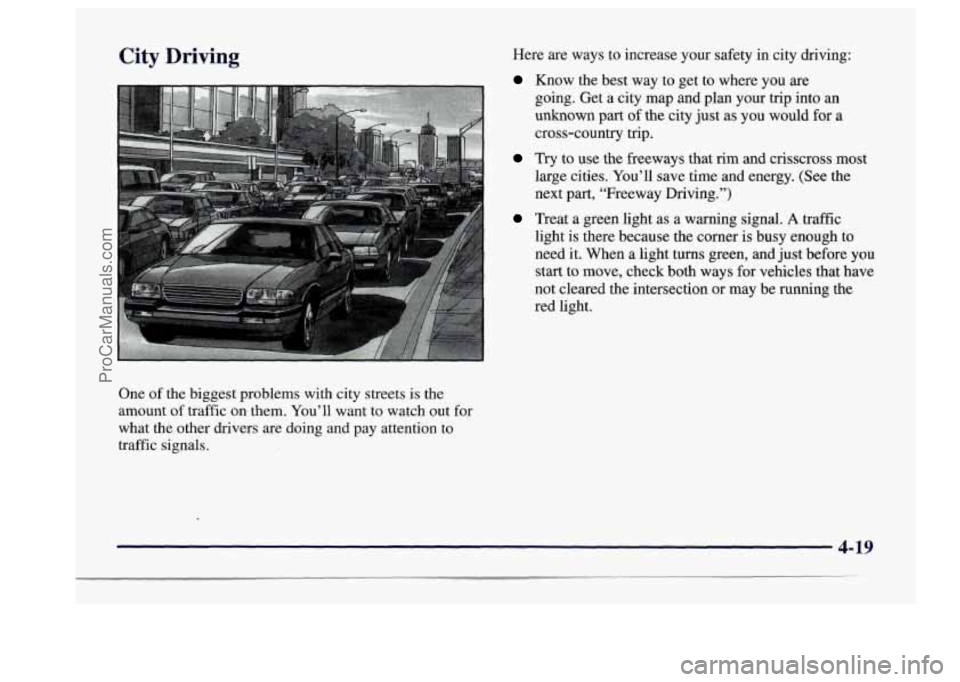
One of the biggest problems with city streets is the
amount of traffic on them. You’ll want to watch out for
what the other drivers are doing and pay attention to
traffic signals. Here
are ways to increase your safety in city driving:
Know the best way to get to where you are
going. Get a city map and plan your trip into an
unknown part
of the city just as you would for a
cross-country trip.
Try to use the freeways that rim and crisscross most
large cities. You’ll save time and energy. (See the
next part, “Freeway Driving.”)
light is there because the corner
is busy enough to
need it. When a light turns green, and just before you
start to move, check both ways
for vehicles that have
not cleared the intersection or may be running
the
red light.
Treat a green light as a warning signal. A traffic
ProCarManuals.com
Page 210 of 406
Winter Driving
Here are some tips for winter driving:
0 Have your vehicle in good shape for winter.
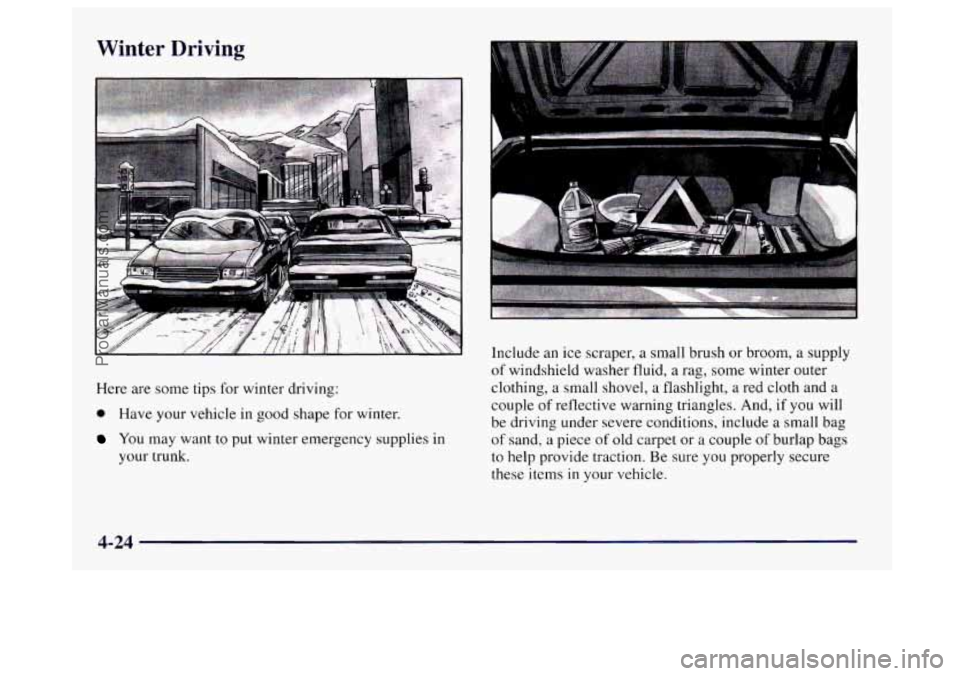
You may want to put winter emergency supplies in
your trunk. Include an
ice scraper,
a small brush or broom, a supply
of windshield washer fluid, a rag, some winter outer
clothing, a small shovel,
a flashlight, a red cloth and a
couple of reflective warning triangles. And, if you will
be driving under severe conditions, include
a small bag
of sand, a piece of old carpet or a couple of burlap bags
to help provide traction. Be sure you properly secure
these items
in your vehicle.
4-24
ProCarManuals.com
Page 241 of 406
Engine Overheating
You will find a coolant temperature gage and a hot
engine warning light on your instrument panel. See
“Engine Coolant Temperature Gage” and “Engine
Coolant Temperature Warning Light” in the Index. You
also have a low coolant warning light on your
instrument panel. See “Low Coolant Light” in the Index.
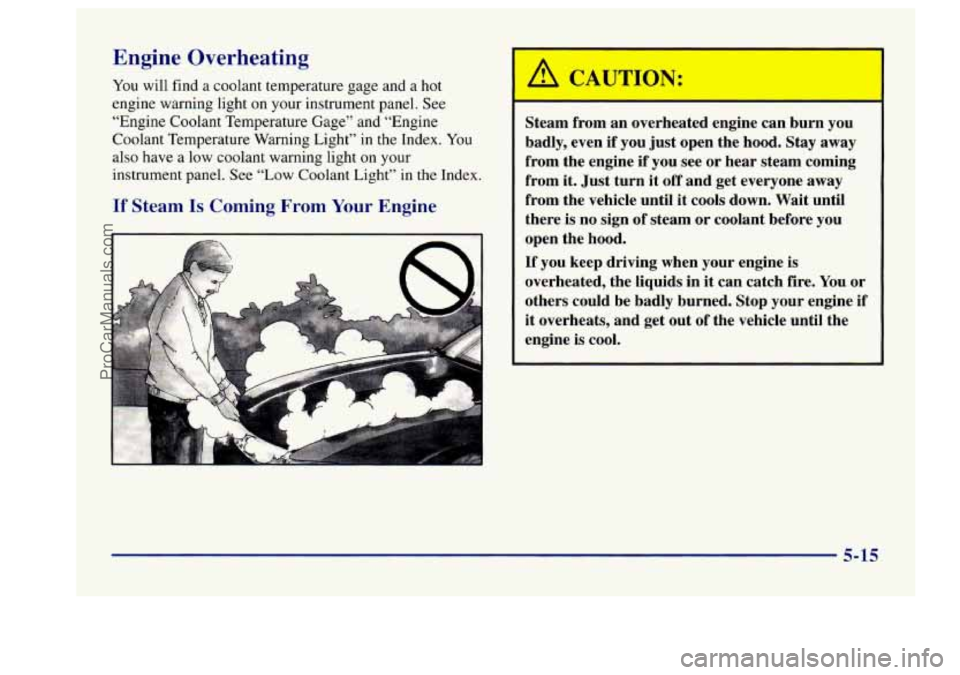
If Steam Is Coming From Your Engine
Steam from an overheated engine can burn you
badly, even if you just open the hood. Stay away
from the engine if you see
or hear steam coming
from it. Just turn it off and get everyone away
from the vehicle until it cools down. Wait until
there is no sign of steam or coolant before you
open the hood.
If you keep driving when your engine is
overheated, the liquids in
it can catch fire. You or
others could be badly burned. Stop your engine
if
it overheats, and get out of the vehicle until the
engine
is cool.
5-15
ProCarManuals.com
Page 280 of 406
When to Chang( Cngine Oil
If any one of these is true for you, use the short tripkity
maintenance schedule:
Most trips are less than 5 to 10 miles (8 to 16 km).
This is particularly important when outside
temperatures are below freezing.
Most trips include extensive idling (such as frequent
driving in stop-and-go traffic).
Most trips are through dusty areas.
You frequently tow a trailer or use a carrier on top of
your vehicle.
The vehicle is used for delivery service, police, taxi
or other commercial application.
Driving under these conditions causes engine
oil to break
down sooner.
If any one of these is true for your vehicle,
then you need to change your oil and filter every
3,000 miles (5 000 km) or 3 months -- whichever occurs
first. (See “Change Oil Soon” Light in the Index.)
If none
of them is true, use the long triphighway
maintenance schedule. Change the oil and filter every
7,500 miles (12 500 km) or 12 months -- whichever
occurs first. Driving a vehicle with a fully warmed
engine under highway conditions causes engine oil to
break down slower. (See
“Change Oil
Soon” Light in the Index.)
What to Do with Used Oil
Did you know that used engine oil contains certain
elements that may be unhealthy for your skin and could
even cause cancer? Don’t let used oil stay on your skin
for very long. Clean your skin and nails with soap and
water, or a good hand cleaner. Wash or properly throw
away clothing or rags containing used engine oil. (See
the manufacturer’s warnings about the use and disposal
of oil products.)
Used oil can be a real threat to the environment. If you
change your own oil, be sure to drain all free-flowing oil
from the filter before disposal. Don’t ever dispose of oil
by putting it in the trash, pouring it on the ground, into
sewers, or into streams or bodies
of water. Instead,
recycle it by taking it to a place that collects used oil.
If
you have a problem properly disposing of your used oil,
ask your dealer, a service station or a local recycling
center for help.
ProCarManuals.com
Page 286 of 406
Engine Coolant
The cooling s stem in your vehicle is filled with
DEX-COOL engine coolant. This coolant is designed
to remain in your vehicle for
5 years or 150,000 miles
(240 000 km) whichever occurs first, if you add only
DEX-COOL’ extended life coolant.
J
The following explains your cooling system and how to
add coolant when it is low.
If you have a problem with
engine overheating or if you need to add coolant to your
radiator, see “Engine Overheating”
in the Index.
A 50/50 mixture of water and DEX-COOL@
coolant will:
0 Give freezing protection down to -34°F (-37°C).
0 Give boiling protection up to 265 OF ( 129 O C).
0 Protect against rust and corrosion.
Help keep the proper engine temperature.
0 Let the warning lights and gages work as
they should.
NOTICE:
When adding coolant, it is important that you use
only
DEX-COOL@ silicate-free) coolant.
If coolant other than DEX-COOL is added to the
system, premature engine, heater core or radiator corrosion may result. In addition, the
engine coolant will require change sooner
-- at
30,000 miles (50 000 km) or 24 months,
whichever occurs first. Damage caused by the use
of coolant other than DEX-COOL@ is not
covered
by your new vehicle warranty.
6-20
ProCarManuals.com
Page 293 of 406
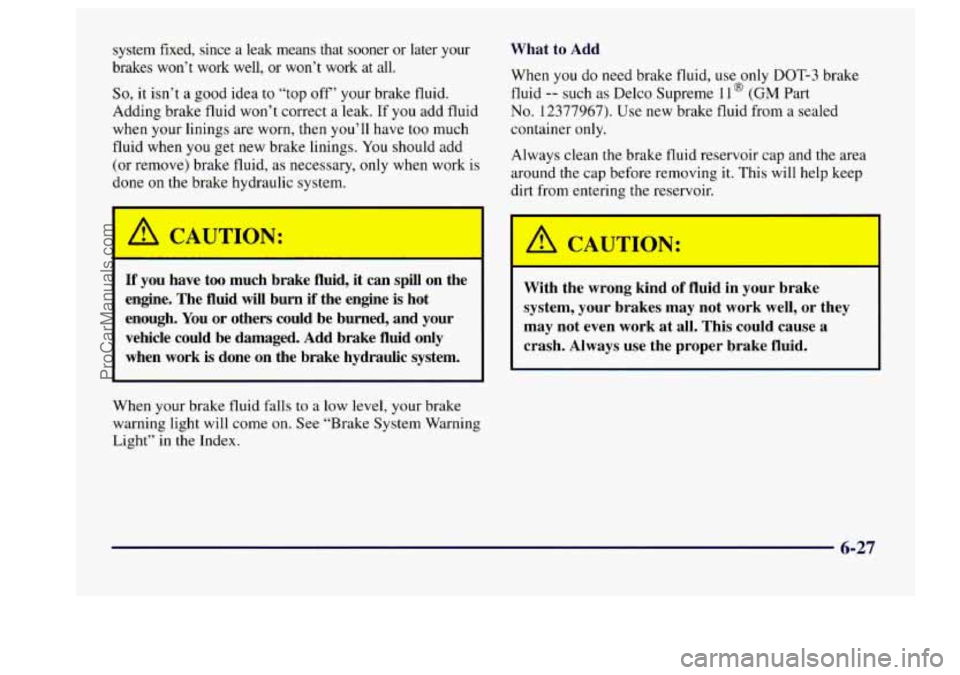
system fixed, since a leak means that sooner or later your
brakes won’t work well, or won’t work at all.
So, it isn’t a good idea to “top off’ your brake fluid.
Adding brake fluid won’t correct a leak. If
you add fluid
when your linings are worn, then you’ll have too much
fluid when
you get new brake linings. You should add
(or remove) brake fluid,
as necessary, only when work is
done on the brake hydraulic system.
What to Add
When you do need brake fluid, use only DOT-3 brake
fluid
-- such as Delco Supreme 11 @I (GM Part
No. 12377967). Use new brake fluid from a sealed
container only.
Always clean
the brake fluid reservoir cap and the area
around the cap before removing it. This will help keep
dirt from entering the reservoir.
A
If you have too much brake fluid, it can spill on the
engine. The fluid
will burn if the engine is hot
enough. You or others could be burned, and your
vehicle could be damaged. Add brake fluid only
when work is done on the brake hydraulic system.
When your brake fluid falls to a low level, your brake
warning light will come on. See “Brake System Warning
Light” in the Index.
CAUTION:
With the wrong kind of fluid in your brake
system, your brakes may not work well, or they
may not even work at all. This could cause a
crash. Always use the proper brake fluid.
6-27
ProCarManuals.com