ECU BUICK CENTURY 1997 Owner's Manual
[x] Cancel search | Manufacturer: BUICK, Model Year: 1997, Model line: CENTURY, Model: BUICK CENTURY 1997Pages: 406, PDF Size: 20.64 MB
Page 92 of 406
PASS-Key@ I1
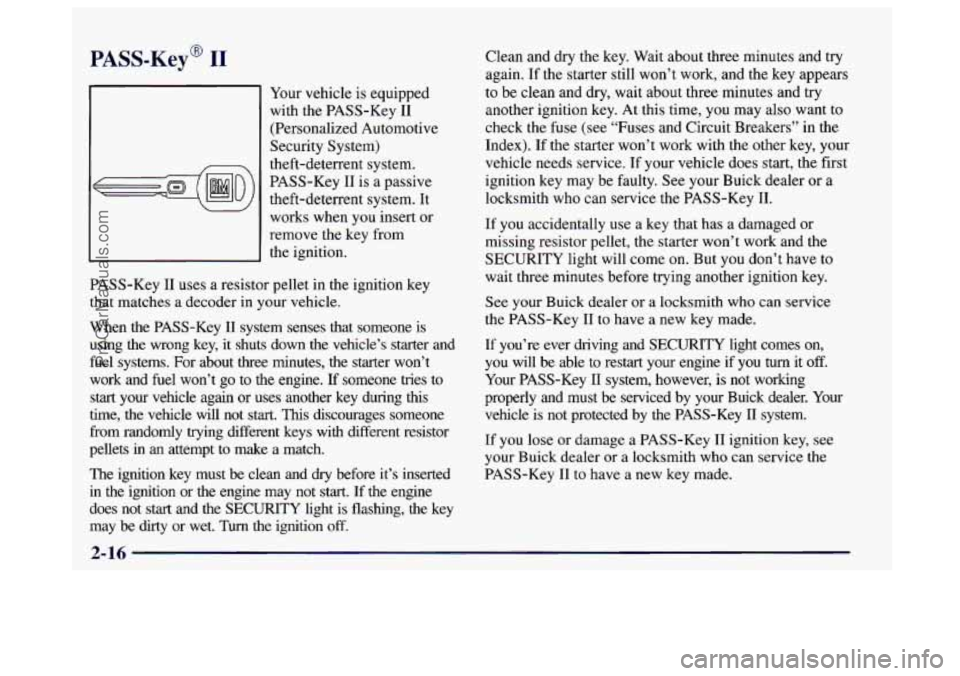
Your vehicle is equipped
with the PASS-Key I1
(Personalized Automotive
Security System)
theft-deterrent system.
PASS-Key I1
is a passive
theft-deterrent system. It
works when you insert or
remove the key from
the ignition.
PASS-Key I1 uses a resistor pellet in the ignition key
that matches
a decoder in your vehicle.
When the PASS-Key I1 system senses that someone is
using the wrong key, it shuts down
the vehicle’s starter and
fuel systems. For about three minutes, the starter won’t
work and fuel won’t go to the engine.
If someone tries to
start your vehicle again or uses another
key during this
time, the vehicle will not start. This discourages someone
from randomly trying different keys with different resistor
pellets in
an attempt to make a match.
The ignition key must be clean and dry before it’s inserted
in the ignition or the engine may not start. If the engine
does not start and the SECURITY light is flashing, the key
may be dirty or wet.
Turn the ignition off. Clean and dry the
key. Wait about three minutes and
try
again. If the starter still won’t work, and the key appears
to be clean and dry, wait about three minutes and try
another ignition key. At this time, you may also want to
check the fuse (see “Fuses and Circuit Breakers’’ in the
Index). If the starter won’t work with the other key, your
vehicle needs service.
If your vehicle does start, the first
ignition key may be faulty. See your Buick dealer or a
locksmith who can service the PASS-Key
11.
If you accidentally use a key that has a damaged or
missing resistor pellet, the starter won’t work and the
SECURITY light will come on. But you don’t have to
wait three minutes before trying another ignition key.
See your Buick dealer or a locksmith who can service
the PASS-Key
I1 to have a new key made.
If you’re ever driving and SECURITY light comes on,
you will be able to restart your engine if you
turn it off.
Your PASS-Key I1 system, however, is not working
properly and must be serviced by your Buick dealer. Your
vehicle
is not protected by the PASS-Key II system.
If you lose or damage a PASS-Key
I1 ignition key, see
your Buick dealer or a locksmith who can service the
PASS-Key I1 to have a new key made.
ProCarManuals.com
Page 142 of 406
Change Oil Soon Light Security Light
CHANGE OIL
SOON
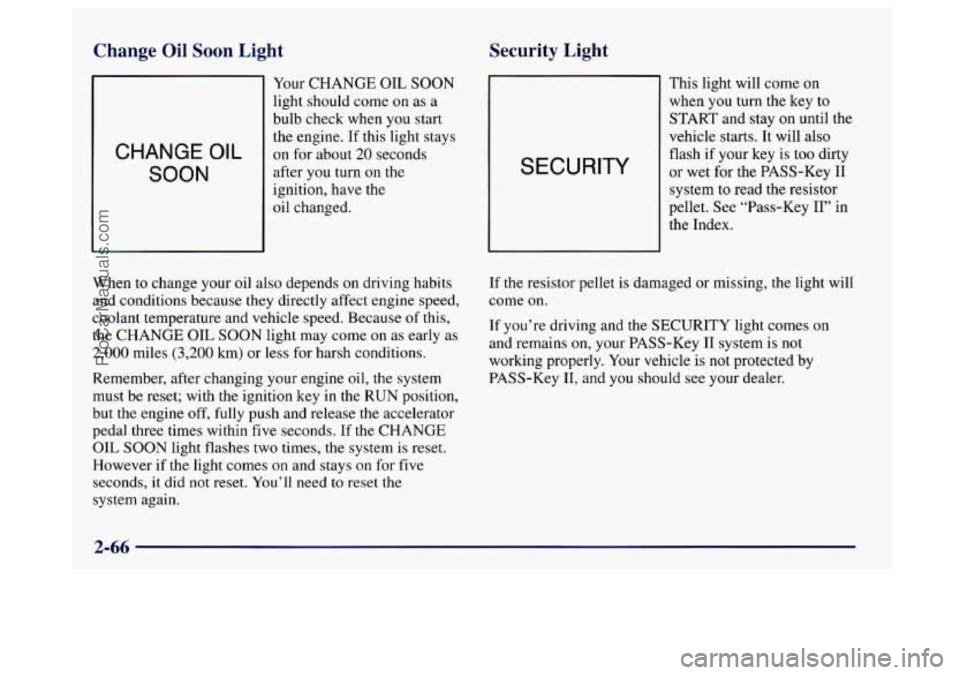
Your
CHANGE OIL SOON
light should come on as a
bulb check when you start
the engine. If this light stays
on for about 20 seconds
after
you turn on the
ignition, have the
oil chaneed. SECURITY
This light will come on
when
you turn the key to
START and stay on until the
vehicle starts. It will also
flash if your key
is too dirty
or wet for the PASS-Key I1
system to read the resistor
pellet. See “Pass-Key
11” in
the Index.
When to change your oil also depends
on driving habits
and conditions because they directly affect engine speed,
coolant temperature and vehicle speed. Because of this,
the
CHANGE OIL SOON light may come on as early as
2,000 miles (3,200 km) or less for harsh conditions.
Remember, after changing your engine oil, the system
must be reset; with the ignition key
in the RUN position,
but
the engine off, fully push and release the accelerator
pedal three times within five seconds.
If the CHANGE
OIL SOON light flashes two times, the system is reset.
However
if the light comes on and stays on for five
seconds,
it did not reset. You’ll need to reset the
system again. If
the resistor pellet is damaged or missing, the light will
come on.
If you’re driving and the SECURITY light comes on
and remains on, your PASS-Key I1 system is not
working properly. Your vehicle is not protected by
PASS-Key
11, and you should see your dealer.
2-66
ProCarManuals.com
Page 176 of 406
NOTE: If you allow more than 15 seconds to elapse
between any steps, the radio automatically reverts to
time and
you must start the procedure over at Step 4.
1.
2.
3.
4.
5.
6.
7.
8.
9.
Write down any three or four-digit number from
000 to 1999 and keep it in a safe place separate from
the vehicle.
Turn the ignition to ACCESSORY or RUN.
Turn the radio
off.
Press the 1 and 4 buttons together. Hold them down
until
--- shows on the display. Next you will use the
secret code number which you have written down.
Press MIN and
000 will appear on the display.
Press MIN again to make the last two digits agree
with your code.
Press
HRS to make the first one or two digits agree
with your code.
Press AM-FM after you have confirmed that the
code matches the secret code
you have written down.
The display will show REP to let you know that you
need to repeat Steps
5 through 7 to confirm your
secret code.
Press AM-FM and this time the display will show
SEC to let you know that your radio is secure.
Unlocking the Theft-Deterrent Feature After a
Power Loss
Enter your secret code as follows; pause no more than
15 seconds between steps:
1. LOC appears when the ignition is on.
2. Press MIN and 000 will appear on the display.
3. Press MIN again to make the last two digits agree
with your code.
with your code.
code matches the secret code
you have written down.
The display will show SEC, indicating the radio is
now operable and secure.
4. Press HRS to make the first one or two digits agree
5. Press AM-FM after you have confirmed that the
If you enter the wrong code eight times, INOP will
appear on the display. You will have to wait an hour
with the ignition on before you can try again. When you
try again, you will only have three more chances
(eight tries per chance)
to enter the correct code before
INOP appears.
If you lose or forget your code, contact your dealer.
3-32
ProCarManuals.com
Page 177 of 406
Disabling the Theft-Deterrent Feature
Enter your secret code as follows; pause no more than
15 seconds between steps:
1. Turn the ignition to ACCESSORY or RUN.
2. Turn the radio off.
3. Press the 1 and 4 buttons together. Hold them down
4. Press MTN and 000 will appear on the display.
5. Press MIN again to make the last two digits agree
6. Press HRS to make the first one or two digits agree
7. Press AM-FM after you have confirmed that the
until
SEC shows on the display.
with your code.
with your code.
code matches the secret code
you have written down.
The display will show
---, indicating that the radio is
no longer secured.
If the code entered is incorrect, SEC will appear on the
display. The radio will remain secured
until the correct
code is entered.
When battery power is removed and later applied to a
secured radio, the radio won’t turn
on and LOC will
appear on the display.
To unlock a secured radio see “Unlocking the
Theft-Deterrent Feature After a Power
Loss” earlier in
this section.
Audio Steering Wheel Controls
(If Equipped)
If your vehicle has this feature, you can control certain
radio functions using the buttons on your steering wheel.
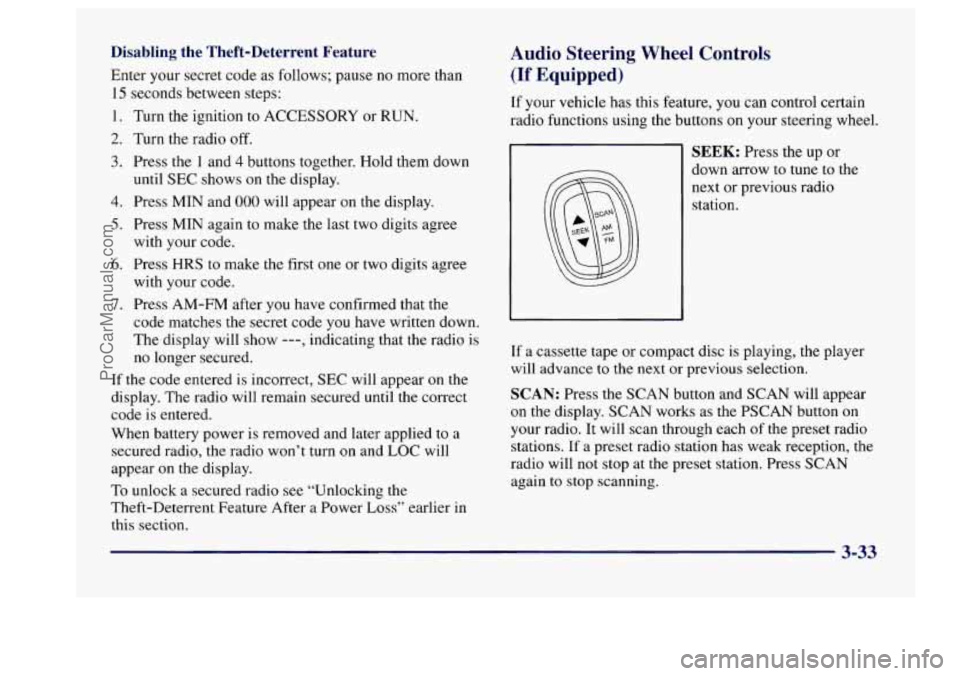
SEEK: Press the up or
down arrow to tune to the
next or previous radio
station.
If a cassette tape or compact disc is playing, the player
will advance to the next or previous selection.
SCAN: Press the SCAN button and SCAN will appear
on the display. SCAN works as the PSCAN button on
your radio. It will scan through each of the preset radio
stations. If a preset radio station has weak reception, the
radio will not stop at the preset station. Press SCAN
again to stop scanning.
3-33
ProCarManuals.com
Page 210 of 406
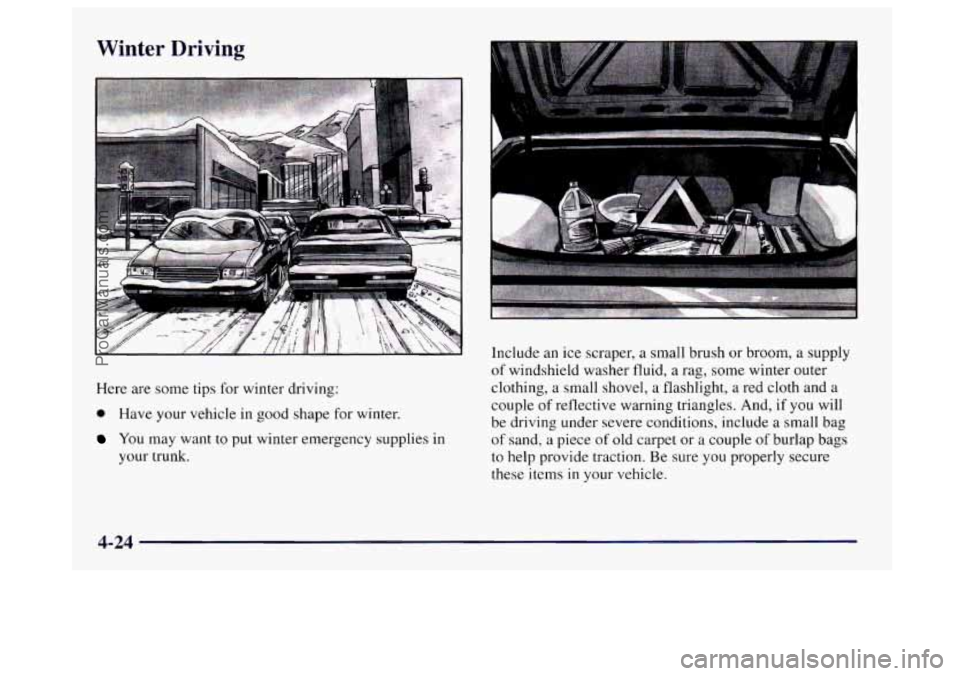
Winter Driving
Here are some tips for winter driving:
0 Have your vehicle in good shape for winter.
You may want to put winter emergency supplies in
your trunk. Include an
ice scraper,
a small brush or broom, a supply
of windshield washer fluid, a rag, some winter outer
clothing, a small shovel,
a flashlight, a red cloth and a
couple of reflective warning triangles. And, if you will
be driving under severe conditions, include
a small bag
of sand, a piece of old carpet or a couple of burlap bags
to help provide traction. Be sure you properly secure
these items
in your vehicle.
4-24
ProCarManuals.com
Page 216 of 406
If you put things inside your vehicle -- like suitcases,
tools, packages or anything else
-- they will go as fast as
the vehicle goes. If you have to stop or turn quickly, or
if there
is a crash, they’ll keep going.
Things you put inside your vehicle can strike
and injure people in
a sudden stop or turn, or in
a crash.
Put things in the trunk of your vehicle. In a
trunk, put them
as far forward as you can.
Try to spread the weight evenly.
inside the vehicle
so that some of them are
above the tops of the seats.
Don’t leave an unsecured child restraint in
your vehicle.
When you carry something inside the
vehicle, secure it whenever you can.
Never stack heavier things, like suitcases,
Towing a Trailer
If you don’t use the correct equipment and drive
properly, you can lose control when you pull
a
trailer. For example, if the trailer is too heavy, the
brakes may not work well
-- or even at all. You
and your passengers could be seriously injured.
Pull a trailer only if you have followed all the
steps in this section. Ask your Buick dealer
for
advice and information about towing a trailer
with your vehicle.
NOTICE:
Pulling a trailer improperly can damage your
vehicle and result in costly repairs not covered by
your warranty.
To pull a trailer correctly, follow
the advice in this part, and see your Buick dealer
for important information about towing a trailer
with your vehicle.
ProCarManuals.com
Page 220 of 406
Safety Ch: - Driving with a Trailer
Towing a trailer requires a certain amount of experience.
Before setting out for the open road, you’ll want to get
to know your rig. Acquaint yourself with the feel of
handling and braking with the added weight of the
trailer. And always keep in mind that the vehicle you are
driving is now a good deal longer and not nearly as
responsive as your vehicle is by itself.
You should always attach chains between your vehicle
and your trailer. Cross the safety chains under the tongue
of the trailer
so that the tongue will not drop to the road
if it becomes separated from the hitch. Instructions
about safety chains may be provided by
the hitch
manufacturer or by the trailer manufacturer. Follow the
manufacturer’s recommendation for attaching safety
chains and do not attach them
to the bumper. Always
leave just enough slack
so you can turn with your rig.
And, never allow safety chains to drag on the ground.
Trailer Brakes
Because you have anti-lock brakes, do not try to tap into
your vehicle’s brake system. If you do, both brake
systems won’t work well, or at all. Before
you start, check the trailer hitch and platform
(and attachments), safety chains, electrical connector,
lamps, tires and mirror adjustment. If the trailer has
electric brakes, start your vehicle and trailer moving and then apply the trailer brake controller by hand to be sure
the brakes are working. This lets you check your
electrical connection at the same time.
During your trip, check occasionally to be sure that the
load is secure, and that the lamps and any trailer brakes
are
still working.
4-34
ProCarManuals.com
Page 235 of 406
Towing Your Vehicle
Try to have a Buick dealer or a professional towing
service tow your vehicle.
If your vehicle has been changed or modified since it
was factory-new by adding aftermarket items like fog
lamps, aero skirting,
or special tires and wheels, these
instructions and illustrations may
not be correct.
Before
you do anything, turn on the hazard
warning flashers.
When you call, tell the towing service:
That your vehicle cannot be towed from the front or
rear with sling-type equipment.
0 That your vehicle has front-wheel drive.
0 The make, model and year of your vehicle.
0 Whether you can still move the shift lever.
0 If there was an accident, what was damaged.
When the towing service arrives,
let the tow operator
know that this manual contains detailed towing
instructions and illustrations. The operator may want to
see them.
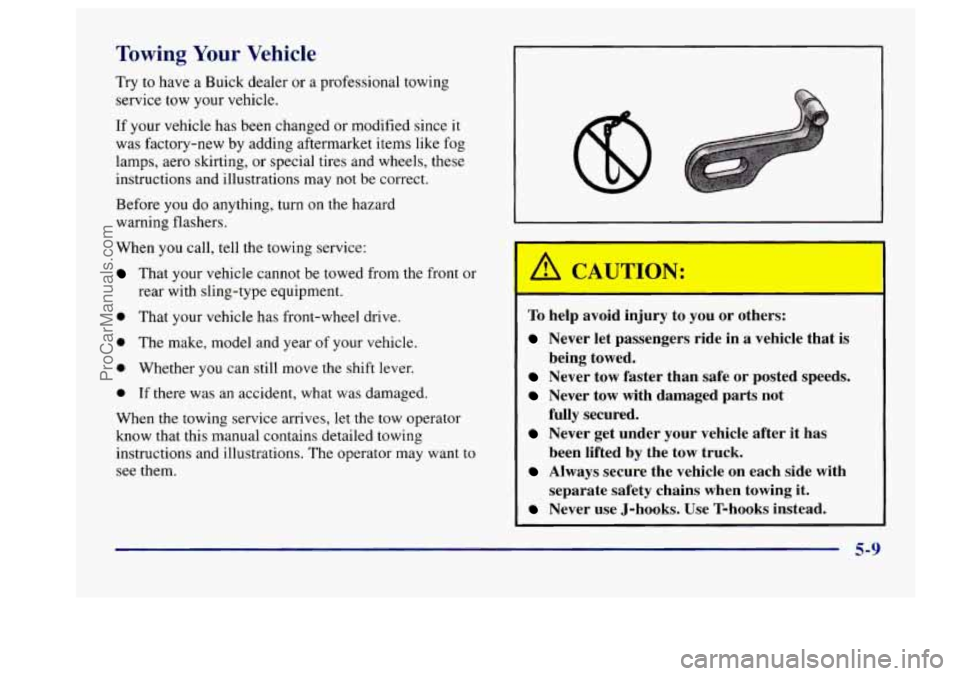
To help avoid injury to you or others:
Never let passengers ride in a vehicle that is
Never tow faster than safe or posted speeds.
Never tow with damaged parts not
fully secured.
Never get under your vehicle after it has
been lifted by the tow truck.
Always secure the vehicle on each side with
separate safety chains when towing it.
Never use J-hooks. Use T-hooks instead.
being towed.
5-9
ProCarManuals.com
Page 236 of 406
r I A CAUTION:
A vehicle can fall from a car-carrier if it isn’t
adequately secured. This can cause a collision,
serious personal injury and vehicle damage. The
vehicle should be tightly secured with chains or
steel cables before
it is transported.
Don’t use substitutes (ropes, leather straps,
canvas webbing, etc.) that can be cut by sharp
edges underneath the towed vehicle. Always use
T-hooks inserted in the T-hook slots. Never use
J-hooks.
They will damage drivetrain and
suspension components.
When your vehicle is being towed, have the ignition key
in the
OFF position. The steering wheel should be
clamped in a straight-ahead position, with a clamping
device designed for towing service. Do not use the
vehicle’s steering column lock for
this. The transaxle
should be in
NEUTRAL (N) and the parking
brake released.
Don’t have your vehicle towed on the drive wheels,
unless you must.
If the vehicle must be towed on the
drive wheels, be sure to follow the speed and distance
restrictions later in this section or your transaxle will be
damaged. If these limitations must be exceeded, then the
drive wheels have
to be supported on a dolly.
5-10
ProCarManuals.com
Page 237 of 406
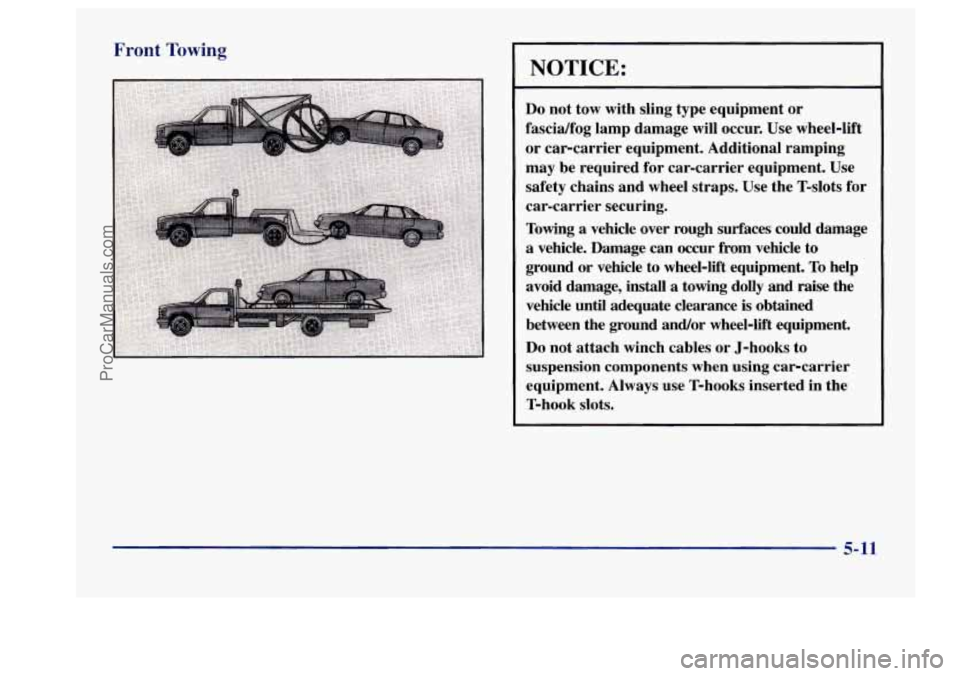
Front Towing
NOTICE:
Do not tow with sling type equipment or
fascidfog lamp damage will occur. Use wheel-lift
or car-carrier equipment. Additional ramping
may be required for car-carrier equipment. Use
safety chains and wheel straps. Use the T-slots for
car-carrier securing.
Towing a vehicle over rough surfaces could damage
a vehicle. Damage can occur from vehicle to
ground or vehicle to wheel-lift equipment. To help
avoid damage, install
a towing dolly and raise the
vehicle until adequate clearance is obtained
between the ground and/or wheel-lift equipment.
Do not attach winch cables or J-hooks to
suspension components when using car-carrier
equipment. Always use T-hooks inserted in the
T-hook slots.
5-11
ProCarManuals.com