oil change BUICK CENTURY 1997 Owners Manual
[x] Cancel search | Manufacturer: BUICK, Model Year: 1997, Model line: CENTURY, Model: BUICK CENTURY 1997Pages: 406, PDF Size: 20.64 MB
Page 13 of 406
I Supplement to the 1997 Buick Regal and Century Owner’s Manuals
This is a correction to information found on page 6-40 (Regal only) and page 6-38 (Century only).
Inflation -- Tire Pressure
The Tire-Loading Information label, which is on the inside of \
the trunk lid shows the correct inflation
pressures for your tires when they’re cold.
“Cold” means your vehicle has been sitting for at least three
hours or driven no more than
1 mile (1.6 km).
This is a correction to information found on page 6-63 (Regal only).
Engine Crankcase
Oil and Filter Change . . . . . . . . . . . . 4.5 quarts (4.2 L)
97RECKEN001
1
ProCarManuals.com
Page 140 of 406
Have you recently changed brands of fuel?
If
so, be sure to fuel your vehicle with quality fuel (see
“Fuel” in the Index). Poor fuel quality will cause your
engine not to run as efficiently as designed. You may
notice this as stalling after start-up, stalling when
you
put the vehicle into gear, misfiring, hesitation on
acceleration or stumbling on acceleration. (These
conditions may
go away once the engine is warmed up.)
This will be detected by the system and cause the light
to turn on.
If
you experience one or more of these conditions,
change the fuel brand
you use. It will require at least one
full tank of the proper fuel to turn the light off.
If none of the above steps have made the light turn off,
have your dealer or qualified service center check the
vehicle. Your dealer has the proper test equipment and
diagnostic tools
to fix any mechanical or electrical
problems that may have developed.
Oil Warning Light
If you have a problem with
your oil, this light may stay
on after you start your
engine, or come on when
you are driving.
This indicates that oil is not going through your engine
quickly enough
to keep it lubricated. The engine could
be low on oil or could have some other oil problem.
Have it fixed right away.
The oil light could also come on in the
following situations:
The light will come on briefly when you turn on the
ignition to show
you that it is working properly. (If it
doesn’t come
on with the ignition on, you may have
a problem with the fuse or bulb. Have it fixed
right away.)
Sometimes when the engine is idling at a stop, the
light may blink on and off. This is normal.
ProCarManuals.com
Page 142 of 406
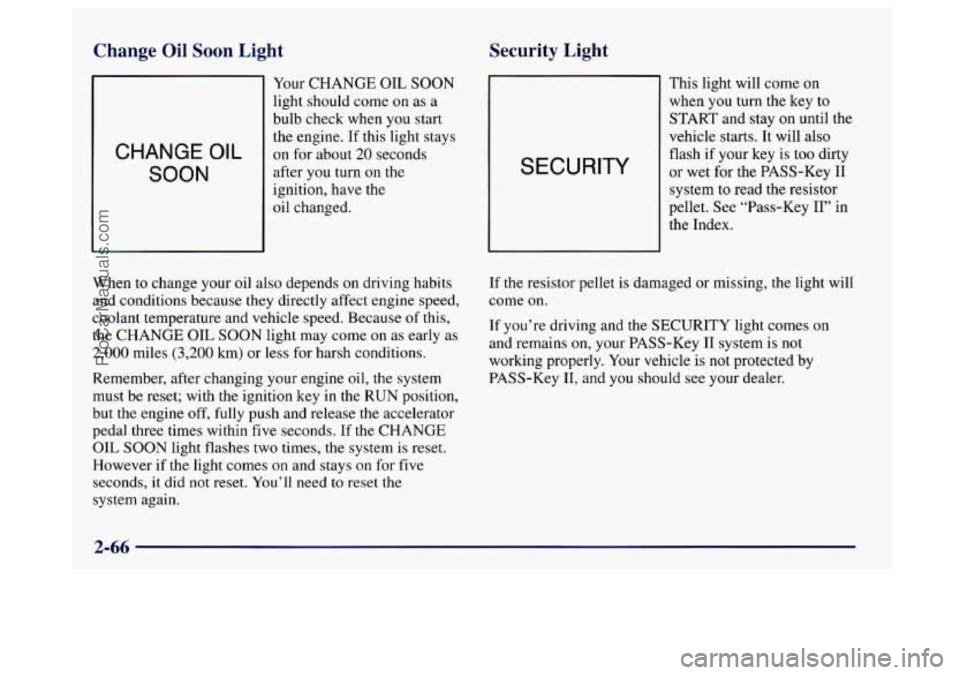
Change Oil Soon Light Security Light
CHANGE OIL
SOON
Your
CHANGE OIL SOON
light should come on as a
bulb check when you start
the engine. If this light stays
on for about 20 seconds
after
you turn on the
ignition, have the
oil chaneed. SECURITY
This light will come on
when
you turn the key to
START and stay on until the
vehicle starts. It will also
flash if your key
is too dirty
or wet for the PASS-Key I1
system to read the resistor
pellet. See “Pass-Key
11” in
the Index.
When to change your oil also depends
on driving habits
and conditions because they directly affect engine speed,
coolant temperature and vehicle speed. Because of this,
the
CHANGE OIL SOON light may come on as early as
2,000 miles (3,200 km) or less for harsh conditions.
Remember, after changing your engine oil, the system
must be reset; with the ignition key
in the RUN position,
but
the engine off, fully push and release the accelerator
pedal three times within five seconds.
If the CHANGE
OIL SOON light flashes two times, the system is reset.
However
if the light comes on and stays on for five
seconds,
it did not reset. You’ll need to reset the
system again. If
the resistor pellet is damaged or missing, the light will
come on.
If you’re driving and the SECURITY light comes on
and remains on, your PASS-Key I1 system is not
working properly. Your vehicle is not protected by
PASS-Key
11, and you should see your dealer.
2-66
ProCarManuals.com
Page 278 of 406
What Kind of Oil to Use
I
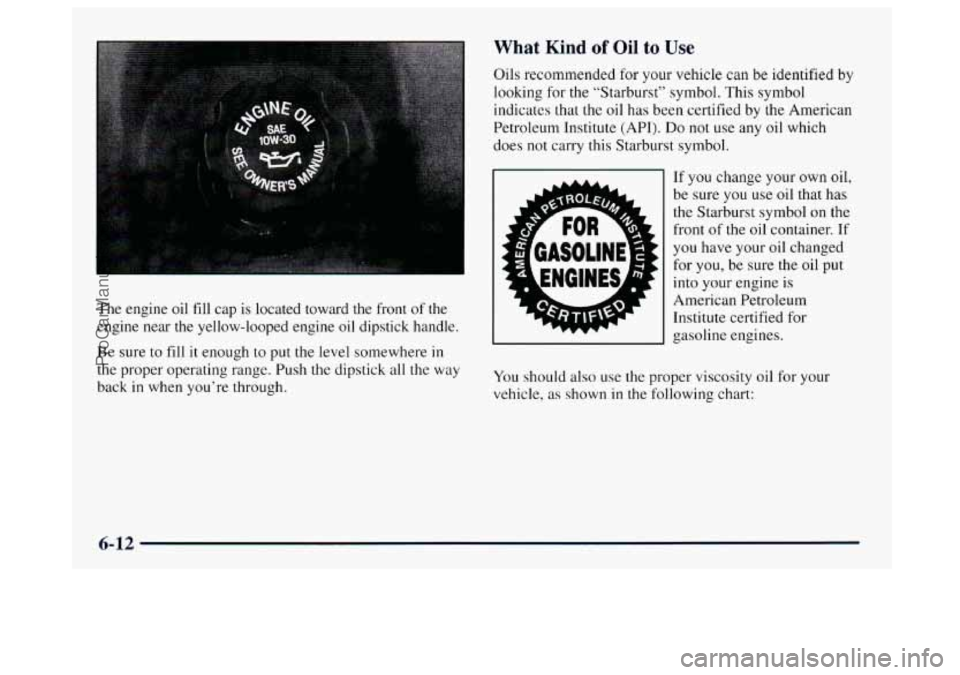
The engine oil fill cap is located toward the front of the
engine near the yellow-looped engine oil dipstick handle.
Be sure to
fill it enough to put the level somewhere in
the proper operating range. Push the dipstick all the way
back
in when you’re through. Oils recommended
for your vehicle can be identified by
looking for the “Starburst” symbol. This symbol
indicates that the oil has been certified by the American
Petroleum Institute
(API). Do not use any oil which
does not carry this Starburst symbol.
If you change your own oil,
be sure you use oil that has
the Starburst symbol on the
front of the oil container. If
you have your oil changed
for you, be sure the oil put
into your engine is
American Petroleum Institute certified for
gasoline engines.
You should
also use the proper viscosity oil for your
vehicle,
as shown in the following chart:
6-12
ProCarManuals.com
Page 280 of 406
When to Chang( Cngine Oil
If any one of these is true for you, use the short tripkity
maintenance schedule:
Most trips are less than 5 to 10 miles (8 to 16 km).
This is particularly important when outside
temperatures are below freezing.
Most trips include extensive idling (such as frequent
driving in stop-and-go traffic).
Most trips are through dusty areas.
You frequently tow a trailer or use a carrier on top of
your vehicle.
The vehicle is used for delivery service, police, taxi
or other commercial application.
Driving under these conditions causes engine
oil to break
down sooner.
If any one of these is true for your vehicle,
then you need to change your oil and filter every
3,000 miles (5 000 km) or 3 months -- whichever occurs
first. (See “Change Oil Soon” Light in the Index.)
If none
of them is true, use the long triphighway
maintenance schedule. Change the oil and filter every
7,500 miles (12 500 km) or 12 months -- whichever
occurs first. Driving a vehicle with a fully warmed
engine under highway conditions causes engine oil to
break down slower. (See
“Change Oil
Soon” Light in the Index.)
What to Do with Used Oil
Did you know that used engine oil contains certain
elements that may be unhealthy for your skin and could
even cause cancer? Don’t let used oil stay on your skin
for very long. Clean your skin and nails with soap and
water, or a good hand cleaner. Wash or properly throw
away clothing or rags containing used engine oil. (See
the manufacturer’s warnings about the use and disposal
of oil products.)
Used oil can be a real threat to the environment. If you
change your own oil, be sure to drain all free-flowing oil
from the filter before disposal. Don’t ever dispose of oil
by putting it in the trash, pouring it on the ground, into
sewers, or into streams or bodies
of water. Instead,
recycle it by taking it to a place that collects used oil.
If
you have a problem properly disposing of your used oil,
ask your dealer, a service station or a local recycling
center for help.
ProCarManuals.com
Page 283 of 406
Automatic Transaxle Fluid
When to Check and Change
A good time to check your automatic transaxle fluid
level
is when the engine oil is changed.
Change both the fluid and filter every
50,000 miles
(83
000 km) if the vehicle is mainly driven under one or
more of these conditions:
In heavy city traffic where the outside temperature
regularly reaches
90°F (32°C) or higher.
In hilly or mountainous terrain.
When doing frequent trailer towing.
Uses such as found in taxi, police or delivery service.
If you do not use your vehicle under any
of these
conditions, the fluid and filter do not require changing.
See "Scheduled Maintenance Services"
in the Index.
How to Check
Because this operation can be a little difficult, you may
choose
to have this done at your Buick dealership
Service Department.
If you do it yourself, be sure to follow all the instructions
here, or you could get a false reading on
the dipstick.
NOTICE:
Too much or too little fluid can damage your
transaxle.
Too much can mean that some of the
fluid could come out and fall on
hot engine parts
or exhaust system parts, starting a fire. Be sure to get an accurate reading if you check your
transaxle fluid.
Wait at least 30 minutes before checking the transaxle
fluid level
if you have been driving:
When outside temperatures are above 90°F (32°C).
At high speed for quite a while.
In heavy traffic -- especially in hot weather.
While pulling a trailer.
To get the right reading, the fluid should be at normal
operating temperature, which
is 180°F to 200°F (82°C
to 93 " C).
Get the vehicle warmed up by driving about
15 miles
(24 km) when outside temperatures are above 50°F
(10°C). If it's colder than 50°F (lO"C), you may have
to drive longer.
6-17
ProCarManuals.com
Page 286 of 406
Engine Coolant
The cooling s stem in your vehicle is filled with
DEX-COOL engine coolant. This coolant is designed
to remain in your vehicle for
5 years or 150,000 miles
(240 000 km) whichever occurs first, if you add only
DEX-COOL’ extended life coolant.
J
The following explains your cooling system and how to
add coolant when it is low.
If you have a problem with
engine overheating or if you need to add coolant to your
radiator, see “Engine Overheating”
in the Index.
A 50/50 mixture of water and DEX-COOL@
coolant will:
0 Give freezing protection down to -34°F (-37°C).
0 Give boiling protection up to 265 OF ( 129 O C).
0 Protect against rust and corrosion.
Help keep the proper engine temperature.
0 Let the warning lights and gages work as
they should.
NOTICE:
When adding coolant, it is important that you use
only
DEX-COOL@ silicate-free) coolant.
If coolant other than DEX-COOL is added to the
system, premature engine, heater core or radiator corrosion may result. In addition, the
engine coolant will require change sooner
-- at
30,000 miles (50 000 km) or 24 months,
whichever occurs first. Damage caused by the use
of coolant other than DEX-COOL@ is not
covered
by your new vehicle warranty.
6-20
ProCarManuals.com
Page 328 of 406
Replacement Bulbs
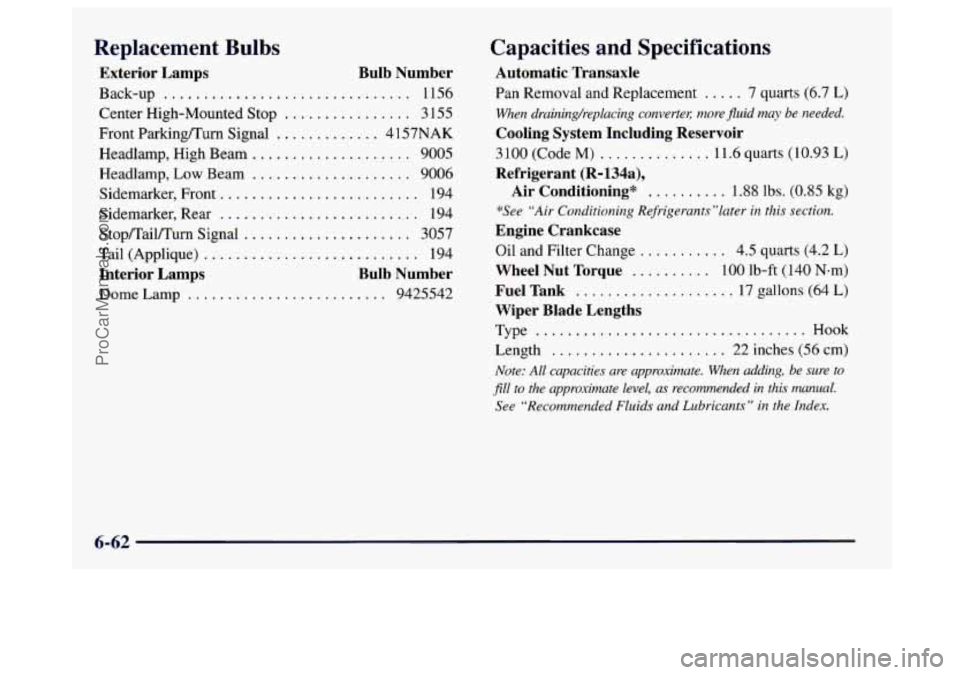
Exterior Lamps Bulb Number
Back-up ............................... 1156
Center High-Mounted Stop
................ 3 155
Front Parkingnurn Signal
............. 4 157NAK
Headlamp, High Beam
.................... 9005
Headlamp,
Low Beam .................... 9006
Sidemarker, Front
......................... 194
Sidemarker, Rear
......................... 194
Stop/Tail/Turn Signal
..................... 3057
Tail (Applique)
........................... 194
Interior Lamps Bulb Number
Dome Lamp ......................... 9425542
Capacities and Specifications
Automatic Transaxle
Pan
Removal and Replacement ..... 7 quarts (6.7 L)
When druiningheplacing convertec more .fluid muy be needed.
Cooling System Including Reservoir
3100 (Code M) .............. 11.6 quarts (10.93 L)
Refrigerant (R-l34a),
*See “Air Conditioning Rejrigerants”1ater in. this section.
Engine Crankcase
Oil and Filter Change ........... 4.5 quarts (4.2 L)
Wheel Nut Torque .......... 100 lb-ft (140 Nsm)
Wiper Blade Lengths
Type .................................. Hook
Note: All capacities are approximate. When adding, be sure to
.fill to the upproximate level, as recommended in this manual.
See “Recommended Fluids and Lubricants” in the Index.
Air Conditioning* .......... 1.88 lbs. (0.85 kg)
Fuel Tank .................... 17 gallons (64 L)
Length
...................... 22 inches (56 cm)
6-62
ProCarManuals.com
Page 332 of 406
I IMPORTANT:
I
KEEP ENGINE OIL
AT THE PROPER
LEVEL AND CHANGE AS
RECOMMENDED
El
protection
Plan
Have you purchased the GM Protection Plan? The Plan
supplements
your new vehicle warranties. See your
Wlwranty and Owner Assistance booklet, or your Buick
dealer
for details.
Introduction
Your Vehicle and the Environment
Proper vehicle maintenance not only helps to keep your
vehicle in good working condition, but also helps the
environment. All recommended maintenance procedures
are important. Improper vehicle maintenance can even
affect the quality
of the air we breathe. Improper fluid
levels or the wrong tire inflation can increase the level
of emissions from your vehicle. To help protect our
environment, and to keep your vehicle in good
condition, please maintain your vehicle properly.
7-2
ProCarManuals.com
Page 335 of 406
Maintenance Schedule
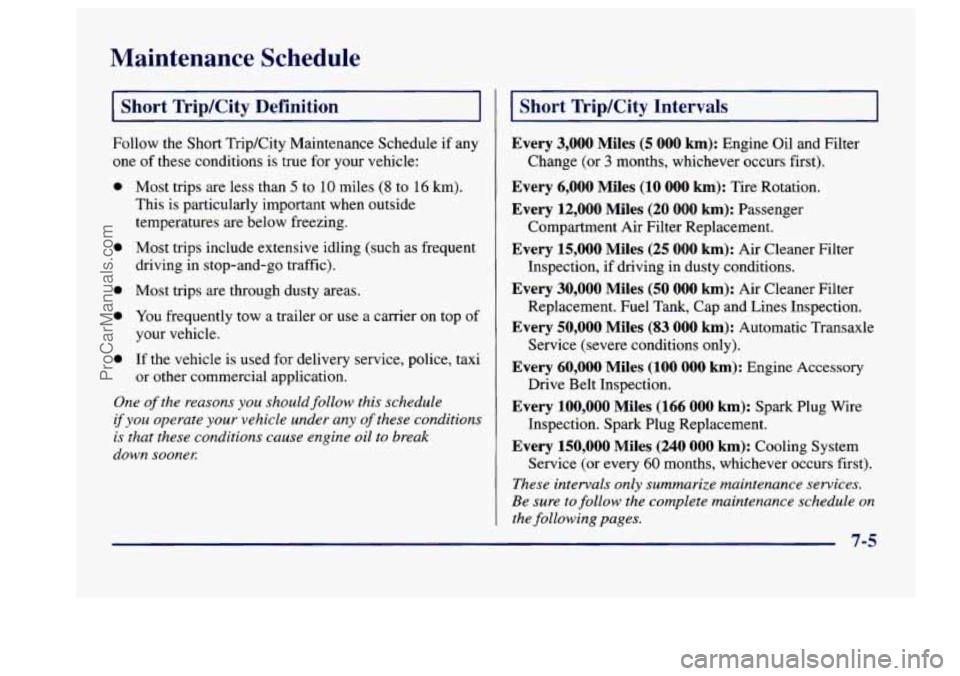
Short TripKity Definition
Follow the Short Trip/City Maintenance Schedule if any
one of these conditions is true for your vehicle:
0
a
0
a
a
Most trips are less than 5 to 10 miles (8 to 16 km).
This is particularly important when outside
temperatures are below freezing.
Most trips include extensive idling (such as frequent
driving in stop-and-go traffic).
Most trips are through dusty areas.
You frequently tow a trailer or use a carrier on top of
your vehicle.
If the vehicle is used for delivery service, police, taxi
or other commercial application.
One of the reasons you should follow this schedule
if you operate your vehicle under any of these conditions
is that these conditions cause engine oil to break
down sooney.
Short Trip/City Intervals
Every 3,000 Miles (5 000 km): Engine Oil and Filter
Change
(or 3 months, whichever occurs first).
Every 6,000 Miles (10 000 km): Tire Rotation.
Every 12,000 Miles (20 000 Jan): Passenger
Compartment Air Filter Replacement.
Every 15,000 Miles (25 000 km): Air Cleaner Filter
Inspection,
if driving in dusty conditions.
Every 30,000 Miles (50 000 km): Air Cleaner Filter
Replacement. Fuel Tank, Cap and Lines Inspection.
Every 50,000 Miles (83 000 km): Automatic Transaxle
Service (severe conditions only).
Every 60,000 Miles (100 000 km): Engine Accessory
Drive Belt Inspection.
Every 100,000 Miles (166 000 km): Spark Plug Wire
Inspection. Spark Plug Replacement.
Every 150,000 Miles (240 000 km): Cooling System
Service (or every
60 months, whichever occurs first).
These intervals only summarize maintenance services.
Be sure
to follow the complete maintenance schedule on
the following pages.
II -7 -5
ProCarManuals.com