lock BUICK CENTURY 2004 User Guide
[x] Cancel search | Manufacturer: BUICK, Model Year: 2004, Model line: CENTURY, Model: BUICK CENTURY 2004Pages: 358, PDF Size: 4.01 MB
Page 30 of 358
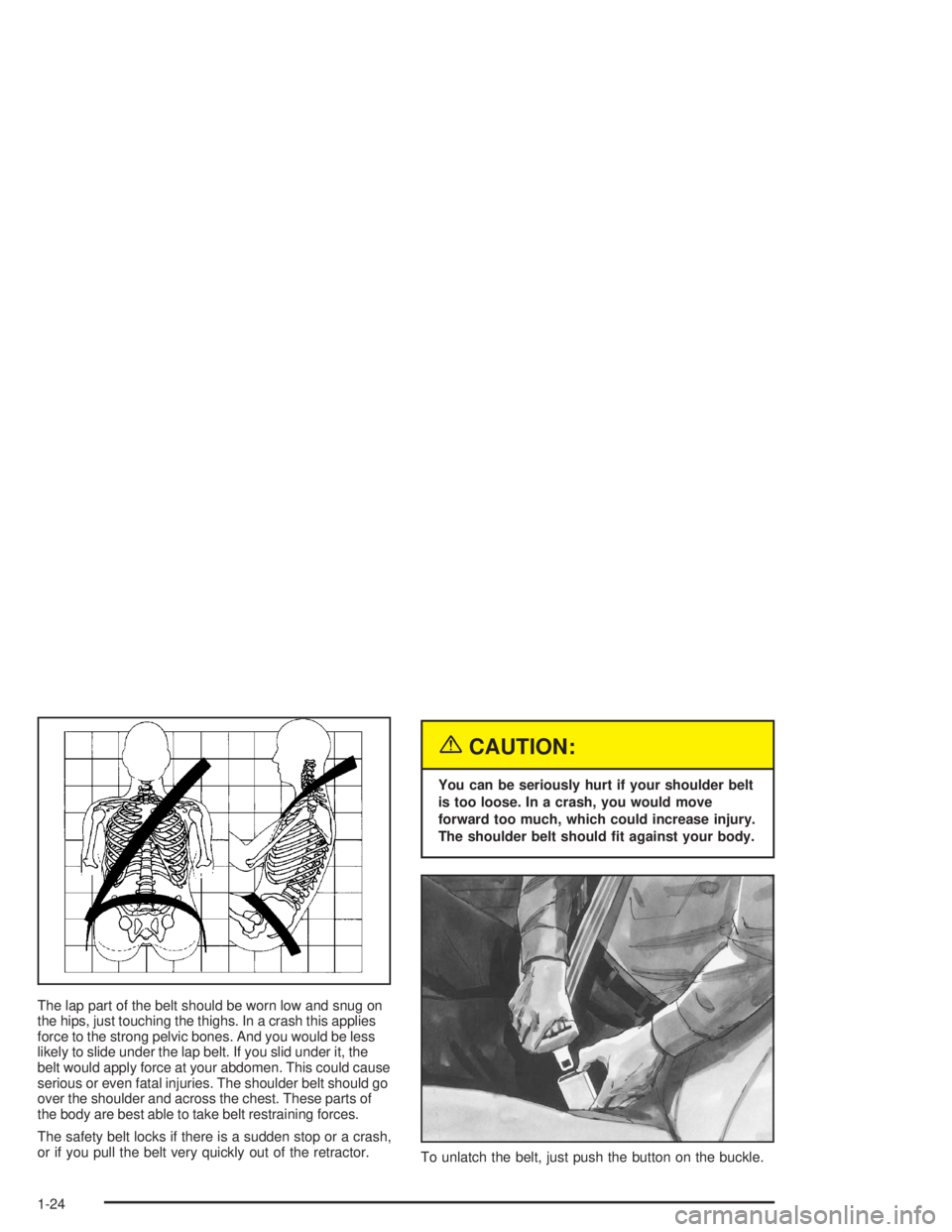
The lap part of the belt should be worn low and snug on
the hips, just touching the thighs. In a crash this applies
force to the strong pelvic bones. And you would be less
likely to slide under the lap belt. If you slid under it, the
belt would apply force at your abdomen. This could cause
serious or even fatal injuries. The shoulder belt should go
over the shoulder and across the chest. These parts of
the body are best able to take belt restraining forces.
The safety belt locks if there is a sudden stop or a crash,
or if you pull the belt very quickly out of the retractor.
{CAUTION:
You can be seriously hurt if your shoulder belt
is too loose. In a crash, you would move
forward too much, which could increase injury.
The shoulder belt should t against your body.
To unlatch the belt, just push the button on the buckle.
1-24
Page 49 of 358
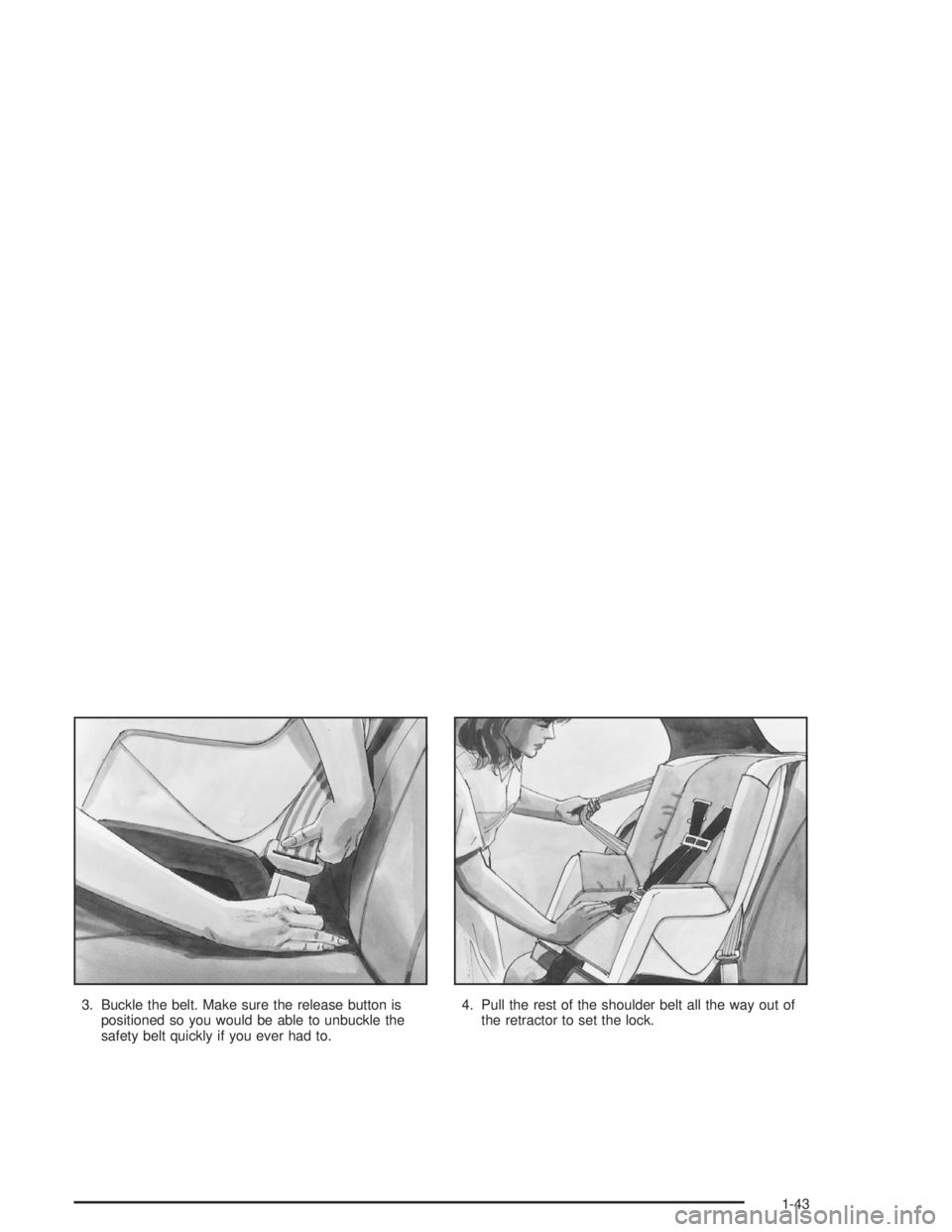
3. Buckle the belt. Make sure the release button is
positioned so you would be able to unbuckle the
safety belt quickly if you ever had to.4. Pull the rest of the shoulder belt all the way out of
the retractor to set the lock.
1-43
Page 54 of 358
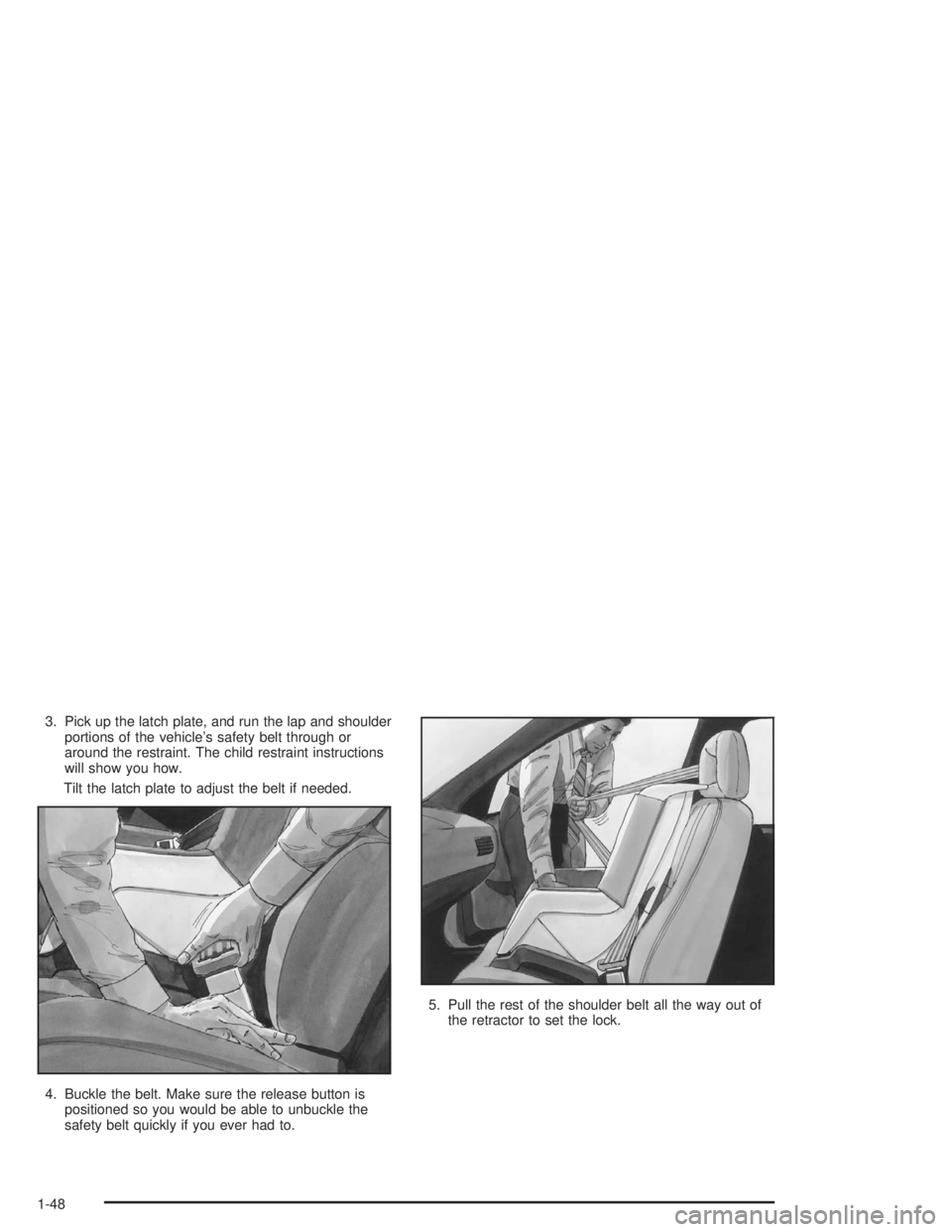
3. Pick up the latch plate, and run the lap and shoulder
portions of the vehicle’s safety belt through or
around the restraint. The child restraint instructions
will show you how.
Tilt the latch plate to adjust the belt if needed.
4. Buckle the belt. Make sure the release button is
positioned so you would be able to unbuckle the
safety belt quickly if you ever had to.5. Pull the rest of the shoulder belt all the way out of
the retractor to set the lock.
1-48
Page 59 of 358
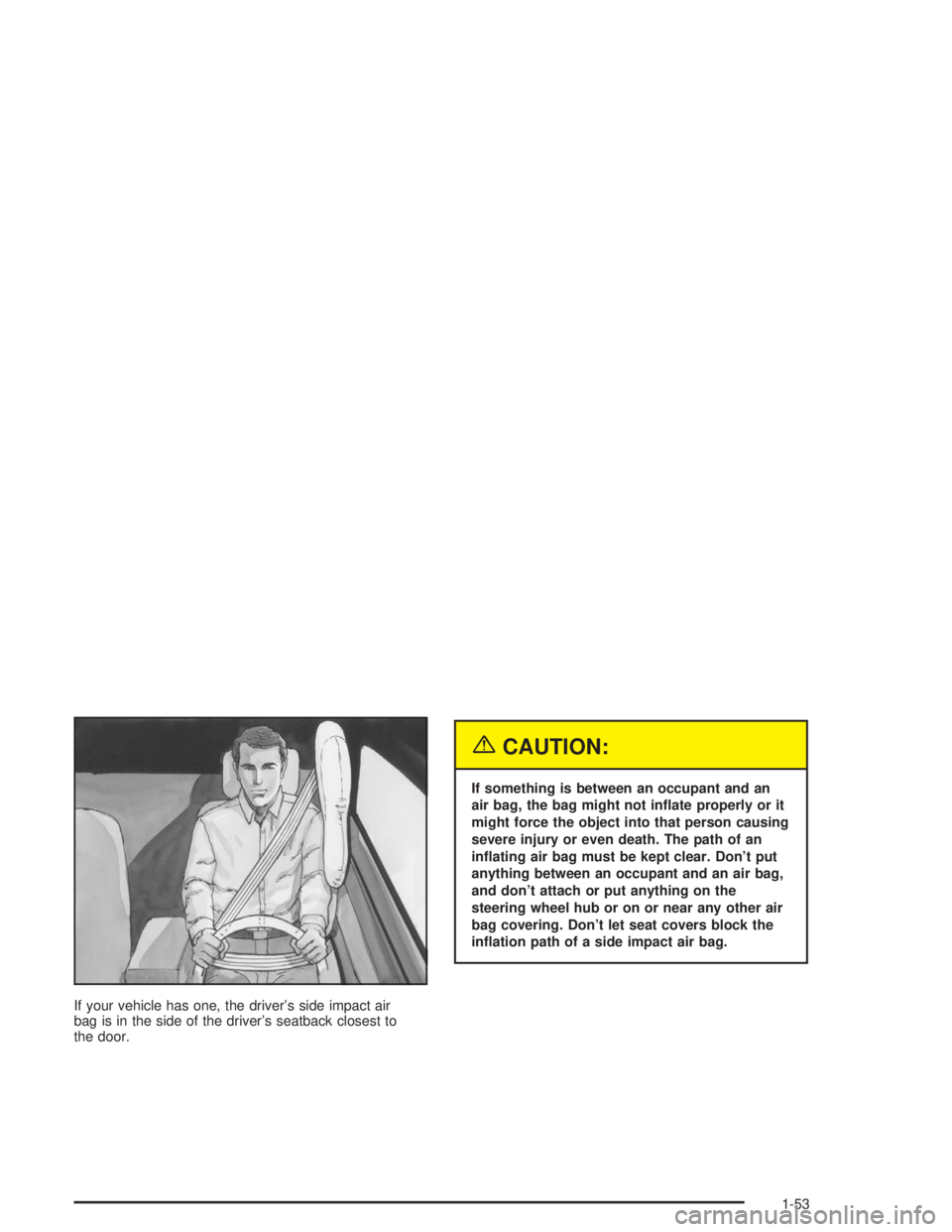
If your vehicle has one, the driver’s side impact air
bag is in the side of the driver’s seatback closest to
the door.
{CAUTION:
If something is between an occupant and an
air bag, the bag might not inate properly or it
might force the object into that person causing
severe injury or even death. The path of an
inating air bag must be kept clear. Don’t put
anything between an occupant and an air bag,
and don’t attach or put anything on the
steering wheel hub or on or near any other air
bag covering. Don’t let seat covers block the
ination path of a side impact air bag.
1-53
Page 67 of 358
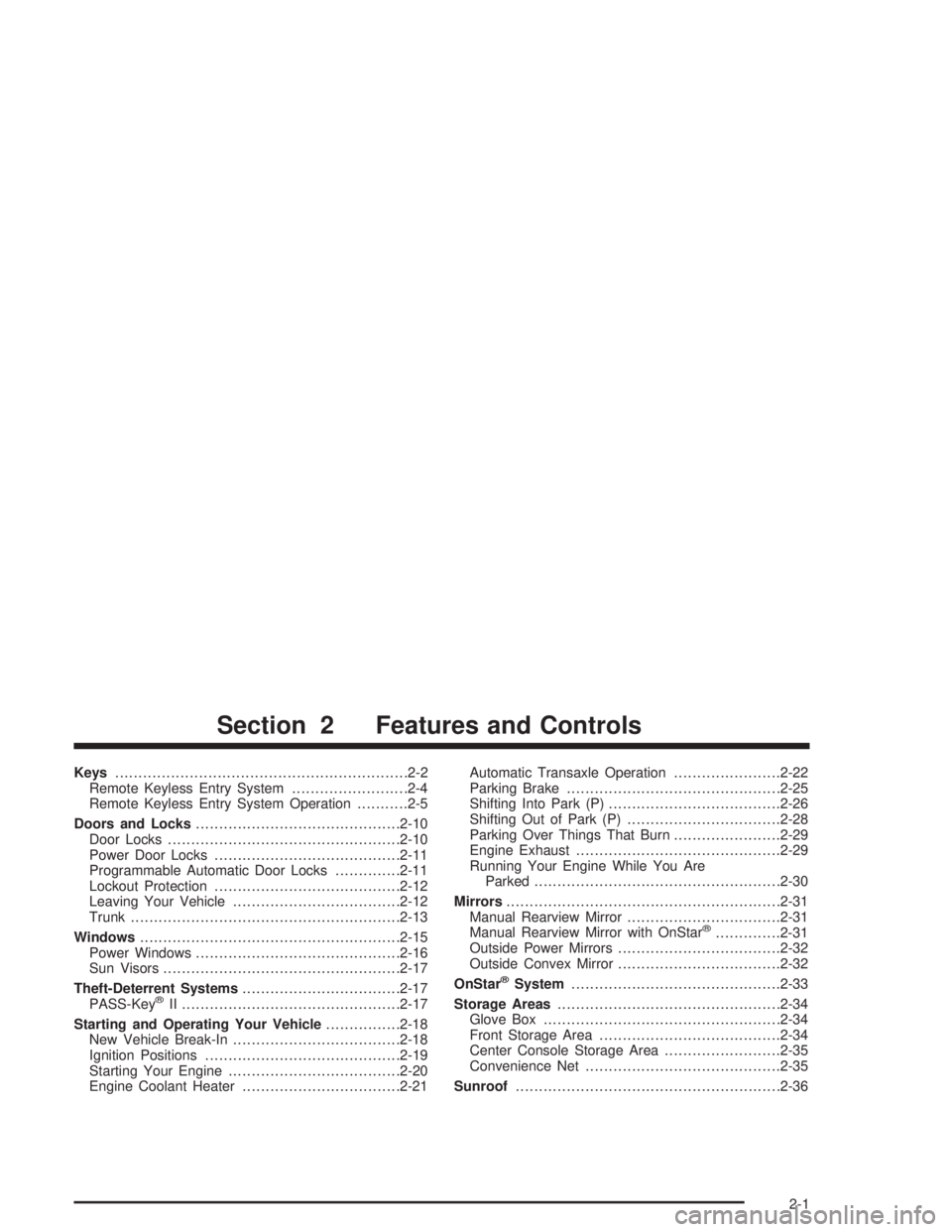
Keys...............................................................2-2
Remote Keyless Entry System.........................2-4
Remote Keyless Entry System Operation...........2-5
Doors and Locks............................................2-10
Door Locks..................................................2-10
Power Door Locks........................................2-11
Programmable Automatic Door Locks..............2-11
Lockout Protection........................................2-12
Leaving Your Vehicle....................................2-12
Trunk..........................................................2-13
Windows........................................................2-15
Power Windows............................................2-16
Sun Visors...................................................2-17
Theft-Deterrent Systems..................................2-17
PASS-Key
®II ...............................................2-17
Starting and Operating Your Vehicle................2-18
New Vehicle Break-In....................................2-18
Ignition Positions..........................................2-19
Starting Your Engine.....................................2-20
Engine Coolant Heater..................................2-21Automatic Transaxle Operation.......................2-22
Parking Brake..............................................2-25
Shifting Into Park (P).....................................2-26
Shifting Out of Park (P).................................2-28
Parking Over Things That Burn.......................2-29
Engine Exhaust............................................2-29
Running Your Engine While You Are
Parked.....................................................2-30
Mirrors...........................................................2-31
Manual Rearview Mirror.................................2-31
Manual Rearview Mirror with OnStar
®..............2-31
Outside Power Mirrors...................................2-32
Outside Convex Mirror...................................2-32
OnStar
®System.............................................2-33
Storage Areas................................................2-34
Glove Box...................................................2-34
Front Storage Area.......................................2-34
Center Console Storage Area.........................2-35
Convenience Net..........................................2-35
Sunroof.........................................................2-36
Section 2 Features and Controls
2-1
Page 69 of 358
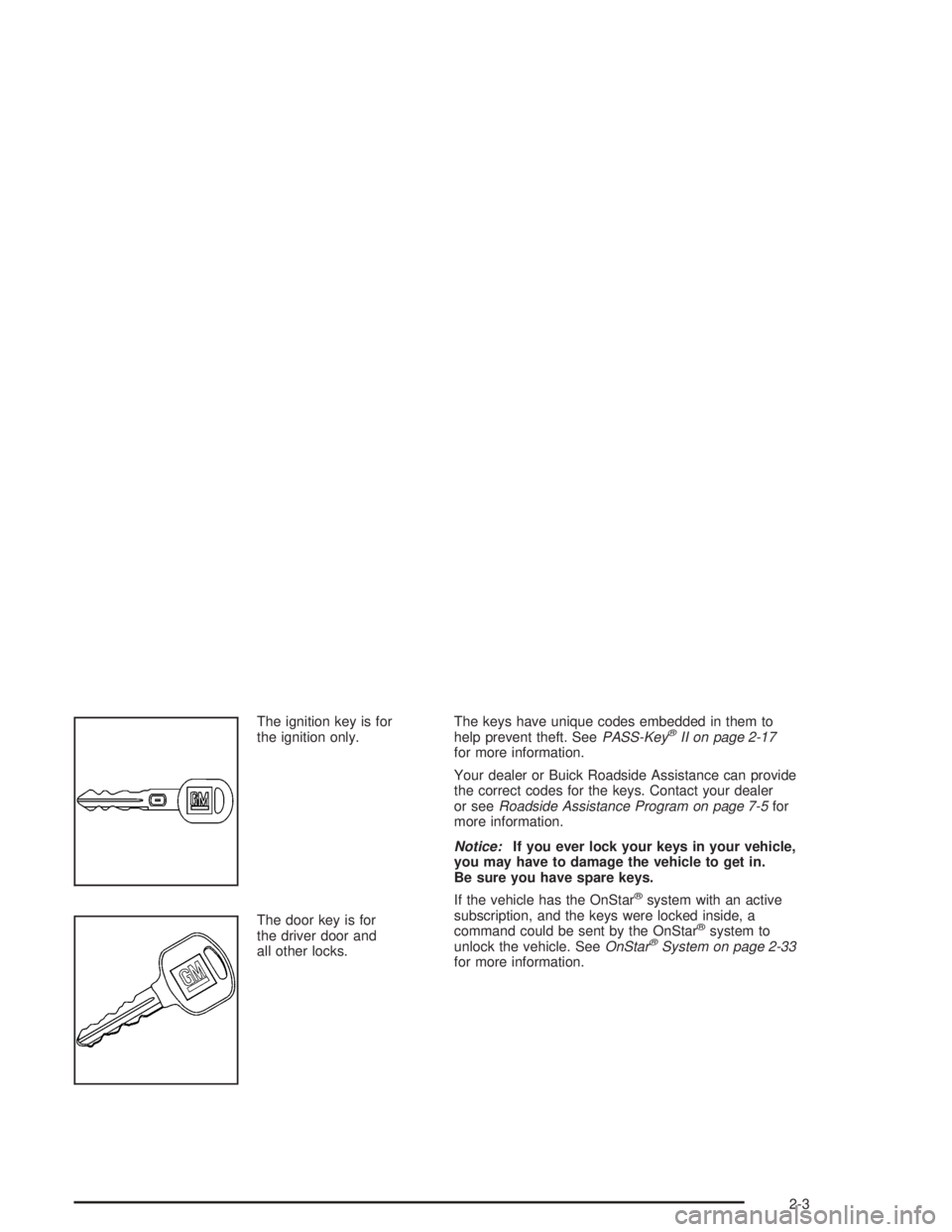
The ignition key is for
the ignition only.
The door key is for
the driver door and
all other locks.The keys have unique codes embedded in them to
help prevent theft. SeePASS-Key®II on page 2-17
for more information.
Your dealer or Buick Roadside Assistance can provide
the correct codes for the keys. Contact your dealer
or seeRoadside Assistance Program on page 7-5for
more information.
Notice:If you ever lock your keys in your vehicle,
you may have to damage the vehicle to get in.
Be sure you have spare keys.
If the vehicle has the OnStar
®system with an active
subscription, and the keys were locked inside, a
command could be sent by the OnStar
®system to
unlock the vehicle. SeeOnStar®System on page 2-33
for more information.
2-3
Page 70 of 358
Remote Keyless Entry System
Your keyless entry system operates on a radio
frequency subject to Federal Communications
Commission (FCC) Rules and with Industry Canada.
This device complies with Part 15 of the FCC Rules.
Operation is subject to the following two conditions:
1. This device may not cause interference, and
2. This device must accept any interference received,
including interference that may cause undesired
operation of the device.
This device complies with RSS-210 of Industry Canada.
Operation is subject to the following two conditions:
1. This device may not cause interference, and
2. This device must accept any interference received,
including interference that may cause undesired
operation of the device.
Changes or modications to this system by other than
an authorized service facility could void authorization to
use this equipment.At times you may notice a decrease in range. This is
normal for any remote keyless entry system. If the
transmitter does not work or if you have to stand closer
to your vehicle for the transmitter to work, try this:
Check the distance. You may be too far from your
vehicle. You may need to stand closer during
rainy or snowy weather.
Check the location. Other vehicles or objects may
be blocking the signal. Take a few steps to the
left or right, hold the transmitter higher, and
try again.
Check to determine if battery replacement is
necessary. See “Battery Replacement” under
Remote Keyless Entry System Operation on
page 2-5.
If you are still having trouble, see your dealer or a
qualied technician for service.
2-4
Page 71 of 358
Remote Keyless Entry System
Operation
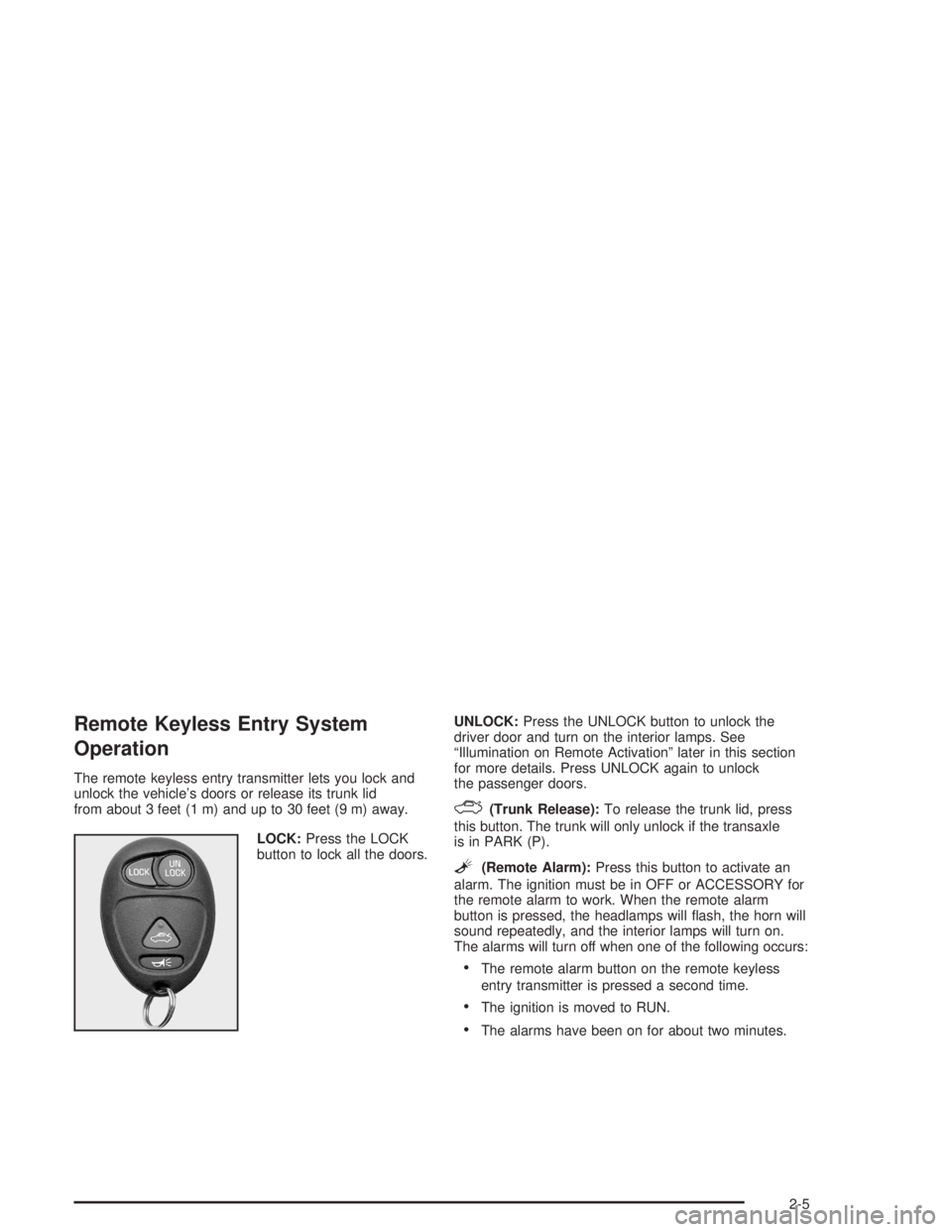
The remote keyless entry transmitter lets you lock and
unlock the vehicle’s doors or release its trunk lid
from about 3 feet (1 m) and up to 30 feet (9 m) away.
LOCK:Press the LOCK
button to lock all the doors.UNLOCK:Press the UNLOCK button to unlock the
driver door and turn on the interior lamps. See
“Illumination on Remote Activation” later in this section
for more details. Press UNLOCK again to unlock
the passenger doors.
F(Trunk Release):To release the trunk lid, press
this button. The trunk will only unlock if the transaxle
is in PARK (P).
L(Remote Alarm):Press this button to activate an
alarm. The ignition must be in OFF or ACCESSORY for
the remote alarm to work. When the remote alarm
button is pressed, the headlamps will ash, the horn will
sound repeatedly, and the interior lamps will turn on.
The alarms will turn off when one of the following occurs:
The remote alarm button on the remote keyless
entry transmitter is pressed a second time.
The ignition is moved to RUN.
The alarms have been on for about two minutes.
2-5
Page 72 of 358
Security Feedback
The remote keyless entry transmitter can be
programmed so that when the LOCK or UNLOCK
button is pressed, the vehicle gives visual or audible
feedback conrmation. Each lock or unlock command
verication must be programmed individually. The
ignition must be OFF for this feature to work.
Programming the LOCK Command
One of four modes can be selected to conrm a
LOCK command.
Mode 1 (One Chime):No Verication
Mode 2 (Two Chimes):Horn Chirp
Mode 3 (Three Chimes):Headlamps Flash
Mode 4 (Four Chimes):Horn Chirp and
Headlamps Flash
The vehicle was originally programmed to Mode 3.
The mode may have been changed since then.
To determine the current lock mode mode, or to change
the lock mode, do the following:
1. Close all doors and turn the ignition key to RUN.
2. Press and hold the power door lock switch in
the LOCK position.3. While holding the power door lock switch in the
LOCK position, press and release the remote
keyless entry transmitter LOCK button.
A series of one to four chimes will sound,
corresponding to the current lock mode.
4. Press the remote keyless entry transmitter LOCK
button to advance to the next lock mode.
If cycled beyond Mode 4, the vehicle will
enter Mode 1.
5. To set a mode, release the power door LOCK
switch after the chime sequence of the desired
mode is heard.
Disconnecting the vehicle’s battery for up to a year will
not affect the programmed mode.
Programming the UNLOCK Command
One of four modes can be selected to conrm an
UNLOCK command.
Mode 1 (One Chime):No Verication
Mode 2 (Two Chimes):Horn Chirp
Mode 3 (Three Chimes):Headlamps Flash
Mode 4 (Four Chimes):Horn Chirp and
Headlamps Flash
2-6
Page 73 of 358
The vehicle was originally programmed to Mode 3.
The mode may have been changed since then.
To determine the current unlock mode mode, or to
change the unlock mode, do the following:
1. Close all doors and turn the ignition key to RUN.
2. Press and hold the power door lock switch in
the unlock position.
3. While holding the power door lock switch in the
unlock position, press and release the remote
keyless entry transmitter UNLOCK button.
A series of one to four chimes will sound,
corresponding to the current unlock mode.
4. Press the remote keyless entry transmitter UNLOCK
button to advance to the next unlock mode.
If cycled beyond Mode 4, the vehicle will
enter Mode 1.
5. To set a mode, release the power door unlock
switch after the chime sequence of the desired
mode is heard.
Disconnecting the vehicle’s battery for up to a year will
not affect the programmed mode.Delayed Locking
This feature can be turned on or off. It delays the
locking of the doors for ve seconds after the power
door LOCK position or the LOCK button on the remote
keyless entry transmitter is pressed and the last
door is closed.
If a door is opened before ve seconds, the delayed
lock is cancelled. When all doors are closed again,
delayed locking begins again.
Three chimes will sound to indicate that this feature is
on. The chime will sound only when the key is not in the
ignition and a door is open.
To cancel delay locking, do any of the following:
Press the unlock portion of the power door
lock switch.
Press the UNLOCK button on the remote keyless
entry transmitter.
Press the LOCK portion of the power door lock
switch a second time.
Press the LOCK button on the remote keyless entry
transmitter a second time or.
Insert the ignition key into the ignition.
2-7