ABS BUICK CENTURY 2004 Owner's Manual
[x] Cancel search | Manufacturer: BUICK, Model Year: 2004, Model line: CENTURY, Model: BUICK CENTURY 2004Pages: 358, PDF Size: 4.01 MB
Page 130 of 358
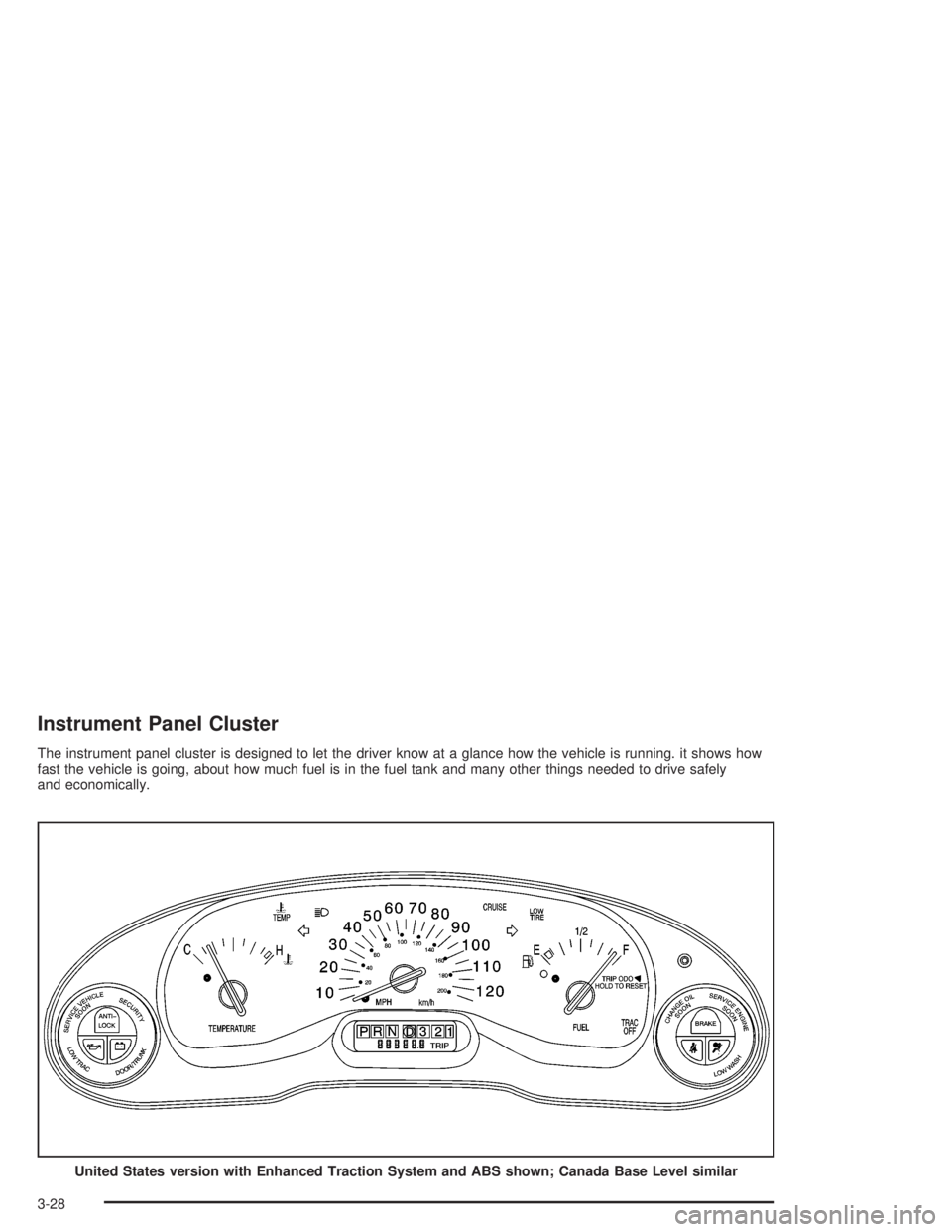
Instrument Panel Cluster
The instrument panel cluster is designed to let the driver know at a glance how the vehicle is running. it shows how
fast the vehicle is going, about how much fuel is in the fuel tank and many other things needed to drive safely
and economically.
United States version with Enhanced Traction System and ABS shown; Canada Base Level similar
3-28
Page 172 of 358
Braking
Braking action involvesperception timeand
reaction time.
First, you have to decide to push on the brake pedal.
That isperception time.Then you have to bring up your
foot and do it. That isreaction time.
Averagereaction timeis about 3/4 of a second. But that
is only an average. It might be less with one driver
and as long as two or three seconds or more with
another. Age, physical condition, alertness, coordination
and eyesight all play a part. So do alcohol, drugs and
frustration. But even in 3/4 of a second, a vehicle moving
at 60 mph (100 km/h) travels 66 feet (20 m). That
could be a lot of distance in an emergency, so keeping
enough space between your vehicle and others is
important.
And, of course, actual stopping distances vary greatly
with the surface of the road (whether it is pavement
or gravel); the condition of the road (wet, dry, icy); tire
tread; the condition of your brakes; the weight of
the vehicle and the amount of brake force applied.
Avoid needless heavy braking. Some people drive
in spurts — heavy acceleration followed by heavy
braking — rather than keeping pace with traffic.
This is a mistake. Your brakes may not have time
to cool between hard stops. Your brakes will wear out
much faster if you do a lot of heavy braking.If you keep pace with the traffic and allow realistic
following distances, you will eliminate a lot of
unnecessary braking. That means better braking and
longer brake life.
If your engine ever stops while you are driving, brake
normally but do not pump your brakes. If you do,
the pedal may get harder to push down. If your engine
stops, you will still have some power brake assist.
But you will use it when you brake. Once the power
assist is used up, it may take longer to stop and
the brake pedal will be harder to push.
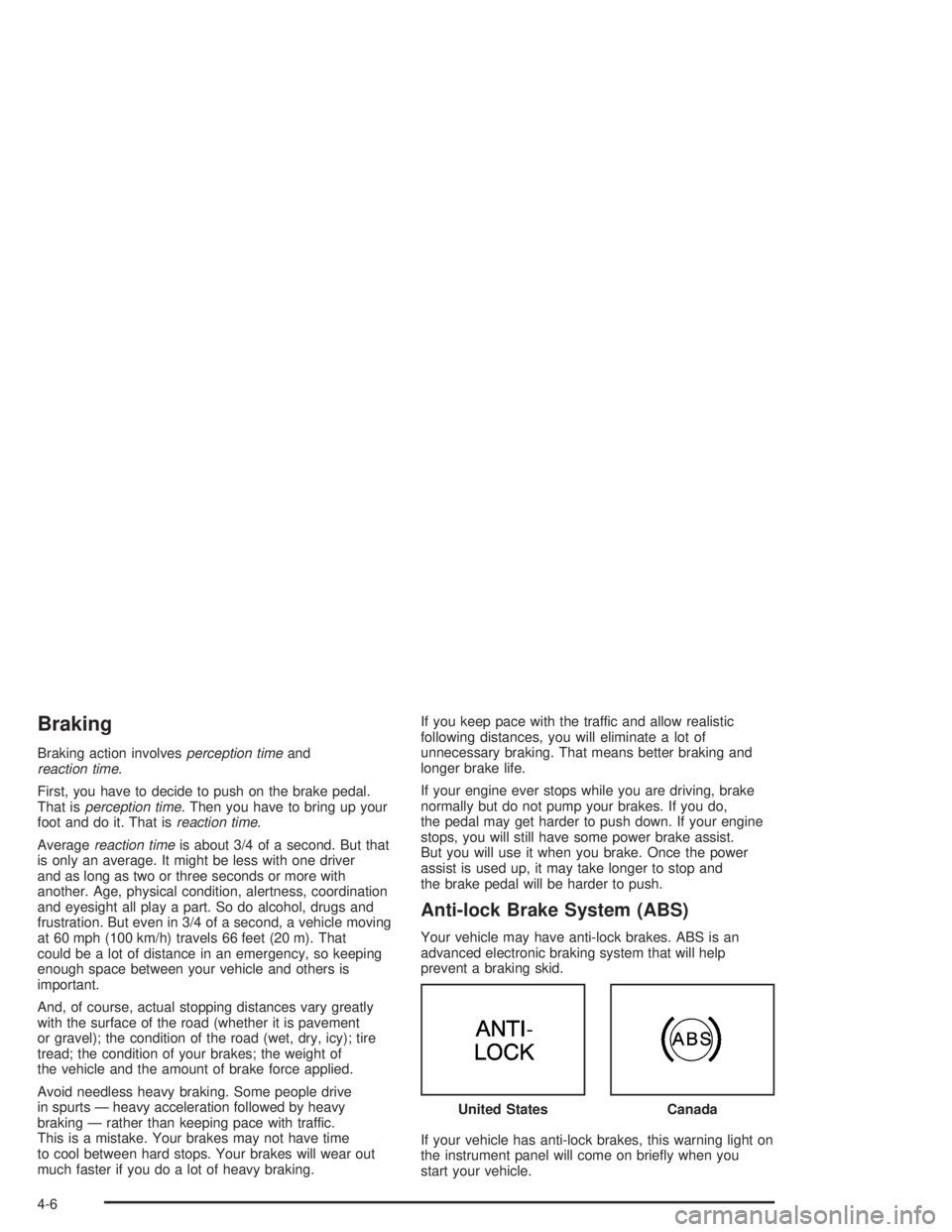
Anti-lock Brake System (ABS)
Your vehicle may have anti-lock brakes. ABS is an
advanced electronic braking system that will help
prevent a braking skid.
If your vehicle has anti-lock brakes, this warning light on
the instrument panel will come on briey when you
start your vehicle.United States
Canada
4-6
Page 173 of 358
When you start your engine, or when you begin to drive
away, your anti-lock brake system will check itself.
You may hear a momentary motor or clicking noise while
this test is going on, and you may even notice that
your brake pedal moves or pulses a little. This is normal.
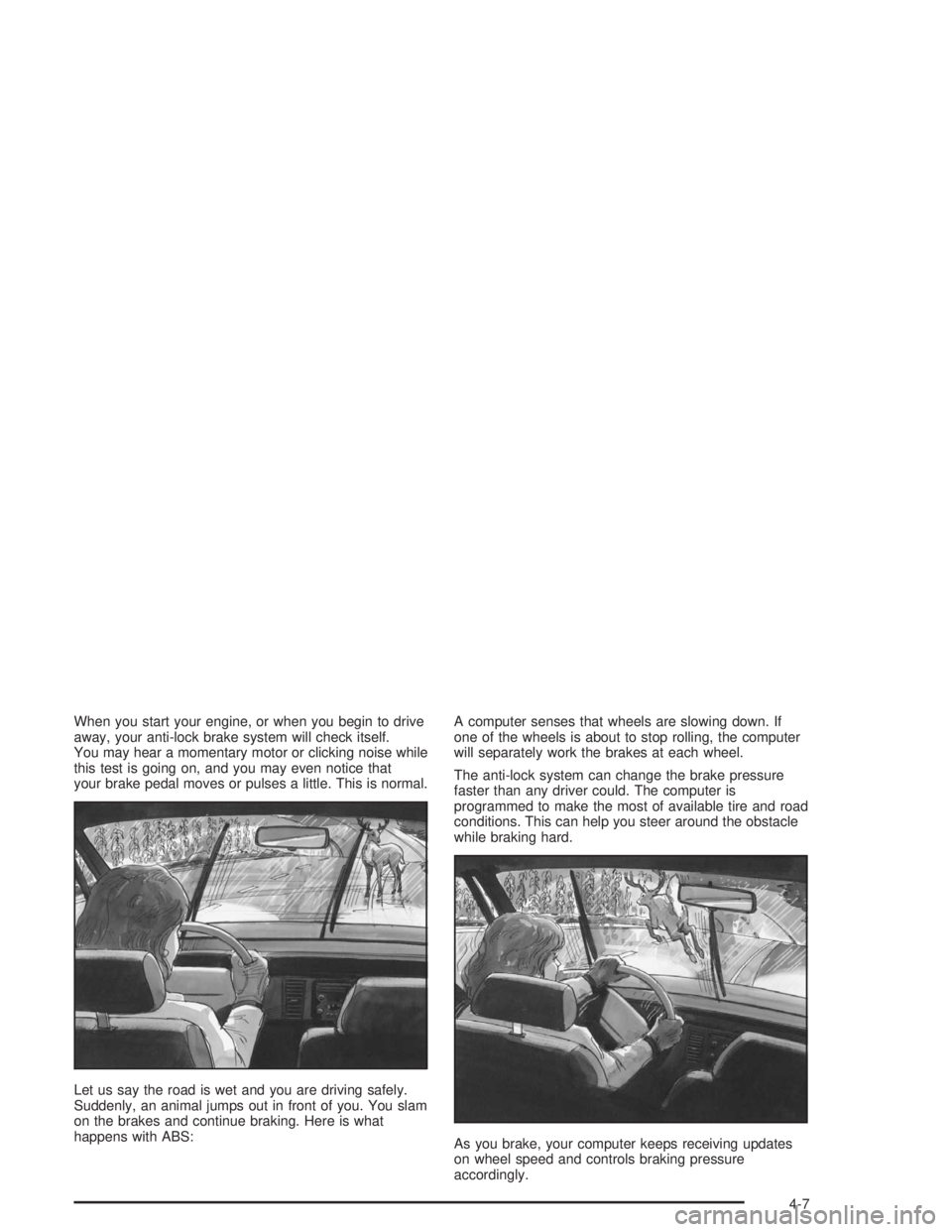
Let us say the road is wet and you are driving safely.
Suddenly, an animal jumps out in front of you. You slam
on the brakes and continue braking. Here is what
happens with ABS:A computer senses that wheels are slowing down. If
one of the wheels is about to stop rolling, the computer
will separately work the brakes at each wheel.
The anti-lock system can change the brake pressure
faster than any driver could. The computer is
programmed to make the most of available tire and road
conditions. This can help you steer around the obstacle
while braking hard.
As you brake, your computer keeps receiving updates
on wheel speed and controls braking pressure
accordingly.
4-7
Page 210 of 358
Turn Signals When Towing a Trailer
When towing a trailer, the vehicle may need a different
turn signal asher and/or extra wiring. Check with
your dealer. The arrows on the instrument panel will
ash whenever signaling a turn or lane change.
Properly hooked up, the trailer lamps will also ash,
telling other drivers you are about to turn, change lanes
or stop.
When towing a trailer, the arrows on the instrument
panel will ash for turns even if the bulbs on the trailer
are burned out. You may think drivers behind you
are seeing your signal when they are not. It is important
to check occasionally to be sure the trailer bulbs are
still working.
Driving On Grades
Reduce speed and shift to a lower gearbeforestarting
down a long hill or steep downgrade. If the vehicle
is not shifted down, the brakes might have to be
used so much that they would get hot and no longer
work well.
On a long uphill grade, shift down and reduce the
vehicle’s speed to around 45 mph (70 km/h) to reduce
the possibility of engine and transaxle overheating.
If towing a trailer, you may want to drive in THIRD (3)
instead of AUTOMATIC OVERDRIVE (
X). Shift
to a lower gear as needed.
Parking on Hills
{CAUTION:
You really should not park your vehicle, with a
trailer attached, on a hill. If something goes
wrong, your rig could start to move. People
can be injured, and both your vehicle and the
trailer can be damaged.
But if the rig ever has to be parked on a hill, here is
how to do it:
1. Apply the regular brakes, but do not shift into
PARK (P) yet.
2. Have someone place chocks under the trailer’s
wheels.
3. When the wheel chocks are in place, release the
regular brakes until the chocks absorb the load.
4. Reapply the regular brakes. Then apply the parking
brake, and shift to PARK (P).
5. Release the regular brakes.
4-44
Page 263 of 358
Bulb Replacement
For any bulb changing procedure not listed in this
section, contact your dealer. For the type of bulb, see
Replacement Bulbs on page 5-55.
Halogen Bulbs
{CAUTION:
Halogen bulbs have pressurized gas inside
and can burst if you drop or scratch the bulb.
You or others could be injured. Be sure to read
and follow the instructions on the bulb
package.
Headlamps
1. Open the hood.
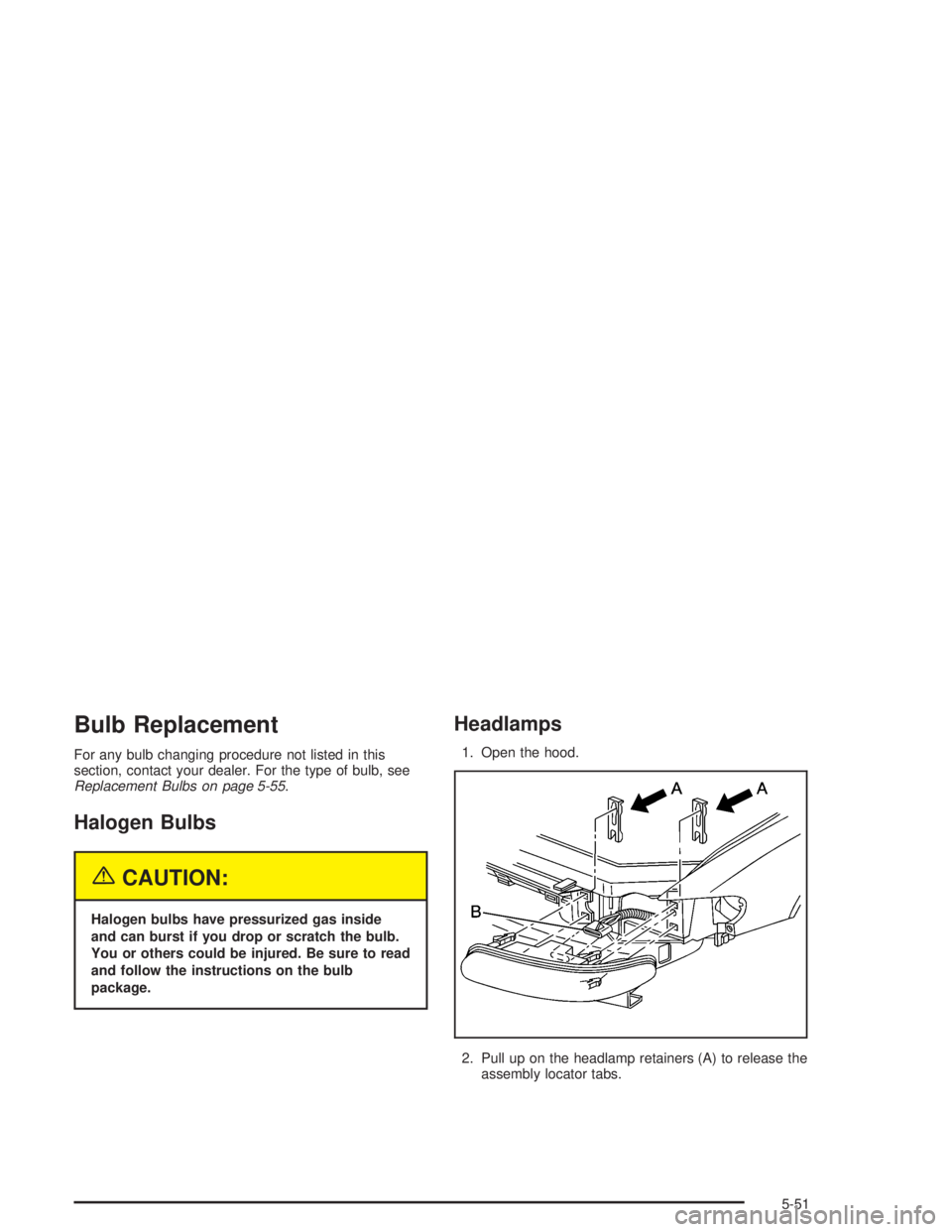
2. Pull up on the headlamp retainers (A) to release the
assembly locator tabs.
5-51
Page 312 of 358
Fuses Usage
HAZRD Hazard Warning Flashers
LH HTD SEAT Not Used
Blank Not Used
BCM ACCYIgnition Signal: Hot in ACCESSORY
and RUN, Body Control Module
Blank Not Used
LOW BLWER Low Blower
ABS Anti-Lock Brakes
TRN SIG Turn Signals, Cornering Lamps
RADIO,
HVAC, RFA,
CLSTR ALDLRadio, Heating Ventilation and Air
Conditioning Head; Remote Keyless
Entry, Cluster
HI BLWR High Blower
RH HTD SEAT Not Used
STR/WHL
CNTRLAudio Steering Wheel Controls
WPR Windshield WipersUnderhood Fuse Block
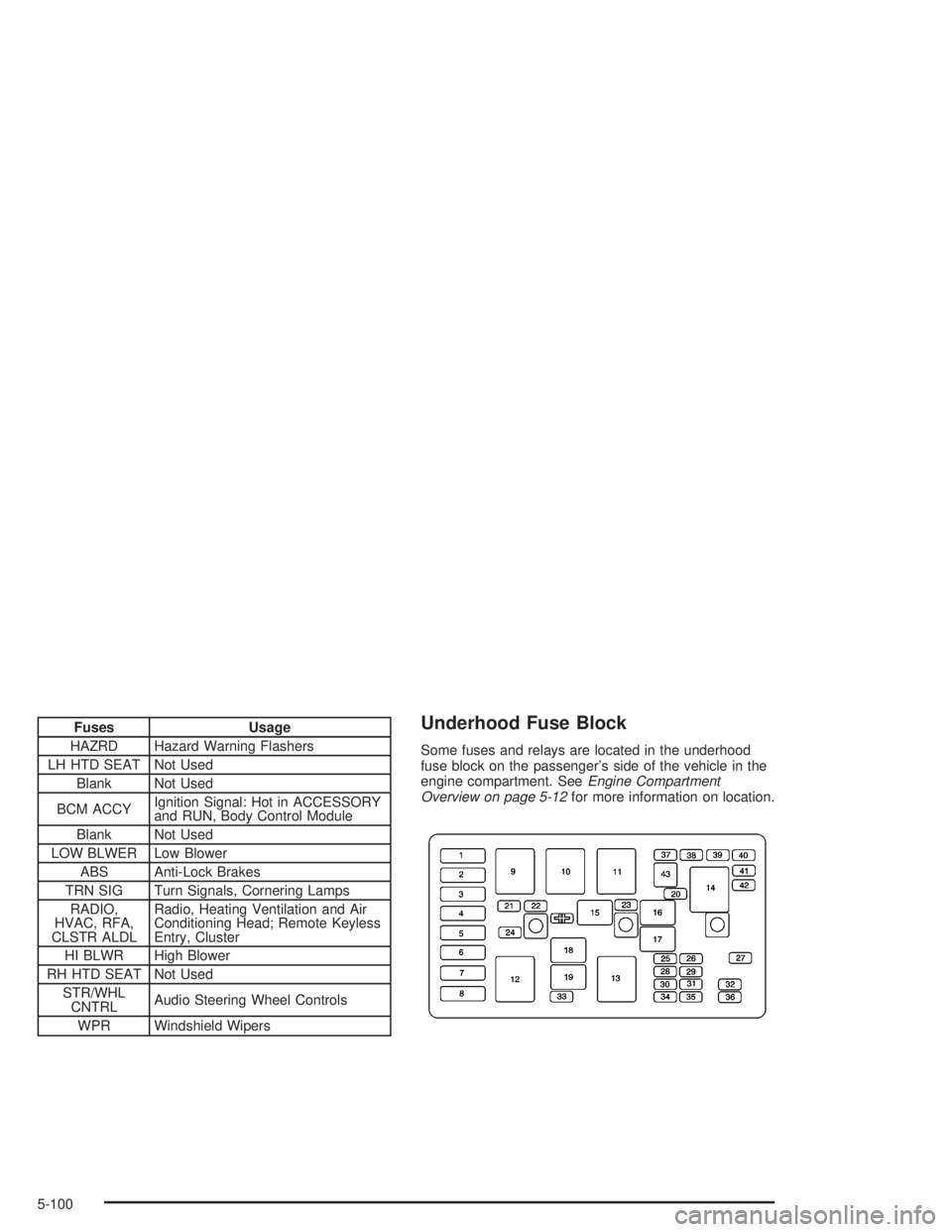
Some fuses and relays are located in the underhood
fuse block on the passenger’s side of the vehicle in the
engine compartment. SeeEngine Compartment
Overview on page 5-12for more information on location.
5-100
Page 345 of 358
A
Accessory Power Outlets.................................3-17
Adding Washer Fluid.......................................5-37
Additional Program Information........................... 7-8
Additives, Fuel................................................. 5-6
Add-On Electrical Equipment............................5-97
Adjusting the Speakers (Balance/Fade)......3-48, 3-55
Air Bag
Readiness Light..........................................3-30
Air Bag Systems.............................................1-49
How Does an Air Bag Restrain?....................1-55
Servicing Your Air Bag-Equipped Vehicle.........1-58
What Makes an Air Bag Inate?....................1-55
What Will You See After an Air Bag
Inates?..................................................1-56
When Should an Air Bag Inate?...................1-54
Where Are the Air Bags?..............................1-52
Air Cleaner/Filter, Engine.................................5-18
Airbag Sensing and Diagnostic Module (SDM)...... 7-9
AM ...............................................................3-63
Antenna, Fixed Mast.......................................3-64
Anti-lock Brake System (ABS)............................ 4-6
Anti-Lock Brake System Warning Light...............3-33Appearance Care............................................5-88
Care of Safety Belts....................................5-91
Chemical Paint Spotting...............................5-94
Cleaning the Inside of Your Vehicle................5-88
Cleaning the Outside of Your Vehicle..............5-91
Finish Damage............................................5-93
Sheet Metal Damage...................................5-93
Underbody Maintenance...............................5-94
Vehicle Care/Appearance Materials................5-95
Weatherstrips..............................................5-91
Ashtrays........................................................3-17
Audio System(s).............................................3-44
Audio Steering Wheel Controls......................3-62
Care of Your Cassette Tape Player................3-63
Care of Your CD Player...............................3-64
Care of Your CDs........................................3-64
Fixed Mast Antenna.....................................3-64
Radio with Cassette and CD.........................3-53
Radio with CD............................................3-45
Setting the Time..........................................3-45
Theft-Deterrent Feature................................3-62
Understanding Radio Reception.....................3-63
Automatic Operation........................................3-21
Automatic Transaxle
Fluid..........................................................5-19
Operation...................................................2-22
1