ABS BUICK ENCLAVE 2009 User Guide
[x] Cancel search | Manufacturer: BUICK, Model Year: 2009, Model line: ENCLAVE, Model: BUICK ENCLAVE 2009Pages: 412
Page 267 of 412

Parking on Hills
{CAUTION
Parking the vehicle on a hill with
the trailer attached can be
dangerous. If something goes
wrong, the rig could start to move.
People can be injured, and both
the vehicle and the trailer can be
damaged. When possible, always
park the rig on a at surface.
If parking the rig on a hill:
1. Press the brake pedal, but do
not shift into P (Park) yet.
Turn the wheels into the curb if
facing downhill or into traffic
if facing uphill.
2. Have someone place chocks
under the trailer wheels.3. When the wheel chocks are in
place, release the brake pedal
until the chocks absorb the load.
4. Reapply the brake pedal. Then
apply the parking brake and shift
the transmission into P (Park).
5. Release the brake pedal.
Leaving After Parking on a Hill
1. Apply and hold the brake
pedal while you:
start the engine,
shift into a gear, and
release the parking brake.
2. Let up on the brake pedal.
3. Drive slowly until the trailer is
clear of the chocks.
4. Stop and have someone pick up
and store the chocks.
Maintenance When Trailer
Towing
The vehicle needs service more
often when pulling a trailer.
SeeScheduled Maintenance on
page 6-3for more information.
Things that are especially important
in trailer operation are automatic
transmission uid, engine oil,
axle lubricant, belts, cooling system
and brake system. It is a good
idea to inspect these before and
during the trip.
Check periodically to see that all
hitch nuts and bolts are tight.
Driving Your Vehicle 4-33
Page 338 of 412

13. Disconnect the air only hose (G)
from the tire valve stem, by
turning it counterclockwise, and
replace the tire valve stem cap.
14. Replace the air only hose (G)
and the power plug (H) and
cord back in its original location.
15. Place the equipment in
the original storage location in
the vehicle.
The tire sealant and compressor kit
has an accessory adapter located
in a compartment on the bottom
of its housing that may be used to
inate air mattresses, balls, etc.Removal and Installation of
the Sealant Canister
To remove the sealant canister:
1. Unwrap the sealant hose.
2. Press the canister release button.
3. Pull up and remove the canister.
4. Replace with a new canister
which is available from your
dealer/retailer.
5. Push the new canister into place.
Tire Sealant and
Compressor Kit Storage
The tire sealant and compressor
kit is located in the storage
compartment on the driver side, at
the rear of the vehicle.1. Press down on the latch tab and
pull the cover off to access the
storage compartment.
2. Press the two tabs on the quick
release buckle to release the tire
sealant and compressor kit strap.
3. Remove the sealant and
compressor kit from its tray.
To store the tire sealant and
compressor kit, reverse the steps.
5-70 Service and Appearance Care
Page 353 of 412

Fabric/Carpet
Use a vacuum cleaner with a soft
brush attachment frequently to
remove dust and loose dirt.
A canister vacuum with a beater bar
in the nozzle may only be used
on oor carpet and carpeted oor
mats. For any soil, always try
to remove it rst with plain water or
club soda. Before cleaning,
gently remove as much of the soil
as possible using one of the
following techniques:
For liquids: gently blot the
remaining soil with a paper towel.
Allow the soil to absorb into
the paper towel until no more can
be removed.
For solid dry soils: remove as
much as possible and then
vacuum.
To clean:
1. Saturate a lint-free, clean white
cloth with water or club soda.
2. Wring the cloth to remove excess
moisture.3. Start on the outside edge of the
soil and gently rub toward the
center. Continue cleaning, using
a clean area of the cloth each
time it becomes soiled.
4. Continue to gently rub the soiled
area until the cleaning cloth
remains clean.
5. If the soil is not completely
removed, use a mild soap
solution and repeat the cleaning
process that was used with
plain water.
If any of the soil remains, a
commercial fabric cleaner or spot
lifter may be necessary. When
a commercial upholstery cleaner or
spot lifter is to be used, test a
small hidden area for colorfastness
rst. If the locally cleaned area
gives any impression that a
ring formation may result, clean the
entire surface.
After the cleaning process has been
completed, a paper towel can be
used to blot excess moisture
from the fabric or carpet.
Leather
A soft cloth dampened with water
can be used to remove dust. If
a more thorough cleaning is
necessary, a soft cloth dampened
with a mild soap solution can
be used. Allow the leather to dry
naturally. Do not use heat to
dry. Never use steam to clean
leather. Never use spot lifters or
spot removers on leather. Many
commercial leather cleaners
and coatings that are sold to
preserve and protect leather may
permanently change the appearance
and feel of the leather and are not
recommended. Do not use
silicone or wax-based products, or
those containing organic solvents to
clean the vehicle’s interior because
they can alter the appearance
by increasing the gloss in a
non-uniform manner. Never use
shoe polish on leather.
Service and Appearance Care 5-85
Page 363 of 412
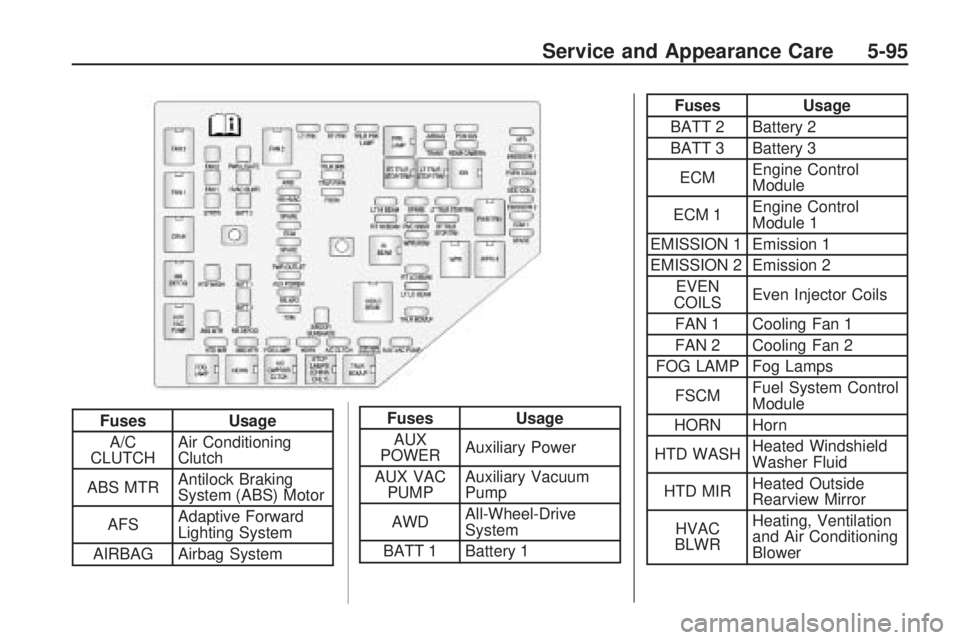
FusesUsage
A/C
CLUTCH Air Conditioning
Clutch
ABS MTR Antilock Braking
System (ABS) Motor
AFS Adaptive Forward
Lighting System
AIRBAG Airbag SystemFuses Usage
AUX
POWER Auxiliary Power
AUX VAC PUMP Auxiliary Vacuum
Pump
AWD All-Wheel-Drive
System
BATT 1 Battery 1
Fuses Usage
BATT 2 Battery 2
BATT 3 Battery 3
ECM Engine Control
Module
ECM 1 Engine Control
Module 1
EMISSION 1 Emission 1
EMISSION 2 Emission 2 EVEN
COILS Even Injector Coils
FAN 1 Cooling Fan 1
FAN 2 Cooling Fan 2
FOG LAMP Fog Lamps
FSCM Fuel System Control
Module
HORN Horn
HTD WASH Heated Windshield
Washer Fluid
HTD MIR Heated Outside
Rearview Mirror
HVAC
BLWR Heating, Ventilation
and Air Conditioning
Blower
Service and Appearance Care 5-95
Page 401 of 412
A
Accessories and
Modications...................... 5-3
Accessory Power Outlets......3-18
Adaptive Forward Lighting
System...........................3-14
Adding Equipment to Your
Airbag-Equipped Vehicle....1-57
Additives, Fuel...................... 5-5
Add-On Electrical
Equipment.......................5-91
Air Cleaner/Filter, Engine.......5-14
Air Conditioning...................3-20
Airbag
Passenger Status
Indicator.......................3-31
Readiness Light................3-31
Airbag System.....................1-45
Adding Equipment to
Your Airbag-Equipped
Vehicle........................1-57
How Does an Airbag
Restrain?.....................1-50
Passenger Sensing
System........................1-52
Servicing Your
Airbag-Equipped
Vehicle........................1-56Airbag System (cont.)
What Makes an Airbag
Inate?........................1-50
What Will You See After an
Airbag Inates?.............1-51
When Should an Airbag
Inate?........................1-48
Where Are the Airbags?.....1-47
All-Wheel Drive....................5-32
All-Wheel-Drive (AWD)
System............................. 4-7
Analog Clock.......................3-19
Antilock Brake
System (ABS).................... 4-4
Antilock Brake, System
Warning Light...................3-34
Appearance Care
Aluminum or
Chrome-Plated
Wheels........................5-88
Care of Safety Belts..........5-86
Chemical Paint Spotting.....5-90
Cleaning Exterior Lamps/
Lenses........................5-87
Fabric/Carpet
...................5-85
Finish Care......................5-87
Finish Damage.................5-90Appearance Care (cont.)
Instrument Panel, Vinyl,
and Other Plastic
Surfaces......................5-86
Interior Cleaning...............5-83
Leather...........................5-85
Sheet Metal Damage........5-89
Tires...............................5-89
Underbody Maintenance....5-90
Washing Your Vehicle........5-86
Weatherstrips...................5-86
Windshield, Backglass, and
Wiper Blades................5-88
Appointments, Scheduling
Service............................. 7-8
Audio System......................3-64
Audio Steering Wheel
Controls.....................3-113
Navigation/Radio System,
see Navigation Manual . . . 3-92
Radio Reception.............3-114
Rear Seat Audio (RSA)....3-111
Setting the Clock..............3-65
Theft-Deterrent Feature....3-113
Audio System(s)..................3-67
Automatic Transmission
Fluid...............................5-15
Operation........................2-24
INDEX i-1
Page 406 of 412

Hood
Checking Things Under....... 5-9
Release............................ 5-9
Horn .................................... 3-5
How to Wear Safety Belts
Properly..........................1-16
I
Ignition Positions..................2-21
Infants and Young Children,
Restraints........................1-28
Ination - Tire Pressure.........5-42
Inator Kit, Tire....................5-57
Instrument Panel
Brightness.......................3-15
Cluster............................3-29
Overview........................... 3-4
Storage Area....................2-49
J
Jump Starting......................5-28
K
Keyless Entry System............ 2-3
Keys.................................... 2-2
L
Labeling, Tire Sidewall..........5-37
Lamp
Malfunction Indicator.........3-36
Lamps
Dome .............................3-15
Dome Lamp Override........3-15
Reading..........................3-16
Lap-Shoulder Belt................1-20
LATCH System for Child
Restraints........................1-34
License Plate Lamps............5-35
Liftgate
Carbon Monoxide.............2-10
Liftgate, Power....................2-10
Light
Airbag Readiness.............3-31
Antilock Brake System
(ABS) Warning..............3-34
Brake System Warning......3-33
Charging System..............3-32
Cruise Control..................3-40
Engine Coolant
Temperature Warning.....3-35
Fog Lamp ........................3-39
Highbeam On...................3-40
Oil Pressure.....................3-39Light (cont.)
Passenger Airbag Status
Indicator.......................3-31
Safety Belt Reminders.......3-30
Security...........................3-39
StabiliTrak
®Indicator.........3-35
Tire Pressure...................3-36
Tow/Haul Mode................3-40
Lighting
Delayed Entry..................3-16
Delayed Exit....................3-16
Entry..............................3-15
Parade Dimming...............3-16
Lights
Exterior Lamps.................3-12
Flash-to-Pass..................... 3-7
High/Low Beam Changer..... 3-7
Loading Your Vehicle............4-16
Lockout Protection................. 2-9
Locks
Delayed Locking................. 2-8
Door ................................. 2-8
Lockout Protection.............. 2-9
Power Door....................... 2-8
Programmable Automatic
Door Locks.................... 2-9
Rear Door Security Locks.... 2-9
Loss of Control....................4-10
i-6 INDEX