mirror BUICK ENCLAVE 2009 Owner's Guide
[x] Cancel search | Manufacturer: BUICK, Model Year: 2009, Model line: ENCLAVE, Model: BUICK ENCLAVE 2009Pages: 412
Page 180 of 412

Press the customization button until
PARK TILT MIRRORS appears
on the DIC display. Press the
set/reset button once to access the
settings for this feature. Then
press the customization button to
scroll through the following settings:
OFF (default):Neither outside
mirror will be tilted down when the
vehicle is shifted into R (Reverse).
DRIVER MIRROR:The driver’s
outside mirror will be tilted down
when the vehicle is shifted into
R (Reverse).
PASSENGER MIRROR:The
passenger’s outside mirror will be
tilted down when the vehicle is
shifted into R (Reverse).
BOTH MIRRORS:The driver’s and
passenger’s outside mirrors will
be tilted down when the vehicle is
shifted into R (Reverse).
NO CHANGE:No change will be
made to this feature. The current
setting will remain.To select a setting, press the
set/reset button while the desired
setting is displayed on the DIC.
EASY EXIT SEAT
If your vehicle has this feature, it
allows you to select your preference
for the automatic easy exit seat
feature. SeeMemory Seat and
Mirrors on page 1-5for more
information.
Press the customization button until
EASY EXIT SEAT appears on
the DIC display. Press the set/reset
button once to access the settings
for this feature. Then press the
customization button to scroll
through the following settings:
OFF (default):No automatic seat
exit recall will occur.
ON:The driver’s seat will move
back when the key is removed from
the ignition. The steering column
will also move up and forward
on vehicles with the power tilt and
telescopic steering feature. See
Power Tilt Wheel and TelescopicSteering Column on page 3-6for
more information.
The automatic easy exit seat
movement will only occur one time
after the key is removed from
the ignition. If the automatic
movement has already occurred,
and you put the key back in
the ignition and remove it again, the
seat and steering column will
stay in the original exit position,
unless a memory recall took place
prior to removing the key again.
NO CHANGE:No change will be
made to this feature. The current
setting will remain.
To select a setting, press the
set/reset button while the desired
setting is displayed on the DIC.
MEMORY SEAT RECALL
If your vehicle has this feature, it
allows you to select your preference
for the remote memory seat recall
feature. SeeMemory Seat and
Mirrors on page 1-5for more
information.
3-62 Instrument Panel
Page 181 of 412
Press the customization button until
MEMORY SEAT RECALL appears
on the DIC display. Press the
set/reset button once to access the
settings for this feature. Then
press the customization button to
scroll through the following settings:
OFF (default):No remote
memory seat recall will occur.
ON:The driver’s seat and outside
mirrors will automatically move
to the stored driving position when
the unlock button on the Remote
Keyless Entry (RKE) transmitter is
pressed. The steering column
will also move on vehicles with the
power tilt and telescopic steering
feature. SeePower Tilt Wheel and
Telescopic Steering Column on
page 3-6for more information. See
“Relearn Remote Key” under
DIC Operation and Displays on
page 3-41for more information on
matching transmitters to driver
ID numbers.NO CHANGE:No change will be
made to this feature. The current
setting will remain.
To select a setting, press the
set/reset button while the desired
setting is displayed on the DIC.
REMOTE START
If your vehicle has this feature, it
allows you to turn the remote
start off or on. The remote start
feature allows you to start the
engine from outside of the vehicle
using the Remote Keyless Entry
(RKE) transmitter. SeeRemote
Vehicle Start on page 2-5for more
information.
Press the customization button until
REMOTE START appears on the
DIC display. Press the set/reset
button once to access the settings
for this feature. Then press the
customization button to scroll
through the following settings:
OFF:The remote start feature will
be disabled.ON (default):The remote start
feature will be enabled.
NO CHANGE:No change will be
made to this feature. The current
setting will remain.
To select a setting, press the
set/reset button while the desired
setting is displayed on the DIC.
FACTORY SETTINGS
This feature allows you to set all of
the customization features back
to their factory default settings.
Press the customization button until
FACTORY SETTINGS appears
on the DIC display. Press the
set/reset button once to access the
settings for this feature. Then
press the customization button to
scroll through the following settings:
RESTORE ALL (default):The
customization features will be set to
their factory default settings.
Instrument Panel 3-63
Page 244 of 412

Loss of Control
Let us review what driving experts
say about what happens when
the three control systems — brakes,
steering, and acceleration — do
not have enough friction where the
tires meet the road to do what
the driver has asked.
In any emergency, do not give up.
Keep trying to steer and constantly
seek an escape route or area of
less danger.
Skidding
In a skid, a driver can lose control
of the vehicle. Defensive drivers
avoid most skids by taking
reasonable care suited to existing
conditions, and by not overdriving
those conditions. But skids are
always possible.
The three types of skids correspond
to the vehicle’s three control
systems. In the braking skid, the
wheels are not rolling. In the
steering or cornering skid, too much
speed or steering in a curvecauses tires to slip and lose
cornering force. And in the
acceleration skid, too much throttle
causes the driving wheels
to spin.
If the vehicle starts to slide, ease
your foot off the accelerator pedal
and quickly steer the way you want
the vehicle to go. If you start steering
quickly enough, the vehicle may
straighten out. Always be ready for
a second skid if it occurs.
Of course, traction is reduced when
water, snow, ice, gravel, or other
material is on the road. For safety,
slow down and adjust your
driving to these conditions. It is
important to slow down on slippery
surfaces because stopping
distance is longer and vehicle
control more limited.
While driving on a surface with
reduced traction, try your best to
avoid sudden steering, acceleration,
or braking, including reducing
vehicle speed by shifting to a lower
gear. Any sudden changes couldcause the tires to slide. You might
not realize the surface is slippery
until the vehicle is skidding. Learn to
recognize warning clues — such
as enough water, ice, or packed
snow on the road to make a
mirrored surface — and slow down
when you have any doubt.
Remember: Any Antilock Brake
System (ABS) helps avoid only the
braking skid.
Driving at Night
Night driving is more dangerous than
day driving because some drivers
are likely to be impaired — by alcohol
or drugs, with night vision problems,
or by fatigue.
Night driving tips include:
Drive defensively.
Do not drink and drive.
Reduce headlamp glare by
adjusting the inside rearview
mirror.
4-10 Driving Your Vehicle
Page 246 of 412

Hydroplaning
Hydroplaning is dangerous. Water
can build up under your vehicle’s
tires so they actually ride on
the water. This can happen if the
road is wet enough and you
are going fast enough. When your
vehicle is hydroplaning, it has little or
no contact with the road.
There is no hard and fast rule about
hydroplaning. The best advice is
to slow down when the road is wet.
Other Rainy Weather Tips
Besides slowing down, other wet
weather driving tips include:
Allow extra following distance.
Pass with caution.
Keep windshield wiping
equipment in good shape.
Keep the windshield washer uid
reservoir lled.
Have good tires with proper tread
depth. SeeTires on page 5-36.
Turn off cruise control.
Before Leaving on a
Long Trip
To prepare your vehicle for a long
trip, consider having it serviced
by your dealer/retailer before
departing.
Things to check on your own
include:
Windshield Washer Fluid:
Reservoir full? Windows
clean — inside and outside?
Wiper Blades:In good shape?
Fuel, Engine Oil, Other Fluids:All
levels checked?
Lamps:Do they all work and are
lenses clean?
Tires:Are treads good? Are tires
inated to recommended
pressure?
Weather and Maps:Safe to
travel? Have up-to-date maps?
Highway Hypnosis
Always be alert and pay attention
to your surroundings while driving.
If you become tired or sleepy, nd a
safe place to park your vehicle
and rest.
Other driving tips include:
Keep the vehicle well ventilated.
Keep interior temperature cool.
Keep your eyes moving — scan
the road ahead and to the sides.
Check the rearview mirror and
vehicle instruments often.
4-12 Driving Your Vehicle
Page 248 of 412

Try not to break the fragile traction. If
you accelerate too fast, the drive
wheels will spin and polish the
surface under the tires even more.
TheStabiliTrak
®System on page 4-5
improves the ability to accelerate on
slippery roads, but slow down and
adjust your driving to the road
conditions. When driving through
deep snow, turn off the traction
control part of the StabiliTrak
®
System to help maintain vehicle
motion at lower speeds.
TheAntilock Brake System (ABS)
on page 4-4improves vehicle
stability during hard stops on a
slippery roads, but apply the brakes
sooner than when on dry pavement.
Allow greater following distance
on any slippery road and watch for
slippery spots. Icy patches can
occur on otherwise clear roads in
shaded areas. The surface of
a curve or an overpass can remain
icy when the surrounding roads
are clear. Avoid sudden steering
maneuvers and braking while on ice.Turn off cruise control, if equipped,
on slippery surfaces.
Blizzard Conditions
Being stuck in snow can be in a
serious situation. Stay with the
vehicle unless there is help nearby.
If possible, use theRoadside
Assistance Program on page 7-6.
To get help and keep everyone
in the vehicle safe:
Turn on theHazard Warning
Flashers on page 3-5.
Tie a red cloth to an outside
mirror.
{CAUTION
Snow can trap engine exhaust
under the vehicle. This may cause
exhaust gases to get inside.
Engine exhaust contains carbon
monoxide (CO) which cannot be
seen or smelled. It can cause
unconsciousness and even death.
If the vehicle is stuck in the snow:
Clear away snow from
around the base of your
vehicle, especially any that is
blocking the exhaust pipe.
Check again from time to
time to be sure snow does
not collect there.
Open a window about two
inches (5 cm) on the side of
the vehicle that is away from
the wind to bring in fresh air.
Fully open the air outlets on or
under the instrument panel.
(Continued)
4-14 Driving Your Vehicle
Page 264 of 412

Safety Chains
Always attach chains between the
vehicle and the trailer. Cross
the safety chains under the tongue
of the trailer to help prevent the
tongue from contacting the road if it
becomes separated from the
hitch. Instructions about safety
chains may be provided by the hitch
manufacturer or by the trailer
manufacturer. Follow the
manufacturer’s recommendation for
attaching safety chains and do
not attach them to the bumper.
Always leave just enough slack so
the rig can turn. Never allow
safety chains to drag on the ground.
Trailer Brakes
A loaded trailer that weighs more
than 1,000 lbs (450 kg) needs
to have its own brake system that is
adequate for the weight of the
trailer. Be sure to read and follow
the instructions for the trailer brakes
so they are installed, adjusted
and maintained properly.Because the vehicle has antilock
brakes, do not try to tap into
the vehicle’s hydraulic brake system.
If you do, both brake systems will
not work well, or at all.
Driving with a Trailer
Towing a trailer requires a certain
amount of experience. Get to
know the rig before setting out for
the open road. Get acquainted
with the feel of handling and braking
with the added weight of the
trailer. And always keep in mind that
the vehicle you are driving is now
longer and not as responsive as the
vehicle is by itself.
Before starting, check all trailer hitch
parts and attachments, safety
chains, electrical connectors, lamps,
tires and mirror adjustments. If the
trailer has electric brakes, start the
vehicle and trailer moving and then
apply the trailer brake controller by
hand to be sure the brakes are
working. This checks the electrical
connection at the same time.During the trip, check occasionally
to be sure that the load is secure,
and that the lamps and any
trailer brakes are still working.
Following Distance
Stay at least twice as far behind the
vehicle ahead as you would when
driving the vehicle without a trailer.
This can help to avoid situations that
require heavy braking and sudden
turns.
Passing
More passing distance is needed
when towing a trailer. Because the
rig is longer, it is necessary to go
much farther beyond the passed
vehicle before returning to the lane.
Backing Up
Hold the bottom of the steering wheel
with one hand. Then, to move the
trailer to the left, move that hand to
the left. To move the trailer to the
right, move your hand to the right.
Always back up slowly and, if
possible, have someone guide you.
4-30 Driving Your Vehicle
Page 361 of 412

Fuses Usage
AIRBAG Airbag
AMP Amplier
BCK/UP/
STOPBack-up
Lamp/Stoplamp
BCMBody Control
Module
CNSTR/
VENTCanister Vent
CTSY Courtesy
DR/LCK Door Locks
DRLDaytime Running
Lamps
DSPLY Display
FRT/WSWFront Windshield
Washer
HTD/COOL
SEATHeated/Cooling
Seats
HVACHeating, Ventilation
and Air ConditioningFuses Usage
IADV/
PWR/LEDInadvertent
Power LED
INFOTMNT Infotainment
LT/TRN/SIGDriver Side Turn
Signal
MSMMemory Seat
Module
PWR
MODEPower Mode
PWR/MIR Power Mirrors
RDO Radio
REAR WPR Rear Wiper
RT/TRN/SIGPassenger Side
Turn Signal
SPARE Spare
SPARE Spare
STR/WHL/
ILLUMSteering Wheel
Illumination
Fuse Side
Service and Appearance Care 5-93
Page 363 of 412
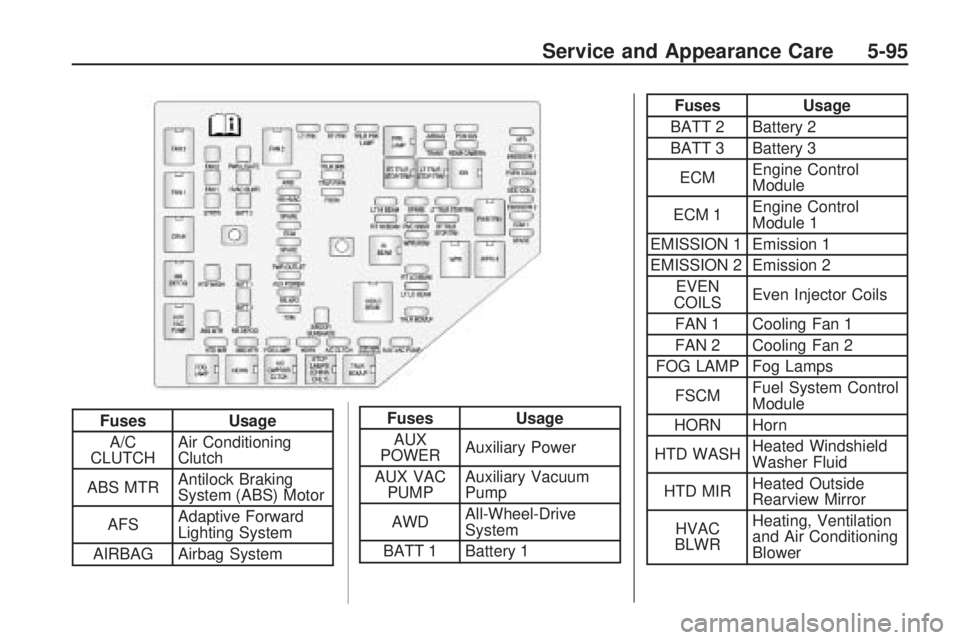
FusesUsage
A/C
CLUTCH Air Conditioning
Clutch
ABS MTR Antilock Braking
System (ABS) Motor
AFS Adaptive Forward
Lighting System
AIRBAG Airbag SystemFuses Usage
AUX
POWER Auxiliary Power
AUX VAC PUMP Auxiliary Vacuum
Pump
AWD All-Wheel-Drive
System
BATT 1 Battery 1
Fuses Usage
BATT 2 Battery 2
BATT 3 Battery 3
ECM Engine Control
Module
ECM 1 Engine Control
Module 1
EMISSION 1 Emission 1
EMISSION 2 Emission 2 EVEN
COILS Even Injector Coils
FAN 1 Cooling Fan 1
FAN 2 Cooling Fan 2
FOG LAMP Fog Lamps
FSCM Fuel System Control
Module
HORN Horn
HTD WASH Heated Windshield
Washer Fluid
HTD MIR Heated Outside
Rearview Mirror
HVAC
BLWR Heating, Ventilation
and Air Conditioning
Blower
Service and Appearance Care 5-95
Page 407 of 412

Lower Anchors and Tethers
for Children......................1-34
Luggage Carrier...................2-51
Lumbar
Manual Controls................. 1-3
Power Controls.................. 1-4
M
Maintenance Schedule
Additional Required
Services........................ 6-6
At Each Fuel Fill................ 6-9
At Least Once a Month....... 6-9
At Least Once a Year.......6-10
Introduction....................... 6-1
Maintenance Footnotes....... 6-7
Maintenance Record.........6-16
Maintenance Replacement
Parts...........................6-14
Maintenance
Requirements................. 6-2
Owner Checks and
Services........................ 6-9
Recommended Fluids and
Lubricants....................6-12
Scheduled Maintenance....... 6-3Maintenance Schedule (cont.)
Using............................... 6-2
Your Vehicle and the
Environment................... 6-2
Malfunction Indicator Lamp....3-36
Manual Lumbar Controls......... 1-3
Memory Seat and Mirrors....... 1-5
Message
DIC Warnings and
Messages....................3-48
Mirrors
Automatic Dimming
Rearview......................2-31
Outside Convex Mirror.......2-34
Outside Heated Mirrors......2-34
Outside Power Foldaway
Mirrors.........................2-33
Outside Power Mirrors.......2-32
Park Tilt..........................2-34
MP3 ...........................3-82, 3-86
MyGMLink.com...................... 7-3
N
Navigation System, Privacy . . . 7-16
Navigation/Radio System, see
Navigation Manual............3-92
New Vehicle Break-In...........2-20
O
Odometer...........................3-30
Off-Road Recovery................ 4-9
Oil
Engine............................5-11
Pressure Light..................3-39
Oil, Engine Oil Life System....5-13
Older Children, Restraints......1-26
Online Owner Center.............. 7-3
OnStar, Privacy....................7-15
OnStar
®System, see
OnStar®Manual...............2-41
Operation, Universal Home
Remote System................2-45
Orange Covered Wiring.........5-91
Outlet Adjustment.................3-25
Outlets
Accessory Power..............3-18
Outside
Convex Mirror..................2-34
Heated Mirrors.................2-34
Power Foldaway Mirrors....2-33
Power Mirrors..................2-32
Overheated Engine Protection
Operating Mode................5-22
Owner Checks and Services . . . 6-9
Owners, Canadian.................... ii
INDEX i-7
Page 408 of 412

P
Paint, Damage.....................5-90
Parade Dimming..................3-16
Park
Shifting Into.....................2-28
Shifting Out of..................2-29
Park Aid.....................2-34, 2-37
Park Brake..........................2-27
Park Tilt Mirrors...................2-34
Parking
Assist.............................2-34
Over Things That Burn......2-30
Passenger Airbag Status
Indicator..........................3-31
Passenger Sensing System . . . 1-52
Passing................................ 4-9
PASS-Key
®III+ Electronic
Immobilizer......................2-18
PASS-Key
®III+ Electronic
Immobilizer Operation........2-18
Perchlorate Materials
Requirements, California...... 5-4
Phone
Bluetooth
®.......................3-92
Power
Door Locks........................ 2-8
Electrical System..............5-92
Liftgate............................2-10Power (cont.)
Lumbar Controls................. 1-4
Outlet 115 Volt Alternating
Current........................3-18
Retained Accessory...........2-22
Seat................................. 1-3
Steering Fluid...................5-22
Tilt Wheel and Telescopic
Steering Column............. 3-6
Windows.........................2-14
Privacy...............................7-14
Event Data Recorders.......7-15
Navigation System............7-16
OnStar............................7-15
Radio Frequency
Identication.................7-16
Programmable Automatic
Door Locks........................ 2-9
R
Radio Frequency Identication
(RFID), Privacy.................7-16
Radio(s).............................3-67
Radios
Navigation/Radio System,
see Navigation Manual . . . 3-92
Rear Seat Audio.............3-111
Reception......................3-114Radios (cont.)
Setting the Clock..............3-65
Theft-Deterrent...............3-113
Reading Lamps...................3-16
Rear Air Conditioning and
Heating System................3-26
Rear Air Conditioning and
Heating System and
Electronic Climate
Controls..........................3-27
Rear Door Security Locks....... 2-9
Rear Seat Armrest...............2-51
Rear Seat Audio (RSA).......3-111
Rear Seat Entertainment
System..........................3-102
Rear Seat Operation.............. 1-8
Rear Vision Camera.............2-37
Rear Windshield Washer/
Wiper............................... 3-9
Rearview Mirror, Automatic
Dimming ..........................2-31
Reclining Seatbacks............... 1-6
Recommended Fluids and
Lubricants........................6-12
Recreational Vehicle Towing . . . 4-21
Remote Keyless Entry (RKE)
System............................. 2-3
Remote Keyless Entry (RKE)
System, Operation.............. 2-3
i-8 INDEX