change time BUICK ENCLAVE 2009 Owner's Guide
[x] Cancel search | Manufacturer: BUICK, Model Year: 2009, Model line: ENCLAVE, Model: BUICK ENCLAVE 2009Pages: 412
Page 295 of 412

Replacing Brake System Parts
The braking system on a vehicle
is complex. Its many parts have to
be of top quality and work well
together if the vehicle is to have
really good braking. The vehicle was
designed and tested with top-quality
brake parts. When parts of the
braking system are replaced — for
example, when the brake linings
wear down and new ones are
installed — be sure to get new
approved replacement parts. If this
is not done, the brakes might
not work properly. For example, if
someone puts in brake linings
that are wrong for the vehicle, the
balance between the front and
rear brakes can change — for the
worse. The braking performance
expected can change in many other
ways if the wrong replacement
brake parts are installed.
Battery
This vehicle has a maintenance free
battery. When it is time for a new
battery, see your dealer/retailer
for one that has the replacement
number shown on the original
battery’s label.
For battery replacement, see your
dealer/retailer or the service manual.
To purchase a service manual,
seeService Publications Ordering
Information on page 7-13.
Warning:Battery posts, terminals,
and related accessories contain
lead and lead compounds,
chemicals known to the State of
California to cause cancer and
reproductive harm. Wash hands
after handling.
Vehicle Storage
{CAUTION
Batteries have acid that can burn
you and gas that can explode. You
can be badly hurt if you are not
careful. SeeJump Starting on
page 5-28for tips on working
around a battery without
getting hurt.
Infrequent Usage: If the vehicle is
driven infrequently, remove the
black, negative (−) cable from the
battery. This helps keep the battery
from running down.
Extended Storage: For extended
storage of the vehicle, remove
the black, negative (−) cable from
the battery or use a battery
trickle charger. This helps maintain
the charge of the battery over
an extended period of time.
Service and Appearance Care 5-27
Page 313 of 412

Federal Communications
Commission (FCC) and
Industry and Science Canada
The Tire Pressure Monitor System
(TPMS) operates on a radio
frequency and complies with Part 15
of the FCC Rules. Operation is
subject to the following
two conditions:
1. This device may not cause
harmful interference.
2. This device must accept any
interference received, including
interference that may cause
undesired operation.
The TPMS operates on a radio
frequency and complies with
RSS-210 of Industry and Science
Canada. Operation is subject to
the following two conditions:
1. This device may not cause
interference.
2. This device must accept any
interference received, including
interference that may cause
undesired operation of the device.Changes or modications to this
system by other than an authorized
service facility could void
authorization to use this equipment.
Tire Pressure Monitor
Operation
This vehicle may have a Tire
Pressure Monitor System (TPMS).
The TPMS is designed to warn
the driver when a low tire pressure
condition exists. TPMS sensors
are mounted onto each tire
and wheel assembly, excluding the
spare tire and wheel assembly,
if the vehicle has one. The TPMS
sensors monitor the air pressure in
the vehicle’s tires and transmits
the tire pressure readings to
a receiver located in the vehicle.When a low tire pressure condition is
detected, the TPMS illuminates the
low tire pressure warning light
located on the instrument panel
cluster.
At the same time a message to
check the pressure in a specic tire
appears on the Driver Information
Center (DIC) display. The low tire
pressure warning light and the DIC
warning message come on at each
ignition cycle until the tires are
inated to the correct ination
pressure. Using the DIC, tire
pressure levels can be viewed by the
driver. For additional information and
details about the DIC operation and
displays seeDIC Operation and
Displays on page 3-41andDIC
Warnings and Messages on
page 3-48.
Service and Appearance Care 5-45
Page 317 of 412

SeeWhen It Is Time for New
Tires on page 5-50andWheel
Replacement on page 5-55.
When rotating the vehicle’s tires,
always use the correct rotation
pattern shown here.
If the vehicle has a compact
spare tire, do not include it in the
tire rotation.
After the tires have been rotated,
adjust the front and rear ination
pressures as shown on the Tire
and Loading Information label.SeeInflation - Tire Pressure on
page 5-42andLoading the
Vehicle on page 4-16.
Reset the Tire Pressure Monitor
System. SeeTire Pressure
Monitor Operation on page 5-45.
Make certain that all wheel nuts
are properly tightened. See
“Wheel Nut Torque” under
Capacities and Specifications on
page 5-98.
{CAUTION
Rust or dirt on a wheel, or on
the parts to which it is fastened,
can make wheel nuts become
loose after time. The wheel
could come off and cause an
accident. When you change a
wheel, remove any rust or dirt
(Continued)
CAUTION (Continued)
from places where the wheel
attaches to the vehicle. In an
emergency, you can use a
cloth or a paper towel to do
this; but be sure to use a
scraper or wire brush later, if
needed, to get all the rust or
dirt off. SeeChanging a Flat
Tire on page 5-71.
Make sure the spare tire, if the
vehicle has one, is stored
securely. Push, pull, and then
try to rotate or turn the tire.
If it moves, tighten the cable.
SeeStoring a Flat or Spare Tire
and Tools on page 5-80.
Service and Appearance Care 5-49
Page 353 of 412

Fabric/Carpet
Use a vacuum cleaner with a soft
brush attachment frequently to
remove dust and loose dirt.
A canister vacuum with a beater bar
in the nozzle may only be used
on oor carpet and carpeted oor
mats. For any soil, always try
to remove it rst with plain water or
club soda. Before cleaning,
gently remove as much of the soil
as possible using one of the
following techniques:
For liquids: gently blot the
remaining soil with a paper towel.
Allow the soil to absorb into
the paper towel until no more can
be removed.
For solid dry soils: remove as
much as possible and then
vacuum.
To clean:
1. Saturate a lint-free, clean white
cloth with water or club soda.
2. Wring the cloth to remove excess
moisture.3. Start on the outside edge of the
soil and gently rub toward the
center. Continue cleaning, using
a clean area of the cloth each
time it becomes soiled.
4. Continue to gently rub the soiled
area until the cleaning cloth
remains clean.
5. If the soil is not completely
removed, use a mild soap
solution and repeat the cleaning
process that was used with
plain water.
If any of the soil remains, a
commercial fabric cleaner or spot
lifter may be necessary. When
a commercial upholstery cleaner or
spot lifter is to be used, test a
small hidden area for colorfastness
rst. If the locally cleaned area
gives any impression that a
ring formation may result, clean the
entire surface.
After the cleaning process has been
completed, a paper towel can be
used to blot excess moisture
from the fabric or carpet.
Leather
A soft cloth dampened with water
can be used to remove dust. If
a more thorough cleaning is
necessary, a soft cloth dampened
with a mild soap solution can
be used. Allow the leather to dry
naturally. Do not use heat to
dry. Never use steam to clean
leather. Never use spot lifters or
spot removers on leather. Many
commercial leather cleaners
and coatings that are sold to
preserve and protect leather may
permanently change the appearance
and feel of the leather and are not
recommended. Do not use
silicone or wax-based products, or
those containing organic solvents to
clean the vehicle’s interior because
they can alter the appearance
by increasing the gloss in a
non-uniform manner. Never use
shoe polish on leather.
Service and Appearance Care 5-85
Page 369 of 412

{CAUTION
Performing maintenance work on
a vehicle can be dangerous. In
trying to do some jobs, you can
be seriously injured. Do your own
maintenance work only if you
have the required know-how and
the proper tools and equipment
for the job. If you have any doubt,
see your dealer/retailer to have a
qualied technician do the work.
SeeDoing Your Own Service
Work on page 5-4.
Some maintenance services can be
complex. So, unless you are
technically qualied and have the
necessary equipment, have
your dealer/retailer do these jobs.
When you go to your dealer/retailer
for service, trained and supported
service technicians will perform
the work using genuine parts.To purchase service information,
seeService Publications Ordering
Information on page 7-13.
Owner Checks and Services on
page 6-8tells what should be
checked, when to check it, and what
can easily be done to help keep
the vehicle in good condition.
The proper replacement parts,
uids, and lubricants to use
are listed inRecommended Fluids
and Lubricants on page 6-12
andMaintenance Replacement
Parts on page 6-14. When the
vehicle is serviced, make sure these
are used. All parts should be
replaced and all necessary repairs
done before you or anyone else
drives the vehicle. We recommend
the use of genuine parts from
your dealer/retailer.
Scheduled Maintenance
When the CHANGE ENGINE
OIL SOON message displays,
service is required for the vehicle.
Have the vehicle serviced as
soon as possible within the next
600 miles (1 000 km). It is possible
that, if driving under the best
conditions, the engine oil life system
might not indicate that vehicle
service is necessary for over a year.
However, the engine oil and lter
must be changed at least once
a year and at this time the system
must be reset. Your dealer/retailer
has trained service technicians
who will perform this work using
genuine parts and reset the system.
If the engine oil life system is ever
reset accidentally, service the vehicle
within 3,000 miles (5 000 km) since
the last service. Remember to reset
the oil life system whenever the oil is
changed. SeeEngine Oil Life
System on page 5-13for information
on the Engine Oil Life System and
resetting the system.
Maintenance Schedule 6-3
Page 390 of 412

General Motors of Canada also
has a Mobility Program. Call
1-800-GM-DRIVE (463-7483) for
details. TTY users call
1-800-263-3830.
Roadside Assistance
Program
For U.S. purchased vehicles, call
1-800-252-1112; (Text Telephone
(TTY): 1-888-889-2438).
For Canadian purchased vehicles,
call1-800-268-6800.
Service is available 24 hours a day,
365 days a year.
Calling for Assistance
When calling Roadside Assistance,
have the following information ready:
Your name, home address, and
home telephone number
Telephone number of your
location
Location of the vehicle
Model, year, color, and license
plate number of the vehicle
Odometer reading, Vehicle
Identication Number (VIN), and
delivery date of the vehicle
Description of the problem
Coverage
Services are provided up to
5 years/100,000 miles (160 000 km),
whichever comes rst.
In the U.S., anyone driving the
vehicle is covered. In Canada, a
person driving the vehicle without
permission from the owner is
not covered.
Roadside Assistance is not a part of
the New Vehicle Limited Warranty.
Buick and General Motors of
Canada Limited reserve the right to
make any changes or discontinue
the Roadside Assistance program at
any time without notication.
Buick and General Motors of
Canada Limited reserve the right to
limit services or payment to anowner or driver if they decide the
claims are made too often, or
the same type of claim is made
many times.
Services Provided
Emergency Fuel Delivery:
Delivery of enough fuel for
the vehicle to get to the nearest
service station.
Lock-Out Service:Service is
provided to unlock the vehicle
if you are locked out. A remote
unlock may be available if
you have OnStar
®. For security
reasons, the driver must
present identication before this
service is given.
Emergency Tow From a Public
Road or Highway:Tow to the
nearest Buick dealer for warranty
service, or if the vehicle was in
a crash and cannot be driven.
Assistance is also given when the
vehicle is stuck in sand, mud,
or snow.
7-6 Customer Assistance Information
Page 393 of 412

Public Transportation or Fuel
Reimbursement
If your vehicle requires overnight
warranty repairs, and public
transportation is used instead of the
dealer’s shuttle service, the
expense must be supported by
original receipts and can only be up
to the maximum amount allowed
by GM for shuttle service. In
addition, for U.S. customers, should
you arrange transportation through
a friend or relative, limited
reimbursement for reasonable fuel
expenses may be available.
Claim amounts should reect actual
costs and be supported by original
receipts. See your dealer for
information regarding the allowance
amounts for reimbursement of
fuel or other transportation costs.
Courtesy Rental Vehicle
Your dealer may arrange to provide
you with a courtesy rental vehicle or
reimburse you for a rental vehicle
that you obtain if your vehicle is kept
for an overnight warranty repair.Rental reimbursement will be limited
and must be supported by original
receipts. This requires that you sign
and complete a rental agreement
and meet state/provincial, local, and
rental vehicle provider requirements.
Requirements vary and may include
minimum age requirements,
insurance coverage, credit card,
etc. You are responsible for fuel
usage charges and may also be
responsible for taxes, levies, usage
fees, excessive mileage, or rental
usage beyond the completion of the
repair.
It may not be possible to provide a
like-vehicle as a courtesy rental.
Additional Program
Information
All program options, such as shuttle
service, may not be available at
every dealer. Please contact
your dealer for specic information
about availability. All Courtesy
Transportation arrangements will be
administered by appropriate
dealer personnel.General Motors reserves the right to
unilaterally modify, change or
discontinue Courtesy Transportation
at any time and to resolve all
questions of claim eligibility pursuant
to the terms and conditions
described herein at its sole
discretion.
Collision Damage Repair
If your vehicle is involved in a
collision and it is damaged, have
the damage repaired by a qualied
technician using the proper
equipment and quality replacement
parts. Poorly performed collision
repairs diminish your vehicle’s
resale value, and safety
performance can be compromised
in subsequent collisions.
Collision Parts
Genuine GM Collision parts are new
parts made with the same materials
and construction methods as the
parts with which your vehicle
was originally built. Genuine GM
Collision parts are your best choice
Customer Assistance Information 7-9
Page 398 of 412
Current and Past Model Order
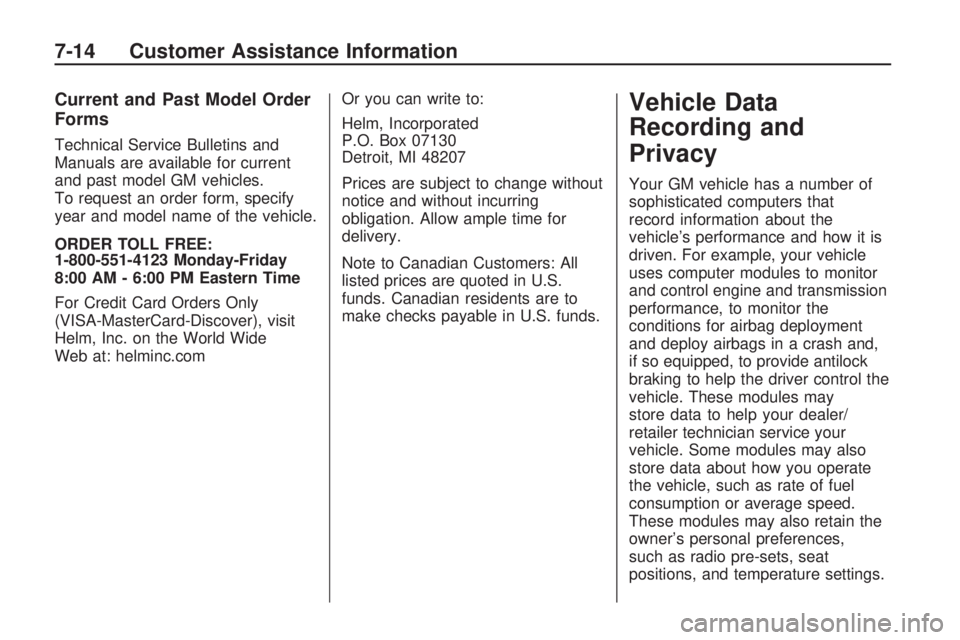
Forms
Technical Service Bulletins and
Manuals are available for current
and past model GM vehicles.
To request an order form, specify
year and model name of the vehicle.
ORDER TOLL FREE:
1-800-551-4123 Monday-Friday
8:00 AM - 6:00 PM Eastern Time
For Credit Card Orders Only
(VISA-MasterCard-Discover), visit
Helm, Inc. on the World Wide
Web at: helminc.comOr you can write to:
Helm, Incorporated
P.O. Box 07130
Detroit, MI 48207
Prices are subject to change without
notice and without incurring
obligation. Allow ample time for
delivery.
Note to Canadian Customers: All
listed prices are quoted in U.S.
funds. Canadian residents are to
make checks payable in U.S. funds.
Vehicle Data
Recording and
Privacy
Your GM vehicle has a number of
sophisticated computers that
record information about the
vehicle’s performance and how it is
driven. For example, your vehicle
uses computer modules to monitor
and control engine and transmission
performance, to monitor the
conditions for airbag deployment
and deploy airbags in a crash and,
if so equipped, to provide antilock
braking to help the driver control the
vehicle. These modules may
store data to help your dealer/
retailer technician service your
vehicle. Some modules may also
store data about how you operate
the vehicle, such as rate of fuel
consumption or average speed.
These modules may also retain the
owner’s personal preferences,
such as radio pre-sets, seat
positions, and temperature settings.
7-14 Customer Assistance Information
Page 405 of 412
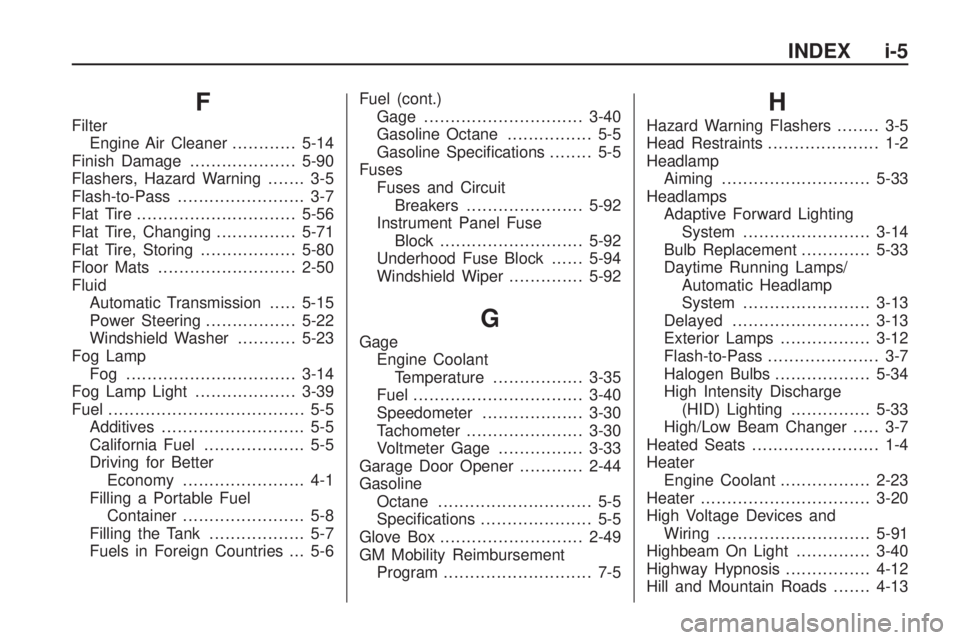
F
Filter
Engine Air Cleaner............5-14
Finish Damage....................5-90
Flashers, Hazard Warning....... 3-5
Flash-to-Pass........................ 3-7
Flat Tire..............................5-56
Flat Tire, Changing...............5-71
Flat Tire, Storing..................5-80
Floor Mats..........................2-50
Fluid
Automatic Transmission.....5-15
Power Steering.................5-22
Windshield Washer...........5-23
Fog Lamp
Fog ................................3-14
Fog Lamp Light...................3-39
Fuel..................................... 5-5
Additives........................... 5-5
California Fuel................... 5-5
Driving for Better
Economy....................... 4-1
Filling a Portable Fuel
Container....................... 5-8
Filling the Tank.................. 5-7
Fuels in Foreign Countries . . . 5-6Fuel (cont.)
Gage ..............................3-40
Gasoline Octane................ 5-5
Gasoline Specications........ 5-5
Fuses
Fuses and Circuit
Breakers......................5-92
Instrument Panel Fuse
Block...........................5-92
Underhood Fuse Block......5-94
Windshield Wiper..............5-92
G
Gage
Engine Coolant
Temperature.................3-35
Fuel................................3-40
Speedometer...................3-30
Tachometer......................3-30
Voltmeter Gage................3-33
Garage Door Opener............2-44
Gasoline
Octane............................. 5-5
Specications..................... 5-5
Glove Box...........................2-49
GM Mobility Reimbursement
Program............................ 7-5
H
Hazard Warning Flashers........ 3-5
Head Restraints..................... 1-2
Headlamp
Aiming ............................5-33
Headlamps
Adaptive Forward Lighting
System........................3-14
Bulb Replacement.............5-33
Daytime Running Lamps/
Automatic Headlamp
System........................3-13
Delayed..........................3-13
Exterior Lamps.................3-12
Flash-to-Pass..................... 3-7
Halogen Bulbs..................5-34
High Intensity Discharge
(HID) Lighting...............5-33
High/Low Beam Changer..... 3-7
Heated Seats........................ 1-4
Heater
Engine Coolant.................2-23
Heater................................3-20
High Voltage Devices and
Wiring.............................5-91
Highbeam On Light..............3-40
Highway Hypnosis................4-12
Hill and Mountain Roads.......4-13
INDEX i-5
Page 410 of 412

Signals, Turn and
Lane-Change..................... 3-7
Spare Tire
Compact.........................5-83
Installing..........................5-74
Removing........................5-72
Storing............................5-80
Specications, Capacities......5-98
Speedometer.......................3-30
StabiliTrak
®Indicator Light.....3-35
Stabilitrak®System................ 4-5
Start Vehicle, Remote............. 2-5
Starting the Engine..............2-22
Steering............................... 4-8
Steering Wheel Controls,
Audio............................3-113
Steering Wheel, Power Tilt
Wheel and Telescopic
Steering Column................ 3-6
Steering Wheel, Tilt and
Telescopic......................... 3-6
Storage Areas
Cargo Management
System........................2-52
Center Console
Storage Area................2-49Storage Areas (cont.)
Cupholders......................2-49
Glove Box.......................2-49
Instrument Panel
Storage Area................2-49
Luggage Carrier...............2-51
Rear Seat Armrest............2-51
Second Row Center
Console.......................2-50
Storing the Tire Sealant and
Compressor Kit................5-70
Stuck in Sand, Mud, Ice,
or Snow..........................4-15
Sun Visors..........................2-16
Sunroof..............................2-53
T
Tachometer.........................3-30
Taillamps
Turn Signal, Stoplamps and
Sidemarker Lamps.........5-34
Telescopic Steering Column,
Power Tilt Wheel................ 3-6
Telescopic Wheel................... 3-6
Theft-Deterrent, Radio.........3-113Theft-Deterrent Systems........2-16
Content Theft-Deterrent.....2-16
PASS-Key
®III+ Electronic
Immobilizer...................2-18
PASS-Key
®III+ Electronic
Immobilizer Operation....2-18
Tilt Wheel............................. 3-6
Time, Setting.......................3-65
Tire
Pressure Light..................3-36
Tire Sealant
Storing............................5-70
Tires..................................5-36
Aluminum or
Chrome-Plated Wheels,
Cleaning......................5-88
Buying New Tires.............5-50
Chains............................5-56
Changing a Flat Tire.........5-71
Cleaning..........................5-89
Compact Spare Tire..........5-83
Different Size...................5-52
If a Tire Goes Flat............5-56
Ination - Tire Pressure.....5-42
Inspection and Rotation.....5-48
Installing the Spare Tire.....5-74
i-10 INDEX