brake BUICK ENCLAVE 2009 Workshop Manual
[x] Cancel search | Manufacturer: BUICK, Model Year: 2009, Model line: ENCLAVE, Model: BUICK ENCLAVE 2009Pages: 412
Page 320 of 412

Non-TPC Spec rated tires may
give a low-pressure warning that
is higher or lower than the proper
warning level you would get with
TPC Spec rated tires. SeeTire
Pressure Monitor System on
page 5-44.
Your vehicle’s original equipment
tires are listed on the Tire and
Loading Information Label.
SeeLoading the Vehicle
on page 4-16, for more
information about the Tire and
Loading Information Label
and its location on your vehicle.
Different Size Tires
and Wheels
If you add wheels or tires that are a
different size than your original
equipment wheels and tires,
this could affect the way your vehicle
performs, including its braking,
ride and handling characteristics,
stability, and resistance to rollover.Additionally, if your vehicle has
electronic systems such as anti-lock
brakes, rollover airbags, traction
control, and electronic stability
control, the performance of these
systems can be affected.
{CAUTION
If you add different sized wheels,
your vehicle may not provide an
acceptable level of performance
and safety if tires not
recommended for those wheels
are selected. You may increase
the chance that you will crash and
suffer serious injury. Only use GM
specic wheel and tire systems
developed for your vehicle, and
have them properly installed by a
GM certied technician.
SeeBuying New Tires on page 5-50
andAccessories and Modifications
on page 5-3for additional
information.
Uniform Tire Quality
Grading
Quality grades can be found
where applicable on the tire
sidewall between tread shoulder
and maximum section width.
For example:
Treadwear 200 Traction AA
Temperature A
The following information relates
to the system developed by the
United States National Highway
Traffic Safety Administration
(NHTSA), which grades tires
by treadwear, traction, and
temperature performance. This
applies only to vehicles sold in
the United States. The grades
are molded on the sidewalls of
most passenger car tires. The
Uniform Tire Quality Grading
(UTQG) system does not apply
5-52 Service and Appearance Care
Page 323 of 412

Wheel Replacement
Replace any wheel that is bent,
cracked, or badly rusted or corroded.
If wheel nuts keep coming loose, the
wheel, wheel bolts, and wheel nuts
should be replaced. If the wheel
leaks air, replace it (except some
aluminum wheels, which can
sometimes be repaired). See your
dealer/retailer if any of these
conditions exist.
Your dealer/retailer will know the
kind of wheel you need.
Each new wheel should have the
same load-carrying capacity,
diameter, width, offset, and be
mounted the same way as the
one it replaces.If you need to replace any of your
wheels, wheel bolts, wheel nuts,
or Tire Pressure Monitor System
(TPMS) sensors, replace them only
with new GM original equipment
parts. This way, you will be sure to
have the right wheel, wheel
bolts, wheel nuts, and TPMS
sensors for your vehicle.
{CAUTION
Using the wrong replacement
wheels, wheel bolts, or wheel nuts
on your vehicle can be
dangerous. It could affect the
braking and handling of your
vehicle, make your tires lose air
and make you lose control. You
could have a collision in which
you or others could be injured.
Always use the correct wheel,
wheel bolts, and wheel nuts for
replacement.Notice:The wrong wheel can
also cause problems with bearing
life, brake cooling, speedometer
or odometer calibration,
headlamp aim, bumper height,
vehicle ground clearance, and tire
or tire chain clearance to the
body and chassis.
SeeChanging a Flat Tire on
page 5-71for more information.
Used Replacement Wheels
{CAUTION
Putting a used wheel on the
vehicle is dangerous. You cannot
know how it has been used or
how far it has been driven. It
could fail suddenly and cause a
crash. If you have to replace a
wheel, use a new GM original
equipment wheel.
Service and Appearance Care 5-55
Page 324 of 412

Tire Chains
{CAUTION
Do not use tire chains. There is not
enough clearance. Tire chains
used on a vehicle without the
proper amount of clearance can
cause damage to the brakes,
suspension or other vehicle parts.
The area damaged by the tire
chains could cause you to lose
control of the vehicle and you or
others may be injured in a crash.
Use another type of traction device
only if its manufacturer
recommends it for use on the
vehicle and tire size combination
and road conditions. Follow that
manufacturer’s instructions. To
help avoid damage to the vehicle,
drive slowly, readjust or remove
the device if it is contacting the
vehicle, and do not spin the
vehicle’s wheels. If you do nd
traction devices that will t, install
them on the front tires.
If a Tire Goes Flat
It is unusual for a tire to blowout
while you are driving, especially if
you maintain the tires properly. See
Tires on page 5-36. If air goes
out of a tire, It is much more likely
to leak out slowly. But if you
should ever have a blowout, here
are a few tips about what to expect
and what to do:
If a front tire fails, the at tire will
create a drag that pulls the vehicle
toward that side. Take your foot
off the accelerator pedal and grip the
steering wheel rmly. Steer to
maintain lane position, and then
gently brake to a stop well out of the
traffic lane.A rear blowout, particularly on a
curve, acts much like a skid
and may require the same correction
you would use in a skid. In any
rear blowout, remove your foot from
the accelerator pedal. Get the
vehicle under control by steering the
way you want the vehicle to go. It
may be very bumpy and noisy,
but you can still steer. Gently brake
to a stop, well off the road if
possible.
5-56 Service and Appearance Care
Page 325 of 412

If a tire goes at, avoid further tire
and wheel damage by driving slowly
to a level place and stopping.
1. Turn on the hazard warning
ashers. SeeHazard Warning
Flashers on page 3-5.
2. Park the vehicle. Set the parking
brake rmly and put the shift
lever in P (Park).
3. Turn off the engine.
4. Inspect the at tire.
{CAUTION
Lifting a vehicle and getting under
it to do maintenance or repairs is
dangerous without the appropriate
safety equipment and training. If a
jack is provided with the vehicle, it
is designed only for changing a at
(Continued)
CAUTION (Continued)
tire. If it is used for anything else,
you or others could be badly
injured or killed if the vehicle slips
off the jack. If a jack is provided
with the vehicle, only use it for
changing a at tire.
This vehicle may come with a jack
and spare tire or a tire sealant
and compressor kit. To use the jack
and spare tire, seeChanging a
Flat Tire on page 5-71. To use the
tire sealant and compressor kit,
seeTire Sealant and Compressor
Kit on page 5-57.
Tire Sealant and
Compressor Kit
{CAUTION
Idling a vehicle in an enclosed
area with poor ventilation is
dangerous. Engine exhaust may
enter the vehicle. Engine exhaust
contains Carbon Monoxide (CO)
which cannot be seen or smelled.
It can cause unconsciousness
and even death. Never run the
engine in an enclosed area that
has no fresh air ventilation. For
more information, seeEngine
Exhaust on page 2-30.
Service and Appearance Care 5-57
Page 339 of 412

Changing a Flat Tire
If a tire goes at, avoid further tire
and wheel damage by driving slowly
to a level place. Turn on the hazard
warning ashers. SeeHazard
Warning Flashers on page 3-5.
{CAUTION
Changing a tire can be
dangerous. The vehicle can slip
off the jack and roll over or fall on
you or other people. You and they
could be badly injured or even
killed. Find a level place to
change your tire. To help prevent
the vehicle from moving:
1. Set the parking brake rmly.
2. Put the shift lever in
P (Park).
(Continued)
CAUTION (Continued)
3. Turn off the engine and do
not restart while the vehicle
is raised.
4. Do not allow passengers to
remain in the vehicle.
To be even more certain the
vehicle will not move, you should
put blocks at the front and rear of
the tire farthest away from the
one being changed. That would
be the tire, on the other side, at
the opposite end of the vehicle.When the vehicle has a at tire (B),
use the following example as a
guide to assist you in the placement
of wheel blocks (A).
A. Wheel Block
B. Flat Tire
The following information explains
how to use the jack and change
a tire.
Service and Appearance Care 5-71
Page 345 of 412

10. Remove any rust or dirt from
the wheel bolts, mounting
surfaces, and spare wheel.
11. Place the spare tire on the
wheel mounting surface.
12. Put the nuts on by hand by
turning the clockwise until
the wheel is held against the
mounting surface. Make
sure the rounded end is toward
the wheel.
13. Lower the vehicle by attaching
the lug wrench to the jack and
turning the wrench
counterclockwise. Lower the
jack completely.{CAUTION
Incorrect or improperly tightened
wheel nuts can cause the wheel
to come loose and even come off.
This could lead to a crash. If you
have to replace them, be sure to
get new original equipment wheel
nuts. Stop somewhere as soon as
you can and have the nuts
tightened with a torque wrench to
the proper torque specication.
SeeCapacities and Specifications
on page 5-98for wheel nut torque
specication.
Notice:Improperly tightened
wheel nuts can lead to brake
pulsation and rotor damage. To
avoid expensive brake repairs,
evenly tighten the wheel nuts in
the proper sequence and to
the proper torque specication.
SeeCapacities and Specifications
on page 5-98for the wheel nut
torque specication.14. Tighten the wheel nuts rmly in
a crisscross sequence, as
shown.
Notice:Wheel covers will not t
on your vehicle’s compact spare.
If you try to put a wheel cover on
the compact spare, the cover or
the spare could be damaged.
Service and Appearance Care 5-77
Page 364 of 412

Fuses Usage
LT HI
BEAMLeft High-Beam
Headlamp
LT LO
BEAMLeft Low-Beam
Headlamp
LT PRK Left Parking Lamp
LT TRLR
STOP/TRNTrailer Left
Stoplamp and Turn
Signal
ODD
COILSOdd Injector Coils
PCM IGNPowertrain Control
Module Ignition
PWR
L/GATEPower Liftgate
PWR
OUTLETPower Outlet
REAR
CAMERARear Camera
RR APORear Accessory
Power Outlet
RR DEFOG Rear DefoggerFuses Usage
RR HVACRear Climate
Control System
RT HI
BEAMRight High-Beam
Headlamp
RT LO
BEAMRight Low-Beam
Headlamp
RT PRK Right Parking Lamp
RT TRLR
STOP/TRNTrailer Right
Stoplamp and Turn
Signal
RVC SNSRRegulated Voltage
Control Sensor
S/ROOF/
SUNSHADESunroof
SPARE Spare
SPARE Spare
SPARE Spare
SPARE Spare
Stop Lamps
(China
Only)Stop Lamps
(China Only)Fuses Usage
STRTR Starter
TCMTransmission
Control Module
TRANS Transmission
TRLR
BCK/UPTrailer Back-up
Lamps
TRLR BRK Trailer Brake
TRLR PRK
LAMPTrailer Parking
Lamps
TRLR PWR Trailer Power
WPR/WSWWindshield
Wiper/Washer
5-96 Service and Appearance Care
Page 370 of 412
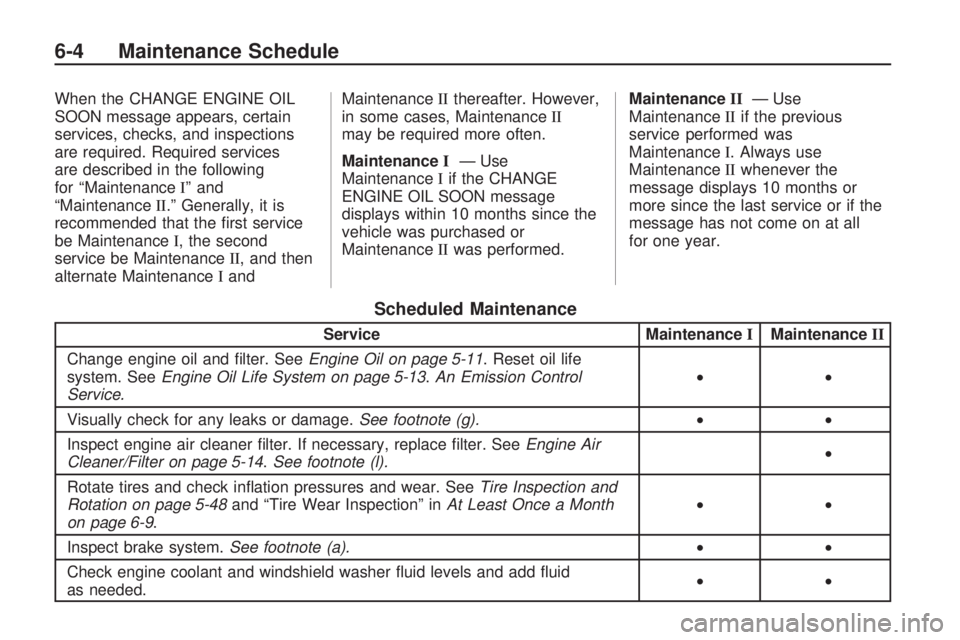
When the CHANGE ENGINE OIL
SOON message appears, certain
services, checks, and inspections
are required. Required services
are described in the following
for “MaintenanceI” and
“Maintenance II.” Generally, it is
recommended that the rst service
be Maintenance I, the second
service be Maintenance II, and then
alternate Maintenance Iand Maintenance
IIthereafter. However,
in some cases, Maintenance II
may be required more often.
Maintenance I—Use
Maintenance Iif the CHANGE
ENGINE OIL SOON message
displays within 10 months since the
vehicle was purchased or
Maintenance IIwas performed. Maintenance
II—Use
Maintenance IIif the previous
service performed was
Maintenance I. Always use
Maintenance IIwhenever the
message displays 10 months or
more since the last service or if the
message has not come on at all
for one year.
Scheduled Maintenance
Service MaintenanceIMaintenance II
Change engine oil and lter. See Engine Oil on page 5-11. Reset oil life
system. See Engine Oil Life System on page 5-13 .An Emission Control
Service. ••
Visually check for any leaks or damage. See footnote (g). ••
Inspect engine air cleaner lter. If necessary, replace lter. See Engine Air
Cleaner/Filter on page 5-14 .See footnote (l). •
Rotate tires and check ination pressures and wear. See Tire Inspection and
Rotation on page 5-48 and “Tire Wear Inspection” in At Least Once a Month
on page 6-9. ••
Inspect brake system. See footnote (a). ••
Check engine coolant and windshield washer uid levels and add uid
as needed. ••
6-4 Maintenance Schedule
Page 373 of 412

Additional Required Services (cont’d)
Service and Miles (Kilometers)25,000
(40 000) 50,000
(80 000) 75,000
(120 000) 100,000
(160 000) 125,000
(200 000) 150,000
(240 000)
Engine cooling system service
(or every ve years, whichever occurs
rst). An Emission Control Service.
See footnote (i). •
Inspect engine accessory drive belt.
An Emission Control Service.
See footnote (k). •
Maintenance Footnotes
(a)
Visually inspect brake lines
and hoses for proper hook-up,
binding, leaks, cracks, chafing, etc.
Inspect disc brake pads for wear
and rotors for surface condition.
Inspect other brake parts, including
calipers, parking brake, etc.
Check parking brake adjustment.
(b) Visually inspect front and
rear suspension and steering
system for damaged, loose, or
missing parts or signs of wear. Inspect power steering lines and
hoses for proper hook-up, binding,
leaks, cracks, chafing, etc.
(c)
Visually inspect hoses and have
them replaced if they are cracked,
swollen, or deteriorated. Inspect all
pipes, fittings and clamps; replace
with genuine parts as needed. To
help ensure proper operation, a
pressure test of the cooling system
and pressure cap and cleaning the
outside of the radiator and air
conditioning condenser is
recommended at least once a year. (d)
Inspect wiper blades for wear,
cracking, or contamination. Clean the
windshield and wiper blades, if
contaminated. Replace wiper blades
that are worn or damaged. See
Windshield Wiper Blade
Replacement on page 5-36 and
Windshield, Backglass, and Wiper
Blades on page 5-88 for more
information.
(e) Make sure the safety belt
reminder light and safety belt
assemblies are working properly.
Look for any other loose or
damaged safety belt system parts.
Maintenance Schedule 6-7
Page 376 of 412

At Least Once a Year
Starter Switch Check
{CAUTION
When you are doing this
inspection, the vehicle could move
suddenly. If the vehicle moves,
you or others could be injured.
1. Before starting this check, be
sure there is enough room
around the vehicle.
2. Firmly apply both the parking
brake and the regular brake.
SeeParking Brake on page 2-27.
Do not use the accelerator
pedal, and be ready to turn off
the engine immediately if it starts.
3. Try to start the engine in
each gear. The vehicle should
start only in P (Park) or
N (Neutral).
If the vehicle starts in any other
position, contact your
dealer/retailer for service.
Automatic Transmission Shift
Lock Control System Check
{CAUTION
When you are doing this
inspection, the vehicle could move
suddenly. If the vehicle moves,
you or others could be injured.
1. Before starting this check, be
sure there is enough room
around the vehicle. It should be
parked on a level surface.
2. Firmly apply the parking brake.
SeeParking Brake on page 2-27.
Be ready to apply the regular
brake immediately if the vehicle
begins to move.3. With the engine off, turn the
ignition to ON/RUN, but do not
start the engine. Without applying
the regular brake, try to move the
shift lever out of P (Park) with
normal effort. If the shift lever
moves out of P (Park), contact
your dealer/retailer for service.
Ignition Transmission Lock
Check
While parked, and with the parking
brake set, try to turn the ignition
to LOCK/OFF in each shift
lever position.
The ignition should turn to
LOCK/OFF only when the
shift lever is in P (Park).
The ignition key should come out
only in LOCK/OFF.
Contact your dealer/retailer if
service is required.
6-10 Maintenance Schedule